Chapter 2: The Early Buddhist Soteriological Baseline
Building on the account in Volume I, this chapter distills the core structure of early Buddhist soteriology: the Four Noble Truths, dependent arising, non-self, and nirvāṇa. This is the baseline against which the book will criticize the Mahāyāna systems. The arguments will not be repeated; only their structure will be extracted.
The function and limits of this chapter
Volume I systematically examined the textual sources, historical background, and philosophical content of early Buddhist soteriology. This chapter will not repeat those arguments. It extracts several key points from them as reference coordinates for the parts that follow; for the details of the argument, see the relevant chapters of Volume I.
It must be emphasized that distillation does not mean simplification. The internal structure of early Buddhist soteriology is far more precise than popular introductions suggest. Its analysis of suffering, diagnosis of craving, and definition of nirvāṇa all contain a philosophical depth that deserves serious treatment. This chapter aims to preserve that depth while organizing it into a clear framework for subsequent criticism.
A methodological self-awareness must first be stated, or this chapter will fall into a concealed circle. The analytical framework proposed in the previous chapter (premise, diagnosis, goal, mechanism, and verification) was, to speak frankly, extracted from the structure of the Four Noble Truths. It is almost a restatement of suffering, origin, cessation, and path. Since the framework comes from the Four Noble Truths, using it to “measure” early Buddhism cannot constitute an independent test. Early Buddhism is bound to fit it. That would be like designing a standard by tracing an object and then measuring the object against that standard: naturally, the result will always fit perfectly. If this chapter treated that necessary fit as a validation of early Buddhism, it would merely prove itself by itself.
This chapter therefore offers no such self-validation. Its purpose in setting out early Buddhism’s answer at every point in the framework is not to “certify” early Buddhism. It is to calibrate each graduation on the scale, allowing the connections between diagnosis and mechanism, and between mechanism and verification, to become fully visible in the clearest specimen with the least metaphysical burden. The real tests come later. Madhyamaka, Yogācāra, tathāgatagarbha, Esoteric Buddhism, and Pure Land were not extracted from the structure of the Four Noble Truths. At any particular link they may fail to connect or may quietly replace one link with another. Whether the framework can show where those systems loosen, break, or substitute terms is the true test of its efficacy. In other words, early Buddhism is not here an object tested by this standard; it is the original instrument by which the standard itself is calibrated. What follows accordingly sets out every graduation on that instrument in the order of premise, diagnosis, goal, mechanism, and verification.
The prior premise: the truth of suffering and the technical meaning of dukkha
Everything begins with the truth of suffering. As the previous chapter explained, the truth of suffering is the prior premise of the entire framework: before asking where suffering comes from, one must establish what suffering is and whether it is universal. Early Buddhism’s position at this point is quite distinctive, and it is also where the teaching is most often read superficially. Most people understand “suffering” only at the shallowest level, treating the truth of suffering as a commonplace remark about life’s disappointments and failing to see that its referent lies much deeper. To misunderstand the truth of suffering is often not to mistake a single word, but to read the entire truth one or even several layers too shallowly.
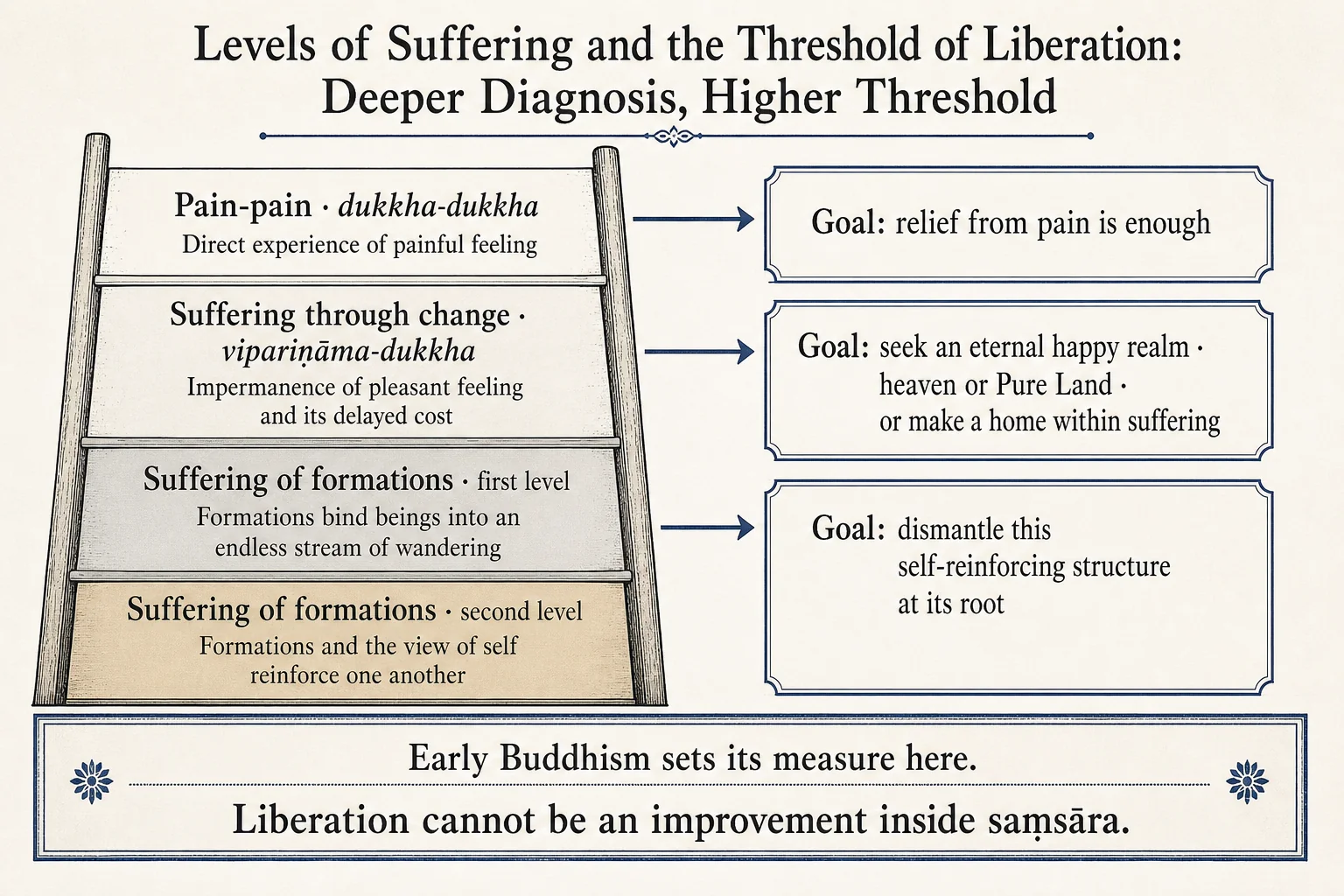
In early Buddhism, “suffering” (dukkha) does not refer only to the feeling of pain. The Pāli word dukkha is closer in meaning to “hard to bear” or “unsatisfactory,” and tradition analyzes its scope at three levels.1 The first is the suffering of pain (dukkha-dukkha), the direct experience of painful feeling: physical pain, grief, illness, death, separation from those one loves, association with those one dislikes, and failure to obtain what one seeks. This is suffering in the most immediate sense, recognizable to every sentient being. The second is the suffering of change (vipariṇāma-dukkha), the impermanence of pleasant feeling. Because every pleasurable experience is impermanent by nature, it contains the suffering of its disappearance and loss. This level takes subtler observation to recognize. People usually fail to notice it while enjoying pleasure and feel its reverse only when the pleasure is gone. The third is the suffering inherent in conditioned existence (saṅkhāra-dukkha), the instability and ultimate incompleteness inherent in every conditioned phenomenon (saṅkhāra). This is the deepest level and the most difficult to grasp through immediate feeling: even in the absence of obvious pain, conditioned existence itself remains structurally unsettled.
Of the three levels, the suffering inherent in conditioned existence is what actually supports early Buddhist soteriology. The previous chapter mentioned a cliché in contemporary sectarian discourse: “People who study Southern Buddhism think life is miserable, so they seek only their own liberation.” Its misunderstanding lies precisely here. The speaker reads the truth of suffering as the suffering of pain and construes it as a pessimistic feeling about life. Early Buddhism rests instead on the suffering inherent in conditioned existence, a much more technical and structural concept with no connection to emotional pessimism. A person may live a subjectively happy life and still remain in suffering in this sense. Precisely because suffering is posited at this level, whether suffering is “universal” is not a piece of common sense shared by everyone but a judgment that requires a particular way of seeing.
The suffering of change and the suffering inherent in conditioned existence are difficult to approach in the abstract, so the following paragraphs expand on them briefly. This elaboration comes from personal observation and experience, not a direct deduction from scripture. It seeks only to give the two concepts experiential points of reference against which they can be compared.
First, the suffering of change actually contains two levels. The first is obvious: the ecstasy of achieving a goal is often followed immediately by emptiness and disorientation. As pleasurable feeling itself subsides, it brings forth its opposite. The second is more hidden: pleasure also has delayed consequences. The better something makes us feel and the more it makes us want to grasp it, the greater the affliction when it is finally lost. Intellectual satisfaction is a clear example. It is pleasurable, yet intellectual powers inevitably decline with age; when that time comes, every former satisfaction becomes an old account that throws present loss into relief. The same is true of kinship, friendship, skill, and even the bliss of meditation. Pleasurable feeling is not merely impermanent. Even as it is enjoyed, it quietly deepens the suffering of its eventual loss. The tighter the grasp, the firmer the bond.
The suffering inherent in conditioned existence can likewise be divided into two levels. Both are connected with Buddhist cosmology, and the second is built upon the first. We must first identify a logical joint that is easily overlooked: to call conditioned activity a bond is not yet to call it suffering. Why should being bound be suffering? The answer lies not in bondage itself but in what it binds one to. Buddhist cosmology fills that bondage with the weight of “suffering.”
The first level rests directly on that cosmology. As Volume I explained, rebirth was a consensus in the India of the time. Given this premise, the suffering of pain and the suffering of change are not matters of a single lifetime. They persist repeatedly and accumulate layer upon layer through an endless stream of lives. Conditioned activity (whether painful feeling, pleasant feeling, or neutral feeling that is neither painful nor pleasant) becomes a thread that ties one to this stream ever more tightly. This is why bondage is suffering: it continues and deepens a stream of rebirth already filled with the suffering of pain and change. The stronger the bond, the more endless the suffering of immeasurable future lives. This also explains why neutral feeling is included in suffering. Though neither painful nor pleasant, it remains conditioned, continues to construct, and perpetuates the stream, thereby adding fuel to future suffering. Remove the premise of rebirth, and the assertion “bondage is suffering” loses its purchase. With that premise, bondage becomes something measurable that points toward endless future suffering.
The second level appears in present psychological experience, but the reason it counts as suffering still reaches back to the first. With sufficiently fine awareness of one’s mental activity, one finds that every “formation” (every act of mental construction) begins by “assuming a self,” while every such construction in turn makes the grasping of “I” and “mine” more viscous. Formations arise from the view of self, the view of self is reinforced by formations, and the two feed each other as the rotation tightens. This presently observable cycle is the stream of rebirth at this very moment, compressed into the span of a single thought. Each cycle of “self-view—construction” is the very act of binding oneself anew to saṃsāra. The second level is therefore not another kind of suffering parallel to the first, but the present mechanism of the first. It turns the remote prospect of “endless future suffering” into a structure operating in the mind right now, one that can be directly observed. Knowing and seeing this cycle and its bondage as they are provides an essential way into the truth of suffering. It restores suffering from an emotional judgment to a presently observable structure of self-reinforcement directly connected to the cosmology of rebirth.
This way of positing suffering directly determines the direction of soteriology. The level at which suffering is judged fixes the level to which the goal of liberation must rise; the two move together. If suffering meant only the suffering of pain, liberation would need only to eliminate painful feeling: analgesia would suffice. If suffering extends to the suffering of change and even to the first level of the suffering inherent in conditioned existence (the unending circulation of pain and pleasure through rebirth), the goal of liberation might be an eternal bliss, an imperishable realm of happiness that brings ceaseless loss to an end. Both heaven and the Pure Land belong to this category. Or one might reverse the valuation, take suffering as pleasure, cease to regard it as something from which one must escape, and make a home and a life within it. Certain practices that proclaim great fearlessness and seek to find and prove meaning within saṃsāra take this form, as do secular existentialism and absurdism. They accept the universality of suffering but choose to endow suffering with meaning or strike a posture within it rather than depart from it. All these goals are reasonable responses to the suffering of change and to the first level of the suffering inherent in conditioned existence. But once suffering is pressed to the second level of conditioned suffering (once one sees as it is the structural entanglement in which “formations” and “self-view” feed and bind one another ever more tightly), none of those goals is sufficient. Eternal bliss remains a pleasant feeling and remains within the entanglement; taking suffering as pleasure abandons even the direction of release. At this level the goal of liberation must be the fundamental dissolution of this self-reinforcing structure and the transcendence of conditioned existence as a whole. Liberation cannot be an improvement within saṃsāra. It must be a fundamental transformation. By setting the measure at this level of conditioned suffering, the truth of suffering also sets the threshold of liberation.
Suffering does not stand alone: the three characteristics close the door to permanence, bliss, self, and purity
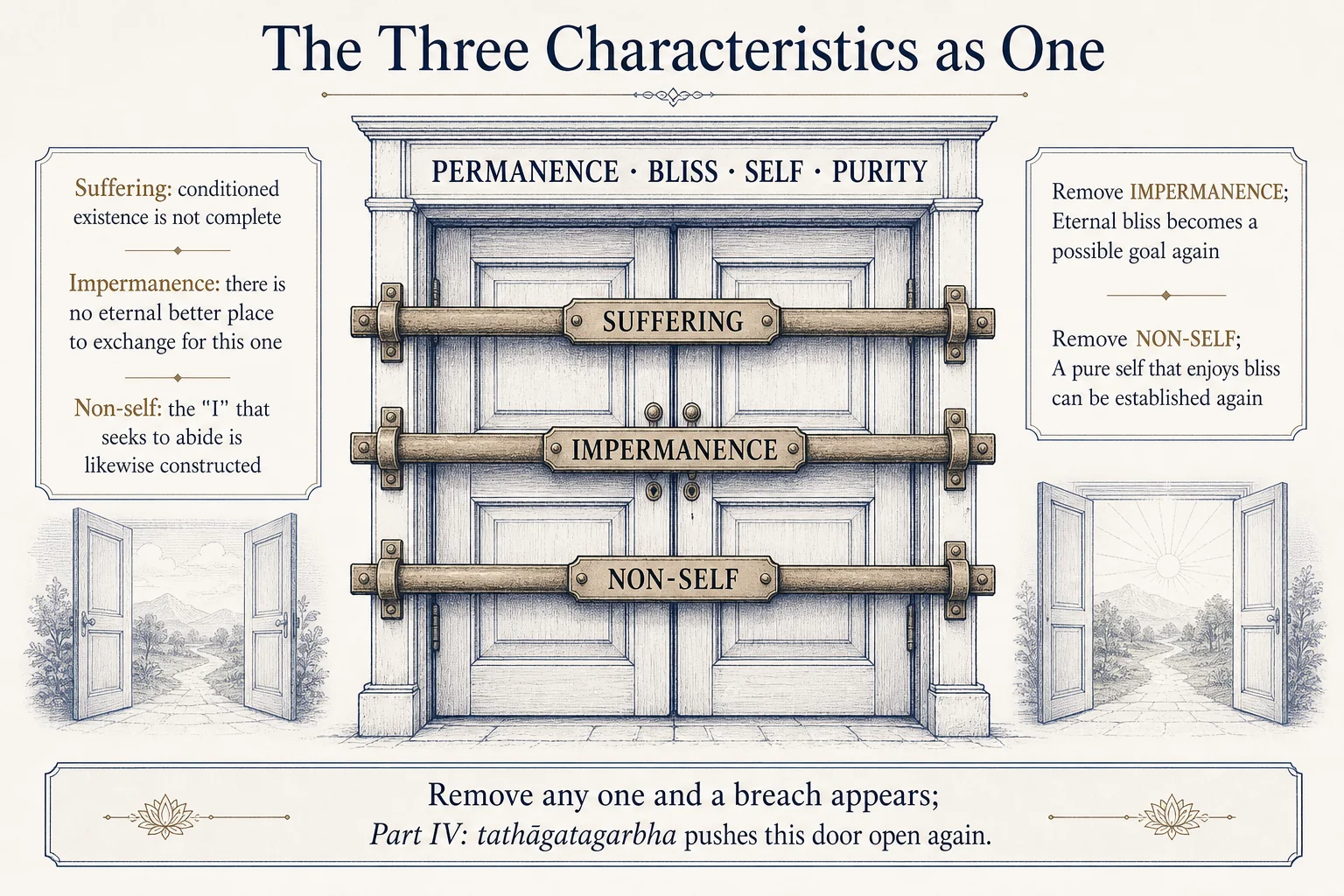
One key step must still be added, or the truth of suffering may be mistaken for a premise capable of standing by itself. Suffering is never presented in isolation. It is repeatedly placed alongside impermanence (anicca) and non-self (anattā), and the three are called the three characteristics. This point is often overlooked, yet without the latter two the whole soteriology cannot stand. The single word “suffering” does not close the path leading to “permanence, bliss, self, and purity.” Imagine someone who accepted suffering but not impermanence or non-self. That person could reasonably hope that, since this world is suffering, one should seek another shore that is permanent and eternally blissful, where a pure self can dwell. Heaven, the Pure Land, and true permanence all express this thought. The other two characteristics are what close this escape route.
Consider impermanence first. Literally, impermanence denies the possibility that any worldly phenomenon can “abide forever”: every conditioned phenomenon arises, ceases, and changes, and none can be permanently maintained. In this respect, it immediately declares that no destination of liberation consisting in “eternal bliss” exists, because the property “eternal” has no place within the conditioned world. We should honestly acknowledge that this step in the early teaching is closer to a declaration, a premise established through observation, than to a proof derived stage by stage. It first sets “change” as its point of departure, just as the Mūlamadhyamakakārikā first secures its own premises and then uses them to dismantle others. Impermanence marks the terrain: if liberation truly exists, it cannot be some “good state that lasts forever.” Impermanence alone, however, cannot explain why the alternative escape route (“replace the self with one that cannot perish, and let it enjoy”) also fails. For that we must consider the third characteristic, non-self.
When non-self is known and seen as it is, rather than merely affirmed verbally, three levels become apparent. First, the construction of “I” collapses in the present. Under close examination, the “I” taken to be the protagonist is only a functional illusion continuously constructed and maintained by formations. The illusion’s function is precisely to bind a person firmly to attachment: only after first establishing an “I” can the cravings “I want permanence, I want pleasure, I do not want to lose” arise. Once the self is seen through, craving loses its subject. Second, the viscous “sense of self” is itself a bond; it need not await some further suffering that it causes. The second level of conditioned suffering above already explained how “self-view” and construction feed one another and bind ever more tightly. Here we need add only that this adhesiveness is bondage in the very moment it is felt, not merely a distant cause of bondage. Third, after non-self is seen through, both the varieties of meaninglessness in saṃsāra and the meanings human beings forcibly create will become transparent. We previously noted an attitude that “takes suffering as pleasure and gives meaning to suffering.” Seen in light of non-self (whether it is self-dramatization or a stubborn posture that insists on standing erect amid the absurd), it remains, in the final analysis, the “I” inventing an account for itself. It remains within bondage and has not truly departed.
Only when the three characteristics are taken together is the truth of suffering fully bounded. Suffering says that existence here is unfulfilling; impermanence says that there is no eternal good place for which it can be exchanged; non-self says that the “I” that wants to make the exchange and take up residence is itself delusive. Remove any one and a breach appears. Without impermanence, eternal bliss becomes an object of pursuit once again. Without non-self, a pure self that enjoys that bliss can again be established. Taken together, those two possibilities are precisely “permanence, bliss, self, and purity.” Early Buddhism therefore repeatedly teaches impermanence and non-self together with suffering, not as three parallel dogmas, but because the latter two close the edges of the truth of suffering and shut the door leading to permanence, bliss, self, and purity. We will later see that tathāgatagarbha systems largely reopen this very door in Part IV. Under the names of true permanence and “permanence, bliss, self, and purity,” they surrender inch by inch the boundary that impermanence and non-self had guarded for soteriology.
The diagnostic question: the truth of origin, from the twelve links to craving and ignorance
Where does suffering come from? This is the diagnostic question, and early Buddhism answers it with the truth of origin (samudaya-sacca). The complete picture of the truth of origin is not exhausted by the word “craving.” It is the entire conditioned chain unfolded by the twelve links of dependent arising (paṭicca-samuppāda): ignorance (avijjā), formations (saṅkhāra), consciousness (viññāṇa), name-and-form (nāmarūpa), the six sense bases (saḷāyatana), contact (phassa), feeling (vedanā), craving (taṇhā), clinging (upādāna), becoming (bhava), birth (jāti), and aging-and-death (jarāmaraṇa). Each of the twelve conditions the next, and together they explain step by step how suffering, represented by aging-and-death, arises.2 The truth of origin is not a single pronouncement but this entire causal structure. When this book speaks of “diagnosis,” it means precisely this chain.
Why, then, do accounts of the truth of origin so often single out ignorance and craving as the roots of suffering? Because among the twelve links only these two are afflictions (kilesa), active driving forces; most of the remaining links are their results or intermediate processes. In the traditional interpretation across three lives, ignorance belongs to the past life and is the root that sets the entire chain in motion. Craving, together with the clinging that follows it, belongs to the present life and is the crucial point at which the chain is reignited now and continued toward the future—becoming, birth, and aging-and-death. These are the two afflictive points, one at either end: one is the root that starts the rotation, and the other is the pivot that keeps it turning. To grasp these two links is to grasp the places in the entire chain where one can actually exert leverage. Most other links have either already been settled (as consciousness, name-and-form, and the six sense bases are results of past karma) or are merely passive intermediaries. Ignorance alone can be dispelled and craving alone ended. To condense the truth of origin into “ignorance and craving” is therefore not to omit the other ten links but to identify the chain’s two motive sources and its two points of intervention. Let us consider them in turn.
Craving (taṇhā) is further analyzed into three kinds: craving for sensual pleasure (kāma-taṇhā), craving for existence itself and continued existence (bhava-taṇhā), and craving for nonexistence or annihilation (vibhava-taṇhā).3
The significance of this threefold division should not be underestimated. It shows that suffering is driven not only by the pursuit of pleasure but also by attachment to existence (the core of any theory of rebirth) and by the wish for annihilation—the psychological root of the annihilationist view. Liberation is thus achieved neither by satisfying desire, forcibly suppressing it, nor seeking annihilation: all three paths remain within the structure of craving.
Now consider ignorance. If craving is the pivot that presently continues the stream, ignorance is the more fundamental root of the entire chain and therefore stands first among the twelve links. The canonical definition of ignorance appears in the standard account of dependent arising: it is not knowing the Four Noble Truths as they are—not knowing suffering, its origin, its cessation, or the path leading to its cessation, as stated in Saṃyutta Nikāya 12.2 and Majjhima Nikāya 9.4 It is worth observing that the cognitive object obscured by ignorance is precisely the four links in this volume’s framework. Ignorance means being wholly in the dark about the entire set of questions: “What is suffering? Where does it come from? Can it cease? How does it cease?” In concrete experience, this failure to know things as they are also appears as failure to understand the impermanence of formations and the non-self of phenomena. Because one does not understand that phenomena are impermanent, one clings; because one does not understand that clinging ultimately produces suffering, one continues to cling; because one does not understand non-self, one makes a fixed “I” the subject and object of clinging. But a warning is necessary. Presenting impermanence, suffering, and non-self as the “three Dharma seals” is a later doctrinal formulation. The early discourses speak of the three characteristics (ti-lakkhaṇa); they do not use the fixed category “three Dharma seals” to define ignorance. Ignorance in its basic sense remains not knowing the Four Noble Truths. Craving arises, in the final analysis, because of this not-knowing. Once diagnosis reaches the level of ignorance, it also specifies the direction of the mechanism below: liberation does not consist in suppressing craving but in dispelling the ignorance on which craving depends. This reconnects directly with the cycle observed in the second level of conditioned suffering. The “self-view” described there is a concrete form of ignorance, while “construction” is the link of formations in dependent arising. In other words, the self-reinforcing structure observed under the truth of suffering is unfolded under the truth of origin into the causal sequence of the twelve links.
The question of the goal: the truth of cessation, nirvāṇa, and cautious silence
What is liberation? This is the question of the goal. Early Buddhism answers with nirvāṇa (Pāli: nibbāna), to which the truth of cessation (nirodha-sacca) points. Nirvāṇa is the most difficult core concept in early Buddhist soteriology. Literally, it means “extinguishing”: the extinguishing of the fires of craving and affliction. Yet when asked what it ultimately refers to, the Buddha answers with deliberate caution.
Nirvāṇa’s negative characteristics can be stated clearly: the cessation of suffering, the ending of craving, and the termination of rebirth. The Dhammapada and other early texts describe nirvāṇa as the highest happiness (paramaṃ sukhaṃ), but this happiness is not an accumulation of pleasurable feelings. It is the complete cessation of suffering, a happiness defined by suffering’s absence.
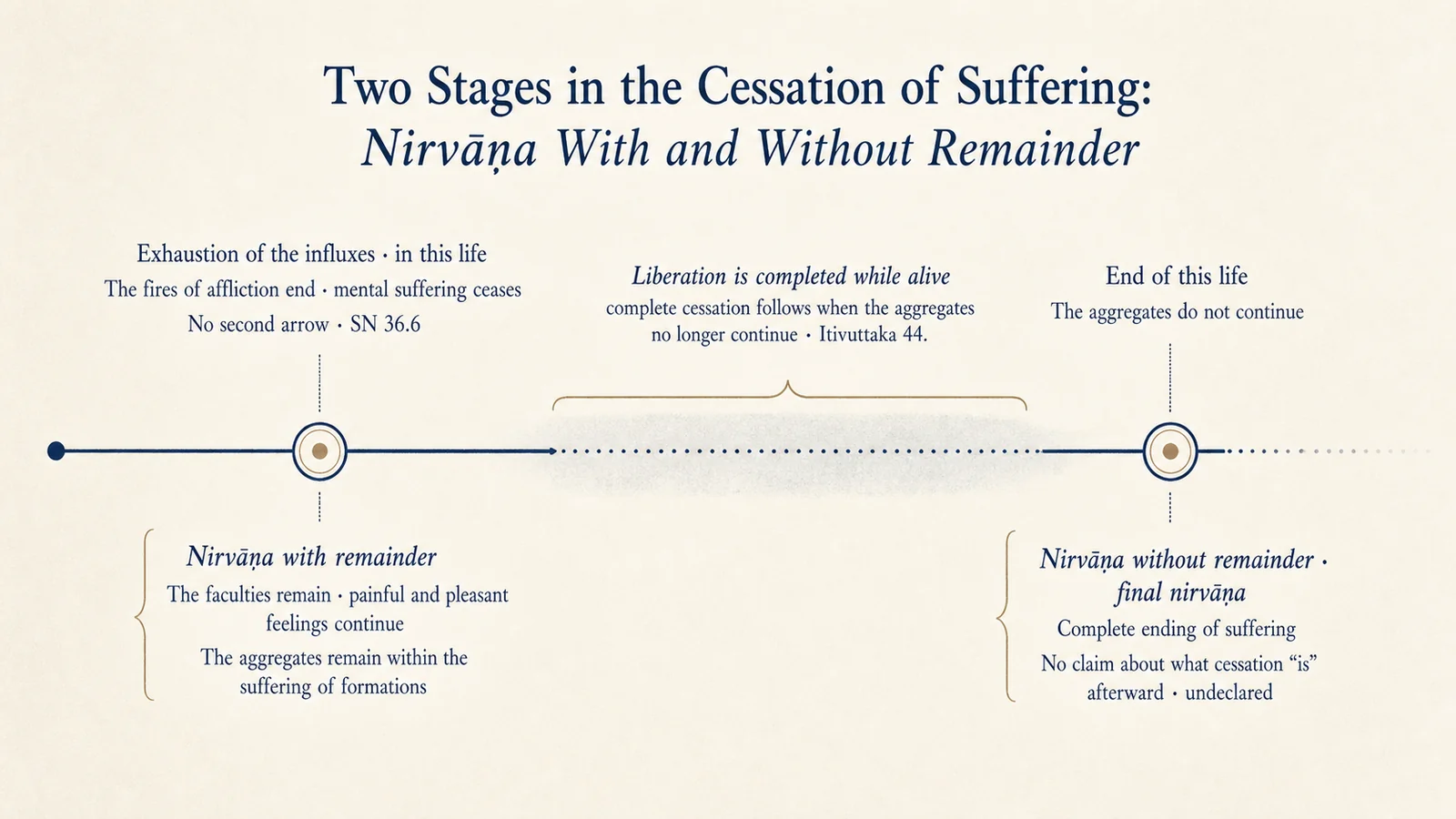
“The cessation of suffering,” however, is not an undifferentiated event. Here the early teaching makes a distinction often overlooked but immensely weighty in doctrine: nirvāṇa with a remainder and nirvāṇa without a remainder—parinirvāṇa.5 One whose influxes are exhausted has eliminated the afflictions in this very life; the fire of craving is extinguished, but the five aggregates, the “remainder” (upādi) produced by past karma, continue. The sense faculties remain and still experience pain and pleasure. The Buddha himself continued after awakening to experience back pain, aging, and illness. This is nirvāṇa with a remainder: liberation is complete, while the stream of mind and body that bears it continues to expend its momentum. At the end of this life, the continuity of the aggregates is not renewed. This is nirvāṇa without a remainder, what is ordinarily called parinirvāṇa: suffering’s complete end.
This two-stage structure implies several points of doctrine that deserve separate explanation. First, liberation is completed in this life, while one is alive. Nirvāṇa is first of all the extinction of afflictions. It is not another name for death and still less a reward collectible only after death. Precisely because the exhaustion of the influxes occurs within this world, it can be observed and verified; the present-world verifiability discussed in the later section “The Question of Verification” is grounded here. Second, the two-stage structure directly encodes the judgment “all formations are suffering” within the truth of cessation. The liberated person’s mental suffering has ended; in the terms of the Discourse on the Dart, that person is not struck by the second arrow. But the first arrow remains. Bodily pain and the suffering of aging and illness persist together with the aggregates. If suffering were merely a matter of feeling, nirvāṇa with a remainder would already be the complete cessation of all suffering and the second stage, nirvāṇa without remainder, would be superfluous. Precisely because the truth of suffering places the measure at suffering inherent in conditioned existence, the continuing aggregates are themselves residual suffering, and “complete cessation” must await their failure to continue. In other words, the distinction between nirvāṇa with and without remainder projects the judgment of conditioned suffering into the truth of cessation: to accept this distinction is to accept that even a liberated person’s five aggregates remain within the suffering inherent in conditioned existence. Third, nirvāṇa without remainder is not described as any “destination” or state of existence. Whether the Tathāgata exists or does not exist after the aggregates cease belongs among the undeclared questions. This is what the metaphor of an extinguished fire indicates, as discussed below. The two-stage distinction therefore does not loosen that cautious silence in the slightest. It says only where suffering ends, not what “is” after cessation.
Later parts of this book will repeatedly return to this distinction, because it is one of the principal sites at which the various systems transform the teaching. If a system no longer regards the aggregates’ continuation as suffering in itself, nirvāṇa without remainder loses its soteriological necessity, and the center of gravity of the truth of cessation shifts elsewhere (Part II).
The key point is that early Buddhism maintains a cautious silence in response to the positive question, “What is nirvāṇa?” Nirvāṇa is not nothingness or annihilation. The Buddha explicitly rejected the annihilationist view (uccheda-diṭṭhi), the nihilistic claim that absolutely nothing remains after death. Nor is nirvāṇa the persistence of an eternal entity or soul. The Buddha equally rejected the eternalist view (sassata-diṭṭhi), according to which some eternal self continues to exist. Asked whether the Tathāgata exists after death and similar questions, the Buddha classed them as “undeclared” (avyākata).6 This is not evasion but philosophical precision. The doctrine of non-self has already dissolved the very framework of such questions, so no meaningful answer exists within it.
This cautious silence is a decisive feature of early Buddhism’s specification of the goal. It guards simultaneously against two equally dangerous tendencies: reifying nirvāṇa as an eternal existence, which would reintroduce the doctrine of identity between brahman and ātman, and reducing nirvāṇa to annihilation, which would render liberation meaningless. This point is especially important for what follows. Later in this volume we will see that the vacuum left by precisely this silence is filled or broken open in different directions by Mahāyāna systems. Tathāgatagarbha in particular fills it with the positive existence of “permanence, bliss, self, and purity.” This is the starting point for the volume’s diagnosis of tathāgatagarbha as “attachment to eternity” in Part IV. Once the goal is rewritten from “the cessation of suffering” as “realizing something permanent,” the coordinates of the entire soteriology shift with it. In this sense, the truth of cessation’s preservation of silence is itself a position.
The question of mechanism: the truth of the path, the Noble Eightfold Path, and the principle of self-reliance
How does liberation occur? This is the question of mechanism, both the most central and the most easily neglected question. Early Buddhism answers with the truth of the path (magga-sacca), presented as the Noble Eightfold Path (aṭṭhaṅgika-magga): right view (sammā-diṭṭhi), right intention (sammā-saṅkappa), right speech (sammā-vācā), right action (sammā-kammanta), right livelihood (sammā-ājīva), right effort (sammā-vāyāma), right mindfulness (sammā-sati), and right concentration (sammā-samādhi).
Let us note in passing one observation of this book: the greatest defect of the Eightfold Path is probably that it has too many items and is hard to remember. It was therefore gradually grouped into the three trainings of ethical discipline, concentration, and wisdom: right speech, right action, and right livelihood belong to ethical discipline; right effort, right mindfulness, and right concentration belong to concentration; right view and right intention belong to wisdom.7 This mnemonic compression is itself a small piece of evidence that early Buddhism was not unchanging but continually organized and developed itself.
The Eightfold Path is only a list of the path’s components. The heart of the mechanism lies in how that list leads to the cessation of suffering. This can be seen by following the order of the three trainings just mentioned. Ethical discipline, concentration, and wisdom are not three parallel subjects of study; they form a causal chain in which the preceding stage prepares the conditions for the next.
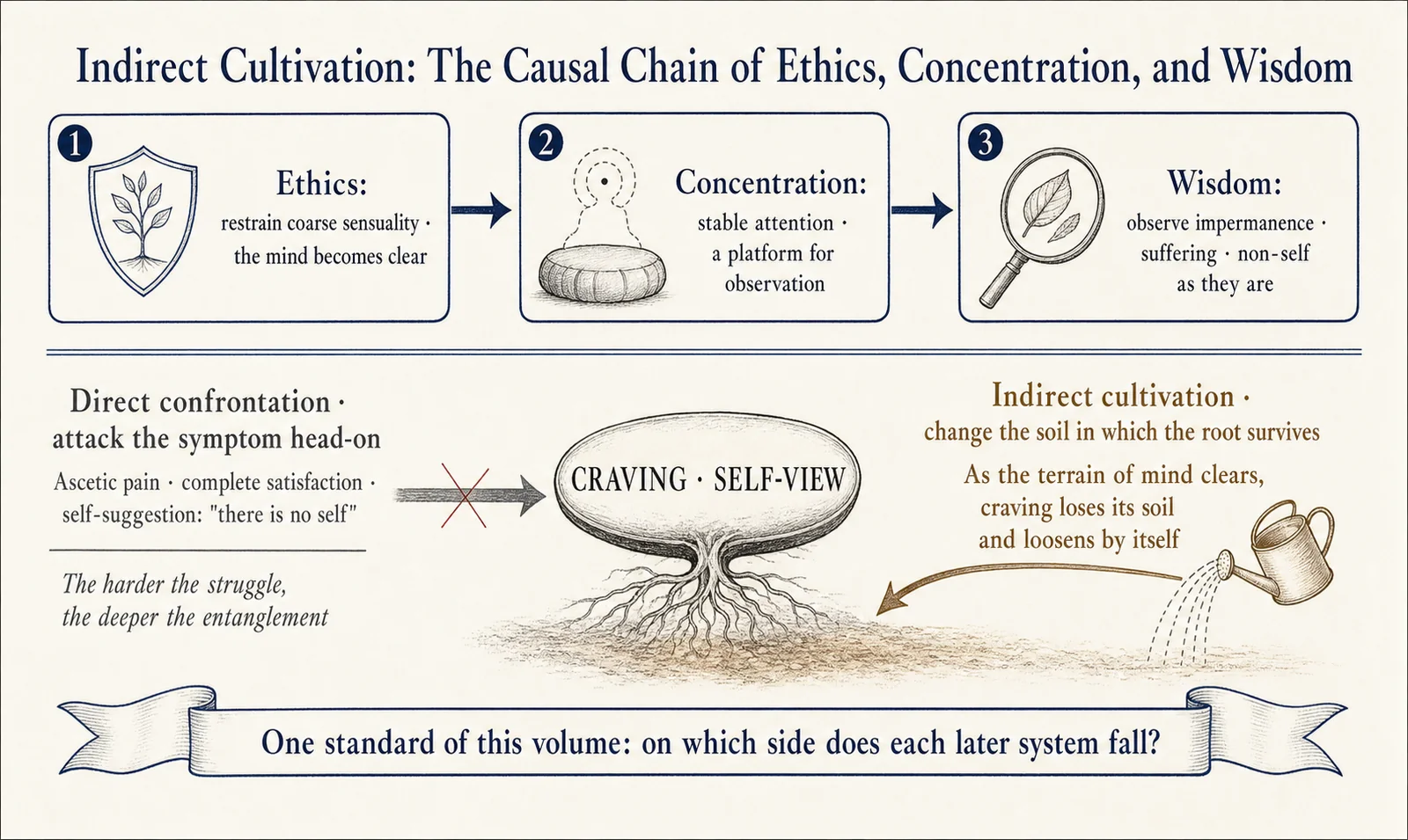
The training in ethical discipline purifies the mind. Its role is not limited to upright conduct. By restraining the pursuit of coarse sensual pleasures, it frees the mind to some extent from the turmoil of its constant outward grasping. Only then does sustained cultivation of concentration become possible. A mind dragged all day by acquisitiveness and remorse cannot sit still and cannot become composed. The training in concentration makes the mind focused and undistracted. Its use becomes fully apparent at the moment of observation. When one tries to observe the subtlest physical and mental phenomena, an untrained mind is immediately deflected by the feelings, emotions, and associations that arise with them; just as the object is coming into focus, attention has already wandered. Concentration provides a stable and unmoving platform of observation, allowing subtle phenomena to be watched continuously without losing them.
Only with the purity of ethical discipline and the stability of concentration can the training in wisdom begin. At this point the causal chain proposed by early Buddhism closes, and it is quite clear: through knowledge and vision as they are (yathābhūtañāṇadassana) of the impermanence, suffering, and non-self of phenomena, craving is weakened; when craving weakens, the conditions for suffering’s arising are removed, and suffering accordingly ceases. Every link in this chain answers the preceding diagnosis. Since the diagnosis locates the root of suffering in ignorance, the mechanism dispels ignorance through observation. Since craving arises dependent on ignorance, craving loosens as ignorance loosens. Diagnosis and mechanism fit precisely here. This becomes one structural measure by which later systems will be assessed: if a system puts its diagnosis in one place and directs its mechanism elsewhere, whether the two can still correspond becomes a problem.
The order of the Eightfold Path also reveals the character of the mechanism. Right view comes first: liberation begins with a correct understanding of the Four Noble Truths, not with a mystical experience or grace bestowed from outside. Practice unfolds on the basis of understanding. Only correct understanding of suffering and its origin can lead to a correct direction of practice. This fundamentally contrasts with the logic of later systems in which empowerment or faith must precede practice. The truth of the path also embodies the principle of the middle way (majjhimā paṭipadā), avoiding both ascetic self-mortification and indulgence. Asceticism cannot end craving because it still takes the body as an object of grasping; indulgence obviously cannot end it either. The mechanism draws its power from lucid observation, not extreme suppression or release.
One note must be added for modern readers, lest “the middle way” be read as an excuse for indolence. On hearing that the Buddha did not advocate asceticism, people today may readily imagine that he commended casual eating, drinking, and unrestrained ease. This is a grave misunderstanding. The “asceticism” the Buddha rejected was the severe self-torment practiced by Jains of his day. The monastic community’s own life, viewed through modern eyes, was already stringent. Most people today would find even the rule against eating after noon difficult to maintain. The Southern Vinaya regulates monastics’ clothing, food, lodging, and daily conduct in exacting detail. Some early disciples were renowned for “ascetic practices” (dhutaṅga), practices that shake off the defilements, and were praised by the Buddha. The middle way is therefore not a comfortable compromise between pain and pleasure. It discards extremes that do not help end craving and preserves every restraint conducive to lucid observation. The intensity of such restraint often far exceeds what people today imagine “moderation” to mean.
This misreading is itself a reminder and directly returns us to the topic at the beginning of the chapter: do we see these concepts through our own “views,” or do we know and see them as they are? Someone who says the Buddha advocated carefree indulgence first experiences feeling through contact, then develops craving for ease on the basis of that feeling, and finally turns that craving back upon the “middle way,” molding the concept into the shape desired. This is precisely the cycle described in the second level of conditioned suffering, now reproduced in scriptural interpretation. The concept is not in itself like this; self-view stains it with the color of self-view.
Returning to the mechanism of liberation, there is another deeply counterintuitive point that deserves separate notice. Since diagnosis has located the root of suffering in craving and ignorance, we naturally suppose that treatment ought to attack those two directly. But the right path identified by the Buddha is emphatically not a frontal assault on the “symptoms.” Imagine what direct intervention would entail. If one insists on exerting force against craving, the available routes are either asceticism or the idea that “if desire is satisfied completely, one will naturally become free of desire.” The discussion of the middle way above has already shown why both fail. If one insists on directly dissolving “self-view,” the probable methods are repeatedly persuading oneself that “there is no self,” or seeking through speculation or ritual a state in which subject and object both disappear. Such practices either degenerate into verbal autosuggestion or remain trapped in metaphysical thought that circles in place. Self-view does not genuinely loosen simply because it is repeatedly denied. Direct confrontation often means opposing craving and self-view on their own territory and with their own logic; the more intense the opposition, the deeper the entanglement. Ordinary people all have moments of non-pathological anxiety. When anxious, the harder we try to forget and “not think,” the more anxious we become and the more we think. What actually improves anxiety is often the disappearance of external pressure, not any argument or speculation.
What makes the Eightfold Path genuinely surprising is that it leaves the entire framework of “direct confrontation.” It does not fight craving head-on or use the statement “non-self” to chase away self-view. It turns instead to the long cultivation of ethical discipline, concentration, and wisdom, gradually making the mind pure, stable, and able to see things as they are. Craving and ignorance are not forcibly severed. On a progressively clearer ground of mind, they gradually lose the soil in which they grow and loosen on their own. This is an indirect, cultivational approach to liberation: rather than directly uprooting the cause of illness, it changes the entire set of conditions on which that cause depends for survival. Remembering this will be especially important for understanding later systems. Many return precisely to the framework of “direct confrontation,” whether by repeatedly speculating about emptiness or by seeking sudden severance through one mantra or one empowerment. The cultivational path set out in this chapter provides another standard by which to measure them.
The distinction becomes clear in the example of mindfulness of the body, one of the four establishments of mindfulness. To practice mindfulness of the body is not to “prove” that the body is impermanent and impure, nor to repeat those propositions as a form of self-hypnosis. It is to weaken attachment to the body through observing and knowing the body as it is. The word “counteract” has two aspects here. It is directed against something: this very attachment is its target. And it does provide a remedy: attachment actually loosens through observation. Yet its method of treatment is neither the forced suppression of a symptom nor frontal combat with craving. It places the mind in observation of things as they are, allowing the object of craving gradually to lose its desirability under lucid vision.
The most distinctive feature of this mechanism is its thoroughgoing principle of self-reliance. In the Pāli Mahāparinibbāna Sutta, the Buddha’s final instruction was: “Be islands unto yourselves, refuges unto yourselves; with the Dhamma as your island and the Dhamma as your refuge, with no other refuge.”8 This is the principle’s most forceful statement. Liberation is the practitioner’s own work. The Buddha is a “teacher of the path” (maggakkhāyin), not a savior. The guide and the walker occupy two different roles. This distinction is exactly what later theories of bodhisattva blessing (and especially the Pure Land theory of other-power) fundamentally change (Parts V and VI).
The question of verification: observable transformation in this life
How is liberation recognized, and who has the authority to recognize it? This is the question of verification, derived from the truths of cessation and the path. Since the goal is the cessation of suffering and the mechanism is the weakening of craving, whether one is “moving toward the goal” should be testable in those two respects. Early Buddhism gives a kind of phenomenological answer: greater mental stability, reduced affliction, and loosened grasping are observable changes immanent within this world. Both practitioners themselves and those around them can partially perceive these changes. Verification does not appeal to a secret realm accessible only to a few and inaccessible to outsiders’ scrutiny.
This present-life verifiability distinguishes early Buddhist soteriology from a purely otherworldly doctrine. It is also a criterion that later parts of this volume will repeatedly employ. As the various systems develop, their standards of verification become increasingly elitist and increasingly devoid of discernible signs. In Chan, “seeing one’s nature” requires a teacher’s confirmation; in Vajrayāna, accomplishment requires a guru’s recognition; in tathāgatagarbha systems, realization of the “intrinsically pure mind” is nearly imperceptible to outsiders. Authority to verify gradually passes from present, observable experience into the hands of a small number of authorities. This transfer is not an inconsequential side issue but bears directly on the epistemological standing of soteriological claims, as the respective parts will explain.
Paths to liberation explicitly rejected by early Buddhism
Understanding a system’s position often requires knowing what it explicitly rejects. Beyond the Four Truths and five questions described above, early Buddhism has several explicit negative positions regarding liberation. These refusals define its boundaries and mark in advance the directions in which later systems will cross them.
First, it rejects the eternalist view (sassata-diṭṭhi). There is no eternal self (ātman) that passes through birth and death and ultimately unites with brahman. The teaching of non-self (anattā) cuts off this route at its root: there is neither an eternal soul to be saved nor a destination of salvation in the identity of brahman and ātman.
Second, it rejects the annihilationist view (uccheda-diṭṭhi). Total annihilation after death is not liberation, because it does not solve the problem of suffering but only evades it. Nirvāṇa is not nothingness.
Third, it rejects purification through ritual. External religious rites (sacrifice, purification ceremonies, incantations, and so forth) cannot bring liberation. Liberation is an internal transformation, not an effect of external behavior. Early Buddhism even established a specific term for this attachment: clinging to rules and observances (sīlabbata-parāmāsa), the view that merely keeping a particular code, ritual, or taboo can itself lead to liberation. It is listed among the three fetters (saṃyojana) to be abandoned upon entering the stream, which shows how rigorously early Buddhism guarded against the idea of “exchanging ritual for liberation.”9 In early texts this rejection targets the Brahmanical sacrificial tradition, but its logic applies equally to the ritualism of later Vajrayāna, despite the latter’s defense in terms of inner meanings (Part V).
Fourth, it rejects an external savior. No deity or other being can complete liberation in place of the practitioner. Suffering must be ended by the one who suffers, because suffering’s roots, craving and ignorance, are in that person’s mind. Liberation must occur there and cannot be imposed from outside. This point creates the most direct tension with the Pure Land theory of other-power (Part VI).
The baseline’s metaphysical bill: rebirth
Before concluding this chapter, one bill must be settled openly. It cannot be allowed to hide beneath praise for “metaphysical restraint.” The section on conditioned suffering already conceded that the claim “bondage is suffering” needs the cosmology of rebirth to supply its weight. The two stages discussed under the truth of cessation, and specifically the necessity of nirvāṇa without remainder, likewise rest on the presupposition that “the continuity of the aggregates crosses death.” To put the matter plainly: rebirth is the baseline’s largest untestable metaphysical commitment. The restraint is real—it posits no first cause, establishes no ontological hierarchy, affirms no truly permanent entity, and preserves silence about the endpoint. The commitment is also real. The baseline inherited the premise of rebirth accepted by Indian traditions of the time, as Part I of Volume I explained. It did not invent the premise, but common acceptance does not make a claim testable. A further distinction is needed. The two classic philosophical objections provoked by beginningless rebirth (why, given infinite time, has everyone not already been liberated, and how could an infinite past ever arrive at the present) together with available defenses were addressed in the philosophical note in Volume I, 1.5. Those concern coherence. The present section reckons with testability, and coherence is not testability.
The effect of this bill on the force of the volume’s criticism must be explained through two readings. The first is the shared-premise reading. Every later system shares the premise of rebirth. The bodhisattva’s three incalculable eons, rebirth in a Pure Land, and the Vajrayāna intermediate state and reincarnation all operate within saṃsāra. Since the premise is shared, every argument in this volume that relies on rebirth (for example, Part II’s appeal to the necessity of nirvāṇa without remainder when criticizing Madhyamaka) checks the moves of those systems on a board they themselves accept. This part of the criticism can stand independently of the volume’s own baseline position. The second is the secularized reading. Remove rebirth, and the suffering inherent in conditioned existence is demoted to structural instability within a single life, while nirvāṇa without remainder loses its referent. But Mahāyāna systems simultaneously lose the arena in which the bodhisattva path, rebirth, and the three incalculable eons operate. Where both sides perish together, a genuine question comes into view: after rebirth is removed, what remains of Buddhist soteriology, and can it still stand? Part VII, the synthetic critique, will answer that question directly. It is recorded here in advance.
One nuance in the design must also be identified. The baseline’s present-life verifiability verifies progress along the path (the reduction of afflictions and loosening of grasping), not the endpoint itself. Testing progress does not require the premise of rebirth; completion of the endpoint does. In other words, the bill for rebirth rests on the second stage of the truth of cessation, not on the truth of the path or on verification. This distribution of weight will be used later when criticizing the various systems.
A structural summary of the early Buddhist baseline
Taken together, early Buddhism’s answers to the framework’s five questions interlock. They can be condensed into four mutually supporting features that will serve as reference coordinates for criticism throughout this book.
First, the measure is set at the suffering inherent in conditioned existence. Suffering is located at this structural level, so the goal of liberation is correspondingly the complete cessation of suffering rather than the realization of something permanent. Cessation occurs in two stages: afflictions cease in this life, as nirvāṇa with a remainder, and the continuity of the aggregates ends after death, as nirvāṇa without remainder. The truth of cessation cautiously refuses to say what “is” after cessation, neither reifying nor nihilistically nullifying the endpoint.
Second, diagnosis and mechanism fit precisely. The roots of suffering are identified as ignorance and craving; the mechanism dispels ignorance and loosens craving by observing things as they are, thereby removing the conditions for suffering’s arising. Diagnosis identifies where the root of illness lies, and the mechanism dissolves the conditions on which that root depends for survival. Together they form a transparent causal chain. The word “dissolves” must be understood correctly: it does not mean a frontal assault. As the section on mechanism explained, the right path precisely avoids direct confrontation with symptoms. It removes the soil from under the root.
Third is the principle of self-reliance. Liberation is the practitioner’s own work. The path can be pointed out, but the practitioner must walk it; no external power can substitute.
Fourth is present-life verifiability. Progress toward liberation can be observed in this world as reduced affliction, greater mental stability, and loosened grasping. Authority to verify is not outsourced to an inscrutable secret realm or an authority figure. This feature distinguishes early Buddhist soteriology from a purely otherworldly doctrine.
These four features will serve as coordinates for evaluating the soteriology of each system in the parts that follow. Any system that departs from any one of them must offer sufficient theoretical explanation and defense. This volume asks precisely whether those departures are necessary soteriological advances or traces left by some form of attachment.
References
This chapter is a structural distillation of Parts I through III of Volume I. For the complete textual sources, historical background, and doctrinal arguments, see those parts; they will not be repeated here. The following notes provide only the sources for several factual scriptural citations and key terms used directly in this chapter, for ease of verification.
References
-
The threefold division into the suffering of pain (dukkha-dukkha), the suffering of change (vipariṇāma-dukkha), and the suffering inherent in conditioned existence (saṅkhāra-dukkha) appears in Saṃyutta Nikāya 45.165 and 38.14, among other texts; for a systematic explanation, see Buddhaghosa, Visuddhimagga XVI. See also Rupert Gethin, The Foundations of Buddhism (Oxford: Oxford University Press, 1998), 61–62. ↩
-
For the standard twelve-link formulation of dependent arising (paṭicca-samuppāda), see the Nidāna Saṃyutta, especially Saṃyutta Nikāya 12.1–12.2; for the interpretation as twofold causality across three lives, see Buddhaghosa, Visuddhimagga XVII. ↩
-
The canonical source for the threefold division of craving (craving for sensual pleasure, craving for existence, and craving for nonexistence) and its relation to the Four Noble Truths is the Dhammacakkappavattana Sutta (Saṃyutta Nikāya 56.11). ↩
-
The standard definition of ignorance (avijjā) is not knowing the Four Noble Truths as they are. See the Sacca Saṃyutta (and Saṃyutta Nikāya 12.2’s definition of ignorance), and the Sammādiṭṭhi Sutta (Majjhima Nikāya 9): not knowing suffering, origin, cessation, and path is called ignorance. The “three Dharma seals” (impermanence of formations, non-self of phenomena, and the peace of nirvāṇa) as a fixed category of doctrinal classification were formulated in sectarian and later treatises. The early discourses speak instead of the “three characteristics” (ti-lakkhaṇa): impermanence, suffering, and non-self. The two should not be confused. This chapter follows the canonical sense in treating the Four Noble Truths as the object obscured by ignorance. ↩
-
The distinction between the nirvāṇa element with a remainder (sa-upādisesā nibbānadhātu) and the nirvāṇa element without a remainder (anupādisesā nibbānadhātu) appears in Itivuttaka 44: an arahant whose influxes are exhausted but who remains alive, whose faculties persist, and who still experiences pain and pleasure, possesses the nirvāṇa element with a remainder; in this very life, all that is felt, no longer delighted in, will become cool—this is the nirvāṇa element without a remainder. For “not being struck by the second arrow,” see the Salla Sutta (Saṃyutta Nikāya 36.6): an ordinary person who experiences painful feeling generates sorrow and distress, as if struck by a second arrow after the first; the learned noble disciple experiences bodily pain without being mentally afflicted and is struck by only one arrow. ↩
-
For the fourteen “undeclared” (avyākata) questions, see the Cūḷamālukya Sutta (Majjhima Nikāya 63) and the Aggivacchagotta Sutta (Majjhima Nikāya 72). The latter uses the metaphor of an extinguished fire to explain why the Tathāgata after death is “not describable.” ↩
-
For the canonical classification of the Eightfold Path under the three trainings (tisso sikkhā) in ethical discipline, concentration, and wisdom, see the Cūḷavedalla Sutta (Majjhima Nikāya 44), in which the nun Dhammadinnā assigns the eight factors to the three groups. ↩
-
See the passage on being “an island unto oneself” (attadīpa) in the Pāli Mahāparinibbāna Sutta (Dīgha Nikāya 16). ↩
-
Clinging to rules and observances (sīlabbata-parāmāsa) is one of the “three fetters”—identity view (sakkāya-diṭṭhi), doubt (vicikicchā), and clinging to rules and observances—to be abandoned upon stream-entry. See Saṃyutta Nikāya 45.179–180 and the standard formulations of the three fetters in other discourses. ↩