Chapter 3: The Southern Route—Abhidhamma Soteriology and Its Cost
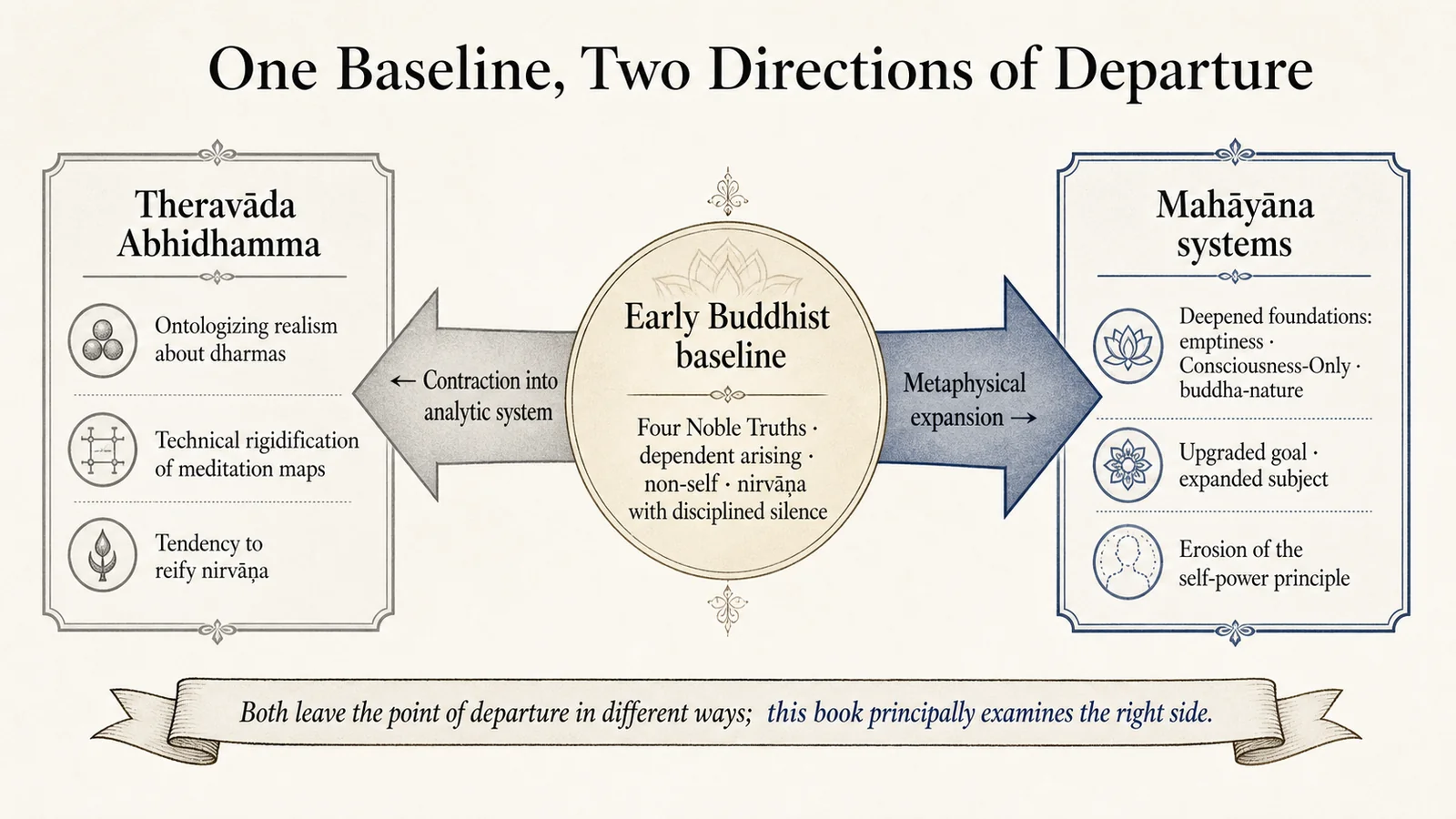
The preceding chapter distilled the structural baseline of early Buddhist soteriology: the Four Noble Truths, dependent arising, non-self, and nirvāṇa. Its path consists in observing the stream of experience as it is, ending craving and ignorance, and bringing suffering to cessation. This baseline is the reference point for the book’s criticism. One clarification is nevertheless necessary. Contemporary Southern Buddhism (especially traditions centered on Theravāda Abhidhamma) is not identical with that baseline. It already represents a systematic transformation of the baseline, though in a direction different from Mahāyāna. Mahāyāna expands toward metaphysics; Southern Abhidhamma tightens toward an analytical system. Both have left the point of departure.
“Divergence” and “preciousness,” however, are not contradictory here. This is in fact a problem of our time. In an era that has long lacked arahants from whom one might seek face-to-face instruction, Southern Abhidhamma is an extraordinarily precious set of exact tools distilled from meditative experience. Even where it diverges philosophically, it still preserves far too much of value to be lightly dismissed. This chapter must therefore separate two matters. As a phenomenological tool and as a ladder by which to approach early practice, Abhidhamma receives this book’s considered esteem. The divergence criticized here is an additional layer of ontological assertion and a self-positioning as “the sole orthodoxy” placed on top of those tools. Every identification of “transformation” and “divergence” below should be read with that qualification and not as a denigration of Abhidhamma itself.
This chapter’s criticism of Southern Abhidhamma soteriology is comparatively limited, and its length is deliberately controlled. This is not because the problems of Southern Buddhism are unimportant. Rather, the soteriological expansions of the Mahāyāna systems are this book’s main objects of criticism, and the nature and degree of Southern divergence differ. It is nonetheless necessary to clarify that divergence before turning to Mahāyāna. Otherwise readers might mistakenly suppose that the book invokes Southern Buddhism to endorse its criticism of Mahāyāna soteriology. In fact, both sides have problems, though problems of different kinds.
I. From Baseline to System: What Is Abhidhammization?
Part II of Volume I traced the formation of Abhidhamma (see 2.5). Beginning with the “matrices” (mātṛkā) in the Buddha’s teaching, it gradually developed into a system of analysis that reduces all experience to minimal units (dharmas), and supplies them with precise definitions, classifications, and causal structures. The Theravāda’s seven treatises and the Sarvāstivāda’s “body and six feet” represent two parallel high points. Buddhaghosa’s commentarial system, around the fifth century, then standardized and consolidated the Southern line into the technical framework on which modern Theravāda meditation traditions in Myanmar, Thailand, Sri Lanka, and elsewhere rely.1
Abhidhamma was originally a tool: it clarified the objects of practice through analysis and reduced “person” and “self” to a stream of momentary dharmas in order to break grasping at a real self. Its initial motive was soteriological. The problem arises when the tool is treated as an end in itself—when meditators must first “correctly understand the Abhidhamma’s characteristics of dharmas” before their observation can count as seeing things as they are. The tool then threatens to displace its purpose, and an analysis originally established to break attachment becomes a threshold that practice must first satisfy.
II. Three Specific Problems
1. The ontologization of dharma realism
Abhidhamma analyzes the stream of experience into “ultimate realities” (paramatthadhamma): consciousness, mental factors, matter, and nirvāṇa, totaling eighty-two dharmas in the Southern reckoning. This began as an analytical framework. In orthodox Southern interpretation, however, these “ultimate realities” are taken to be the smallest units of real existence, in contrast with “conventional constructs” (paññatti). The proposition that “dharmas have intrinsic nature” (not expressly stated by early Buddhism but systematically advanced by Abhidhamma) turns a language of analysis into an ontology.2 Nāgārjuna’s Madhyamaka critique was directed precisely at this point, as Part II will show, while the mainstream Southern response still tends to defend rather than reassess this dharma realism.
The early Buddhist teaching is “phenomenological”: it describes how experience flows without claiming that fixed, real units underlie experience. Abhidhamma’s dharma realism crosses that boundary. Southern Buddhism’s problem is that it regards this crossing as the correct road by which the original teaching was preserved, without consciously recognizing it as a philosophical commitment.
The weight of this step is clearest in contemporary teaching. Modern Abhidhamma courses often contrast mental and material dharmas as “ultimate realities” (paramatthadhamma) with the persons, events, and things of everyday discourse as “concepts” (paññatti). At the level of naming alone, the distinction presents little problem. It merely separates “dharmas” that can be observed as they are from constructions posited by the mind, and is useful in itself. The real overreach comes with the further assertion that mental and material dharmas “ultimately and truly exist.” Once a convenient distinction in terminology is read as real existence in ontology, attention quietly shifts from “what should be observed to help bring suffering to cessation?” to “which things are genuinely real?” The focus of liberation is thereby led astray. Between a useful distinction and a system of dharma realism lies only one easily unnoticed turn.
Applied to people, that turn can sometimes produce fruits directly opposed to liberation. On more than one occasion, this book’s author has encountered teachers or fellow Southern practitioners who displayed a certain air of superiority because they “understood ultimate realities.” The slightest recollection of liberation’s goal makes clear that such intellectual superiority is precisely something to be observed and relinquished; it offers liberation no help whatever. By contrast, Bhikkhu Bodhi warns listeners early in his Abhidhamma lectures to use the Abhidhamma as a macroscopic map, rather than holding it against their immediate experience and trying to match it mind by mind.3 In this book’s view, that is the appropriate attitude toward Abhidhamma: it marks the terrain but does not replace walking the road oneself.
2. The technical ossification of the meditative path
Consistent with the qualification at the opening of this chapter, the rigidity identified here does not reside in the discipline of Abhidhamma itself. The point can be made more concretely. Southern Abhidhamma (the line inherited by the Visuddhimagga and the manuals of categories) describes a remarkably precise phenomenology of mind. Its classification of mental factors, delineation of cognitive processes, and discrimination of absorption, impulsion, process-free states, and related phenomena may contain elements of idealization and simplification. Yet the very points on which it focuses suggest that it was likely distilled from genuine meditative experience rather than constructed out of empty scholasticism. For people today seeking to align their meditation with early Buddhist practice, it is one of the most powerful tools available. In this respect, requiring meditators to study Abhidhamma is not itself the source of ossification; it is instead proof of the discipline’s extraordinary importance.
Ossification appears elsewhere. When we begin to manage this analytical system as “I” and “mine,” enumerate defenses of its “status as the Buddha’s word,” and even enshrine it as the sole path to liberation and an ultimate description of “reality,” we risk buying the casket and returning the pearl. What is precious is the pearl that points toward liberation, not the exquisite box that carries it. Here the direction is genuinely reversed. The early teaching observes present experience as it is, thereby breaking self-grasping and seeing impermanence and non-self. Abhidhamma should be a subsequent systematic organization of that work. Once meditation is bound to the requirement “first master the Abhidhamma’s characteristics of dharmas, and only then can one speak of seeing things as they are,” observation risks becoming a footnote to a conceptual map. The order of tool and purpose has quietly been inverted.
The application of Abhidhamma cognitive processes in Burmese traditions displays this tension in concentrated form. Before undertaking actual observation, meditators are often required to master systematically the seventeen moments of a cognitive process, the distinction between five-door and mind-door processes, the wholesome or unwholesome quality of various moments of impulsion (javana), and the combinations of mental factors. “Correct vipassanā” can then readily be defined as observation conforming to this technical account.4 The Pa-Auk line is especially representative. It was for this reason excluded for a time from certain mainland Chinese practice centers some years ago. That exclusion had internal reasons worth recording as they are. First, Pa-Auk’s requirements for concentration are far stricter than those of most schools: some people recognized elsewhere as having “entered the first jhāna” may be judged at Pa-Auk not even to have reached access concentration. Second, some of the more outspoken Pa-Auk students directly claim that “without studying Abhidhamma, there is no possibility of liberation.” Third, the Pa-Auk line defends Abhidhamma orthodoxy with great firmness, which is precisely where it most readily conflicts with practitioners today who incline toward early Buddhism. Of these three points, the first concerns the strictness of the standard for concentration and is not necessarily a defect. The latter two fall exactly within the ossification described here: a tool is elevated into the sole gate of liberation and the orthodox boundary of the Buddha’s word. The Mahāsi line is different. Its method is direct, taking the labeling of present experience as the practice and not making study of the treatises a prerequisite. Its possible ossification lies at the other end: the progress map of the sixteen insight knowledges can become a standard checklist for certifying stages in interview. The former places the framework before observation; the latter places it after. In both cases, the framework stands above observation. The latter form is structurally identical to the problem of verification discussed in the second half of Part II, so it will not be elaborated here.
One further qualification is necessary: Abhidhammization is not the only form of “Southern Buddhism.” Representatives of the Thai Forest tradition such as Ajahn Chah and Mahā Boowa explicitly do not make Abhidhamma’s technical framework a prerequisite of meditation, and their approaches more closely resemble the directness of the early teaching. This tension internal to the Southern tradition is itself a signal. To equate the Abhidhamma system with “Southern Buddhism,” and still more with early Buddhism itself, is to mistake a part for the whole.
3. The temptation to reify nirvāṇa—and Southern Buddhism’s restraint
The third problem must be written with particular care, because it is easy to charge Southern Buddhism with a bill it does not owe. The temptation to reify nirvāṇa is real, but Southern Abhidhamma is in fact quite restrained at this point and should not be treated as identical to Sarvāstivāda.
Consider first how the Southern tradition handles nirvāṇa. In the Abhidhammattha-saṅgaha’s list of ultimate realities, nirvāṇa is the sole “unconditioned dhamma” (asaṅkhata); it is not, however, the sole “supramundane dhamma” (lokuttara). The consciousnesses of the four paths and four fruits are also supramundane, though conditioned, and they take nirvāṇa as their object (ārammaṇa). The Paṭisambhidāmagga can accordingly speak of nine supramundane dhammas: four paths, four fruits, and nirvāṇa. The important point is that nirvāṇa does not act as a generative cause producing other dhammas, though it conditions path and fruition consciousness as their object. To say that a consciousness takes nirvāṇa as its object does not itself inflate nirvāṇa into a productive substance. 5
Sarvāstivāda goes further. It expressly lists cessation through discernment, nirvāṇa, as one of its seventy-five dharmas (see 3.2) and establishes its intrinsic nature within a realist framework, thereby giving reification a stronger sense. The immediate targets of Nāgārjuna’s “Examination of Nirvāṇa” belong to the realist setting of Indian sectarian Abhidharma. That critique cannot simply be transferred, without further argument, unchanged to the categories of later Theravāda Abhidhamma.6 This does not exempt Theravāda categories from philosophical criticism; it requires the criticism to address what they actually claim.
After this attribution has been clarified, however, criticism of the tendency remains valid and important. Once nirvāṇa is placed on a list of “ultimate realities,” however cautious the language, it has been placed in the position of “some ultimate reality.” A crack in the door remains through which later thinkers can advance toward positive existence. Tathāgatagarbha systems later exploit precisely that crack when they rewrite nirvāṇa as the positive existence of “permanence, bliss, self, and purity” (Part IV). In other words, even if the Southern tradition itself maintains restraint, the philosophical step of “listing nirvāṇa as an ultimate dhamma” does not act as a gate against Mahāyāna doctrinal drift. It inadvertently supplies a fulcrum from which that drift can advance. This book criticizes the tendency and the opening, not the Southern tradition for having crossed through it.
III. The Boundary of the Criticism
The criticism above does not negate the value of Southern traditions. Their preservation of monastic discipline, systematic meditation methods, and deep commentarial literature are genuine achievements. Southern Buddhism’s preservation of the early teaching is, on the whole, more conservative and closer to the earliest stratum than that of the Mahāyāna systems. Nor does this book’s criticism mean that “Mahāyāna should replace Southern Buddhism,” for the Mahāyāna systems have their own and more serious problems. Those are the topics of the parts that follow.
The heart of the criticism is only this: the mainstream self-positioning of the Southern Abhidhamma tradition in soteriology (the claim “this is the faithful preservation and systematization of the Buddha’s original teaching”) is philosophically overconfident. Abhidhamma is an interpretation, not a transparent transcription. Treating an interpretive framework as the path of liberation itself is a kind of rigidity, however precise that framework may be.
Mahāyāna critics, beginning with Nāgārjuna, saw this point and took it as their point of departure. Their criticism contains genuine insight. Whether their own alternatives actually solve the problem is the question that the following parts of this book will seriously pursue.
References
For detailed accounts of Abhidhamma’s formation and the systems of the Theravāda’s seven treatises and Sarvāstivāda, see Parts II and III of Volume I; they will not be repeated here. The following notes provide sources only for facts and arguments directly relevant to this chapter.
References
-
For the development of Abhidhamma from “matrices” (mātṛkā) into a system and Buddhaghosa’s standardization of the Southern line in the Visuddhimagga, see Volume I, Part II, 2.5. The elevation of Abhidhamma into the core framework of meditation by the modern Burmese insight movement is a documentable modern history; see Erik Braun, The Birth of Insight: Meditation, Modern Buddhism, and the Burmese Monk Ledi Sayadaw (Chicago: University of Chicago Press, 2013). ↩
-
The Southern Abhidhamma contrasts “ultimate realities” (paramattha-dhamma) with “concepts” (paññatti) and gives ultimate realities the doctrinal sense of “intrinsic nature” (sabhāva). For the standard formulation, see the Abhidhammattha-saṅgaha; for analysis, especially chapters 1–2, see Y. Karunadasa, The Theravāda Abhidhamma: Its Inquiry into the Nature of Conditioned Reality (Hong Kong: Centre of Buddhist Studies, University of Hong Kong, 2010). The count of eighty-two dhammas (one consciousness, fifty-two mental factors, twenty-eight kinds of matter, and nirvāṇa) likewise follows this system. ↩
-
Bhikkhu Bodhi’s advice to “treat the Abhidhamma as a map rather than matching it mind by mind” comes from his series of Abhidhamma lectures, circulated online as audio and video courses based on the Abhidhammattha-saṅgaha, rather than from his published writings. For the textual basis, see his edition and translation, A Comprehensive Manual of Abhidhamma: The Abhidhammattha Saṅgaha of Ācariya Anuruddha (Kandy: Buddhist Publication Society, 1993). ↩
-
For the technical description of the seventeen moments of a cognitive process (citta-vīthi), five-door and mind-door processes, impulsion (javana), and related topics, see chapter 4 of the Abhidhammattha-saṅgaha and the Visuddhimagga. For the Pa-Auk line’s approach based on jhāna and contemplation of material clusters, see Pa-Auk Sayadaw, Knowing and Seeing, in its various editions; for the Mahāsi line’s dry-insight approach, see Mahāsi Sayādaw, Manual of Insight (Somerville: Wisdom Publications, 2016). The chapter’s specific assessments of the two lines and its account of reasons for Pa-Auk’s exclusion rely in part on field observation in contemporary meditation communities. ↩
-
On nirvāṇa as the sole unconditioned ultimate reality and on the eight (or, expanded, forty) types of supramundane consciousness that take it as object, see Bhikkhu Bodhi, ed. and trans., A Comprehensive Manual of Abhidhamma (Kandy: Buddhist Publication Society, 1993), Chapters 1 and 6. On the four paths, four fruits, and nirvāṇa as nine supramundane dhammas, see Paṭisambhidāmagga 2.8. “Sole unconditioned dhamma” must therefore be distinguished from “sole supramundane dhamma.” ↩
-
For Nāgārjuna’s refutation of the claim that “nirvāṇa possesses intrinsic nature,” see the “Examination of Nirvāṇa,” chapter 25 of the Mūlamadhyamakakārikā. For Sarvāstivāda’s establishment of cessation through discernment, nirvāṇa, as one of seventy-five real dharmas, see Volume I, 3.2, and Collett Cox, Disputed Dharmas: Early Buddhist Theories on Existence (Tokyo: International Institute for Buddhist Studies, 1995). The distinction made in this chapter is that Nāgārjuna refutes Sarvāstivāda-style positive reification, not Southern Abhidhamma’s negative treatment of nirvāṇa. ↩