Part II, Chapter 5: The Truth of the Path II—Seed Theory and the Mechanism’s Idle Rotation
Part II, Chapter 5 of the Madhyamaka part examined Madhyamaka’s lack of mechanism: the tension between holding no thesis and prescribing a direction of practice, and the thinness of its causal explanation. Yogācāra’s problem lies at the mirror-image extreme. Its causal explanation is not too sparse but too abundant—so abundant that it can absorb every possible experience. This chapter argues that the explanatory system of seeds and conditioning is omnipotent as explanation but nearly idle as mechanism. A theory capable of balancing the books after every result no longer bears responsibility for any result. Madhyamaka fails through too little mechanism; Yogācāra fails through too much. In opposite ways, both fail the same test: does the causal account place any constraint upon experience?
1. How the explanatory system operates
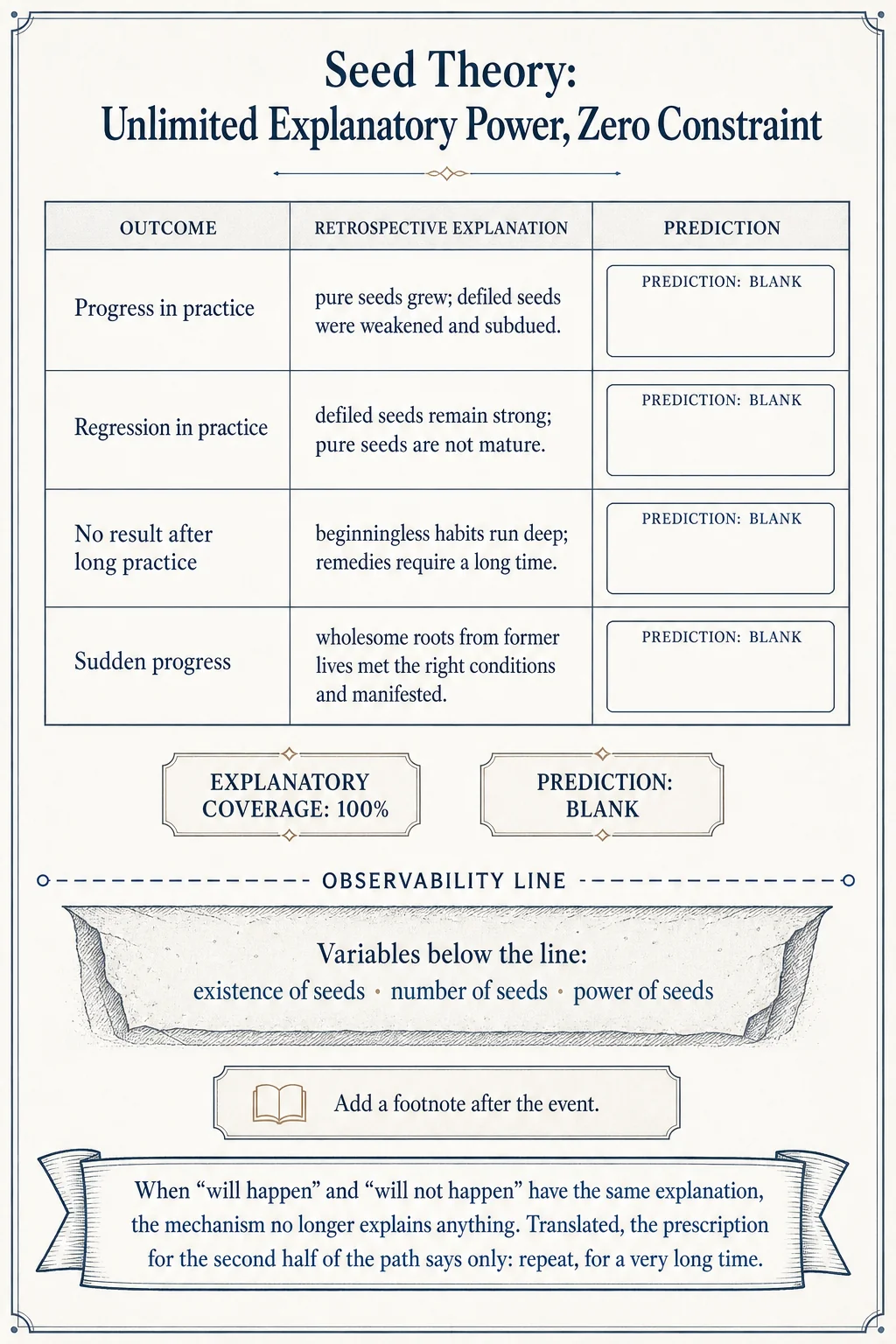
Recall Part I, Chapter 3: every change in practice is redescribed as an increase or decrease in the power of seeds. Progress means that pure seeds have grown while defiled seeds have weakened or been suppressed. Regression means that defiled seeds remain powerful and pure seeds have not matured. Long practice without result means that beginningless habitual tendencies are deep and their counteragents require a long time. Sudden progress means that wholesome roots from a former life have now encountered conditions and become manifest. The system possesses a ready explanatory entry for every possible course of experience.
Its explanatory coverage is one hundred percent, and that is precisely the problem. A theory of mechanism has value because it distinguishes “what the mechanism predicts will occur” from “what it predicts will not occur.” When the two columns contain the same entries, the mechanism no longer explains anything; it merely adds a note after the event. However precisely the six characteristics of seeds are specified (momentary cessation, coexistence with their result, continuous succession, determinate nature, dependence upon conditions, and production of their own result), one fact does not change. The existence, number, and power of seeds are wholly unobservable, for they are stored in the unknowable storehouse consciousness. Every judgment about seeds can therefore be inferred only backward from its result. A cause inferred backward will always match its result.1
2. Operational content in the latter half: translating the explanation back
The shape sketched in Part I, Chapter 1 now becomes concrete. The long latter half of the five stages and ten grounds is Yogācāra’s own engineering project for the problem that “innate grasping remains after the path of seeing.” Seed theory is the project’s entire account of mechanism. Translate that account back into operational language and ask what it actually tells practitioners to do. The instructions in the first half are concrete: hear and reflect, observe ethical conduct, and perform the four investigations, each with a method (Part I, Chapter 2). Across the latter two incalculable eons, the translated instruction reduces to one sentence: reproduce what was seen on the path of seeing, repeatedly and for a long time—repeatedly cultivate nonconceptual wisdom. Why must it take so long? Because the seeds of innate habitual tendencies are numerous and powerful and cannot be eradicated by one seeing. Seed theory explains the necessity of the duration but adds no content to “how.” The curriculum pairing each of the ten grounds with a perfection comes from the Daśabhūmika Sūtra and is not deduced from seed theory. Practice on the grounds remains calm and insight and the six perfections, just as it was before seed theory was established.2 The theory redescribes an existing curriculum. It says much about “why so long” and nothing about “what to do.” Regarding the project Yogācāra most takes pride in as its own, its account of mechanism seems to say a great deal and nothing at all. It can explain every rate of progress but cannot issue a prescription different from the old one.
3. Draw the map first, then look for landmarks
An unfalsifiable mechanism combined with prior doctrinal study produces a deeper epistemological circuit, which may be called “draw the map first, then look for landmarks.” Practitioners first systematically learn the complete map of eight consciousnesses, three natures, and five stages. This is a prescribed operation of preparation and, according to conditioning through correct hearing, the learning itself plants causes of liberation. They then “observe things as they are” in meditation. Yet what to observe and what counts as having observed it have already been prescribed by the map. Heaviness is a manifestation of seeds; pliancy is the growth of pure seeds; whatever appears in concentration awaits classification as an object resembling its material basis or an image-only object. Once an experience occurs, it is immediately assigned to a predetermined category. The act of assignment is then experienced as “confirmation of what the treatise said.” Confirmation strengthens trust in the map, and trust further shapes how the next experience is read. Here the theory of conditioning becomes self-referential: on its own account, learning the framework plants the framework’s seeds. When practitioners later “directly realize” that the framework is true, are they making a discovery or harvesting a crop?
This circuit is not unique to Yogācāra. Every system of practice with a detailed phenomenological map faces it; the Theravāda checklist of sixteen insight knowledges is a close relative, as discussed in Chapter 3 of the Introduction and Madhyamaka Part II, Chapter 6. Yogācāra, however, brings the circuit to its most fully equipped form. Its map is the most detailed, study is placed earliest, and the theory itself describes learning as planting. The better the map, the harder it is to know whether one is seeing the terrain or the map.
4. The rhetoric of “depth”
This explanatory system carries one more common instrument of defense: depth. The mode of operation of the storehouse consciousness is subtle and known fully only by a buddha; ordinary and foolish beings cannot fathom the arising and ceasing of seeds; the realm of transformation of the basis is beyond words. Whenever a key link in the mechanism is questioned, “profound” performs the work of an answer. Two kinds of depth must be distinguished. One is depth in the object: the matter itself is complex, so a theory of it is complex. The other is rhetorical depth: the theory redescribes its own untestability as the object’s inaccessible height. The first is a virtue in a theory; the second is an exemption clause. Yogācāra literature contains both. The system’s structural difficulty (an unobservable basis and an unfalsifiable explanation) makes the second indispensable. Whenever an explanation cannot be independently verified, “the realm is profound” steps in. This volume does not deny that contemplative experience can be genuinely deep. It identifies only that, within a system whose entire mechanism is installed inside the unknowable, the word “deep” can no longer distinguish whether it describes reality or protects the theory.
5. Fairness: a symmetrical test against the baseline
As usual, apply the test symmetrically. Is the baseline causal chain (observation, weakening of craving, cessation of suffering) equally unfalsifiable? No. Its causal variables are observable: the strength of craving, the rise and fall of afflictions, and the tightening or loosening of appropriation can be inspected by the practitioner and indirectly corroborated by others—present-life verifiability in Chapter 2 of the Introduction. Failure of the mechanism can appear: if long observation does not diminish greed, then this route is ineffective for this person at this time, an empirical judgment that can genuinely hold. Yogācāra locates its causal variable, the power of seeds, where it cannot be observed, so failure can always be absorbed by explanation: the seeds have not matured, or karmic obstruction is deep. Both mechanisms are coarse-grained, but one places its variables in the light and the other in the dark. Their difference in testability follows from that choice. This is the same principle as the “asymmetrical license” in Madhyamaka Part II, Chapter 2: asymmetry in the criticism follows from asymmetry in the theories’ arrangements.
6. Summary
Yogācāra’s truth of the path provides the fullest route map of the five systems (the preceding chapter gave it due credit) and the most detailed causal explanation. But the direction of detail is mistaken. It sinks every variable in the mechanism into an unknowable basis, giving the explanation unlimited explanatory power and zero constraining power. Madhyamaka’s mechanism is a load-bearing wall without a construction plan. Yogācāra’s is an exquisitely designed explanatory system that never makes a mistake and therefore can never be tested to discover whether it actually bears weight. Under this system, practitioners always know how to explain everything that happens, but nothing that happens can test the explanation. Translated into plain language, the prescription in their hands contains only one instruction: repeat, for a long time. The problem of verification has now reached capacity. The next chapter addresses it directly.
References
(For the six characteristics of seeds, conditioning, and the dispute over intrinsic versus newly conditioned seeds, see the notes to Part I, Chapter 3. For the comparison between “drawing the map before looking for landmarks” and the Theravāda checklist of sixteen insight knowledges, see Chapter 3 of the Introduction and Madhyamaka Part II, Chapter 6. For the baseline mechanism’s observable variables, see Chapter 2 of the Introduction.)
References
-
The classic source for this chapter’s judgment is Popper: a theory that accommodates every possible observation in advance and is “confirmed everywhere” displays precisely the symptom of untestability. See Karl Popper, Conjectures and Refutations: The Growth of Scientific Knowledge (London: Routledge & Kegan Paul, 1963), chap. 1; his examples are Freudian and Adlerian psychology and Marxist historiography. Lakatos subsequently offered a fairer criterion. Repairing the “protective belt” of auxiliary hypotheses around a hard core is normal theoretical practice; the distinction is whether the repair constitutes a progressive problemshift, which additionally predicts new testable content, or a degenerating problemshift, which merely absorbs existing counterexamples. See Imre Lakatos, “Falsification and the Methodology of Scientific Research Programmes,” in Imre Lakatos and Alan Musgrave, eds., Criticism and the Growth of Knowledge (Cambridge: Cambridge University Press, 1970). By this criterion, the Yogācāra research program (with the storehouse consciousness as its hard core and the characteristics of seeds and transformational birth-and-death as its protective belt) belongs to the degenerating type. For naming the individual device as an ad hoc hypothesis and an immunization strategy, see the note to Part II, Chapter 3. ↩
-
The pairing of the ten grounds with the ten perfections and the hindrance eradicated and truth realized on each ground derives from the Daśabhūmika Sūtra, the “Ten Grounds” chapter of the Avataṃsaka Sūtra. Consciousness-Only thinkers incorporated it into their own system; see fascicles 9–10 of the Cheng weishi lun. For “repeatedly cultivating” nonconceptual wisdom during the stage of cultivation, see fascicle 9 of the Cheng weishi lun. ↩