Part II, Chapter 3: The Truth of Cessation—Transformation of the Basis: Cessation or Upgrade?¶
The preceding two chapters examined the location of suffering and its cause; this chapter examines the endpoint. Yogācāra’s truth of cessation, presented in Part I, Chapter 1, has two components: transformation of the basis (āśraya-parāvṛtti, the replacement of the support) and the four kinds of nirvāṇa (intrinsically pure by nature, with remainder, without remainder, and without fixed abode). It also has one supporting arrangement: birth-and-death is divided into the ordinary and transformational kinds. In a test structurally parallel to that in the Madhyamaka chapter on cessation, this chapter proceeds in two steps. It first records what Yogācāra gains at this point and then examines what it loses. The conclusion may be stated in advance: it wins in form and loses in content. The two-stage form of cessation is preserved intact, but the content of the two stages is replaced item by item.
1. What is gained: formal preservation of the two-stage structure
Part II, Chapter 1 of the Madhyamaka part observed that a system in which saṃsāra and nirvāṇa are nondual must delete the second level of the suffering of formations; nirvāṇa without remainder consequently loses its soteriological necessity within the Madhyamaka framework. Yogācāra does not pay that price. In the Cheng weishi lun’s list of four nirvāṇas, nirvāṇa with remainder and nirvāṇa without remainder appear unchanged, corresponding in words to the baseline’s two stages (Introduction, Chapter 2). The concept of transformation of the basis also acknowledges that liberation is not merely a change of viewpoint. A real replacement must occur at the level of the support; the defiled basis must actually be dealt with. Formally, this is the most complete preservation of the baseline structure of cessation among the Mahāyāna systems.
Yogācāra also understands clearly why this form is needed. Its dissatisfaction with Madhyamaka’s “only refuting, never establishing” is precisely that, unless realization of emptiness is made effective through transformation of the basis, there is nowhere to locate the distinction between defilement and purity. The entire point of transformation of the basis is to provide a real site at which “cessation” occurs. This motive points in the same direction as the baseline.
2. What is lost I: item-by-item replacement of the two stages’ content
Now consider the content. The baseline’s two stages are these: afflictions end in the present life (nirvāṇa with remainder), and the continuum of the aggregates ends after death (nirvāṇa without remainder). The complete ending of suffering takes the form of the continuum’s nonrenewal, and the truth of cessation makes no statement about what follows cessation. Yogācāra’s endpoint, however, is not located at these two stages. In its hierarchy, a disciple’s nirvāṇa without remainder is an incomplete conjured city. The superior attainment of buddhahood is nirvāṇa without fixed abode. After transformation of the basis, the eight consciousnesses become the four wisdoms, and a pure continuum turns without interruption, performing beneficial works for beings throughout the endless future. The two stages remain on the list and are then surpassed in the hierarchy.
The decisive replacement concerns the referent of the word “cessation.” Baseline cessation is stopping: the termination of a conditioned continuum. The simile of a fire extinguished when its fuel is exhausted resolutely refuses any picture of continuation. Yogācāra cessation is purified perpetuity: a defiled continuum is exchanged for a pure continuum, consciousness for wisdom, and the storehouse consciousness for great mirror wisdom, while operation itself never pauses for an instant. In this part’s terms, the truth of cessation is rewritten from “shut the system down” to “replace the system so that it never needs to shut down.” This is not a supplement to the baseline truth of cessation but its reversal. The doctrinal force driving the reversal is the bodhisattva path—benefiting beings without entering nirvāṇa. Its psychological force reaches the edge of the fear diagnosed in the preface as a precursor to tathāgatagarbha: anxiety about annihilation has already received anticipatory reassurance here in the form of “pure perpetuity.”
3. What is lost II: transformational birth-and-death, a second kind of birth-and-death invented for remaining in the world
The replacement in the preceding section requires doctrinal technology to support it. Perpetuity needs a body: once saints have been declared to have eradicated the afflictions, by what means do they remain in the world of birth-and-death? Part II, Chapter 1 of the Madhyamaka part recorded nirvāṇa without fixed abode and retaining afflictions to sustain birth as testimony to a specially devised accommodation. Yogācāra inherits this accommodation and turns “transformational birth-and-death” into a formal doctrine—the complete engineering diagram of the arrangement.1 The plan is fixed in the Śrīmālādevī Siṃhanāda Sūtra, which divides death into two: “There are two kinds of death … ordinary death and inconceivable transformational death. Ordinary death belongs to false beings; inconceivable transformational death belongs to arahants, pratyekabuddhas, and powerful bodhisattvas with mind-made bodies, until they attain final unsurpassed awakening.” Fascicle 8 of the Cheng weishi lun supplies strict definitions. Ordinary birth-and-death is “the coarse ripened result in the three realms, produced by contaminated wholesome and unwholesome karma through the supporting power of the afflictive hindrances; the length of bodily life has a fixed limit according to the power of its conditions.” Transformational birth-and-death is “the exceptionally subtle ripened result produced by discriminating uncontaminated karma through the supporting power of the cognitive hindrances; through the power of compassion and vows bodily life is transformed and has no fixed limit.”2 Saints who have eradicated the afflictive hindrances no longer receive an ordinary body. They receive a mind-made body instead and remain in the world through transformational birth-and-death until it finally ends at the stage of buddhahood. Bodhisattvas dominated by compassion use the simpler technology of retaining afflictions to sustain birth before the eighth ground, deliberately retaining afflictive hindrances so that they may continue receiving an ordinary body. The doctrine’s entire burden of explaining continued presence in the world rests upon this division.
The alteration this invention makes to the baseline becomes clearest in three steps.
First, jurisdiction contracts. Not a word of the twelve links changes, and birth still conditions aging-and-death, but their jurisdiction is restricted to ordinary birth-and-death. The chain in which afflictions produce karma and karma produces suffering now explains only the birth-and-death of ordinary beings—the sūtra calls them “false beings.” The saints’ continuation is arranged outside the chain’s jurisdiction. The baseline established the twelve links as the grammar of all wandering-on; now they are the grammar of only its defiled half.
Second, the grammar is copied. Yet the structure of the continuation removed from the chain reproduces its deep grammar without alteration. The Śrīmālādevī Siṃhanāda Sūtra states the parallel without disguise: “Just as appropriation conditions contaminated karma as cause and birth in the three existences follows, so the ground of ignorance conditions uncontaminated karma as cause and produces the three kinds of mind-made body belonging to arahants, pratyekabuddhas, and powerful bodhisattvas.” Appropriation conditions contaminated karma and produces the three existences; the ground of ignorance conditions uncontaminated karma and produces a mind-made body. The same sentence of dependent arising is retained while every component is upgraded: ignorance becomes the subtler ground of ignorance, contaminated karma becomes uncontaminated karma, craving and appropriation become compassion and vows, birth becomes mind-made birth, and death becomes inconceivable transformational death. Only the category at the output remains unchanged. What it produces is still “birth” and “death.” The name itself confesses as much: it is called transformational death. “Aging” has indeed disappeared; bodily life is altered through compassionate vows and has no fixed limit, so it no longer has an allotted span of decline. “Death,” diluted, remains in the name.
Third, the term is removed at buddhahood. Transformational birth-and-death lasts “until final unsurpassed awakening”: even this purified machine of birth-and-death must stop at buddhahood. After buddhahood, however, the continuum of the four wisdoms turns perpetually throughout the endless future, and that continuum is no longer registered as birth-and-death. The chain thus ends twice. Ordinary birth-and-death ends when the afflictive hindrances are eradicated; transformational birth-and-death ends when buddhahood is attained. Continuation remains after the second ending, but its name has been removed from the vocabulary. The verdict in the preceding section was that the word remains while its content is changed. Here the same operation is used in reverse: the content remains while the word is withdrawn. “Birth conditions aging-and-death” has not been argued away. Its jurisdiction is first contracted, its grammar then copied, and its name finally removed.
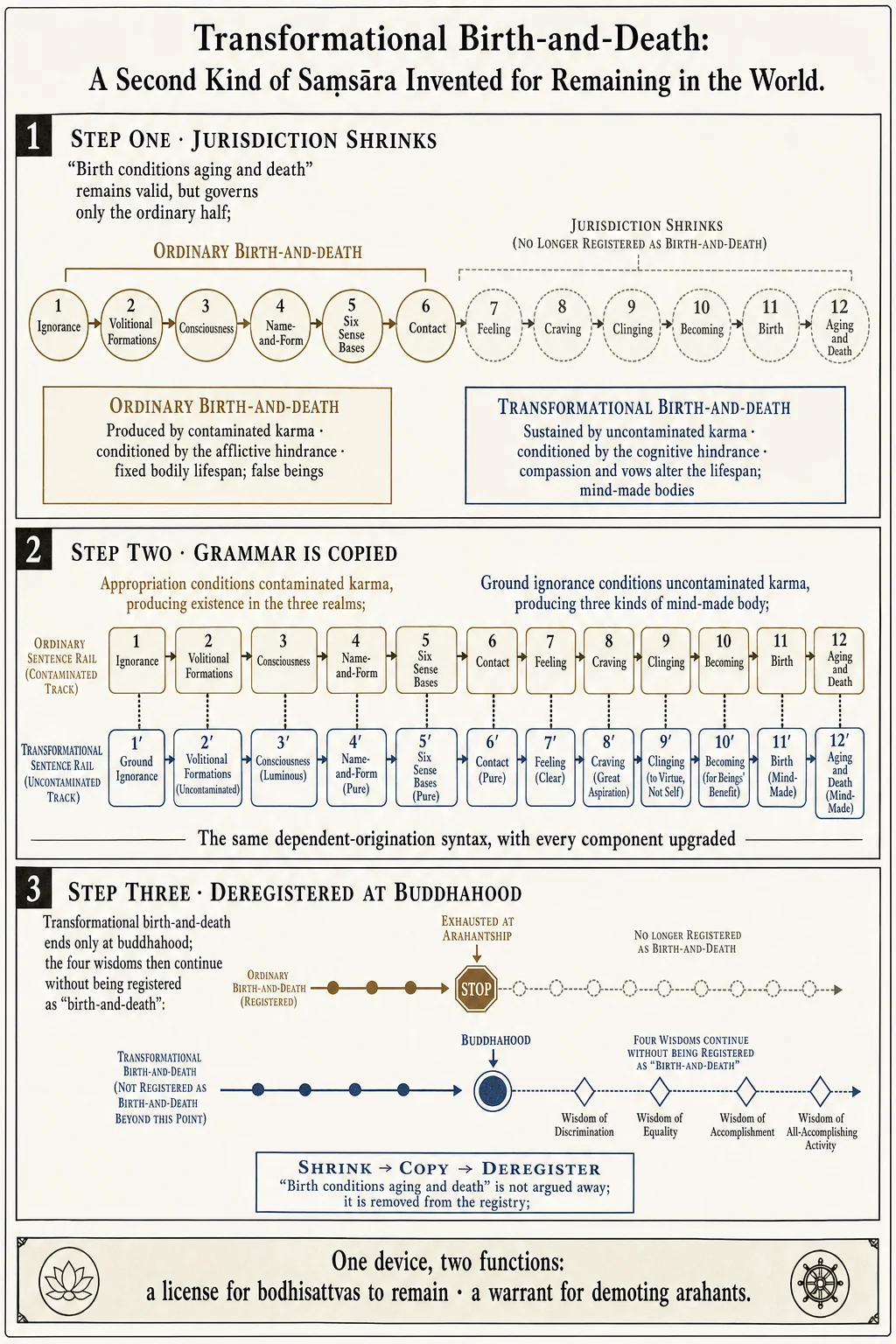
Two further details of this technology must be recorded for later chapters. First, the Cheng weishi lun knows that the causal transaction violates its own rules: by the system’s definition, uncontaminated karma does not produce ripened results. Its solution is to have uncontaminated concentration and vows support old contaminated karma, “causing the result already obtained to continue for a long time and successively increase in excellence; it is provisionally said to produce it,” before concluding, “its wondrous function is difficult to fathom, and hence it is called inconceivable.”3 A system that assumes an obligation of explanatory completeness (Part II, Chapter 7) invokes the two labels “provisionally said” and “inconceivable” precisely at the joint of the doctrine of remaining in the world. The baseline’s undeclared questions refuse explanation. Here, “inconceivable” is a seal pasted over the point where the explanatory chain breaks. The one place where the entire machine itself admits that it cannot turn is exactly where it is required to produce the doctrine of remaining in the world. Second, the same device performs two tasks. A mind-made body is both a license allowing bodhisattvas to remain in the world and a judgment demoting the arahant. The same chapter of the Śrīmālādevī Siṃhanāda Sūtra says that arahants and pratyekabuddhas “have residual birth-dharmas not yet exhausted, and therefore have birth … they are far from the realm of nirvāṇa.” Because they have not eradicated the ground of ignorance and still undergo transformational birth-and-death, arahants are judged not to have truly completed the path. The two pieces of evidence recorded in Part II, Chapter 1 of the Madhyamaka part (the bodhisattva’s prolonged presence and the arahant’s demotion) are two faces of the same doctrinal invention. That invention also inflicts retrospective damage upon the circuit of verification: “birth is ended” is narrowed until it is true only of ordinary birth-and-death. That consequence is reserved for Part II, Chapter 6.
4. What is lost III: the back door of nirvāṇa intrinsically pure by nature
The first item on the list of four nirvāṇas requires separate examination. “Nirvāṇa intrinsically pure by nature” teaches that the thusness of all phenomena is originally pure, that this purity is not produced by practice, that all sentient beings possess it equally, and that saints merely realize and disclose it.4 To place this item on the list of “nirvāṇas” amounts to declaring that, in one sense, cessation is not an event yet to occur but a fact that has always already been so. Practice does not produce purity; it reveals purity.
Readers of the Madhyamaka part will recognize where this door leads. The change of cessation from an “event” into a “perspective” is the very mutation recorded in its chapter on the truth of cessation (Madhyamaka Part II, Chapter 3). The grammar of “original purity, defiled by adventitious stains” is the framework of the entire tathāgatagarbha system (Part IV). The difference is that Madhyamaka reaches this point through a transgressive reading of the nonduality of saṃsāra and nirvāṇa and can still claim that later readers misunderstood it. Yogācāra writes the claim into its formal list of nirvāṇas and places it first. When tathāgatagarbha opens the door to permanence, bliss, self, and purity (Introduction, Chapter 2), the hinge has already been installed by Yogācāra.
This back door was genuinely contested within the tradition, and both attackers and defenders left works behind. Consciousness-Only thinkers fitted a lock of their own. Kuiji distinguished buddha-nature as principle from buddha-nature as practice. All sentient beings possess buddha-nature as principle (the equality of thusness, which is what the first nirvāṇa indicates), but buddha-nature as practice, the intrinsic uncontaminated seeds capable of initiating practice and attaining buddhahood, differs according to the five dispositions. Nirvāṇa intrinsically pure by nature belongs to principle, not practice: the word “principle” leaves the door open while “practice” shuts it. Proponents of the One Vehicle immediately pushed against it. In the early Tang, Lingrun argued that all sentient beings can attain buddhahood and exchanged challenges with proponents of the new translations such as Shentai. Later, Fabao’s Treatise on the Ultimate Meaning of Buddha-Nature in the One Vehicle attacked the five dispositions directly, and Huizhao answered with the Treatise Displaying the Wisdom-Sun of the Middle and the Extremes.5 The outcome is clear. The mainstream Chinese traditions (Tiantai, Huayan, and Chan) collectively entered on the tathāgatagarbha side, while the Faxiang school retreated to the margins with its distinction between principle and practice. The lock was constructed with great precision. But once a system places “original purity” first on its list of nirvāṇas, history shows that no later-added distinction can resist its pull.
5. What is lost IV: the problem of the subject of transformation
Transformation of the basis leaves one more structural problem. Who accomplishes the transformation? What continues from before to after it? If the storehouse consciousness becomes great mirror wisdom, then one thing persists through the transformation—consciousness while defiled and wisdom while pure. Its compatibility with non-self requires explanation, and every such explanation makes the continuant look more like a subject under a changed name. If nothing persists, and the end of defilement and rise of purity are merely earlier and later phases of a continuum, then the “replacement of one and the same support” promised by the phrase transformation of the basis comes to nothing. Liberation becomes replacement rather than transformation, opening the fissure “I practice, but a buddha receives the result.” Yogācāra replies that a continuum is nominally established and is neither annihilated nor eternal. The form of this answer closely resembles that of the Pudgalavādins it criticized, and Yogācāra understands better than anyone the weight carried by such an answer (Volume I, 3.5). The ambiguity at the endpoint is the same ambiguity appearing in three places: at the beginning, in the location of suffering; at the foundation, in the status of the storehouse; and here, at the endpoint.
The tradition made one famous attempt to resolve this problem. The Mahāyānasaṃgraha school transmitted through Paramārtha established a ninth consciousness, the amala-vijñāna or stainless consciousness. By positing the result of transformation as a separate pure consciousness, it gave a name to what continues across defilement and purity. Xuanzang’s school explicitly rejected the proposal, ruling that “stainless consciousness” is merely the name of the eighth consciousness in its purified state and not a separate ninth consciousness.6 These two choices enacted the present dilemma in history. Establishing the amala-vijñāna provides a subject of transformation, but a pure consciousness persisting through defilement and purity has already set one foot in tathāgatagarbha. It is no accident that the Mahāyānasaṃgraha masters later merged with the Dilun school into the current of true permanence. Refusing to establish it preserves the language of non-self, at the cost of returning “who transforms the basis?” to the ambiguity of a nominally established continuum. The tradition tried both routes. One leads to Part IV; the other remains inside this section’s problem. No one has yet supplied a third.
6. Summary
Formally, Yogācāra’s truth of cessation preserves the baseline more completely than any of the five systems: the two stages remain listed, and transformation of the basis takes their reality seriously. In content, however, it completes three replacements: cessation becomes purified perpetuity; an event becomes an always-already fact in the first nirvāṇa; and cessation without self becomes transformation whose subject cannot be specified. The doctrinal technology supporting the first replacement is transformational birth-and-death. Its jurisdiction contracts, its grammar is copied, and its name is removed at buddhahood. The words “birth conditions aging-and-death” remain intact while continued presence in the world proceeds without obstruction. The gap between fidelity at the level of claims and reversal at the level of function is more concealed here than in Madhyamaka. Madhyamaka at least says in words that saṃsāra and nirvāṇa are nondual; Yogācāra preserves every item of the baseline vocabulary and changes the content beneath it. With the endpoint established, the next two chapters examine the path: first whether its practice is cultivation or confrontation, and then whether the mechanism of which it is so proud actually explains anything.
References¶
References
-
The “specially devised accommodation” of the Madhyamaka part is what philosophy of science calls an ad hoc hypothesis: a supposition introduced specifically to absorb a counterexample and possessing no independently testable content of its own. Hans Albert calls such repairs that immunize a theory against criticism an Immunisierungsstrategie, or immunization strategy; Karl Popper earlier called them conventionalist strategies. See Karl Popper, The Logic of Scientific Discovery (London: Hutchinson, 1959), §§19–20; Hans Albert, Traktat über kritische Vernunft (Tübingen: Mohr Siebeck, 1968). Transformational birth-and-death is a textbook specimen: its sole reason for existing is the counterexample “one eradicates the afflictions yet remains in the world,” and beyond this it predicts nothing that can be checked. For the related criterion of fairness (Lakatos’s progressive or degenerating problemshift), see the note in Part II, Chapter 5. ↩
-
The two kinds of death (ordinary death and inconceivable transformational death), the three kinds of mind-made body, and the quotations about “the ground of ignorance conditioning uncontaminated karma as cause” all come from the “One Vehicle” chapter of Guṇabhadra’s translation of the Śrīmālādevī Siṃhanāda Ekayāna Mahopāya Vaipulya Sūtra (T no. 353). The definitions of ordinary and inconceivable transformational birth-and-death come from fascicle 8 of the Cheng weishi lun. On retaining afflictions to sustain birth and the distinction between wisdom-dominant and compassion-dominant bodhisattvas in receiving bodies, see fascicle 8 of the Cheng weishi lun and Kuiji’s Cheng weishi lun shuji. ↩
-
“Uncontaminated concentration and vows support contaminated karma, causing the result already obtained to continue for a long time and successively increase in excellence; it is provisionally said to produce it,” and “its wondrous function is difficult to fathom, and hence it is called inconceivable,” both appear in fascicle 8 of the Cheng weishi lun in its discussion of the continuation of birth-and-death. The former answers the objection that “uncontaminated karma should not produce birth-and-death.” ↩
-
For the definition of “nirvāṇa intrinsically pure by nature” among the four nirvāṇas (the principle of thusness, the characteristic of all phenomena, intrinsically pure despite adventitious defilements and possessing countless subtle qualities), see fascicle 10 of the Cheng weishi lun. Its grammatical affinity with the tathāgatagarbha formula “mind intrinsically pure, defiled by adventitious stains” is examined in detail in Part IV of this volume. For the baseline meaning of nirvāṇa with and without remainder, see Introduction, Chapter 2. ↩
-
For the distinction between buddha-nature as principle and buddha-nature as practice, see Kuiji’s Dasheng fayuan yilin zhang. On the Tang debate over buddha-nature: Lingrun challenged the new-translation school’s doctrine of five dispositions, Shentai answered him, and the later exchange between Fabao’s Treatise on the Ultimate Meaning of Buddha-Nature in the One Vehicle and Huizhao’s Treatise Displaying the Wisdom-Sun of the Middle and the Extremes marked its high point. See Volume I, 10.7, on the position of the Chinese Faxiang school. ↩
-
For Paramārtha’s school and the ninth amala-vijñāna, see works such as his translations of the Viniscaya-saṃgrahaṇī and the Treatise on the Transformation of Consciousness. Xuanzang’s school identifies “stainless consciousness” as the name of the eighth consciousness in its purified state, present at the stage of the Tathāgata, and does not establish a separate ninth consciousness; see fascicle 3 of the Cheng weishi lun. ↩