Part II, Chapter 3: Verification—A Check from Which No One Returns
Pure Land is the least verifiable of the five systems for a simple reason: its central event occurs after death. However much verification in the preceding four systems drifts, is hollowed out, canceled, or positioned in advance, evidence at least remains within this life. Pure Land moves the moment of redemption entirely to the other shore, where no one can return as witness.
1. Amitābha’s welcome at death: verification at the moment of dying
The definitive account in the line of Shandao and Hōnen is Amitābha’s welcome at death. When practitioners die, Amitābha and a host of noble beings approach with a lotus throne and guide them into birth. This arrangement fixes verification at the instant of death. The problem follows. Only the dying person experiences that instant, precisely when the person loses the capacity to report to others. Witnesses can observe at most auspicious signs—a distinctive fragrance, light, a peaceful expression, or death while seated. The equals sign between those signs and “certainly attained birth” is written by the system, not proven by the signs themselves. A peaceful seated death shows that someone died peacefully; it does not show that the person went to the Land of Bliss. This is the same situation as Vajrayāna’s rainbow body (Vajrayāna Part II, Chapter 3), but more thorough. Rainbow body at least leaves a body that can be examined; the corpse of one supposedly born in the Pure Land does not point toward the other shore at all.
2. Accomplishment of the cause in ordinary life: verification retreats into one moment of entrusting
The Shin line appears to bring the problem forward: because the cause is accomplished in ordinary life, there is no need to wait until death; birth is settled at the moment entrusting is settled. On the surface, verification returns to this life. Examined closely, it retreats to a point even less accessible. Settled entrusting is a purely internal event and, under Shin Buddhism’s own rules, does not arise through one’s power but is transferred by Amitābha (Part I, Chapter 2). The question “has my entrusting truly been settled?” can therefore be checked neither externally by others nor internally by oneself. The moment one reflects and calculates “have I entrusted?”, one returns to self-power’s calculation and betrays other-power. Verification is suspended where neither end can reach: it cannot be publicly checked from outside and must not be inspected within. It arrives earlier than the welcome at death but becomes even less accessible.
3. Reading the five systems together: verification takes its final step
Place the five systems’ verification in a line, and a clear retreat reaches completion. Madhyamaka’s criterion historically drifts from cessation toward debate. Yogācāra’s checkpoints are hollowed out by an unknowable basis. Tathāgatagarbha cancels the object of verification—all possess buddha-nature and the claim cannot be wrong. Vajrayāna reconstructs the outer form of verification but positions authority in the teacher before practice. Pure Land is the fifth step and endpoint: it moves verification after death, making the check unrecoverable in principle. The baseline formula is “Birth is ended, the holy life has been lived, what had to be done has been done, and I know for myself there is no further becoming”—a completed statement in this life, verifiable by the person concerned (Introduction, Chapter 2). Pure Land’s birth is a promise redeemed only after death, with no survivor able to report it. No one born in the Pure Land has returned to say, “Birth is ended.” From a self-verifiable completed statement to a promise from which no one returns, verification loses blood step by step across the five systems and is drained entirely in Pure Land.
4. The other register: the present-life therapeutic effect of surrendering the self
The verdict in the preceding three sections concerns the account of birth: it is redeemed after death and no one returns to check. Pure Land possesses another register, recording the effect in this life of the act of surrendering the self upon living people. In this register, Pure Land records genuine achievement, and research outside Pure Land has repeatedly registered it over recent decades.
In modern psychology, “surrendering the self to a higher presence” is not empty speech. It can have observable therapeutic effects, with the most concentrated evidence coming from addiction treatment. The first three of Alcoholics Anonymous’s Twelve Steps constitute a procedure of entrusting: admit powerlessness over alcohol—step one; believe that a power greater than oneself can restore one to health—step two; decide to turn one’s will and life over to that higher presence as one understands it—step three. In the 1940s and 1950s, the psychiatrist Harry Tiebout described the operation as a psychological mechanism called “surrender.” Its therapeutic power lies not in the doctrine believed but in genuinely shutting down the self’s machine that ceaselessly seeks control, victory, and personal accomplishment. A person releases the struggle with the self, and an observable peace follows.1 This is not an isolated clinical impression. A 2020 Cochrane systematic review synthesized many randomized controlled studies and concluded that Twelve-Step treatment was superior to other established therapies in maintaining continuous abstinence and comparable to them on most other measures.2 Surrendering the self has real effects.
The effect is neither limited to addiction nor to Christianity. Psychology of religion studies “surrender” as a distinct coping style and differentiates it from passive waiting. Surrender is an active relinquishment of will, entrusting the problem to a higher presence rather than sitting still until that presence acts. Multiple studies associate this mode of coping with better psychological adjustment and greater spiritual well-being.1 Surrender heals precisely because one gives away the most exhausting burden: the conviction that one must carry everything alone.
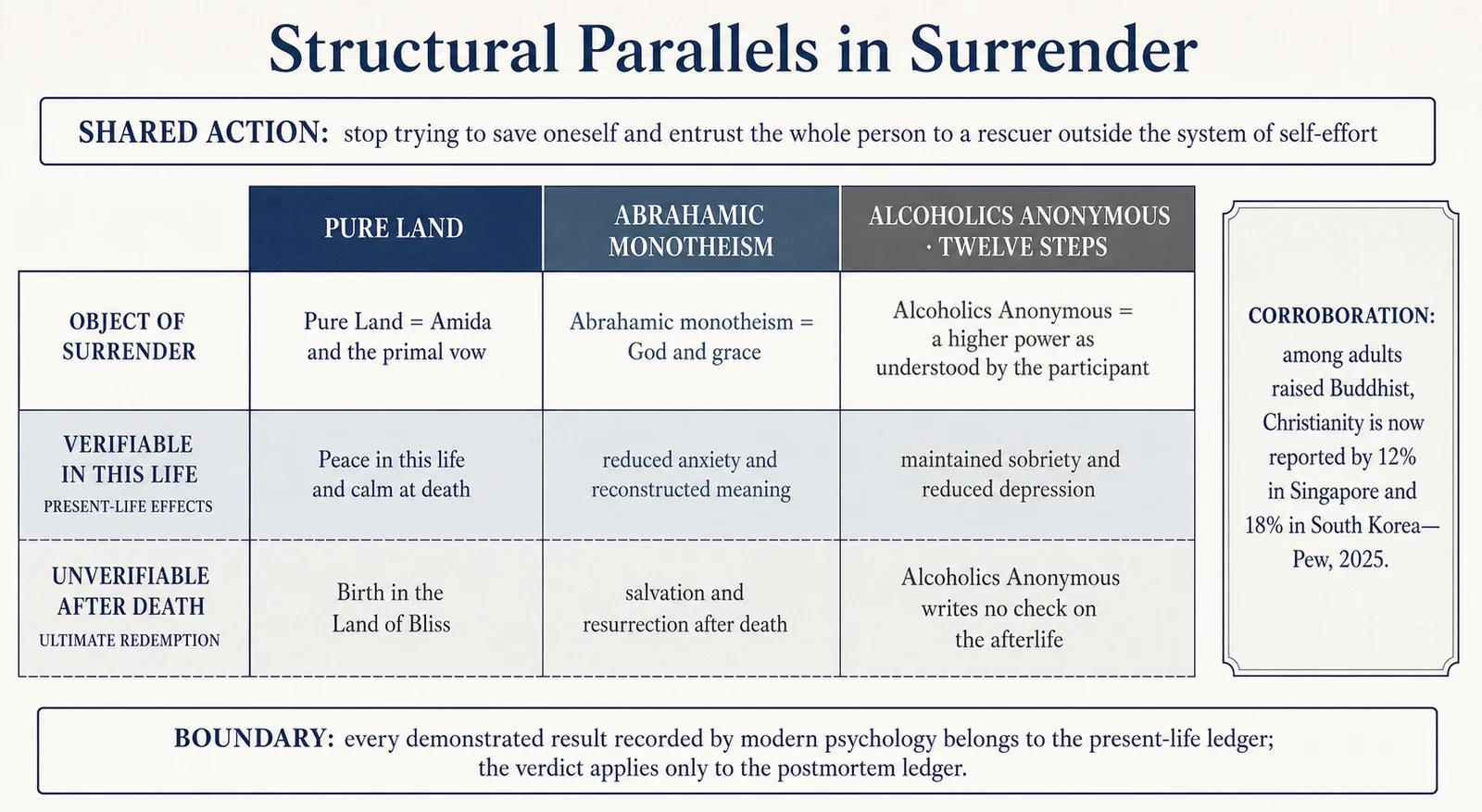
At this point, the structural equivalence between Pure Land and the Abrahamic religions can no longer be concealed. A Pure Land practitioner entrusts the self to Amitābha’s Fundamental Vow; a person in recovery to a higher power; a Christian to divine grace. The objects carry different names, but the act surrendered is one: stop saving oneself and stake the whole person upon a savior outside the system. Only the name inserted into the position changes. A table can be drawn, but its angle must differ from the Introduction. There, the comparison concerned doctrinal claims—sin and ignorance, forgiveness and abandoning affliction. This table separates the accounts for verification: which column can be tested in this life, and which is moved beyond death?
| Pure Land | Abrahamic monotheism | Alcoholics Anonymous Twelve Steps | |
|---|---|---|---|
| Object of entrusting | Amitābha Buddha and the Fundamental Vow | God and grace | A higher power as one understands it |
| What is surrendered | Every attempt at self-powered rescue | Pride in justification through works | The compulsion to control alcohol and life |
| Effect testable in this life | Peace in the present life and composure at death | Relief of anxiety and reconstruction of meaning | Maintenance of abstinence and reduction of depression |
| Moment of ultimate redemption | Birth in the Land of Bliss after death | Salvation after death and resurrection at the end of time | None—no afterlife claim |
| Can that redemption be checked? | No; no one returns | No; it likewise lies beyond death | Not applicable |
The table shows the boundary within the shared structure. Alcoholics Anonymous redeems only the present-life column and issues no check for the afterlife, so the whole table rests cleanly within what can be tested. Pure Land and monotheism both move decisive redemption beyond death in the last two rows; that is this chapter’s verdict. The shared structure sharpens it. Pure Land’s present-life testable column (the healing power of entrusting) and its untestable postmortem column (redemption through birth) are two columns, not one. Every genuine achievement registered by modern psychology belongs to the former. Surrender can heal a living person; this fact does not cross the boundary even slightly to prove that the presence entrusted will arrive after death as promised.
The shared structure extends even to rhetoric. Both traditions call the broadest road the narrowest. Christianity declares the gospel open to all and salvation available to anyone who believes, yet establishes the “narrow gate”: “the gate is narrow … that leads to life, and few find it” (Matthew 7). Pure Land’s birth through nembutsu is easy within the easy path (a three-year-old can say the Name), yet in the Smaller Sukhāvatīvyūha the Buddha himself calls it “the Dharma difficult for all the world to believe.” Pure Land masters present “easy practice” and “difficult faith” as two faces of one thing. Practice is supremely easy while entrusting is supremely difficult: it opposes the stream of birth-and-death and ordinary expectations. Everyone can recite, but few wholly and irrevocably entrust.3 One road is easily obtained but has a narrow gate; the other is easily practiced but difficult to believe. Both place a psychological gate across a road opened to ordinary people. The gate’s first function is to incorporate into faith the natural doubt “if it is so easy, might it be false?” A convenient misreading must be prevented: this is not qualification screening. The grammar of salvation in both traditions declares that no qualification is checked at the gate. Grace is freely given and the Name freely recited. What is narrow is not the threshold but the self-reliance within the mind that refuses surrender. The fact that “few enter” is therefore rewritten in advance into two judgments. Failure to enter does not show the gate false but that one refuses; what blocks one is worldly cleverness and calculation one cannot relinquish. Few believers do not show the belief questionable but precious—difficulty of faith becomes glory rather than defect. Doubt is transformed from a challenge outside the system into a symptom already entered in its case file. The Eighteenth Vow is freely given with almost no condition; its only exclusion names the five grave offenses and slander of the true Dharma. What appears in advance on the exclusion list is rejection itself.
Self-verifying soteriology does not contain this gate, for a plain reason: its difficulty lies on the road, not at the entrance. In the baseline, gate and road are continuous. Entering is taking the first step, and right view itself is the first factor of the Noble Eightfold Path. Faith is only a working hypothesis at departure, checked along the way, confirmed if the road works and freely discarded if it does not—the position of the Kālāma Sutta; the formula praising the Dharma is “come and see.” The baseline can open the gate as widely as possible and welcome doubt at the entrance because every step can be checked. The difficulty is walking, not believing. It never conceals that few complete the road. The Dhammapada says directly that few cross to the far shore while the rest wander on this side.4 Yet this small number is presented simply as an ordinary fact of a long road, not manufactured into the road’s glory or a selection of the traveler. The grammar of salvation does the opposite. Once the road is made extremely easy, the “few” loses a place to stand and must be removed from the road and recast as the narrow gate of “faith.” Once this step is seen, the gate occupies a familiar location: exactly the place vacated by verification. A testable system leaves the gate open and lets the road’s difficulty speak for itself. An untestable system levels the road and piles all difficulty at the entrance. “A Dharma difficult to believe” is the internal doctrinal name for a Dharma difficult to verify.
Seen from outside the tradition (the criterion of this volume is the fourth external position described in Part I, Chapter 2), the gate produces a second result that the scriptures do not conceal: a sense of election among those inside. Christianity declares the gospel open to the simple yet explains disbelief as the blindness of the clever: “You have hidden these things from the wise and learned, and revealed them to little children” (Matthew 11). Paul states it more directly: the message of the cross is foolishness to those perishing, while God chooses the foolish things of the world to shame the wise (1 Corinthians 1). “That scholar does not believe because worldly cleverness cannot see the savior” is not a later believer’s invention but an answer already present in scripture. Pure Land’s counterpart is equally conspicuous. The Sūtra on the Contemplation of Amitāyus calls one who recollects the Buddha “a puṇḍarīka—a white lotus—among people.” Shandao develops this into five praises: a good person among people, a wondrously good person, a supreme person, a rare person, and the most excellent person.5 The rhetorical lever must be seen clearly. The ticket of entry is acknowledgment that one is an “evil ordinary being subject to birth-and-death” (deep faith regarding the being), while the receipt is “the most excellent person among people.” Self-deprecation is payment; election is receipt. The Shin line goes still further. One whose entrusting is settled immediately enters the rightly settled group in this life and already belongs to those destined for salvation. Later tradition compiled biographies of exemplary believers (the Biographies of Wondrously Good People), and humility itself became a category of praise.5
Modern psychology and sociology of religion provide mechanisms explaining why this rhetoric works so reliably. Social identity theory observes that groups sustain members’ self-esteem through “positive distinctiveness,” while something generally judged difficult to believe automatically makes its believers rare. Classic experiments on severity of initiation by Aronson and Mills show that the higher the cost of entry, the higher members value the group they joined; difficult belief is a cognitive entrance fee. Iannaccone’s theory of strict churches further shows that costly requirements screen out the half-committed and strengthen the investment of those who remain; a creed contradicting surrounding common sense is itself a form of cost. Berger’s “cognitive minority” shows that groups whose beliefs are rejected by the surrounding world commonly preserve them by reading minority status as “everyone else is blind; we alone see.” Experimental work supplies a more direct record: the more intrinsically religious people are, the farther above average they rate their own virtue, a phenomenon researchers call “holier-than-thou.”6 None of these studies targets Pure Land or the narrow gate, yet together they identify one general device in human psychology: turn “few believe” into “believers are rare and precious.” The gate’s ledger can now be completed. Its first product incorporates doubt outside the gate as a symptom; its second casts faith inside as a medal. Together, they recover the fact most damaging to a doctrine of salvation—“most people do not believe.” Externally, it proves the world blind; internally, the believer precious. Draw the customary boundary. This registers rhetorical structure and does not claim every believer is proud. Traditions contain their own prohibitions against pride in salvation—Shin Buddhism condemns hongan-bokori, presumption upon the Fundamental Vow, and the model of the “wondrously good person” emphasizes humility. But those prohibitions target indulgence, not the rhetoric of election itself. When humility becomes a group’s praised category, superiority gains its most respectable carrier.
The shared structure leaves one observable piece of corroboration. If Pure Land and Christianity are two dialects of one grammar of salvation, believers should move between them at low cost—low enough to create a visible current of conversion in the same culture. The data have that form. A 2025 Pew Research Center survey found that among adults raised Buddhist, 12 percent in Singapore and as many as 18 percent in South Korea had converted to Christianity; Hong Kong creates a similar impression, although it was outside the sample.7 People do not easily convert to a structure wholly foreign to them. Such smooth transition is possible because the name changes while the grammar “entrust oneself to a savior” remains. The East Asian current from Buddhism into Christianity is less a contest between religions than movement of the same religious need between two signs over a door. That movement itself corroborates that Pure Land has already crossed to the side of salvation.
5. Boundary and summary
As usual, draw the boundary, especially clearly for Pure Land. This chapter does not deny that composure at death and peace after entrusting are real and observable present-life effects. Many practitioners genuinely die more calmly and live more securely than before their practice. But all these effects belong to the preceding section’s other register. They show that faith brings real settlement; they do not show that “birth in the Land of Bliss” occurs as fact. Two things must be separated: peace through nembutsu is a psychological fact verifiable in this life; redemption through birth is an unrecoverable metaphysical promise after death. The verdict falls only upon the latter. The object of verification is moved wholly beyond death and becomes a sentence no one can check and no one can refute. The diagnosis of attachment and summary of the whole volume follow in the final chapter.
References
References
-
On “surrender” as a psychological mechanism, see the psychiatrist Harry M. Tiebout’s essays “The Act of Surrender in the Therapeutic Process” (1949), “Surrender versus Compliance in Therapy” (1953), and “The Ego Factors in Surrender in Alcoholism” (1954). Tiebout treated one of the founders of Alcoholics Anonymous and described surrender as ego-reduction whose efficacy lies in stopping the ego’s grasp for control. On styles of religious coping (self-directing, deferring, and collaborative), see Kenneth Pargament, The Psychology of Religion and Coping (1997). For separating “surrender” from passive deferring and measuring its positive relation to spiritual well-being, see A. Wong-McDonald and R. L. Gorsuch, “Surrender to God: An Additional Coping Style?,” Journal of Psychology and Theology 28, no. 2 (2000): 149–61. ↩↩
-
J. F. Kelly, K. Humphreys, and M. Ferri, “Alcoholics Anonymous and other 12-step programs for alcohol use disorder,” Cochrane Database of Systematic Reviews (2020). The review synthesizes randomized controlled and quasi-experimental studies and concludes that Alcoholics Anonymous and Twelve-Step Facilitation are no worse than, and on several measures better than, established treatments such as cognitive behavioral therapy in producing and maintaining abstinence. It is cited here only for the present-life efficacy of the surrender mechanism; its specialized conclusions on addiction are outside this volume’s subject. ↩
-
For the “narrow gate,” see Matthew 7:13–14: “the gate is narrow and the road is constricted that leads to life, and few find it.” For the “Dharma difficult to believe,” see Kumārajīva’s translation of the Smaller Sukhāvatīvyūha Sūtra: “I teach this Dharma difficult for all the world to believe.” Pure Land presents “easy practice and difficult faith” together: the practice is supremely easy (recitation of the Name), while faith is supremely difficult because it opposes the stream of birth-and-death and ordinary expectations; Shandao and Shinran return repeatedly to this point. For the Eighteenth Vow’s exception, “except those who commit the five grave offenses or slander the true Dharma,” see the note to Part I, Chapter 1. Later commentators commonly read this as deterrence rather than permanent exclusion; see Shandao’s Commentary on the Contemplation Sūtra in Four Fascicles. On the Christian side, the one sin that “will not be forgiven” is likewise rejection in the form of blasphemy against the Holy Spirit (Matthew 12:31–32). What both traditions exclude in advance is refusal itself. ↩
-
Dhammapada verses 85–86: few among people cross to the far shore; the rest wander on this side. Ehipassiko, “come and see,” is the canonical formula praising the Dharma in recollection of the Dharma. “Do not believe merely through a lineage of teachers or oral tradition” appears in the Kālāma Sutta (AN 3.65) and in the note to Vajrayāna Part II, Chapter 3. ↩
-
“You have hidden these things from the wise and learned, and revealed them to little children,” Matthew 11:25; “God chose the foolish things of the world to shame the wise,” 1 Corinthians 1:18–27. “A puṇḍarīka—a white lotus—among people” appears in the circulation section of the Sūtra on the Contemplation of Amitāyus: “If one recollects the Buddha, know that this person is a white lotus among people; Bodhisattva Avalokiteśvara and Bodhisattva Mahāsthāmaprāpta are their excellent friends.” Shandao’s explanation in the “Meaning of Nonmeditative Good” section of his Commentary on the Contemplation Sūtra in Four Fascicles gives five praises: “Those who recollect the Buddha are good people among people, wondrously good people, supreme people, rare people, and the most excellent people.” Immediate entry in the rightly settled group in this life for one whose entrusting is settled is one of Shin Buddhism’s “ten benefits in the present life”; see the chapter on entrusting in Shinran’s Kyōgyōshinshō. The Biographies of Wondrously Good People is a late-Edo collection by the Shin monk Gōsei and others of exemplary devotion among ordinary believers; its title derives from Shandao’s praise. ↩↩
-
On “positive distinctiveness” in social identity theory, see Henri Tajfel and John C. Turner, “An Integrative Theory of Intergroup Conflict” (1979). On severity of initiation and evaluation of a group, see Elliot Aronson and Judson Mills, “The Effect of Severity of Initiation on Liking for a Group,” Journal of Abnormal and Social Psychology 59 (1959): 177–81. On strict churches, see Laurence R. Iannaccone, “Why Strict Churches Are Strong,” American Journal of Sociology 99, no. 5 (1994): 1180–1211. On the “cognitive minority,” see Peter L. Berger, A Rumor of Angels (1969). On intrinsic religiosity and seeing oneself as more virtuous, see W. C. Rowatt, A. Ottenbreit, K. P. Nesselroade Jr., and P. A. Cunningham, “On Being Holier-Than-Thou or Humbler-Than-Thee: A Social-Psychological Perspective on Religiousness and Humility,” Journal for the Scientific Study of Religion 41, no. 2 (2002): 227–37. See also Leon Festinger, Henry W. Riecken, and Stanley Schachter, When Prophecy Fails (1956), on believers increasing proselytization after a prophecy fails, another mechanism that recovers counterevidence as fuel for faith. ↩
-
Pew Research Center, “Religious Switching Into and Out of Buddhism” (March 2025): among adults raised Buddhist, approximately 12 percent in Singapore and as many as 18 percent in South Korea had converted to Christianity. The research covers the United States, Japan, South Korea, Singapore, Sri Lanka, and Thailand, but not Hong Kong. Other regional studies in sociology of religion document East Asian conversions from Buddhism to Christianity. The observation is cited only as corroboration of structural equivalence, not as a causal claim. ↩