Part II, Chapter 4: Determining Attachment and Concluding Audit—Attachment to Salvation
Following the compressed format, the diagnosis of attachment and concluding audit are combined in one chapter. This is also the final chapter criticizing an individual system in this volume. The five systems’ audits conclude here; their full comparative table is reserved for the synthetic criticism in Part VII.
1. The object of attachment and its side of fear
Each of the first four systems grasps one object. Madhyamaka grasps intellect, Yogācāra a foundation, tathāgatagarbha eternity and guarantee, and Vajrayāna the result. Pure Land grasps being saved: not arriving through oneself, but being taken away by another and guaranteed through a vow. Its side of fear is accordingly deepest and most naked: despair of self-power. Tathāgatagarbha fears annihilation and uncertainty; Vajrayāna fears the long schedule; Pure Land fears “I have no ability at all.” Shandao’s deep faith regarding the being makes this despair the starting point of faith: there are no conditions for escape.1 Attachment to salvation is the reverse side of despair in self-power: because I can never accomplish it, I seek one who can and ask that person to accomplish the whole of me.
Distinguish it precisely once more from tathāgatagarbha. Tathāgatagarbha advances one’s own fruit; the basis lies in oneself (originally a buddha), so the guarantee is self-signed. Pure Land relocates the basis entirely outside the system and advances another’s vow-power; the guarantee is signed by another. Pure Land is thus advancement in its limiting form. Even its collateral, one’s own buddha-nature, is no longer needed; everything is staked directly upon another’s vow. The object of attachment stands entirely outside the self for the first time.
Close off one route of retreat. Pure Land does contain attempts to bring other-power back into self-power. “Mind-only Pure Land” and “Amitābha of one’s own nature” teach that the Pure Land is merely the purity of one’s mind and Amitābha does not lie outside one’s nature. This is an attempt to reread a doctrine of salvation back into soteriology, described in Volume I. But the reading remains a tributary and has never replaced other-power Pure Land as the mainstream of popular faith. The reason is not hard to see. Once Amitābha becomes one’s own mind, there is no longer another to whom one can entrust oneself, and the operation on which Pure Land’s efficacy depends (handing the whole self away) collapses. The marginal position of Mind-only Pure Land confirms in reverse Pure Land’s nature. It wants not a buddha illuminated from within the mind but a real savior standing outside oneself. Attempts to recover Pure Land for soteriology fail because its inner structure is already salvific.
2. The mechanism word: entrusting
The five mechanism words are complete: recursion for Madhyamaka, iteration for Yogācāra, advance payment for tathāgatagarbha, rehearsal for Vajrayāna, and entrusting for Pure Land. In the first four, the self continues to act: winds around itself, drills into depth, draws credit against the fruit, or rehearses in the present. Entrusting alone is a verb in which the self stops acting. The result enters one’s hands not through personal operation but by handing the whole project to another. Precisely for this reason, it is the least laborious in the series and travels farthest—outside soteriology’s door.
Read the five mechanisms together and two trends reach their endpoints. The proportion of self-power declines: Madhyamaka rests entirely upon seeing—the highest concentration of self-power; Yogācāra divides the road in two; tathāgatagarbha advances the endpoint; Vajrayāna carries self-powered engineering to its maximum but still requires personal rehearsal; Pure Land reaches zero. The strength of guarantee rises: Madhyamaka supplies almost none (everything rests upon one seeing), and increases step by step until Pure Land reaches the maximum—another guarantees everything and, once entrusting is settled, failure is impossible. Pure Land is the common endpoint of both lines: lowest self-power, highest guarantee. It illuminates the direction of the entire Mahāyāna trajectory. The less one can bear the unguaranteed road of self-power, the farther one moves toward guarantee. Pure Land is the terminus of that inability to bear.
3. Concluding audit: verdicts on the five questions
Gather the verdicts in the established format—level of claims and level of functions. Arguments appear in the indicated chapters.
The truth of suffering: at the level of claims, the framework of suffering and saṃsāra remains, and the system faces both Sahā’s difficulty and human weakness—an achievement to be credited. At the level of function, suffering is assigned to geography—the defiled land—and its remedy becomes migration rather than cessation (Part II, Chapter 1).
The truth of origin: at the level of claims, diagnosis is honest and makes no empty promise that everyone can attain. At the level of function, diagnosis changes from craving to incapacity, responsibility for abandoning affliction is transferred entirely to a buddha, and the path’s content as self-transformation is emptied (Part II, Chapter 1).
The truth of cessation: at the level of claims, the vocabulary of nirvāṇa and buddhahood remains. At the level of function, birth immediately means nonretrogression—a guarantee signed by another. Advance payment leaves the self and is staked upon a Fundamental Vow outside the system (Part II, Chapter 2).
The truth of the path: at the level of claims, nembutsu is simple and practicable by anyone. At the level of function, the mechanism is entrusting, the principle of self-power is explicitly abolished, and liberation becomes being saved (Part II, Chapter 2).
Verification: at the level of claims, birth has accounts of Amitābha’s welcome at death and accomplishment of the cause in ordinary life. At the level of function, the object of verification moves after death, no one returns, and the check becomes unrecoverable. The line of accomplishment in ordinary life retreats further to a point that cannot be checked externally and must not be inspected internally (Part II, Chapter 3).
Attachment: attachment to salvation, operating through entrusting; its side of fear is despair in self-power (this chapter).
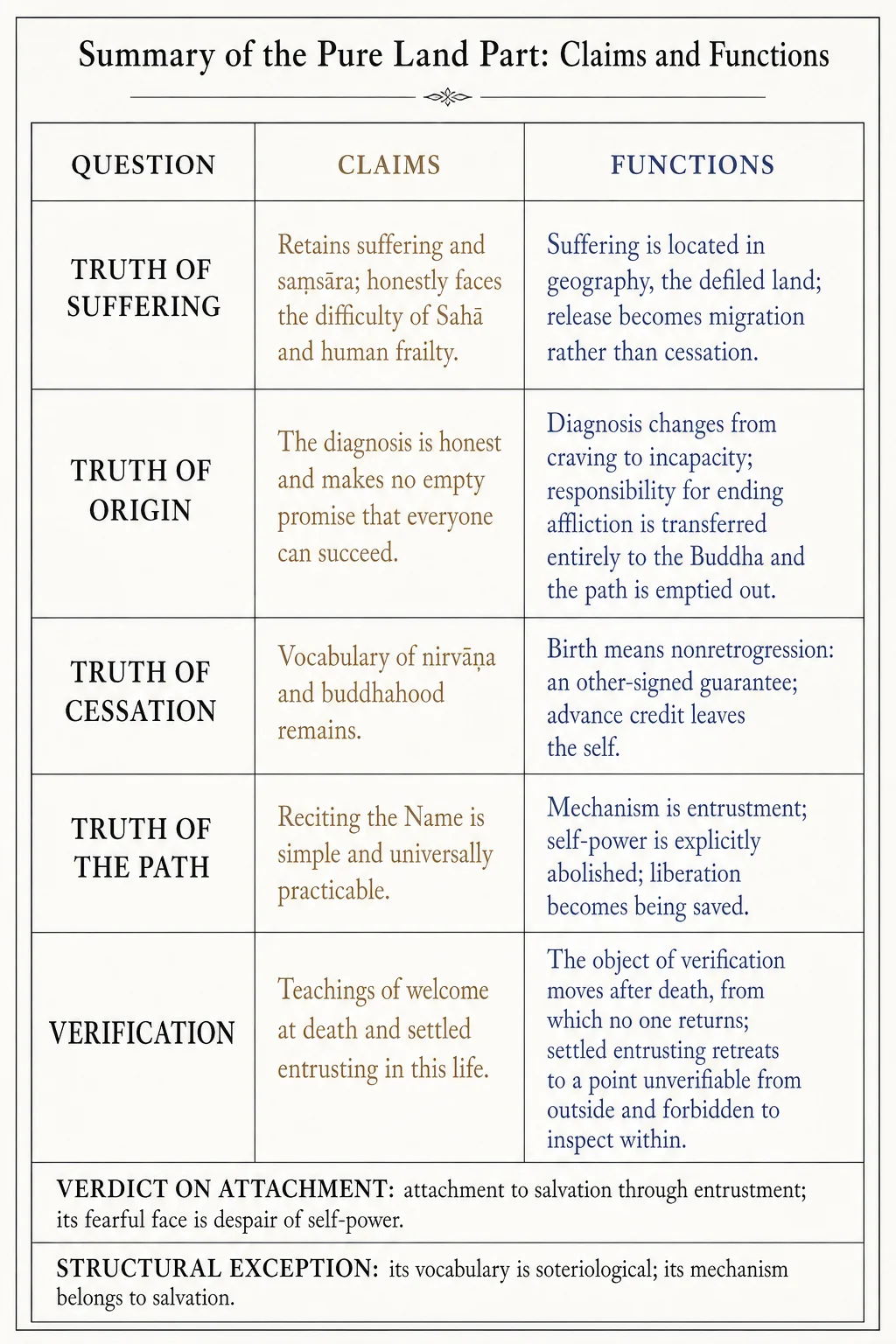
4. The trajectory through the five systems
Read across the five systems: self-power declines to zero, guarantee rises to fullness, and verification retreats beyond death. Pure Land sits at the endpoint of this trajectory and thereby exposes its character most clearly. These are not five parallel proposals for liberation but stages in relinquishing the “unguaranteed road of self-power.” Pure Land relinquishes it most thoroughly, and soteriology completes its transformation into a doctrine of salvation here. The full item-by-item comparative table is reserved for Part VII’s synthetic criticism, where the whole field can be viewed at once.
5. A balanced word and transition
Three points must be stated on Pure Land’s behalf, and each carries real weight. First, its diagnosis of self-conceit within self-power is one of the deepest religious insights among the five systems. It sees through the way self-powered cultivation produces the most concealed self-grasping and offers a radical solution—complete surrender. This insight resonates with doctrines of grace in other traditions2 and with the baseline’s caution against attachment to practice. Second, Pure Land is honest, and its honesty has humane depth. Unlike Vajrayāna’s promise that “everyone can attain buddhahood in this body,” it faces most people’s impotence under self-power and leaves a road for those at the end of all roads. This humaneness is not speculation from a quiet study but grows from disorder and suffering. Almost without exception, Pure Land masters turned toward the Pure Land after separation and death, grave illness and anxiety, war and famine. Tanluan fell seriously ill midway through his work, feared the impermanence of his life, and traveled to Tao Hongjing seeking ten fascicles of scriptures of the immortals to prolong it. On his return he met Bodhiruci, who told him that the Buddha’s teaching possessed a longevity far superior to the immortals. Tanluan burned the Daoist texts and entrusted himself to the Pure Land: only after facing his own mortality did he bow his head. Daochuo lived through the upheavals at the end of the Northern Dynasties and Emperor Wu of Northern Zhou’s persecution of Buddhism. For him the Final Dharma was not a theory but something witnessed. Hōnen and Shinran lived through the Genpei War, the Yōwa famine, and great earthquakes, when corpses filled the roads inside and outside the capital—conditions recorded by Kamo no Chōmei in the Hōjōki. Shinran lost his parents early and entered Mount Hiei at nine; in middle age he was exiled to Echigo during the Jōgen persecution and called himself Gutoku, “foolish and stubble-haired,” neither monk nor layperson. These were not philosophers reasoning at leisure. Within the extremity of their own lives and those of sentient beings, they sought a road for people equally without one. Historically, Pure Land consequently settled the lives of more ordinary believers than any other system—not the few elites able to retreat for ten years, but people with little literacy who labored throughout precarious lives. Pure Land doctrine has indeed traveled far from the original concern—the self-verifiable cessation of suffering in this life—but it carries the plainest compassion among the five systems: it cannot bear to leave the weakest and most powerless without any possible road in their hands.3 Volume I, Part X repeatedly encountered this point in its history; it is fully recorded here. Third, the present-life peace produced by nembutsu is real (the other register), and modern psychology now provides empirical support for the surrender mechanism, structurally equivalent to Alcoholics Anonymous and the Abrahamic religions (Part II, Chapter 3, section 4). These three statements coexist with the verdict. Measured against the baseline, Pure Land provides less content than any other system in the column “does the cessation of suffering occur in a verifiable way?” because it no longer answers that question. It answers another: how am I saved? The verdict does not say Pure Land is wrong; it says Pure Land has changed the question.
Transition. The five systems beneath the baseline have now all been examined. Madhyamaka uses intellectual seeing to abandon affliction; Yogācāra drills toward a foundation; tathāgatagarbha advances original awakening; Vajrayāna rehearses the resultant stage; Pure Land entrusts itself to other-power. A complete trajectory from “see through it by oneself” to “seek salvation from another” has five marked coordinates. What tendency do they share, does a unified pathology underlie those tendencies, and after all this, what form of soteriology remains credible? These general questions are reserved for the synthetic criticism in Part VII.
References
References
-
For the two kinds of deep faith concerning the being and the Dharma, see Shandao’s Commentary on the Contemplation Sūtra in Four Fascicles, “Meaning of Nonmeditative Good”: “First, decisively and deeply believe that I myself am now an evil ordinary being subject to birth-and-death, always sinking and wandering from distant eons until now, without the conditions for escape”—deep faith regarding the being; “Second, decisively and deeply believe that Amitābha Buddha’s forty-eight vows embrace sentient beings”—deep faith regarding the Dharma. See Part I, Chapters 1 and 2. ↩
-
Comparative theologians have long noted the structural equivalence between Pure Land (especially Japanese Jōdo Shinshū) and Protestant “justification by faith, grace alone.” Section 17 of Karl Barth’s Church Dogmatics, vol. I/2, “The Revelation of God as the Abolition of Religion,” discusses this point and calls Jōdo Shinshū (Hōnen, Shinran, and Amitābha’s other-power) the “most complete and thoroughgoing” parallel outside Christianity. Barth then argues that structural resemblance cannot determine truth and that grace alone (in his account, the name of Christ) distinguishes truth from falsehood. From the opposite direction, the argument corroborates this volume’s reading: structurally, Pure Land has indeed moved onto the side of salvation. ↩
-
On Tanluan (476–542), his illness during his work, acquisition of ten fascicles of “scriptures of the immortals” from Tao Hongjing, meeting Bodhiruci on his return, and burning the Daoist texts after receiving a Pure Land scripture, see his biography in fascicle 6 of the Continued Biographies of Eminent Monks. Daochuo (562–645) lived through Emperor Wu of Northern Zhou’s persecution of Buddhism in Jiande (574–577) and the late Northern Dynasties’ disorder. Hōnen (1133–1212) and Shinran (1173–1263) lived through the Genpei War (1180–1185), Yōwa famine (1181), and Genryaku earthquake (1185); for conditions in the capital, see Kamo no Chōmei’s Hōjōki. Shinran entered monastic life at nine, was exiled to Echigo in the Jōgen persecution (1207), and called himself “Gutoku Shinran, neither monk nor layperson.” For the masters’ lives and the rise of Pure Land amid disorder, see Volume I, Part X. ↩