Part II, Chapter 2: The Truths of Cessation and Path—The Guarantee of Other-Power
The truths of cessation and path are combined for a reason parallel to the preceding two parts: Pure Land itself erases the boundary. Birth in the Pure Land, cessation, is attained through nembutsu and other-power—the path. Cessation is the result of path, path the means of cessation; they are two ends of one thing. Their combination is the verdict.
1. The truth of cessation: a guarantee signed by another
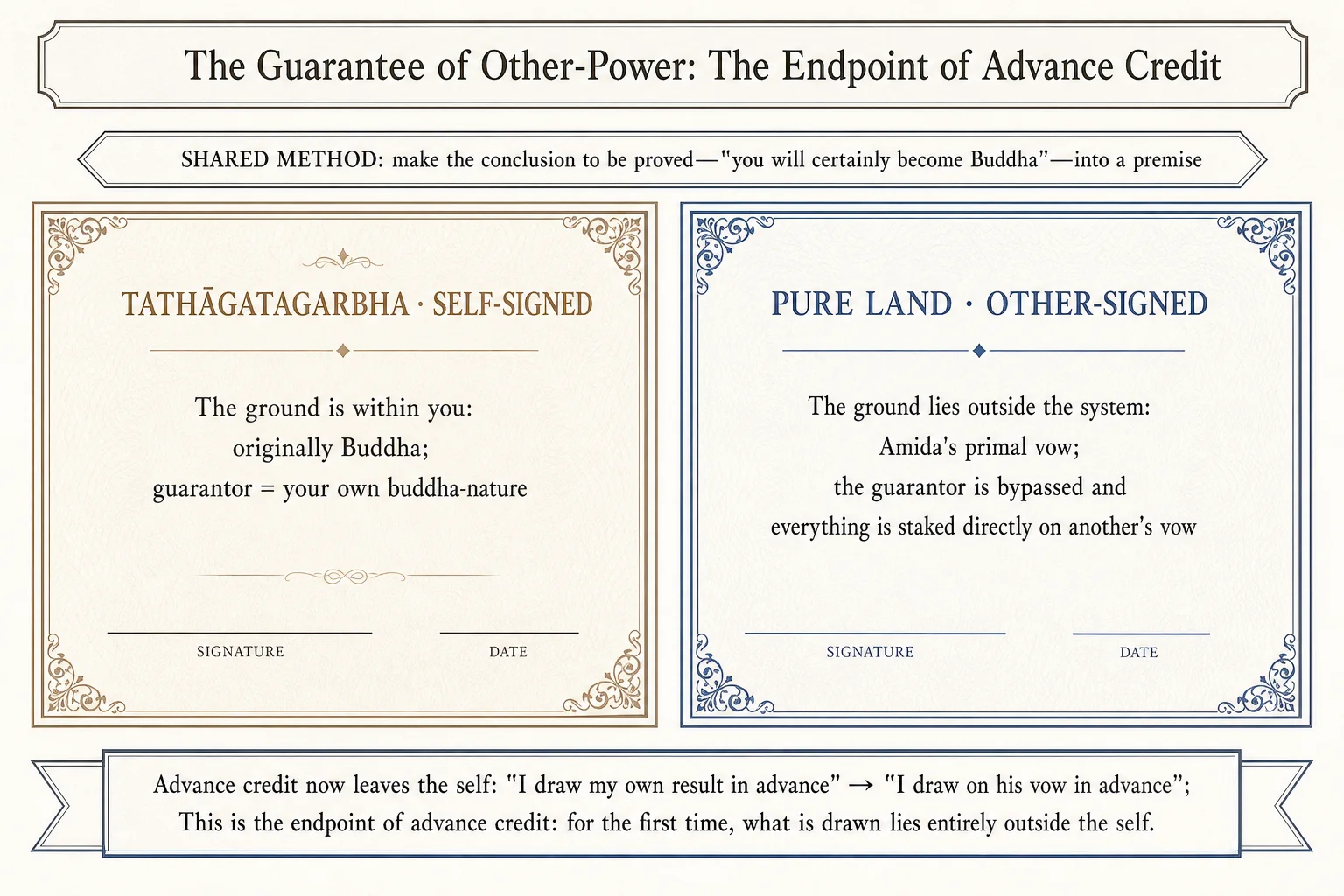
Pure Land’s cessation is birth in the Land of Bliss; birth immediately establishes nonretrogression, making buddhahood certain (Part I, Chapter 1). Placed within this volume’s audit, its shape is immediately familiar: this is a second version of tathāgatagarbha’s guarantee. Tathāgatagarbha makes a conclusion awaiting proof (one will attain buddhahood) into a premise in advance—one is originally a buddha. Pure Land does the same: it makes “you will attain buddhahood” into a premise—birth means nonretrogression. Only the issuer changes. Tathāgatagarbha’s guarantee is self-signed: its basis lies within oneself, originally a buddha and intrinsically pure. Pure Land’s guarantee is signed by another: its basis lies not in oneself but in the vow of a buddha outside the system; Amitābha’s Fundamental Vow guarantees one will not regress.
The difference appears to change only the guarantor, but in fact deepens advance payment once more and for the final time. Tathāgatagarbha advances the attributes of one’s own resultant stage (original awakening and intrinsic possession), and the collateral remains at least “your own buddha-nature.” Pure Land removes even that collateral. It relocates the entire basis of buddhahood outside the system and stakes it upon another’s vow. Advance payment now leaves the self. It is no longer “I withdraw my fruit early” but “I withdraw his vow early.” This is the endpoint of the line of advancement traced in this volume: for the first time, what is withdrawn lies completely outside oneself.
2. The truth of the path: entrusting and abolition of the self-power principle
The truth of the path accordingly becomes the simplest and most thorough among the five systems. It is not cultivation (Yogācāra’s conditioning), not confrontation (Madhyamaka’s dismantling of grasping), not disclosure (tathāgatagarbha’s removal of obstruction), and not rehearsal (Vajrayāna’s deity yoga). It is a fifth verb: entrust. I do not move toward the endpoint; I am taken away. Recollection of the Buddha is not work that “produces” the cause of birth. In the extreme form of Shin Buddhism, nembutsu does not even count as a cause but as grateful recitation by one already saved.
This step abolishes the hardest of the baseline’s four structural features: the principle of self-power—the route can be indicated, but the walking must be one’s own; no external power can substitute, as stated in Chapter 2 of the Introduction. However deeply they rewrite everything else, the first four systems retain this principle. Madhyamaka requires one to see, Yogācāra to condition, tathāgatagarbha to trust and disclose, and Vajrayāna to rehearse. Pure Land alone explicitly abolishes it. One is not responsible for walking; substitution is the whole mechanism. This brings the thought experiment at the end of Volume I into the open. If liberation consists in one stream of consciousness transforming through its own activity until craving ends (Volume I, 12.4), then “an external power transforms you” cannot in principle reach liberation; it can reach only salvation. A person placed by external power in a nonretrogressive land and one who has personally ended craving are not the same thing.
3. The internal slope toward radicalization
Pure Land contains an internal logic that pushes it toward the extreme. Once “self-power cannot be relied upon” becomes a premise, every residue of self-power appears incomplete, an implicit distrust of other-power and a new layer of self-conceit. The logic necessarily tends toward absolute other-power, eliminating self-power more thoroughly at every step. Hōnen cultivates nembutsu exclusively and abandons miscellaneous practices—yet retains the self-power in “I exclusively practice.” Shinran rules that entrusting too is Amitābha’s transference—removing the self-power in “I entrust.” The evil person as true object makes those with no self-power to rely upon the true objects of the Fundamental Vow—self-power becomes an obstruction and incapacity a qualification. Accomplishment of the cause in ordinary life brings birth forward to the moment entrusting is settled—abolishing the remaining space for “effort at death.” Every step down the slope is coherent because it simply relinquishes self-power more thoroughly. Its endpoint is a purely passive salvation in which no active share remains with the practitioner.
At the top of the slope lies a genuine and profound insight that deserves explicit credit: self-powered practice itself can produce the most concealed attachment to self. The more diligently one practices, the more stubbornly “I cultivate, I attain, I stand above those who do not practice” persists. Because it speaks in the name of “diligence,” it becomes still harder to notice—the same illness of self-grasping at the level of treatment examined in Madhyamaka Part II, Chapter 7. Completely relinquishing self-power genuinely can sever this layer of conceit. There is no “I practice” left for conceit to attach to. On this point, Pure Land’s religious insight is unsurpassed among the five systems. It accords with the baseline warning against decorating the self through practice and with doctrines of grace in other traditions.
The credit coexists with the verdict. Pure Land’s means of dismantling self-grasping is outsourcing the entire project of liberation to another, at the cost of surrendering three things at once: the principle of self-power, present-life verifiability, and the condition that “cessation must be produced through the transformation of this very stream” (Volume I, 12.4). It dismantles the conceit of self-power but does not abandon craving. It entrusts craving, together with the self that knows itself powerless, to another. Conceit really does release its grip, but not because the self is seen through; the whole self is handed to someone else to hold.
4. Summary
The truth of cessation is a guarantee signed by another, moving the basis of buddhahood outside oneself. The truth of the path is entrusting, abolishing the self-power principle and replacing liberation with being saved. Read together, Pure Land has the least laborious and most thorough mechanism among the five systems: least laborious because other-power carries everything, most thorough because it relinquishes soteriology’s last baseline—“transform oneself through oneself.” Only one question remains, and it is the sharpest: how can something occurring entirely on the side of other-power and redeemed after death be verified? The next chapter addresses it.
(The judgments concerning cessation and path in this chapter likewise synthesize sources already cited in the notes to Part I, Chapter 2—for recollection of the Buddha and other-power, the evil person as true object, accomplishment of the cause in ordinary life, and absolute other-power. For the principle of self-power, see Chapter 2 of the Introduction; for the thought experiment, Volume I, Part XII, Chapter 4. No separate notes are added here.)