Part I, Chapter 2: Internal Defenses—Two Paths, Two Gates, and the Final Dharma
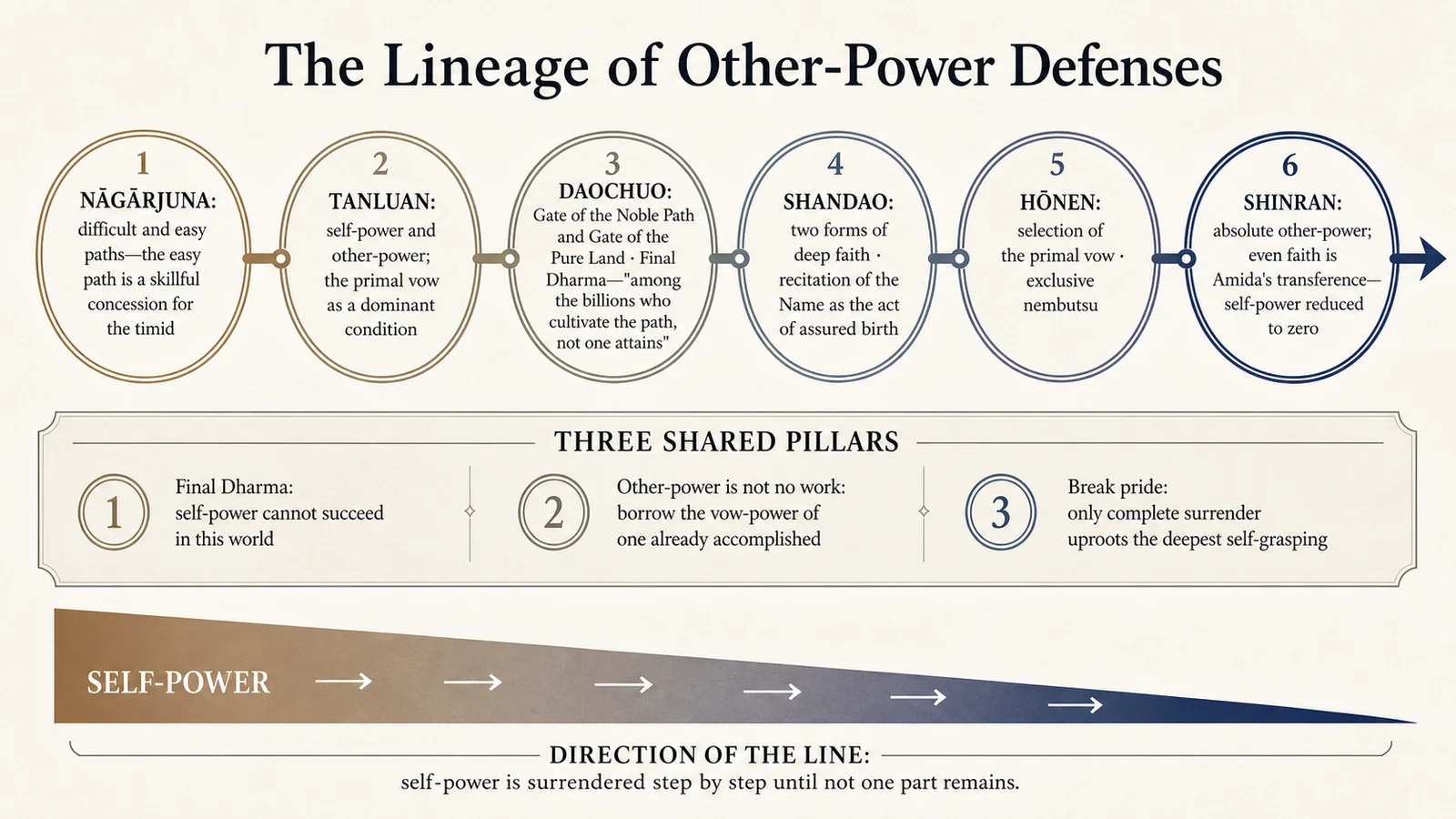
Pure Land requires a separate chapter for its own defense because from the beginning it bears one accusation: relying on other-power and seeking birth in a Pure Land is laziness and escape from practice. Nearly the whole history of Pure Land doctrine consists of layered replies to this charge. Following this volume’s method, the chapter presents the strongest defenses in full without weakening them in advance; their cost is left to Part II. The defenses vary widely, but they form a clear line of transmission.
The difficult path and easy path—Nāgārjuna
The source lies with Nāgārjuna, but the source itself contains a complication disputed repeatedly in later tradition. The “Chapter on Easy Practice” in the Daśabhūmika-vibhāṣā indeed distinguishes a difficult path from an easy path. The difficult path resembles traveling on foot over land and is arduous; the easy path resembles traveling by boat over water and is pleasant.1 Yet the context of the original must be stated accurately. The chapter begins with a question that Nāgārjuna rebukes directly. Someone asks: if the bodhisattva path requires difficult practices through eons before nonretrogression, can there be a swift and expedient easy path? Nāgārjuna first condemns the question as “feeble, cowardly, without great resolve, and not the words of one with the spirit of a mature person.” Only then does he say that the Buddha’s Dharma contains innumerable gates, some difficult and some easy, and point out an easy route for people of this capacity. In Nāgārjuna, then, the easy path is an expedient concession to the timid, not a main gate honored equally with the difficult path. Moreover, his easy practice consists in reverently reciting the names of many buddhas in the ten directions to seek nonretrogression (Amitābha is only one specially mentioned among them), and aims at nonretrogression on the bodhisattva stages, not birth in a Pure Land followed by buddhahood. Beginning with Tanluan, later Pure Land rereads the passage in two steps: it raises the concession for the timid into a principal gate for an entire age of teaching; narrows recitation of many buddhas to exclusive recitation of Amitābha; and connects “nonretrogression” to “birth in the Land of Bliss and buddhahood there.” Each step has grounds, but each also moves beyond Nāgārjuna’s text. The judgment “Pure Land quotes Nāgārjuna out of context” refers precisely to this. Which side is correct is a case in interpretive history that this volume does not decide. It simply makes the foundation clear: one of Pure Land’s oldest foundation stones is itself a citation requiring reinterpretation before it can stand securely.
Self-power, other-power, and the Fundamental Vow—Tanluan
Tanluan’s Commentary on the Treatise on Birth is the first systematic Chinese Pure Land treatise and the first to use the term “other-power” explicitly in a Pure Land context. It connects the difficult and easy paths to self-power and other-power and establishes Amitābha’s Fundamental Vow as the “dominant condition” for birth. An ordinary being is born not through personally accumulated merit but because Amitābha’s already accomplished vow-power serves as the dominant condition.2 A succession of Tanluan’s similes expresses completely why “other-power does not mean no effort.” It resembles crossing water in a boat: the power lies not in oneself but in the vessel. It resembles one spark consuming firewood accumulated by a hundred people over a hundred years: Fundamental Vow-power can suddenly extinguish karma accumulated through many eons. It resembles light entering a dark room: however long darkness has accumulated, the room brightens as soon as light arrives. Other-power is not something for nothing; it borrows power already prepared by one who has completed the road.
The Gate of the Sacred Path, the Gate of the Pure Land, and the Final Dharma—Daochuo
Daochuo’s Collection on the Land of Peace and Bliss advances the structure one step. It classifies the Buddha’s teaching into two gates. Through the Gate of the Sacred Path, one relies on self-power to practice, eradicate, and attain nobility. Through the Gate of the Pure Land, one relies on other-power, obtains birth, and completes the path. He supplies a historical reason: the Final Dharma. After the periods of the True and Semblance Dharma comes the age of the Final Dharma, when beings have dull capacities and heavy obstructions and the Sacred Path is difficult to enter. He states directly that during the Final Dharma, among hundreds of millions who undertake practice, not one attains; only the Gate of the Pure Land remains passable.3 Seeking other-power is therefore no longer a retreat for the constitutionally timid but the only suitable gate for an entire age. Pure Land is not inferior; the time has come when the Sacred Path is impassable.
Two kinds of deep faith and recitation of the Name in accord with the Fundamental Vow—Shandao
Shandao tightens the mechanism. On one side, he establishes “two kinds of deep faith”: deeply trust that one is an evil ordinary being without conditions for escape—the being; deeply trust that Amitābha’s vow-power certainly saves this ordinary being—the Dharma. The two are one. Without the first, urgency is lost; without the second, refuge is lost (Part I, Chapter 1). On the other, he narrows the direct cause of birth to recitation of the Name. Among practices directed toward birth, reciting Amitābha’s name is the “act of certain settlement” conforming to that buddha’s Fundamental Vow; other acts are auxiliary.4 Visualization is difficult while recitation is easy, so the Pure Land gate opens to anyone who is illiterate or lacks leisure for concentration. From this point, “recollection of the Buddha” takes its definitive form as vocal recitation of the Name.
Selection of the Fundamental Vow and absolute other-power—Hōnen and Shinran
The Japanese line carries this development to its endpoint. Hōnen’s Collection on the Selection of the Nembutsu in the Fundamental Vow establishes “selection”: among all practices, Amitābha selected recitation of the Name alone as the practice of the Fundamental Vow; practitioners should therefore abandon miscellaneous practices and cultivate nembutsu exclusively.5 Shinran goes further toward absolute other-power. Even the entrusting upon which birth depends does not arise from self-power but is directed to sentient beings by Amitābha—other-power transference. Nothing in the practitioner counts as personal achievement. This produces two famous propositions. First, “the evil person is the true object”: “Even a good person attains birth; how much more an evil person.” Good people rely on their own ability, so self-power mixes with their entrusting. Evil people know they possess no power to rely upon and can only entrust themselves wholly; they therefore accord more purely with the object of the Fundamental Vow.6 Second, the karmic cause is accomplished in ordinary life. One need not wait for Amitābha’s welcome at death; at the moment entrusting is settled, birth is settled. At this point, self-power has been cleaned away entirely.
The shared framework of the defenses
Extracted from their variety, these defenses share one framework supported by three pillars. First, the Final Dharma: self-power is objectively impossible in this age, so seeking other-power is not negligence but recognition of historical conditions. Second, other-power does not mean no effort: birth relies upon vow-power prepared by one already accomplished; borrowing power is not doing nothing, just as a passenger must still board the boat. Third, the dismantling of self-conceit: self-powered practice itself conceals the deepest attachment to self—“I practice; I attain.” Only complete relinquishment can abandon this layer of conceit as well. The last defense is the deepest, and Part II responds positively to it. All three pillars presuppose one thing: the road of self-power is blocked. Once that premise is accepted, everything else in Pure Land follows.
Challenges from outside the school: whom do these defenses answer?
The layered defenses above were not erected from nothing. Every level blocks a specific charge. Only when the main charges are stated can the points at which the defenses exert force be seen clearly.
First, easy practice is cowardice. This challenge comes directly from Nāgārjuna’s text. Nāgārjuna himself first calls the search for easy practice “feeble and cowardly,” as noted at the beginning of the chapter. Does raising the easy path into the principal gate therefore pass off an expedient provided for the weak as the ultimate right path? Proponents of the Sacred Path use this to deride Pure Land as an inferior vehicle and an excuse for those unwilling to strive. Pure Land’s doctrines of the Final Dharma and three capacities answer directly: the practitioner is not timid; the age makes the difficult path objectively impassable.
Second, an intention referring to another time. This was historically the fiercest challenge and came from the Mahāyānasaṃgraha school of Yogācāra. The Mahāyānasaṃgraha lists four “intentions” within the Buddha’s speech. One is an “intention referring to another time”: the Buddha sometimes describes a remote fruit as though it were immediately attainable in order to encourage the indolent to begin. Mahāyānasaṃgraha masters therefore classified the Larger Sukhāvatīvyūha’s “ten recollections immediately produce birth” as an intention referring to another time. Recollection of the Buddha is only a remote cause of birth, while the scripture calls it immediate as expedient encouragement and should not be read as literal redemption. This judgment nearly cut off Pure Land’s prospects in China. If birth is only an intention referring to another time, reciting in this life does not immediately constitute its cause. In his Commentary on the Contemplation Sūtra in Four Fascicles, Shandao directly reverses the judgment. The ten recollections in the scripture are ten complete with faith and aspiration and constitute a true karmic cause accordant with the Fundamental Vow; birth is planted in the very thought and its recompense is not false, so the teaching does not fall under another time.7 Much of Pure Land’s “recitation as the act of certain settlement” and “the karmic cause accomplished in ordinary life” is directed against this challenge. One additional observation: the “other time” targeted by this criticism reappears in another form in Part II, Chapter 3. Birth is indeed moved to another time—after death. This volume’s question is not how long cause and result are separated but that no one can return from that time to check.
Third, evil presents no obstacle. This challenge targets the evil person as the true object: if evil people are precisely those embraced by the Fundamental Vow, does evil no longer obstruct birth, and does increasing evil even increase one’s correspondence with the vow? In Japan the weakness became a popular abuse: committing evil wantonly while presuming upon the Fundamental Vow. Shinran himself repeatedly blocks it in the Tannishō: one should not seek poison merely because one possesses an antidote; entrusting in the Fundamental Vow does not confer a license to do evil.8 This challenge reveals other-power’s ethical vulnerability most clearly. Part II does not develop it separately; its presence is recorded here.
Clarity is required: the criticism in Part II of this volume is not the same as these internal and external challenges. The Sacred Path’s charge that Pure Land is inferior competes for rank from the standpoint of self-power. The Mahāyānasaṃgraha school’s “intention referring to another time” judges truth within a Yogācāra framework of causation. This volume stands upon the early Buddhist baseline and asks one question: as a method for ending suffering, how much testable content remains in Pure Land? The three challenges each occupy a position; this volume’s criterion is a fourth. They are placed side by side so readers can see that Pure Land’s varied defenses form a system argued into watertight coherence while under attack from every direction. This volume does not ask whether it is internally coherent but what it has coherently substituted for soteriology. Part II begins there: when self-power is relinquished, what exactly is relinquished?
References
References
-
For the division between difficult and easy paths and the similes of land and water travel, see the “Chapter on Easy Practice,” fascicle 5 of Kumārajīva’s translation of the Daśabhūmika-vibhāṣā attributed to Nāgārjuna (T no. 1521). Nāgārjuna’s rebuke (“feeble, cowardly, without great resolve, and not the words of one with the spirit of a mature person”) appears in the same chapter. The easy practice consists in reverently reciting the names of many buddhas in the ten directions to seek avaivartika, nonretrogression; Amitābha is one specially mentioned buddha among them. Scholars question Nāgārjuna’s authorship because no Sanskrit text survives and the work was not transmitted in Tibet; Lindtner, Yinshun, and others nevertheless argue that the attribution is credible. Pure Land’s elevation and Amitābha-centered narrowing of the chapter, and the judgment that it “quotes out of context,” belong to Pure Land interpretive history; see Volume I, Part X. ↩
-
In fascicle 2 of Tanluan’s Commentary on the Treatise and Verses on Aspiration for Birth in the Sukhāvatīvyūha (the Commentary on the Treatise on Birth, T no. 1819), self-power and other-power are applied to the two paths and the Fundamental Vow made the dominant condition. The similes of the boat, fire consuming wood, and light entering a dark room appear in the same fascicle. This is the first Pure Land use of the term other-power. For an overview including Roger Corless and recent scholarship, see Volume I, Part X. ↩
-
For the classification into the Gate of the Sacred Path and Gate of the Pure Land and for Pure Land as the sole gate passable in the Final Dharma, see fascicle 1 of Daochuo’s Collection on the Land of Peace and Bliss. “Among hundreds of millions of sentient beings who undertake practice, not one attains” is a representative formulation of his view of the Final Dharma, with slight textual variations. ↩
-
For the two kinds of deep faith, see Shandao’s Commentary on the Contemplation Sūtra in Four Fascicles, “Meaning of Nonmeditative Good,” cited in the note to Part I, Chapter 1. Recitation of the Name as the “act of certain settlement” and other practices as auxiliary acts occur in the same work, fascicle 4: “一心專念彌陀名號,行住坐臥不問時節久近念念不捨者,是名正定之業,順彼佛願故。若依禮誦等,即名為助業”. His Liturgy for Birth urges exclusive recitation without using this pair of terms, and is therefore not cited here. ↩
-
Hōnen’s Collection on the Selection of the Nembutsu in the Fundamental Vow establishes selection of the Fundamental Vow, exclusive cultivation of nembutsu, and abandonment of miscellaneous practices. Hōnen already contains the beginning of the teaching that evil persons attain birth; scholarship contains dedicated studies of the genealogy of akunin shōki, the evil person as true object. ↩
-
For absolute other-power, entrusting as Amitābha’s transference (other-power transference), and the karmic cause accomplished in ordinary life, see the chapters on entrusting and practice in Shinran’s The True Teaching, Practice, and Realization of the Pure Land Way—the Kyōgyōshinshō. “Even a good person attains birth; how much more an evil person,” appears in article 3 of the Tannishō, compiled by Yuien. ↩
-
Kālāntara-abhiprāya, “intention referring to another time,” is one of four intentions in Asaṅga’s Mahāyānasaṃgraha, preserved in translations by Paramārtha and Xuanzang. Mahāyānasaṃgraha masters used it to classify “recollection of the Buddha immediately produces birth” as an intention referring to another time—recollection is a remote cause of birth, while the scripture speaks this way as encouragement. Shandao’s “Reconciliation of the Intention Referring to Another Time” in the “Profound Meaning” section of the Commentary on the Contemplation Sūtra in Four Fascicles argues that the ten recollections are complete with faith and aspiration and form the direct cause conforming to the Fundamental Vow, so their recompense in birth is not false. This dispute was decisive for establishing Pure Land teaching in the Sui and Tang. ↩
-
The abuse of the “evil person as true object” is called hongan-bokori in Japan—committing evil wantonly while presuming upon the Fundamental Vow. For Shinran’s rejection, see article 13 of the Tannishō, compiled by Yuien. ↩