Part II, Chapter 4: Determining Attachment and Concluding Audit—Attachment to the Result
Following the compressed format, the diagnosis of attachment and concluding audit are combined in one chapter. The preface gives one-line verdicts for the first three systems and promises only to judge Vajrayāna and Pure Land by the same criterion. This chapter supplies Vajrayāna’s sentence: attachment to the result.
1. The object of attachment and its side of fear
Identify the object first. Vajrayāna writes what it grasps into its name: it calls itself the resultant vehicle and its method taking the fruit as the path. It does not grasp understanding (the intellectual attachment of Madhyamaka and Yogācāra), and not merely a written guarantee—tathāgatagarbha’s attachment to certainty, satisfied by the declaration “originally a buddha.” It wants the result itself: to hold and use the completed stage of buddhahood now. Speed is only the surface of this attachment. Precisely because it wants the result, it cannot tolerate delay, and “buddhahood in this very body” becomes its slogan. Mistaking speed for the object obscures the deeper grasping beneath it. The wish is not merely to arrive sooner, but a refusal to leave the fruit at the road’s end; it must be brought into one’s hands.
The side of fear then becomes clear, and Mahāyāna itself produces it: fear of the schedule. The bodhisattva path makes buddhahood the sole ultimate goal and fixes its duration at three incalculable eons. The prescription “repeat for a long time” in Yogācāra’s latter half writes this duration explicitly (Yogācāra Part II, Chapter 5). For someone who genuinely believes it, this is not magnificence but despair. The only result worth desiring has been moved incalculable eons away, and no visible mark of progress can be crossed in this life. There is an irony worth pausing over. The baseline already promises realization in the present life. At the end of the Satipaṭṭhāna Sutta, the fruit of nobility is expected within seven years or even seven days; arahantship is the work of this life. Mahāyāna creates the schedule of three incalculable eons by replacing cessation with buddhahood as the endpoint. Vajrayāna’s buddhahood in this very body goes full circle and takes back the schedule “accomplishable in this life.” But the goal has changed from cessation to buddhahood, so the same schedule now requires vastly heavier engineering. What drives that engineering is impatience to possess the result. The fear is genuine and the response well targeted. This remains honest religious work and must be credited first. The verdict asks only the cost.
Once this verdict is stated, at least three internal defenses arrive and must be considered one by one. None succeeds. The first is the most powerful: seeking swift accomplishment is compelled by great compassion, not selfish attachment. Sentient beings suffering cannot wait three incalculable eons; moreover, buddhahood in this body is permitted only under the governance of bodhicitta—the exoteric-esoteric lock of Part I, Chapter 1. If the motivation is compassion, how can it be attachment? This defense misses its target, because “attachment” in this volume never means selfishness. The object grasped is not “I must attain buddhahood first” but the structure “take the fruit into one’s hands and operate it now.” An advance driven entirely by great compassion remains an advance. Motive, compassionate or selfish, does not alter the fruit’s early withdrawal. The second defense: speed comes from superior method and differences of capacity, not impatience. The Lamp for the Three Modes names four excellences of the Mantra Vehicle—unmistaken view, many methods, no austerities, and suitability for the sharp, as cited in the note to Part II, Chapter 3. But “many methods” and “sharp capacity” are self-stipulated claims of efficiency—the system stipulates the coefficient, as Part II, Chapter 2 observed. They restate “this road is fast” without proving the fast road leads to cessation of suffering. The third defense is the most subtle. Kūkai distinguishes three meanings of buddhahood in this very body: possessing it in principle, empowerment, and manifest attainment. “This very body” first means manifestation of an inherently present buddha, possession in principle, not seizing a fruit from nowhere. At the ultimate level, moreover, there is neither one who attains nor anything attained, so the accusation “seizing the result” presupposes the subject-object duality the system denies.1 Yet the distinction between possession in principle and manifest attainment is exactly what this volume calls the levels of claims and functions, now named by the tradition itself. “Buddha in principle” is advance payment—the claim; “manifest attainment of buddhahood” requires long engineering—the function. The distinction does not dissolve the paradox; it is the paradox’s internal doctrinal name. As for nonattainment, the blade cuts Vajrayāna itself. If there truly is nothing to attain, the complete rehearsal of taking the fruit as the path has no fruit to operate, and Vajrayāna above all refuses to stop at nonattainment: it insists upon bringing the fruit into daily performance. The first defense misidentifies the referent of attachment; the other two return separately to verdicts already reached in this volume.
2. The mechanism word: rehearsal
The four mechanism words are now complete: recursion for Madhyamaka, iteration for Yogācāra, advance payment for tathāgatagarbha, and rehearsal for Vajrayāna. The first three exert themselves toward understanding or certainty; rehearsal exerts itself toward possession. It no longer argues the endpoint, explains it, or declares it. It takes the endpoint and performs it now. In one parallel sentence: Madhyamaka argues the result into place; Yogācāra explains it into place; tathāgatagarbha declares it already in place; Vajrayāna rehearses it into place. All four hold the endpoint in mind, but their relation to it differs. The first three seek to understand it, establish it, or receive its guarantee. Vajrayāna wants to operate it. Under the definition given in the tathāgatagarbha part, the object of advance payment is a status that only verification is authorized to confer. Rehearsal embodies that advance: the conferred status is no longer merely the content of a belief but a role performed every day. Tathāgatagarbha stops after obtaining the written guarantee. Vajrayāna refuses to stop there. It converts the guarantee into daily operations, turning “originally a buddha” from a belief into a set of actions.
The distinctive risk of rehearsal now appears. An argument can be refuted, an explanation compared, and a declaration questioned. Rehearsal has something the first three lack: psychological felt reality. For someone who lives daily through a buddha’s body, speech, and mind, “I am approaching” is no longer a belief but a felt experience. Felt reality is rehearsal’s product, not evidence of its result; the system nevertheless registers felt experience as signs of attainment—bliss, luminosity, and warmth. Rehearsal therefore carries attachment one step beyond advance payment. Advance payment purchases certainty, which disappointment can still shake. Rehearsal purchases a sense of presence, renewed daily by practice itself. Combined with the promise of this very body, the circuit closes: more practice produces more feeling, more feeling produces more belief, and more belief produces more practice. The more smoothly this circuit turns, the farther it moves from the system-external question “has suffering ceased?” The two do not logically intersect.
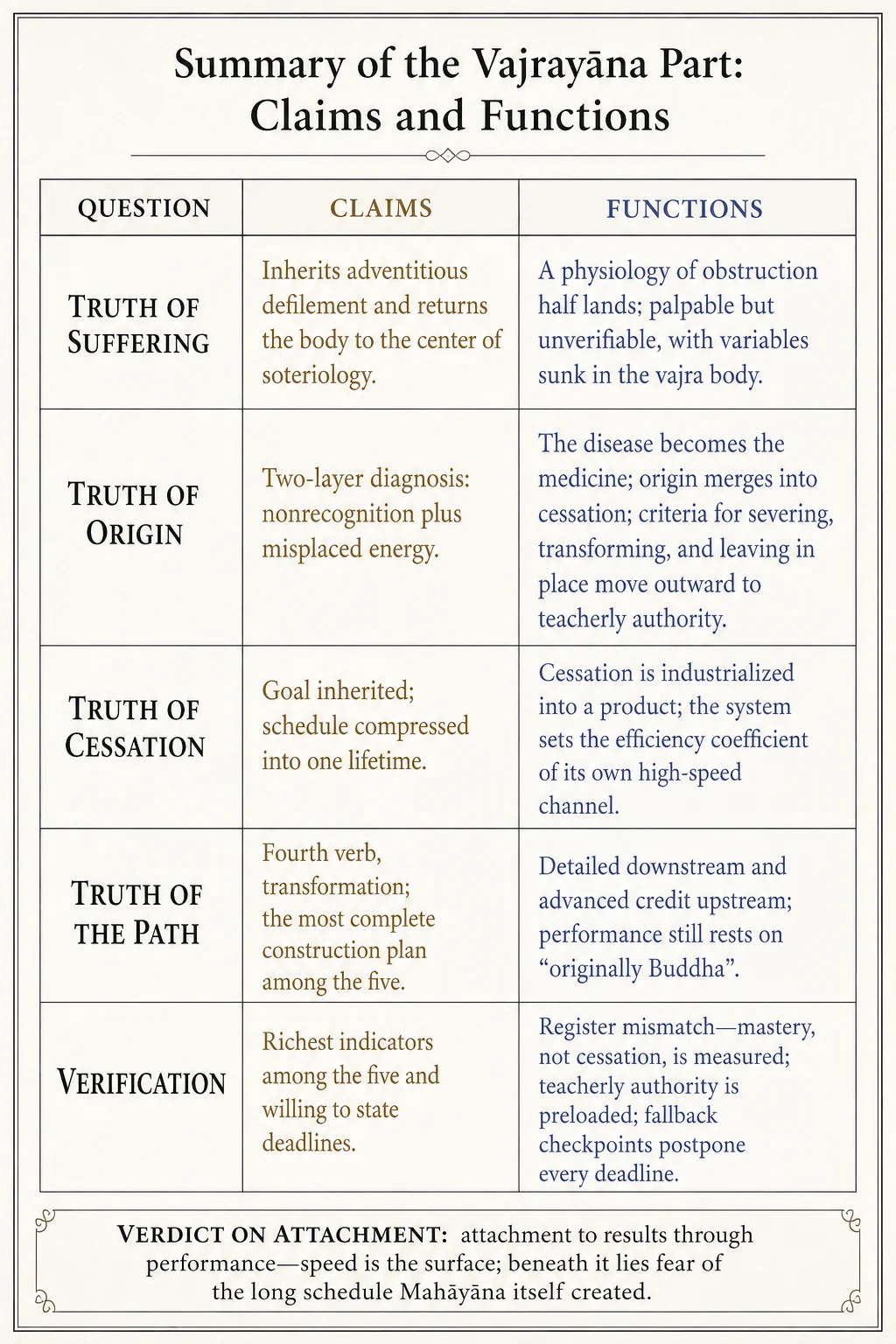
3. Concluding audit: verdicts on the five questions
Gather the verdicts in the established format—level of claims and level of functions. Arguments appear in the indicated chapters.
The truth of suffering: at the level of claims, it inherits the grammar of adventitious stains and returns the body to the center of soteriology—an achievement to be credited. At the level of function, obstruction’s physiology is half a step grounded: it offers feel but no check, while its variables sink into the vajra body (Part II, Chapter 1).
The truth of origin: at the level of claims, a two-level diagnosis combines nonrecognition with misplaced energy. At the level of function, treating the lesion as medicinal material merges the truth of origin into cessation, while the criterion separating abandonment, transformation, and allowing is exported to teacherly authority (Part II, Chapter 1).
The truth of cessation: at the level of claims, the goal follows the old specification and the schedule is compressed into this very body. At the level of function, cessation is industrialized as a product; the system stipulates the high-efficiency channel’s coefficient, which nothing external can calibrate (Part II, Chapter 2).
The truth of the path: at the level of claims, transformation is the fourth verb and supplies the most complete construction plan among the five systems—an achievement to be credited. At the level of function, downstream is intricate while upstream rests upon advance payment; rehearsal’s load remains “originally a buddha.” Deity pride is the most compressed specimen of separation between claims and functions (Part II, Chapter 2).
Verification: at the level of claims, it has the richest indicators and dares to write a deadline—achievements to be credited. At the level of function, the registers misalign—technical mastery is measured, not cessation—teacherly authority is positioned in advance and enters the causal mechanism, and fallback gates ensure that the deadline never arrives (Part II, Chapter 3).
Attachment: attachment to the result, operating through rehearsal. Speed, this very body, is its temporal expression, and its side of fear is Mahāyāna’s self-created fear of the schedule (this chapter).
4. The four systems side by side
| Madhyamaka | Yogācāra | Tathāgatagarbha | Vajrayāna | |
|---|---|---|---|---|
| Shape of the road | One step: seeing emptiness is liberation | Two steps: path of seeing plus two incalculable eons of conditioning | Zero steps: originally a buddha | Construction atop zero steps: heavy engineering within this body |
| Location of suffering | Moved into views | Moved into the storehouse | Moved into the guest position | Remains guest; adventitious stains receive a physiology |
| Diagnosis | Wrong level | Correct level but too deep | Self-canceling | Engineered: the lesion is medicinal material |
| Mechanism | Deficient—no construction plan | Excessive—the plan cannot be checked | Vacant—only the completed drawing | Complete but suspended—the plan is whole, its support an advance |
| Verification | Criterion drifts | Hollowed out; authority belongs to scholastic lineage | Canceled; authority belongs to the certifier | Outer form reconstructed; authority positioned in the teacher beforehand |
| Object of attachment | Intellect—argument itself | Foundation—the ultimate basis | Eternity and guarantee | Result—the resultant stage itself |
| Mechanism of attachment | Recursion | Iteration | Advance payment | Rehearsal |
Read the four columns together. The monotonic line of the first three continues: advance payment grows heavier, and Vajrayāna’s daily operation likewise begins from an advance. The publicity of verification grows thinner, moving from a debating hall observable by all to a point where doubt itself is an offense. But the fourth column differs in kind. The first three are theories; the fourth is a technical institution. It does not debate them but uses them as components. Tathāgatagarbha’s conclusion supplies its raw material, Yogācāra’s path structure its organizational method, and Madhyamaka’s view of emptiness its safety protocol. The three theoretical routes converge into a closed operational system. The problem of testing is not answered but institutionally exempted: every link has an operation, every operation an explanation, and every explanation’s load-bearing point remains within the system. This is the full meaning of “strongest form.” Its strength lies in depending nowhere upon the outside—and precisely for that reason, nowhere accepting the outside.
5. A balanced word and transition
Three points must be stated on Vajrayāna’s behalf. First, it alone among the five systems takes “method” seriously to the end. It believes liberation is a teachable craft and builds Mahāyāna’s most complete pedagogical engineering upon that belief. The engineering contains extensive genuine psychological and bodily technologies (training of attention and imagery, coordination between breath and emotion, and staged rehearsal of dying), whose value does not depend on their metaphysical packaging. Second, its awareness of risk is highest among the five systems, as Part I, Chapter 1 recorded with the exact scope and limits of the credit. It observes and records accidents on its own road (wrong turns, demonic states, and student selection), and does not tell the particular lie “this teaching is absolutely safe.” Third, it directly answers the despair created when Mahāyāna moves the only result infinitely far away. Within its world, practitioners’ daily lives are also the fullest: a road filled with engineering is not easily experienced as empty. These statements coexist with the verdict. The verdict does not say that Vajrayāna lacks content but that its content cannot demonstrate to anyone outside the system that it relates to the cessation of suffering.
Transition. Vajrayāna carries self-powered engineering to its maximum: every phenomenon can become equipment, the body is a site of awakening, affliction is fuel, and the guru is the channel. At the limit of self-power, Mahāyāna soteriology has only one direction left: hand the entire project away. Pure Land grasps the same result but takes the opposite route—not personal rehearsal but entrusting, not accomplishment in this body but acquisition through rebirth, as the mechanism withdraws from one’s body into a buddha’s vow-power. Attachment to the result remains; the route by which it enters one’s hands changes. After maximal self-power comes maximal other-power, two prescriptions for the same despair. Part VI, the final system, examines this handing over.
References
(The chapter’s other verdicts are based on the chapters and notes of Part I and Part II of this Vajrayāna part and are not separately annotated. For the promised time in the Satipaṭṭhāna Sutta, see the conclusion of MN 10 and the discussion in Chapter 2 of the Introduction.)
References
-
Kūkai, The Meaning of Attaining Buddhahood in This Very Body. Later Shingon doctrinal analysis distinguishes three meanings: buddhahood through possession in principle—sentient beings inherently possess a buddha’s three mysteries and are buddhas at the level of principle; buddhahood through empowerment—the correspondence and mutual empowerment of the three mysteries yields direct realization; and buddhahood through manifest attainment—the complete qualities of the fruit become manifest. See the Stanford Encyclopedia of Philosophy, “Kūkai” (2023). ↩