Part II, Chapter 2: The Truths of Cessation and Path—Taking the Fruit as the Path
The truths of cessation and path are combined here for a reason structurally parallel to that of the preceding chapter: Vajrayāna itself erases the boundary. The resultant vehicle is “resultant” because the path consists in rehearsing the fruit. Cessation and path are not two truths here but the noun and verb forms of one thing. Their combination is the verdict.
1. The truth of cessation: a new schedule and new technology
Vajrayāna inherits the goal of cessation and changes two things. First, the schedule: three incalculable eons are compressed into one lifetime.1 Second, the process sheet: the three bodies receive a manufacturing process for the first time. The subtlest wind and mind produce an illusory body and establish the cause of the enjoyment body; clear light realizes the dharma-body; their union accomplishes buddhahood. The preceding three parts observed three fates for cessation. Madhyamaka deobjectifies and then reobjectifies it. Yogācāra preserves its vocabulary while changing its content. Tathāgatagarbha advances it as a premise. Vajrayāna supplies a fourth: it industrializes cessation. Cessation is no longer a state (the baseline) or a fact (tathāgatagarbha), but a product, with raw material (wind and mind), a process (stages), a delivery date (this body), and quality control (signs of attainment). Criticism falls at two points. First, both raw material and product lie beneath the observable line—the vajra body, as discussed in the preceding chapter. All the industrialization’s concreteness is concreteness inside the plan. Second, compressing the schedule depends upon declaring a causal channel more efficient by orders of magnitude—wisdom arising from entry into the central channel vastly surpasses provisions accumulated over incalculable eons. The system itself stipulates this channel’s coefficient of efficiency; nothing external can calibrate it. Why does one session of deity yoga equal eons of generosity and ethical conduct? The answer exists only in the tantras’ own promise. The schedule changes, while the party making the change retains sole possession of its basis.
2. The truth of the path: the fourth verb and its load-bearing point
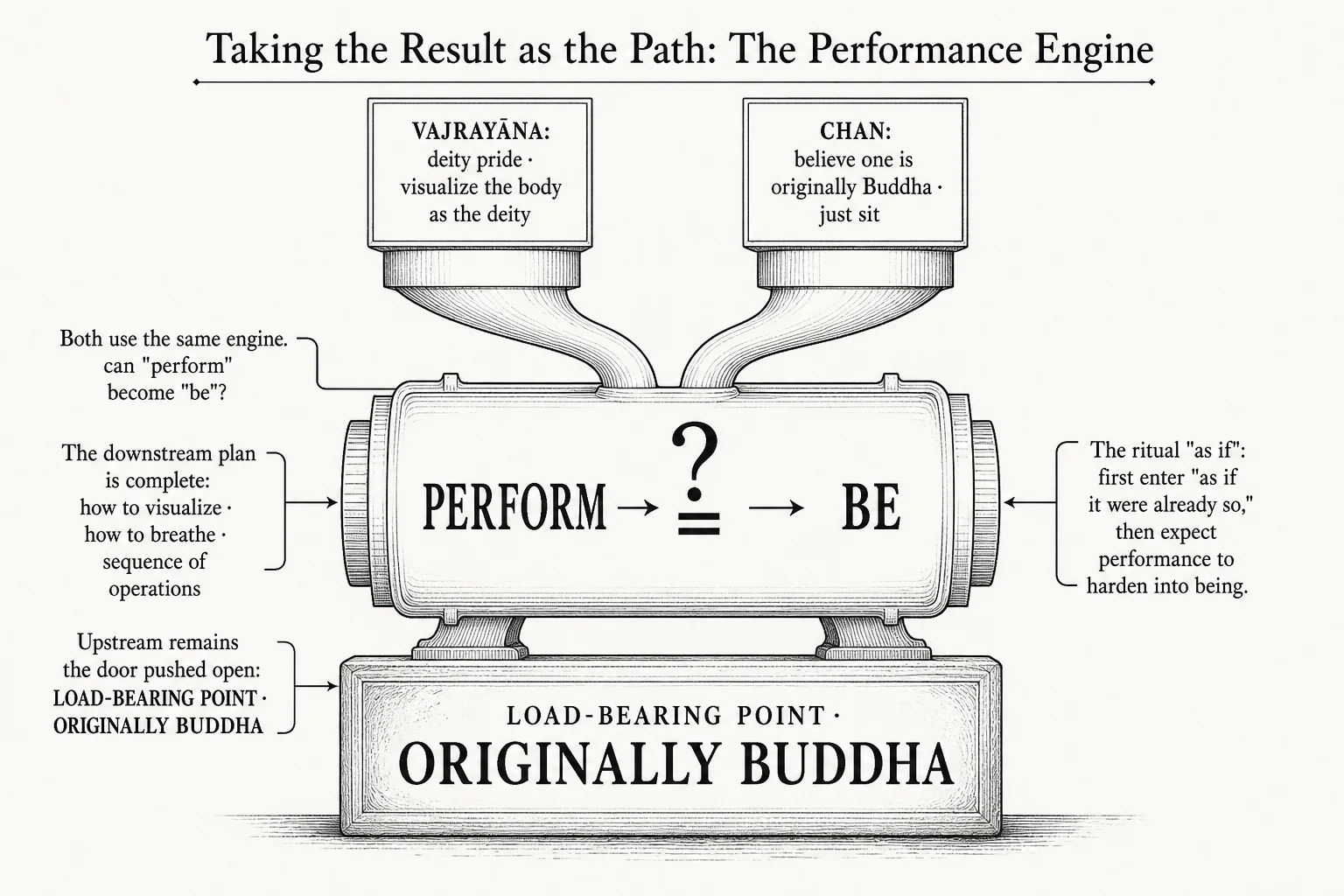
Transformation. The famous sentence of the Hevajra Tantra is this verb’s banner: “The world is bound by passion; by passion too it is released.”2 It presupposes that the energy of affliction and the energy of awakening share a source (the five poisons and five wisdoms), and operationalizes this through rehearsal. Deity yoga makes the resultant body, speech, and mind into daily practice; deity pride prescribes “I am the deity” as contemplative content. Looking back at the preceding systems’ verbs, each leaves a vacancy. Confrontation has no construction plan; cultivation is demoted to foundation—Yogācāra Part II, Chapter 4: cultivation is the foundation, confrontation the engine; disclosure has no operation. Transformation plus rehearsal appears to supply everything: object, procedure, daily curriculum, and assessment. Only one load-bearing question remains: why should rehearsal become accomplishment? An actor plays a king every day; on which day does the actor become king? Traced to its root, the system’s answer is the same sentence: because you were originally the king. Deity pride does not count as false speech, and visualizing oneself as the deity does not count as self-suggestion, only because the tathāgatagarbha premise guarantees that what is rehearsed is already present and that rehearsal merely awakens it. Every new mechanism therefore rests at its load-bearing point upon the old guarantee. Vajrayāna adds construction detail—how to visualize, how to breathe, and which practice precedes which, none of which the first three systems possess. It does not repair the load-bearing structure—why these operations lead to buddhahood still receives the answer “originally a buddha.” The downstream construction plan is complete; upstream remains the door pushed open. The more intricate the engineering, the easier it is to forget where it hangs.
3. Deity pride: the last fetter becomes the first instrument
The most astonishing mutation deserves its own section. On the baseline road, conceit is one of the five higher fetters, beside desire for form, desire for the formless, restlessness, and ignorance. It is abandoned only at the final threshold; cessation of the sense “I am” is almost another name for liberation. Vajrayāna makes a technically constructed conceit the prescribed operation on the first day of the generation stage. The system defends itself: deity pride arises with the deity within emptiness as its object rather than the five aggregates and therefore produces no grasping. Under the test established in Part III, ask the familiar question: was the claim “deity pride produces no grasping” encountered or written into the definition? No observation precedes it. It is a stipulated property in the operating manual. The manual itself knows the risk; otherwise it would require neither the heavy penalties of samaya nor the famous phrase “only up or down.” A system using conceit as an instrument knows the instrument can cut the hand. The baseline arrangement leaves its most dangerous affliction until last and lays years of dispassion beneath its removal. Vajrayāna moves it to the first day and uses view as protection. Is the protection enough? The system’s own answer is that view alone is insufficient; teacher, vows, and lineage must guard it together. The path’s safety is therefore once again staked upon teacherly authority. This converges with the preceding chapter’s transfer of the truth of origin’s criterion to qualification: every rope returns to the same post.
4. Corroboration: rehearsal is not unique to Vajrayāna
Rehearsal appears to be a uniquely bold tantric invention, but its Chinese counterpart has long contained the same structure. Chan presents itself as practical cultivation: not established in words, a separate transmission outside the teachings, directly pointing to mind. It places itself opposite ritual and scholastic doctrine. Recent scholarship has questioned that self-portrait. Chan awakening’s presentation as pure, immediate, and unmediated is substantially a modern rhetorical construction—Robert Sharf’s work on the modern discourse of “meditative experience.” Chan as actually practiced, from monastic regulations to encounter dialogue, is highly ritualized, while Song encounter dialogue is itself a conventionalized literary performance—T. Griffith Foulk’s work on Chan ritual.3 Once “direct and unmediated” is no longer treated as settled fact, the deep structural equivalence between Chan and Vajrayāna appears: both take rehearsal of the fruit as the path. Vajrayāna instructs practitioners to generate deity pride and visualize themselves as the deity. Chan instructs practitioners to trust they are originally buddhas and “just sit.” Dōgen’s unity of practice and realization carries the point to its endpoint: seated meditation is not a means to buddhahood; seated meditation itself is buddha-conduct. One does not practice in order to become a buddha but sits in the identity of a buddha. This is the religious form of “fake it until you make it”; in ritual theory, the “subjunctive” form of ritual—enter an “as-if already so” world first, then expect “as if” to become “is,” as Seligman and others analyze ritual’s as-if structure.4
This corroboration serves three purposes in this volume. First, rehearsal is not a Vajrayāna eccentricity but a broader Mahāyāna structure. Chan, which identifies itself with immediate practical cultivation, belongs within it; Vajrayāna merely develops it into the most heavily instrumented form. Second, it reconnects Vajrayāna to its nominal opposite—the Chinese tradition of practical cultivation. Both use the same engine and rest on the same load-bearing point: whether “perform” can become “be” ultimately depends on tathāgatagarbha’s premise “originally a buddha.” Third, a shared mechanism produces a shared problem, the question repeated throughout this volume: who verifies the equals sign between performing a buddha and being a buddha, and when does it fall due? As usual, add a balanced qualification, equally applicable to Chan and Vajrayāna. Ritual’s “as if” does not spin idle. It has real power to shape dispositions—this is precisely ritual theory’s affirmative claim. Both the Chan hall and the maṇḍala can genuinely change a person. This volume does not deny that efficacy; it insists only that it belongs in the other register. It proves that rehearsal performs work, not that its work is the cessation of suffering.
5. The circuit at the summit, boundary, and summary
No-practice at the summit turns the panorama of the path into a circuit: starting point and endpoint are the same sentence, while between them lie daily practices counted in the hundreds of thousands. The circuit has two readings. In the traditional reading, heavy engineering is scaffolding for those of middling and lower capacity; those of sharp capacity enter no-practice directly. In the structural reading, the circuit exposes the separation between resultant-vehicle claim and causal-vehicle function. If rehearsal truly is manifestation of the fruit, the stages should not be so long. If the stages are indispensable, “already arrived” is only a claim. The system mediates between the readings through spiritual capacity: the sharp enter suddenly, the dull proceed gradually. But capacity cannot be known by oneself and is judged by the teacher—another rope returns to the post. The boundary and summary: this chapter does not deny the pedagogical intelligence of the staged design. Moving from imagination to body and from coarse to subtle is reasonable training theory. Its verdict concerns structure: cessation is industrialized, its schedule rewritten while the evidence remains in the rewriter’s possession; the path’s fourth verb has a downstream mechanism but no upstream one, a complete construction plan still supported by advance payment; deity pride is the most compressed specimen of the separation between claims and functions; and every safety mechanism flows back to teacherly authority. Verification follows in the next chapter.
References
References
-
Three incalculable eons constitute the full bodhisattva path: the first extends from generating the aspiration to the path of seeing—the first ground; the second from the first through the seventh ground; the third from the eighth ground to buddhahood. Thus two incalculable eons remain after the path of seeing—the number used in Yogācāra Part II, Chapter 3—while the complete course is three. Buddhahood in this very body compresses the complete course, so comparison with the exoteric path properly uses three; the tantric promise of “accomplishment in this life” takes that schedule as its background. ↩
-
“The world is bound by passion; by passion too it is released,” Hevajra Tantra II.ii.51 in D. Snellgrove’s edition. The wording differs in the Chinese Ritual Scripture of the Great Teaching-King, Vajra of Great Compassion, Emptiness, and Wisdom. Using desire as path is broadly taught in Highest Yoga Tantra. ↩
-
On the substantially modern construction of Chan “meditative experience” as pure, immediate, and unmediated, see Robert H. Sharf, “Buddhist Modernism and the Rhetoric of Meditative Experience,” Numen 42, no. 3 (1995), and “Ritual,” in Donald S. Lopez Jr., ed., Critical Terms for the Study of Buddhism (University of Chicago Press, 2005). On the ritual character of Chan, especially in the Song, and encounter dialogue as a literary genre, see T. Griffith Foulk, “Myth, Ritual, and Monastic Practice in Sung-Dynasty Ch’an,” in Patricia B. Ebrey and Peter N. Gregory, eds., Religion and Society in T’ang and Sung China (University of Hawai‘i Press, 1993). For Dōgen’s “unity of practice and realization,” see the Bendōwa in the Shōbōgenzō. For sudden and gradual awakening and seeing one’s nature in Chan, see Volume I, Part X. ↩
-
On ritual as “subjunctive” and as the construction of an “as-if” world, see Adam B. Seligman, Robert P. Weller, Michael J. Puett, and Bennett Simon, Ritual and Its Consequences: An Essay on the Limits of Sincerity (Oxford University Press, 2008), especially Chapter 1. ↩