Part II, Chapter 3: Verification—Signs of Attainment and Teacherly Authority
Vajrayāna’s problem of verification reaches an extreme at both ends. At one, it supplies the richest observable indicators among the five systems—an achievement to be credited. At the other, it completes the most thorough advance positioning of the power to verify—a mutation. This chapter tests both ends separately and then examines how they combine into a schedule that cannot fail.
1. What deserves credit: a system willing to provide indicators
Verification progressively loses blood across the preceding three systems. Madhyamaka’s criterion drifts, Yogācāra’s checkpoints are hollowed out, and tathāgatagarbha’s object is canceled. Vajrayāna moves in the opposite direction. It lists indicators that are embodied and sensible, some in principle open to corroboration by others. Inner heat produces warmth; the stopping of breath has signs; lucid dreaming is the first gate of dream yoga; and signs at death appear on a checklist. The boldest is the rainbow body. Dzogchen traditions claim that, at death, the body of a superior adept transforms into rainbow light and shrinks until only hair and nails remain—a physical claim in principle open to third-party inspection.1 Vajrayāna alone among the five systems dares to include checkable things in its promise. Record one achievement first: a system willing to give indicators at least formally accepts the question of verification again and is more candid than a “path with nothing to verify.”
2. What do the indicators measure, and who has the power to read them?
The indicators must pass two questions. First: what do they measure? As usual, the two registers separate. Warmth proves that heat production can be trained; lucid dreaming that metacognition can be trained; bliss, luminosity, and nonthought that concentrative states can be trained. All are entered in the register of “technical mastery.” The equals sign from technical mastery to the permanent ending of affliction is written by the system (bliss within bliss-emptiness is coemergent wisdom, and when that wisdom appears obstructions end), not measured by the indicators. The body temperature of an adept in inner heat can be inspected; whether greed and hatred have ended receives no answer from the thermometer. If real, rainbow body is an astonishing physical anomaly. Yet no public inferential chain runs from physical anomaly to cessation of suffering. The “only” in “only completely accomplished practitioners can attain rainbow body” is signed by the system itself. The indicators are genuine indicators, but their referent is not liberation; it is liberation’s proxy inside the system. The tradition understands this internally. It repeatedly warns that experiences of bliss, luminosity, and nonthought can become wrong turns and, when grasped, causes for the three realms—a structure parallel to the texts distinguishing demonic states cited in Yogācāra Part II, Chapter 6. The checklist of experiences therefore does not itself determine progress or regression. That determination belongs to the second question: who reads the measurement? Although the list of signs is public, all interpretive authority belongs to the teacher. The same experience can be judged progress or delusion. A student’s self-judgment has no force. The outer form of verification returns, but authority to read it is more concentrated than in any preceding system.
3. Mutation: verification authority positioned in advance
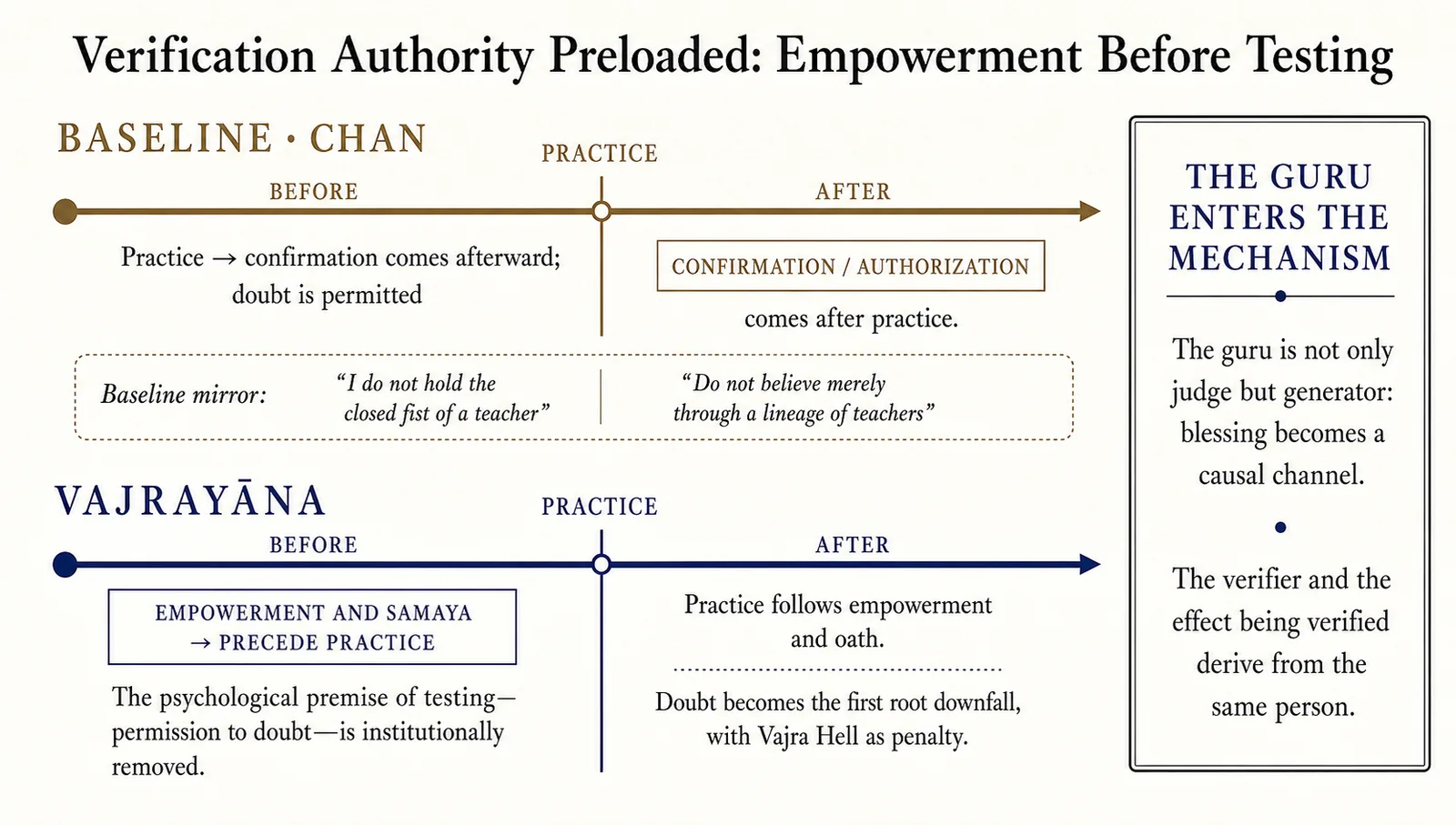
Compared with Chan certification, tantric teacherly authority has two further mutations. The first is advance positioning. Certification adjudicates after practice; empowerment binds before practice. Before students can test any claim, they have vowed to see the teacher as a buddha and accepted a precept making disparagement of the guru the first root downfall. Doubt is not discouraged but criminalized, with vajra hell as penalty. The psychological precondition of testing, permission to doubt, is institutionally removed. The baseline offers a contrasting mirror. Near death, the Buddha says that his teaching contains no “teacher’s fist,” no secret withheld in the teacher’s hand. The Kālāma Sutta makes “do not believe merely through a lineage of teachers” a principle.2 Vajrayāna reverses both: the teaching is held in the fist (secrecy and empowerment), and faith in the teacher precedes hearing it. Second, the teacher enters the mechanism. In the preceding systems, the verifier is only judge. The tantric guru is also generator: blessing is established as a real causal channel, and guru yoga is made the root of practice. “See the teacher as a buddha” is not merely respectful ritual but a basis of the practice. When judge and causal mechanism coincide, both verification and the effect being verified originate in the same person. Later scholars can still reopen the textual circuit of a scholastic lineage; the personal circuit is monopolized in the present by the living transmission.
4. Fallback gates: a schedule that never expires
Buddhahood in this very body is a hard promise, and a hard promise should permit hard failure. If someone practices diligently for a lifetime and does not attain buddhahood in this body, will the system recognize the failure? It need not. A series of fallback gates awaits.3
| Gate | Time | Form of attainment |
|---|---|---|
| This body | Present life | Direct realization of the three bodies—for those of highest capacity |
| Death | Appearance of the clear light of death | Liberation through the meeting of mother and child clear light |
| Intermediate state of reality | When postmortem appearances arise | Liberation by recognizing appearances as one’s own manifestation |
| Intermediate state of becoming | Before rebirth | Transference to a pure land, or selection of a wholesome womb and return |
| Later lives | For those whose samaya remains intact | Traditions commonly promise buddhahood within sixteen lives |
No gate permits outside corroboration. By definition, clear light at death and the experience of the intermediate state have no surviving third-party observer. Buddhahood in this body is therefore a testable deadline at the level of claims and a line of extension that never comes due at the level of function. Every possible manner of death is compatible with the system. This shares the structure of tathāgatagarbha’s claim that all possess buddha-nature, with a change in packaging. Universal possession writes universality openly. Here a deadline is written openly and extensions placed behind it. The promise appears as a deadline; failure is absorbed as extension. The warning from Part I, Chapter 1 belongs in the same file. “Only up or down” redescribes injury in advance as evidence of high pressure; fallback gates redescribe death in advance as the next station. Both are components of one structure. Accident and failure alike enter the system’s explanatory range, and no outcome becomes counterevidence.
As usual, reserve space for the strongest defense. This time it has two faces. First is the teaching of three capacities. Doctrinally, buddhahood in this very body is promised only to those of highest capacity; middling and lower practitioners require time. The gates of death, intermediate state, and later lives are therefore not post hoc exemptions but a legitimate graded arrangement, and each requires corresponding preparation—someone who has not practiced clear-light yoga will not recognize the clear light of death. The Lamp for the Three Modes lists four excellences of the Mantra Vehicle, one of which is “for those of sharp capacity.”4 The second defense is weightier and comes from within Vajrayāna. Sakya Paṇḍita’s Clear Differentiation of the Three Codes fiercely attacks the “single white panacea”—the claim that one recognition of mind’s nature suddenly accomplishes everything. A fruit depends on many conditions and cannot arise from a single cause. The doctrine replaces bodhisattva disciplines with “a false, momentary semblance of realization,” and he compares it to the defeated sudden approach of Moheyan in the Samye debate.5 Both defenses deserve serious consideration, yet neither preserves the gates’ testability. The doctrine of three capacities gives flexibility a principle but does not make any outcome checkable. Dividing the schedule according to capacity explains why the schedule stretches, not how it is tested. Principled indefinite extension remains indefinite extension. Sakya Paṇḍita’s cut supports this volume more directly. If the shortcut is false and the full course cannot be omitted, “this body,” “resultant vehicle,” and “already arrived” belong only at the level of claims. The engineering that must be traversed belongs functionally to a causal vehicle. The strictest internal voice exposes in its own words Part I, Chapter 1’s “heavy engineering for one already arrived.”
5. Boundary and summary
The boundary: this chapter does not judge the authenticity of any rainbow-body case—that would require independent empirical investigation, and the truth or falsity of individual cases would not alter the structural argument. It does not deny the practical teaching value of signs as feedback and does not treat teacher-student relations as inherently wrong—every craft has teachers. The verdict records structure alone. The indicators are rich but the registers misalign: they measure mastery, not cessation. Interpretation is concentrated and doubt is an offense: teacherly authority is positioned in advance, and the teacher enters the mechanism. The promise is conspicuous while fallback is unlimited: the deadline never expires. Read across four systems, the problem of verification completes a circle. Madhyamaka drifts, Yogācāra hollows out, tathāgatagarbha cancels, and Vajrayāna reconstructs verification’s entire outer form while filling it with loyalty to the system and trust in the teacher. The final chapter gathers attachment and the overall table.
References
References
-
Signs along the path (warmth, bliss, luminosity, nonthought, dreams, clear light at death, and related phenomena) appear throughout Highest Yoga Tantra’s staged texts and oral instructions. Warnings that attachment to bliss, luminosity, and nonthought becomes a wrong turn are common in Kagyu and Nyingma. Rainbow body (’ja’ lus) belongs to the Nyingma Dzogchen tradition; modern reports of individual cases all originate within the tradition. ↩
-
“No teacher’s fist” (ācariya-muṭṭhi, a secret held back by the teacher) in the Pāli Mahāparinibbāna Sutta (DN 16). “Do not believe merely through oral tradition or a lineage of teachers,” in the Kālāma Sutta (AN 3.65). For the meaning of both, see Chapter 2 of the Introduction. ↩
-
For successive liberation at clear light at death, the intermediate state of reality, and the intermediate state of becoming, and for transference, see the system of intermediate-state teachings represented by the Great Liberation Through Hearing in the Intermediate State, popularly called the Tibetan Book of the Dead. Highest Yoga Tantra traditions widely teach that those with pure samaya will attain buddhahood within sixteen lives, with small variations in wording. ↩
-
The Lamp for the Three Modes (Nayatrayapradīpa), composed by Tripiṭakamāla, gives four excellences of the Mantra Vehicle over the Pāramitā Vehicle: it is not confused about meaning (its view is unmistaken), has many methods, has no austerities, and is for those of sharp capacity. Restricting buddhahood in this very body to those of highest capacity while requiring middling and lower capacities to proceed gradually over eons is standard in Highest Yoga Tantra’s staged path. ↩
-
Sakya Paṇḍita (1182–1251), in the Clear Differentiation of the Three Codes, attacks the Kagyu “single white panacea” (dkar po chig thub), the view that one sudden realization alone suffices. A fruit depends on many conditions and cannot arise from one cause; the view encourages avoidance of bodhisattva disciplines in favor of “a false, momentary semblance of realization” and resembles Moheyan’s sudden approach, defeated in the Samye debate. See the Stanford Encyclopedia of Philosophy, “Sa skya Paṇḍita” (2024). For the Samye debate, see Volume I, Part XI, and the Madhyamaka Part II, Chapter 4 of this volume. ↩