Chapter 4: Conclusion—Returning to the Original Concern
This is the book’s conclusion. Mahāyāna’s philosophical creativity is a genuine achievement in the history of human thought, but the efficacy of its soteriology is an independent question. This volume’s criticism is not negation but discernment.
Review of the criticism
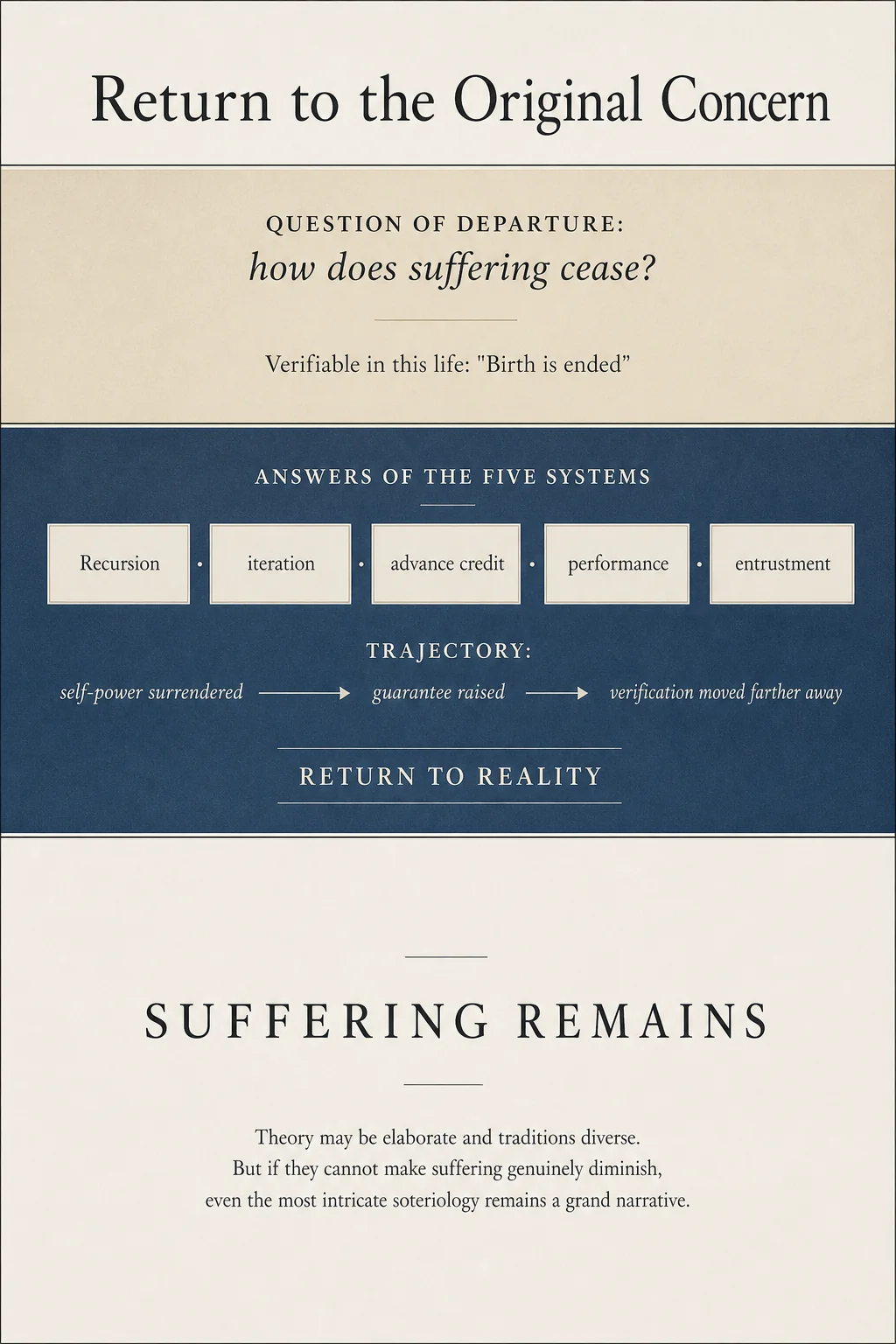
The philosophical criticism of Madhyamaka, Yogācāra, tathāgatagarbha, Vajrayāna, and Pure Land can be summarized in one sentence. Each system deepens Buddhist philosophical reflection in its own way, but on soteriology’s three central questions (the diagnosis of suffering, the mechanism of liberation, and verification in practice) each departs to a different degree from the baseline established by early Buddhism. Read together, their departures have a clear direction: self-power is progressively relinquished, guarantee steadily strengthened, and verification moved to places increasingly difficult to check. At the theoretical level of soteriology, these systems contain problems that can be stated precisely. They deserve serious engagement, not circumvention through “skillful means” or “profound and inconceivable.”
The meaning of “original concern”
The phrase “original concern” is borrowed from Chinese Buddhist discourse and means the original care and deepest pedagogical motive of the Buddha’s teaching. Traditional descriptions of the Buddha’s “original concern in appearing in the world” commonly connect it with guiding sentient beings to recognize suffering and emerge from it. Under the title “returning to the original concern,” this book does not advocate antiquarianism. It does not say that only the early Pāli tradition is real Buddhism or that every later development is deviation and decline. It identifies a basic fact often concealed by the theoretical expansion of the systems: the original concern of Buddhist soteriology is the cessation of suffering—allowing concrete people, suffering and trapped in appropriation, to find a genuinely practicable way out.
This concern does not disappear during theoretical development, but it is often buried beneath layers of philosophical framework and becomes less clearly visible. When practitioners must first master a complex theory of Consciousness-Only, Madhyamaka philosophy, or an inner Vajrayāna cosmology simply to understand what they practice, the theoretical system has already traveled a substantial distance from the concern with suffering. When the criterion of liberation moves from the actual reduction of affliction to victory in philosophical debate, acquisition of lineage qualification, or birth at death, cessation of suffering has already receded into a secondary position in practice.
The relation between philosophical criticism and practice
A book offering philosophical criticism of soteriology must explain the relation of that criticism to practice. Does criticism mean practitioners should abandon their traditions and return to practice within a Pāli tradition? That interpretation misunderstands the book’s position.
The relation should be this: philosophical lucidity about soteriology is an attitude of practice, not practice’s opposite. Early Buddhism already makes right view the first factor of the Noble Eightfold Path: lucid understanding is practice’s starting point, not an obstruction. Practitioners who clearly recognize the theoretical difficulties in their own methods occupy a healthier position than those who believe blindly and never reflect—not because criticism itself possesses contemplative value, but because lucidity is itself part of practice.
Suffering remains
Suffering remains. This is not rhetoric but the reality every soteriology must face. Return to that reality, to suffering’s concrete presence, to the original motive that made the Buddha sit down at Bodh Gayā and speak at the Deer Park: this is what the book calls “returning to the original concern.” Theory can be elaborate and traditions diverse. But if they ultimately cannot bring suffering genuinely to diminish, even the most intricate soteriology remains a grand narrative rather than a true path of liberation.
References
(This chapter concludes the volume. For its verdicts and sources, see the chapters and notes of the preceding six parts; no separate notes are added.)