Chapter 2: Shared Tendencies in Mahāyāna Soteriology
The preceding chapter’s comparative table displays differences and trajectories. Across those differences run several tendencies shared by all five systems. This chapter extracts five and states each concisely; the detailed arguments appear in the individual parts, while only their structure is registered here.
Tendency 1: metaphysical expansion
Early Buddhist soteriology is broadly phenomenological. It describes structures of experience that practitioners can recognize in the present and remains silent about questions beyond experience. The Mahāyāna systems undergo substantial expansion. Emptiness gradually changes from an instrument of dismantling into an ontology such as “thusness” or “dharma realm.” Buddha-nature changes from a potential for buddhahood into an entity possessing permanence, bliss, self, and purity. The storehouse consciousness changes from a concept explaining mental continuity into something with the status of foundational reality. The cost is twofold. Once an analytic instrument is reified, it can become a new object of appropriation—Madhyamaka itself warns that emptiness too is empty. The more ontological commitments a system makes, the more premises it must defend and the more theoretical fragility it acquires.
Tendency 2: elitism and absence of indicia in certifying attainment
Progress in early Buddhist practice possesses relatively observable marks—the sequential abandonment of the ten fetters. In Mahāyāna, certification moves in two directions. Elitism: authority to certify the highest attainment concentrates in lineage authorities—certification, judgment by a guru, and recognition of reincarnations—while no one outside the system can verify it. Absence of indicia: the content of attainment offers progressively fewer inspectable signs—what the Doctrine of the Mean expresses as “without evidence, there is no credibility.” Seeing one’s nature cannot be externally described; transformation of consciousness into wisdom offers few points of entry for testing; birth in a Pure Land happens after death. Combined, the two prevent ordinary practitioners from independently assessing progress and force reliance upon authority’s certification. Soteriology becomes an undertaking highly dependent upon institutional trust, fundamentally distant from the baseline spirit “be an island and refuge to yourself.”
Tendency 3: a gap between systems of practice and goals of liberation
A sound soteriology should maintain a reasonable proportion between the accessibility of the path and its goal. The complete systems of Mahāyāna practice become increasingly inaccessible to ordinary people. Madhyamaka requires sustained philosophical training; Yogācāra specialized contemplation of Consciousness-Only; tathāgatagarbha has a low threshold of entry but equally elaborate complete systems—calm-and-insight and contemplation of the dharma realm; Vajrayāna explicitly requires empowerment and lineage. Pure Land arises from awareness of this gap, but solves it by replacing self-power with other-power rather than reducing difficulty within the framework of self-power. The deeper cause lies in the goal’s definition. Once buddhahood is placed infinitely far away (the salvation of immeasurable beings and a schedule of three incalculable eons), the gap between path and goal becomes unavoidable.
Tendency 4: the unbounded expansion of “skillful means”
Skillful means has a legitimate role: it explains the contextual adaptation of teachings. In practice, however, its boundaries grow progressively indistinct. Other-power is skillful means; transforming desire is skillful means; teaching permanence is skillful means; rapid attainment is skillful means. When “skillful means” can justify every departure after the fact, it changes from explanatory instrument into a shield against criticism and epistemologically approaches abuse of ad hoc hypotheses. A healthy system should draw the boundary of skillful means and explain which claims are literally true and which are temporary guidance. If it cannot, “skillful means” becomes merely a name for avoiding questions.
Tendency 5: institutional transformation of soteriology
As monastic systems become institutionalized, cessation of suffering as a criterion of practice is substantially replaced by markers of institutional legitimacy. In scholastic traditions, skill in debate becomes the principal indicator of progress. In traditions of certification by authority, institutional recognition itself becomes a sign of attainment. The replacement is not conspiracy but the natural result of institutional operation. Identifying it separates institutional authority from soteriological credibility; the two do not occupy the same level.
One spine beneath the five tendencies
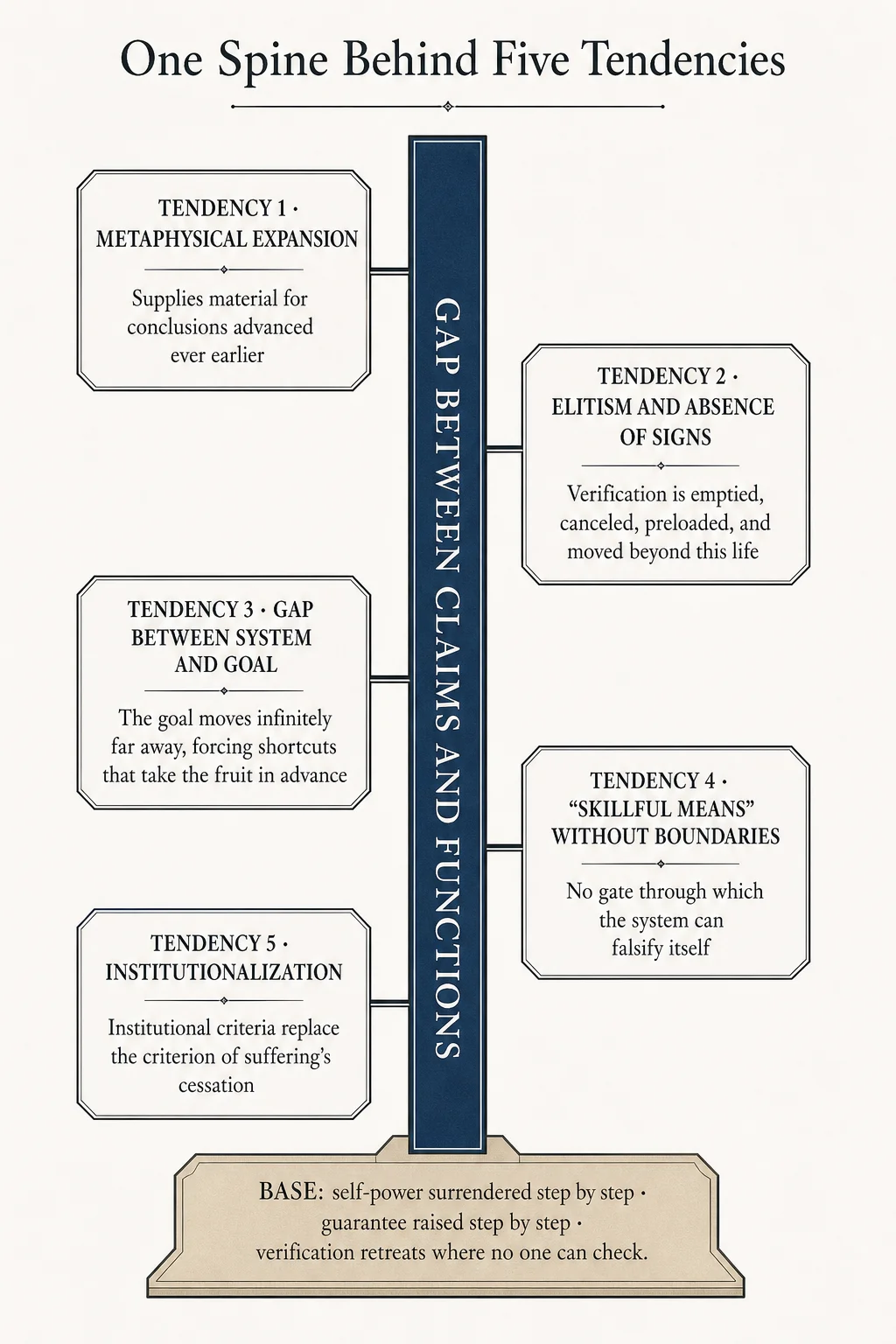
These tendencies are not five unrelated facts. One spine runs beneath them—the trajectory identified by the preceding chapter’s comparative table. Metaphysics expands because material is needed to support a conclusion delivered progressively earlier and redeemed through progressively less self-power—advance payment requires collateral in a foundation. Attainment becomes more elitist, less marked, and more dependent upon authority because verification is successively hollowed out, canceled, and positioned in advance until it leaves the present life—the retreat of verification. The gap between practice and goal grows because the goal is pushed infinitely far away—three incalculable eons and perfect buddhahood—forcing shortcuts that bring the endpoint into present possession—tathāgatagarbha’s advance, Vajrayāna’s rehearsal, and Pure Land’s entrusting. “Skillful means” can expand without boundary because a system that moves verification beyond checkable range naturally lacks a gate through which it can be falsified. Institutionalization can replace the criterion of suffering’s cessation with institutional criteria because, at the level of function, the thing that should serve as criterion has already been replaced. In one sentence: the five tendencies are five manifestations (in metaphysics, epistemology, theory of practice, defensive strategy, and institution) of one thing, the separation between levels of claims and functions. Their shared platform is the trajectory in which self-power is surrendered step by step, guarantee rises by stages, and verification retreats toward a place no one can check.
References
(This chapter is a synthetic extraction. For examples and sources, see the chapters of the preceding six parts; no separate notes are added.)