Chapter 3: What Makes a Soteriology Credible?
Criticism requires grounds. This chapter states explicitly the five criteria on which the book’s criticism rests, extracted from the structure of early Buddhist soteriology. They are minimum standards for evaluating any soteriology: necessary, not sufficient, conditions. When a system fails them, that does not mean its practices necessarily lack benefit; it means its theoretical claims cannot be sustained epistemologically.
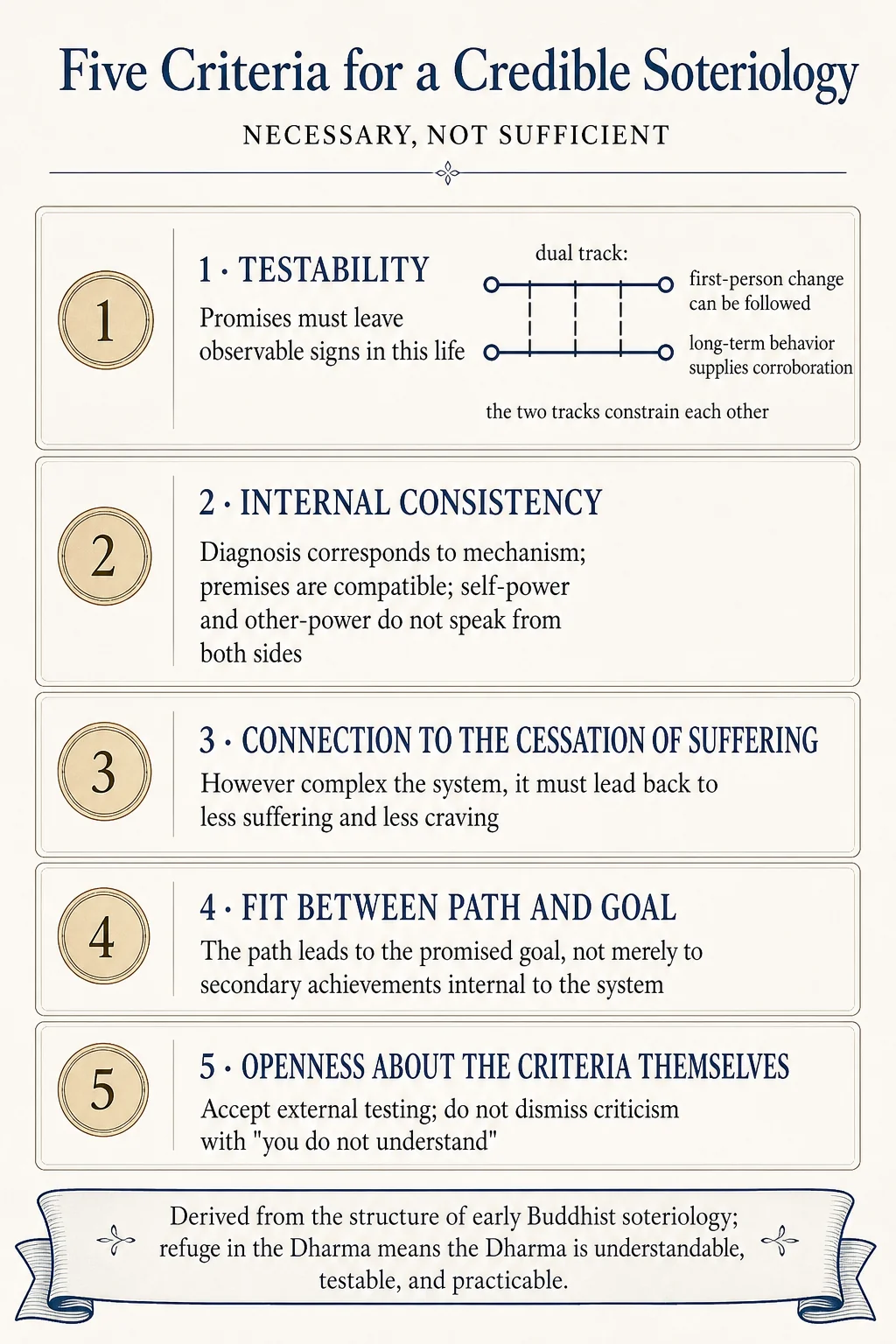
Criterion 1: testability
The central promise of a credible soteriology should leave observable signs within the progress of practice in this life. It cannot postpone all verification until after death or incalculable eons, nor entrust it entirely to the judgment of authority. Testability here does not mean third-person laboratory testing. The meta-level observation at the end of Volume I already noted that “public, observable, and repeatable” are conditions of admission to the scientific method rather than discoveries of that method. If they alone govern, first-person phenomena such as suffering, craving, and cessation are expelled from reality before testing begins (Volume I, Part XII, Chapter 5). Within tradition, Dharmakīrti’s direct perception preserves an epistemological place for first-person experience, but the instrument cuts both ways. Yogic direct perception is precisely an object of criticism in this volume’s Yogācāra part: expectation and doctrine shape experiential reports, and maps can confirm themselves. This book therefore proposes two-track testability: first-person traceability (the growth and decline of affliction and craving in introspection) combined with long-term behavioral corroboration—people in sustained contact can partially observe actual changes in patterns of response. Introspection alone cannot prevent the map from confirming itself; behavior alone returns all adjudicative authority to the third person. Mutual constraint between the two faithfully reconstructs the early Buddhist structure of criteria.
Criterion 2: internal consistency
Theoretical claims cannot contradict one another. Three typical problems recur. Diagnosis and mechanism fail to correspond—the diagnosis identifies ignorance, but the mechanism bypasses ignorance and does something else. Metaphysical premises stand in tension—the intrinsically pure mind and non-self. Self-power and other-power appear consistent at the surface but conflict more deeply—a theory proclaims self-power while practice relies upon blessings, then avoids the question through “self and other are nondual.”
Criterion 3: connection with cessation of suffering
However complex the system, a credible soteriology should be traceable back to the reduction of suffering and craving. Complexity itself is not the problem. The question is whether complexity preserves a clear connection to cessation. After consciousness is transformed into wisdom, how does suffering concretely diminish? How does the statement “suffering never originally existed” explain suffering’s actual presence before recognition of awareness? If answers stop repeatedly at highly generalized descriptions and cannot be traced to the actual growth and decline of suffering, this criterion is not met.
Criterion 4: correspondence between path and goal
A path should actually point toward its promised goal rather than toward secondary achievements internal to the system—victory in debate, mastery of ritual, or acquisition of institutional status. Baseline correspondence is transparent: mindfulness allows one to notice craving’s arising; noticing creates a gap; the gap weakens habitual reaction. A complex system must give an equally substantive explanation of “how.” “This skillful means is profound and cannot be measured by exoteric teaching” substitutes the system’s authority for an argument establishing correspondence.
Criterion 5: openness concerning the criteria themselves
A credible soteriology should accept testing through external criticism instead of systematically exempting itself through “this teaching is profound; you do not understand.” Language has limits, and some experiences may exceed conceptual grasp; both can be acknowledged. But if every criticism can be avoided as insufficient understanding, the system is immunized against all tests. Openness is not weakness but theoretical maturity. “Take the Dharma as refuge” already contains a simple openness: the Dharma is understandable, testable, and practicable.
Inside and outside the criteria
Mahāyāna traditions contain elements that can withstand all five criteria. The loosening of appropriation through Madhyamaka can be traced in practice. Yogācāra’s observation of the activity of consciousness has a relatively clear relation to countering affliction. Chan’s language of “pointing directly to the present” and interpretations of tathāgatagarbha that use pure mind as a basis for confidence without staking an ontology each contain aspects compatible with the criteria. Distinguishing them identifies more reliable resources within tradition. Finally, the limits of the criteria themselves must be stated. They are extracted from early Buddhism and are not the only possible framework. This book welcomes evidence-based challenges to them, exactly as the fifth criterion requires.
References
(The criteria in this chapter are extracted from early Buddhist soteriology, with related analyses throughout the preceding six parts. For Dharmakīrti’s epistemology and the meta-level discussion of the thought experiment, see Volume I, Parts VIII and XII. For drift in criteria of attainment, see Madhyamaka Part II, Chapter 6. No separate notes are added.)