续篇第六章 观禅(下):葛印卡的旧行与三张地图¶
第四、第五两章复述了马哈希与帕奥两系的观。本章复述葛印卡一系:十日课程第四天以后,学员从头到脚依次觉知全身的感受,对一切感受保持平等心;这一系又用"旧行"(saṅkhāra)的积存、浮现与除尽,来说明这一操作做的是什么、走到了哪一步。课程的日程、三天半的安般预备、第四天按日程转观,以及乌巴庆原以光相为转观之机,已见第三章第二节,本章不再复述。第六节用一段对照缅甸另外两个禅修系统,第七节把三系的观并列起来。本章只复述三系自己的说法,并交代各名目的出处层次,判断留给第十章。
所据文献分两类。一类是葛印卡一系自己的文献:Hart 据葛印卡十日课程的晚间开示压缩而成的《开示集要》(The Discourse Summaries),Hart 据葛印卡的教导与问答写成的 The Art of Living,乌巴庆的讲稿 The Essentials of Buddha-Dhamma in Meditative Practice,以及内观研究所编的《乌巴庆纪念集》(Sayagyi U Ba Khin Journal)所收的乌巴庆讲稿与葛印卡文章。《开示集要》按课程日次编排,下文径称"第几天的开示"。另一类是外部的记述与参照:Zeng 等人对葛印卡内观中"觉知""平等心"两个概念的心理学分析,Kornfield、Pyi Phyo Kyaw 与 Jordt 对孙伦、莫哥两系的记述,以及菩提比丘所编《摄阿毗达磨义论》英译本的解说,后者用来核对名目的出处。
几个名目的时代须先交代。"色聚"(kalāpa)、"有分"(bhavaṅga)、"坏灭"(bhaṅga)、"行舍"(saṅkhārupekkhā)都出自注释书与阿毗达磨一系,是后出的范畴。菩提比丘指出,色法分组为色聚,虽可由大种与所造色的区分推出,却是在注释书里才明确写出的;坏灭、行舍是观智的名目,乌巴庆所列的十级观智与《摄阿毗达磨义论》的十种观智逐项相同(见第五节)。葛印卡与乌巴庆都把色聚之说归于佛陀。1 下文凡用这些名目,都是复述葛印卡一系的说法;行、受、想、缘起与念住是经中本有的名目,这一系对它们的用法,下文逐项注明。
一、扫描:觉知与平等心
第四天起,所缘由鼻孔区域扩到全身,学员按次序把注意力从头移到脚,觉知每一部位的感受。第四天的开示回答了几个操作上的问题:任何次序都可以,但必须有次序,否则有些部位会一直是"盲"的;每次注意两三英寸宽的一段,心钝时可以取整个面部或整条上臂,再逐渐缩小;某处觉知不到感受,可以停留约一分钟,仍然没有,就去觉知衣物或空气的接触,然后继续往下;别处生起感受时不跳过去,到了那里再观察;心利时从头到脚一轮约十分钟,现阶段不宜更快,心钝时一轮可能要三十分钟到一小时;开始时只觉知到表面的感受也可以,日后再进入内部。2 所觉知的是任何自然、平常的身体感受,不论苦乐、粗细、强弱,也不因为它出于气候、久坐或旧病而忽略它,葛印卡称之为"无选择的观察"。3 Hart 列出可能出现的感受,有热、冷、重、轻、痒、跳动、收缩、扩张、压、痛、刺麻、脉动、振动,修习者不寻找特殊的感受,也不追究感受的原因。4 乌巴庆的开示里已有从头顶往下的扫描:注意力从头顶移到前额、面部、颈、肩,再沿两臂往下,心到哪里,就像小火炬触到哪里,觉知体内原子单位的燃烧与消灭。5
这一操作有两面,觉知与平等心。第四天的开示说,第一面是打破意识层与潜意识层之间的隔阂,使整个心都能觉知;第二面是平等心,对一切感受都觉知,但不起反应,不结新的贪嗔之结。6 第七天的开示重述这两面,并说修内观的目的在于对一切感受培养平等心,经验某一类感受不是目的;感受时时变化,道上的进步只能以对每一种感受所培养的平等心来衡量。第八天的开示又说,衡量进步的唯一尺度是已经培养的平等心。7 Hart 以鸟的两翼、车的两轮比喻二者,说两者必须同样强。8
这一系以身体感受为所缘,理由有三层。其一,葛印卡说佛陀教法的独特之处,在于指认身体感受是贪嗔开始之处,也是必须在那里除去贪嗔之处;外在对象与反应之间有一个"被遗忘的环节",就是感受。9 Hart 说感受是身与心交会之处,它生于身而由心感知。10 其二,四念住都被归入对感受的观察。第十天的开示说,要体验身体就必须感受身体,所以身随观必然包括受随观;心中所生的一切都伴有身体的感受,所以观心也离不开对感受的觉知。11 其三,乌巴庆说无常可以经由六根中任何一根的触来体会,但身触覆盖的范围最广,也最明显,初学者经由身体的感受体会色法的变化最容易,所以这一系选身体的感受作媒介。12
Zeng 等人从心理学的角度分析了这两种能力。他们把"觉知"界定为对细微身体感受及相关心理过程的敏感,说借身体感受监察情绪的技术为葛印卡内观所独有,这种觉知与西方正念概念所说的当下注意有显著的不同;"平等心"则与正念疗法所说的接纳较为接近。13 两篇文章只处理这两个概念及其测量,不涉及下文的旧行模型。
二、"行"作反应与业
葛印卡一系所说的"行",首先指心的反应。第四天的开示把心分为四部分:识只知道有某物来到根门,不加区别;想依过去的经验与记忆认出它,评为好或坏;受随这一评价而成为乐受或苦受;行是反应,对乐受起喜欢,对苦受起不喜欢,刹那的喜欢发展为强烈的贪,不喜欢发展为强烈的嗔。开示说,行才是"真正会结果的种子"。14 Hart 以同样的次第讲心的四种过程,把行译作"反应",并在注中说明,此处的行取作思(cetanā),即意志、意图。15 《开示集要》所附词表说,行是五蕴之一,又是缘起的第二支,"行就是业",是产生未来之果、塑造未来之生的行为。16 乌巴庆也以行为业:每一身、语、意的行为都留下一种称为行的力,"俗称为业",按善恶记入个人的贷方或借方;每个人都有一笔行的积存,作为维持生命的能量来源。17
行有深浅之别。第四天的开示说,有些反应留下的印象很浅,几乎立即消除,有些稍深,要过一些时候,有些很深,要很久才能消除;一天、一月、一年终了时,人只记得印象最深的一两个行,一生终了时,印象最深的行必然在心中浮现,下一生就以同样性质的心开始。18 葛印卡在〈死时发生什么〉一文里分得更细:有些行浅得不结实质的果,有些稍重而在今生用尽,有些更重,随生命之流进入下一生,却不引生新的一生;许多业则是"有业"或"有行"(bhava-saṅkhāra),引生新的一生,各自带着与某一生存之界的振动相应的磁力,临终时生起的是哪一个,心流就接上三十一界中的哪一界。浅深之别,他用画在水上、沙上、石上的线作比。19 同文说,引生再生的有行深藏在有分之中,内观者以平等心观察临终的种种感受,这些有行就没有机会生起;内观者逐渐减少储存在自己心流的有分中的有行,便缩短了生死之路。此文所用的"有分"一名出自阿毗达磨:在《摄阿毗达磨义论》里,有分是维持一期生命自结生至死亡之相续的心,属异熟心;葛印卡此文在括注中把它释为"引生再生之业的所在"。20
三、旧行的存货与浮现
旧行的存货在这一系的文献里出现在三层上下文中:缘起,浮现的机制,解脱的阶次。前两层见于 Hart 书第八章与第六、第八天的开示,第三层见第五节。
缘起一层。Hart 在第八章"过去反应的存货"一小节说,保持觉知与平衡,可以停止制造新的反应,苦却还有另一面:每个人都有一笔条件作用的存货,即过去反应的总和,即使不再增添,积存的旧行仍会带来苦。21 他把 saṅkhāra 译为"形成",兼指形成的动作与所形成的东西,每一反应既是一串心理过程的末一步,又可以是新一串的第一步。条件作用经由想起作用:识只登记接触的发生,不加区别;想则依过去经验的储存来评价、分类新的现象,过去的反应成为理解新经验的参照点,本来中性的感受随这一被扭曲的知觉立即成为乐受或苦受,对它的反应又造成新的条件作用。22 Hart 说,行的这一双重作用可以从十二缘起看出:第二支行是识生起的直接前提,行又排在识、想、受之后,以贪嗔的形式重现,贪嗔发展为执取,成为新一轮身心活动的推动力。23 第六天与第十天的开示也说,想依过去的经验与过去的行给感受以评价,感受随之成为乐或苦。24
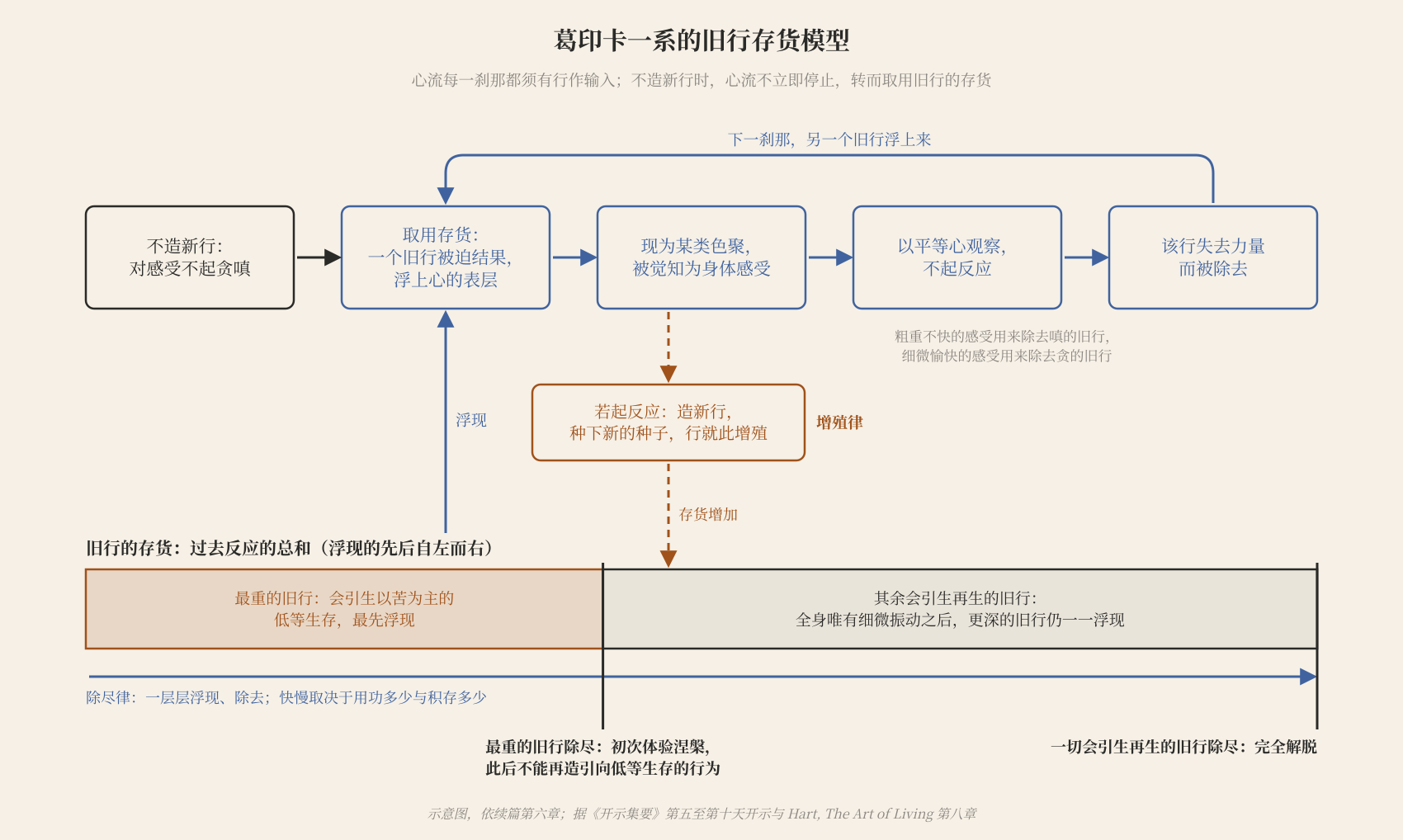
浮现机制一层。第六天的开示说,身体由色聚组成,色聚由四界及其所属的性质组成;色聚生起有四个原因,两个属物质,即所吃的食物与所处的环境,两个属心,即当下的行与过去的行。当下起嗔,火界占优的色聚随即生起,人觉得热;起怖,风界占优的色聚生起,人觉得颤抖。过去的行是种子,经过一段时间结果,种下时经验到什么感受,它的果浮上心的表层时就生起同样的感受。开示要求学员不去判断某一感受出于四因中的哪一因,只观察而不造新的行:不给心新的反应作输入,旧的反应自然结果,现为感受;观察它,它就灭去;再不反应,另一个旧行就必须结果。25 第八天的开示与 Hart 的书都以断食作比。身体停食,并不立即停止运作,它会消耗体内储存的能量,储存耗尽才会死亡。心流每一刹那都需要行作输入,下一刹那生起的心就是这一行的产物;某一刹那不造新的行,心流也不立即停止,它会取用旧行的存货,一个旧行被迫结果,浮上心的表层以维持心流,现为身体的感受。对这一感受起反应,就又种下新的种子;以平等心观察它,它就失去力量而被除去,下一刹那另一个旧行再浮上来。26 Hart 把"行缘识"一支读作每一刹那的心理输入,说旧的条件作用使某一类色聚生起,从而在身体层面显现,被体验为感受;他称内观为"一种精神的断食"。27
存货有类别。第九天的开示说,某一类烦恼在意识层生起时,同一类的旧存货会从潜意识升起,与当下的烦恼相连而增殖;只是观察,当下的烦恼失去力量,同类旧存货的一部分也被除去。28 第十天的开示说,粗重不快的感受是除去嗔的旧行存货的工具,细微愉快的感受是除去贪的旧行存货的工具。29 Hart 说,嗔的条件作用存在一日,心遇到不快的经验就倾向于以嗔反应;某一类条件反应除尽,就脱离那一类苦,一切条件反应依次除尽,心即完全解脱。30
这一模型并不始于葛印卡。乌巴庆已说,行积存于每个人身上,作为维持生命的能量来源;体会无常的力量可以除去个人账上积存的行,同时新的行仍在积累,维持生命的能量也在减少,所以除尽一切行是"一生乃至更长时间的事";除尽一切行的人苦即尽,因为再没有行提供维持任何形式之生命的能量。31
浮现机制的名目可以与阿毗达磨对照。《摄阿毗达磨义论》第六品说,色法由业、心、时节、食四者生起。32 葛印卡所说色聚生起的四因可以与之逐项对应:过去的行对应业,当下的行对应心,所处的环境对应时节,所吃的食物对应食。色聚的分组是注释书写定的,已见开头。存货的浮现、心流以旧行代替新行、平等心使浮现之行灭去,则是乌巴庆与葛印卡一系的说法。这一循环与它的两个终点画成下图,各步的措辞都取自上引的开示与 Hart 的书。
四、两处"诸行无常"
这一系有两处以"诸行无常"一类经句讲行,两处的方向不同:第一处由反应之行说到一切有为,第二处把经中泛说诸行的偈读作心的条件作用的增殖与除尽。
第一处是《法句经》第 277 偈。第六天的开示引此偈,偈义是:以慧照见一切行无常之时,即于苦生厌离,这是清净之道。开示接着说,这里的"行"不只指心的反应,也指这些反应的结果;每一个心的反应都是一颗会结果的种子,人在生命中经验到的一切都是果,是自己的行为,也就是自己过去或现在的行所结的果;所以偈义是,凡生起、凡和合而成的,都会灭去、分解。33 Hart 在第七章引同一偈,前文讲在受这一环断开链条,说苦的原因是业,即盲目的贪嗔反应,也就是行;引偈之后他补说:"这里'行'一词意义很宽。心的盲目反应叫作行,这一行为的结果、它的果也叫作行,如种如果。我们在生命中遇到的一切,归根到底都是自己心的行为的结果。所以就最广义说,行指这个有为世界中的一切,凡被造作、形成、和合者。"34 两处的推论都分三步:反应是行,反应之果也是行;所遇的一切都是自己的行之果;所以一切有为都是行。中间那一步是一条业报的前提。第八天的开示在别处也说,人现在面对黑暗还是光明,不能选择,那由过去的行决定。35
第二处是帝释偈。第八天的开示开头引此偈,作为"增殖律"与其反面"除尽律"的总纲。偈的巴利原文可译为:"诸行实无常,是生灭之法;生已而复灭,彼寂灭为乐。"开示随即解释:每一个行、每一种心的条件作用都是无常的,有生灭的性质;它灭去,下一刻又生起,再生起,行就这样增殖;修习者若发展智慧、客观地观察,增殖便停止,除尽开始;行生起而修习者保持平等心,它便失去全部力量而被除去;一层层旧行生起而被除去,除去多少,就享有多少快乐,过去的行全部除去,就享有完全解脱的无限快乐。36 偈末"彼寂灭为乐"的"寂灭"(vūpasamo),开示所附的英译作"除尽"(eradication),帝释偈由此成了存货除尽的经证。Hart 在第八章"一切条件反应依次除尽,心即完全解脱"一句之后引出同一偈,并自注此偈出《长部》第 16 经,是佛入灭后诸天之王帝释所说。37
经中的场合如下。《长部》第 16 经说,世尊般涅槃,与般涅槃同时,帝释说此偈;《长阿含经》卷四〈游行经〉的平行段落作:“陰行無有常,但為興衰法;生者無不死,佛滅之為樂。”38 同一偈又是《长部》第 17 经的结句:佛讲完大善见王的八万四千城、宫殿、象、马与宝物,说这些行都已过去、灭去、变易,足以对一切行生厌、离贪、解脱,然后说此偈。39 两经的场合,一是佛的入灭,一是王者已经消散的城池与宝物。
上面几节所见"行"的用法,归纳如下:
| 用法 | 文献所说 | 出处 |
|---|---|---|
| 反应 | 心的第四部分:对乐受起喜欢,对苦受起不喜欢;"真正会结果的种子" | 《开示集要》第四天,pp. 35–36;Hart, pp. 26–27 |
| 思 | 此处的行取作思(cetanā),即意志、意图 | Hart, pp. 155–156 注 |
| 业 | 五蕴之一、缘起第二支,"行就是业";每一行为留下的力,"俗称为业" | 《开示集要》词表,p. 118;乌巴庆 Essentials, p. 13 |
| 有深浅的积存 | 浅、稍深、深三等;引生再生者为有行,储于有分 | 第四天,p. 36;〈死时发生什么〉,pp. 133–135 |
| 过去反应的存货 | 不造新行时浮现,现为色聚,被觉知为感受 | 第六天,p. 49;第八天,p. 62;Hart, pp. 101–105 |
| 反应之果 | 人在生命中经验到的一切都是自己的行所结的果 | 第六天,p. 45;Hart, p. 93 |
| 一切有为 | 就最广义说,行指有为世界中的一切 | Hart, p. 93 |
| 心的条件作用 | 帝释偈的诸行读作每一种心的条件作用,"寂灭"读作除尽 | 第八天,p. 60;Hart, p. 105 |
五、阶次与终点
这一系用旧行的除尽说明观的阶次与解脱的两步。第七天的开示说,学员保持平等心,迟早会在原先"盲"的部位感到感受,粗重、坚实、不快的感受开始溶为细微的振动,全身有一股很愉快的能量流动;危险在于把这一愉快的经验当作目标。体验过全身细微振动的自由流动之后,某处又出现粗重的感受或盲区,葛印卡说这是进步的征象,并非退步:修习者随觉知与平等心的增长深入潜意识,发掘出藏在那里的不净,深根的行浮到表层时,许多伴随着粗重不快的感受或盲区,持续观察而不反应,感受灭去,它所显现的那个行也随之灭去。40
解脱分两步。同日的开示接着说,最重的行,即会引生以苦为主的低等生存的行,未除尽之前不能体验涅槃;修内观时最先浮现的正是这些行,保持平等心,它们就灭去;这类行全部除尽,自然初次体验涅槃,此后不能再造引向低等生存的行为;再逐步进到更高的阶段,直到一切会在有为世界任何一处引生未来生命的行都已除尽,这样的人完全解脱。41 开示把这段说明插在一首经偈的三段之间引出。经偈出自《相应部》第 36 相应的〈虚空经〉,说比丘勤勉不舍正知,便能遍知诸受,遍知诸受,现法中即成无漏,身坏之后住于法而不入名数;其汉译平行《杂阿含经》卷十七第 471 经作:“比丘勤方便,正智不傾動,於此一切受,黠慧能了知。了知諸受故,現法盡諸漏,身死不墮數,永處般涅槃。”42 最重之行先浮现、除尽即初见涅槃这一层,是开示在经偈之间所作的说明。开示又说,全身唯有细微振动的阶段很愉快,但不是最终的目标,更深的行仍会一一生起、灭去,全部除尽,才体验"不死"。43 第五天的开示则说,开始修习不必先相信前世与来世,修内观时现在最重要。44
阶次的名目见于第十天的开示。葛印卡说,《念住经》每一节都以同样的句子作结,不论从哪一处开始,修习者都必须经过几个"站":第一站是分别经验生起与灭去,此时觉知的是粗重的感受,如痛,它生起,似乎停留一段时间,终于灭去;再往前是同时经验生灭,粗重坚实的感受溶为以极快速度生灭的细微振动,身心结构的坚实感消失,这就是坏灭;经验到身心结构的坏灭,对它的执着才去掉,面对任何情境都能不执,即进入行舍;这时深藏在潜意识里的旧行开始浮到表层,葛印卡说这是进步,因为不浮上表层就无从除去。45 他所说的结句,是《念住大经》"或于身随观集法而住,或于身随观灭法而住,或于身随观集灭法而住"一段;《中阿含经》〈念处经〉每一节的结句作“如是比丘觀內身如身,觀外身如身,立念在身,有知有見,有明有達”,没有随观集、灭的句子。46 至于多快到达目标,葛印卡说取决于用功多少,以及要除去的过去之行积存了多少。47 与这条线并行的是无常、无我、苦三相:Hart 说修习者先体会感受不断变化,即无常,进而体会没有恒常的我,再体会执着无常之物即是苦;第十天的开示说,分解表面的实相,是为了使修习者从"我"的幻觉中出来。48
乌巴庆另列十级观智:思惟、生灭、坏灭、怖畏、过患、厌离、欲解脱、审察、行舍、随顺。他说这是修内观过程中经过的层次,在短时间内达到目标的人,这些层次只能在事后回顾时才知道;某些层次须由合格的老师调整或帮助;修习者也不应预期这些成就,以免妨碍对无常的连续觉知。49 这十级与《摄阿毗达磨义论》第九品所列的十种观智逐项相同。50 乌巴庆又说,须观察无常,直到轮回中积累的无量旧不善业除尽,才成为入流者;修习者生起的涅槃界与体内的不净相冲,会引起"一种动荡,必须忍受"。51
葛印卡一系的阶次及其名目的出处层次,列如下:
| 阶次 | 葛印卡一系的说明 | 出处 | 名目的出处层次 |
|---|---|---|---|
| 粗重感受、盲区 | 开始时多遇粗重不快的感受;觉知不到之处停约一分钟 | 第四天,pp. 30–31;第五天,p. 38 | 操作说明 |
| 分别经验生、灭 | 粗重的感受生起,似乎停留,终于灭去 | 第十天,p. 82 | 《念住大经》结句的随观集法、灭法 |
| 同时经验生灭;自由流动 | 粗重感受溶为细微振动,全身能量流动 | 第七天,p. 52;第十天,p. 82 | 《念住大经》结句的随观集灭法 |
| 坏灭 | 身心结构的坚实感消失,唯有生灭的振动 | 第十天,p. 82;词表,p. 113 | 观智名目,后出 |
| 行舍 | 深藏的旧行浮现为身体感受,以平等心除去 | 第十天,p. 82;词表,p. 118 | 观智名目,后出 |
| 最重之行除尽 | 初次体验涅槃,此后不再造引向低等生存的行为 | 第七天,p. 55 | 存货模型;所插入的经偈出〈虚空经〉 |
| 一切引生再生之行除尽 | 完全解脱 | 第五天,p. 44;第七天,p. 55 | 存货模型 |
六、缅甸的其他系统(对照)
缅甸另有两个以一位禅师为中心的系统,可作对照。孙伦禅师(Sunlun Sayadaw,1878–1952)出家前务农,据 Kornfield 所记,他起初只觉知入出息,后来加上鼻端的触,再扩到劳作中一切的触,1920 年年中证入流,同年十月证阿罗汉;孙伦禅修中心的集体共修,先以约四十五分钟作急促有力的呼吸,再转为觉知身体的感受,静坐不动直到两三小时,尤重痛受;孙伦一系的老师批评马哈希等法以概念发展定力,没有直接的观。52 Pyi Phyo Kyaw 记孙伦与另一位禅师都以急促、有力、有节奏的呼吸引起强烈而多半不快的身体感受,再观察这些感受,并记缅甸僧团的长老曾以巴利三藏与藏外文献为准分别考问二人,以验证民间视他们为阿罗汉的说法。53 莫哥禅师(Mogok Sayadaw,1899–1962)承雷迪一系,重缘起。Kornfield 记其教法分三部分:修习之前先在理智上理解法,分别概念与究竟实相,明了究竟实相由界与蕴组成,再讲缘起;然后以入出息念集中心,转修观心或观受;修习深入时,一切知觉都只是五蕴的生起与消失。54 莫哥开示的英译者也说,他的开示多以空、缘起与修行诸经为本,是修观的基础知识,修习者在修习之前与修习之中都应了解。55 Jordt 把马哈希一系与这两系对照:马哈希把注意力从阿罗汉崇拜引开,形成一套理性化、形式化的方法,未证悟而受过内观教学训练的比丘也能传授;围绕莫哥、孙伦这类著名阿罗汉比丘建立的寺院,则走了以个人魅力为中心的传统崇拜之路,比丘去世之后,围绕他的道德共同体通常就解散了。56 孙伦一系以身体的感受、尤其是痛受为观的所缘,这一点与葛印卡相近。
七、三张地图
三系的观都以名色为所缘。马哈希一系逐一标记身心现象的生起与灭去(第四章);帕奥一系以定力之光辨识究竟色法、究竟名法及其因(第五章);葛印卡一系从头到脚觉知身体的感受,对一切感受保持平等心(本章第一节)。三系的分别在于用什么地图来说明修习者看到了什么、走到了哪一步。
马哈希一系的地图是观智的次第,从名色分别智起,经缘摄受智、思惟智、生灭智、坏灭智、怖畏智等,再经行舍智、随顺智、种姓智,到道智、果智与省察智,按《清净道论》的七清净分段。Manual of Insight 第六章逐级给出各智的征象,英译本的主编序称这一章为评估修习与观智发展的完整模板,书末附图列出整张次第。57 观智的层次由老师据小参报告判断(第四章),马哈希中心有一部保密的教学手册;道果是否证得,名义上只有佛能确知。58
帕奥一系的地图是阿毗达磨的分析:先在四界分别观中把色聚分为透明与不透明两类,辨识每一色聚中至少八种色法;再辨识名法,即各根门的心路过程;再辨识过去世与未来世,按缘起的三轮逐支看过去五因引生现在五果,未来世要看到无明无余灭尽的那一世,即证阿罗汉道之时;然后修观智。59 色聚与心路是注释书与阿毗达磨的范畴;进度据学员在小参中的报告判断,帕奥自称从不印证禅那与道果(第二章第四节)。
葛印卡一系的地图是旧行的存货:感受是旧行浮现的显现,平等心使浮现之行灭去,最重之行除尽即初见涅槃,一切引生再生之行除尽即完全解脱。这张地图由三层材料组成:缘起、受、想与《念住大经》的结句出自经;色聚、有分与坏灭、行舍等观智名目出自注释书与阿毗达磨;旧行的积存、浮现与除尽出自乌巴庆、葛印卡一系。进步的唯一尺度是平等心,乌巴庆所列的十级观智只在事后回顾时才知道。
三系的观可以并列如下:
| 马哈希 | 帕奥 | 葛印卡 | |
|---|---|---|---|
| 所缘 | 身心现象,入门为腹部起伏的压触,一一标记 | 究竟色法、究竟名法及其因,以定力之光辨识 | 全身的身体感受,从头到脚依次觉知 |
| 地图 | 观智次第:名色分别智至省察智 | 色聚、心路过程、三世缘起,再修观智 | 旧行浮现为感受;生灭、坏灭、行舍 |
| 地图的出处层次 | 按《清净道论》七清净分段的观智次第 | 注释书与阿毗达磨的色聚、心路;缘起的三轮与三世 | 经(缘起、受、想、念住结句);注释书与阿毗达磨(色聚、有分、观智名目);乌巴庆、葛印卡一系(存货) |
| 进度由谁判 | 老师据小参报告判观智层次,有保密的手册;道果名义上只有佛能确知 | 学员在小参中报告,禅师据报告指导,自称不印证 | 以平等心为唯一尺度;十级观智事后回顾才知,某些层次由老师调整 |
| 终点 | 道智、果智、省察智 | 观至无明无余灭尽之世,证阿罗汉道 | 最重之行除尽初见涅槃;一切引生再生之行除尽即完全解脱 |
三张地图与共同的所缘,画成下图:底下一层是三系共同的名色,上面三栏是各系叠加的地图及其出处层次。
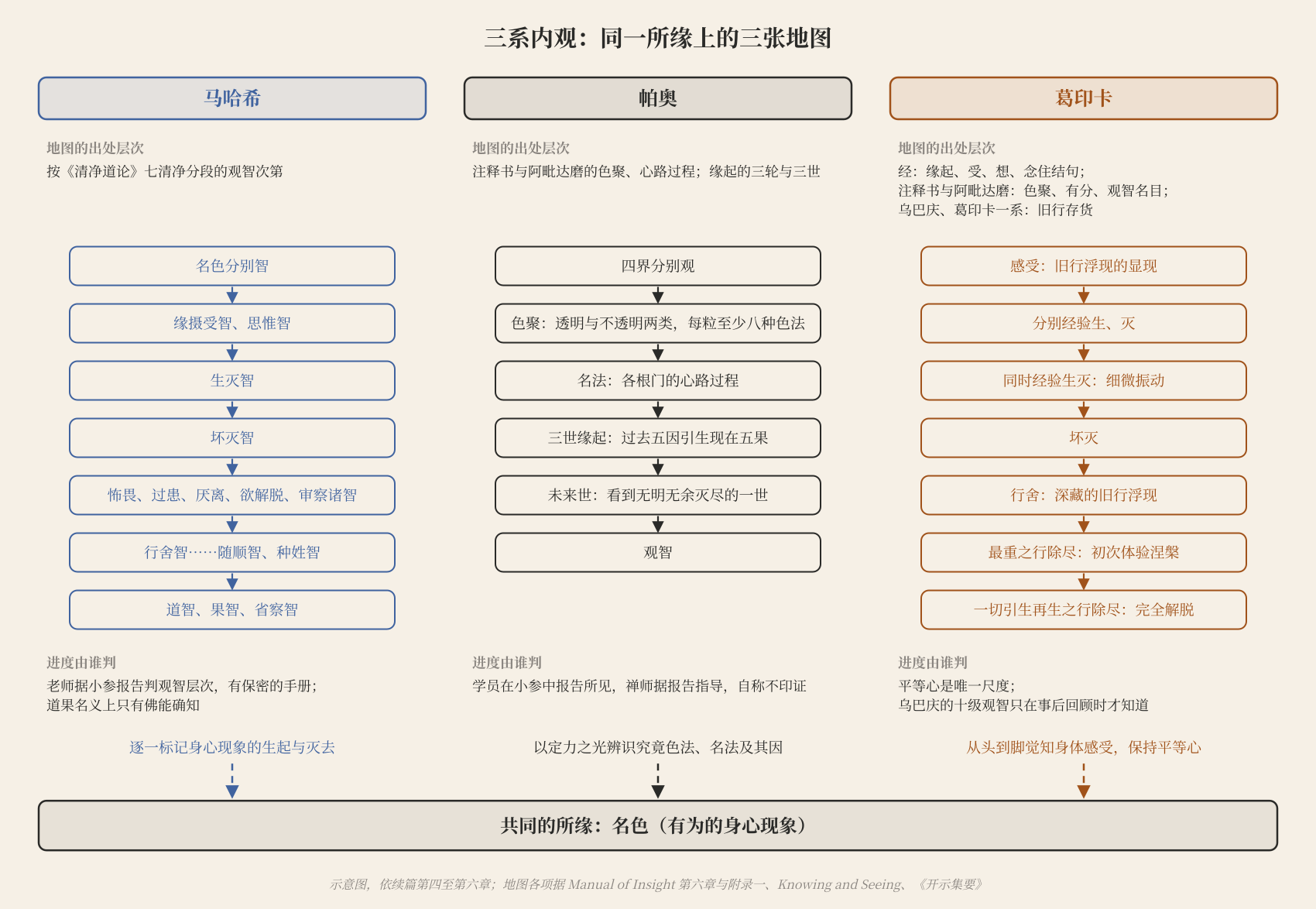
与格鲁一系对照,宗喀巴的观以教义先行定义的所破为对象,见须从他闻,所破须先认识(第二篇续篇《宗喀巴禅法》第二章第一节)。三系内观的所缘是名色,即有为的身心现象;三系的分别落在验收所用的地图上,三张地图的出处层次各不相同,葛印卡一系的一张由经、注释书与本系之说三层叠成。所缘与地图之间是什么关系,在第十章第二节讨论。
参考文献
-
Bhikkhu Bodhi (ed.), A Comprehensive Manual of Abhidhamma: The Abhidhammattha Sangaha of Ācariya Anuruddha, Onalaska: BPS Pariyatti Editions, 2000(电子书无印本页码,按章节引),导论 "The Commentaries" 一节:"The organization of material phenomena into groups (kalāpa), though implied by the distinction between the primary elements of matter and derived matter, is first spelled out in the Commentaries." 葛印卡说:"The entire structure of the body, the Buddha explained, is composed of subatomic particles—kalāpā—consisting of the four elements and their subsidiary characteristics, joined together."(S. N. Goenka, The Discourse Summaries: Talks from a Ten-day Course in Vipassana Meditation, condensed by William Hart, Onalaska: Vipassana Research Publications, 2012 电子书(初版 Vipassana Research Institute, 1987),Day Six, p. 48)乌巴庆说:"The Buddha taught his disciples that everything that exists at the material level is composed of kalāpas."(Sayagyi U Ba Khin, The Essentials of Buddha-Dhamma in Meditative Practice, Onalaska: Vipassana Research Publications, 2012 电子书(初版 Vipassana Research Institute, 1991),p. 15) ↩
-
Goenka, Discourse Summaries, Day Four, pp. 30–32。p. 30:"Any order may be followed, but an order is necessary. Otherwise there is the danger of neglecting some parts of the body, and those parts will remain blind, blank." p. 31:"If this situation occurs throughout the body, it may be possible to move from head to feet in about ten minutes, but it is not advisable to move more quickly at this stage." p. 32:"Take a section of the body about two or three inches wide; then move ahead another two or three inches, and so on." ↩
-
Goenka, Discourse Summaries, Day Four, p. 33:"Never ignore a sensation on the grounds that it is caused by atmospheric conditions, or by sitting for long hours, or by an old disease." "It is a choiceless observation. Never try to select sensations; instead, accept whatever arises naturally." ↩
-
William Hart, The Art of Living: Vipassana Meditation as Taught by S. N. Goenka, Onalaska: Vipassana Research Publications 电子书(初版 Harper & Row, 1987),p. 88:"We move attention systematically throughout the physical structure from head to feet and feet to head, from one extremity to the other." "They may be of any type: heat, cold, heaviness, lightness, itching, throbbing, contraction, expansion, pressure, pain, tingling, pulsation, vibration, or anything else." "Nor is any effort made to discover the cause of a sensation." ↩
-
U Ba Khin, "The Ten Soldiers of Māra," in Sayagyi U Ba Khin Journal, Igatpuri: Vipassana Research Institute, 1991, p. 73(编者说明此篇据乌巴庆在课程中所作缅语开示的译文节录):"Focus your attention on the top of your head, and move down through the whole body, from the top of the head to the forehead and then the face, from the face to the neck, the neck to the shoulders, from the shoulders along to the hands. Wherever the mind goes it may be like touching with a small torch and feeling the heat wherever the torch touches, wherever the mind goes. Why? Because there is burning and annihilation taking place inside; it is the innate nature of combustion of atomic units within." ↩
-
Goenka, Discourse Summaries, Day Four, p. 37:"The first is breaking the barrier between the conscious and unconscious levels of the mind." "The second aspect of the technique is equanimity. One is aware of all that one experiences, of every sensation, but does not react, does not tie new knots of craving or aversion, does not create misery for oneself." ↩
-
Goenka, Discourse Summaries, Day Seven, p. 52:"In fact, the purpose of practicing Vipassana is not to experience a certain type of sensation, but rather to develop equanimity towards all sensations. Sensations keep changing, whether gross or subtle. One's progress on the path can be measured only by the equanimity one develops towards every sensation." Day Eight, p. 63:"The only yardstick to measure one's progress on the path is the equanimity that one has developed." ↩
-
Hart, The Art of Living, p. 100:"Both are essential, just as a bird requires two wings to fly or a cart needs two wheels to move. And they must be equally strong." ↩
-
Goenka, Discourse Summaries, Day Six, pp. 47–48:"Sensation is the forgotten missing link between the external object and the reaction." "The unique element in his teaching lies elsewhere, in his identifying physical sensation as the crucial point at which craving and aversion begin, and at which they must be eliminated." 第十天又说,当时与现在一样,人们一般以为反应是对外在感官对象的反应,"between the object and the reaction is a missing link: sensation"(Day Ten, pp. 80–81)。 ↩
-
Hart, The Art of Living, p. 88:"Sensation is the crossroads where mind and body meet. Although physical in nature, it is also one of the four mental processes (see Chapter Two). It arises within the body and is felt by the mind." ↩
-
Goenka, Discourse Summaries, Day Ten, p. 80:"To experience this reality directly, one must feel the body, that is, must be aware of sensations throughout the body. Thus observation of body—kāyānupassanā—necessarily involves observation of sensations—vedanānupassanā." "And whatever arises in the mind, The Buddha discovered, will be accompanied by a physical sensation." 词表 satipaṭṭhāna 条(pp. 118–119):"All four are included in the observation of sensations, since sensations are directly related to body as well as to mind." ↩
-
U Ba Khin, Essentials, p. 17:"In practice, however, we have found that of all types of feeling, the feeling by contact of touch with the component parts of the body in a process of change, covers the widest area for introspective meditation." "This is the main reason why we have chosen bodily feeling as a medium for quick understanding of anicca." ↩
-
Xianglong Zeng, Tian P. S. Oei, Yiqing Ye and Xiangping Liu, "A Critical Analysis of the Concepts and Measurement of Awareness and Equanimity in Goenka's Vipassana Meditation," Journal of Religion and Health 54, no. 2 (2015): 399–412。p. 403:"Although the technique of using bodily sensation to monitor emotions is quite unique to GVM, the awareness of one's own emotions is obviously present in many people." p. 410:"Awareness in GVM, which refers to sensitivity toward bodily sensations and associated emotions, is significantly different from the present moment attention in the Western concept of mindfulness." 同页说 equanimity 与正念疗法的 acceptance "have relatively more similarity"。另见 Xianglong Zeng, Tian P. S. Oei and Xiangping Liu, "Monitoring Emotion Through Body Sensation: A Review of Awareness in Goenka's Vipassana," Journal of Religion and Health 53, no. 6 (2014): 1693–1705。p. 1693 摘要:"Awareness is one of the two most important abilities cultivated in Goenka's Vipassana meditation, which refers to sensitivity to subtle bodily sensations and the associated psychological processes." ↩
-
Goenka, Discourse Summaries, Day Four, pp. 35–36。p. 36:"Here is the real seed that gives fruit, the action that will have results: the saṅkhāra, the mental reaction." ↩
-
Hart, The Art of Living, pp. 26–27;第二章注 1(pp. 155–156):"Here saṅkhāra is taken as equivalent to cetanā/sañcetanā, meaning will, volition, intention." Hart 在同注举《增支部》〈思经〉与《相应部》〈七处经〉等为据。 ↩
-
Goenka, Discourse Summaries, 词表 p. 118,saṅkhāra 条:"One of the five aggregates (khandhā), as well as the second link in the Chain of Conditioned Arising (paṭicca samuppāda). Saṅkhāra is the kamma, the action that gives future results and that thus is actually responsible for shaping one's future life." ↩
-
U Ba Khin, Essentials, p. 13:"each action—whether by deed, word or thought—leaves behind an active force called saṅkhāra (or kamma in popular terminology), which goes to the credit or debit account of the individual, according to whether the action is good or bad. There is, therefore, an accumulation of saṅkhāras (or kamma) with everyone, which functions as the supply-source of energy to sustain life, which is inevitably followed by suffering and death." 同样的说法又见乌巴庆 "The Real Values of True Buddhist Meditation," in Sayagyi U Ba Khin Journal, p. 67。 ↩
-
Goenka, Discourse Summaries, Day Four, p. 36:"And like it or not, at the end of life, whatever saṅkhāra has made the strongest impression is bound to come up in the mind; and the next life will begin with a mind of the same nature, having the same qualities of sweetness or bitterness." ↩
-
S. N. Goenka, "What Happens at Death?," in Sayagyi U Ba Khin Journal, pp. 132–135;引文在 p. 133:"Many kammas however, are bhava-kammas, or bhava-saṅkhāras, those that give a new birth, a new life. Each one of these bhava-kammas (actions that give rise to the process of becoming) carries a magnetic force that is in tune with the vibrations of a particular plane of existence." "Some are like a line drawn on water, some like a line drawn on sand and some a line on rock." ↩
-
Goenka, "What Happens at Death?," p. 134:"Then, even those related bhava-saṅkhāras lying deep in the bhavaṅga (seat of birth-producing kamma) will not have an opportunity to arise." p. 135:"by slowly decreasing the stock of accumulated bhava-saṅkhāras stored in the bhavaṅga of his flow of consciousness, one shortens one's journey of becoming and reaches the goal sooner." 有分的界定见 Bodhi (ed.), Comprehensive Manual, 第三品 §8 解说:"Bhavanga is the function of consciousness by which the continuity of the individual is preserved through the duration of any single existence, from conception to death." 同处说有分心是与结生心同类的异熟心。 ↩
-
Hart, The Art of Living, p. 101:"By ceasing to react from this moment forward, we may create no further cause of misery, but each one of us has a stock of conditioning, the sum total of our past reactions. Even if we add nothing new to the stock, the accumulated old saṅkhāras will still cause us suffering." ↩
-
Hart, The Art of Living, p. 101:"The word saṅkhāra may be translated as 'formation,' both the act of forming and that which is formed." "Perception, however, is discriminative. It draws on the store of past experiences in order to evaluate and categorize any new phenomenon." "In accordance with the distorted perception, an essentially neutral sensation immediately becomes pleasant or unpleasant." ↩
-
Hart, The Art of Living, pp. 101–102:"The second link in the chain is saṅkhāra, which is the immediate precondition for the arising of consciousness, the first of the four mental processes. However, saṅkhāra is also last in the series of processes, following consciousness, perception, and sensation. In this form it reappears, later in the chain, after sensation, as the reaction of craving and aversion." ↩
-
Goenka, Discourse Summaries, Day Six, p. 47:"The perception gives a valuation to the sensation as good or bad, based on one's past experiences and conditionings, past saṅkhārā." Day Ten, p. 78:"Apparent, integrated truth is always full of illusions, because at this level saññā operates, perception, which is distorted by past reactions." 词表 saññā 条(p. 118):"It is ordinarily conditioned by one's past saṅkhārā, and therefore conveys a colored image of reality." ↩
-
Goenka, Discourse Summaries, Day Six, pp. 48–49。p. 49:"The flow of mind requires mental input, which again is of two types: either a present or a past saṅkhāra." "Whatever sensation one experienced when planting the seed, the same sensation will arise when the fruit of that saṅkhāra comes to the surface of the mind." "Of these four causes, one should not try to determine which is responsible for the arising of a particular sensation." "If one does not give the input of a new reaction to the mind, automatically an old reaction will give its fruit, manifesting as sensation." ↩
-
Goenka, Discourse Summaries, Day Eight, p. 62:"If at any moment one does not generate a new saṅkhāra the flow does not stop at once; instead it draws on the stock of old saṅkhārā. An old saṅkhāra will be forced to give its fruit, that is, to come to the surface of the mind in order to sustain the flow; and it will manifest as a physical sensation." 断食之喻又见 Hart, The Art of Living, pp. 103–104。 ↩
-
Hart, The Art of Living, p. 104:"According to the chain of conditioned arising, consciousness originates from reaction (see p. 48)." "The conditioning will appear at the physical level by causing a particular type of kalāpa to arise, which one then experiences as sensation within the body." p. 105:"Vipassana meditation therefore is a kind of fasting of the spirit in order to eliminate past conditioning." ↩
-
Goenka, Discourse Summaries, Day Nine, p. 68:"Whenever a defilement starts at the conscious level, one's old stock of that type of defilement arises from the unconscious, becomes connected with the present defilement, and starts multiplying. If one just observes, not only the present impurity but also some portion of the old stock will be eradicated." ↩
-
Goenka, Discourse Summaries, Day Ten, p. 82:"One uses the gross, unpleasant sensations as tools with which to eradicate the old stock of saṅkhārā of aversion; one uses the subtle, pleasant sensations as tools with which to eradicate the old stock of saṅkhārā of craving." ↩
-
Hart, The Art of Living, p. 105:"When the conditioned responses of a certain type are eradicated, one is free of that type of suffering. And when all conditioned responses have been eradicated one after another, the mind is totally liberated." ↩
-
U Ba Khin, Essentials, p. 13:"This process begins with the correct understanding of anicca while further accumulations of fresh actions and the reduction of the supply of energy to sustain life are taking place simultaneously, from moment to moment and from day to day. It is, therefore, a matter of a whole lifetime or more to get rid of all one's saṅkhāras. He who has rid himself of all saṅkhāras comes to the end of suffering, for then no saṅkhāra remains to give the necessary energy to sustain him in any form of life." ↩
-
Bodhi (ed.), Comprehensive Manual, 第六品 §9:"Kammaṃ, cittaṃ, utu, āhāro cā ti cattāri rūpasamuṭṭhānāni nāma. Material phenomena originate in four ways, from kamma, consciousness, temperature, and nutriment." ↩
-
Goenka, Discourse Summaries, Day Six, p. 45:"Here the word saṅkhārā means not only mental reactions, but also the results of these reactions. Every mental reaction is a seed which gives a fruit, and everything that one experiences in life is a fruit, a result of one's own actions, that is, one's saṅkhārā, past or present. Hence the meaning is, 'Everything that arises, that becomes composed, will pass away, will disintegrate.'" 所引偈见同书所附巴利引文,p. 97:"Sabbe saṅkhārā aniccā'ti; yadā paññāya passati, atha nibbindati dukkhe—esa maggo visuddhiyā."(Dhammapada XX.5 (277)) ↩
-
Hart, The Art of Living, p. 93:"Here the word saṅkhāra has a very wide meaning. A blind reaction of the mind is called saṅkhāra, but the result of that action, its fruit, is also known as saṅkhāra; like seed, like fruit. Everything that we encounter in life is ultimately the result of our own mental actions. Therefore in the widest sense, saṅkhāra means anything in this conditioned world, whatever has been created, formed, composed." 前文:"The cause of suffering is the kamma, the mental deed, that is, the blind reaction of craving and aversion, the saṅkhāra."(同页)偈的出处见第七章注 6(p. 157):"Dhammapada, XX. 5 (277)." ↩
-
Goenka, Discourse Summaries, Day Eight, p. 66:"One cannot choose whether one faces darkness now or brightness; that is determined by one's past saṅkhārā." ↩
-
Goenka, Discourse Summaries, Day Eight, p. 60;该日开示的提要首句为 "The law of multiplication and its reverse, the law of eradication"。p. 60:"Every saṅkhāra, every mental conditioning is impermanent, having the nature of arising and passing away. It passes away, but next moment it arises again, and again; this is how the saṅkhāra multiplies. If one develops wisdom and starts observing objectively, the process of multiplication stops and the process of eradication begins." "If all the past saṅkhārā are eradicated, one enjoys the limitless happiness of full liberation." 同书所附巴利引文,p. 103:"Aniccā vata saṅkhārā, uppādavaya-dhammino. Uppajjitvā nirujjhanti, tesaṃ vūpasamo sukho." 英译末句作 "their eradication brings happiness"。 ↩
-
Hart, The Art of Living, p. 105;第八章注 1(p. 157):"D. 16, Mahā-Parinibbāna Suttanta. The verse is spoken by Sakka, king of the gods, after the passing of the Buddha." ↩
-
《长部》第 16 经《大般涅槃经》,缅甸第六次结集本第 221 段:"Parinibbute bhagavati saha parinibbānā sakko devānamindo imaṃ gāthaṃ abhāsi – 'Aniccā vata saṅkhārā, uppādavayadhammino; Uppajjitvā nirujjhanti, tesaṃ vūpasamo sukho'ti." 英译见 Maurice Walshe (trans.), The Long Discourses of the Buddha: A Translation of the Dīgha Nikāya, Somerville: Wisdom Publications, 1995(初版 1987,题 Thus Have I Heard;电子书无印本页码,按节引),DN 16.6.10:"Impermanent are compounded things, prone to rise and fall, / Having risen, they're destroyed, their passing truest bliss." 汉译见《长阿含经》卷四〈游行经〉,后秦佛陀耶舍、竺佛念译。 ↩
-
《长部》第 17 经《大善见王经》,缅甸第六次结集本第 272 段及经末偈:"Passānanda, sabbete saṅkhārā atītā niruddhā vipariṇatā. Evaṃ aniccā kho, ānanda, saṅkhārā … Yāvañcidaṃ, ānanda, alameva sabbasaṅkhāresu nibbindituṃ, alaṃ virajjituṃ, alaṃ vimuccituṃ." Walshe 译本 DN 16 注 457 亦说此偈 "Frequently quoted, it concludes DN 17"。 ↩
-
Goenka, Discourse Summaries, Day Seven, pp. 52–53。p. 52:"Even after one has experienced a free flow of subtle vibrations throughout the body, it is quite possible that again a gross sensation may arise somewhere, or a blind area. These are signs not of regression but of progress." p. 53:"If one continues to observe without reacting, the sensation passes away, and with it the saṅkhāra of which it is a manifestation." ↩
-
Goenka, Discourse Summaries, Day Seven, p. 55:"One cannot experience nibbāna until the heaviest saṅkhārā have been eliminated—those that would lead to a future life in a lower form of existence where misery would predominate. Fortunately, when one starts to practice Vipassana, it is these very saṅkhārā that arise first. … When all such saṅkhārā have been eradicated, then naturally one experiences nibbāna for the first time. … Gradually one proceeds to higher stages, until all the saṅkhārā have been eradicated that would have led to future life anywhere within the conditioned world. Such a person is fully liberated" ↩
-
经偈的巴利原文见《开示集要》所附巴利引文,p. 98,出处标作 Paṭhama Ākāsa Sutta, Saṃyutta Nikāya XXXVI:"Yato ca bhikkhu ātāpī sampajaññaṃ na riñcati, tato so vedanā sabbā parijānāti paṇḍito; So vedanā pariññāya diṭṭhe dhamme anāsavo, kāyassa bhedā Dhammaṭṭho, saṅkhyaṃ nopeti vedagū." 开示正文(Day Seven, p. 55)把此偈分作三段,依次以 "The Buddha said" "The Buddha continued" "the Buddha concluded" 引出。汉译平行见《杂阿含经》卷十七第 471 经。 ↩
-
Goenka, Discourse Summaries, Day Seven, p. 56:"Naturally this stage is very blissful, but still it is not the final goal, and one must not become attached to it." "If one continues to observe equanimously, one after another all the deeper saṅkhārā will arise and pass away. When they are all eradicated, then one experiences the 'deathless'" ↩
-
Goenka, Discourse Summaries, Day Five, p. 44:"To start the work, it is not necessary that one should first believe in past lives and future lives. In practicing Vipassana, the present is most important." 同页:"Gradually you will progress towards a stage in which all saṅkhārā leading to new birth, and therefore to new suffering, have been eradicated: the stage of total liberation, full enlightenment." ↩
-
Goenka, Discourse Summaries, Day Ten, pp. 81–82。p. 82:"This is the stage of bhaṅga—dissolution—in which one experiences the ultimate truth of mind and matter: constantly arising and passing away, without any solidity." "Then one becomes detached in the face of any situation; that is, one enters the stage of saṅkhāra-upekkhā. Very deep lying impurities—saṅkhārā—buried in the unconscious now start appearing at the surface level of the mind. This is not a regression; it is a progress, for unless they come to the surface, the impurities cannot be eradicated." 词表 bhaṅga 条(p. 113)与 saṅkhārupekkhā 条(p. 118)同此。 ↩
-
《念住大经》结句见《开示集要》所附巴利引文,p. 109:"Samudaya-dhammānupassī vā kāyasmiṃ viharati, vaya-dhammānupassī vā kāyasmiṃ viharati, samudaya-vaya-dhammānupassī vā kāyasmiṃ viharati."(Mahā-Satipaṭṭhāna Sutta, Dīgha Nikāya 22)《中阿含经》卷二十四〈念处经〉(第 98 经)。 ↩
-
Goenka, Discourse Summaries, Day Ten, p. 83:"How soon one may reach the goal depends on how much work one does, and how large an accumulation of past saṅkhārā one has to eradicate." ↩
-
Hart, The Art of Living, pp. 90–91;Goenka, Discourse Summaries, Day Ten, p. 79:"The purpose of disintegrating apparent reality is to enable the meditator to emerge from the illusion of 'I.'" ↩
-
U Ba Khin, Essentials, p. 18:"These are the levels of attainment which one goes through during the course of Vipassana meditation. In the case of those who reach the goal in a short time, they can be known only in retrospect. Along with one's progress in understanding anicca, one may reach these levels of attainment—subject, however, to adjustments or help at certain levels by a competent teacher. One should avoid looking forward to such attainments in anticipation, as this will distract from the continuity of awareness of anicca" ↩
-
Bodhi (ed.), Comprehensive Manual, 第九品 §25:"(1) Sammasanañāṇaṃ, (2) udayabbayañāṇaṃ, (3) bhangañāṇaṃ, (4) bhayañāṇaṃ, (5) ādīnavañāṇaṃ, (6) nibbidāñāṇaṃ, (7) muñcitukamyatāñāṇaṃ, (8) paṭisankhāñāṇaṃ, (9) sankhār'upekkhāñāṇaṃ, (10) anulomañāṇañ cā ti dasa vipassanāñāṇāni." ↩
-
U Ba Khin, "The Ten Soldiers of Māra," p. 73:"How long will one have to work? Until all the immeasurable, uncountable old akusala kamma (unwholesome actions) accumulated along one's journey through the saṃsāra (cycle of rebirth) are eradicated by observing the nature of anicca. Then one becomes sotāpanna" U Ba Khin, "The Real Values of True Buddhist Meditation," in Sayagyi U Ba Khin Journal, p. 68:"When one develops nibbāna dhātu, the impact of this nibbāna dhātu upon the impurities and poisons within his own system will create a sort of upheaval, which must be endured." ↩
-
Jack Kornfield, Living Dharma: Teachings of Twelve Buddhist Masters, Boston: Shambhala, 1996(初版题 Living Buddhist Masters, 1977),pp. 83–86。p. 86:"During the first forty-five minutes the entire hall is engaged in intensely practicing the heavy breathing concentration exercise. On the Sayadaw's instruction, the yogis then turn to mindfulness of sensation in the body, continuing to sit motionless until the end of a two- or three-hour period." 同页说孙伦一系的老师 "criticize other techniques such as Mahasi Sayadaw and Taungpulu Sayadaw as developing concentration through concepts but not direct insight"。 ↩
-
Pyi Phyo Kyaw, "The Sound of the Breath: Sunlun and Theinngu Meditation Traditions of Myanmar," Contemporary Buddhism 20, nos. 1–2 (2019): 247–291。p. 247 摘要:"Their meditation techniques are similarly distinctive in employing rapid, strong and rhythmic breathing. They combined this with the contemplation of the intense, usually unpleasant, bodily sensations that are thus induced." "Senior members of the Burmese Sangha catechised both masters separately, using Pāli canonical and post-canonical texts as a benchmark to verify the popular belief amongst Burmese people that they were arahants." 另一位禅师是 Theinngu Sayadaw(1913–1973)。 ↩
-
Kornfield, Living Dharma, pp. 209–210。p. 210:"First, Mogok stresses the importance of intellectual understanding of Dharma before actual meditation practice. He teaches the distinction between concepts and ultimate reality, and how ultimate reality is composed of the elements and aggregates. Then he explains the cycle of dependent origination" "Then practice is changed to either meditation on consciousness (the knowing faculty of mind) or meditation on feeling." ↩
-
Bhikkhu Uttamo (trans.), Dhamma Talks by Mogok Sayadaw: Emptiness, Conditioned, and Unconditioned, Taiwan, 2025(据缅语录音英译,免费流通本),Introduction, p. 2:"because Sayadaw's talks were mostly based on emptiness (suññatā), dependent co-origination (paṭiccasamuppāda) and many suttas on practice. These teaching were the foundation knowledge for insight practice. It is very important for yogis to know them before and during the practice." ↩
-
Ingrid Jordt, Burma's Mass Lay Meditation Movement: Buddhism and the Cultural Construction of Power, Athens: Ohio University Press, 2007, p. 32:"Mahasi drew attention away from arahat cults and helped sublimate the spiritual energy into the formation of a rationalized, formalized method that could be transmitted by monks who had not attained enlightenment themselves but who were trained in the pedagogy of vipassanā. By contrast, the monasteries built up around other famous (arahat) monks, such as Mogok Sayadaw and Sunlun Sayadaw, have gone the way of traditional cults focused on a charismatic monk." ↩
-
Mahāsi Sayādaw, Manual of Insight, trans. and ed. Vipassanā Mettā Foundation Translation Committee, Somerville: Wisdom Publications, 2016, 第六章 "Stages of Insight Knowledge",p. 303 起;主编序,p. xxv:"The sixth chapter, 'Stages of Insight Knowledge,' presents a comprehensive template for evaluating one's practice and one's development of insight knowledge." 书末附录一 "The Progress of Insight" 为图表,无页码,以七清净分段列出各智。 ↩
-
Jordt, Burma's Mass Lay Meditation Movement, p. 66:"The manual is kept secret so that inexperienced persons will not read it and be hindered by attempts to anticipate what is to come next." "At the same time, however, a sayadaw can never know with certainty whether the yogi has attained enlightenment—only Buddhas are said to have this knowledge." ↩
-
Pa-Auk Sayadaw, Knowing and Seeing: Talks and Questions-and-Answers at a Meditation Retreat in Taiwan, 2nd ed., © W. K. Ng, 2000。色聚的两类与八色见 pp. 125–126;名法与心路过程见 Talk 5,p. 163 起;缘起的三轮与过去世、未来世见 pp. 189–195,p. 195:"You must discern as many lives into the future as it takes till ignorance ceases without remainder. This happens with the attainment of the arahant path";观智见 Talk 7,p. 217 起。 ↩