续篇第一章 止禅(上):两乘之说与安般的来历¶
导论第三章第二节讨论南传阿毗达磨解脱论的代价时,点到缅甸的两个禅修传统,没有展开。续篇十章处理三个具体的案例:马哈希尊者(Mahāsi Sayādaw,1904–1982)一系,帕奥禅师(Pa-Auk Sayadaw,1934 年生)一系,以及承乌巴庆(U Ba Khin,1899–1971)而由葛印卡(S. N. Goenka)推广到世界各地的一系。三系都出自缅甸,都在上座部的经与注释书传统中立论,都把"内观"作为修行的核心。第一至第三章按三系自己的文献复述止的操作,第四至第六章复述观的操作,第七章读创立者对自身修证的说法,第八章读实践者留下的记述,第九章汇集外部的批评,第十章给出本卷的判断。前九章只复述与归纳。
止的三章处理的问题是:修观之前要不要先得止,得到什么程度才算得。三系的回答从必经到预备不等。帕奥以先在安般或遍处上证得禅那、再以定力之光修观为主要进路,纯观乘者也须在四界上修到近行定的光明;马哈希一系以刹那定直接修观,不另设止的阶段;葛印卡的十日课程以三天半的安般作预备,第四天按课程日程转入内观。三种回答都在上座部注释书的框架里立论,分歧落在注释书的几个名目指的是什么、要求多强。本章交代两乘之说与安般的文本来历,第二章复述帕奥一系的安般、禅那与判准,第三章复述马哈希的刹那定与葛印卡的安般预备,并整理禅那之争。
三章所据的文献分三层。第一层是经与论:《中部》第 118 经《入出息念经》与《长部》第 22 经《念住大经》的安般一段,汉译平行取《中阿含经》卷二十四〈念处经〉;优波底沙《解脱道论》卷七与觉音《清净道论》第四、第八品的安般与地遍,以及《清净道论大复注》论两种"乘"的一段。第二层是三系的教本:马哈希的 Manual of Insight 与 Practical Insight Meditation,其弟子班迪达禅师(Sayadaw U Pandita)的开示集;帕奥的 Knowing and Seeing、Mindfulness of Breathing and Four Elements Meditation 与缅文的《趣向涅槃之道》,弟子玛欣德尊者的两部华语讲录,《帕奥禅师佛学问答整理》,以及陈法菱据帕奥缅语教禅录音所作的解析;葛印卡十日课程的开示摘要、Hart 据之写成的 The Art of Living 与乌巴庆的讲稿。第三层是围绕"禅那是否必经"的讨论,取泰国森林传统的阿姜布拉姆与佛使比丘、德宝法师(Henepola Gunaratana)的禅那研究,以及 Cousins、Sujato、Sharf、Crosby、Braun 与无著比丘的研究。
几个名目的时代须先交代。"近行定"(upacāra-samādhi)、"安止定"(appanā-samādhi)、"刹那定"(khaṇika-samādhi)、"止乘者"(samatha-yānika)、"纯观乘者"(suddha-vipassanā-yānika)与"干观者"(sukkha-vipassaka)都是注释书与复注的范畴,四部尼柯耶不用;"遍作相""取相""似相"(parikamma-、uggaha-、paṭibhāga-nimitta)的分级出自《清净道论》一系,把禅相当作所缘去专注也是后出的做法。德宝法师在为两乘之说找经证之前先承认,三个名称都首见于注释书。1 经文里有止(samatha)与观(vipassanā),有四禅,也有心的光明,但没有这一套分级。Ñāṇamoli 在《清净道论》英译的注中也指出,遍作相、取相、似相三种相不见于三藏。2 下文凡用到这些名目,都是复述三系所依的注释书体系,不当作早期经典的用语。各名目的出处列如下:
| 名目 | 巴利 | 本章所据的最早出处 | 四部尼柯耶 |
|---|---|---|---|
| 近行定、安止定 | upacāra-samādhi、appanā-samādhi | 《清净道论》第四品第 32–33 节 | 不作定的名目 |
| 刹那定 | khaṇika-samādhi | 《清净道论大复注》(Vism-mhṭ 9–10、13) | 不作定的名目 |
| 止乘者、纯观乘者 | samatha-yānika、suddha-vipassanā-yānika | 《清净道论》第十八品第 3–5 节;《大复注》 | 无此名目;前身见《增支部》四种人(AN 4.92–94) |
| 干观者 | sukkha-vipassaka | 觉音的注释(如《增支部注》) | 无此名目 |
| 遍作相、取相、似相 | parikamma-、uggaha-、paṭibhāga-nimitta | 《清净道论》(第四品第 30–31 节说取相与似相) | 三种相不见于三藏 |
一、止在三系里的位置
三系分岔的文本前提是注释书的"两乘"之说。《清净道论》第十八品说,止乘者修观时,从初禅等任一禅那出定,辨识禅支及与之相应的诸法;纯观乘者不经禅那,从四界的辨识入手,止乘者若愿意也可以走这条路。3 《清净道论大复注》在第一品的释文里有一段后来被反复引用的话:止乘者若离近行定与安止定,纯观乘者若离刹那定,两类人若离无常、苦、无我三解脱门,都不可能证得出世间法。4 这段话承认两条进路,又给纯观乘者配上一种只有复注才说到的定。两乘之说在经中有一个前身:《增支部》说有人得内心之止而未得增上慧法观,有人得观而未得止,有人两者都未得,有人两者皆得,佛陀劝前两种人各自补修所缺的一面。德宝法师认为,有人能得其一而缺其二,这一点为按能力分乘提供了起点,但他也说,最终一切修行者都必须修观才能证得解脱之道。5 两条进路在注释书里的分量并不相等。Braun 指出,《清净道论》把心清净排在见清净之前,觉音并说戒、心二清净是须先圆满的根,结构上偏向先止;书中提到不经禅那者的地方很少。6
近代缅甸把注释书里居次的那一条进路提升为首要。雷迪禅师(Ledi Sayadaw)主张观的修习本身已足,不必有标作止的修法为辅。7 他 1904 年写的安般手册(Braun 称之为 Breath Meditation)说,经与注释都说要在入出息念上证得四禅之后才转入观,能这样做最好;不能,也可以从第三、第二、初禅转入,未得禅那者可以从近行定、从知长短息的阶段转入,甚至在数息阶段、心中妄念已经平息时就可以转入。Braun 据此判断,雷迪的做法让《清净道论》里看来居于次要的"干观"取得了首要的地位。8
马哈希在 Manual of Insight 第二章明说,这部书的主旨正是说明纯观乘者如何修行,也就是如何不以止定为基础而修纯观;对纯观乘者而言,"单凭刹那定就足以带来证得道智与果智所需的心清净"。9 帕奥一系的英文开示集由编者交代宗旨:帕奥修观的主要进路是先修止,再以止作为修观的必要工具;他也教纯观,所以两种方法的正统教导都有说明。10 帕奥所说的纯观乘者,从四界分别观入手,要在身体中看到透明的色块发光,能连续专注这一光明至少半小时,才算达到近行定,然后分析色聚。11 弟子问纯毗婆舍那能否修到阿罗汉,他答:“是的,如果正確地依照佛陀所教導的方法而修行的話,純毗婆舍那法也能修到阿羅漢。這種阿羅漢稱為純觀行阿羅漢,通常他們必須從四界分別觀開始修行。”12 葛印卡一系的课程说明写道,十日课程的前三天半修一种专注心的练习,这是内观本身的预备,内观在第四天传授。13 Crosby 概括缅甸诸内观传统时说,它们都把阿毗达磨的分析纳入四念住,差异在正念与预备性的止怎样修习。14 葛印卡在第一天的开示里说,这一禅修的最终目的不在心的专注,专注只是一个帮助,是通向心的净化的一步;开示摘要所附的词表说,三种定之中,刹那定已足以作为开始修内观的预备。15
三系都承认两乘,分歧在两处。其一,一般人应走哪一乘:帕奥以先止后观为主,纯观乘为其次;马哈希以纯观乘为主;葛印卡把安般定位为一段有日程的预备,并不把学员分成两乘。其二,纯观乘所需的那一份定要到什么程度:帕奥的纯观乘者仍须在四界上修到注释书称为近行定的光明,马哈希的纯观乘者不另修止,刹那定在观的过程中自然生起。后一个分歧见第三章第三节。
两乘与三系的位置,可以画成下图:上一条路是止乘者,先得近行定或安止定,出定后辨识禅支与名色,再修观;下一条路是纯观乘者,不另修止。
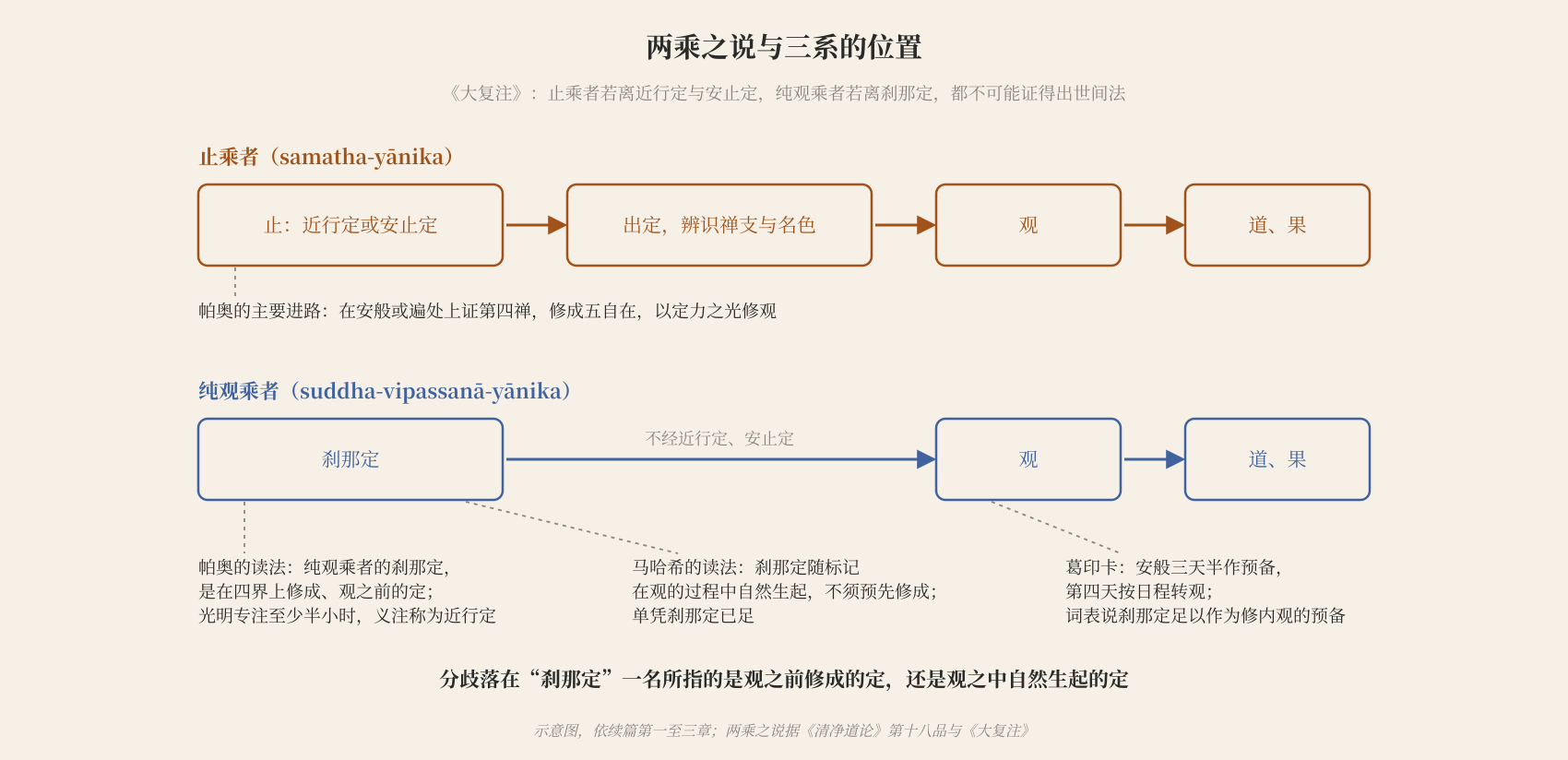
三系对修观之前要不要先得止的回答,可以并列如下(各系的判准见第二章第四节与第三章第一、二节):
| 帕奥 | 马哈希 | 葛印卡 | |
|---|---|---|---|
| 止的地位 | 主要进路是先证禅那再以定力之光修观;纯观乘者也须在四界上修到近行的光明 | 不另设止的阶段,刹那定在观的过程中自然生起 | 三天半的安般作为内观的预备 |
| 主要的乘 | 止乘为主,兼教纯观乘 | 纯观乘 | 不把学员分成两乘 |
| 止的所缘 | 作为概念的呼吸、遍相等;纯观乘者为四界 | 不另设;入门所缘是腹部的起伏,所觉知的是压触 | 鼻孔区域的自然呼吸,第二天起为同一区域内的身体感受 |
| 转观的时点 | 通常在第四禅及其五自在之后;近行定的光明亦可 | 一开始即修观 | 第四天,按课程日程 |
二、安般的经文与注释书
安般的修法以《入出息念经》与《念住大经》为经中依据,经文本身却很简略。《入出息念经》的第一组四事是:知吸气长、呼气长,知吸气短、呼气短,学习经验一切身而吸气、呼气,学习使身行宁静而吸气、呼气;经中说,这样修习时,比丘在身上随观身,因为入出息是诸身之中的一种身。16 《中阿含经》卷二十四〈念处经〉的平行段落作:“念入息即知念入息,念出息即知念出息,入息長即知入息長,出息長即知出息長,入息短即知入息短,出息短即知出息短;覺一切身息入,覺一切身息出,覺止身行息入,覺止口行息出。”17 经文没有数息,没有禅相,也没有说要在某种相上入定。《杂阿含经》卷二十九第 807 经记佛陀二月独坐,自述所修即是安那般那念:“入息時念入息如實知,出息時念出息如實知。若長若短,一切身覺入息念如實知,一切身覺出息念如實知。身行休息入息念如實知”,修到粗思惟止息之后,“更入微細思惟,多住而住”;经末称安那般那念是“聖住、天住、梵住、學住、無學住、如來住”。18 这一经把安般说成佛陀自己的住处,次第也止于入出息、长短、一切身与身行的休息,同样没有禅相。"一切身"指什么,经文本身不定:汉译作"一切身息",菩提比丘的英译在"whole body"之后用方括号补上"of breath",陈法菱依帕奥一系的理解,也说这里的"全身"与"身行"“不是指涉生理上的身體,而是「入出息身」”。19 这是一种读法,有汉译的支持,但读法本身属于注释传统。
《解脱道论》卷七〈行门品〉说安般,所说的"相"是触觉性的:“彼坐禪人以九小煩惱清淨心現念入息,彼相得起。名相者,如抽綿、抽古貝觸身成樂觸,如涼風觸身成樂觸。如是入出息風觸鼻口脣,念作風想,不由形色,此謂相。”相得自在之后,依次起喜、起舍,心不乱,诸盖灭而禅支起。同卷又说,有的修行人一开始见到"異相",如烟、如雾、如尘、如碎金,见种种色,心若不明了而对异相作异想,就成颠倒,不成出入息想;明了的修行人不作异想,异相随即消失。20 同卷还记先师所说的四种修法:算、随逐、安置、随观,数息从一数到十,或从一数到五。
《清净道论》第八品把对这一业处的作意分为八个阶段:数、连续、触、安置、观察、转离、清净、对这些的回顾,并逐一配属,数就是数,连续是持续不断,触是气息所触之处,安置是安止,观察是观,转离是道,清净是果,回顾是省察。数息时不可少于五,也不可超过十:少于五,心在窄处躁动,如牛群关在狭窄的栏里;超过十,心便以数字而不以呼吸为所缘。21 这一配属把从数息到证果的全程都安排在安般一个业处之内,帕奥的数息规定即出于此。
《清净道论》第八品记下两种说法。有人说,禅相对某些人显现为轻触,如棉、如丝棉、如风;注释书的说法则是,它对有些人显现如星、如宝珠串、如珍珠串,对另一些人如长绳、花环、烟,或如蛛网、云膜、莲花、车轮、月轮、日轮。觉音解释说,这一个业处所以显现各异,是因为想不同,禅相"生于想,以想为源,由想产生"。22 第八品还记下一项分歧:禅相出现后,学人去告诉老师,长部诵者说老师既不应说"这是相",也不应说"这不是相",免得学人自满而止步或灰心而放弃;中部诵者则说应告诉他"这是相,善哉"。23 觉音接着说,禅相一出现,诸盖即被镇伏,念得以建立,心即入于近行定;第四品则把近行与安止的区别说成禅支的强弱,近行时心一时以相为所缘、一时落入有分,如幼童被扶起站立而一再跌倒。24
文献的层次由此可以分出。经文讲的是呼吸、身行的寂止与四念住;《解脱道论》的相是鼻端唇上的乐触,视觉性的影像被归为异相;《清净道论》以光明影像为相,并承认它因人而异、由想而生。无著比丘指出,以禅相作为所缘去培育是后来传统的特色,经中的前身是《随烦恼经》(MN 128)所记佛陀与弟子在修定过程中遇到的光与色,但那部经并没有让光本身成为所缘。他又在注中指出,帕奥受注释书影响,把第一组的第四事读成暗指第四禅,所以要求学员先修完第一组、证得四禅、观完色法与名法,然后才修第二组。25 三种文本的差异列如下:
| 经(MN 118、《中阿含经》〈念处经〉、《杂阿含经》第 807 经) | 《解脱道论》卷七 | 《清净道论》第八品 | |
|---|---|---|---|
| 修法的次第 | 第一组四事:知长短、经验一切身、使身行宁静 | 算、随逐、安置、随观 | 数、连续、触、安置、观察、转离、清净、回顾 |
| 数息 | 无 | 从一数到十,或从一数到五 | 不少于五,不超过十 |
| 相 | 无 | 鼻唇间的乐触,"不由形色";视觉影像为"异相" | 有人说是轻触;注释书说如星、如珠串等光明影像,"由想产生" |
| 相与定 | 无 | 相得自在之后起喜、起舍,诸盖灭而禅支起 | 禅相一现,即入近行定 |
三、小结
本章交代了两件事。其一,三系在修观之前要不要先得止这一问题上的分岔,有一个共同的文本前提,即注释书的两乘之说:止乘者以近行定或安止定为基础修观,纯观乘者以复注所说的刹那定为基础。两乘在注释书里分量不等,《清净道论》的结构偏向先止;近代缅甸从雷迪起把纯观乘提升为首要,马哈希以纯观乘为主,帕奥以止乘为主而兼教纯观乘,葛印卡把安般定为三天半的预备。其二,帕奥与葛印卡所修的安般,经文只给出第一组四事,没有数息,也没有禅相;《解脱道论》以鼻唇间的乐触为相,把视觉影像归为异相;《清净道论》以光明影像为相,承认它由想而生,并把从数息到证果的全程安排在安般一个业处之内。第二章复述的帕奥安般,依据的是《清净道论》这一层。
参考文献
-
Henepola Gunaratana, The Path of Serenity and Insight: An Explanation of the Buddhist Jhānas, Delhi, 1985, p. 146:"Though all three terms appear initially in the commentaries rather than in the suttas, the recognition of the two vehicles seems implicit in a number of canonical passages." 三名指 samathayānika、vipassanāyānika(又称 suddhavipassanāyānika)与 sukkhavipassaka。书中所举的经证是《增支部》四种人之说(AN 4.92–94),见同书 p. 148。本章所用印本为 2013 年马来西亚免费流通重印本,版面与印本同。 ↩
-
Bhikkhu Ñāṇamoli (trans.), The Path of Purification, 4th ed., Kandy: Buddhist Publication Society, 2010, 第三品注 33:"The three kinds, that is, the preliminary-work sign, learning sign and counterpart sign, do not appear in the Piṭakas. There the use rather suggests association of ideas as, for example, at M I 180, M I 119, A I 4, etc., than the more definitely visualized 'image' in some instances of the 'counterpart sign' described in the following chapters." ↩
-
《清净道论》第十八品第 3 至 5 节。Bhikkhu Ñāṇamoli (trans.), The Path of Purification, 4th ed., Kandy: Buddhist Publication Society, 2010, XVIII.5:"But one whose vehicle is pure insight, or that same aforesaid one whose vehicle is serenity, discerns the four elements in brief or in detail in one of the various ways given in the chapter on the definition of the four elements." ↩
-
《清净道论大复注》(Vism-mhṭ 13),Ñāṇamoli 英译第一品注所引:"for without the access and absorption concentration in one whose vehicle is serenity, or without the momentary concentration in one whose vehicle is insight, and without the gateways to liberation (see XXI.66f.), the supramundane can never in either case be reached."同注又引 Vism-mhṭ 9–10:"for no insight comes about without momentary concentration." ↩
-
Gunaratana, The Path of Serenity and Insight, p. 148,所引经为 AN 4.92–94(Gunaratana 依 PTS 本卷页记作 AN 2:92–93;英译见 Bhikkhu Bodhi, The Numerical Discourses of the Buddha, Boston: Wisdom Publications, 2012, pp. 473–474):"The fact that individuals are capable of one attainment in the absence of the other provides a starting point for a differentiation of vehicles adapted to their differing capacities. In the end, however, all meditators have to enter upon the development of insight in order to reach the liberating path." 同页说注释书把"内心之止"释为安止心定,把"增上慧法观"释为摄受诸行的观智。 ↩
-
Erik Braun, The Birth of Insight: Meditation, Modern Buddhism, and the Burmese Monk Ledi Sayadaw, Chicago: University of Chicago Press, 2013, p. 139:"While the Visuddhimagga acknowledges this possibility of choosing between first cultivating calm or first pursuing insight, its structure suggests it prefers the former. … Mention of those who work without the jhānas are few." ↩
-
Kate Crosby, Theravada Buddhism: Continuity, Diversity, and Identity, Chichester: Wiley Blackwell, 2014, p. 146:"A key advocate was Ledi Sayadaw (see Chapter 7), who taught that the development of insight was sufficient and did not need to be supported by the practices labeled as samatha (Braun 2008: 5–6)." ↩
-
Braun, The Birth of Insight, pp. 138–139。Braun 所译雷迪原文:"The suttas and the commentaries say that one can move to the fourth stage [of practice, which is vipassanā] only after attaining the four jhānas through mindfulness of breathing. If one can proceed in this way, it is best. But if one cannot, one can also move to vipassanā from the third jhāna, from the second, or from the first. If one has not reached the jhānas, one can move to insight practice from access concentration or from the stage of noting the long and short breaths. One can also move to vipassanā from the stage of counting the breaths, when you have pacified the thoughts of the mind that run hither and thither." Braun 的判断:"What makes Ledi's approach distinctive, then, is that it gives preeminence to the 'dry' technique that was seemingly a secondary option in Buddhaghosa's view." ↩
-
Mahāsi Sayādaw, Manual of Insight, trans. and ed. Vipassanā Mettā Foundation Translation Committee, Somerville: Wisdom Publications, 2016, p. 57:"The principal emphasis of this book is to explain precisely this point: how those who take the vehicle of insight to enlightenment practice—that is, how to develop pure insight without a foundation of tranquility concentration." 刹那定一句见 p. 49:"Momentary concentration alone is enough for them to bring about the mental purification required for path knowledge and fruition knowledge." ↩
-
Pa-Auk Sayadaw, Knowing and Seeing: Talks and Questions-and-Answers at a Meditation Retreat in Taiwan, 2nd ed., © W. K. Ng, 2000, Editorial Note, pp. 11–12:"The talks are concerned mainly with the Sayadaw's principal approach to insight meditation: to practise tranquillity meditation first, after which to use it as a necessary vehicle for insight meditation. The Sayadaw teaches also pure-insight meditation, which is why he provides an exposition of the orthodox instructions for both methods." 本书所收是帕奥 1998 年在台湾新竹壹同寺两个月禅修营的开示与问答,编者说明开示与问答都是事先在帕奥禅林拟好的(p. 11)。 ↩
-
帕奥,Knowing and Seeing, p. 124:"When you can concentrate on this light continuously for at least half an hour, you have reached access concentration. With that light, discern the space-element in that transparent form, by looking for small spaces in it. You will find that the transparent form breaks down into small particles, which are called rūpa kalāpas." 同页与 p. 125 说纯观乘者可以把这一近行定当作修观时休息的堡垒。 ↩
-
《帕奥禅师佛学问答整理》(整理者与年份未署,无页码),前部〈慧學釋疑〉问答 41。 ↩
-
William Hart, The Art of Living: Vipassana Meditation as Taught by S. N. Goenka, Onalaska: Vipassana Research Publications 电子书(初版 Harper & Row, 1987),p. 7:"During the first three and a half days the participants practice an exercise of mental concentration. This is preparatory to the technique of Vipassana proper, which is introduced on the fourth day of the course." ↩
-
Crosby, Theravada Buddhism, p. 163:"While closely based on the Mahasatipaṭṭhāna Sutta, the vipassanā methods all incorporate Abhidhamma analyses into the four satipaṭṭhāna, as also found in the third division Visuddhimagga even though not all traditions accept the Visuddhimaga as a correct authority. There are variations in the way mindfulness, and any preparatory samatha, are to be developed." ↩
-
S. N. Goenka, The Discourse Summaries: Talks from a Ten-day Course in Vipassana Meditation, condensed by William Hart, Onalaska: Vipassana Research Publications, 2012 电子书(初版 Vipassana Research Institute, 1987),Day One, p. 11:"They are not permitted because the final aim of this meditation is not concentration of mind. Concentration is only a help, a step leading to a higher goal: purification of mind, eradicating all the mental defilements, the negativities within, and thus attaining liberation from all misery, attaining full enlightenment." 词表 p. 117,samādhi 条:"Of these, khaṇika samādhi is sufficient preparation in order to be able to begin the practice of vipassanā." ↩
-
《中部》第 118 经《入出息念经》§§18、24。庄春江译(庄春江工作站,agama.buddhason.org):“當吸氣長時,知道:『我吸氣長。』或當呼氣長時,知道:『我呼氣長。』或當吸氣短時,知道:『我吸氣短。』或當呼氣短時,知道:『我呼氣短。』學習:『經驗一切身地,我將吸氣。』學習:『經驗一切身地,我將呼氣。』學習:『使身行寧靜地,我將吸氣。』學習:『使身行寧靜地,我將呼氣。』”又:“比丘們!我說這樣是在諸身中身的一種,即:吸氣與呼氣。”英译见 Bhikkhu Ñāṇamoli and Bhikkhu Bodhi (trans.), The Middle Length Discourses of the Buddha, Boston: Wisdom Publications, 1995, pp. 943–945:"I say that this is a certain body among the bodies, namely, in-breathing and out-breathing."(§24) ↩
-
《中阿含经》卷二十四〈念处经〉(第 98 经)。同一段亦见卷二十〈念身经〉(第 81 经),彼处"覺"作"學"。 ↩
-
《杂阿含经》卷二十九第 807 经。经末全句:“若有正說,聖住、天住、梵住、學住、無學住、如來住,學人所不得當得,不到當到,不證當證,無學人現法樂住者,謂安那般那念,此則正說。”巴利对应为《相应部》54.11。 ↩
-
Ñāṇamoli and Bodhi, Middle Length Discourses, p. 944:"He trains thus: 'I shall breathe in experiencing the whole body [of breath]'." 帕奥一系的读法见陈法菱〈达至"心清净":帕奥禅师的"入出息念"教禅文本之引导解析〉,《正观》第 107 期(2023 年 12 月),第 67–126 页,引文在第 79 页。陈法菱所据是帕奥以缅语讲解《入出息念经》的录音,她称之为 ASR,并据以译成中文(第 79–80 页)。 ↩
-
优波底沙《解脱道论》卷七〈行门品〉之四,梁僧伽婆罗译。"異相"一段原文:“復有坐禪人從初見異相,如煙、如霧、如塵、如碎金,猶如針刺、如蟻所嚙,見種種色。若坐禪人心不明了,於彼異相心作異想,成顛倒,不成出入息想。若明了坐禪人不作異意想,念現入息,念現出息,離作餘想。若如是作意,異相即滅。”相得自在以下一段原文:“彼相自在,以相自在欲起修行,由欲自在念現入息、念現出息,起喜;已喜自在,已欲自在,念現入息、念現出息,起捨;彼已捨自在,已欲自在,已喜自在,念現入息、念現出息,其心不亂。若心不亂,諸蓋滅,禪分起。”四种修法见同卷:“復次先師說四種修念安般,所謂算、隨逐、安置、隨觀。” ↩
-
《清净道论》第八品第 189 至 190 节。Ñāṇamoli 译,VIII.189:"Here are the stages in giving attention to it: (1) counting, (2) connection, (3) touching, (4) fixing, (5) observing, (6) turning away, (7) purification, and (8) looking back on these. Herein, counting is just counting, connection is carrying on, touching is the place touched [by the breaths], fixing is absorption, observing is insight, turning away is the path, purification is fruition, looking back on these is reviewing." VIII.190:"And when counting, he should not stop short of five or go beyond ten or make any break in the series." ↩
-
《清净道论》第八品第 214 至 216 节。Ñāṇamoli, The Path of Purification, VIII.214:"some say that when it appears it does so to certain people producing a light touch like cotton or silk-cotton or a draught."VIII.215:"But this is the exposition given in the commentaries: It appears to some like a star or a cluster of gems or a cluster of pearls …"VIII.216:"It is born of perception, its source is perception, it is produced by perception." ↩
-
《清净道论》第八品第 218 节。Ñāṇamoli 译:"But [say the Dīgha reciters] the teacher should say neither 'This is the sign' nor 'This is not the sign'; after saying 'It happens like this, friend,' he should tell him, 'Go on giving it attention again and again;' … But the Majjhima reciters say that he should be told, 'This is the sign, friend. Well done. Keep giving attention to it again and again.'" ↩
-
《清净道论》第八品第 220 节:"So as soon as the sign appears, his hindrances are suppressed, his defilements subside, his mindfulness is established, and his consciousness is concentrated in access concentration."第四品第 33 节:"It is because they are not strong that when access has arisen, the mind now makes the sign its object and now re-enters the life-continuum, just as when a young child is lifted up and stood on its feet, it repeatedly falls down on the ground."(均据 Ñāṇamoli 译本) ↩
-
Bhikkhu Anālayo, Mindfulness of Breathing: A Practice Guide and Translations, Cambridge: Windhorse Publications, 2019, 第四章 "Contemplation of the Mind":"Although concern with the cultivation of such a nimitta is characteristic of later tradition, a precedent can be found in the Upakkilesa-sutta … The discourse does not give the impression that the light itself should become the object of meditation, in fact no object of meditation is described at all." 第八章注 19:"Influenced by the commentarial understanding that the fourth step is an implicit reference to the fourth absorption, Pa-Auk (no date) instructs the meditator to proceed from the first tetrad of mindfulness of breathing to mastery of the four absorptions and the cultivation of insight into materiality (by way of the kalāpas) and mentality (by way of the cognitive process) … Only after covering all this does he take up the second tetrad of mindfulness of breathing." 所据为该书电子版,无印本页码,按章与注引。 ↩