续篇第四章 观禅(上):马哈希的标记、观智与道果判定¶
止的三章复述了三系对修观之前要不要先得止的回答,第三章第四节归纳了三系判准的分布:帕奥落在止的一侧,马哈希并入观智的进度,葛印卡按日程转观。观这一边,三系的所缘都是名色,即身心现象的生灭,差别在用什么来判定修习者看到了哪一步:马哈希一系用观智的阶次表,帕奥一系用阿毗达磨的色聚、心路过程与三世缘起,葛印卡一系用旧行浮现为感受的模型。观的部分分为三章,本章复述马哈希一系,第五章复述帕奥一系,第六章复述葛印卡一系并作三系的归纳。导论第三章第二节说,马哈希系的方法以当下标记为法,不以论书研习为前提,可能的僵化在另一端,即十六观智的进度地图在小参核对中成为阶位认定的标准清单。本章按马哈希一系自己的文献复述这句话所涉的三件事:座上怎样标记,观智的阶次表怎样写定、怎样使用,道果怎样判定。判断留到第十章。
所据文献分三层。第一层是经与论:《中部》第 24 经《车经》与《中阿含经》卷二〈七车经〉所列的七清净,《无碍解道》论母所列的诸智,《清净道论》第十八至二十二品,《摄阿毗达磨义论》第九品的十观智。第二层是马哈希一系的教本:马哈希 1945 年以缅文写成、2016 年译为英文的 Manual of Insight,本章主要用其第五章"实修指导"与第六章"观智的阶次";他先以缅文写成、1950 年译为巴利文的《内观进程》(巴利本题 Visuddhiñāṇakathā,向智尊者 1965 年英译为 The Progress of Insight,温宗堃中译题《清净智论》);入门手册 Practical Insight Meditation;向智尊者 The Heart of Buddhist Meditation 中记马哈希禅修中心课程的一章;班迪达禅师的开示集 In This Very Life。1 第三层是研究:Jordt 在仰光马哈希禅修中心所作的民族志,Crosby 论缅甸内观的段落,菩提比丘论"纯粹注意"一语的文章,无著比丘论观智表来历的论文。
几个名目的时代须先交代。七清净的名目见于《车经》与〈七车经〉,经中舍利弗与满慈子一问一答,只说七者依次相续而趣向无余涅槃,不说每一清净包含哪些智;把观智逐项配入七清净的后五项,是《清净道论》的安排。观智(vipassanā-ñāṇa)的列举最早见于《无碍解道》,属论书层,十六之数是后来据《清净道论》归纳的;十种观染(vipassanūpakkilesa)也首见于《无碍解道》,由《清净道论》加以解说;道智、果智被理解为刹那之事,在《无碍解道》中已经如此。刹那定是复注的名目,已见第三章第一节。"标记"是马哈希一系的修法用语,英译作 noting 或 labeling。下文凡用到这些名目,都是复述马哈希一系所依的体系,不当作早期经典的用语。
一、马哈希的标记法
马哈希的标记法出自明贡长老(Mingun Jetavan Sayadaw,U Nārada,1868–1955)一系。向智尊者记,U Nārada 在二十世纪初遍访缅甸的禅修者,未得满意的指导,后在实皆山区遇到一位传说已入圣道的比丘,对方反问他为什么在佛语之外寻找,并说念处这条唯一之道佛已宣说;他于是回头研读经文与传统的解释,依之实修,确定了这一方法的要点。向智称之为"缅甸念处法",并说明这不是缅甸人的发明,只是古道在缅甸复兴。2 Crosby 说,经马哈希下传的这一法脉又称"新缅甸法""马哈希法",或径称"上升与下降"。3
以腹部的起伏作主所缘,是马哈希引入的,入门的指导已见第三章第一节。4 Jordt 指出,佛陀的话里没有一处明说要观腹部的起伏,马哈希的书为此专门举证。5 Manual of Insight 的举证是:腹部的起伏是风界的显现,属触所缘,观它时所觉知的压与动正是风界的特相;《相应部》蕴相应、六处相应与界、谛诸经,以及《念住大经》的法念处与身念处,都要人如实观色、触、风界为无常、非我、苦谛所摄,所以观腹部起伏合于佛陀的教导。6 向智另作一点区分:腹部的起伏虽由呼吸引起,观它不应看作入出息念的一种,所观的是腹部起伏时的轻微压感,不是呼吸。7 第三章第三节所记克明达长老的批评,则把它看作一种以腹部为所缘的呼吸练习。
标记的程序,Manual of Insight 第五章用日常语言写出。修习者把心放在腹部,吸气时腹部上升,心里标作"上升",呼气时下降,标作"下降",默标而不出声,也不为使起伏明显而改变呼吸。8 起了念头,按其内容标作"想""白日梦""想象""思量""游走"之类,标过即回到腹部;想吞咽,身体僵硬、发热、发痒、疼痛,先标那个感受,想动时标"想动",动时逐一标各个动作,动作都放慢。9 约一天后若觉得只标起伏太容易、起伏之间有空隙,就加上"坐"作第三个所缘,再不够,可加身上一处触点作第四个;平常的看与听不必标,有意去看去听、或声色明显时才标两三次;懒惰、怀疑、期待、沮丧、欢喜等心态,起时也标。10 时间上,除睡眠之外,昼夜不断地标。11 班迪达禅师的指导相同,并补充说,标记用一个简单的词最好,眼、耳、舌三门就说"看""听""尝",身上的感受可选"暖""压""硬""动"一类稍带描述的词。12
标记所用的词与所觉知的对象,几种教本分得很清楚。马哈希承认,初学时不可避免地带着腹部形状一类的概念,开始只能在概念的层次上观,观智成熟后才会穿透概念而达究竟实相。13 Practical Insight Meditation 说,不要口头重复"上升""下降",也不要把它们当作词来想,只觉知腹部起伏的实际过程。14 向智尊者说得更细:心里默念的两音节的词,只是让注意在每一个知觉上停留那么长的时间,熟悉了节奏就放下;所念的对象是各个感受,既不是触点的位置,也不是"触""坐"这两个词。15 班迪达禅师说,标记的用处是帮助修习者清楚地知觉经验的实际性质,而不陷入经验的内容。16 到了所缘生灭极快的阶段,马哈希不再要求逐一命名:标一个所缘时可能已觉知到四五个乃至十个,一一命名会使人疲倦,此时只须刹那刹那地觉知,最重要的是对每一所缘觉知得准确。17 Jordt 的概括是,学员开始时用概念性的标签把注意引向确切的对象,后来标签脱落,只经验到感觉的硬、热、动等性质。18 依这些说法,标记是一种随阶段去留的辅助,它所要成就的是觉知的准确与连续。
"纯粹注意"(bare attention)一语出自向智尊者。菩提比丘说,据他所知,第一个用这一说法刻画正念的就是向智。19 向智的定义是:在相续的知觉刹那里,对发生在自己身上、身内的事作清楚而专一的觉知;只记录所观察的事实,不以行为、言语或心中的评论去回应,评论若起,它本身也成为纯粹注意的对象,作一个简短的标记之后放下。20 他在《内观进程》英译的注中说,书中的关键词 sallakkhaṇa(动词 sallakkheti,字面义是"清楚地标出")译作 noticing,与他书中所说的纯粹注意是同一回事。21 菩提比丘指出,向智并不认为纯粹注意是非概念、非语言的,他所修过的马哈希体系强调对经验的各个成分作精确的标记;菩提比丘本人认为,这一说法作为修习的程序指引可以接受,作为对正念的理论描述则有问题,因为"注意"是作意(manasikāra)的通行译词,作意与念(sati)的作用不同。22
标记的单位,也是小参报告的单位。班迪达禅师说,密集禅修期间个别小参尽量每天举行,报告约十分钟,先报过去二十四小时坐禅与经行各多少小时,再从主所缘腹部起伏说起描述坐禅;每一个所缘都按三步报告:发生了什么,怎样标记它,标记之后它怎样了;报告只限于直接经验到的,不包括想象、观想与意见。23 他说,清楚准确的报告使老师能够评估修习,指出错误。24 Jordt 所见的马哈希禅修中心也是如此:新学员先报自上次报告以来坐与行的时数,老师据此估计学员用了多少精进、得到多少定,作为判断其报告的证据之一。25 几种教本对标记的规定,归纳如下:
| 项目 | 规定 | 出处 |
|---|---|---|
| 主所缘 | 腹部的上升与下降;所觉知的是压与动,属风界 | Manual of Insight, pp. 264–265;Practical Insight Meditation, pp. 3–4 |
| 与入出息念的关系 | 起伏由呼吸引起,所观的却不是呼吸,不应看作入出息念的一种 | 向智, p. 95 |
| 用词 | 日常语言,一个简单的词最好;默标,不出声 | Manual of Insight, pp. 265–266;班迪达, p. 15 |
| 词与所缘 | 不把"上升""下降"当作词来想;词只定注意停留的时长,熟悉节奏后放下 | Practical Insight Meditation, p. 4;向智, p. 95 |
| 不必命名的时候 | 所缘生灭极快时,只须刹那刹那觉知,不必一一命名 | Manual of Insight, p. 282 |
| 范围与时间 | 渐次加入坐、触点与一切动作、心态;除睡眠外昼夜不断 | Manual of Insight, pp. 273–275 |
| 报告 | 每天小参约十分钟;先报坐、行的时数,再按"发生了什么、怎样标记、标记后怎样"三步报告 | 班迪达, pp. 24–27 |
二、观智的阶次表
观智的阶次表在马哈希一系是衡量进度的主要标准。Crosby 说,缅甸内观的进步主要按修习者对观智的经验来衡量,所依的是《摄阿毗达磨义论》的十观智。26 Jordt 记一位马哈希系比丘的话:以观智来衡量修行,是从马哈希的时代开始的,此前人们不这样衡量。27 Jordt 的报道人与马哈希系的教师手册说的则是十六观智。28 十与十六之差,出在这张表的层层增订上。
阶次表的名目由几层文献分别写定。七清净的名目与次第见于经,〈七车经〉作:“以戒淨故,得心淨,以心淨故,得見淨,以見淨故,得疑蓋淨,以疑葢淨故,得道非道知見淨,以道非道知見淨故,得道跡知見淨,以道跡知見淨故,得道跡斷智淨,以道跡斷智淨故,世尊沙門瞿曇施設無餘涅槃也。”29 经文到此为止,各清净的内容没有交代。《无碍解道》开卷的论母列七十三智,其中第四至十四项依次是法住智(即摄受缘的慧)、思惟智、生灭随观智、随观坏灭的慧(论母径称为观智)、过患智(即现起怖畏的慧)、行舍智(即欲解脱、审察、安住的慧)、种姓智、道智、果智、解脱智、省察智;这里怖畏与过患合为一智,欲解脱与审察并入行舍,没有名色分别智、厌离智与随顺智。30 《清净道论》把这些智分配到七清净的后五项:第十八品见清净讲名色的辨识,第十九品度疑清净讲摄受缘,第二十品道非道智见清净从思惟智讲起,到生灭智初起时的十种观染,认出观染不是道即成此清净;第二十一品说,行道智见清净由八智与第九的随顺智构成;第二十二品说,种姓智既不属第六清净,也不属第七清净,智见清净本义是四道智。31 《摄阿毗达磨义论》第九品列十观智,从思惟智到随顺智,其七清净表把思惟智与幼弱的生灭智配给第五清净,成熟的生灭智以下配给第六清净。32 温宗堃的中译附录指出,《摄阿毗达磨义论》只说十观智,注释书则把名色分别与缘摄受也当作观智,连种姓智共十三种。33 两份清单相比,通行的十六观智是在十观智之前加名色分别智、缘摄受智,之后加种姓智、道智、果智与省察智。各项与出处列如下:
| 序 | 观智 | 巴利 | 七清净 | 《无碍解道》论母 | 《清净道论》 | 《摄阿毗达磨义论》十观智 |
|---|---|---|---|---|---|---|
| 1 | 名色分别智 | nāmarūpapariccheda-ñāṇa | 三、见清净 | 无此项 | XVIII | 不在其内 |
| 2 | 缘摄受智 | paccayapariggaha-ñāṇa | 四、度疑清净 | 第 4 项,称法住智 | XIX | 不在其内 |
| 3 | 思惟智 | sammasana-ñāṇa | 五、道非道智见清净 | 第 5 项 | XX.2 起 | 第一 |
| 4 | 生灭智 | udayabbaya-ñāṇa | 幼弱时属第五,成熟时属第六 | 第 6 项 | XX.93 起;XXI.3 起 | 第二 |
| 5 | 坏灭智 | bhaṅga-ñāṇa | 六、行道智见清净 | 第 7 项 | XXI.10 | 第三 |
| 6 | 怖畏智 | bhaya-ñāṇa | 第六 | 第 8 项,与过患合为一智 | XXI.29 | 第四 |
| 7 | 过患智 | ādīnava-ñāṇa | 第六 | 同上 | XXI.35 | 第五 |
| 8 | 厌离智 | nibbidā-ñāṇa | 第六 | 无此项 | XXI.43 | 第六 |
| 9 | 欲解脱智 | muñcitukamyatā-ñāṇa | 第六 | 第 9 项,并入行舍 | XXI.45 | 第七 |
| 10 | 审察智 | paṭisaṅkhā-ñāṇa | 第六 | 同上 | XXI.47 | 第八 |
| 11 | 行舍智 | saṅkhārupekkhā-ñāṇa | 第六 | 第 9 项 | XXI.61 | 第九 |
| 12 | 随顺智 | anuloma-ñāṇa | 第六,为其终点 | 无此项 | XXI.128 | 第十 |
| 13 | 种姓智 | gotrabhū-ñāṇa | 不属第六,亦不属第七 | 第 10 项 | XXII.1、5 | 不在其内 |
| 14 | 道智 | magga-ñāṇa | 七、智见清净 | 第 11 项 | XXII.2–14 | 不在其内 |
| 15 | 果智 | phala-ñāṇa | 随道智之后 | 第 12 项 | XXII.15 | 不在其内 |
| 16 | 省察智 | paccavekkhaṇa-ñāṇa | 随果智之后 | 第 14 项 | XXII.19–21 | 不在其内 |
论母第 13 项的解脱智不在十六观智之内。表中名称依温宗堃的中译,思惟智温译作"触知智(思惟智)"。
无著比丘认为,作为当代内观框架的这套观智,是上座部历史发展的产物;早期经典里找不到这样一张表,但有其前身。34 前身是一种见于诸部传本的次第:《长部》第 33 经与汉译《长阿含》《中阿含》《杂阿含》都有"无常想、无常苦想、苦无我想"的次第,《增一阿含》作"无常,无常者即是苦,苦者即是无我";他把生灭、坏灭两智看作对无常的观,怖畏至欲解脱诸智归于对苦的观,其后诸智落实对无我的观。35 表的起点与终点则偏离早期思想:名色分别智依《清净道论》把"名"界定为包括识在内的四无色蕴,早期经典里的"名"指受、想、思、触、作意,不含识;道、果在《无碍解道》已被理解为刹那之事,早期经典里的"道"可以指长达多年的修行历程。36 中段诸智里,无著比丘单独指出怖畏智在早期经典里找不到对应;经中虽有毒蛇、杀手、吞热铁丸一类激起急迫感的譬喻,却没有把恐惧当作观的高阶所必经的体验,《无碍解道》也还把怖畏与过患合为一智。37 无著比丘同时声明,指出这些差异并不是说《清净道论》的阶次表有错,只是说它是关于观怎样展开的一种特定的表述。38
马哈希把这张表写成了修习者可以对照的进度。《内观进程》开头说,这部书是为已得殊胜成就的修习者略写的,让他们易于了解自己的体验;修习者以腹部起伏或身触为主所缘,渐次观到六门的名色,直至见法、度疑。39 班迪达禅师为巴利本所写的序说,缅文本是佛历二四九二年应几位在家学员之请写的,他们说马哈希先前所写的两册内观方法太详细,少闻的人难以阅读、理解与记持。40 向智尊者的英译序说,这部书原本不打算出版,缅文本或巴利本的手抄本、打字本只给在禅修中心完成一期严格修习且有所成就的人;外国学员只拿到几页油印的英文,简述各阶观智,用意是让禅修者把自己的经验认作所述的某一阶,据以调整此后的修习,不为次要的现象所误导。1954 年马哈希同意以缅文字母刊印巴利本,此后又允许英译。41 书中逐阶写出的标志,大多是修习者可以在小参中报告的身心现象:痛受、影像、光明、喜、姿势上的不安,以及专注持续的时长。下图把七清净的后五项、十六观智与《内观进程》为各阶所记的标志排在一起,左侧的虚线回环表示证初果之后再修时,从生灭智起重走到行舍智。
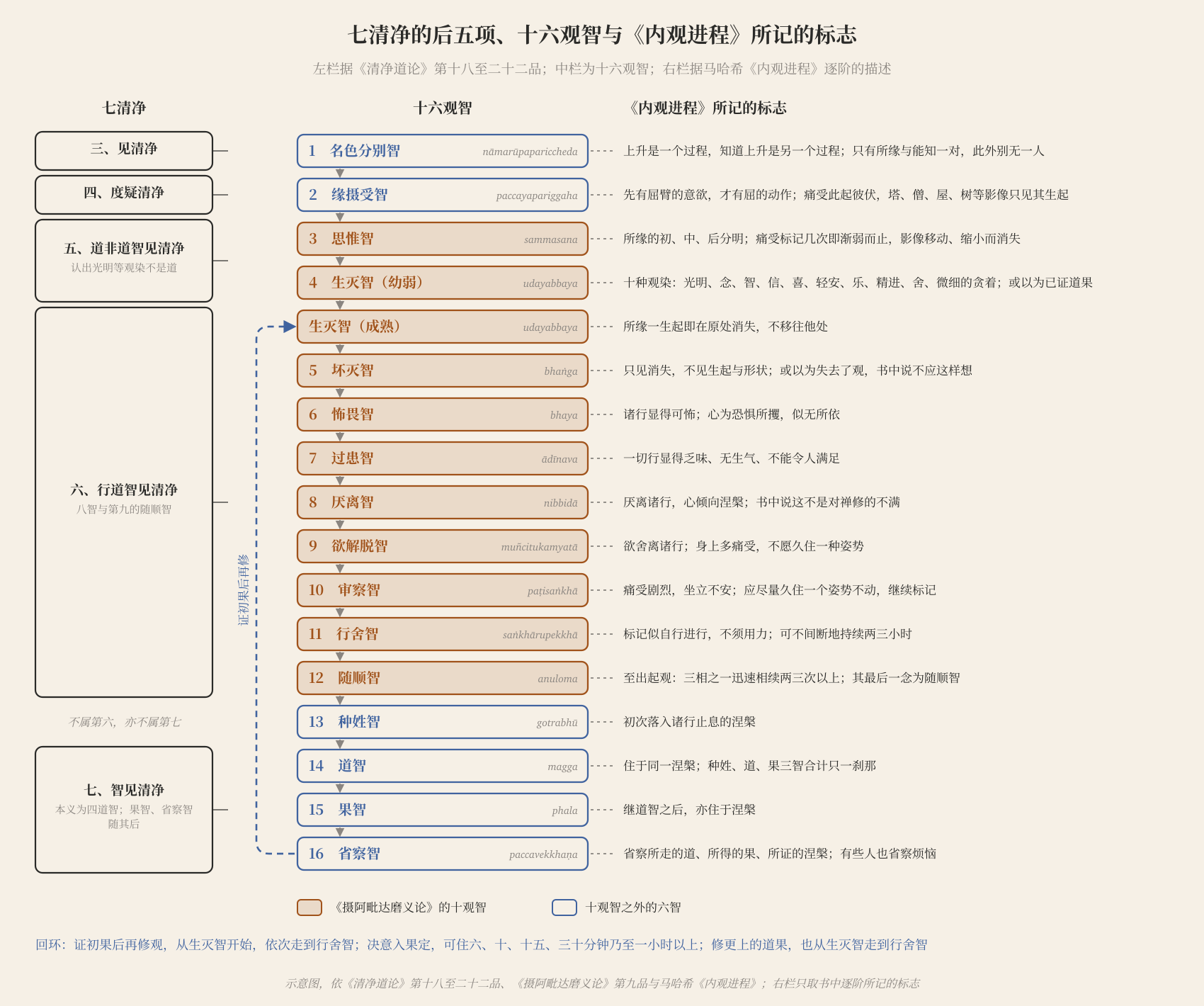
各阶的标志,《内观进程》依次写出。思惟智之前,痛受此起彼伏,塔、僧、屋、树、云一类影像接连出现,修习者只见其生起;到思惟智,能见所缘的初、中、后,痛受标记几次便渐弱而止,影像移动、缩小而消失。42 生灭智初起时,十种观染相继出现:光明,强念,锐利的智,强信,五种喜,轻安,乐,不缓不急的精进,舍,以及对这些的微细贪着;修习者往往认为自己必定已证出世间的道果、禅修已经完成,把非道当作道。认出光明等不是道、只有继续标记才是观之道,这一决断可以出于修习者自己,也可以出于别人的指导,书中称之为道非道智见清净。43 坏灭智时只见消失,不见生起与形状,修习者可能以为失去了观;怖畏智时,心为恐惧所攫,似无所依;审察智时常有剧烈的痛与坐立不安,应尽量久住一个姿势不动;行舍智时,标记似自行进行,可不间断地持续两三小时。44 种姓智、道智、果智合计只一刹那,如一念标记之长,之后的省察智省察所走的道、所得的果与所证的涅槃,有些人也省察烦恼。45
阶次表同时规定了怎样读这些现象。马哈希在几处特意说明某一现象不是它看来的样子:坏灭智时以为失去了观,不应这样想;厌离智时心若不满、无精打采,这并非对禅修的不满,正是厌离智;观染中的光明与喜乐不是道,喜爱它们就是走在错路上,正确的观之道只是继续标记。46 Manual of Insight 另区分两种恐惧:见诸法迅速坏灭而生的恐惧与无力,是修习正常进展的标志;若长时陷于这类思惟、带着不悦而怕得受不了,这种基于不悦的恐惧不是观智,所以要把那些思惟一一标记。47 欲解脱智一段说,有些修习者不能自己得出继续修下去的结论,老师向他们解释了他们的体验之后,他们才能继续修习。48
修习期间要不要让修习者知道这张表,马哈希一系的文献多主张不让。向智记马哈希禅修中心的课程说,学员不应受别人暗示他可能看到或应当看到什么的影响,所以开始时不作理论讲解,只给做什么、不做什么的指示。49 Manual of Insight 说,知道或听说过观智阶次的人,行舍智阶段的起伏会更多,所以最好不要预先学习观智怎样推进。50 Jordt 说,教师手册保密,以免没有经验的人读了之后试图预期下一步而受阻;Crosby 说,内观圈子里谈论高阶的证得,是老师与学生一对一的事,有隐私与礼节上的约束。51 同一传统的另一些文献则公开写出整个阶次。Manual of Insight 以缅文分两册出版,第五章用日常语言描述各阶的体验,马哈希说这些说明对中等智力的人已经足够,照着修习可以证得诸观智与道果,同时又劝人在有经验的老师指导下修习;《内观进程》的巴利本 1954 年刊印,英译 1965 年出版。52
证得初果之后,这张表成了可以按决意重走的程序。《内观进程》说,圣者再修观时通常从生灭智开始;决意入果定时,从生灭智依次升到行舍智,定力圆满则心入于果定,可以决意住六、十、十五或三十分钟,乃至一小时以上;修更高的道果,同样从生灭智走起,不像初修时那样难,一天甚至一小时就能到行舍智。53 Manual of Insight 第五章写得更具体:怖畏、过患、厌离、欲解脱诸智若因久未经历而不清楚,可以为每一智决意一段时间,例如决意"愿生灭智持续半小时",它就在这段时间内出现,期满之后下一智自然出现,不出现就再决意下一智;修习者会发现所得的智像罗盘的指针一样,在满意于当前一阶之后转向下一阶。54 修更高的道果,要先定下修多少天,并决意在此期间不入已得的果定。55
三、道果的判定
马哈希一系的判定分两层。观智到了哪一层,由老师据小参报告判断,并有一份内部手册;道果在名义上不由老师认证,马哈希说只有佛能确认,学员靠省察智、法镜与听观智的录音自知。实际上,长时入果定被当作向老师与同修表明证得的办法,会内某些职位要求"通过课程"。
名义上的立场,Manual of Insight 第六章讲得完整。它引《相应部》的法镜:圣弟子成就对佛、法、僧的不坏净信与圣者所爱的戒,若愿意,可以自己记说自己是入流者。马哈希的解释是,在家人反复省察自己具足这四项之后,可以自己断定已证入流,必要时告诉同一阶位的人;不需要别人确认,因为除了佛,没有人能确认。但禅修老师有责任向学员讲解观智的次第、道智与果智、省察智与法镜,因为大多数圣者说不全自己经历过的观智及其特征,也不能分辨哪些烦恼已断、哪些未断,好比旅人经过陌生之地,没有人告诉就叫不出沿途各处的名字。56 比丘若是圣者,只能依律中容许的"说实"(bhūtārocana)向同修透露,用意限于让他们欣赏法的功德、生起修习的兴趣。57 Jordt 记马哈希禅修中心的说法相同:老师永远不能确知学员是否证悟,据说只有佛有这种知识;依比丘的波罗提木叉,宣称证得可被逐出僧团,在家人没有这一禁忌,但这样做被认为不得体,不像真有成就的人;比丘替学员宣称证得极为审慎,通常只在与其他老师讨论学员进度时才说。58
学员自知的途径有三。其一是省察智:道果之后必有的是省察道、果、涅槃,省察已断与未断的烦恼则只见于学过哪一道断哪些烦恼的人。59 其二是法镜,已见上段。其三是录音:马哈希禅修中心在朔望日播放马哈希讲观智阶次的录音,只给老师判定已深入若干观智的学员听,学员听后自己判断经历了什么;Jordt 说这一"自己知道"的程序是马哈希为避免宣称证得的两难而设的,课后学员之间以"听过录音没有""课程通过了没有"相询,暗指已证初果。60 马哈希也限定了可以拿经典来核对的项目,只有五项:到随顺智为止的观智次第,出起观的特殊出现,随顺智最后一念自行落入涅槃,省察智的出现,以及其后回到生灭智;道心过程中的各个心刹那,修习者无法分辨,不应去分析。61
观智层次的判定落在老师一边。班迪达禅师为观智列表附了一句告诫:修习者不要去想进度,即使最有经验的禅修者也不可能评估自己的修习,只有老师在长期的亲身经验与训练之后,才能开始在别人的口头报告里辨认这一进程的细微迹象。62 Jordt 说,马哈希把小参中学员的禅修经验记录下来,也要门下老师照做,汇集分析,以找出趋向观智途中心理模式的规律,结果成为一份手册的基础,用来指导日后的老师小参,并判断学员达到的观智层次。63 她在注中说明,这份手册题为 "Meditation Teacher's Diary (or) Records",是两位僧人在马哈希督导下编成的,未出版,只在师徒之间传递。64 手册由在家护持组织 Nuggaha 控制分发,经导师长老(nayaka sayadaw)建议的僧人教师才能领到一册;Nuggaha 主席告诉她,到 1995 年,原印一百册中有九十册仍在会所。65 手册的导言说,没有修过内观、或修得不够久而未达全部十六智的人不应看这本书,因为知道了内容就会对它形成观念,或者生起怀疑,修习时想到这些,所得的智就不纯,夹杂了读来的知识。66 手册按描述经验的清楚程度把学员分为三型:第一型能有系统地讲清楚,老师只须听;第二型不能按刹那与次第描述,老师可问引导性的问题,并问一些尚不可能遇到或与其状况无关的经验,有时把错的说成对的,以测试他说的是否亲历;第三型讲不好,一被引导就答出从别人那里听来的话,对这一型不可给提示,只问可作两种回答的问题,让学员猜不出老师想知道什么。67 Jordt 说,这些手段的用意,是尽量确定学员的体验是真正的观智,而不只是概念。68
道果在名义上不由老师认证,实际上有几种让证得被看见的做法。第一种是果定。Manual of Insight 讲证果的利益时说,圣者经常长时入果定,可以使老师与同修确信其已证道果;入果定前可决意时长,五分钟、十分钟、十五分钟、半小时、一小时、两小时或更久,智锐利的人才可能住满所定的时间。69 Jordt 记,证得之后,学员决意重新省察趋向涅槃的过程,以自行验证,老师再令其决意长住果中;据说中心有学员如此决意之后坐着两天不动,班迪达禅师还嘱咐学员在决意里加一条,若禅修之处失火,即使时间未满也要自动出定。70 第二种是会内的资格:Nuggaha 与妇女福利会的执行委员都须"通过课程"(passing the course),听过观智录音也被当作证得的一种证明。71 第三种是一度出现的信物:马哈希访问斯里兰卡时得到几颗阿罗汉舍利,转赠学员,一时被传为他认可受赠者证悟的标志;他起初不知道人们这样看待,知道之后就不再赠送,并声明受赠与否与修习无关。72 判定的名义与实际,列如下:
| 层面 | 名义上 | 实际上 |
|---|---|---|
| 谁确认道果 | 只有佛能确认,不需他人确认(Manual of Insight, p. 431);老师不能确知(Jordt, p. 66) | 老师据小参报告判定观智层次,有一份限制流通的教师手册(Jordt, pp. 66–69, 228) |
| 学员怎样知道 | 省察智省察道、果、涅槃(Manual of Insight, p. 419);依法镜自己断定(p. 431) | 朔望日的观智录音,只给老师判定已深入若干观智的学员听(Jordt, p. 66) |
| 怎样让人知道 | 在家人必要时可告诉同一阶位者(Manual of Insight, p. 431);比丘只能依"说实"向同修透露(p. 432),宣称证得可被逐出僧团(Jordt, p. 66) | 经常长时入果定,可使老师与同修确信(Manual of Insight, p. 447);老师令学员决意长住果定(Jordt, p. 82) |
| 会内的资格 | 无明文 | Nuggaha 与妇女福利会的执委须"通过课程"(Jordt, p. 83) |
| 信物 | 无明文 | 马哈希所赠舍利一度被传为认可证悟的标志,他知道后停送(Jordt, p. 83) |
与帕奥一系相比,两系的结构相同:老师在名义上不认证道果,实际上有一套依学员报告判定层次的程序。帕奥一系的三项检查与"过关"之说,以及帕奥自称从不印证任何人证得禅那与道果,已见第二章第四节。差别有两点:第二章所述的三项检查确认的是禅那,落在止的一侧,马哈希一系判定的是观智的层次,落在观的一侧;马哈希一系把判定的经验写成了一份成文的教师手册,并由在家组织控制其流通。格鲁一系的证得同样不宣说,判准在当事人心里(第二篇续篇《宗喀巴禅法》第六章第三节);马哈希一系在不宣说之外,另有供老师逐阶核对的手册与供学员自知的录音。马哈希本人怎样对待自己的证得,第七章第三节再作讨论。
四、小结
本章复述了马哈希一系观的三件事。其一,标记法:以腹部起伏为主所缘,以日常语言默标一切身心现象,昼夜不断;标记的词只是辅助,所观的是感受本身,所缘生灭极快时可以不再命名;标记的单位也是小参报告的单位。其二,观智的阶次表:七清净的名目见于经,观智的列举始于《无碍解道》,由《清净道论》分配到七清净的后五项,《摄阿毗达磨义论》定为十观智,通行的十六观智在其前后各有增补;无著比丘认为这张表是历史发展的产物,早期经典有其前身而无其表,怖畏智在早期找不到对应。马哈希在《内观进程》里为各阶写出可报告的标志,并规定怎样读这些现象;表在修习期间不交给修习者,证果之后则成为可以按决意的时限重走的程序。其三,道果的判定:名义上只有佛能确认,学员靠省察智、法镜与观智录音自知;实际上观智层次由老师据报告判定,有一份限制流通的教师手册,长时入果定可以使老师与同修确信,会内职位要求通过课程。这些做法合不合理,本章不作判断,留给第十章。
参考文献
-
Mahāsi Sayādaw, Manual of Insight, trans. and ed. Vipassanā Mettā Foundation Translation Committee, Somerville: Wisdom Publications, 2016, Managing Editor's Preface, p. xxiii:"Mahāsi Sayadaw wrote Manual of Insight in Seikkhun, west of Mandalay, over a seven-month period in 1945". 同页说缅文原本分两册出版。《内观进程》见 Mahāsi Sayādaw, The Progress of Insight through the Stages of Purification, trans. Nyanaponika Thera, Kandy: The Forest Hermitage, 1965, Translator's Foreword, p. ii:"This treatise was first written in the Burmese language and later, in 1950, a Pāli version of it was composed by the Author." 中译见马哈希尊者著、温宗堃译《清净智论》(巴汉对照),2006 年 8 月网络修订版。下文 Manual of Insight 与《内观进程》只注书名与页码。 ↩
-
Nyanaponika Thera, The Heart of Buddhist Meditation, New York: Citadel Press, 1969(美国初版;原为 1962 年伦敦 Rider 本), pp. 85–86。p. 85 所记反问:"'Why are you searching outside of the Master's word? Has not the Only Way, Satipaṭṭhāna, been proclaimed by Him?'" p. 86:"we propose to call it here the Burmese Satipaṭṭhāna Method; not in the sense that it was a Burmese invention but because it was in Burma that the practice of that ancient Way had been so ably and energetically revived." 同页记 U Nārada 卒于 1955 年 3 月 18 日,享年八十七。下文此书只注"向智"与页码。 ↩
-
Kate Crosby, Esoteric Theravada: The Story of the Forgotten Meditation Tradition of Southeast Asia, Boulder: Shambhala Publications, 2020, p. 40:"The lineage from the first Mingun Sayadaw via Mahasi Sayadaw is also known as the 'New Burmese Method' or the 'Mahasi Method,' or sometimes as 'rising and falling.'" 同页记明贡长老 U Nārada 生卒为 1868–1955。 ↩
-
《内观进程》注 4, p. 27:"The attention directed to the movement of the abdomen, was introduced into the methodical practice of Insight-meditation by the author of this treatise, the Venerable Mahāsi Sayadaw, and forms here the basic object of meditative practice." 向智, p. 94 同。 ↩
-
Ingrid Jordt, Burma's Mass Lay Meditation Movement: Buddhism and the Cultural Construction of Power, Athens: Ohio University Press, 2007, p. 227 注 10:"Nowhere in the actual words of the Buddha (as found in the canonical texts) is it stated that one should specifically undertake observation of the rise and fall of the abdomen." 同注说,与马哈希同时代的孙伦、莫哥两位禅师教人观鼻端的出入息,两边为此长期相争,争执主要在弟子之间。 ↩
-
Manual of Insight, pp. 265–266。p. 265:"The rise and fall of the abdomen is a manifestation of the air element, one of the types of tactile, physical phenomena. When observing the rise and fall, you will experience pressure and movement—characteristics of the air element". p. 266:"Therefore, observing the rise and fall of the abdomen is clearly consistent with the teaching of the Buddha, because one understands the pressure and movement of the air element as it really is." ↩
-
向智, p. 95:"Though it is the breathing which causes the abdominal movement, the attention directed to the latter must not be regarded as a variety of the 'Mindfulness of Breathing' (ānāpānasati). In the practice described here the object of mindfulness is not the breath but just the rise and fall of the abdomen as felt by the slight pressure." ↩
-
Manual of Insight, pp. 264–265。p. 264:"When breathing in, you will experience the rising movement of the abdomen. Note this as 'rising.' When breathing out, you will experience the falling movement. Note this as 'falling.'" p. 265:"A meditator should do this mentally, not audibly. Do not make the breath more vigorous than usual so as to make the rise and fall more distinct". ↩
-
Manual of Insight, pp. 266–268;p. 266:"When this happens, you note them using everyday language." ↩
-
Manual of Insight, pp. 273–275;p. 273:"After about a day, you are likely to feel that simply noting the rise and fall of the abdomen is too easy." ↩
-
Manual of Insight, p. 275:"In this way, you should continuously and uninterruptedly note all day and all night, except during the hours of sleep." 同一规定见 Practical Insight Meditation, p. 15,已见第三章第一节。 ↩
-
Sayadaw U Pandita, In This Very Life: The Liberation Teachings of the Buddha, trans. U Aggacitta, ed. Kate Wheeler, 2nd ed., Boston: Wisdom Publications, 1993, pp. 14–15。p. 14:"One helpful aid to precision and accuracy is to make a soft mental note of the object of awareness, naming the sensation by saying the word gently and silently in the mind". p. 15:"In making the verbal label, there is no need for complex language. One simple word is best." 下文此书只注"班迪达"与页码。 ↩
-
Manual of Insight, p. 264:"Initially, of course, it is almost impossible to avoid a conceptual sense of solid form. So in the beginning, you must observe objects on a conceptual level. … In due time, however, insight knowledge will break through to the absolute reality beyond concepts." ↩
-
Mahāsi Sayādaw, Practical Insight Meditation: Basic and Progressive Stages, trans. U Pe Thin and Myanaung U Tin, Kandy: Buddhist Publication Society, 未载年份(著者序署 1970 年), p. 4:"Never verbally repeat the words rising, falling, and do not think of rising and falling as words. Be aware only of the actual process of the rising and falling movement of the abdomen." ↩
-
向智, p. 95:"One should dwell on the single perception just for the length of these two-syllable words (spoken internally, and later to be abandoned when one has got into the time rhythm). It should be noted that the object of mindfulness is here the respective sensation, and not the places of contact in themselves, nor the words 'touching-sitting'." ↩
-
班迪达, pp. 15–16:"But remember that in using the labeling technique, your goal is not to gain verbal skills. Labeling technique helps us to perceive clearly the actual qualities of our experience, without getting immersed in the content." ↩
-
Manual of Insight, p. 282:"A meditator should simply be aware of them from moment to moment, without naming them, so that he or she can follow them. … You may tire if you attempt to name all the objects that occur. What matters most is being precisely and accurately aware of each object." ↩
-
Jordt, Burma's Mass Lay Meditation Movement, p. 65:"Initially, yogis employ conceptual labels to draw their attention to precise objects for observation. Eventually, these labels are dropped, and the yogis come to experience physical sensations, for example, in terms of their sensate qualities". 下文此书只注"Jordt"与页码。 ↩
-
Bhikkhu Bodhi, "What Does Mindfulness Really Mean? A Canonical Perspective," Contemporary Buddhism 12, no. 1 (2011): 19–39, 引文在 pp. 28–29:"To my knowledge, the first person to use the expression 'bare attention' to characterize mindfulness was the elder German monk, Ven. Nyanaponika Thera". ↩
-
向智, p. 30:"Bare Attention is the clear and single-minded awareness of what actually happens to us and in us, at the successive moments of perception. … If during the time, short or long, given to the practice of Bare Attention, any such comments arise in one's mind, they themselves are made objects of Bare Attention, and are neither repudiated nor pursued, but are dismissed, after a brief mental note has been made of them." ↩
-
《内观进程》注 15, p. 29:"'Noticing' (sallakkhaṇa) is a key term in this treatise. The corresponding verb in the Pāli language is sallakkheti (sam-lakh), which can be translated, adequately as well as literally, by 'to mark clearly'. … 'Noticing' is identical with 'bare attention', the term used in the translator's book 'The Heart of Buddhist Meditation'". ↩
-
Bodhi, "What Does Mindfulness Really Mean?" p. 29:"The Mahasi Sayadaw system of insight meditation, which he had practiced, stresses the importance of precisely labeling the constituents of one's experience". 菩提比丘的保留见 p. 27(作为培养正念的程序指引可以接受,作为适用于正念一切形态的理论描述则难成立)与 p. 30(以"注意"说念,有把念与作意混同之虞)。 ↩
-
班迪达, pp. 24–26。p. 24:"During an intensive vipassanā retreat, personal interviews are held as often as possible, ideally every day." 同页:"First, report how many hours of sitting you did and how many of walking in the most recent twenty-four-hour period." p. 25:"please report your experience in three phases. One, you identify what occurred. Two, you report how you noted it. And three, you describe what you saw, or felt, or understood; that is, what happened when you noted it." p. 26:"you must restrict your descriptions to what you have experienced directly, rather than what you may imagine, visualize and opine about the object." ↩
-
班迪达, p. 28:"A clear and precise report enables the teacher to assess your practice; then point out mistakes or make corrections to put you back on the right path." ↩
-
Jordt, pp. 71–72。p. 71:"First, they report how many hours of sitting and walking meditation they have performed since their last report." p. 72:"From the report of the number of hours a yogi has spent in continuous sitting and walking throughout the day, the sayadaw is able to determine how much effort (viriya) the yogi is exerting. … He can then evaluate this as one piece of evidence in judging the yogi's reports." ↩
-
Crosby, Esoteric Theravada, p. 41:"Progress in Vipassanā is measured primarily in relation to the practitioner's experience of insight knowledges, vipassanā-ñāṇa. … The Burmese Vipassanā tradition looks to a different formulation of these found in the highly influential twelfth-century Comprehensive Manual of Abhidhamma, the Abhidhammatthasaṅgaha. This text lists a set of ten vipassanā-ñāṇa". Crosby 所说的 Vipassanā,指十九世纪末以来在缅甸形成的诸内观传统(p. 40)。 ↩
-
Jordt, p. 64,马哈希系比丘 U Aggadhamma 语:"This nyanzin [insight] approach got started in the Mahasi period. Previously, people would not measure their practice by nyanzin." ↩
-
Jordt, p. 64("realization of one or more of the sixteen insights");p. 68 所引教师手册导言("the 16 levels of knowledge")。 ↩
-
《中阿含经》卷二〈七车经〉(第 9 经)。巴利对应为《中部》第 24 经《车经》(Rathavinīta Sutta),英译见 Bhikkhu Ñāṇamoli and Bhikkhu Bodhi (trans.), The Middle Length Discourses of the Buddha, Boston: Wisdom Publications, 1995, pp. 242–244;§15 说七清净依次为达到下一清净而设,智见清净为无取般涅槃而设。 ↩
-
《无碍解道》(Paṭisambhidāmagga)卷首论母(Mātikā)第 4 至 14 项,据缅甸第六次结集本;PTS 本在卷一第 1 页,《清净道论》XX.93 引生灭智的定义即出此处。第 4 项原文:"Paccayapariggahe paññā dhammaṭṭhitiñāṇaṃ."第 8 项:"Bhayatupaṭṭhāne paññā ādīnave ñāṇaṃ."第 9 项:"Muñcitukamyatāpaṭisaṅkhāsantiṭṭhanā paññā saṅkhārupekkhāsu ñāṇaṃ." ↩
-
《清净道论》第十八至二十二品。Bhikkhu Ñāṇamoli (trans.), The Path of Purification, 4th ed., Kandy: Buddhist Publication Society, 2010。第二十品第 2 节起讲思惟智,第 93 节起讲生灭智,十种观染见第 105 至 106 节,认出光明等不是道而成道非道智见清净见第 128 至 129 节。XXI.1:"Now, insight reaches its culmination with the eight knowledges, and knowledge in conformity with truth is ninth; these are what is called purification by knowledge and vision of the way." XXII.1:"Its position is to advert to the path, and so it belongs neither to purification by knowledge and vision of the way nor to purification by knowledge and vision, but being intermediate, it is unassignable." XXII.2:"Purification by knowledge and vision properly consists in knowledge of the four paths". ↩
-
Bhikkhu Bodhi (ed.), A Comprehensive Manual of Abhidhamma: The Abhidhammattha Sangaha of Ācariya Anuruddha, Onalaska: BPS Pariyatti Editions, 2000, IX §25 与 IX §22 的七清净表(Table 9.2)。十观智原文:"(1) Sammasanañāṇaṃ, (2) udayabbayañāṇaṃ, (3) bhaṅgañāṇaṃ, (4) bhayañāṇaṃ, (5) ādīnavañāṇaṃ, (6) nibbidāñāṇaṃ, (7) muñcitukamyatāñāṇaṃ, (8) paṭisaṅkhāñāṇaṃ, (9) saṅkhār'upekkhāñāṇaṃ, (10) anulomañāṇañ cā ti dasa vipassanāñāṇāni." ↩
-
温宗堃译《清净智论》附录一〈七清净与十六阶智〉,第 145–146 页;所引为第 146 页注 3:“《精解》只提到「觸知智」乃至「隨順智」等十種觀智。但巴利註釋書中,「名色分別」、「緣攝受」也被視為觀智;廣義而言,包含「種姓智」的話,共有十三種觀智。”《精解》指《阿毗达摩概要精解》,即上注菩提比丘本的中译。 ↩
-
Bhikkhu Anālayo, "The Insight Knowledge of Fear and Adverse Effects of Mindfulness Practices," Mindfulness 10, no. 10 (2019): 2172–2185, 引文在 p. 2173:"The main point to be taken away from this comparison is that the insight knowledges, in the form these are employed as a framework for contemporary vipassanā meditation, are the result of a historical process of growth (Anālayo 2012a). In fact, no such list can be found in the early discourses, although these texts do present precedents for the main dynamic underlying the progression of insight depicted in later exegesis." 同页列出《清净道论》体系的十六观智,与《无碍解道》较简的一份对照。 ↩
-
Anālayo, "The Insight Knowledge of Fear," p. 2174。无著比丘所举的五个传本是 DN 33、DĀ 9、MĀ 86、SĀ 1034、EĀ 37.10。"The insight knowledges of rise and fall and of dissolution reflect insight into impermanence. The ensuing knowledges of fear, disadvantage, disenchantment, and wishing for deliverance can be subsumed under the header of insight into dukkha. The remaining knowledges leading up to the breakthrough to stream-entry can then be seen as actualizing insight into not self." ↩
-
Anālayo, "The Insight Knowledge of Fear," p. 2174:"In early Buddhist thought, 'name' stands for the mental factors of feeling tone, perception, intention, contact, and attention; it does not include consciousness (Anālayo 2019b). The exposition of this knowledge in the Visuddhimagga, however, defines 'name' as corresponding to the four immaterial aggregates (Vism 593)." 又:"In fact, already the Paṭisambhidāmagga understands these two knowledges to be of a momentary character (Paṭis I 69 and 71)." ↩
-
Anālayo, "The Insight Knowledge of Fear," p. 2175:"In fact, no counterpart to the insight knowledge of fear can be found, although there are some passages that evoke a sense of urgency." 《无碍解道》合怖畏与过患为一智,见同文 p. 2173。 ↩
-
Anālayo, "The Insight Knowledge of Fear," p. 2174:"This is not to take the position that there is something wrong with the Visuddhimagga's scheme of insight knowledges. Instead, the point is only to note that this is a specific form of presentation on how insight unfolds." ↩
-
《内观进程》, p. 1:"It has been written in brief for the benefit of meditators who have obtained distinctive results in their practice, so that they may more easily understand their experience." ↩
-
温宗堃译《清净智论》附录二,班迪达禅师〈缅文字体巴利本之序〉,第 148 页:“身為大念處阿闍黎、最上大智者的馬哈希長老,為了讓少聞者能易於憶持,在佛曆二四九二年,造寫此論。” ↩
-
《内观进程》, Translator's Foreword, p. ii:"As the treatise deals chiefly with the advanced stages of the practice, it was originally not intended for publication. Handwritten or typed copies of the Burmese or Pāli version were given only to those who, with some measure of success, had concluded a strict course of practice at the meditation centre. For the use of meditators from foreign countries, only a few cyclostyled sheets in English, briefly describing the phases of insight-knowledge, were issued instead of the treatise itself. This was done to enable the meditator to identify his personal experience with one or other of the stages described, so that he might direct his further progress accordingly, without being diverted or mislead by any secondary phenomena that may have appeared during his practice." ↩
-
《内观进程》, pp. 7–10;p. 8:"The shape of a Dagoba, monk, man, house, tree, park, heavenly mansion, cloud, and many other such images of various kind will appear." ↩
-
《内观进程》, pp. 10–13;p. 13:"'Surely I must have attained to the Supramundane Path and Fruition! Now I have finished the task of meditation.' This is mistaking what is not the Path for the Path". 同页论道非道智见清净:"While engaged in noticing, the meditator, either by himself or through instructions from someone else, comes to this decision: 'The Brilliant Light and the other things experienced by me, are not the Path.'" 向智注 27(p. 30)说,十种观染首见于《无碍解道》(PTS 本卷二第 100 页起),《清净道论》加以解说,马哈希所列的名目与次序与两书略有不同;《清净道论》XX.105 的次序是光明、智、喜、轻安、乐、胜解、策励、现起、舍、欲。 ↩
-
《内观进程》, pp. 15–20。p. 15:"It is for that reason that a meditator may here think: 'I have lost the Insight'; but he should not think so." p. 16:"At that time, his mind itself is gripped by fear and seems helpless." p. 18:"Though he wants to change his bodily posture, still he should not give in easily to that wish, but should endeavour to remain motionless for a longer period in the same posture and continue to carry on the practice of noticing." p. 20:"it will go on even for two or three hours without interruption." ↩
-
《内观进程》, pp. 22–23;p. 22 说种姓、道、果三智为时极短:"It is very short, and lasts for just an instant, like the duration of a single thought of noticing." 英译本的编号把"至出起观"单列为第十二,随顺智以下依次后移一号,与通行的十六之数不同;温宗堃中译以至出起观为第十一至十三智的合称。 ↩
-
《内观进程》, p. 15(见上注);p. 17:"He therefore should know that this state of mind is not dissatisfaction with meditation, but is precisely the 'Knowledge of Disgust' that has the aspect of being disgusted with the formations." Manual of Insight, p. 284:"To delight in bright light and other pleasant experiences is to be on the wrong path. The correct path of insight is to just continue noting." ↩
-
Manual of Insight, p. 287:"There is no need to worry. This indicates that your practice is improving according to the usual development of the meditation process. … This kind of fear based on displeasure is not insight knowledge. Therefore note all these reflections without fail so that fear based on displeasure cannot arise." ↩
-
Manual of Insight, p. 289:"Some meditators do not come to this conclusion by themselves. However, once their teachers explain their experience to them, they can carry on with their practice." ↩
-
向智, p. 88:"He should not be influenced by others giving him suggestions or hints about what he may see or is expected to see. Therefore, in the aforementioned course of practice, no theoretical explanations are given, but only the bare instructions about what to do and not to do, at the start of the practice." 同书 p. 87 说,该中心一期课程通常为一至两个月。 ↩
-
Manual of Insight, p. 292:"Those who know or have heard about the stages of insight knowledge may encounter even more fluctuations. This is why it is better not to learn how the insight knowledges progress in advance." ↩
-
Jordt, p. 66:"The manual is kept secret so that inexperienced persons will not read it and be hindered by attempts to anticipate what is to come next." Crosby, Esoteric Theravada, p. 41:"While the higher attainments are not strictly secret—after all, they are described explicitly in the Visuddhimagga and elsewhere—discussion of them in Vipassanā circles is a matter of one-to-one interaction between teacher and pupil, subject to expectations of privacy and decorum." ↩
-
Manual of Insight, Managing Editor's Preface, p. xxiii(缅文原本分两册出版);p. 301:"The explanations of how to practice insight that I have given here in this book are perfectly sufficient for those of fair intelligence. If they read this book and properly and systematically practice, with strong faith, aspiration, and energy, they can surely attain the different insight knowledges as well as path knowledge and fruition knowledge." p. 302 劝人在能清楚讲解观智阶次的老师指导下修习。《内观进程》巴利本的刊印与英译,见其译者序 p. ii。 ↩
-
《内观进程》, pp. 23–25。p. 23:"For when the Noble Disciples (namely, Stream-winners, etc.) resume the practice of Insight (by noticing), the 'Knowledge of Arising and Passing Away' usually arises at the beginning." p. 24:"to abide in it a long time, say for 6, 10, 15 or 30 minutes, for an hour or more." p. 25:"In a single day, or even in a single hour, he can gain the 'Knowledge of Equanimity about Formations'." ↩
-
Manual of Insight, pp. 296–297:"For example, if you set a time limit when you practice by resolving, 'May the knowledge of arising and passing away last for half an hour,' then that insight knowledge will occur within that time period but not beyond." p. 297:"You will also find that your knowledge shifts, in due time, like the needle of a compass, to the next higher level of knowledge once you are satisfied with the current level." ↩
-
Manual of Insight, p. 298:"To do this, you should first determine how many days you are going to practice, and then resolve: 'May the fruition that I have already attained no longer arise during this period of time; may the next higher path knowledge and fruition knowledge arise instead.'" ↩
-
Manual of Insight, pp. 430–431。法镜一段,马哈希注出 Bhikkhu Bodhi 英译《相应部》p. 1800,属第 55 相应(入流相应)。p. 431:"There is no need for anyone else to confirm the attainment, because no one other than the Buddha could do that. Nonetheless it is the responsibility of a meditation teacher to explain the progression of the insight knowledges, the path knowledge and fruition knowledge, the reviewing knowledge, and this Dhamma exposition called the mirror of Dhamma. … In this respect noble persons can be compared to travelers visiting an unfamiliar place." ↩
-
Manual of Insight, p. 432:"However a monk who is an ariya can only reveal his spiritual attainment, if he wishes, in such a way that he would not violate the monastic rule that allows a monk to reveal his spiritual achievement to his fellow monks and nuns for only two purposes (bhūtārocana): to help them appreciate the virtues of the Dhamma and to arouse their interest in practice." ↩
-
Jordt, p. 66:"At the same time, however, a sayadaw can never know with certainty whether the yogi has attained enlightenment—only Buddhas are said to have this knowledge. According to the monk's Pātimokkha (the 227 rules of monastic life), a monk can be disrobed for making declarations of attainment. This taboo is not incumbent on laity, although it is considered gauche and uncharacteristic of a person with true achievement." ↩
-
Manual of Insight, p. 419:"The following three kinds of reviewing certainly always occur: reviewing the path, reviewing the fruit, and reviewing nibbāna. These two kinds of reviewing, however, may or may not occur: reviewing which defilements have been destroyed and reviewing which defilements still remain." 同页说后两种"may occur only for those persons who have learned which path abandons which defilements"。《内观进程》p. 23 亦说并非人人省察烦恼。 ↩
-
Jordt, p. 66:"At MTY, a tape of Mahasi Sayadaw discussing the stages of insight outlined here is played on half-moon and full-moon days. It is reserved for those yogis who have been determined by a sayadaw to be sufficiently deep in a number of the insights. The yogi listens to the tape and decides for himself what has been experienced. Mahasi developed this 'know by yourself' procedure to avoid the dilemma of making declarations." 学员之间的问话 "Did you listen to the tape?" "Did you pass the course?" 见同页。 ↩
-
Manual of Insight, p. 418:"The only aspects of the practice that are appropriate to be checked against the texts are: the sequence of the insight knowledges up to insight knowledge of adaptation; the extraordinary occurrence of insight that leads to emergence; the last awareness of phenomena during adaptation that immediately and by itself falls into nibbāna; the occurrence of reviewing knowledge; and the return to insight knowledge of arising and passing away." ↩
-
班迪达, p. 269,附录 "The Progress of Insight":"This list is provided with a strong cautionary note: if you are practicing meditation, don't think about progress! It is quite impossible for even the most experienced meditator to evaluate his or her own practice; and only after extensive personal experience and training can a teacher begin to recognize the specific, subtle signs of this progression in the verbal reports of another meditator." Jordt, p. 70 引同一段。班迪达这份列表把"道与非道之观"列为一阶,并把前几阶配以四种"观禅那"(pp. 270–272),排法与《内观进程》不同。 ↩
-
Jordt, p. 67:"Mahasi Sayadaw kept a record of the meditation experiences of his yogi interviews, and he asked meditation teachers under his guidance to do the same. He compiled and analyzed the results with the aim of determining regularities in mental patterns experienced en route to the attainment of nyanzin, or insights leading to enlightenment. His empirical findings became the basis for a manual that would be used to guide 'future teachers in interviews with their students or yogis. . . . [I]t will also be useful in judging the yogi's level of vipassanā (insight) knowledge attained.'" ↩
-
Jordt, p. 228 注 13:"This quote is from the introduction of the 'Meditation Teacher's Diary (or) Records.' The manual is an unpublished text compiled by two monks (Saya Kyan and Saya Kywet) under the supervision of Mahasi Sayadaw. The manual is not publicly available and is transmitted from teacher to student for pedagogical purposes." 正文说手册以马哈希的记录与分析为基础,注说由两位僧人在其督导下编成,两说并记。 ↩
-
Jordt, p. 67:"only on the advice of a nayaka sayadaw are monk teachers issued a copy of the manual. The president of the Nuggaha told me that these are 'very strictly controlled' and that as of 1995, 90 of the original 100 copies of the document were still in the Nuggaha office." ↩
-
Jordt, p. 68 所引手册导言:"Therefore those who have not practiced the vipassana meditation or those who have not practiced long enough to attain the full 16 levels of knowledge should not be allowed to look at this book. For, if they had known the contents of this book, they might form ideas or concepts on them, or they might not understand and begin to have doubts about the practice." ↩
-
Jordt, pp. 68–69。p. 69 所引手册:"To test whether the yogi was speaking the true experience or not we asked about the sort of experiences which could not be met as yet; and also which do not relate to the condition of the yogi's experience or sometimes said the wrong thing as if it was right. Sometimes we asked questions that could give two types of answers." 又:"Ask in such a way that the yogi could not guess what you wish to know." ↩
-
Jordt, p. 69:"The techniques for confirming that the yogi is really experiencing what she says she is are meant to create as much certainty as possible that her experiences are truly vipassanā insights and not mere conceptualizations." ↩
-
Manual of Insight, pp. 447–449。p. 447:"Furthermore, by frequently entering the attainment of fruition for long periods, they can assure their teachers and fellow meditators of their realization of path and fruition." p. 449:"This period of time may be five minutes, ten minutes, fifteen minutes, half an hour, one hour, two hours, or longer." 同页说只有智慧锐利者才可能住满所定的时间。第五章 p. 295 说,当时也有定力强、观智利的修习者能入果定一、二、三小时。 ↩
-
Jordt, p. 82:"The sayadaw then asks the yogi to resolve to reside in phala (the null experience of nibbāna) for extended periods of time. It is claimed that some yogis at the Yeiktha have made these resolves and remained for two days in the sitting position without moving." ↩
-
Jordt, p. 83:"'Passing the course' is required for members of the executive committees of both organizations." 同页:"Further, there are so-called proofs of one's attainment, such as listening to the nyanzin tape mentioned earlier." ↩
-
Jordt, p. 83:"He was at first unaware of the significance being attributed to his gift, that is, that it was a sign of his recognition of the yogi's attainment of enlightenment. He thereafter stopped giving the dalone and disclaimed any significance of a yogi's practice by his or her receipt of them." ↩