Part I, Chapter 4: Insight I: Mahāsi's Noting, the Insight Knowledges, and the Assessment of Path and Fruition¶
The three chapters on calm restated the three lineages' answers to the question whether calm must be attained before insight is developed, and Chapter 3, Section 4 summarized how their criteria are distributed: Pa-Auk's fall on the side of calm, Mahāsi's are merged into the progress of insight knowledge, and Goenka switches to insight by the timetable. On the side of insight, the object for all three lineages is mentality-materiality, that is, the arising and passing away of mental and physical phenomena. They differ in what they use to determine which step the meditator has seen: the Mahāsi lineage uses the table of the stages of insight knowledge; the Pa-Auk lineage uses the Abhidhamma's kalāpas, cognitive processes, and dependent origination across three lives; the Goenka lineage uses a model in which old saṅkhāras surface as sensations. The part on insight is divided into three chapters: this chapter restates the Mahāsi lineage, Chapter 5 the Pa-Auk lineage, and Chapter 6 the Goenka lineage, together with a summary of all three. Chapter 3 of the Introduction, Section 2 said that the Mahāsi method takes present-moment noting as its practice and does not presuppose study of the treatises, and that its possible rigidity lies at the other end: the progress map of the sixteen insight knowledges becomes, in checking at interviews, a standard checklist for recognizing stages. Following the Mahāsi lineage's own literature, this chapter restates the three matters that statement involves: how noting is done in the sitting, how the table of the stages of insight knowledge was fixed and how it is used, and how path and fruition are assessed. Judgment is left to Chapter 10.
The sources fall into three layers. The first is sutta and treatise: the seven purifications listed in the Rathavinīta Sutta (Majjhima Nikāya 24) and in the Qiche jing (七車經, "Discourse on the Seven Chariots") in fascicle 2 of the Madhyama Āgama; the knowledges listed in the matrix (mātikā) of the Paṭisambhidāmagga; chapters XVIII to XXII of the Visuddhimagga; and the ten insight knowledges in chapter IX of the Abhidhammattha-saṅgaha. The second layer is the Mahāsi lineage's own manuals: Mahāsi's Manual of Insight, written in Burmese in 1945 and translated into English in 2016, of which this chapter mainly uses the fifth chapter, "Practical Instructions," and the sixth, "Stages of Insight Knowledge"; The Progress of Insight, which he first wrote in Burmese and in 1950 composed in Pāli (the Pāli version is titled Visuddhiñāṇakathā; Nyanaponika Thera's English translation of 1965 is The Progress of Insight, and Wen Zongkun's Chinese translation is titled Qingjing zhi lun 清淨智論); the introductory manual Practical Insight Meditation; the chapter in Nyanaponika Thera's The Heart of Buddhist Meditation describing the course at the Mahāsi meditation center; and Sayadaw U Paṇḍita's collected talks, In This Very Life.1 The third layer is scholarship: Jordt's ethnography of the Mahāsi meditation center in Yangon, Crosby's passages on Burmese insight meditation, Bhikkhu Bodhi's article on the expression "bare attention," and Bhikkhu Anālayo's paper on the origins of the table of insight knowledges.
The dates of several terms must be stated first. The names of the seven purifications are found in the Rathavinīta Sutta and the Qiche jing, where Sāriputta and Puṇṇa Mantāniputta question and answer each other; the suttas say only that the seven follow one another in sequence and lead to nibbāna without remainder, and do not say which knowledges each purification contains. Assigning the insight knowledges one by one to the last five of the seven purifications is the arrangement of the Visuddhimagga. The enumeration of insight knowledges (vipassanā-ñāṇa) first appears in the Paṭisambhidāmagga and belongs to the layer of the treatises; the number sixteen was arrived at later on the basis of the Visuddhimagga. The ten corruptions of insight (vipassanūpakkilesa) also first appear in the Paṭisambhidāmagga and are explained by the Visuddhimagga. Path knowledge and fruition knowledge are already understood as momentary events in the Paṭisambhidāmagga. Momentary concentration is a term of the subcommentaries, as noted in Chapter 3, Section 1. "Noting" is a practice term of the Mahāsi lineage, also rendered "labeling." Wherever these terms are used below, they restate the system on which the Mahāsi lineage relies and are not treated as the vocabulary of the early texts.
1. Mahāsi's method of noting
Mahāsi's method of noting comes from the line of the Mingun Jetavan Sayadaw (U Nārada, 1868–1955). Nyanaponika records that in the early twentieth century U Nārada traveled throughout Burma visiting meditators without finding satisfactory guidance, until in the hills of Sagaing he met a monk who was said to have entered the noble path. This monk asked him in return why he was searching outside the Master's word, since the only way, satipaṭṭhāna, had been proclaimed by the Buddha. U Nārada then went back to study the suttas and their traditional explanations, practiced according to them, and settled the main points of the method. Nyanaponika calls it the "Burmese Satipaṭṭhāna Method" and explains that it is not a Burmese invention, only the revival of an ancient way in Burma.2 Crosby says that this lineage, as handed down through Mahāsi, is also known as the "New Burmese Method" or the "Mahasi Method," or sometimes as "rising and falling."3
Taking the rise and fall of the abdomen as the primary object was introduced by Mahāsi; the introductory instructions were given in Chapter 3, Section 1.4 Jordt points out that nowhere in the words of the Buddha is it said explicitly that one should observe the rise and fall of the abdomen, and that Mahāsi's book offers scriptural support specifically on this point.5 The Manual of Insight argues as follows. The rise and fall of the abdomen is a manifestation of the air element and belongs among tactile objects; the pressure and movement experienced in observing it are precisely the characteristics of the air element. The suttas of the Saṃyutta Nikāya in the collections on the aggregates, on the six sense bases, and on the elements and the truths, together with the contemplation of dhammas and the contemplation of the body in the Mahāsatipaṭṭhāna Sutta, all require one to see materiality, touch, and the air element as they really are, as impermanent, not-self, and included in the truth of suffering; therefore observing the rise and fall of the abdomen accords with the Buddha's teaching.6 Nyanaponika makes a further distinction: although the rise and fall of the abdomen is caused by breathing, observing it should not be regarded as a form of mindfulness of breathing, since what is observed is the slight pressure felt as the abdomen rises and falls, not the breath.7 The criticism by Kheminda Thera recorded in Chapter 3, Section 3, by contrast, treats it as a breathing exercise with the abdomen as its object.
The procedure of noting is written out in everyday language in the fifth chapter of the Manual of Insight. The meditator places the mind on the abdomen; when breathing in, the abdomen rises, and one notes "rising" in the mind; when breathing out, it falls, and one notes "falling." One notes silently, not aloud, and does not alter the breath to make the rise and fall more distinct.8 When a thought arises, one notes it according to its content as "thinking," "daydreaming," "imagining," "considering," "wandering," and the like, and after noting returns to the abdomen. When one wants to swallow, or the body becomes stiff, hot, itchy, or painful, one first notes that sensation; when one wants to move, one notes "wanting to shift"; when moving, one notes each movement in turn, and all movements are slowed down.9 After about a day, if noting only the rise and fall feels too easy and there are gaps between them, one adds "sitting" as a third object, and if that is still not enough, a point of touch on the body as a fourth. Ordinary seeing and hearing need not be noted; only when one deliberately looks or listens, or when a sight or sound is prominent, does one note it two or three times. States of mind such as laziness, doubt, expectation, dejection, and gladness are also noted when they arise.10 As to time, one notes continuously day and night, except during sleep.11 U Paṇḍita's instructions are the same, and he adds that a single simple word is best for a note: for the eye, ear, and tongue doors one says "seeing," "hearing," "tasting," and for bodily sensations one may choose slightly more descriptive words such as "warmth," "pressure," "hardness," or "motion."12
The manuals clearly distinguish the words used in noting from the objects of awareness. Mahāsi grants that at first it is unavoidable to carry concepts such as the shape of the abdomen, so that in the beginning one can only observe at the level of concepts; only when insight knowledge matures does it break through concepts to ultimate reality.13 Practical Insight Meditation says that one should not repeat "rising" and "falling" verbally, nor think of them as words, but be aware only of the actual process of the abdomen's rising and falling.14 Nyanaponika is more detailed: the two-syllable words spoken internally serve only to keep attention on each perception for that length of time, and are dropped once one is familiar with the rhythm; what is noted is the respective sensation, neither the places of contact nor the words "touching" and "sitting."15 U Paṇḍita says that the purpose of labeling is to help the meditator perceive clearly the actual qualities of experience without becoming immersed in its content.16 At the stage where objects arise and pass away extremely quickly, Mahāsi no longer requires naming each one. While noting one object one may already be aware of four or five, or even ten; naming each would tire one out, so at this point one need only be aware from moment to moment, and what matters most is to be aware of each object precisely.17 Jordt's summary is that students at first use conceptual labels to direct attention to precise objects; later the labels drop away, and they experience only qualities of sensation such as hardness, heat, and movement.18 On these accounts, noting is an aid that is kept or dropped according to the stage, and what it aims to achieve is precise and continuous awareness.
The expression "bare attention" comes from Nyanaponika Thera. Bhikkhu Bodhi says that to his knowledge Nyanaponika was the first person to use it to characterize mindfulness.19 Nyanaponika's definition is the clear and single-minded awareness of what happens to us and in us at successive moments of perception: it only registers the facts observed and does not respond to them by action, speech, or mental comment; if comments arise, they themselves become objects of bare attention and are dismissed after a brief mental note.20 In a note to his English translation of The Progress of Insight, he says that the treatise's key term sallakkhaṇa (verb sallakkheti, literally "to mark clearly"), which he translates as "noticing," is identical with what his own book calls bare attention.21 Bhikkhu Bodhi points out that Nyanaponika did not regard bare attention as nonconceptual or nonverbal, since the Mahāsi system he had practiced stresses precise labeling of the components of experience. Bodhi himself holds that the expression is acceptable as a procedural guideline for practice but problematic as a theoretical description of mindfulness, because "attention" is the standard translation of manasikāra, whose function differs from that of mindfulness (sati).22
The unit of noting is also the unit of the interview report. U Paṇḍita says that during an intensive retreat, individual interviews are held as often as possible, ideally every day, and last about ten minutes. One first reports how many hours of sitting and of walking one did in the past twenty-four hours, and then describes the sitting, beginning with the primary object, the rise and fall of the abdomen. Each object is reported in three steps: what happened, how one noted it, and what happened to it after noting. The report is restricted to what was experienced directly and excludes imaginings, visualizations, and opinions.23 He says that a clear and precise report enables the teacher to assess the practice and point out mistakes.24 The Mahāsi meditation center that Jordt observed worked the same way: new students first report the hours of sitting and walking since their last report, and from this the teacher estimates how much effort the student is exerting and how much concentration has been gained, as one piece of evidence in judging the student's reports.25 The rules for noting in these manuals are summarized below:
| Item | Rule | Source |
|---|---|---|
| Primary object | The rising and falling of the abdomen; what is perceived is pressure and movement, belonging to the air element | Manual of Insight, pp. 264–265; Practical Insight Meditation, pp. 3–4 |
| Relation to mindfulness of breathing | The rise and fall is caused by the breath, but what is observed is not the breath; it should not be regarded as a form of mindfulness of breathing | Nyanaponika, p. 95 |
| Wording | Everyday language; one simple word is best; noted silently, not aloud | Manual of Insight, pp. 265–266; U Pandita, p. 15 |
| Words and objects | "Rising" and "falling" are not to be thought of as words; the word only sets how long attention stays on a perception and is dropped once the rhythm is familiar | Practical Insight Meditation, p. 4; Nyanaponika, p. 95 |
| When naming is unnecessary | When objects arise and pass away extremely quickly, one need only be aware from moment to moment without naming each | Manual of Insight, p. 282 |
| Scope and time | Sitting, points of touch, all movements, and states of mind are added step by step; continuous day and night except during sleep | Manual of Insight, pp. 273–275 |
| Reporting | An interview of about ten minutes each day; first the hours of sitting and walking, then a report in three steps: what happened, how it was noted, what happened after noting | U Pandita, pp. 24–27 |
2. The table of the stages of insight knowledge
In the Mahāsi lineage, the table of the stages of insight knowledge is the main standard for measuring progress. Crosby says that progress in Burmese insight meditation is measured primarily by the meditator's experience of the insight knowledges, relying on the ten insight knowledges of the Abhidhammattha-saṅgaha.26 Jordt records the words of a Mahāsi-lineage monk: measuring practice by insight knowledges began in Mahāsi's time, and before that people did not measure it in this way.27 Jordt's informants and the Mahāsi lineage's teachers' manual, however, speak of sixteen insight knowledges.28 The difference between ten and sixteen comes from the successive enlargements of the table.
The names on the table were fixed by several layers of literature. The names and order of the seven purifications are found in the suttas. The Qiche jing reads: "Because of purity of virtue one attains purity of mind; because of purity of mind one attains purity of view; because of purity of view one attains purity from the hindrance of doubt; because of purity from the hindrance of doubt one attains purity of knowledge and vision of what is the path and what is not the path; because of purity of knowledge and vision of what is the path and what is not the path one attains purity of knowledge and vision of the way; because of purity of knowledge and vision of the way one attains purity of knowledge of the severance of the way; because of purity of knowledge of the severance of the way, the Blessed One, the recluse Gotama, makes known nibbāna without remainder."29 The sutta ends there; it does not explain what each purification contains. The matrix at the opening of the Paṭisambhidāmagga lists seventy-three knowledges, of which items 4 to 14 are, in order: knowledge of the stability of dhammas (that is, the understanding that discerns conditions); knowledge of comprehension; knowledge of contemplation of rise and fall; understanding of contemplation of dissolution (which the matrix calls simply insight knowledge); knowledge of danger (that is, the understanding of appearance as terror); knowledge of equanimity toward formations (that is, the understanding of desire for deliverance, of reflection, and of composure); change-of-lineage knowledge; path knowledge; fruition knowledge; knowledge of deliverance; and reviewing knowledge. Here terror and danger form a single knowledge, desire for deliverance and reflection are merged into equanimity toward formations, and there is no knowledge of delimiting mentality-materiality, no knowledge of disenchantment, and no knowledge of conformity.30 The Visuddhimagga distributes these knowledges among the last five of the seven purifications. Chapter XVIII, on purification of view, treats the discernment of mentality-materiality; chapter XIX, on purification by overcoming doubt, treats the discernment of conditions; chapter XX, on purification by knowledge and vision of what is and is not the path, begins with the knowledge of comprehension and goes up to the ten corruptions of insight that appear when the knowledge of rise and fall first arises, and recognizing that the corruptions are not the path constitutes this purification. Chapter XXI says that purification by knowledge and vision of the way consists of eight knowledges together with the knowledge of conformity as the ninth. Chapter XXII says that change-of-lineage knowledge belongs neither to the sixth purification nor to the seventh, and that purification by knowledge and vision properly consists of the four path knowledges.31 Chapter IX of the Abhidhammattha-saṅgaha lists ten insight knowledges, from the knowledge of comprehension to the knowledge of conformity; its table of the seven purifications assigns the knowledge of comprehension and the immature knowledge of rise and fall to the fifth purification, and the mature knowledge of rise and fall and those after it to the sixth.32 An appendix to Wen Zongkun's Chinese translation points out that the Abhidhammattha-saṅgaha speaks only of ten insight knowledges, whereas the commentaries also count the delimitation of mentality-materiality and the discernment of conditions as insight knowledges, making thirteen in all if change-of-lineage knowledge is included.33 Comparing the two lists, the usual sixteen insight knowledges add the knowledge of delimiting mentality-materiality and the knowledge of discerning conditions before the ten, and change-of-lineage knowledge, path knowledge, fruition knowledge, and reviewing knowledge after them. The items and their sources are as follows:
| No. | Insight knowledge | Pāli | Seven purifications | Paṭisambhidāmagga matrix | Visuddhimagga | Ten insight knowledges of the Abhidhammattha-saṅgaha |
|---|---|---|---|---|---|---|
| 1 | Knowledge of delimiting mentality-materiality | nāmarūpapariccheda-ñāṇa | 3. Purification of view | Not listed | XVIII | Not included |
| 2 | Knowledge of discerning conditions | paccayapariggaha-ñāṇa | 4. Purification by overcoming doubt | Item 4, called knowledge of the stability of dhammas | XIX | Not included |
| 3 | Knowledge of comprehension | sammasana-ñāṇa | 5. Purification by knowledge and vision of what is and is not the path | Item 5 | From XX.2 | First |
| 4 | Knowledge of rise and fall | udayabbaya-ñāṇa | Fifth when immature, sixth when mature | Item 6 | From XX.93; from XXI.3 | Second |
| 5 | Knowledge of dissolution | bhaṅga-ñāṇa | 6. Purification by knowledge and vision of the way | Item 7 | XXI.10 | Third |
| 6 | Knowledge of appearance as terror | bhaya-ñāṇa | Sixth | Item 8, combined with danger into one knowledge | XXI.29 | Fourth |
| 7 | Knowledge of danger | ādīnava-ñāṇa | Sixth | As above | XXI.35 | Fifth |
| 8 | Knowledge of disenchantment | nibbidā-ñāṇa | Sixth | Not listed | XXI.43 | Sixth |
| 9 | Knowledge of desire for deliverance | muñcitukamyatā-ñāṇa | Sixth | Item 9, merged into equanimity toward formations | XXI.45 | Seventh |
| 10 | Knowledge of reflection | paṭisaṅkhā-ñāṇa | Sixth | As above | XXI.47 | Eighth |
| 11 | Knowledge of equanimity toward formations | saṅkhārupekkhā-ñāṇa | Sixth | Item 9 | XXI.61 | Ninth |
| 12 | Knowledge of conformity | anuloma-ñāṇa | Sixth, as its end point | Not listed | XXI.128 | Tenth |
| 13 | Change-of-lineage knowledge | gotrabhū-ñāṇa | Neither the sixth nor the seventh | Item 10 | XXII.1, 5 | Not included |
| 14 | Path knowledge | magga-ñāṇa | 7. Purification by knowledge and vision | Item 11 | XXII.2–14 | Not included |
| 15 | Fruition knowledge | phala-ñāṇa | Follows path knowledge | Item 12 | XXII.15 | Not included |
| 16 | Reviewing knowledge | paccavekkhaṇa-ñāṇa | Follows fruition knowledge | Item 14 | XXII.19–21 | Not included |
The knowledge of deliverance, item 13 of the matrix, is not among the sixteen insight knowledges. The Chinese names in this book follow Wen Zongkun's Chinese translation, which renders the knowledge of comprehension as 觸知智 (思惟智), "knowledge of touching-knowing (knowledge of comprehension)."
Bhikkhu Anālayo holds that the insight knowledges, in the form in which they serve as the framework of contemporary insight meditation, are the product of a historical development within the Theravāda: no such list is found in the early texts, though they contain its precursor.34 The precursor is a sequence found in the transmissions of several schools. Dīgha Nikāya 33 and the Chinese Dīrgha Āgama, Madhyama Āgama, and Saṃyukta Āgama all have the sequence "perception of impermanence, perception of suffering in what is impermanent, perception of nonself in what is suffering," and the Ekottarika Āgama has "impermanent; what is impermanent is suffering; what is suffering is nonself." He takes the two knowledges of rise and fall and of dissolution as insight into impermanence, assigns the knowledges from terror to desire for deliverance to insight into suffering, and sees the knowledges after them as actualizing insight into nonself.35 The beginning and end of the table, however, depart from early thought. The knowledge of delimiting mentality-materiality follows the Visuddhimagga in defining "mentality" (nāma) as the four immaterial aggregates, including consciousness, whereas in the early texts "mentality" refers to feeling, perception, intention, contact, and attention, and does not include consciousness. Path and fruition are already understood as momentary events in the Paṭisambhidāmagga, whereas in the early texts the "path" can refer to a course of practice lasting many years.36 Among the middle knowledges, Anālayo singles out the knowledge of terror as having no counterpart in the early texts. The suttas do have similes that evoke a sense of urgency, such as poisonous snakes, murderers, and swallowing a red-hot iron ball, but they do not treat fear as an experience that the higher stages of insight must pass through, and the Paṭisambhidāmagga still combines terror and danger into a single knowledge.37 Anālayo also states that pointing out these differences does not mean that the Visuddhimagga's scheme of stages is wrong; it means only that the scheme is one particular presentation of how insight unfolds.38
Mahāsi turned this table into a course of progress against which meditators can compare themselves. The Progress of Insight says at its opening that it was written in brief for meditators who have obtained distinctive results, so that they may more easily understand their experience; the meditator takes the rise and fall of the abdomen or bodily touch as the primary object and gradually comes to observe mentality-materiality at the six doors, up to seeing the Dhamma and overcoming doubt.39 U Paṇḍita's preface to the Pāli version says that the Burmese text was written in the Buddhist year 2492 at the request of several lay students, who said that the two volumes on the method of insight that Mahāsi had written earlier were too detailed for those of little learning to read, understand, and remember.40 Nyanaponika's foreword to the English translation says that the treatise was originally not intended for publication: handwritten or typed copies of the Burmese or Pāli version were given only to those who had completed a strict course of practice at the meditation center with some measure of success. Meditators from abroad received only a few cyclostyled sheets in English briefly describing the stages of insight knowledge, the purpose being to let the meditator identify his own experience with one or another of the stages described and direct his further practice accordingly, without being misled by secondary phenomena. In 1954 Mahāsi agreed to have the Pāli version printed in Burmese script, and later he permitted the English translation.41 The signs the treatise records stage by stage are mostly mental and physical phenomena that a meditator can report at interview: painful feelings, images, light, rapture, restlessness of posture, and the length of time concentration lasts. The figure below sets side by side the last five of the seven purifications, the sixteen insight knowledges, and the signs that The Progress of Insight records for each stage; the dashed loop on the left indicates that practice resumed after stream-entry goes again from the knowledge of rise and fall to the knowledge of equanimity toward formations.
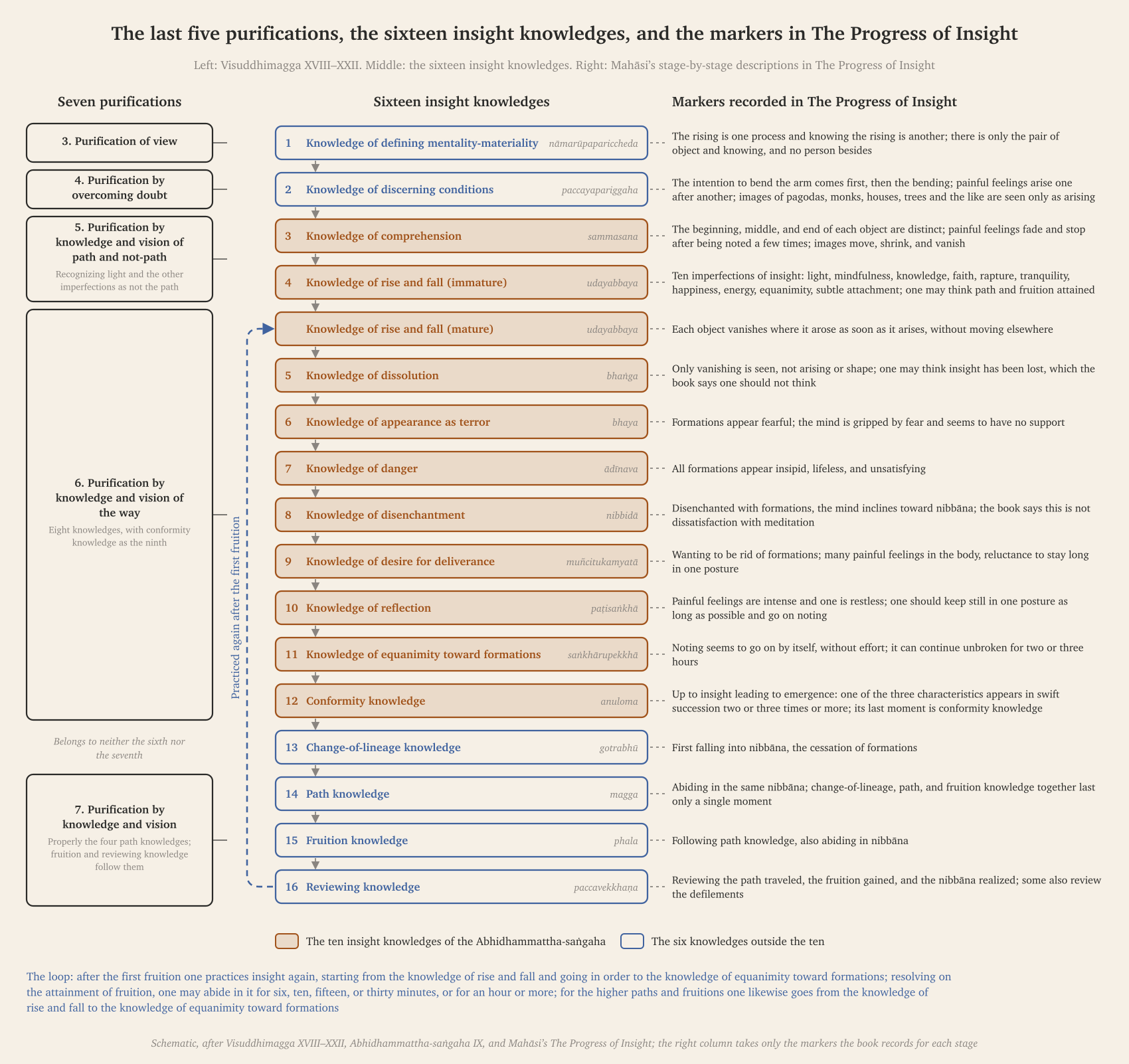
The Progress of Insight sets out the signs of each stage in order. Before the knowledge of comprehension, painful feelings arise one after another, and images such as dagobas, monks, houses, trees, and clouds appear in succession; the meditator sees only their arising. At the knowledge of comprehension, one sees the beginning, middle, and end of the object; painful feelings, after being noted a few times, weaken and stop; images move, shrink, and disappear.42 When the knowledge of rise and fall first arises, the ten corruptions of insight appear one after another: light, strong mindfulness, sharp knowledge, strong faith, the five kinds of rapture, tranquility, happiness, energy neither slack nor tense, equanimity, and a subtle attachment to all of these. The meditator often thinks that he must surely have attained the supramundane path and fruition and that the work of meditation is finished, mistaking what is not the path for the path. The decision that the light and the rest are not the path, and that only continued noting is the path of insight, may come from the meditator himself or from someone else's instruction; the treatise calls this purification by knowledge and vision of what is and is not the path.43 At the knowledge of dissolution one sees only disappearance, not arising or shape, and the meditator may think that insight has been lost. At the knowledge of terror, the mind is gripped by fear and seems helpless. At the knowledge of reflection, there is often severe pain and restlessness, and one should try to stay motionless in one posture for as long as possible. At the knowledge of equanimity toward formations, noting seems to proceed by itself and can continue without interruption for two or three hours.44 Change-of-lineage knowledge, path knowledge, and fruition knowledge together last only an instant, as long as a single thought of noting. The reviewing knowledge that follows reviews the path traveled, the fruition attained, and the nibbāna realized; some also review the defilements.45
The table also prescribes how these phenomena are to be read. At several points Mahāsi expressly explains that a phenomenon is not what it seems. At the knowledge of dissolution one thinks that insight has been lost, but one should not think so. At the knowledge of disenchantment, if the mind is dissatisfied and listless, this is not dissatisfaction with meditation but precisely the knowledge of disenchantment. The light and happiness among the corruptions of insight are not the path; to delight in them is to be on the wrong path, and the correct path of insight is simply to continue noting.46 The Manual of Insight further distinguishes two kinds of fear. The fear and helplessness that arise on seeing phenomena dissolve rapidly are a sign that practice is progressing normally. But if one dwells on such reflections for a long time and becomes unbearably afraid with displeasure, this fear based on displeasure is not insight knowledge, and so those reflections must each be noted.47 The passage on the knowledge of desire for deliverance says that some meditators cannot reach on their own the conclusion that they should continue practicing; only after their teachers explain their experience to them can they carry on.48
On whether meditators should be told about this table during practice, most of the Mahāsi lineage's literature says they should not. Nyanaponika's account of the course at the Mahāsi meditation center says that the student should not be influenced by others' suggestions of what he may or should see, so no theoretical explanations are given at the start, only instructions on what to do and what not to do.49 The Manual of Insight says that those who know or have heard about the stages of insight knowledge will meet even more fluctuations at the stage of equanimity toward formations, so it is better not to learn in advance how the insight knowledges progress.50 Jordt says that the teachers' manual is kept secret so that inexperienced persons will not read it and be hindered by trying to anticipate the next step; Crosby says that in insight circles, discussion of the higher attainments is a one-to-one matter between teacher and student, subject to constraints of privacy and decorum.51 Other texts of the same tradition, however, set out the whole sequence of stages publicly. The Manual of Insight was published in Burmese in two volumes, and its fifth chapter describes the experience of each stage in everyday language. Mahāsi says that these explanations are sufficient for people of fair intelligence, and that by practicing accordingly they can attain the insight knowledges and path and fruition, while also urging people to practice under an experienced teacher. The Pāli version of The Progress of Insight was printed in 1954, and the English translation appeared in 1965.52
After stream-entry, the table becomes a procedure that can be retraced by resolution. The Progress of Insight says that when noble disciples resume insight practice, the knowledge of rise and fall usually arises first. When one resolves to enter the attainment of fruition, one rises in order from the knowledge of rise and fall to the knowledge of equanimity toward formations, and when concentration is complete the mind enters the attainment of fruition; one can resolve to remain in it for six, ten, fifteen, or thirty minutes, or for an hour or more. To develop a higher path and fruition, one likewise begins from the knowledge of rise and fall, and it is not as difficult as at first: in a single day, or even a single hour, one can reach the knowledge of equanimity toward formations.53 The fifth chapter of the Manual of Insight is more specific. If the knowledges of terror, danger, disenchantment, and desire for deliverance are unclear because they have not been experienced for a long time, one can resolve on a period of time for each knowledge, for example resolving, "May the knowledge of arising and passing away last for half an hour," and it will appear within that period; when the period is over, the next knowledge appears of itself, and if it does not, one resolves on the next. The meditator will find that the knowledge attained shifts like the needle of a compass to the next stage once he is satisfied with the current one.54 To develop a higher path and fruition, one must first decide how many days to practice and resolve not to enter the fruition already attained during that period.55
3. The assessment of path and fruition
Assessment in the Mahāsi lineage has two layers. Which level of insight knowledge has been reached is judged by the teacher from interview reports, with the help of an internal manual. Path and fruition are nominally not certified by the teacher: Mahāsi says that only the Buddha can confirm them, and students come to know for themselves through reviewing knowledge, the mirror of the Dhamma, and listening to a recording on the insight knowledges. In practice, entering the attainment of fruition for long periods is treated as a way of showing teachers and fellow meditators that one has attained, and certain positions in the organization require "passing the course."
The nominal position is set out fully in the sixth chapter of the Manual of Insight. It cites the mirror of the Dhamma from the Saṃyutta Nikāya: a noble disciple who possesses unwavering confidence in the Buddha, the Dhamma, and the Saṅgha, and the virtues dear to the noble ones, may, if he wishes, declare of himself that he is a stream-enterer. Mahāsi's explanation is that a layperson, after repeatedly reviewing that he possesses these four, may judge for himself that he has attained stream-entry and, if necessary, tell those of the same attainment; no one else need confirm it, because no one but the Buddha can do so. Nevertheless, a meditation teacher has the responsibility to explain to students the sequence of the insight knowledges, path knowledge and fruition knowledge, reviewing knowledge, and the mirror of the Dhamma, because most noble persons cannot fully describe the insight knowledges they have passed through and their characteristics, nor tell which defilements have been abandoned and which have not; they are like travelers passing through an unfamiliar place, who cannot name the places along the way unless someone tells them.56 A monk who is a noble person may reveal his attainment to his fellow monastics only by the "declaration of what is true" (bhūtārocana) permitted in the Vinaya, and only for the purpose of helping them appreciate the virtues of the Dhamma and arousing their interest in practice.57 Jordt records the same position at the Mahāsi meditation center: a teacher can never know with certainty whether a student has attained enlightenment, since only Buddhas are said to have this knowledge; under the monks' Pātimokkha, a declaration of attainment can lead to disrobing; laypeople are not bound by this taboo, but making such a declaration is considered gauche and unlike a person of true achievement; and monks are extremely cautious about declaring attainment on a student's behalf, usually doing so only when discussing a student's progress with other teachers.58
Students have three ways of knowing for themselves. The first is reviewing knowledge: what always follows path and fruition is the reviewing of path, fruition, and nibbāna, while reviewing the defilements abandoned and those remaining occurs only in those who have learned which path abandons which defilements.59 The second is the mirror of the Dhamma, discussed in the preceding paragraph. The third is the recording. On half-moon and full-moon days, the Mahāsi meditation center plays a recording of Mahāsi discussing the stages of insight knowledge, only to students whom a teacher has judged to be sufficiently deep in a number of the insight knowledges; after listening, students decide for themselves what they have experienced. Jordt says that Mahāsi devised this "know by yourself" procedure to avoid the dilemma of declaring attainment, and that after a course students ask one another "Did you listen to the tape?" and "Did you pass the course?", implying stream-entry.60 Mahāsi also limits the items that may be checked against the texts to five: the sequence of the insight knowledges up to the knowledge of conformity; the extraordinary occurrence of insight leading to emergence; the last moment of the knowledge of conformity falling by itself into nibbāna; the occurrence of reviewing knowledge; and the subsequent return to the knowledge of rise and fall. The individual mind-moments within the process of the path consciousness cannot be distinguished by the meditator and should not be analyzed.61
Assessment of the level of insight knowledge lies with the teacher. U Paṇḍita attaches a warning to his list of insight knowledges: meditators should not think about progress; even the most experienced meditator cannot evaluate his or her own practice, and only after long personal experience and training can a teacher begin to recognize the subtle signs of this progression in another meditator's verbal reports.62 Jordt says that Mahāsi kept records of the meditation experiences students reported at interview and asked the teachers under his guidance to do the same; he compiled and analyzed the results in order to find regularities in the mental patterns on the way to the insight knowledges, and the findings became the basis of a manual used to guide future teachers in interviews and to judge the level of insight knowledge a student has reached.63 She explains in a note that this manual is titled "Meditation Teacher's Diary (or) Records," that it was compiled by two monks under Mahāsi's supervision, and that it is unpublished and passed only from teacher to student.64 Its distribution is controlled by the lay support organization, the Nuggaha, and only monk teachers recommended by a nayaka sayadaw are issued a copy; the president of the Nuggaha told her that as of 1995, ninety of the original hundred copies were still in the organization's office.65 The manual's introduction says that those who have not practiced insight meditation, or have not practiced long enough to attain all sixteen knowledges, should not look at the book, because knowing its contents they would form ideas about it or begin to have doubts; if they thought of these things during practice, the knowledge they attained would not be pure but mixed with knowledge from reading.66 The manual divides students into three types according to how clearly they describe their experience. The first type can describe it systematically and clearly, and the teacher need only listen. The second cannot describe it moment by moment and in sequence; the teacher may ask leading questions, and may also ask about experiences that could not yet have been met or that are unrelated to the student's condition, sometimes presenting something wrong as if it were right, to test whether the student is reporting what was actually experienced. The third type describes poorly and, once led, answers with what has been heard from others; with this type no hints may be given, and only questions admitting two kinds of answer may be asked, so that the student cannot guess what the teacher wants to know.67 Jordt says that the purpose of these techniques is to make as certain as possible that the student's experiences are true insight knowledges and not mere concepts.68
Although path and fruition are nominally not certified by the teacher, in practice there are several ways in which attainment is made visible. The first is the attainment of fruition. Discussing the benefits of attaining fruition, the Manual of Insight says that by frequently entering the attainment of fruition for long periods, noble persons can assure their teachers and fellow meditators of their realization of path and fruition. Before entering, one may resolve on a duration: five minutes, ten minutes, fifteen minutes, half an hour, one hour, two hours, or longer; only those of keen wisdom are likely to remain for the full period resolved upon.69 Jordt records that after attainment, the student resolves to review again the process leading to nibbāna, as a self-verification, and the teacher then asks the student to resolve to remain in fruition for extended periods. It is said that some students at the center made such resolves and then sat for two days without moving, and U Paṇḍita also instructed students to add to their resolution that if the place of meditation caught fire, they should automatically come out of fruition even if the full period had not elapsed.70 The second is qualification within the organizations: members of the executive committees of both the Nuggaha and the Women's Welfare Association are required to have passed the course ("passing the course"), and having listened to the insight-knowledge recording is also treated as a kind of proof of attainment.71 The third is a token that appeared for a time. When Mahāsi visited Sri Lanka he received some relics of arahants, which he gave to students, and for a time these were said to be a sign that he recognized the recipient's enlightenment. At first he was unaware that people saw them this way; once he learned of it, he stopped giving them and declared that receiving them or not had nothing to do with a student's practice.72 The nominal and actual sides of assessment are set out below:
| Aspect | Nominally | In practice |
|---|---|---|
| Who confirms path and fruition | Only the Buddha can confirm; no one else's confirmation is needed (Manual of Insight, p. 431); the teacher cannot know with certainty (Jordt, p. 66) | The teacher judges the level of insight knowledge from interview reports, using a teachers' manual of restricted circulation (Jordt, pp. 66–69, 228) |
| How the student knows | Reviewing knowledge reviews path, fruition, and nibbāna (Manual of Insight, p. 419); one judges for oneself by the mirror of the Dhamma (p. 431) | The insight-knowledge recording on half-moon and full-moon days, played only to students whom the teacher has judged to be deep in a number of the insight knowledges (Jordt, p. 66) |
| How others are told | A layperson may, if necessary, tell those of the same attainment (Manual of Insight, p. 431); a monk may reveal it to fellow monastics only by the "declaration of what is true" (p. 432), and declaring attainment can lead to disrobing (Jordt, p. 66) | Frequently entering the attainment of fruition for long periods can assure teachers and fellow meditators (Manual of Insight, p. 447); the teacher asks the student to resolve to remain long in fruition (Jordt, p. 82) |
| Qualification within the organizations | No written rule | Members of the executive committees of the Nuggaha and the Women's Welfare Association must have "passed the course" (Jordt, p. 83) |
| Tokens | No written rule | Relics given by Mahāsi were for a time said to be a sign of recognized enlightenment; he stopped giving them once he learned of this (Jordt, p. 83) |
Compared with the Pa-Auk lineage, the two lineages share the same structure: the teacher nominally does not certify path and fruition, but in practice there is a procedure for judging levels from the student's reports. The Pa-Auk lineage's three checks and its talk of "passing," together with Pa-Auk's statement that he has never certified anyone's attainment of jhāna or of path and fruition, were discussed in Chapter 2, Section 4. There are two differences. The three checks described in Chapter 2 confirm jhāna and fall on the side of calm, whereas what the Mahāsi lineage judges is the level of insight knowledge, on the side of insight. And the Mahāsi lineage wrote its experience of assessment into a written teachers' manual whose circulation is controlled by a lay organization. In the Geluk lineage, too, attainment is not declared, and the criterion lies in the practitioner's own mind (Part III of Essay 2, The Meditation of Tsongkhapa, Chapter 6, Section 3); the Mahāsi lineage, besides not declaring attainment, also has a manual for teachers to check stage by stage and a recording by which students know for themselves. How Mahāsi treated his own attainment is discussed in Chapter 7, Section 3.
4. Summary
This chapter has restated three matters concerning insight in the Mahāsi lineage. First, the method of noting: the rise and fall of the abdomen is the primary object, and all mental and physical phenomena are noted silently in everyday language, continuously day and night. The noting words are only an aid; what is observed is the sensation itself, and when objects arise and pass away extremely quickly, naming may be dropped. The unit of noting is also the unit of the interview report. Second, the table of the stages of insight knowledge: the names of the seven purifications are found in the suttas; the enumeration of insight knowledges begins with the Paṭisambhidāmagga; the Visuddhimagga distributed them among the last five of the seven purifications; the Abhidhammattha-saṅgaha fixed ten insight knowledges; and the usual sixteen add further items before and after these. Anālayo holds that the table is the product of historical development, that the early texts contain its precursor but not the table itself, and that the knowledge of terror has no counterpart in the early texts. In The Progress of Insight, Mahāsi wrote out reportable signs for each stage and prescribed how these phenomena are to be read. During practice the table is not given to the meditator; after attainment it becomes a procedure that can be retraced within time limits set by resolution. Third, the assessment of path and fruition: nominally only the Buddha can confirm attainment, and students come to know for themselves through reviewing knowledge, the mirror of the Dhamma, and the insight-knowledge recording. In practice, the level of insight knowledge is judged by the teacher from reports, with a teachers' manual of restricted circulation; long periods in the attainment of fruition can assure teachers and fellow meditators; and positions in the organizations require passing the course. Whether these practices are reasonable, this chapter does not judge; that is left to Chapter 10.
References
-
Mahāsi Sayādaw, Manual of Insight, trans. and ed. Vipassanā Mettā Foundation Translation Committee, Somerville: Wisdom Publications, 2016, Managing Editor's Preface, p. xxiii: "Mahāsi Sayadaw wrote Manual of Insight in Seikkhun, west of Mandalay, over a seven-month period in 1945". The same page says that the Burmese original was published in two volumes. For The Progress of Insight, see Mahāsi Sayādaw, The Progress of Insight through the Stages of Purification, trans. Nyanaponika Thera, Kandy: The Forest Hermitage, 1965, Translator's Foreword, p. ii: "This treatise was first written in the Burmese language and later, in 1950, a Pāli version of it was composed by the Author." The Chinese translation is Mahāsi, Qingjing zhi lun 清淨智論 (Pāli and Chinese in parallel), trans. Wen Zongkun 溫宗堃, online revised edition, August 2006. Below, the Manual of Insight and The Progress of Insight are cited by title and page only. ↩
-
Nyanaponika Thera, The Heart of Buddhist Meditation, New York: Citadel Press, 1969 (first American edition; originally London: Rider, 1962), pp. 85–86. The question recorded on p. 85: "'Why are you searching outside of the Master's word? Has not the Only Way, Satipaṭṭhāna, been proclaimed by Him?'" p. 86: "we propose to call it here the Burmese Satipaṭṭhāna Method; not in the sense that it was a Burmese invention but because it was in Burma that the practice of that ancient Way had been so ably and energetically revived." The same page records that U Nārada died on 18 March 1955 at the age of eighty-seven. Below, this book is cited as "Nyanaponika" with page number. ↩
-
Kate Crosby, Esoteric Theravada: The Story of the Forgotten Meditation Tradition of Southeast Asia, Boulder: Shambhala Publications, 2020, p. 40: "The lineage from the first Mingun Sayadaw via Mahasi Sayadaw is also known as the 'New Burmese Method' or the 'Mahasi Method,' or sometimes as 'rising and falling.'" The same page gives the dates of the Mingun Sayadaw U Nārada as 1868–1955. ↩
-
The Progress of Insight, note 4, p. 27: "The attention directed to the movement of the abdomen, was introduced into the methodical practice of Insight-meditation by the author of this treatise, the Venerable Mahāsi Sayadaw, and forms here the basic object of meditative practice." Nyanaponika, p. 94, says the same. ↩
-
Ingrid Jordt, Burma's Mass Lay Meditation Movement: Buddhism and the Cultural Construction of Power, Athens: Ohio University Press, 2007, p. 227, note 10: "Nowhere in the actual words of the Buddha (as found in the canonical texts) is it stated that one should specifically undertake observation of the rise and fall of the abdomen." The same note says that the Sunlun and Mogok Sayadaws, Mahāsi's contemporaries, taught observation of the in- and out-breath at the tip of the nose, and that the two sides contended over this for a long time, the dispute being mainly among disciples. ↩
-
Manual of Insight, pp. 265–266. p. 265: "The rise and fall of the abdomen is a manifestation of the air element, one of the types of tactile, physical phenomena. When observing the rise and fall, you will experience pressure and movement—characteristics of the air element". p. 266: "Therefore, observing the rise and fall of the abdomen is clearly consistent with the teaching of the Buddha, because one understands the pressure and movement of the air element as it really is." ↩
-
Nyanaponika, p. 95: "Though it is the breathing which causes the abdominal movement, the attention directed to the latter must not be regarded as a variety of the 'Mindfulness of Breathing' (ānāpānasati). In the practice described here the object of mindfulness is not the breath but just the rise and fall of the abdomen as felt by the slight pressure." ↩
-
Manual of Insight, pp. 264–265. p. 264: "When breathing in, you will experience the rising movement of the abdomen. Note this as 'rising.' When breathing out, you will experience the falling movement. Note this as 'falling.'" p. 265: "A meditator should do this mentally, not audibly. Do not make the breath more vigorous than usual so as to make the rise and fall more distinct". ↩
-
Manual of Insight, pp. 266–268; p. 266: "When this happens, you note them using everyday language." ↩
-
Manual of Insight, pp. 273–275; p. 273: "After about a day, you are likely to feel that simply noting the rise and fall of the abdomen is too easy." ↩
-
Manual of Insight, p. 275: "In this way, you should continuously and uninterruptedly note all day and all night, except during the hours of sleep." The same rule is in Practical Insight Meditation, p. 15, cited in Chapter 3, Section 1. ↩
-
Sayadaw U Pandita, In This Very Life: The Liberation Teachings of the Buddha, trans. U Aggacitta, ed. Kate Wheeler, 2nd ed., Boston: Wisdom Publications, 1993, pp. 14–15. p. 14: "One helpful aid to precision and accuracy is to make a soft mental note of the object of awareness, naming the sensation by saying the word gently and silently in the mind". p. 15: "In making the verbal label, there is no need for complex language. One simple word is best." Below, this book is cited as "U Pandita" with page number. ↩
-
Manual of Insight, p. 264: "Initially, of course, it is almost impossible to avoid a conceptual sense of solid form. So in the beginning, you must observe objects on a conceptual level. … In due time, however, insight knowledge will break through to the absolute reality beyond concepts." ↩
-
Mahāsi Sayādaw, Practical Insight Meditation: Basic and Progressive Stages, trans. U Pe Thin and Myanaung U Tin, Kandy: Buddhist Publication Society, n.d. (the author's preface is dated 1970), p. 4: "Never verbally repeat the words rising, falling, and do not think of rising and falling as words. Be aware only of the actual process of the rising and falling movement of the abdomen." ↩
-
Nyanaponika, p. 95: "One should dwell on the single perception just for the length of these two-syllable words (spoken internally, and later to be abandoned when one has got into the time rhythm). It should be noted that the object of mindfulness is here the respective sensation, and not the places of contact in themselves, nor the words 'touching-sitting'." ↩
-
U Pandita, pp. 15–16: "But remember that in using the labeling technique, your goal is not to gain verbal skills. Labeling technique helps us to perceive clearly the actual qualities of our experience, without getting immersed in the content." ↩
-
Manual of Insight, p. 282: "A meditator should simply be aware of them from moment to moment, without naming them, so that he or she can follow them. … You may tire if you attempt to name all the objects that occur. What matters most is being precisely and accurately aware of each object." ↩
-
Jordt, Burma's Mass Lay Meditation Movement, p. 65: "Initially, yogis employ conceptual labels to draw their attention to precise objects for observation. Eventually, these labels are dropped, and the yogis come to experience physical sensations, for example, in terms of their sensate qualities". Below, this book is cited as "Jordt" with page number. ↩
-
Bhikkhu Bodhi, "What Does Mindfulness Really Mean? A Canonical Perspective," Contemporary Buddhism 12, no. 1 (2011): 19–39, quotation at pp. 28–29: "To my knowledge, the first person to use the expression 'bare attention' to characterize mindfulness was the elder German monk, Ven. Nyanaponika Thera". ↩
-
Nyanaponika, p. 30: "Bare Attention is the clear and single-minded awareness of what actually happens to us and in us, at the successive moments of perception. … If during the time, short or long, given to the practice of Bare Attention, any such comments arise in one's mind, they themselves are made objects of Bare Attention, and are neither repudiated nor pursued, but are dismissed, after a brief mental note has been made of them." ↩
-
The Progress of Insight, note 15, p. 29: "'Noticing' (sallakkhaṇa) is a key term in this treatise. The corresponding verb in the Pāli language is sallakkheti (sam-lakh), which can be translated, adequately as well as literally, by 'to mark clearly'. … 'Noticing' is identical with 'bare attention', the term used in the translator's book 'The Heart of Buddhist Meditation'". ↩
-
Bodhi, "What Does Mindfulness Really Mean?" p. 29: "The Mahasi Sayadaw system of insight meditation, which he had practiced, stresses the importance of precisely labeling the constituents of one's experience". Bhikkhu Bodhi's reservations are at p. 27 (acceptable as a procedural guideline for cultivating mindfulness, hard to sustain as a theoretical description applicable to all forms of mindfulness) and p. 30 (explaining mindfulness as "attention" risks conflating mindfulness with attention, manasikāra). ↩
-
U Pandita, pp. 24–26. p. 24: "During an intensive vipassanā retreat, personal interviews are held as often as possible, ideally every day." On the same page: "First, report how many hours of sitting you did and how many of walking in the most recent twenty-four-hour period." p. 25: "please report your experience in three phases. One, you identify what occurred. Two, you report how you noted it. And three, you describe what you saw, or felt, or understood; that is, what happened when you noted it." p. 26: "you must restrict your descriptions to what you have experienced directly, rather than what you may imagine, visualize and opine about the object." ↩
-
U Pandita, p. 28: "A clear and precise report enables the teacher to assess your practice; then point out mistakes or make corrections to put you back on the right path." ↩
-
Jordt, pp. 71–72. p. 71: "First, they report how many hours of sitting and walking meditation they have performed since their last report." p. 72: "From the report of the number of hours a yogi has spent in continuous sitting and walking throughout the day, the sayadaw is able to determine how much effort (viriya) the yogi is exerting. … He can then evaluate this as one piece of evidence in judging the yogi's reports." ↩
-
Crosby, Esoteric Theravada, p. 41: "Progress in Vipassanā is measured primarily in relation to the practitioner's experience of insight knowledges, vipassanā-ñāṇa. … The Burmese Vipassanā tradition looks to a different formulation of these found in the highly influential twelfth-century Comprehensive Manual of Abhidhamma, the Abhidhammatthasaṅgaha. This text lists a set of ten vipassanā-ñāṇa". By Vipassanā, Crosby means the insight traditions formed in Burma from the late nineteenth century onward (p. 40). ↩
-
Jordt, p. 64, quoting the Mahāsi-lineage monk U Aggadhamma: "This nyanzin [insight] approach got started in the Mahasi period. Previously, people would not measure their practice by nyanzin." ↩
-
Jordt, p. 64 ("realization of one or more of the sixteen insights"); p. 68, quoting the introduction to the teachers' manual ("the 16 levels of knowledge"). ↩
-
Madhyama Āgama, fascicle 2, Qiche jing 七車經 (no. 9). The Pāli parallel is Majjhima Nikāya 24, the Rathavinīta Sutta; English translation in Bhikkhu Ñāṇamoli and Bhikkhu Bodhi (trans.), The Middle Length Discourses of the Buddha, Boston: Wisdom Publications, 1995, pp. 242–244. §15 says that each of the seven purifications serves to reach the next, and that purification by knowledge and vision serves final nibbāna without clinging. ↩
-
Paṭisambhidāmagga, opening matrix (mātikā), items 4 to 14, according to the Burmese Sixth Council edition; in the PTS edition at vol. 1, p. 1. The definition of the knowledge of rise and fall quoted in Visuddhimagga XX.93 comes from here. Item 4 reads: "Paccayapariggahe paññā dhammaṭṭhitiñāṇaṃ." Item 8: "Bhayatupaṭṭhāne paññā ādīnave ñāṇaṃ." Item 9: "Muñcitukamyatāpaṭisaṅkhāsantiṭṭhanā paññā saṅkhārupekkhāsu ñāṇaṃ." ↩
-
Visuddhimagga XVIII–XXII. Bhikkhu Ñāṇamoli (trans.), The Path of Purification, 4th ed., Kandy: Buddhist Publication Society, 2010. Chapter XX treats the knowledge of comprehension from §2 and the knowledge of rise and fall from §93; the ten corruptions of insight are at §§105–106, and the recognition that the light and the rest are not the path, which constitutes purification by knowledge and vision of what is and is not the path, at §§128–129. XXI.1: "Now, insight reaches its culmination with the eight knowledges, and knowledge in conformity with truth is ninth; these are what is called purification by knowledge and vision of the way." XXII.1: "Its position is to advert to the path, and so it belongs neither to purification by knowledge and vision of the way nor to purification by knowledge and vision, but being intermediate, it is unassignable." XXII.2: "Purification by knowledge and vision properly consists in knowledge of the four paths". ↩
-
Bhikkhu Bodhi (ed.), A Comprehensive Manual of Abhidhamma: The Abhidhammattha Sangaha of Ācariya Anuruddha, Onalaska: BPS Pariyatti Editions, 2000, IX §25 and the table of the seven purifications at IX §22 (Table 9.2). The ten insight knowledges in the original: "(1) Sammasanañāṇaṃ, (2) udayabbayañāṇaṃ, (3) bhaṅgañāṇaṃ, (4) bhayañāṇaṃ, (5) ādīnavañāṇaṃ, (6) nibbidāñāṇaṃ, (7) muñcitukamyatāñāṇaṃ, (8) paṭisaṅkhāñāṇaṃ, (9) saṅkhār'upekkhāñāṇaṃ, (10) anulomañāṇañ cā ti dasa vipassanāñāṇāni." ↩
-
Wen Zongkun, trans., Qingjing zhi lun, Appendix 1, "The Seven Purifications and the Sixteen Stages of Knowledge" (七清淨與十六階智), pp. 145–146; the passage cited is note 3 on p. 146: "The Jingjie mentions only the ten insight knowledges, from the 'knowledge of touching-knowing' to the 'knowledge of conformity.' But in the Pāli commentaries, 'delimitation of mentality-materiality' and 'discernment of conditions' are also regarded as insight knowledges; broadly speaking, if change-of-lineage knowledge is included, there are thirteen insight knowledges in all." The Jingjie (精解) is the Apidamo gaiyao jingjie (阿毗達摩概要精解), the Chinese translation of the Bodhi edition cited in the preceding note. ↩
-
Bhikkhu Anālayo, "The Insight Knowledge of Fear and Adverse Effects of Mindfulness Practices," Mindfulness 10, no. 10 (2019): 2172–2185, quotation at p. 2173: "The main point to be taken away from this comparison is that the insight knowledges, in the form these are employed as a framework for contemporary vipassanā meditation, are the result of a historical process of growth (Anālayo 2012a). In fact, no such list can be found in the early discourses, although these texts do present precedents for the main dynamic underlying the progression of insight depicted in later exegesis." The same page lists the sixteen insight knowledges of the Visuddhimagga scheme and compares them with the shorter list in the Paṭisambhidāmagga. ↩
-
Anālayo, "The Insight Knowledge of Fear," p. 2174. The five versions Anālayo cites are DN 33, DĀ 9, MĀ 86, SĀ 1034, and EĀ 37.10. "The insight knowledges of rise and fall and of dissolution reflect insight into impermanence. The ensuing knowledges of fear, disadvantage, disenchantment, and wishing for deliverance can be subsumed under the header of insight into dukkha. The remaining knowledges leading up to the breakthrough to stream-entry can then be seen as actualizing insight into not self." ↩
-
Anālayo, "The Insight Knowledge of Fear," p. 2174: "In early Buddhist thought, 'name' stands for the mental factors of feeling tone, perception, intention, contact, and attention; it does not include consciousness (Anālayo 2019b). The exposition of this knowledge in the Visuddhimagga, however, defines 'name' as corresponding to the four immaterial aggregates (Vism 593)." Also: "In fact, already the Paṭisambhidāmagga understands these two knowledges to be of a momentary character (Paṭis I 69 and 71)." ↩
-
Anālayo, "The Insight Knowledge of Fear," p. 2175: "In fact, no counterpart to the insight knowledge of fear can be found, although there are some passages that evoke a sense of urgency." That the Paṭisambhidāmagga combines fear and danger into one knowledge is noted in the same article, p. 2173. ↩
-
Anālayo, "The Insight Knowledge of Fear," p. 2174: "This is not to take the position that there is something wrong with the Visuddhimagga's scheme of insight knowledges. Instead, the point is only to note that this is a specific form of presentation on how insight unfolds." ↩
-
The Progress of Insight, p. 1: "It has been written in brief for the benefit of meditators who have obtained distinctive results in their practice, so that they may more easily understand their experience." ↩
-
Wen Zongkun, trans., Qingjing zhi lun, Appendix 2, U Paṇḍita's "Preface to the Pāli Version in Burmese Script" (緬文字體巴利本之序), p. 148: "The Elder Mahāsi, a great teacher of satipaṭṭhāna and a man of supreme great wisdom, composed this treatise in the Buddhist year 2492 so that those of little learning could easily remember it." ↩
-
The Progress of Insight, Translator's Foreword, p. ii: "As the treatise deals chiefly with the advanced stages of the practice, it was originally not intended for publication. Handwritten or typed copies of the Burmese or Pāli version were given only to those who, with some measure of success, had concluded a strict course of practice at the meditation centre. For the use of meditators from foreign countries, only a few cyclostyled sheets in English, briefly describing the phases of insight-knowledge, were issued instead of the treatise itself. This was done to enable the meditator to identify his personal experience with one or other of the stages described, so that he might direct his further progress accordingly, without being diverted or mislead by any secondary phenomena that may have appeared during his practice." ↩
-
The Progress of Insight, pp. 7–10; p. 8: "The shape of a Dagoba, monk, man, house, tree, park, heavenly mansion, cloud, and many other such images of various kind will appear." ↩
-
The Progress of Insight, pp. 10–13; p. 13: "'Surely I must have attained to the Supramundane Path and Fruition! Now I have finished the task of meditation.' This is mistaking what is not the Path for the Path". On purification by knowledge and vision of what is and is not the path, the same page: "While engaged in noticing, the meditator, either by himself or through instructions from someone else, comes to this decision: 'The Brilliant Light and the other things experienced by me, are not the Path.'" Nyanaponika's note 27 (p. 30) says that the ten corruptions of insight first appear in the Paṭisambhidāmagga (PTS ed., vol. 2, pp. 100 ff.) and are explained in the Visuddhimagga, and that the names and order in Mahāsi's list differ slightly from both; the order in Visuddhimagga XX.105 is illumination, knowledge, rapturous happiness, tranquility, bliss, resolution, exertion, assurance, equanimity, and attachment. ↩
-
The Progress of Insight, pp. 15–20. p. 15: "It is for that reason that a meditator may here think: 'I have lost the Insight'; but he should not think so." p. 16: "At that time, his mind itself is gripped by fear and seems helpless." p. 18: "Though he wants to change his bodily posture, still he should not give in easily to that wish, but should endeavour to remain motionless for a longer period in the same posture and continue to carry on the practice of noticing." p. 20: "it will go on even for two or three hours without interruption." ↩
-
The Progress of Insight, pp. 22–23; p. 22 says that the three knowledges of change of lineage, path, and fruition are extremely brief: "It is very short, and lasts for just an instant, like the duration of a single thought of noticing." The numbering of the English translation lists "insight leading to emergence" separately as the twelfth knowledge, so that the knowledge of conformity and those after it each move down one number, which differs from the usual count of sixteen; Wen Zongkun's Chinese translation treats insight leading to emergence as a collective name for the eleventh to thirteenth knowledges. ↩
-
The Progress of Insight, p. 15 (see the preceding note); p. 17: "He therefore should know that this state of mind is not dissatisfaction with meditation, but is precisely the 'Knowledge of Disgust' that has the aspect of being disgusted with the formations." Manual of Insight, p. 284: "To delight in bright light and other pleasant experiences is to be on the wrong path. The correct path of insight is to just continue noting." ↩
-
Manual of Insight, p. 287: "There is no need to worry. This indicates that your practice is improving according to the usual development of the meditation process. … This kind of fear based on displeasure is not insight knowledge. Therefore note all these reflections without fail so that fear based on displeasure cannot arise." ↩
-
Manual of Insight, p. 289: "Some meditators do not come to this conclusion by themselves. However, once their teachers explain their experience to them, they can carry on with their practice." ↩
-
Nyanaponika, p. 88: "He should not be influenced by others giving him suggestions or hints about what he may see or is expected to see. Therefore, in the aforementioned course of practice, no theoretical explanations are given, but only the bare instructions about what to do and not to do, at the start of the practice." On p. 87 the same book says that a course at the center usually lasts one to two months. ↩
-
Manual of Insight, p. 292: "Those who know or have heard about the stages of insight knowledge may encounter even more fluctuations. This is why it is better not to learn how the insight knowledges progress in advance." ↩
-
Jordt, p. 66: "The manual is kept secret so that inexperienced persons will not read it and be hindered by attempts to anticipate what is to come next." Crosby, Esoteric Theravada, p. 41: "While the higher attainments are not strictly secret—after all, they are described explicitly in the Visuddhimagga and elsewhere—discussion of them in Vipassanā circles is a matter of one-to-one interaction between teacher and pupil, subject to expectations of privacy and decorum." ↩
-
Manual of Insight, Managing Editor's Preface, p. xxiii (the Burmese original was published in two volumes); p. 301: "The explanations of how to practice insight that I have given here in this book are perfectly sufficient for those of fair intelligence. If they read this book and properly and systematically practice, with strong faith, aspiration, and energy, they can surely attain the different insight knowledges as well as path knowledge and fruition knowledge." On p. 302 Mahāsi urges practice under a teacher who can explain the stages of insight knowledge clearly. On the printing of the Pāli version of The Progress of Insight and its English translation, see its Translator's Foreword, p. ii. ↩
-
The Progress of Insight, pp. 23–25. p. 23: "For when the Noble Disciples (namely, Stream-winners, etc.) resume the practice of Insight (by noticing), the 'Knowledge of Arising and Passing Away' usually arises at the beginning." p. 24: "to abide in it a long time, say for 6, 10, 15 or 30 minutes, for an hour or more." p. 25: "In a single day, or even in a single hour, he can gain the 'Knowledge of Equanimity about Formations'." ↩
-
Manual of Insight, pp. 296–297: "For example, if you set a time limit when you practice by resolving, 'May the knowledge of arising and passing away last for half an hour,' then that insight knowledge will occur within that time period but not beyond." p. 297: "You will also find that your knowledge shifts, in due time, like the needle of a compass, to the next higher level of knowledge once you are satisfied with the current level." ↩
-
Manual of Insight, p. 298: "To do this, you should first determine how many days you are going to practice, and then resolve: 'May the fruition that I have already attained no longer arise during this period of time; may the next higher path knowledge and fruition knowledge arise instead.'" ↩
-
Manual of Insight, pp. 430–431. For the mirror of the Dhamma, Mahāsi refers to Bhikkhu Bodhi's English translation of the Saṃyutta Nikāya, p. 1800, in the fifty-fifth saṃyutta (the connected discourses on stream-entry). p. 431: "There is no need for anyone else to confirm the attainment, because no one other than the Buddha could do that. Nonetheless it is the responsibility of a meditation teacher to explain the progression of the insight knowledges, the path knowledge and fruition knowledge, the reviewing knowledge, and this Dhamma exposition called the mirror of Dhamma. … In this respect noble persons can be compared to travelers visiting an unfamiliar place." ↩
-
Manual of Insight, p. 432: "However a monk who is an ariya can only reveal his spiritual attainment, if he wishes, in such a way that he would not violate the monastic rule that allows a monk to reveal his spiritual achievement to his fellow monks and nuns for only two purposes (bhūtārocana): to help them appreciate the virtues of the Dhamma and to arouse their interest in practice." ↩
-
Jordt, p. 66: "At the same time, however, a sayadaw can never know with certainty whether the yogi has attained enlightenment—only Buddhas are said to have this knowledge. According to the monk's Pātimokkha (the 227 rules of monastic life), a monk can be disrobed for making declarations of attainment. This taboo is not incumbent on laity, although it is considered gauche and uncharacteristic of a person with true achievement." ↩
-
Manual of Insight, p. 419: "The following three kinds of reviewing certainly always occur: reviewing the path, reviewing the fruit, and reviewing nibbāna. These two kinds of reviewing, however, may or may not occur: reviewing which defilements have been destroyed and reviewing which defilements still remain." The same page says that the latter two "may occur only for those persons who have learned which path abandons which defilements". The Progress of Insight, p. 23, also says that not everyone reviews the defilements. ↩
-
Jordt, p. 66: "At MTY, a tape of Mahasi Sayadaw discussing the stages of insight outlined here is played on half-moon and full-moon days. It is reserved for those yogis who have been determined by a sayadaw to be sufficiently deep in a number of the insights. The yogi listens to the tape and decides for himself what has been experienced. Mahasi developed this 'know by yourself' procedure to avoid the dilemma of making declarations." The students' questions to one another are on the same page. ↩
-
Manual of Insight, p. 418: "The only aspects of the practice that are appropriate to be checked against the texts are: the sequence of the insight knowledges up to insight knowledge of adaptation; the extraordinary occurrence of insight that leads to emergence; the last awareness of phenomena during adaptation that immediately and by itself falls into nibbāna; the occurrence of reviewing knowledge; and the return to insight knowledge of arising and passing away." ↩
-
U Pandita, p. 269, appendix "The Progress of Insight": "This list is provided with a strong cautionary note: if you are practicing meditation, don't think about progress! It is quite impossible for even the most experienced meditator to evaluate his or her own practice; and only after extensive personal experience and training can a teacher begin to recognize the specific, subtle signs of this progression in the verbal reports of another meditator." Jordt, p. 70, quotes the same passage. U Pandita's list treats "Insight into Path and Not-Path" as a stage of its own and assigns four "vipassana jhanas" to the earlier stages (pp. 270–272), an arrangement that differs from The Progress of Insight. ↩
-
Jordt, p. 67: "Mahasi Sayadaw kept a record of the meditation experiences of his yogi interviews, and he asked meditation teachers under his guidance to do the same. He compiled and analyzed the results with the aim of determining regularities in mental patterns experienced en route to the attainment of nyanzin, or insights leading to enlightenment. His empirical findings became the basis for a manual that would be used to guide 'future teachers in interviews with their students or yogis. . . . [I]t will also be useful in judging the yogi's level of vipassanā (insight) knowledge attained.'" ↩
-
Jordt, p. 228, note 13: "This quote is from the introduction of the 'Meditation Teacher's Diary (or) Records.' The manual is an unpublished text compiled by two monks (Saya Kyan and Saya Kywet) under the supervision of Mahasi Sayadaw. The manual is not publicly available and is transmitted from teacher to student for pedagogical purposes." Jordt's main text says that the manual was based on Mahāsi's own records and analysis, while the note says it was compiled by two monks under his supervision; both accounts are recorded here. ↩
-
Jordt, p. 67: "only on the advice of a nayaka sayadaw are monk teachers issued a copy of the manual. The president of the Nuggaha told me that these are 'very strictly controlled' and that as of 1995, 90 of the original 100 copies of the document were still in the Nuggaha office." ↩
-
Jordt, p. 68, quoting the introduction to the manual: "Therefore those who have not practiced the vipassana meditation or those who have not practiced long enough to attain the full 16 levels of knowledge should not be allowed to look at this book. For, if they had known the contents of this book, they might form ideas or concepts on them, or they might not understand and begin to have doubts about the practice." ↩
-
Jordt, pp. 68–69. The manual as quoted on p. 69: "To test whether the yogi was speaking the true experience or not we asked about the sort of experiences which could not be met as yet; and also which do not relate to the condition of the yogi's experience or sometimes said the wrong thing as if it was right. Sometimes we asked questions that could give two types of answers." Also: "Ask in such a way that the yogi could not guess what you wish to know." ↩
-
Jordt, p. 69: "The techniques for confirming that the yogi is really experiencing what she says she is are meant to create as much certainty as possible that her experiences are truly vipassanā insights and not mere conceptualizations." ↩
-
Manual of Insight, pp. 447–449. p. 447: "Furthermore, by frequently entering the attainment of fruition for long periods, they can assure their teachers and fellow meditators of their realization of path and fruition." p. 449: "This period of time may be five minutes, ten minutes, fifteen minutes, half an hour, one hour, two hours, or longer." The same page says that only those of keen wisdom are able to remain for the full period resolved upon. In the fifth chapter, p. 295, Mahāsi says that there were then also meditators of strong concentration and keen insight who could enter the attainment of fruition for one, two, or three hours. ↩
-
Jordt, p. 82: "The sayadaw then asks the yogi to resolve to reside in phala (the null experience of nibbāna) for extended periods of time. It is claimed that some yogis at the Yeiktha have made these resolves and remained for two days in the sitting position without moving." ↩
-
Jordt, p. 83: "'Passing the course' is required for members of the executive committees of both organizations." On the same page: "Further, there are so-called proofs of one's attainment, such as listening to the nyanzin tape mentioned earlier." ↩
-
Jordt, p. 83: "He was at first unaware of the significance being attributed to his gift, that is, that it was a sign of his recognition of the yogi's attainment of enlightenment. He thereafter stopped giving the dalone and disclaimed any significance of a yogi's practice by his or her receipt of them." ↩