Part I, Chapter 2: Calm II: Pa-Auk's Ānāpāna, Jhāna, and Criteria
Chapter 1 set out how the doctrine of the two vehicles and mindfulness of breathing appear in three layers of text: the suttas, the Vimuttimagga, and the Visuddhimagga. This chapter restates calm in the Pa-Auk lineage: the breath as a concept is taken as the object; the practitioner passes through counting and four stages; the nimitta develops from the preliminary sign and the learning sign into the counterpart sign; he enters access and absorption, balances the five faculties and the seven factors of awakening, and develops the four jhānas and the five masteries; he then attains jhāna on many meditation subjects, and finally turns to insight with four-elements meditation as the entrance. Of the three lineages, the Pa-Auk lineage describes calm in the greatest detail and states its criteria most explicitly, so this chapter uses four sections, the last of them devoted entirely to the criteria.
The chapter relies mainly on four kinds of literature: Knowing and Seeing, the English talks and questions and answers from Pa-Auk's 1998 retreat in Taiwan; Mindfulness of Breathing and Four Elements Meditation, which deals specifically with mindfulness of breathing and the four elements; the Chinese-language lecture records of his disciple Bhante Mahinda and the Collected Questions and Answers of Pa-Auk Sayadaw; and Chen Faling's analysis based on recordings of Pa-Auk's meditation instruction in Burmese. Chen Faling's article also draws on her field records from more than eight years at Pa-Auk Forest Monastery, from 2012 to 2020; the steps added after 2015 are known only from her account.1
The sequence of Pa-Auk's mindfulness of breathing, from the breath to the turn to insight, is drawn in the figure below; the three checks come after the attainment of the first jhāna and before the development of the five masteries.
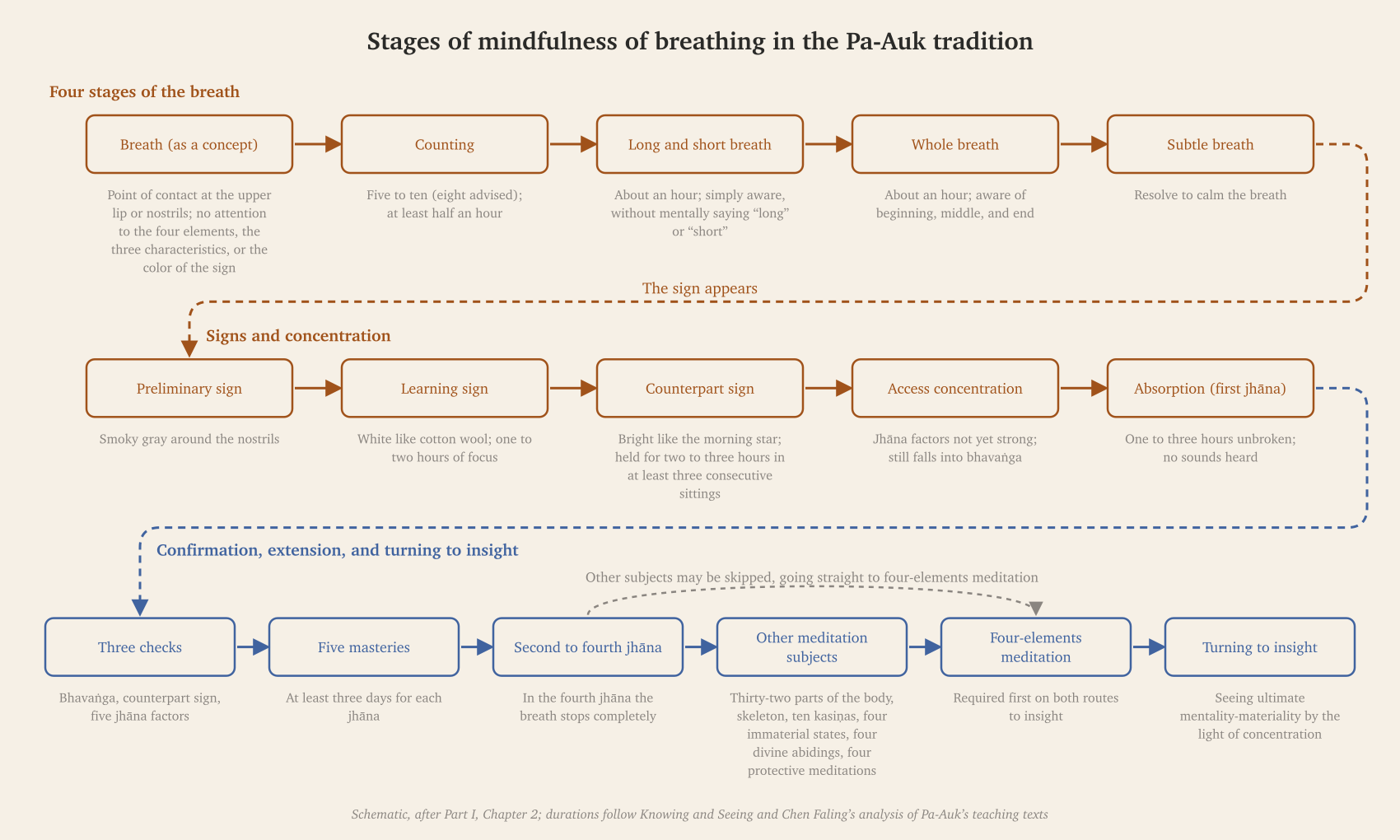
1. Pa-Auk's mindfulness of breathing: from the breath to the counterpart sign
The object Pa-Auk prescribes is the breath as a concept. Having sat down, the meditator is aware of the breath as it passes in and out through the nostrils, and is aware of it at the most evident point of contact, on the upper lip or around the nostrils, without following it into the body or out of the body, since otherwise concentration cannot be perfected. He specifically names three things not to attend to: the individual characteristics of the four elements in the breath, such as hardness, roughness, flowing, heat, supporting, and pushing; the general characteristics of the breath, namely impermanence, suffering, and nonself; and the color of the nimitta. His instruction is: "Simply be aware of the in-and-out breath as a concept."2 Bhante Mahinda explains the same point with the classifications of the Abhidhamma: the breath is a conceptual dhamma, belongs to the mind-object, and is an object of the mind door only; the coolness, warmth, softness, and hardness touched by the skin belong to the tangible object: "If we are aware here at the philtrum of warmth, coolness, tingling, softness, and the like, we are only practising the sensation of the skin here, and not developing mindfulness of breathing."3 The Burmese recording of Pa-Auk's instruction on which Chen Faling relies puts it more bluntly: to practice directly the three characteristics of the in-breath and out-breath, impermanence, suffering, and nonself, "is to practise a conceptual dhamma as though it were an ultimate dhamma; it is not the calm meditation of mindfulness of breathing taught by the Buddha."4
When the mind cannot concentrate, the meditator first counts. Following the Visuddhimagga, Pa-Auk has the meditator count at the end of each breath, at least to five and not beyond ten; he suggests counting to eight, as a reminder that what one is developing is the Noble Eightfold Path. After concentrating in this way for at least half an hour, the meditator moves to the second stage, being aware of whether the breath is long or short, where long and short refer to duration and not to physical length, and he is only aware of it without mentally reciting "long" or "short." If after about an hour the nimitta has not appeared, he moves to the third stage, being aware of the beginning, middle, and end of the whole breath; if after about another hour the nimitta still has not appeared, he moves to the fourth stage, resolving to make the breath calm while continuing to be aware of the whole breath, and doing nothing else to make the breath calm.5 He also explains that in actual practice the four stages may occur together, and that the suttas present them separately only to make them easier to understand.6 The steps compiled by Chen Faling from the Burmese recordings attach a duration to every step. Abiding on the in-breath and out-breath without stray thoughts, one gradually resolves to extend the time from ten minutes to twenty and thirty: "your mindfulness must be stable on the in-breath and out-breath for at least one hour, and sustained for two or three sittings," and only then does one practice the long and short breath.7 She also records that from 2015 Pa-Auk added four steps at the stage of the subtle breath: the length of the subtle breath, the whole subtle breath, the complete merging of the breath and the nimitta, and the mind plunging into the bright counterpart sign, each requiring three continuous hours; in 2018 Pa-Auk trained ten-precept nuns to reach five hours at the last step, and trained bhikkhus to reach seven hours.8
When the breath becomes subtle, many people think it has stopped. Pa-Auk reminds them that only seven kinds of beings do not breathe: the dead, the foetus in the womb, the drowned, the unconscious, those in the fourth jhāna, those in the attainment of cessation, and Brahmās; the practitioner is not among them and merely lacks strong enough mindfulness. He should keep his awareness at the place where he last noticed the breath and wait for it to reappear.9 The nimitta looks different to different people: like cotton wool, like the morning star, like a ruby, like a pearl, like a long string, like a wreath of flowers, like smoke, like a cobweb, like a lotus, like a wheel, like the sun or the moon. Pa-Auk distinguishes two grades by brightness: a nimitta that is white like cotton wool and usually dull and opaque is the learning sign; one that is bright like the morning star, brilliant and clear, is the counterpart sign; the same shape is the learning sign when dull and the counterpart sign when bright. He keeps the Visuddhimagga's explanation that the nimitta is produced by perception, and that because people's perceptions before the nimitta appears differ, the nimitta differs.10 When the nimitta first appears, the meditator must not move his mind from the breath, must not play with the nimitta or deliberately change its shape, and should ignore a nimitta that appears at a distance; only when the nimitta appears at the place of contact, is stable, and appears to be the breath itself, with the breath appearing to be the nimitta, does he set the breath aside and attend only to the nimitta. After he has concentrated on the white learning sign for one to two hours, it becomes clear and bright and turns into the counterpart sign; he then resolves to concentrate on the counterpart sign for one, two, or three hours.11 Whether a nimitta is necessary, Pa-Auk decides by meditation subject: subjects such as mindfulness of breathing, the kasiṇas, and foulness require a nimitta if jhāna is to be attained, while recollection of the Buddha and the like do not; in loving-kindness, breaking down the boundaries between oneself and others is the sign.12 He also says that the real ānāpāna nimitta comes from the breath and is made to appear by the breath produced by a deeply concentrated mind; a sign far from the nostrils is not a real one; some signs arise because of concentration and yet are not the real ānāpāna nimitta; only a sign that can produce jhāna is called an ānāpāna nimitta; if one concentrates on a sign that cannot produce jhāna, concentration will not be strong, and the sign will soon disappear.13 On this account, whether a sign is a real ānāpāna nimitta is decided in the end by whether it can produce jhāna. In another answer Pa-Auk says that the preliminary sign appears, when concentration is a little stronger, as a smoky grey around the nostrils, then turns white like cotton wool as the learning sign, then bright like the morning star as the counterpart sign. He also matches the three signs with three kinds of concentration: the concentration focused on the preliminary sign and the learning sign is called preparatory concentration, which is "sometimes called momentary concentration"; the concentration focused on the counterpart sign and close to jhāna is called access concentration; and the concentration that enters jhāna is called absorption concentration.14
At the stage of the counterpart sign, the practitioner reaches access or absorption concentration. Both take the counterpart sign as object; the difference lies in whether the jhāna factors are fully developed. In access concentration the jhāna factors are not yet strong and the mind still falls into bhavaṅga; the practitioner will say that everything stopped, and may even think that it is Nibbāna.15 In his answers Pa-Auk gives a way of telling the two apart: if many bhavaṅga minds arise during concentration, one can call it access concentration, but the object must be the counterpart sign; only when one abides completely, for a long time and without interruption, with the counterpart sign as object, can one call it absorption concentration. If the practitioner finds that he is often not aware of the counterpart sign, or that his mind has for a moment thought of an object other than the counterpart sign, he knows that bhavaṅga minds have occurred in between. In absorption one can go for one, two, three hours or more without hearing sounds, knowing nothing but the counterpart sign.16 He also says that each of the four jhānas has access first and absorption after, with the same ānāpāna counterpart sign as object, the difference lying in the level of concentration: the first, second, and third access jhānas have the five jhāna factors, while the fourth access jhāna has equanimity in place of happiness; the four access jhānas suppress, in order, bodily pain, mental displeasure, bodily pleasure, and mental joy; at the fourth access jhāna the breath is at its subtlest and has nearly stopped, and only at the fourth absorption jhāna does it stop completely.17
2. The five faculties, the seven factors of awakening, the jhāna factors, and the four jhānas
For the passage from access to absorption, Pa-Auk requires the balancing of the five faculties and the seven factors of awakening. If faith is too strong, wisdom is not clear and the other faculties weaken along with it, so that excessive faith in fact leads to a decrease of faith; if effort is too strong, the mind cannot concentrate calmly on the counterpart sign, and the three factors of tranquility, concentration, and equanimity cannot arise fully; a person in whom wisdom is strong and faith weak "can become quite crafty," passing judgements without meditating, a condition as hard to cure as an illness caused by an overdose of medicine; one in whom concentration is strong and effort weak becomes lazy, and one in whom effort is strong and concentration weak becomes restless. Mindfulness is needed in every situation, as salt is needed in every dish and a prime minister in all the affairs of a king.18 The adjustment of the seven factors of awakening depends on sinking and restlessness: when effort is insufficient and the mind slips away from the counterpart sign, one develops the three factors of investigation of dhammas, effort, and joy to rouse it; when there is too much effort and the mind is restless and scattered, one develops tranquility, concentration, and equanimity to restrain it.19 Pa-Auk adds a further explanation for beginners: since a beginner's five faculties are still weak, balancing concentration and wisdom is not so important, and he need only know the breath clearly; to talk about and criticize mindfulness of breathing too much is an excess of wisdom.20
When the five faculties are fully developed, concentration goes beyond access into absorption, and the mind knows the counterpart sign without interruption, for several hours, even all night or all day. After the mind has stayed continuously concentrated on the counterpart sign for one to two hours, the practitioner should try to discern the place in the heart where the mind door rests, that is, the heart-base materiality; Pa-Auk says that the bhavaṅga mind is bright and luminous, and that the commentaries call it the mind door. After many attempts, once he can discern the mind door and the counterpart sign appearing in it, he discerns the five jhāna factors one by one: applied thought is directing the mind to the counterpart sign, sustained thought is keeping the mind on the counterpart sign, joy is liking for the counterpart sign, happiness is pleasure in the counterpart sign, and one-pointedness is the mind's being fixed on the counterpart sign; once skilled, he can discern the five factors all at once.21 A beginner who enters jhāna should stay in jhāna for long periods and not spend too much time discerning the jhāna factors, and should develop the five masteries: adverting, entering, resolving to remain in jhāna for a predetermined time and remaining for the full time, emerging at the predetermined time, and reviewing the jhāna factors. Pa-Auk cites the discourse on the mountain cow in the Aṅguttara Nikāya: one who has not mastered the first jhāna and hurries on loses the first jhāna and cannot attain the higher jhānas either.22
To go from the first jhāna to the second, one must emerge from the first jhāna and reflect on the faults of the first jhāna and the merits of the second: the first jhāna is close to the five hindrances, and its two factors of applied and sustained thought are gross, so it is less peaceful than the second jhāna, which is without applied and sustained thought. No longer desiring applied and sustained thought, and desiring only joy, happiness, and one-pointedness, one concentrates again on the counterpart sign and can attain the second jhāna. The third jhāna gives up joy and the fourth gives up happiness, by the same sequence. On the attainment of the fourth jhāna the breath stops completely, and this is regarded as the completion of the fourth step of the first tetrad, "calming the bodily formation."23 The schedule compiled by Chen Faling is more concrete. Before practicing the second jhāna, one first abides in the first jhāna for three hours with the counterpart sign as object, and after emerging reflects on the faults of the first jhāna; in the next sitting one abides two hours and fifty-five minutes in the first jhāna and five minutes in the second; in the sitting after that, two hours and forty minutes in the first and twenty minutes in the second, and so on; the five masteries of each of the four jhānas are practiced for at least three days, or until the meditator is satisfied.24 Recording the instruction she received at the main monastery in Mawlamyine in 2013, she notes that the teacher required the times of entering, abiding in, and emerging from jhāna to differ from the clock by preferably no more than one minute, and required that one enter jhāna within one minute of concentrating on the in-breath and out-breath; only then did it count as a well-mastered first jhāna.25 Once the fourth jhāna has been attained and the five masteries developed, the light of concentration is bright and brilliant, and the practitioner can turn to insight or continue to develop other meditation subjects of calm.26
3. The other meditation subjects: the thirty-two parts of the body, the skeleton, the ten kasiṇas, the four immaterial attainments, the four divine abidings, and the four protective meditations
The usual teaching sequence at Pa-Auk Forest Monastery is to attain jhāna on many meditation subjects and then to turn to insight. Pa-Auk says that after the fourth ānāpāna jhāna they usually teach meditators the thirty-two parts of the body, the skeleton, and the white kasiṇa, and then other subjects, but that the practitioner may also turn directly to insight after the fourth ānāpāna jhāna.27 The thirty-two parts of the body are practiced by discerning, with the light of concentration, the thirty-two parts of the body one by one, from head hair to urine, in forward and in reverse order; then by discerning the thirty-two parts of another person in front of oneself, alternating between internal and external, and gradually extending to the ten directions, until whatever one sees, human or animal, is only a combination of thirty-two parts.28 Following the commentaries, Pa-Auk says that there are three entrances to Nibbāna: the color kasiṇas, attention to repulsiveness, and four-elements meditation, which is called voidness; he also explains that all three are called only calm, not insight.29
The skeleton is the entrance to the white kasiṇa. Discerning the internal and external skeleton with the light, and attending to its repulsiveness, one takes the color, shape, location, and boundaries of the skeleton as the learning sign and its repulsiveness as the counterpart sign, and can attain the first jhāna. One then takes the whitest part of an external skeleton and attends to it as "white, white"; after one to two hours the skeleton disappears and only a white circle remains, which is the learning sign when white like cotton wool and the counterpart sign when bright like the morning star. To make the jhāna stable and lasting, one must expand the counterpart sign, each time first resolving to expand it by one to four inches, and expanding it further once it is stable, until it pervades the ten directions and one sees only white, without a trace of any materiality, internal or external; here one attains the four jhānas of the white kasiṇa.30 The four color kasiṇas can take parts of the body as objects: head hair or the iris for the blue kasiṇa, fat or urine for the yellow, blood or flesh for the red, and bones, teeth, or nails for the white; once they are mastered, one can use flowers or other external things. The remaining six kasiṇas are earth, water, fire, wind, space, and light; each has its own way of taking the learning sign, and all are developed to the fourth jhāna.31 On the basis of one of the nine kasiṇas other than the space kasiṇa, one reflects on the faults of materiality, replaces the kasiṇa sign with the space it occupies, and develops the base of boundless space; one then develops in order the base of boundless consciousness, the base of nothingness, and the base of neither perception nor non-perception, making eight attainments in all.32
Among the four divine abidings, loving-kindness is first developed towards oneself, in order to appreciate that others likewise seek happiness and avoid suffering, but one does not enter jhāna with oneself as object; it is then developed towards respected and beloved persons of the same sex, about ten persons for each category, and in turn towards very dear persons, neutral persons, and enemies, up to the third jhāna; then the boundaries between the four kinds of person are broken down, and the ten directions are pervaded in the way described in the Paṭisambhidāmagga. Compassion and sympathetic joy are also developed to the third jhāna, and equanimity, with a neutral person as object, to the fourth.33 The four protective meditations are loving-kindness, recollection of the Buddha, foulness, and recollection of death; recollection of the Buddha and recollection of death reach only access concentration, while foulness can attain the first jhāna.34 Pa-Auk explains the reason for this arrangement. According to the Theravāda tradition, meditation subjects are divided into the personal meditation subject, which each person uses to cultivate concentration as the basis for insight, and the general meditation subjects, which every meditator should develop, the latter being the four protective meditations; one whose personal meditation subject is mindfulness of breathing should also develop the four protective meditations before insight. "This is the orthodox method." The fourth jhāna of the white kasiṇa makes the mind clear, and loving-kindness developed after it easily reaches the jhāna of loving-kindness within a single sitting, so the thirty-two parts of the body, the skeleton, and the white kasiṇa are usually taught before the protective meditations. But he adds at once: "If, however, a meditator wants to go straight to Vipassanā, without practising the four protective meditations, he can do so. There is no problem."35
Four-elements meditation holds a special place among these subjects. Pa-Auk says that there are two ways of developing insight: one first develops a calm subject such as mindfulness of breathing up to jhāna and then develops insight; the other develops four-elements meditation, which can reach only access concentration, and develops insight without jhāna. "Both paths require, however, that the meditator develops four-elements meditation prior to Vipassanā. I teach both paths at my meditation centres in Myanmar."36 The Pa-Auk lineage divides the four elements into twelve characteristics: hardness, roughness, heaviness, softness, smoothness, and lightness of the earth element; flowing and cohesion of the water element; heat and coldness of the fire element; supporting and pushing of the wind element. The beginner starts with the easy ones, pushing and hardness; each characteristic is first noticed at one place in the body and then throughout the body, and the remaining characteristics are added in turn; flowing and cohesion cannot be known directly by touch and must be inferred from the first ten, so they come last. When all twelve characteristics are clear, he changes to discerning them quickly in the order earth, water, fire, wind, at least three rounds a minute; when some characteristic becomes too strong to bear, he concentrates on its opposite to restore balance; then he sees the first six at a glance as the earth element, the next two as the water element, and so on, looking down on the whole body from behind the shoulders, and discerns the four elements again and again, hundreds, thousands, even a million times. When he is close to access concentration he will see light, first smoky grey, then gradually white like cotton wool; the whole body appears as a white form, which then becomes transparent like a block of ice or glass; as he continues to discern the four elements within it, it sparkles and emits light, and when he can concentrate on this light continuously for at least half an hour, that is access concentration.37 In Pa-Auk's system this stage is both the purification of mind of the pure-insight practitioner and the entrance through which one whose vehicle is calm passes into insight, which is why the Nibbānagāmini-paṭipadā says that four-elements meditation belongs to both calm and insight (see Chapter 3, Section 3).
Pa-Auk's statements about the concentration that each meditation subject can reach are summarized as follows:
| Meditation subject | Concentration attainable | Pa-Auk's explanation |
|---|---|---|
| Mindfulness of breathing | Four jhānas | The breath stops completely at the fourth jhāna |
| Thirty-two parts of the body | Discerned with the light of the fourth jhāna | Alternating internal and external, extended to the ten directions |
| Skeleton (attention to repulsiveness) | First jhāna | Color, shape, and so on as the learning sign; repulsiveness as the counterpart sign |
| Four color kasiṇas: blue, yellow, red, white | Four jhānas | Parts of the body may serve as objects; the white kasiṇa is the best |
| Six kasiṇas: earth, water, fire, wind, space, light | Four jhānas | Each has its own way of taking the learning sign |
| Four immaterial attainments | From the base of boundless space to the base of neither perception nor non-perception | Based on one of the nine kasiṇas other than the space kasiṇa |
| Loving-kindness, compassion, sympathetic joy | Third jhāna | First developed towards oneself, but jhāna is not entered with oneself as object; the boundaries between the four kinds of person are broken down |
| Equanimity | Fourth jhāna | A neutral person as object |
| Recollection of the Buddha, recollection of death | Access concentration | Two of the four protective meditations |
| Foulness (corpse) | First jhāna | One of the four protective meditations; loving-kindness is also a protective meditation |
| Four-elements meditation | Access concentration | Must be developed first on both paths of insight; concentrating on the light for at least half an hour is access concentration |
The aim of developing these calm subjects is insight. Pa-Auk says that the four jhānas are developed to serve as the basis for insight, and that he does not encourage developing them for the sake of rebirth in the fine-material realm; the light of concentration produced by calm lets the practitioner see ultimate mentality-materiality, and so see clearly the impermanence, suffering, and nonself of mentality-materiality and its causes; calm also provides a place to rest, so that when tired from insight one can enter jhāna and remain there for a long time, and return to insight once restored.38 Crosby's overview says that Pa-Auk's teaching follows the Visuddhimagga strictly and therefore requires students to stay for three to six months.39
4. The criteria of the Pa-Auk lineage
The criteria of the Pa-Auk lineage have four layers: the counterpart sign as a precondition, duration as a threshold, three checks as confirmation, and long-term self-examination as the conclusion. The content and the sources of the four layers are listed first, and each layer is then restated in turn:
| Layer | Content | Source |
|---|---|---|
| Counterpart sign | Even access concentration must take the counterpart sign as object; without a nimitta, not even access concentration can be attained | Knowing and Seeing, pp. 101–102; Bhante Mahinda, Shangzuobu fojiao xiuxue rumen, p. 228 |
| Duration | The counterpart sign held steady for two to three hours, in at least three consecutive sittings; from 2015, four steps of three hours each added at the stage of the subtle breath | Chen Faling, pp. 98–99 |
| Three checks | Checking the bhavaṅga mind; discerning the counterpart sign at the bhavaṅga; discerning the five jhāna factors one by one and then all at once | Chen Faling, pp. 100–102; Knowing and Seeing, pp. 32–33 |
| Long-term self-examination | Examining one's experience over many days and many months, and not telling others too soon; the teacher guides only on the basis of interview reports and does not certify | Knowing and Seeing, pp. 242–243; Collected Questions and Answers of Pa-Auk Sayadaw, Q&A 2-1 |
First, even access concentration requires the counterpart sign. Pa-Auk says that if many bhavaṅga states occur during concentration one can call it access concentration, "But the nimitta must be the paṭibhāga-nimitta."16 Bhante Mahinda cites the verse of the Paṭisambhidāmagga quoted in Chapter VIII of the Visuddhimagga, which makes three things, the sign, the in-breath, and the out-breath, the conditions for attaining access and absorption; following the subcommentary, he takes "the sign" in the verse to be the counterpart sign, and concludes: "If there is no nimitta, or if there is one but one does not attend to it, such a person, far from attaining absorption concentration, cannot attain even access concentration!"40 This layer agrees with the Visuddhimagga's statement that as soon as the nimitta appears one enters access concentration (see Chapter 1, Section 2).
Second, duration. The recording on which Chen Faling relies says that the mind must "settle naturally on the bright 'counterpart sign' … for 2 to 3 hours, for at least 3 consecutive sittings" before access or absorption concentration is reached; after 2015, four steps each requiring three hours were further added at the stage of the subtle breath, the last of which is abiding on the counterpart sign for three hours.41 The English collection of talks says that only after the mind has stayed continuously concentrated on the counterpart sign for one to two hours does one try to discern the heart-base; Bhante Mahinda's lecture record says that only when a practitioner can concentrate continuously on the nimitta for two or three hours or longer will the meditation teacher instruct him to check the bhavaṅga.42
Third, the three checks. Chen Faling writes that, to determine whether a meditator has entered the absorption concentration of the first jhāna, Pa-Auk set up three standards for assessing concentration, namely checking the bhavaṅga mind, the counterpart sign, and the five jhāna factors, and she says that this practice had already begun in 1995. She records the instruction she herself received in 2013: after the mind has abided stably on the counterpart sign for three hours, "check in the region of the heart whether the bhavaṅga mind can be seen"; the bhavaṅga mind "is like a mirror; check it for only one or two seconds, otherwise the heart will ache somewhat"; after a correct report, one discerns the counterpart sign at the bhavaṅga, and then discerns the five jhāna factors one by one and then all at once.43 She adds in a note that Chinese meditators call this step "passing" (guoguan 過關) and Western meditators say "pass," but that from the teachers' side the checking's "main intention is to give the meditator a standard for assessing the level of his concentration by himself; it is not like an examination, nor is it the teacher examining the student by psychic powers."44 Bhante Mahinda gives a separate explanation of the term "bhavaṅga": "'Bhavaṅga' here is a borrowed term; it is not 'bhavaṅga' in the Abhidhamma sense. Strictly speaking, it is the heart-base."42 When he speaks of attaining jhāna he says only "very probably," on the ground that "it has not yet been checked."45
Fourth, long-term self-examination. Pa-Auk tells the story of the Elder Mahānāga, who had practiced calm and insight for sixty years, during which no defilement arose in him; he thought himself an arahant while he was in fact still an ordinary person, and only after his pupil, the arahant Dhammadinna, showed him this did he go on to develop insight. From this Pa-Auk advises that if one thinks one has attained the first jhāna or the like, one should examine one's experience thoroughly over many days and many months, and should not tell others too soon that one has attained the first jhāna.46 In the questions and answers of a retreat for Chinese meditators he clarified: "I have never certified that any meditator has attained jhāna, path, or fruition. Although I do guide meditators in practising the first jhāna, the second jhāna, and so on according to the teachings of the Pāli texts, I guide them only on the basis of what they report in interviews; this does not mean that I have certified the results of their practice." He went on to say that the students' reports may be true or may be false.47 It follows that the content of the three checks is the student's report of what he sees in the sitting, and that the teacher gives instructions for the next step on the basis of the report without announcing a result. This is close to the position of the Dīgha reciters recorded in the Visuddhimagga, who hold that the teacher should say neither "This is the sign" nor "This is not the sign" (see Chapter 1, Section 2).
The literature of the Pa-Auk lineage gives two reasons for these requirements. One is the need of insight. Pa-Auk says that without knowing ultimate mentality, ultimate materiality, and their causes, one cannot attain Nibbāna; Vipassanā momentary concentration is seeing thoroughly the impermanence, suffering, and nonself of ultimate mentality-materiality and their causes, and "Without seeing ultimate mentality-materiality and their causes, how can there be Vipassanā momentary concentration. It is impossible."48 What he requires, then, is light sufficient to see ultimate mentality-materiality, and not necessarily jhāna. Asked whether one can attain the supramundane with access concentration alone, he answers that one can: access concentration also has bright light, with which one can discern the kalāpas, ultimate mentality-materiality, and their causes, and then develop insight stage by stage; he also says that if someone can see ultimate mentality-materiality and their causes thoroughly without developing calm, it is of course not necessary for him to develop calm.49 The other reason is to prevent misidentification. Practitioners in access concentration often fall into bhavaṅga and say "I knew nothing" or "Both the objects and the mind noting them ceased," and wrongly believe that they have realized Nibbāna when in fact they have only fallen into bhavaṅga; Pa-Auk says that if someone thinks this is Nibbāna, the idea is a big rock blocking the way to Nibbāna.50 Speaking of how to choose a teacher, Bhante Mahinda turns the same caution on teachers: "If most of the students taught by a certain 'meditation teacher' 'attain jhāna,' or quickly reach 'dependent origination' and 'insight meditation,' this does not mean that he is 'skilful' at teaching meditation; rather, his method itself has serious problems."51 Besides the criteria there is a way of adapting. A student asked what to do if he had sat for three or five years or longer without any nimitta at all. Pa-Auk answered that he should first check whether he had practiced systematically by the correct method under a competent teacher, and whether he had been diligent every day; if he had done all this and still made no progress, "then he can change to another meditation subject: that is, choose one of the forty meditation subjects of the Visuddhimagga, and then practise it diligently for more than a month and see what the result is"; if that does not work, he changes again.52
Section II of Chapter 3 of the Introduction records the author's long-term observation: the criteria of the Pa-Auk lineage are stricter than those elsewhere, and a person recognized elsewhere as having attained the first jhāna may be judged at Pa-Auk not to have attained even access concentration; that section notes that this point has no documentary corroboration. This section lists only the written evidence of the Pa-Auk lineage itself.
5. Summary
Calm in the Pa-Auk lineage, as restated in this chapter, has three features. First, its object and sequence both follow the Visuddhimagga: the breath as a concept, counting and the four stages, the three grades of preliminary sign, learning sign, and counterpart sign, access and absorption, the five masteries, and a series of meditation subjects from the thirty-two parts of the body and the skeleton to the ten kasiṇas, the four immaterial attainments, the four divine abidings, and the four protective meditations. Second, in this lineage calm is a tool for insight: what Pa-Auk wants is light sufficient to see ultimate mentality-materiality; the light of access concentration also allows the turn to insight, and the pure-insight practitioner develops the same light on the four elements; the four protective meditations and similar subjects belong to the orthodox sequence but can be omitted. Third, the criteria are explicit, and their content rests on the students' self-reports: the counterpart sign is the precondition, two to three hours in three consecutive sittings is the threshold, the bhavaṅga mind, the counterpart sign, and the five jhāna factors are the confirmation, and self-examination over many days and many months is the conclusion; Pa-Auk says of himself that he only guides on the basis of interview reports and never certifies. Chapter 3 turns to Mahāsi and Goenka, both of whom treat calm differently.
References
-
Chen Faling 陳法菱, "Dazhi 'xin qingjing': Pa'ao chanshi de 'ruchuxi nian' jiaochan wenben zhi yindao jiexi" 達至「心清淨」:帕奧禪師的「入出息念」教禪文本之引導解析 (Attaining "purification of mind": a guided analysis of Pa-Auk Sayadaw's meditation-teaching text on mindfulness of breathing), Zhengguan 正觀 107 (December 2023): 67–126. P. 69, n. 2: "Where no specific source is mentioned in the text of this article, everything comes from my field research records and findings from more than eight years at Pa-Auk Forest Monastery (2012–2020)." The teaching text Chen Faling relies on is a recording of Pa-Auk explaining the Ānāpānasati Sutta in Burmese, which she calls ASR and on which she based her Chinese translation (pp. 79–80); the steps added after 2015 are at p. 99. ↩
-
Pa-Auk Sayadaw, Knowing and Seeing: Talks and Questions-and-Answers at a Meditation Retreat in Taiwan, 2nd ed., © W. K. Ng, 2000, pp. 20–21: "Do not pay attention to the individual characteristics (sabhāva-lakkhaṇa), general characteristics (sāmañña-lakkhaṇa) or colour of the nimitta (sign of concentration). … Simply be aware of the in-and-out breath as a concept. The concept of the breath is the object of mindfulness-of-breathing." (The original prints the Pāli letters in an old-style font; standard transliteration is used here and below.) ↩
-
Bhante Mahinda (comp. and trans.), Shangzuobu fojiao xiuxue rumen 上座部佛教修學入門 (An introduction to the study and practice of Theravāda Buddhism), Pa-Auk Disciples Series, preface dated 2008, pp. 207–208. ↩
-
Chen Faling, "Dazhi 'xin qingjing'," p. 94, n. 54. ↩
-
Pa-Auk, Knowing and Seeing, pp. 21–23; the sentence on counting to eight is at p. 21: "We suggest you count to eight, because that reminds you of the Noble Eightfold Path, which you are trying to develop." At p. 23 the same book cites the four factors given in the Visuddhimagga for calming the breath: reflecting, repeatedly bearing in mind, attending, and reviewing. ↩
-
Pa-Auk, Knowing and Seeing, Q&A 1.1, p. 37. ↩
-
Chen Faling, "Dazhi 'xin qingjing'," pp. 93–94. ↩
-
Chen Faling, "Dazhi 'xin qingjing'," p. 99: "In 2018, in the training for this step, the Great Sayadaw even trained thilashin to reach five hours, and trained bhikkhus to reach seven hours." Thilashin are the ten-precept nuns of Burma. ↩
-
Pa-Auk, Knowing and Seeing, pp. 23–24. ↩
-
Pa-Auk, Knowing and Seeing, pp. 24–25: "In most cases, a pure white nimitta like cotton wool is the uggaha-nimitta (taken-up sign or learning sign), which is usually dull and opaque. When the nimitta becomes bright like the morning star, brilliant and clear, it is the paṭibhāga-nimitta (counterpart sign). … The nimitta appears to different people in different ways, because it is produced by perception." ↩
-
Pa-Auk, Knowing and Seeing, pp. 25–26: "If your nimitta appears at the place where the breath touches, is stable, and appears as if it is the breath itself, and the breath as if it is the nimitta, then forget about the breath, and be just aware of the nimitta." ↩
-
Pa-Auk, Knowing and Seeing, Q&A 1.2, pp. 37–38: "In some meditation subjects (kammaṭṭhāna) like mindfulness-of-breathing, kasiṇa-meditation and repulsiveness-meditation (asubha), a nimitta is necessary, if one wants to attain jhāna … In lovingkindness-meditation (mettā-bhāvanā), breaking down the boundaries is called the nimitta." ↩
-
Pa-Auk, Knowing and Seeing, Q&A 1.4, p. 40: "A real ānāpāna-nimitta comes from the breath. … If the nimitta is far from the nostrils, it is not a real nimitta. A nimitta may occur because of concentration, but not necessarily the real ānāpāna-nimitta. If the nimitta produces jhāna, we call it an ānāpāna-nimitta. But if it does not produce jhāna, it is not the real ānāpāna-nimitta." ↩
-
Pa-Auk, Knowing and Seeing, Q&A 3.1, pp. 97–99. P. 98: "When concentration is a little stronger, a smoky grey usually appears around the nostrils. This smoky grey is also called the parikamma-nimitta." P. 97: "the three types of concentration are: preparatory concentration (parikamma-samādhi) sometimes called momentary concentration (khaṇika-samādhi), access concentration (upacāra-samādhi), and absorption concentration (appanā-samādhi)." ↩
-
Pa-Auk, Knowing and Seeing, p. 26: "The meditator will say that everything stopped, and may even think it is Nibbāna. In reality the mind has not stopped, but the meditator is just not sufficiently skilled to discern this, because the bhavaṅga mind states are very subtle." ↩
-
Pa-Auk, Knowing and Seeing, Q&A 3.2–3.3, pp. 101–102: "If many bhavaṅga states occur during concentration, one can say that it is access concentration. But the nimitta must be the paṭibhāga-nimitta. Only if one is able to stay in complete absorption for a long time, without interruption, with also the paṭibhāga-nimitta as object, can one say that it is absorption jhāna, absorption concentration." ↩↩
-
Pa-Auk, Knowing and Seeing, Q&A 3.4, pp. 102–103: "The jhāna factors at the first access-jhāna suppress physical pain (kāyika-dukkha-vedanā); at the second, mental suffering (domanassa-vedanā); at the third, physical pleasant feeling (kāyika-sukha-vedanā); and at the fourth, mental pleasant feeling or happiness (somanassa-vedanā). … At that level, the breath is the subtlest, and has nearly stopped. It stops completely at the fourth absorption-jhāna." ↩
-
Pa-Auk, Knowing and Seeing, pp. 27–31; the sentence on craftiness is at p. 29: "If, on the other hand, wisdom is strong and faith is weak, a person can become quite crafty. Without meditating, they will spend their time simply passing judgements." The similes of salt and of the prime minister are at p. 30, where Pa-Auk gives Visuddhimagga IV.49 as the source. ↩
-
Pa-Auk, Knowing and Seeing, pp. 31–32. ↩
-
Pa-Auk, Knowing and Seeing, Q&A 2.1, pp. 64–66: "If a meditator discusses and criticizes mindfulness-of-breathing too much, we can say his wisdom is excessive." ↩
-
Pa-Auk, Knowing and Seeing, pp. 32–33: "When your mind stays continuously concentrated on the paṭibhāga-nimitta for one or two hours, you should try to discern the area in the heart where the mind-door (bhavaṅga consciousness) rests, that is the heart-base materiality. The bhavaṅga consciousness is bright and luminous, and the commentaries explain that it is the mind-door (manodvāra)." The same passage also appears in Pa-Auk, Mindfulness of Breathing and Four Elements Meditation (W.A.V.E. revised free-distribution reprint, undated), pp. 14–15. ↩
-
Pa-Auk, Knowing and Seeing, pp. 33–34. ↩
-
Pa-Auk, Knowing and Seeing, pp. 34–36: "With the attainment of the fourth jhāna, the breath stops completely. This completes the fourth stage in the development of mindfulness-of-breathing." ↩
-
Chen Faling, "Dazhi 'xin qingjing'," p. 103. ↩
-
Chen Faling, "Dazhi 'xin qingjing'," pp. 103–104, n. 74. The instructor named in the note is Sayadaw Revata, a meditation-teaching monk of Pa-Auk Forest Monastery. ↩
-
Pa-Auk, Knowing and Seeing, p. 36. ↩
-
Pa-Auk, Knowing and Seeing, p. 36: "the light of concentration is bright, brilliant and radiant, and he can, if he wishes, move on to develop Vipassanā meditation. The meditator can, on the other hand, continue to develop Samatha meditation." Q&A 2.2, p. 69: "Therefore, after the fourth ānāpāna-jhāna we usually teach meditators to do the thirty-two parts of the body, skeleton-meditation and white-kasiṇa meditation." ↩
-
Pa-Auk, Knowing and Seeing, pp. 44–46. ↩
-
Pa-Auk, Knowing and Seeing, p. 47: "They are the meditation subjects of the colour kasiṇas (vaṇṇakasiṇa), repulsiveness (paṭikūla-manasikāra), and voidness of self (suññata), which is four-elements meditation. They are, however, referred to as Samatha meditation only, not Vipassanā." ↩
-
Pa-Auk, Knowing and Seeing, pp. 47–54. ↩
-
Pa-Auk, Knowing and Seeing, pp. 51, 55–58. ↩
-
Pa-Auk, Knowing and Seeing, pp. 58–63. ↩
-
Pa-Auk, Knowing and Seeing, pp. 75–89; that jhāna cannot be entered with oneself as object is stated at p. 77. ↩
-
Pa-Auk, Knowing and Seeing, pp. 89–94; on recollection of the Buddha, "you can with this meditation subject attain only access-jhāna" (p. 92); on recollection of death, "you can with this meditation subject attain only access concentration" (p. 93). ↩
-
Pa-Auk, Knowing and Seeing, Q&A 2.2, pp. 68–71. P. 68: "So a meditator may use mindfulness-of-breathing as his pārihāriya-kammaṭṭhāna. But he must also practise the four protective meditations before practising Vipassanā. This is the orthodox method." The passage quoted at the end of the paragraph is at p. 71. ↩
-
Pa-Auk, Knowing and Seeing, p. 114. ↩
-
Pa-Auk, Knowing and Seeing, pp. 116–124; "at least three rounds a minute" is at p. 120, looking down from behind the shoulders at p. 121, the light turning from grey to white to transparent at p. 123, and half an hour as access concentration at p. 124. Pa-Auk's source is the brief method of defining the four elements in Visuddhimagga XI.41–43, cited at p. 115 of the same book. ↩
-
Pa-Auk, Knowing and Seeing, p. 55: "But here we do not encourage the development of jhānas for the sake of attaining rebirth in the fine-material realm, but for the sake of using them as a basis for developing Vipassanā meditation." Pp. 95–96: "It is the light of this concentration which lets you see ultimate mentality-materiality for Vipassanā. … Samatha also gives you a place to rest in." ↩
-
Kate Crosby, Theravada Buddhism: Continuity, Diversity, and Identity, Chichester: Wiley Blackwell, 2014, p. 164: "His teaching follows the Visuddhimagga strictly and therefore requires students to stay for three to six months." ↩
-
Bhante Mahinda, Shangzuobu fojiao xiuxue rumen, pp. 227–228. The verse is quoted in Visuddhimagga VIII.217 from the Paṭisambhidāmagga; the subcommentary explains "the sign" as the counterpart sign (Nimitte'ti yathāvutte paṭibhāganimitte), which Bhante Mahinda cites on the same page. ↩
-
Chen Faling, "Dazhi 'xin qingjing'," pp. 98–99. ↩
-
Pa-Auk, Knowing and Seeing, p. 32; Bhante Mahinda, Shangzuobu fojiao xiuxue rumen, p. 248. ↩↩
-
Chen Faling, "Dazhi 'xin qingjing'," pp. 100–102. For the date 1995, Chen Faling relies on the oral account of the Venerable Miji 覓寂 in Taiwan (p. 100); the talks of Pa-Auk's 1998 retreat in Taiwan already describe discerning the bhavaṅga mind, discerning the counterpart sign, and checking the five jhāna factors (p. 101). ↩
-
Chen Faling, "Dazhi 'xin qingjing'," p. 102, n. 71. ↩
-
Bhante Mahinda, Shangzuobu fojiao xiuxue rumen, p. 247. ↩
-
Pa-Auk, Knowing and Seeing, Q&A 7.5, pp. 242–243: "So if you think to yourself, 'I have attained the first jhāna, etc.', you should examine your experience thoroughly over many days, and many months." "So I should like to suggest, that you do not say to others, 'I have attained the first jhāna, etc.' too soon, because there may be someone who does not believe you." The story of the Elder Mahānāga also appears in the Collected Questions and Answers of Pa-Auk Sayadaw (Pa'ao chanshi foxue wenda zhengli 帕奧禪師佛學問答整理; compiler and year not stated; unpaginated), first part, "Resolving Doubts about Wisdom" (慧學釋疑), Q&A 36. ↩
-
Collected Questions and Answers of Pa-Auk Sayadaw, first part, "Doubts about Learning Buddhism" (學佛群疑), Q&A 2-1. The passage continues: "Their reports of their results may be true or may be false, because some meditators are honest and some are not." ↩
-
Pa-Auk, Knowing and Seeing, p. 101: "Without knowing ultimate mentality, ultimate materiality, and their causes, one cannot attain Nibbāna." The sentence quoted in the text is in Q&A 4.6, p. 153, where Pa-Auk also says: "So, if a meditator can see ultimate mentality-materiality and their causes thoroughly and clearly, without having done any Samatha meditation, it is of course not necessary for him to practise Samatha meditation." ↩
-
Pa-Auk, Knowing and Seeing, Q&A 4.5, p. 151: "Yes, one can. At access concentration there is also bright, brilliant and radiant light. With that light, one can discern kalāpas, ultimate materiality, ultimate mentality, and their causes. One can then continue with Vipassanā meditation stage by stage." The sentence about not needing to practice calm is at p. 153, quoted in the previous note. ↩
-
Pa-Auk, Mindfulness of Breathing and Four Elements Meditation, pp. 89–90: "This is because there are some meditators who fall into bhavaṅga and say 'I knew nothing' or 'Both the objects and the mind noting them ceased'. They believe wrongly that they have realised Nibbāna, but actually all they have done is to fall into bhavaṅga." The simile of the big rock is in Knowing and Seeing, Q&A 3.2, p. 100: "If a meditator thinks it is Nibbāna, this idea is a very big 'rock' blocking the way to Nibbāna." ↩
-
Bhante Mahinda, Nanchuan shangzuobu fojiao 南传上座部佛教 (Southern Theravāda Buddhism), subtitled Zhiguan chanxiu cidi 止观禅修次第 (The stages of calm and insight meditation), Singapore: Pa-Auk Meditation Centre, 2018, p. 51, under the heading "Certifying at every turn: the blind leading the blind." A note on the same page cites Ledi's view that even if meditators strive diligently all their lives, the rate of success is at most thirty, forty, or fifty percent. ↩
-
Collected Questions and Answers of Pa-Auk Sayadaw, second part, "Questions and Answers Arranged by Topic" (問答類編), section "Resolving Doubts about Concentration" (定學釋疑), under mindfulness of breathing, Q&A 35. ↩