Part I, Chapter 10: This Book's Critique¶
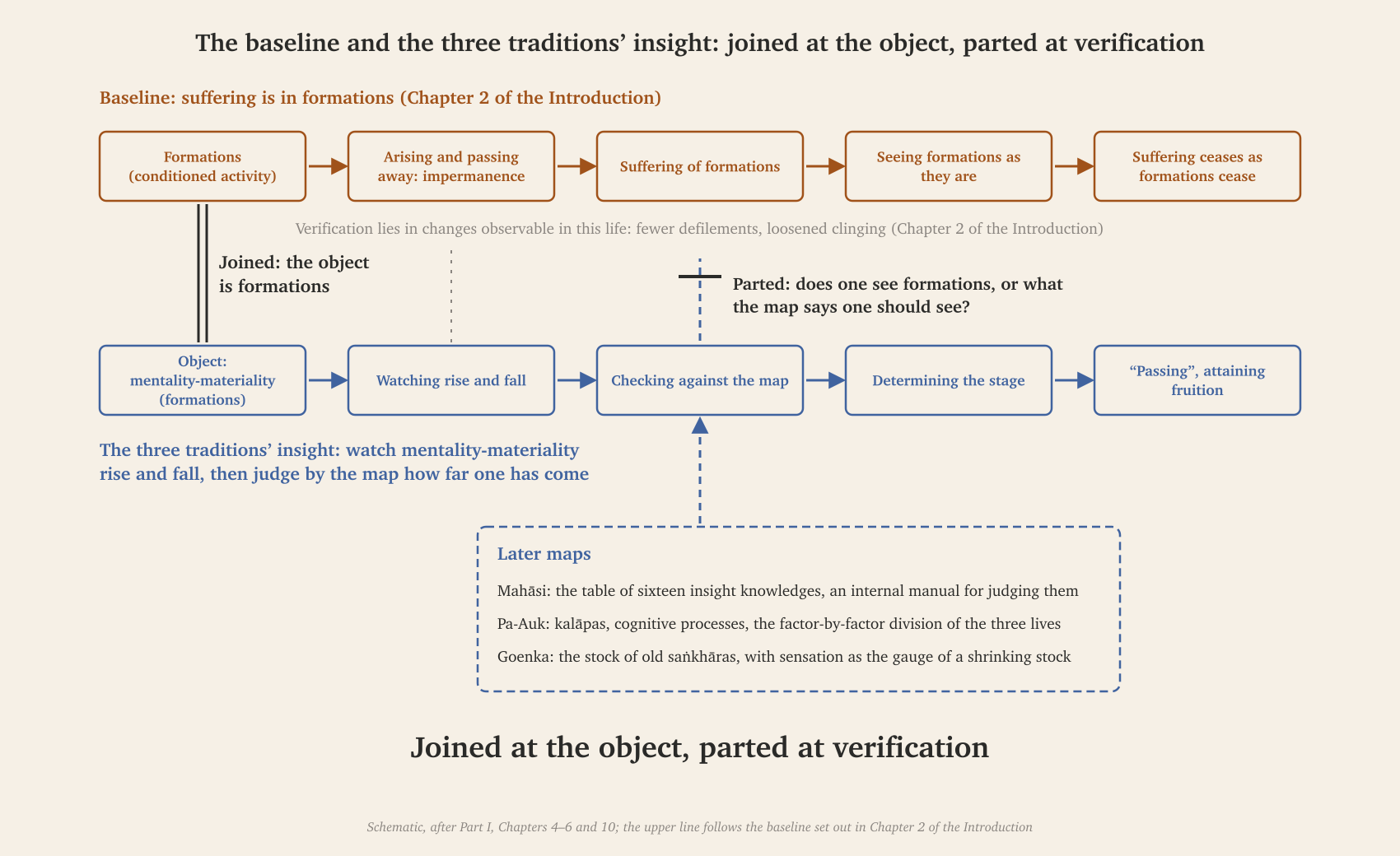
The nine preceding chapters set out, from the sources, the three lineages' calm and insight, their founders' own accounts, the records of practitioners, and the criticisms made from outside, and confined themselves to restating and summarizing. This chapter gives the judgment of this volume. There is one fundamental difference from Part III of Essay 2, The Meditation of Tsongkhapa, Chapter 6, and it must be stated first. What the Geluk tradition negates in the meditation session is an object of negation defined in advance by doctrine, and that chapter judged it to have no point of contact with the baseline. What the insight of the three lineages observes, by contrast, is mentality-materiality, that is, formations, and its object falls squarely on the baseline. So this chapter cannot simply carry over the criticism of "finding the grasping," and the question becomes a different one. The object is formations, but whether something counts as seeing, and how far one has seen, is decided by a later map: is what is seen really formations, or is it what the map prescribes should be seen? Below, the level of the object is acknowledged first; verification is discussed next; a separate section then deals with Pa-Auk's requirements for calm; after that come the consequences of the way verification is done; and finally the place of this tradition within this volume's framework is fixed and the boundaries of the critique are drawn.
1. The object is formations: this is acknowledged first
What the insight of the three lineages observes is the arising and passing away of bodily and mental phenomena. The Mahāsi lineage notes the rising and falling of the abdomen, bodily sensations, and the arising of thoughts; the Pa-Auk lineage discerns materiality and mentality and then contemplates their causal arising and passing away; the Goenka lineage is aware of sensations throughout the body from head to foot and maintains equanimity toward all sensations (Chapters 4 to 6). These are all conditioned bodily and mental phenomena, precisely what Chapter 2 of the Introduction calls formations. Chapter 2 of the Introduction locates suffering in formations, and the insight of the three lineages falls in the same place. What they observe is not an object of negation first defined by doctrine and then recognized by the practitioner in introspection. By the principle of symmetry, this must be said first, and said fully: applied here, the criterion this book relied on in criticizing the Geluk tradition is one that the three lineages pass.
The end point also agrees with the baseline. Goenka says that when the heaviest saṅkhāras, those that would lead to birth in the lower realms, have been eradicated, one experiences nibbāna for the first time, and when all the saṅkhāras that would lead to rebirth have been eradicated, there is no further rebirth (Chapter 6, Section 5).1 Chapter 2 of the Introduction says that the cessation of suffering lies in the cessation of formations, in the cessation of conditioned continuity; Goenka's end point does not conflict with this. So it cannot be described as suffering put in the wrong place; that is what this book said in criticizing the Geluk tradition. The Mahāsi and Pa-Auk lineages take path, fruition, and nibbāna as the end point, following the framework of the Abhidhamma and the commentaries, and the end point itself also lies within the baseline.
The Pa-Auk lineage's requirements for calm are, in this book's view, consistent with the early regimen of training; the reasons are given in Section 3. This point, together with the object being formations, belongs to what is acknowledged first.
2. Verification is decided by the map
The object is formations, but verification uses a later map. The Mahāsi lineage uses the table of the sixteen insight knowledges, together with the internal manual by which teachers assess the level of insight knowledge. The Pa-Auk lineage requires seeing kalāpas, cognitive processes, and the link-by-link divisions of the twofold causation across three lives; all three come from the Abhidhamma and the commentaries. This book itself accepts the teaching of three lives, but only its direction, not the detailed divisions of the twofold causation across three lives (see the opening of Chapter 5). The Goenka lineage requires sensations to dissolve layer by layer according to the model of a stock of old saṅkhāras (Chapter 6, Section 7). The situation Jordt records runs in exactly the opposite direction: lay people take the agreement between their meditation experience and the treatises as a first-person verification of the treatises.2 Meditative experience is used to verify the map, and the map is used in turn to verify meditative experience.
The question for this section is whether what is seen is formations, or what the map prescribes should be seen. This is the southern version of the question raised by the Geluk step of "finding the grasping," but it falls at a different point: the Geluk problem lies in the object, while the problem here lies in verification. Chapter 2 of the Introduction says that early Buddhist verification rests on changes observable in this life: greater steadiness of mind, fewer defilements, looser grasping.3 The verification of the three lineages rests instead on whether what the practitioner reports seeing agrees with the map. The three lineages are taken in turn below.
The Mahāsi lineage knows that practitioners' reports are liable to be shaped by expectation. Jordt says that the internal manual is kept secret so that inexperienced people will not read it and be hindered by trying to anticipate what comes next; that the manual teaches teachers to frame their questions so that the practitioner cannot guess what the teacher wants to know; and that when practitioners claim to have seen arising and passing away, teachers will say that these are merely thoughts and imaginings (Chapter 8, Section 1).4 These measures themselves show that a report may agree with the map because the practitioner knows the map. Bhikkhu Anālayo's analysis of noting points to the same place: "Fast noting can easily proceed from noting what has just appeared, to what is just appearing, to what is just about to appear, to what one expects to be just about to appear. From this point onward, the act of noting can actually serve to create experience." He is speaking of Ingram, but the mechanism he describes belongs to the noting method itself: expectation takes part in what is seen (Chapter 9, Section 6).5 The Mahāsi lineage's safeguard is to keep the map secret and to have the teacher frame the questions. The safeguard depends on skill on the teacher's side, and what is verified is still whether the report agrees with the table of insight knowledges.
In the case of the Pa-Auk lineage, the safeguards it has set up for itself must be acknowledged first. On the side of calm, this lineage has three checks: discerning the bhavaṅga consciousness at the heart, discerning the counterpart sign in the bhavaṅga, and discerning the five jhāna factors one by one and then all at once (Chapter 2, Section 4). Pa-Auk also says that one who believes he has attained the first jhāna or the like should examine it thoroughly over many days and many months and not be too quick to tell others.6 This lineage also understands that images in the meditation session can be fabricated by the mind. Pa-Auk's Nibbānagāmini-paṭipadā says that thoughts such as "Will I see it like this? Will I see this kind of form?", that is, various anticipations, make conceptual masses and conceptual images appear (Chapter 5, Section 3). Bhante Mahinda puts it more directly: "When your aggregate of perception has been strengthened to the extreme, so that whatever you visualize you can make appear, your calm and insight meditation has already gone off course! Then, when you practice meditation on materiality, you need only visualize kalāpas and you will be able to see 'kalāpas.' When you practice dependent origination, you need only visualize that in your previous life you were a man, and your previous life will be a 'man'"; "so-called visualization is in fact nothing but psychological suggestion and self-hypnosis" (Chapter 8, Section 4).7 The test he gives is not to presuppose light or signs, but "simply to concentrate honestly on the breath, until, as soon as you close your eyes, the breath is light and the light is breath"; only if at that point the light still appears steadily even when one is thinking that one does not want to see it can one be sure that it is the nimitta. The author's understanding is close to this but put differently: when one has reached a state in which it no longer matters whether there is light or not, and one concentrates more steadily on the meditation subject, that is, the breath, then the light that appears steadily at that point and cannot be ignored is what is called the nimitta.
These safeguards lie on the side of calm: the stability of the jhāna factors, the bhavaṅga, and the counterpart sign. In the insight stages, the "seeing" of kalāpas, cognitive processes, and past and future lives is mediated by images, and clarity and directness alone cannot tell whether something is seen by insight or fabricated. The remedy the Nibbānagāmini-paṭipadā gives is to contemplate the four great elements in the image and see kalāpas; but kalāpas themselves are also presented as images, so this only replaces one kind of image with another. This lineage has a further cross-check for the insight stages: the object of the near-death impulsion of the previous life must be the same as the objects of the rebirth-linking, bhavaṅga, and death consciousness of this life, and the number of mental phenomena must also be the same (Chapter 5, Section 3). This cross-check rests on whether the images agree with the rules of the Abhidhamma, not on whether the images come from anticipation; and the rules themselves are known to the practitioner in advance, so anticipation can produce images that agree with them precisely by following the rules. The discernment of past lives also has the test of "continuing": if what is seen corresponds to cause and effect, one can continue, and if it does not, one cannot continue (Chapter 8, Section 4). This book records this and makes no judgment on it.
The author's own meditation experience is relevant here, and is marked as the author's own account. The scenes that arise along with wandering thoughts differ from deliberate imagining; they are a more direct "seeing," close to dreaming, and can fabricate and construct any image whatever. The so-called "seeing the Buddha in samādhi," as anyone who has seriously practiced meditative concentration will know, is an illusion that can be induced, and it may be controlled or uncontrolled; the author once saw Pennywise (the clown in Stephen King's novel It) "in samādhi." The author's inference is that this is a physiological phenomenon produced by the brain's visual cortex under a certain degree of suggestion in the absence of sensory stimulation; the author also holds that seeing images in this way does not count as entering concentration.8 Sensory deprivation experiments can serve as indirect corroboration, though they are not studies of meditation. When healthy subjects were blindfolded for ninety-six hours, ten of thirteen reported visual hallucinations, some simple, such as spots of light, and some complex, such as faces, landscapes, and ornate objects; these generally began after the first day of blindfolding, and the subjects knew that they were not real. When exposed to a uniform, unstructured visual field, most observers have hallucination-like percepts.9 On this basis, this book's judgment is that relying on images as the evidence for verification is not acceptable. The Pa-Auk lineage does readily give the impression of emphasizing light and nimittas, and this impression is to some extent accurate; beginners without guidance can produce such images through fabrication in their own minds, as the lineage's own literature also says. The problem is not that this lineage does not know that images can be fabricated, but that the cross-checks of the insight stages come back in the end to whether the images agree with the rules.
The Goenka lineage is the third map, and the main argument of this section. This map has three layers.
The first is the premise of kamma and its results. Goenka deliberately extends "saṅkhāra" from the sense of reaction to the sense of everything conditioned, and he does so on the strength of a premise about kamma and its results. Hart records Goenka's explanation: the blind reaction of the mind is called saṅkhāra, and its result is also called saṅkhāra; "Everything that we encounter in life is ultimately the result of our own mental actions," so that in the widest sense saṅkhāra is whatever has been created, formed, and composed in this conditioned world (Chapter 6, Section 2).10 The line "their stilling is bliss" in Sakka's verse "Impermanent, truly, are formations" is read in the discourse of the eighth day as the eradication of all past saṅkhāras (Chapter 6, Section 4).11 So this book does not criticize him for "conflating" two kinds of saṅkhāra; he deliberately joined them into a single line. What is to be criticized is this premise and the consequences drawn from it.
The second is that the suffering of formations is made concrete as a stock that can be counted off layer by layer. Hart says that, following the chain of dependent origination, consciousness arises from reaction; that past conditioning appears at the physical level by causing a particular type of kalāpa to arise, which is experienced as sensation in the body; and that Vipassana is "a kind of fasting of the spirit," undertaken to eliminate past conditioning. Goenka says that the heaviest saṅkhāras arise first, and only when they have been eradicated does one experience nibbāna for the first time, after which deeper saṅkhāras are eradicated layer by layer (Chapter 6, Section 3).12 Bodily sensation thereby becomes the measure of how far the stock has been reduced.
The third is an empirical claim: old saṅkhāras surface as kalāpas and are perceived as sensations. The Abhidhamma speaks of kamma-produced materiality, but Chapter 6, Section 7, has already shown that the further layer, "old saṅkhāras surfacing as kalāpas and appearing as sensations," belongs to the lineage's own teaching and does not come from the suttas or the commentaries. If this claim is to hold, there must be some way to distinguish which sensations are old saṅkhāras surfacing and which are not; yet in this lineage's account every sensation, including gross pain, is counted as the stock diminishing. That being so, nothing could count as evidence against this model. Its consequences are taken up again in the third point of Section 4.
3. Pa-Auk's standard for calm is not high (the author's judgment)
The Pa-Auk lineage requires the counterpart sign to remain steady for two or three hours, which comes close to "two to three hours without wandering thoughts" (Chapter 2, Section 4). This book's judgment is that this requirement is not high, and that modern people's view of it as "too high a standard" has no basis.
The basis for this judgment is the day of a bhikkhu as recorded in the early scriptures. The Discourse on the Attendant in the Madhyama Āgama says that after a bhikkhu has gone for alms and finished his meal, he "either walks up and down or sits in meditation, purifying his mind of obstructive states"; so during the day, and so in the first watch of the night. In the middle watch he enters his dwelling and lies down on his right side, "his mind fixed on the perception of light (意係明相), with right mindfulness and right knowing, constantly bearing in mind the thought of rising"; in the last watch he rises quickly and again walks up and down and sits in meditation. The discourse calls this "the bhikkhu's lion's way of lying down."13 This passage links the end of the meal with practice through the whole of the following day and night. The same regimen appears in discourses 275 (with its Pāli parallel at Aṅguttara Nikāya 8.9) and 503 of the Saṃyukta Āgama, in the words "in the first and last watches of the night, diligently awake" in the Ambaṭṭha Discourse of the Dīrgha Āgama, and in four places in the Ekottarika Āgama; the Pāli scriptures call it devotion to wakefulness (jāgariyānuyoga), found in Majjhima Nikāya 39, 53, 107, and 125 and in Aṅguttara Nikāya 3.16 and 4.37.14 Eating one meal a day is also stated explicitly in the scriptures: the Buddha says, "I eat at a single sitting … you too should learn to eat at a single sitting."15
Writing strictly according to the texts, three points must be made clear. First, the texts speak of walking and sitting meditation in alternation, not of sitting alone. Second, according to the texts, practice continues to the end of the first watch, one lies down only in the middle watch, and one rises in the last watch; the night is divided into three watches and only the middle watch is for lying down, which in fact amounts to more than "practicing until midnight." Third, what the texts describe is an ideal regimen of training, not the diary of any particular bhikkhu.
How long a single sitting lasts, the texts do not say. The daily regimen says only that walking and sitting alternate during the day and in the first and last watches of the night; it does not fix the length of a sitting. The precedents for long sitting that can be found in the texts are of three kinds. The first is an open-ended resolve: after his alms round, past midday, a bhikkhu "sits cross-legged, and does not uncross his legs until the taints are destroyed"; in the Pāli parallel, he resolves not to break this sitting until his mind is liberated from the taints.16 The second is an ability the Buddha claims for himself: the Buddha tells the Jain ascetics (Nigaṇṭhas) that he can sit cross-legged for seven days and seven nights without moving his body; in the Pāli parallel, he can abide for one day and night, and up to seven days and nights, without moving his body or uttering a word, experiencing the peak of pleasure.17 The third is continual sitting without lying down: Majjhima Nikāya 113 lists the continual sitter alongside the one-session eater among the ascetic practices, and the point of that discourse is that the practitioner should not on that account exalt himself and disparage others.18 The texts also have expressions for very short spans, such as cultivating loving-kindness "for the space of a finger snap," which say that even a very short time has merit; they are not a standard for a sitting.19
From the author's own meditation experience, the author infers that when one meditates for more than ten hours a day, a sitting of two hours should be a very common state of affairs. This sentence is the author's inference and is kept separate from what the texts above record. By way of comparison, the Mahāsi lineage sets essentially no requirement on how long one sits, and in its intensive retreats a single sitting usually lasts less than an hour; this is what the author has seen and heard (Chapter 3 of the Introduction, Section (ii)).
There are two situations in which "the standard is too high" is given as a reason, and this book's judgment on each is as follows. The first is wanting to obtain certification of the "first jhāna." This book considers this unnecessary: whether one has reached the first jhāna does not differ according to whether a teacher approves it; and besides, as shown above, this standard is not really strict. Pa-Auk himself also says that he has never certified any meditator's attainment of jhāna, path, or fruition (Chapter 7, Section 4). The second is that the Pa-Auk lineage requires calm before insight, and those who for a long time cannot reach its standard for the first jhāna feel a heavy sense of frustration. This deserves sympathy; but it must still be pointed out calmly that between "I did my best and still did not reach a standard" and "this standard is unreasonable" there is a wide gap.
What this chapter criticizes is the map used for verification, not the requirements for calm. Pa-Auk's requirements for calm are consistent with the early regimen of training, and, together with the object being formations in Section 1, belong to what this book acknowledges first.
4. Consequences
First, no certification in name, but checkpoints in fact. Mahāsi said that apart from the Buddha no one can confirm attainment; Pa-Auk says that he never certifies anyone. Yet both lineages have procedures for assessing levels. The Mahāsi lineage has the internal manual, tape recordings played only to those judged to have gone deep into the insight knowledges, and the demonstration of attainment to the teacher by long entries into the attainment of fruition; the Pa-Auk lineage has the three checks and what students call "passing" (guoguan) (Chapter 4, Section 3; Chapter 8, Section 4). By the Vinaya a bhikkhu may not declare to lay people a superhuman state he has actually attained, so the attainment of the fruit comes to be seen through the conjectures of biographies, the stories told by devotees, and long attainments of fruition (Chapter 7). Here the tone must be moderated: the teacher of the retreat on which Ingram attained arahantship advised him in person not to go around calling himself an arahant (Chapter 8, Section 3), so the inflation of self-reports in the West cannot be said to be a direct consequence of this system of recognition.
Second, the Dark Night. The table of insight knowledges (shared by Mahāsi and Pa-Auk) writes difficulty in as a stage and tells practitioners about it in advance. But what agrees with experiences of difficulty is a modern reading. Lindahl and colleagues point out that Buddhaghosa's knowledge of appearance as terror is a cognitive insight into impermanence with no emotional character, and that Buddhaghosa says explicitly, "It does not fear"; it was Mahāsi and others who emphasized the emotional character of these insight knowledges (Chapter 9, Section 8).20 In systematic research, fear is the most common category, but the figure of 82% combines three traditions, and the research did not test whether experiences of difficulty correspond to the stages of insight knowledge (Chapter 8, Section 6). The map may also induce difficulty: Bhikkhu Anālayo says that experiencing dissolution and fear in the cultivation of insight depends on the specific attitude and instructions of Theravāda vipassanā; Lindahl and colleagues say that worldviews and analytical meditation practices may shape associated experiences, although they also acknowledge that fear may also arise from sensitization (Chapter 9, Sections 1 and 8).21 Forewarning and induction cannot be separated, and the question comes back to verification in Section 2.
Third, the map interprets every experience as progress. Goenka says that the return of gross sensations and the appearance of blind spots in the body are "signs not of regression but of progress," and that the surfacing of deep impurities at the stage of equanimity toward formations is likewise "a progress." U Ba Khin says that the impact of the nibbāna element on the impurities and poisons in one's system creates a sort of upheaval, which must be endured.22 Pagis records a student whose social anxiety grew worse after a course and who adopted the teachers' interpretation that this was deep sediment rising to the surface; one teacher told a student, "these are old saṅkhāras leaving you" (Chapter 8, Section 5).23 The Mahāsi lineage maps fear onto the knowledge of appearance as terror and regards it as an "inevitable" part of progress (Chapter 8, Section 6). Since no kind of experience counts as counterevidence, verification can never fail. Lindahl and colleagues list purification narratives among the risk factors that lead practitioners to continue practicing even when adverse consequences appear, and this can serve as indirect corroboration.24
Fourth, rigidity. One map leaves room for only one path (Chapter 3 of the Introduction, Section (ii)). The old meditation practice (borān kammaṭṭhāna) that Crosby records as having been displaced did not have its main home in Myanmar (Chapter 9, Section 3); the Thai Forest tradition is another path, and Ajahn Chah said that absorption is not necessary and did not speak of levels of attainment (Chapter 8, Section 7; Chapter 9, Section 2). What Bhante Mahinda records, students asking around everywhere for the answers to each stage and, when they cannot pass with one teacher, switching to another (Chapter 8, Section 4), is the same map being treated as an examination syllabus to be got through.
5. The place of this tradition within this volume's framework
Chapter 3 of the Introduction, Section (ii), says that Abhidhamma as a field of study is not itself the source of rigidity; rigidity arises once "we begin to manage this analysis as 'I' and 'mine,'" and once meditation is tied to the requirement that one must first learn the definitions of dhammas correctly before one can speak of observing things as they are, "observation risks becoming a footnote to a conceptual map."25 The three lineages are concrete examples of the situation described in that section, but the point at which it applies must be stated precisely: that the three lineages observe formations is not within the critique; what becomes "a footnote to a conceptual map" is verification.
Compared with the Geluk tradition, the relation between the two lines is different. What the Geluk negates is an object of negation defined by doctrine, and the line of its insight never meets the line of the baseline. The three lineages observe formations, and the two lines meet at the object and part at verification.
6. Boundaries
Training in calm has measurable effects: three months of training in calm improved perceptual discrimination and sustained attention (Chapter 9, Section 8). This is not within the critique.
This book does not doubt anyone's sincerity. The three lineages' forewarning of the difficult stages deserves to be recorded. That Mahāsi set up the tape recordings to avoid making declarations and took back the relics that had been treated as tokens of recognition (Chapter 7, Section 3), and that Pa-Auk says he has never certified anyone (Chapter 7, Section 4), must also be recorded as they are.
Finally, this book's own position must be stated. As soon as actual practice is involved, it can be seen that the theory and teaching of these three lineages cannot be made fully theoretical and analytical in the way that more philosophical and systematic teachings can. The criterion for calm rests on the counterpart sign and the jhāna factors, and the verification of insight rests on whether reports agree with the map; what they rely on in the end is practitioners' reports of their own experience and teachers' readings of those reports. This book, too, has no better way of judging whether practice has succeeded than the report and reading used by the three lineages, and this should be said plainly. This is a barrier between third-person observation and first-person experience that cannot as yet be crossed. The baseline of this volume is the contemplation of formations recorded in the texts and the changes observable in this life described in Chapter 2 of the Introduction, and this chapter points out the limits of the way verification is done on the basis of that baseline; this does not mean that this book has some other, clearer and more reliable way that could replace it. In teaching that concerns human experience, the way of the three lineages, though not one hundred percent clear and reliable, is perhaps, if anything, the best that can be achieved at present. This chapter's judgment on images draws on the author's own meditation experience; that part has been marked as the author's own account and the author's inference, and written separately from the literature and the experiments.
References
-
Goenka, Discourse Summaries, Day Seven, p. 55: "When all such saṅkhārā have been eradicated, then naturally one experiences nibbāna for the first time. … Gradually one proceeds to higher stages, until all the saṅkhārā have been eradicated that would have led to future life anywhere." (Already quoted in Chapter 6, Section 5.) ↩
-
Jordt, Burma's Mass Lay Meditation Movement, p. 64: "The concordance between vipassanā meditation and the Abhidhamma has become a form of first-person verification of the texts for the laity." ↩
-
See the section "The question of verification: changes observable in this life" in Chapter 2 of the Introduction to Volume 2. ↩
-
Jordt, Burma's Mass Lay Meditation Movement, p. 66: "The manual is kept secret so that inexperienced persons will not read it and be hindered by attempts to anticipate what is to come next." p. 69: "Ask in such a way that the yogi could not guess what you wish to know." p. 73: "these are merely thoughts and imaginations". ↩
-
Anālayo, "Meditation Maps, Attainment Claims, and the Adversities of Mindfulness," p. 2109. ↩
-
For the three checks, see the article by Chen Faling 陳法菱 cited in Chapter 2, Section 4, pp. 100–102. Pa-Auk, Knowing and Seeing, Q&A 7.5, pp. 242–243: "you should examine your experience thoroughly over many days, and many months." ↩
-
Pa-Auk, Nibbānagāmini-paṭipadā (趣向涅槃之道), vol. 3, section on dependent origination, original p. 104 (already cited in a note to Chapter 5). Bhante Mahinda 玛欣德, Nanchuan shangzuobu fojiao zhiguan chanxiu cidi 南传上座部佛教止观禅修次第 (Theravāda Buddhism: The Stages of Calm and Insight Meditation), p. 426; the test is on the same page. The same book, p. 208: "the stronger the power of concentration, the more real the illusions conjured up by the aggregate of perception will be." Bhante Mahinda (comp. and trans.), Shangzuobu fojiao xiuxue rumen 上座部佛教修學入門 (An Introduction to the Study and Practice of Theravāda Buddhism), p. 225: "You must know that these signs are all produced by the mind's perception; they are hallucinations!" ↩
-
If applied to the origins of the Mahāyāna sūtras, this inference of the author's may perhaps explain how seeing Buddhas and hearing the Dharma in samādhi came about in sūtras of the Prajñāpāramitā type. Fascicle 9 of the Daoxing banruo jing (Lokakṣema's translation of the Aṣṭasāhasrikā), in the chapter on the Bodhisattva Sadāprarudita, records that Sadāprarudita, on hearing the teaching of an emanated Buddha, "because of his joy and elation, at once attained the samādhi of seeing the Buddhas of the ten directions" (CBETA, T08, no. 224, p. 472, a18 ff.), and the Buddhas of the ten directions praise and instruct him in that samādhi; "The Bodhisattva Sadāprarudita awoke from samādhi and thought: 'Where did the Buddhas originally come from? Where have they gone?'" (ibid., p. 472, a26 ff.); and in the same fascicle Dharmodgata's answer is: "Emptiness originally comes from nowhere and goes nowhere; the Buddha is likewise." (ibid., p. 473, c9 ff.). The Prajñāpāramitā sūtra itself tells of receiving the teaching in samādhi, and itself describes the Buddhas so seen as coming from nowhere and going nowhere. For the hypothesis that new sūtras arose from seeing Buddhas and hearing the Dharma in meditative concentration, see the table of hypotheses in Volume 1, Part I, Essay 4, Chapter 1, and Section 4 of the topical series Who Wrote the Mahāyāna Sūtras?, part 3 (Chinese only). How meditative contemplation was actually carried out at that time can no longer be known, so this is only the author's inference from personal meditation experience, consistent with the judgment in Section 5 of that part of the series that the matter is "unprovable." ↩
-
Lotfi B. Merabet et al., "Visual Hallucinations During Prolonged Blindfolding in Sighted Subjects," Journal of Neuro-Ophthalmology 24.2 (2004): 109–113, p. 109: "Ten (77%) of the subjects reported visual hallucinations, which were both simple (bright spots of light) and complex (faces, landscapes, ornate objects). The onset of hallucinations was generally after the first day of blindfolding. Subjects were insightful as to their unreal nature." Jiří Wackermann, Peter Pütz, and Carsten Allefeld, "Ganzfeld-induced Hallucinatory Experience, Its Phenomenology and Cerebral Electrophysiology," Cortex 44 (2008): 1364–1378, p. 1364: "Ganzfeld, i.e., exposure to an unstructured, uniform stimulation field, elicits in most observers pseudo-hallucinatory percepts". ↩
-
Hart, The Art of Living, p. 93; the passage continues: "Therefore in the widest sense, saṅkhāra means anything in this conditioned world, whatever has been created, formed, composed." ↩
-
Goenka, Discourse Summaries, Day Eight, p. 60: "If all the past saṅkhārā are eradicated, one enjoys the limitless happiness of liberation." (Already quoted in Chapter 6, Section 4.) ↩
-
Hart, The Art of Living, pp. 104–105: "The conditioning will appear at the physical level by causing a particular type of kalāpa to arise, which one then experiences as sensation within the body." "Vipassana meditation therefore is a kind of fasting of the spirit in order to eliminate past conditioning." Goenka, Discourse Summaries, Day Seven, p. 55: "Fortunately, when one starts to practice Vipassana, it is these very saṅkhārā that arise first." Day Ten, pp. 82–83. ↩
-
Madhyama Āgama, fascicle 8, Discourse on the Attendant (no. 33), CBETA, T01, no. 26, p. 473, c20 ff. (to p. 474, a4): "Having finished his alms round in the village … he either walks up and down or sits in meditation, purifying his mind of obstructive states. During the day, walking up and down or sitting in meditation, having purified his mind of obstructive states, again in the first watch of the night he either walks up and down or sits in meditation, purifying his mind of obstructive states." "In the middle watch of the night he enters his dwelling, wishing to lie down … he lies down on his right side, one foot placed on the other, his mind fixed on the perception of light, with right mindfulness and right knowing, constantly bearing in mind the thought of rising. In the last watch of the night he rises quickly from lying down and either walks up and down or sits in meditation, purifying his mind of obstructive states. Such is the bhikkhu's lion's way of lying down." ↩
-
Saṃyukta Āgama, fascicle 11, discourse 275, CBETA, T02, no. 99, p. 73, b13 ff.: "During the day that Nanda walks up and down and sits in meditation, removing the obstruction of the hindrances, so as to purify his body. In the first watch of the night he walks up and down and sits in meditation … In the middle watch of the night … he lies down on his right side, knees bent and one foot placed on the other, his mind fixed on the perception of light, attending to the thought of rising. In the last watch of the night he slowly wakes and slowly rises, and walks up and down and sits in meditation"; Pāli parallel AN 8.9, Bhikkhu Bodhi (trans.), The Numerical Discourses of the Buddha, Boston: Wisdom Publications, 2012, pp. 1121–1122: "During the day, while walking back and forth and sitting, Nanda purifies his mind of obstructive qualities." Saṃyukta Āgama, fascicle 18, discourse 503 (p. 132, c20 ff.). Dīrgha Āgama, fascicle 13, Ambaṭṭha Discourse (T01, no. 1, p. 84, c27 ff.): "The bhikkhu, thus accomplished in noble virtue, having attained the noble faculties, knowing moderation in eating, is diligently awake in the first and last watches of the night." Ekottarika Āgama, fascicle 12, chapter 21, discourse 6; fascicle 26, chapter 34, discourse 5; fascicle 40, chapter 44, discourse 4; fascicle 47, chapter 49, discourse 8; of these, the passage in fascicle 40 places lying down in the last watch, which differs from the usual regimen. Pāli: MN 39 §10, Bhikkhu Ñāṇamoli and Bhikkhu Bodhi (trans.), The Middle Length Discourses of the Buddha, Boston: Wisdom Publications, 1995, p. 365: "'We will be devoted to wakefulness. During the day, while walking back and forth and sitting, we will purify our minds of obstructive states. In the first watch of the night, while walking back and forth and sitting, we will purify our minds of obstructive states. In the middle watch of the night we will lie down on the right side in the lion's pose … After rising, in the third watch of the night, while walking back and forth and sitting, we will purify our minds of obstructive states.'" MN 53 (p. 462), MN 107 (p. 875), MN 125 (p. 994); AN 3.16 (p. 212), AN 4.37 (p. 427). ↩
-
Madhyama Āgama, fascicle 51, Discourse to Bhaddāli (no. 194), CBETA, T01, no. 26, p. 746, b20 ff.: "I eat at a single sitting; having eaten at a single sitting, I am without striving and without seeking, free of illness and pain, my body light, my strength vigorous, at ease and happy. You too should learn to eat at a single sitting"; fascicle 50, Discourse to Moliyaphagguna (no. 193), has the same. Pāli MN 65, p. 542: "Bhikkhus, I eat at a single session. By so doing, I am free from illness and affliction, and I enjoy health, strength, and a comfortable abiding. Come, bhikkhus, eat at a single session." MN 21, p. 218. Not eating after noon rests separately on the Vinaya rule against eating at the wrong time. ↩
-
Madhyama Āgama, fascicle 48, Discourse at the Gosiṅga Sāla Grove (no. 184), CBETA, T01, no. 26, p. 729, b13 ff.: "Having finished his alms round, past midday, he puts away his robe and bowl, washes his hands and feet, places his sitting cloth on his shoulder … spreads out his sitting cloth, sits cross-legged, and does not uncross his legs until the taints are destroyed". Pāli MN 32 §17, p. 312: "'I shall not break this sitting position until through not clinging my mind is liberated from the taints.'" ↩
-
Ekottarika Āgama, fascicle 35, chapter 41, discourse 1, CBETA, T02, no. 125, p. 744, b6 ff.: "Can King Bimbisāra, as I can, sit cross-legged for seven days and seven nights without his body moving?" The Madhyama Āgama, fascicle 25, Discourse on the Mass of Suffering (no. 100, p. 587, c1 ff.), has "silent and speechless, and because of this experiencing joy and happiness for seven days and seven nights," without the words "sitting cross-legged, body unmoving." Pāli MN 14 §22, p. 189: "I can abide without moving my body or uttering a word, experiencing the peak of pleasure for one day and night…for seven days and nights." ↩
-
MN 113, pp. 910–911: among the ascetic practices are "a continual sitter" and "a one-session eater"; "So, putting the practice of the way first, he neither lauds himself nor disparages others because of his being a one-session eater." ↩
-
Ekottarika Āgama, fascicle 19, chapter 27, discourse 3, CBETA, T02, no. 125, p. 644, c20 ff.: "Therefore it is not as good as having compassion for beings for the space of a finger snap; the merit of this cannot be reckoned." What is discussed there is the relative degree of merit. Saṃyukta Āgama, fascicle 47, discourse 1256 (p. 345, a5 ff.): "Thus the beings who can repeatedly, even for as little as a finger snap, cultivate a mind of loving-kindness toward all beings are like the soil on a fingernail," which says that the beings who can do this are very few. ↩
-
Lindahl et al., "Fear and Terror in Buddhist Meditation," p. 151: "It does not fear. For it is simply the mere judgment that past formations have ceased…"; "a fundamentally cognitive insight into impermanence that does not have an affective character". p. 152: "Mahāsi Sayadaw (1994) and Matara Sri Ñāṇārāma (1993) … highlight their affective character". ↩
-
Anālayo, "The Insight Knowledge of Fear," p. 2178: "the cultivation of insight meditation leading to experiences of dissolution and fear depends on a specific attitude and corresponding instructions in the context of Theravāda vipassanā meditation." Lindahl et al., "Fear and Terror in Buddhist Meditation," p. 165: "meditation-related worldviews and analytical meditation practices could shape associated experiences"; the same page: "insight-related fear might not always be a result of a change in worldview … sensitization". ↩
-
Goenka, Discourse Summaries, Day Seven, p. 52; Day Ten, p. 82: "This is not a regression; it is a progress, for unless they come to the surface, the impurities cannot be eradicated." U Ba Khin, "The Real Values of True Buddhist Meditation," in Sayagyi U Ba Khin Journal, p. 68: "When one develops nibbāna dhātu, the impact of this nibbāna dhātu upon the impurities and poisons within his own system will create a sort of upheaval". (All discussed in Chapter 6.) ↩
-
Pagis, Inward, p. 137: "it turns every emotional downfall into a part of the training and a temporary station on the way to a better state." Cooper et al., "Like a Vibration," p. 16 of 27. ↩
-
Lindahl, Palitsky, and Britton, "Worldviews," p. 5: "high expectations … (idealization) … purification narratives … (effortful orientations) all tended to engage in continued practice despite adverse consequences". ↩
-
See Chapter 3 of the Introduction to Volume 2, Section (ii), "Technical rigidity in the path of meditation." ↩