Part I, Chapter 5: Insight II: Pa-Auk's Kalāpas, Cognitive Processes, and Three Lives¶
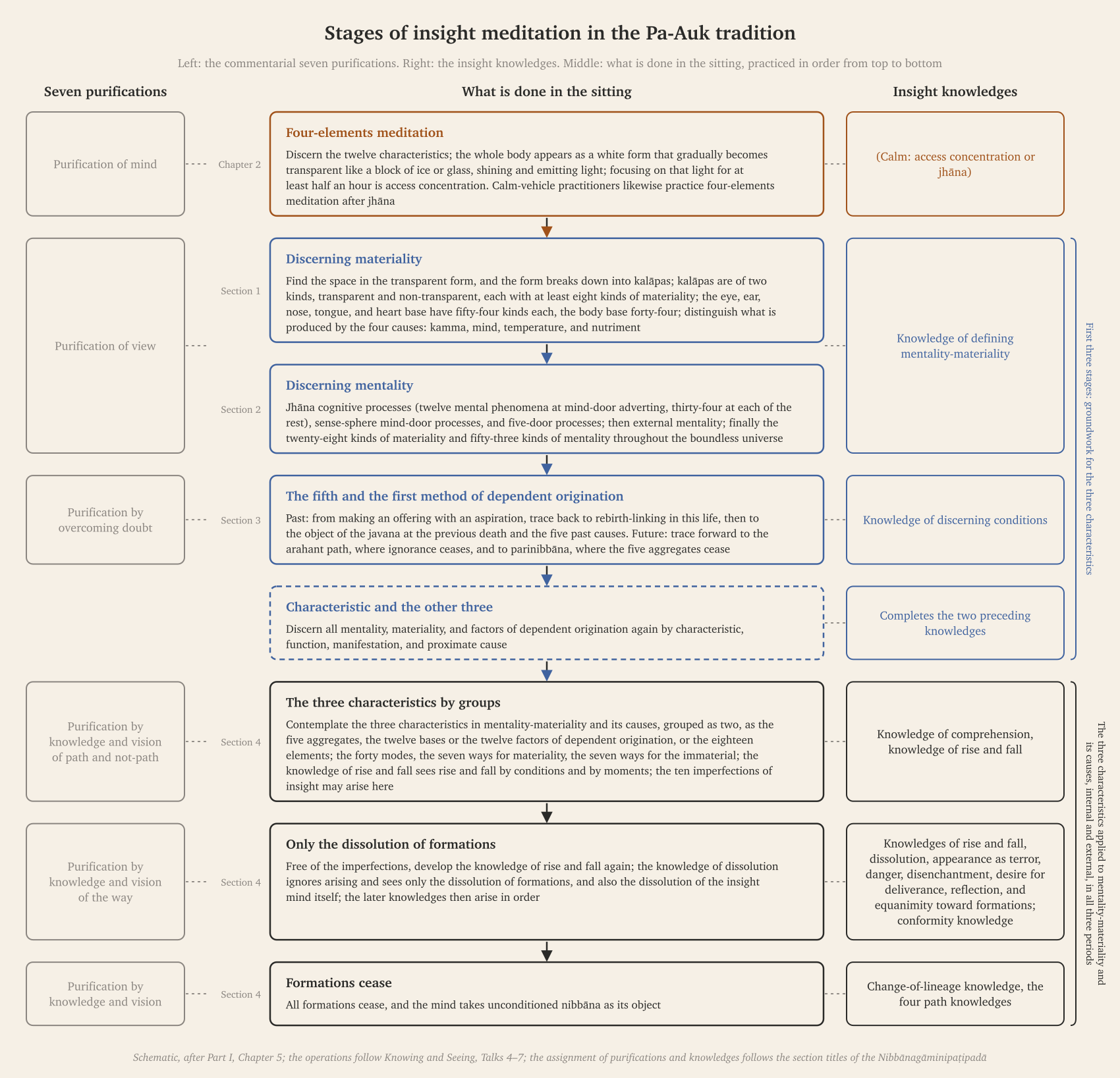
Chapter 4 restated the insight of the Mahāsi lineage. This chapter restates the insight of the Pa-Auk lineage. In practice, Pa-Auk's insight falls into four stages. In the light of concentration from four-elements meditation, the body is broken down into kalāpas and the ultimate materiality in each kalāpa is discerned; this is called meditation on materiality. Following the cognitive process, the consciousness and mental factors in each mind-moment are discerned; this is called meditation on mentality. Tracing back into past lives and forward into future lives, the causes of mentality-materiality are discerned; this is called dependent origination. Finally, this mentality-materiality and its causes are contemplated by the three characteristics of impermanence, suffering, and non-self, and the insight knowledges are passed through in order. Pa-Auk counts all four stages as insight: analyzing kalāpas is "the beginning of Vipassanā meditation," and discerning mentality is "the next stage in Vipassanā meditation."1 Among the seven purifications of the commentaries, the first two stages belong to purification of view, the third to purification by overcoming doubt, and the fourth to the purifications that follow: purification by knowledge and vision of what is and what is not the path, purification by knowledge and vision of the way, and purification by knowledge and vision. Pa-Auk's Burmese work, the Nibbānagāmini-paṭipadā, devotes separate sections and volumes to these four stages. The preface to its third volume says that one who skips ahead to seek the knowledge of discerning cause and condition, which belongs to purification by overcoming doubt, before the three purifications of virtue, mind, and view are complete, will find it very hard to succeed.2
This chapter draws mainly on the Pa-Auk lineage's own literature: Talks 4 to 7 of Knowing and Seeing with their questions and answers (Chinese translation Rushi zhijian 如实知见), Parts 2 and 3 of Mindfulness of Breathing and Four Elements Meditation, the Nibbānagāmini-paṭipadā, the Collected Questions and Answers of Pa-Auk Sayadaw, and Bhante Mahinda's Shangzuobu fojiao xiuxue rumen (An Introduction to the Study and Practice of Theravāda Buddhism) and Apidamo jiangyao (Lectures on Abhidhamma). The base texts used for comparison are chapters 17 and 18 of the Visuddhimagga and A Comprehensive Manual of Abhidhamma, edited by Bhikkhu Bodhi, an English translation of the Abhidhammattha-saṅgaha with explanatory guide. Of the objections raised against this lineage from outside, only those recorded in Braun's article are taken up here; the rest are in Chapter 9. The twelve characteristics of four-elements meditation, the light of access concentration, and the two routes to insight have been covered in Chapter 2, Section 3, and Pa-Auk's reading of momentary concentration for the pure-insight practitioner in Chapter 3, Section 3. This chapter picks up at the point where the transparent form breaks into kalāpas.
Most of the terms used in this chapter are categories of the Abhidhamma Piṭaka, the commentaries, or the subcommentaries; the four Nikāyas do not use them. Ñāṇamoli points out in the notes to his English translation of the Visuddhimagga that "The 'material groups' are not in the Piṭakas," and that the cognitive series "is unknown as such in the Piṭakas." Bhikkhu Bodhi lists the detailed account of the cognitive process, the seventeen mind-moments, the kalāpas, and the heart-base as distinctive features of the commentaries, while cautioning that this line of development should not be pushed too far, since most of the commentarial apparatus may have been transmitted alongside the Abhidhamma Piṭaka.3 Wherever these terms are used below, they restate the Abhidhamma and commentarial system on which the Pa-Auk lineage relies. The sources of the terms are listed as follows:
| Term | Pāli | Source used in this chapter | In the Tipiṭaka |
|---|---|---|---|
| Kalāpa | rūpa-kalāpa | First made explicit in the commentaries; chapter 6 of the Abhidhammattha-saṅgaha lists twenty-one kinds | Ñāṇamoli: not in the Tipiṭaka; Bodhi: implied by the distinction between the primary elements and derived matter |
| Counting of decads and octads | dasaka, aṭṭhaka | Visuddhimagga, chapter 18, §§5–10 | Listed by Ñāṇamoli as a new doctrine absent from the Tipiṭaka |
| Heart-base | hadaya-vatthu | The commentaries | The Paṭṭhāna speaks only of the materiality on which mind depends |
| Cognitive process | citta-vīthi | Its organization completed in the commentaries; chapter 4 of the Abhidhammattha-saṅgaha | Not as such; rudiments in the Abhidhamma Piṭaka |
| Bhavaṅga, adverting | bhavaṅga, āvajjana | Already in the Paṭṭhāna | Yes (Abhidhamma Piṭaka) |
| Receiving, investigating, determining, registration | sampaṭicchana, santīraṇa, voṭṭhapana, tadārammaṇa | Only in the commentaries | No |
| The life span of matter as seventeen mind-moments | — | The commentaries; chapter 4 of the Abhidhammattha-saṅgaha | No |
| The divisions of the twofold causation across three lives | — | The five past causes and five present effects of the Paṭisambhidāmagga; Visuddhimagga, chapter 17, §§284–298 | The Paṭisambhidāmagga belongs to the Khuddaka Nikāya; the four Nikāyas have the twelve links but not these divisions |
| Stages of insight knowledge | ñāṇa | The Paṭisambhidāmagga; Visuddhimagga, chapters 18 to 22 | The Paṭisambhidāmagga belongs to the Khuddaka Nikāya; for the situation in the four Nikāyas see Chapter 4 |
This book itself also accepts the doctrine of three lives (Volume 1, Part II, Essay 13, Chapter 4), and that chapter at the same time identifies the precise divisions of the twofold causation across three lives as a construction of the commentaries, adopting its direction but not its details. Section 3 of this chapter only sets out Pa-Auk's procedure in the meditation session and how it corresponds item by item to these divisions; it does not discuss the three lives as such.
The four stages of Pa-Auk's insight meditation, from purification of mind to path knowledge, and their correspondence to the seven purifications and the insight knowledges, are drawn in the figure below.
1. Meditation on materiality: from the transparent form to kalāpas
The starting point of meditation on materiality is the transparent form seen when four-elements meditation reaches access concentration. Pa-Auk says that as one approaches access concentration, the whole body appears as a white form; as one continues to discern the four elements, it becomes transparent like a block of ice or glass. This transparent materiality is the five transparent-elements (pasāda); it looks like a single block because the three kinds of compactness (ghana), of continuity, group, and function, have not yet been seen through. If one continues to discern the four elements in the transparent form, it sparkles and emits light, and being able to concentrate on this light continuously for at least half an hour is access concentration. One then looks for small spaces in the transparent form, and the transparent form breaks down into small particles, which are called kalāpas. Pa-Auk says that reaching this point is purification of mind, after which one develops purification of view by analyzing the kalāpas: "That is the beginning of Vipassanā meditation."4 The practitioner of the vehicle of calm likewise practices four-elements meditation after jhāna and sees the kalāpas by the light of jhāna (Chapter 2, Section 3).
Kalāpas fall into two groups, and each contains at least eight kinds of materiality; the practitioner must analyze them down to the single kalāpa. Pa-Auk says that kalāpas containing one of the five transparent-elements are transparent and all others are opaque, and that a kalāpa contains at least eight kinds of materiality: earth, water, fire, air, color, odor, flavor, and nutritive essence.5 When kalāpas are first seen, they arise and pass away very quickly and still look like particles with size. Pa-Auk says that at this point the three kinds of compactness have not been broken and the practitioner is still in the realm of concepts; to contemplate the arising and passing away of the kalāpas at this point would be "trying to do Vipassanā on concepts." One must continue analyzing until one sees the four elements in a single kalāpa, and only then has one reached ultimate realities. When the kalāpas arise and pass away too quickly to be analyzed, he teaches students to ignore their arising and passing away, just as one pretends not to see someone one does not wish to meet but has met by accident.6 A question-and-answer passage that the third edition of Rushi zhijian added from the recordings of the talks puts it more directly: "According to the Abhidhamma taught by the Buddha, those particles are only concepts (paññatti); concepts are not objects of insight knowledge." Pa-Auk goes on to say that those who contemplate only the arising and passing away of the particles, when the particles vanish and a white transparent form remains, take this for the cessation of materiality, and when the mind falls into bhavaṅga take that for the cessation of mentality; in fact they have not yet reached the knowledge of analyzing mentality-materiality.7
Each kind of materiality is paired with a method of identifying it in the session, and the analysis proceeds through the six bases, eye, ear, nose, tongue, body, and mind, in turn. Color is the easiest to discern. Odor and flavor can be known by nose consciousness and tongue consciousness, and also by mind consciousness, so one must discern at the same time the nose or tongue transparent-element and "the bright, luminous bhavaṅga mind," which is the mind door. Pa-Auk says it is located in the heart and depends on the heart-base, and he cites The Dispeller of Delusion to the effect that when development is strong, the color, odor, and flavor of a kalāpa can be known by mind-door impulsion alone.8 Life-faculty materiality is found only in kamma-produced kalāpas. An opaque kalāpa containing the life faculty, outside the place where the heart-decad kalāpas are, is either a sex-decad kalāpa or a life-nonad kalāpa, and the one containing sex-determining materiality is the former. Heart-base materiality is in the opaque kalāpas in the lower part of the bhavaṅga mind.9 The two transparent-elements in the eye are distinguished by their objects: take the color of a kalāpa some distance away; if the color impinges on the transparent-element being observed, it is the eye transparent-element, and if not, it is the body transparent-element. The ear, nose, and tongue transparent-elements are tested in the same way by sound, odor, and flavor.10 From this it is reckoned that the eye contains six kinds of kalāpa and fifty-four kinds of materiality, listed as follows:
| Kalāpa | Materiality contained | Number | Origin | Transparent or not | Pa-Auk's method of identification |
|---|---|---|---|---|---|
| Eye-decad kalāpa | The eight inseparables, life faculty, eye transparent-element | 10 | Kamma | Transparent | Take the color of a kalāpa some distance away; the transparent-element on which the color impinges is the eye transparent-element |
| Body-decad kalāpa | The eight inseparables, life faculty, body transparent-element | 10 | Kamma | Transparent | Take the earth, fire, and air elements of a nearby kalāpa; the transparent-element on which they impinge is the body transparent-element |
| Sex-decad kalāpa | The eight inseparables, life faculty, sex-determining materiality | 10 | Kamma | Opaque | Look for sex-determining materiality in an opaque kalāpa that contains the life faculty |
| Consciousness-produced nutritive-essence-octad kalāpa | The eight inseparables | 8 | Consciousness | Opaque | Concentrate on the bhavaṅga mind and wiggle a finger; consciousness-produced kalāpas are seen spreading through the six bases |
| Temperature-produced nutritive-essence-octad kalāpa | The eight inseparables | 8 | Temperature (the fire element) | Opaque | See the fire element, at its stage of presence, produce four or five generations of temperature-produced kalāpas |
| Nutriment-produced nutritive-essence-octad kalāpa | The eight inseparables | 8 | Nutriment | Opaque | While eating or after eating, see the nutritive essence in the food produce new kalāpas that spread through the whole body |
| Total | 54 |
In the table, the eight inseparables are earth, water, fire, air, color, odor, flavor, and nutritive essence. The names, numbers, and methods of identification follow Talk 4 of Knowing and Seeing and the eye-door table in Part 2 of Mindfulness of Breathing and Four Elements Meditation.11
The same reckoning is applied to the other bases, and the numbers agree with chapter 18 of the Visuddhimagga. The ear, nose, and tongue bases and the heart-base each have fifty-four kinds of materiality; the body base has only one transparent-element, the body transparent-element, and so has forty-four.12 Chapter 18 of the Visuddhimagga, explaining how the pure-insight practitioner discerns mentality-materiality by way of the four elements, says: each of the twenty-four bodily parts beginning with head hair contains the body decad, the sex decad, and three nutritive-essence octads, forty-four kinds of materiality in all; sweat, tears, spittle, and snot have sixteen each; stomach contents, excrement, pus, and urine have eight each; and the eye has fifty-three kinds of materiality besides its transparent-element, fifty-four in all.13 The detailed method in Pa-Auk's book, which discerns the forty-two bodily parts one by one, also lists numbers of kinds of materiality that agree with the Visuddhimagga.14
Kalāpas are divided by origin into four classes: kamma, consciousness, temperature, and nutriment. For the last three, Pa-Auk gives an occasion on which they can be observed; for kamma-produced materiality, he asks that it be accepted provisionally. Concentrating on the bhavaṅga mind and wiggling a finger, one can see a large number of consciousness-produced kalāpas, arising because one wants to wiggle the finger, spread through the six bases. The fire element is temperature, and at its stage of presence it produces four or five generations of temperature-produced kalāpas. While eating or after eating, one can see the nutritive essence in the food, with the help of the kamma-produced digestive fire, produce new kalāpas that spread through the whole body, and nutriment eaten in one day can produce materiality for up to seven days.15 Kamma-produced materiality cannot yet be seen for oneself at this stage. Pa-Auk says that kamma-produced kalāpas are produced by kamma of past lives, and that to know whether that kamma was giving, virtuous conduct, or meditation, one must discern past and future mentality-materiality, which comes only with the knowledge of discerning cause and condition: "At the present stage you just have to accept provisionally that these rūpa kalāpas are produced by kamma."16 He also says that the practitioner should first know, learn, and memorize all kinds of materiality and mentality, and cites the Greater Discourse on the Cowherd as his authority: a bhikkhu who does not understand as it actually is that "All material form of whatever kind consists of the four great elements and the material form derived from the four great elements" is like a cowherd who does not know the number of his cattle. The commentary Pa-Auk cites explains "has no knowledge of form" as not knowing the number of kinds of materiality and the causes of their arising, the number being the twenty-five kinds of materiality listed in the Pāli canon. From this he concludes that to know the number of kinds of materiality and the causes of their arising, one must analyze the kalāpas one by one.17 This sentence of the sutta says only that all material form is the four great elements and the form derived from them. The number of kinds of materiality and their causes come from the commentary, and analyzing kalāpas one by one is Pa-Auk's reading of the commentary.
Pa-Auk also uses kalāpas to explain the light in concentration. The consciousness-produced kalāpas generated by the consciousness of calm and insight, and the temperature-produced kalāpas generated by the fire element within them, are bright in color and arise in close succession, "like in an electric bulb," and so appear as light. He says that during calm meditation most people do not yet understand that this light is a group of kalāpas and understand it only at the knowledge of rise and fall, and he describes this as "the most scientific way to understand the light experienced in meditation."18
2. Meditation on mentality: the cognitive process
Meditation on mentality takes the Abhidhamma's cognitive process as the format of observation. Before explaining meditation on mentality, Pa-Auk first sets out "the basic facts of Abhidhamma necessary to understand the discernment of mentality." Mentality consists of consciousness and fifty-two mental factors. There are eighty-nine kinds of consciousness, which are further divided into consciousness within cognitive processes and the process-free consciousness of rebirth-linking, bhavaṅga, and death. There are six kinds of cognitive process, the five-door processes of eye, ear, nose, tongue, and body, and the mind-door process. Each process consists of a series of different kinds of consciousness arising in order according to the "natural order of consciousness" (cittaniyāma), and Pa-Auk says: "If you want to discern mentality, you must see them as they occur in that natural order."19 At a retreat for Chinese meditators he also said that those who practice meditation on materiality, meditation on mentality, and the twelve links of dependent origination "must have some basic knowledge of the Abhidhamma; otherwise they cannot practice these meditation subjects thoroughly."20
The discernment of mentality has four steps, and one who has attained jhāna begins from the jhāna cognitive process. The four steps are to discern all the kinds of internal consciousness, every mental factor in each kind of consciousness, the cognitive processes of the six doors, and external mentality. There are two reasons for beginning from the jhāna process. In developing jhāna one has already discerned the five jhāna factors and so has experience; and jhāna impulsion consciousness arises many times in succession and is easy to discern, whereas in a sense-sphere process impulsion arises only seven times before the next process takes its place. The method is to re-enter the first jhāna and, after emerging, discern the bhavaṅga, the mind door, and the counterpart sign of mindfulness of breathing at the same time. When the counterpart sign appears in the bhavaṅga, one discerns the five jhāna factors, then adds the others one by one, beginning with contact, feeling, or consciousness, until one sees all thirty-four mental formations in each first-jhāna impulsion consciousness. The mind-door process of the first jhāna consists of six kinds of consciousness: mind-door adverting, with twelve mental formations; and preparatory, access, conformity, change-of-lineage, and jhāna impulsion consciousness, each with thirty-four.21 The pure-insight practitioner who has attained only access concentration begins from the access concentration of four-elements meditation, that is, returns to the point where the transparent form of the body sparkles and emits light, because without jhāna there is no way to discern the mentality of jhāna consciousness.22
For the sense sphere, the mind-door process is discerned first and then the five-door processes, and the eye-door process Pa-Auk lists corresponds item by item to chapter 4 of the Abhidhammattha-saṅgaha. The mind-door process contains fewer kinds of consciousness and so comes first. A wholesome sense-sphere mind-door process consists of mind-door adverting (twelve mental formations), seven impulsions (thirty-four, thirty-three, or thirty-two), and two registrations, and for each of the twenty-eight kinds of materiality one must discern the process it gives rise to at the mind door. The five-door processes begin with the eye door: first discern the eye door, then the mind door, then both at once; then concentrate on the color of a group of kalāpas nearby, and one will see, one after the other, an eye-door process and a mind-door process taking that same color as object.23 The eye-door process Pa-Auk lists has seven kinds of consciousness. Chapter 4 of the Abhidhammattha-saṅgaha says that an eye-door process with a very great object lasts seventeen mind-moments; Pa-Auk lists only the fourteen process consciousnesses beginning from five-door adverting and does not list the three preceding moments of bhavaṅga. The two are set side by side as follows:
| Mind-moment | Abhidhammattha-saṅgaha, chapter 4 (very great object) | Pa-Auk's list | Mental formations in each moment (Pa-Auk) |
|---|---|---|---|
| 1 | Past bhavaṅga | Not listed | — |
| 2 | Vibrating bhavaṅga | Not listed | — |
| 3 | Arrest of bhavaṅga | Not listed | — |
| 4 | Five-door adverting | Five-door adverting | 11 |
| 5 | Eye consciousness | Eye consciousness | 8 |
| 6 | Receiving | Receiving | 11 |
| 7 | Investigating | Investigating | 11 or 12 |
| 8 | Determining | Determining | 12 |
| 9–15 | Impulsion, normally seven times | Seven impulsions | 34, 33, or 32 |
| 16–17 | Registration, twice | Two registrations | 34, 33, 32, 12, or 11 |
| Thereafter | Lapse into bhavaṅga | A series of bhavaṅga, then a mind-door process with the same object: mind-door adverting, seven impulsions, two registrations | As for the mind-door process above |
On the speed of mind-moments, the Pa-Auk lineage follows the Abhidhamma account. Bhikkhu Bodhi, explaining this chapter, says that a mind-moment has three sub-moments, arising, presence, and dissolution; that the life span of material phenomena equals seventeen mind-moments; that a five-door object enters the range of the sense door at its stage of presence; and that according to the commentators, billions of mind-moments elapse in the time it takes for lightning to flash or the eyes to blink.24 Bhante Mahinda, lecturing on the same chapter for the Pa-Auk lineage, says that "in a finger snap or a blink of the eye, several trillion consciousnesses have already arisen and passed away."25 What Pa-Auk asks his students to discern is precisely all the mentality in every mind-moment. Asked why he did not teach contemplation of feeling, he answered that contemplating feeling alone is not enough to realize nibbāna: "one must contemplate as they really are all the mental phenomena in every mind-moment of the six-door cognitive processes."26 Chapter 3 of the Introduction, Section (ii), has already touched on the Burmese tradition's requirement regarding the seventeen moments, and the point is not developed further here.
Wholesome and unwholesome are determined by attention, and external mentality-materiality is discerned after the internal, finally extending throughout the infinite universe. Pa-Auk says that to look at an object and know it as materiality, mentality, cause, effect, impermanence, suffering, non-self, or repulsiveness is wise attention, and the impulsion is wholesome; to see it as a person, a man, a woman, a being, gold or silver, or as permanent, pleasant, or self, is unwise attention, and the impulsion is unwholesome. Developing loving-kindness and giving, in which the impulsion is wholesome while connected with concepts, is an exception. To discern unwholesome processes, one need only pay unwise attention to the same objects.27 In the fourth step, the discernment of external mentality, one first discerns the four elements in the clothes one is wearing and sees them break down into temperature-produced nutritive-essence-octad kalāpas, then extends this to the floor, the house, trees, and on to all inanimate external materiality; one then discerns the materiality of other beings, and then the cognitive processes in another being's eye door and mind door. One extends in this way until in the infinite universe one sees only mentality and materiality, and no beings, men, or women. Pa-Auk says that by this stage the practitioner has discerned the twenty-eight kinds of materiality and the fifty-three kinds of mentality throughout the infinite universe.28
"Bhavaṅga" and "mind door" are used in this lineage's literature in several senses, at different levels. Chapter 3 of the Abhidhammattha-saṅgaha says, "But the life-continuum is called the mind door," and Bhikkhu Bodhi's explanation specifically points out that the five doors are the five kinds of sensitive materiality, whereas the mind door is mental, namely the bhavaṅga consciousness. Pa-Auk says that the bright, luminous bhavaṅga mind is the mind door and depends on the heart-base, and students must discern it in concentration. Mindfulness of Breathing and Four Elements Meditation calls it the "bhavaṅga mind transparent-element," which the Chinese translation of the Nibbānagāmini-paṭipadā renders as "bhavaṅga mind sensitive element" (有分意净界).29 Bhante Mahinda, for his part, says that the "bhavaṅga" in the checking of the jhāna factors is a borrowed term, and that "strictly speaking it is the heart-base" (Chapter 2, Section 4). The third volume of the Nibbānagāmini-paṭipadā distinguishes three senses of mind door: the bhavaṅga is called the mind door; the bhavaṅga consciousness together with mind-door adverting is called the mind door; and by a borrowed designation based on location, the heart-base is also called the mind door. The book says: "The mind door and the heart-base are different in their reality as dhammas; they are the same only by borrowed designation."30 The bhavaṅga discerned in meditation on mentality is the resultant consciousness that arises between two cognitive processes and sustains the stream of consciousness through a life. What its object is cannot yet be seen at this stage. Pa-Auk said in answer to a question that one who has reached access concentration can know that he sometimes falls into bhavaṅga but cannot see the bhavaṅga consciousness, "because the object of the bhavaṅga consciousness is the object taken by the near-death impulsion consciousness of the previous life." Only by practicing as far as dependent origination, seeing the near-death impulsion consciousness of the previous life and its object, can one distinguish the bhavaṅga consciousness.31
3. Dependent origination: contemplating past and future lives
The stage of dependent origination discerns the causes of mentality-materiality across three lives, past, present, and future. Pa-Auk says that one who can discern mentality and materiality as above can also discern their causes, and this is the discernment of dependent origination; dependent origination concerns how causes and effects operate over the three periods of past, present, and future. The Buddha taught four methods according to the faculties of his hearers, and Sāriputta taught a fifth in the Paṭisambhidāmagga. Pa-Auk most often teaches the fifth and the first, both of which involve discerning the five aggregates of the present, the past, and the future and distinguishing which of them are causes and which are effects.32 The twelve links are grouped into three rounds: ignorance, craving, and clinging are the round of defilements; formations and kamma-process becoming are the round of kamma; consciousness, mentality-materiality, the six bases, contact, and feeling are the round of results. Pa-Auk says that birth and aging-and-death are these same five links from consciousness to feeling. The round of defilements is the cause of the round of kamma, and the round of kamma is the cause of the round of results; discerning dependent origination is seeing this sequence, beginning from the past.33 The division into three rounds in chapter 17 of the Visuddhimagga is the same.
The Pa-Auk lineage explains that past lives are contemplated by insight knowledge, not by psychic power. The English editor of Knowing and Seeing adds a note at this point: the psychic power of recollecting past lives can see supramundane states, the five aggregates of clinging, clan, appearance, pleasure and pain, and concepts such as names and race, whereas what Pa-Auk speaks of is the power of insight, "which enables you to see only the five aggregates of clinging."34 In the first volume of the Nibbānagāmini-paṭipadā, Pa-Auk gives scriptural proof. The Khajjanīya Sutta of the Saṃyutta Nikāya (SN 22.79) says that all ascetics and brahmins who recollect the past in sequence by knowledge recollect the five aggregates of clinging or one of them. The objects of psychic power are of four kinds, but the sutta mentions only the five aggregates of clinging, "so it can be known that what is meant here is not recollecting in sequence the continuity of aggregates that existed in the past by the psychic power of recollecting past lives, but only recollecting in sequence by insight knowledge."35 At a retreat for Chinese meditators, someone asked whether, after entering jhāna through mindfulness of breathing, one could know in what country one had been born in a past life and who one had been. Pa-Auk answered that one could not, since that belongs to the range of the psychic knowledge of past lives; insight knowledge can see the mentality-materiality of past lives, "but it cannot see name concepts, such as your name, the name of your birthplace, and so on."36
The discernment of the past begins from an act of offering and is traced back step by step to the moment of death in the previous life. Pa-Auk's procedure is as follows. First, make an offering of candles, flowers, or incense before a stūpa or Buddha image, with the aspiration to become a bhikkhu, a bhikkhunī, a man, a woman, or a deva in a future life. Then sit down and develop concentration, discerning internal and external mentality-materiality in turn, because discerning external mentality-materiality is similar to discerning past mentality-materiality. Next, discern the mentality-materiality at the time of the offering as if it were an external object, and an image of oneself making the offering will appear. Discern the four elements in the image, and the image breaks down into kalāpas; discern all the materiality of the six bases, especially the fifty-four kinds in the heart-base, and one can then discern the bhavaṅga and the mind-door processes that arise between bhavaṅgas. Discerning back and forth, one finds the mind-door process of the round of defilements, with twenty mental formations, and the mind-door process of the round of kamma, with thirty-four. Take the aspiration to become a bhikkhu as an example: ignorance is mistaking a "bhikkhu" for an ultimate reality, craving is the longing for a bhikkhu's life, and clinging is attachment to it, and these three are in the consciousness of the round of defilements; formations are the wholesome volition of the offering and kamma is its kammic force, and these two are in the consciousness of the round of kamma.37 One then traces back, one day ago, one week ago, one month ago, one year ago, two years ago, three years ago, until reaching the mentality-materiality of the rebirth-linking consciousness at conception in this life. Seeking the cause of rebirth-linking, one then sees the mentality-materiality at the moment of death in the previous life, or the object of the near-death impulsion consciousness. This object is either a kamma, or a kamma sign (such as a stūpa, flowers, or the thing given), or a destiny sign; for a human rebirth the destiny sign is the future mother's womb, which "is usually red like a red carpet." Having discerned this object, one has also discerned the formations and kamma that produced the resultant aggregates of this life, and the ignorance, craving, and clinging that preceded them.38
Pa-Auk gives the examples of two students for this step. A woman student, at the moment of death in her previous life, saw the kamma of a woman offering fruit to a bhikkhu. Discerning that woman's mentality-materiality, beginning with the four elements, she found that the woman was a poor, uneducated villager who made the offering out of sorrow at her own situation, with the aspiration to become an educated woman in a big city in a future life. Pa-Auk says that in this life the student is an educated woman in a big city in Myanmar, and that with right view she saw directly how the kammic force of offering fruit in her past life produced the five aggregates of this life. A male student, at the moment of death in his previous life, saw four kammas competing to ripen: teaching the Buddhist texts, giving Dhamma talks, meditating, and teaching meditation. On investigation, it was the kamma of insight meditation, before and after each sitting of which he had made the aspiration to become a bhikkhu who would propagate the Dhamma in a future life. Pa-Auk says that the ability to discern causes and effects in this way is called the knowledge of discerning cause and condition.39 Having discerned the five causes in the previous life and the five effects in this life, one uses the same method to trace back to the second, third, and fourth lives, and "as many lives back as you can." If the past or future life one sees is in the brahma realm, there are only three bases: eye, ear, and mind.40
The third volume of the Nibbānagāmini-paṭipadā describes the tracing back in more detail and deals in advance with two matters: images and cross-checking. The first is images. When one takes up mentality-materiality going backward, images often appear of oneself doing good or bad deeds, or of one's childhood. The book says that this is because in saṃsāra the mind has long been accustomed to solid masses such as "this person he" and "this person I," and when it takes up ultimate materiality and mentality it occasionally falls back onto concepts: "these concept images too are only formation signs (saṅkhāra-nimitta)." The book also says: "Because the mind has long been habituated to the domain of concepts, the attention contained in the mind takes conceptual masses as its object; and because of such thoughts as 'Will I see it like this? Will I see this kind of form?', that is, various anticipations, conceptual masses and conceptual images appear." The remedy is to contemplate the four great elements in the image, see the kalāpas, and then analyze the ultimate materiality in them and the mentality that arises dependent on it, which the book calls "extracting from concepts the essence of the elements, which is called ultimate reality."41 The second is cross-checking. The book requires special attention to four objects: the object of the near-death impulsion of the previous life, the object of the rebirth-linking consciousness of this life, the object of the bhavaṅga of this life, and the object of the future death consciousness of this life. "The objects of these four must be the same." Of the rebirth-linking consciousness, bhavaṅga consciousness, and death consciousness within one life, "not only must the objects be the same; the number of consciousness and mental factors must also be the same."42 This rule comes from the Abhidhamma: Bhikkhu Bodhi, explaining chapter 5 of the Abhidhammattha-saṅgaha, says that the object of the last javana process becomes the object of the rebirth consciousness and bhavaṅga in the next existence, and in turn becomes the object of the death consciousness of that existence.43
The discernment of the future proceeds from the present forward to the life in which one attains the arahant path and final nibbāna. The method is to look forward from present mentality-materiality to the kamma, kamma sign, or destiny sign that will appear at death in this life, and then discern the mentality-materiality of rebirth-linking in the next life. One continues in this way "till ignorance ceases without remainder," that is, to the life in which one attains the arahant path, and then on to the end of that life, when the five aggregates cease without remainder, that is, one's own final nibbāna.44 Pa-Auk says that the future one sees "may still change"; it is the result of past and present causes, and the present causes include the meditation one is doing. The Nibbānagāmini-paṭipadā cites the two kinds of "those in their last existence" in the Yamaka by way of explanation: "for false last-existence beings such as King Ajātasattu, the future life can indeed change." The book also asks students to "please test this repeatedly for yourselves: establish various kammas, and make various suppositions called imaginings (kappanā), associated with craving and views, and then observe the results."45 In answer to a question, Pa-Auk gave the example of students who, when practicing dependent origination, saw that they still had four or five future lives, and after practicing insight for some time saw only one or two: "so for such people the future will still change according to causes and conditions."46 The reason one must see the last life lies in the sequence of insight knowledges. The knowledge of rise and fall must contemplate causal arising and causal cessation, and causal cessation means the cessation of the defilements on attaining arahantship and the cessation of formations at final nibbāna. Pa-Auk says: "If you do not see your own last life, in which you abandon all defilements and realize the fruit of arahantship, you cannot contemplate causal cessation, or causal arising and cessation, but can only see causal arising. Therefore it is necessary to be able to see your own last life." For past lives, no number of lives is prescribed; the reasons Pa-Auk gives for contemplating them are to remove doubt about past lives, to remove attachment to the five aggregates of past lives, and to find the seeds of wholesome deeds and of wisdom accumulated in past lives.47
The contemplation of future lives has met objections and doubts both inside and outside Myanmar, and Pa-Auk has a separate reply to those who criticize the doctrine of three lives. Braun records that well-known monks in Myanmar objected that seeing future lives cannot belong to insight, because insight observes only what really exists, and future lives have not yet happened. Pa-Auk's American disciple Shaila Catherine wrote that when she first received this instruction she was skeptical, and as she left the interview she shook her head, thinking: does my teacher seriously expect me to see past lives?48 Pa-Auk answered critics of Buddhaghosa in a question-and-answer session. The commentaries, he said, were handed down from the Buddha's time through the councils, and Buddhaghosa merely translated them from Sinhala back into Pāli; the Buddha said in the suttas that causes in past lives produce effects in the present life, and to deny this is the view of the inefficacy of action; and if the kamma by which one obtained a human body in this life had been done in this life, then one who did wholesome kamma and aspired to become a deva should become a deva immediately, which is impossible. The answer concludes: "Therefore it can be seen very clearly that the teaching of dependent origination is not imagination, and it is wrong to criticize the commentator Buddhaghosa for creating confusion."49 What this answer relies on is the transmission of the commentaries and doctrinal reasoning; it does not cite anything seen in the meditation session as evidence.
The tracing back into past lives and the tracing forward into future lives are drawn in the figure below, with the five causes and five effects of chapter 17 of the Visuddhimagga marked above.
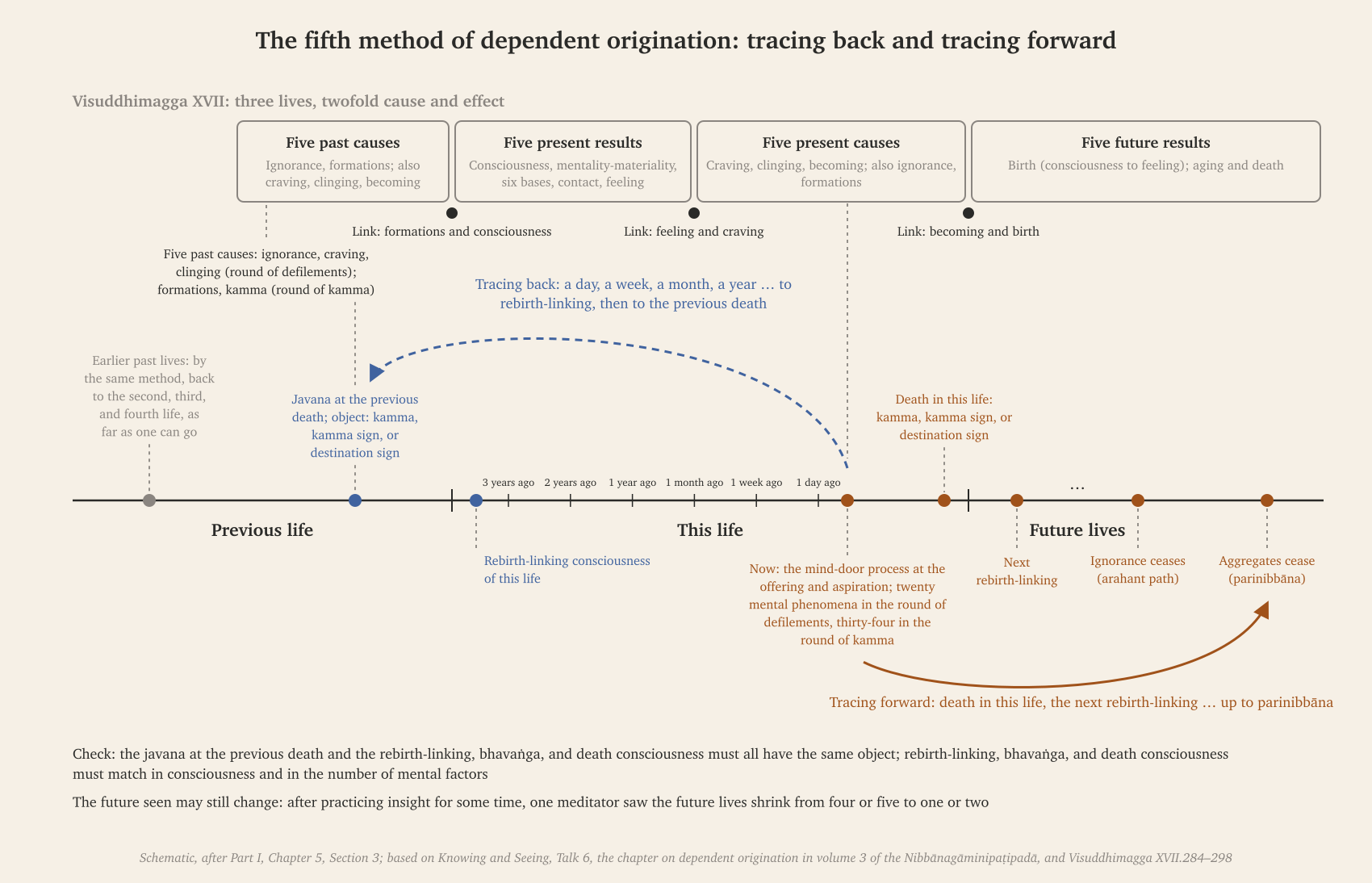
The items Pa-Auk discerns in the session correspond item by item to the divisions of the twofold causation across three lives in chapter 17 of the Visuddhimagga. The Visuddhimagga organizes the twelve links by three periods, three connections, four groups, and twenty aspects. Ignorance and formations belong to the past, the eight links from consciousness to becoming to the present, and birth and aging-and-death to the future; there is a connection between formations and rebirth-linking consciousness, between feeling and craving, and between becoming and birth. It also cites the Paṭisambhidāmagga: in the previous kamma-process becoming there is delusion, which is ignorance; accumulation, which is formations; attachment, which is craving; embracing, which is clinging; and volition, which is becoming; and these five things are conditions for rebirth-linking in the present life.50 In explaining "there is accumulation, which is formations," the Visuddhimagga takes giving as its example: after a person has had the thought "I shall give a gift," the prior volitions arising while he prepares the things needed for the gift over a month, or perhaps a year, are called formations, and the volition at the moment he actually places the offering in the recipient's hand is called becoming.51 The two are set side by side as follows:
| Visuddhimagga, chapter 17 | Division | Pa-Auk's procedure in the session | Example given in the Pa-Auk lineage |
|---|---|---|---|
| Five past causes (§§292–293, citing the Paṭisambhidāmagga) | The text names ignorance and formations, and includes craving, clinging, and becoming | At the object of the near-death impulsion of the previous life, discern ignorance, craving, and clinging of the round of defilements (a mind-door process with twenty mental formations) and formations and kamma of the round of kamma (thirty-four mental formations) | A poor village woman offers fruit to a bhikkhu, aspiring to become an educated woman in a big city in a future life |
| Five present effects (§§294–295) | Rebirth-linking consciousness, mentality-materiality, the six bases, contact, feeling | Discern the mentality-materiality of the rebirth-linking consciousness of this life, whose object must be the same as the object of the near-death impulsion of the previous life | In this life, an educated woman in a big city in Myanmar |
| Five present causes (§296) | The text names craving, clinging, and becoming, and includes ignorance and formations | Starting from the mind-door process at the time of an offering and aspiration in this life, discern the round of defilements and the round of kamma | Offering candles, flowers, or incense, with the aspiration to become a bhikkhu in a future life |
| Five future effects (§297) | Consciousness to feeling, which the text calls birth as a whole; aging-and-death is their aging and death | Look forward to the kamma, kamma sign, or destiny sign at death in this life, and discern the mentality-materiality of rebirth-linking in the next life, on to the arahant path and final nibbāna | At the end of this life the kamma of offering almsfood appears, and the five resultant aggregates of a future existence as a bhikkhu arise |
| Three rounds (§298) | Formations and becoming are the round of kamma; ignorance, craving, and clinging the round of defilements; consciousness to feeling the round of results | The same division | — |
The Pa-Auk side of the table follows Talk 6 of Knowing and Seeing and the section on dependent origination in the third volume of the Nibbānagāmini-paṭipadā.52 As the table shows, what Pa-Auk requires to be discerned in the session is every cell of these divisions: which five things are causes, which five are effects, where the connections fall, and how many mental formations each cognitive process contains.
4. Pa-Auk's insight knowledges
Pa-Auk lists sixteen insight knowledges. The first two are the meditation on materiality, meditation on mentality, and dependent origination described in the preceding three sections, and the contemplation of formations by the three characteristics begins with the third, the knowledge of comprehension. Pa-Auk says that to see nibbāna the sixteen insight knowledges must be developed progressively. The knowledge of analyzing mentality-materiality is accomplished in discerning mentality and materiality, and the knowledge of discerning cause and condition in discerning dependent origination; once these two have been developed, every kind of mentality, materiality, and factor of dependent origination must be discerned once more according to its characteristic, function, manifestation, and proximate cause. The Nibbānagāmini-paṭipadā devotes a separate fourth volume, the section on the four aspects of characteristic and the rest, to this.53 The names of the insight knowledges come from the Paṭisambhidāmagga and the Visuddhimagga; how the Mahāsi lineage uses this list and makes assessments by it is described in Chapter 4. The Pa-Auk lineage's point of entry is this: what the three characteristics contemplate is the mentality-materiality and its causes that the first three stages have already broken down into ultimate realities, internal and external, throughout the three lives. If the breaking down has not been completed, Pa-Auk says, the momentary concentration of insight is "impossible" (Chapter 2, Section 4).
The third knowledge, the knowledge of comprehension, contemplates formations by the three characteristics in categories, and there are further sets of exercises for those who cannot progress by it. The knowledge of comprehension divides formations into two categories, mentality and materiality, or into the five aggregates, or the twelve bases or twelve links of dependent origination, or the eighteen elements, and contemplates the three characteristics in each category. Pa-Auk's method is as follows. Re-establish the fourth jhāna or a strong, bright light, and discern the real materiality of the six doors, the book noting that artificial materiality is not an object of insight. Take materiality as one category: see its arising and passing away and know it as impermanent; see the oppression brought by its constant arising and passing away and know it as suffering; see that there is no permanent self in it and know it as non-self; alternate between internal and external, extending from near to far until the infinite universe. Treat mentality in the same way. Then contemplate the mentality-materiality of one life from rebirth-linking to death, and then the past and future lives already discerned.54 For those who cannot progress quickly by this, there are three sets of exercises. The first is the forty modes: ten of impermanence, twenty-five of suffering, and five of non-self. The second is the seven ways for materiality, the second of which counts a lifetime as a hundred years and divides it into progressively smaller periods, down to dividing each footstep into six periods, lifting, raising, moving forward, lowering, placing, and pressing, and seeing that the materiality of each period arises and ceases in that period and does not pass on to the next. The third is the seven ways for mentality, in which a later insight consciousness contemplates the three characteristics of an earlier insight consciousness, up to the eleventh contemplating the tenth. Pa-Auk says that it is best to do these exercises only for present mentality-materiality, internal and external.55
The fourth knowledge, the knowledge of rise and fall, is divided into causal and momentary rise and fall, and the reason, given in the preceding section, why one must see the last life lies in this step. Momentary rise and fall is seeing the five aggregates arise and pass away in every mind-moment from the rebirth-linking consciousness to the death consciousness. Causal rise and fall uses the fifth method of dependent origination: looking back, one sees how the five causes at death in the previous life make the kamma-produced materiality of this life arise; looking forward, one sees how the cessation of the five causes when one attains arahantship and final nibbāna makes kamma-produced materiality cease. Consciousness-produced, temperature-produced, and nutriment-produced materiality are treated likewise. The detailed method has three steps: first contemplating only arising, then only passing away, then both arising and passing away. Then, in combination with the first method, one contemplates the arising and cessation of the twelve links in forward order, Pa-Auk citing the text of the thirty-eighth discourse of the Majjhima Nikāya.56
Ten imperfections of insight may arise at the stage of the knowledge of rise and fall; for the knowledges after that, Pa-Auk in his talk lists only their names. The ten imperfections are light, knowledge, rapture, tranquility, happiness, resolution, exertion, established mindfulness, equanimity, and attachment. Pa-Auk says that of these only light and attachment are not wholesome mental states, and that the other eight become imperfections only when they become objects of attachment; the remedy is to contemplate each one as impermanent, suffering, and non-self.57 The fifth knowledge, the knowledge of dissolution, ignores the arising of formations and attends only to their momentary dissolution, a second insight consciousness contemplating the dissolution of the first. For the knowledges that follow, the knowledges of appearance as terror, of danger, of disenchantment, of desire for deliverance, of reflection, and of equanimity toward formations, Pa-Auk in this talk lists only the names, saying, "There are a few instructions for them, but I do not have time to explain." He goes on to say that eventually all formations cease and the mind takes the unformed nibbāna directly as its object.58 The two bodies of literature allot their space differently. Talk 7 of Knowing and Seeing spends pages 218 to 233 on the knowledges of comprehension and of rise and fall, and pages 233 to 235 on the knowledges from dissolution onward and the path. The section on insight meditation in the fifth volume of the Nibbānagāmini-paṭipadā spends original pages 1 to 166 on the knowledge of comprehension, pages 167 to 277 on the knowledge of rise and fall, pages 278 to 462 on the knowledges from dissolution to conformity, and from page 463 onward on change-of-lineage knowledge and the four path knowledges.59
Having gone through all this, the Pa-Auk lineage speaks of a practitioner as having "finished," but does not take this as attainment of the fruit. Pa-Auk explains that "finished" only means that "according to their reports, they were able to practice calm and insight meditation thoroughly, but this does not mean that they are noble ones."60 He says of himself that he guides only on the basis of interview reports and has never certified anyone's attainment of jhāna or of path and fruition; see Chapter 2, Section 4. Bhante Mahinda, speaking on Pa-Auk's method, says that at every stage of meditation, as long as the method is correct, "his experience must be able to withstand examination against the suttas and treatises."61
5. Summary
The insight of the Pa-Auk lineage restated in this chapter can be summed up in three points. First, insight in this lineage is divided into four stages, and the first three are prerequisites for contemplation by the three characteristics. Meditation on materiality breaks the body down into kalāpas and analyzes the ultimate materiality in each one; meditation on mentality discerns, following the cognitive process, the consciousness and mental factors in every mind-moment, from internal to external and throughout the infinite universe; the stage of dependent origination traces back to the object of the near-death impulsion of the previous life and forward to one's own final nibbāna. Only the fourth stage contemplates this mentality-materiality and its causes by the three characteristics and passes through the sixteen insight knowledges in order, and causal rise and fall within the knowledge of rise and fall uses the last life seen in the preceding stage. Second, the terms, numbers, and order of every stage are taken from the Abhidhamma and the commentaries: the fifty-four kinds of materiality in the eye follow the reckoning of chapter 18 of the Visuddhimagga; the eye-door process corresponds item by item to chapter 4 of the Abhidhammattha-saṅgaha; the five causes, five effects, and three rounds of the three lives are the divisions of chapter 17 of the Visuddhimagga; kalāpas and the cognitive process are not found in the Tipiṭaka. Third, this lineage's literature attaches explanations and cross-checks to what is seen in the session. Kamma-produced materiality need only be accepted provisionally before the knowledge of discerning cause and condition. Past lives are contemplated by insight knowledge, which sees only the five aggregates of clinging and not names. Anticipation can make conceptual images appear, and the remedy is to contemplate the four great elements in the image. The objects and the number of mental phenomena of the near-death impulsion of the previous life and of the rebirth-linking, bhavaṅga, and death consciousness of this life must be the same. Future lives may change as insight is developed. The rules on which the cross-checks rely also come from the Abhidhamma and the commentaries. Chapter 6 turns to the Goenka lineage and sets the insight of the three lineages side by side in summary.
References
-
Pa-Auk Sayadaw, Knowing and Seeing: Talks and Questions-and-Answers at a Meditation Retreat in Taiwan, 2nd ed., © W. K. Ng, 2000, p. 124: "Having reached this stage, which is purification of mind (citta-visuddhi), you can proceed to develop purification of view (diṭṭhi-visuddhi), by analysing the rūpa kalāpas. That is the beginning of Vipassanā meditation." p. 163: "In this talk, I would like to explain a little about how to discern mentality (nāma-kammaṭṭhāna), which is the next stage in Vipassanā meditation." (The original prints Pāli letters in an old-style font; they are given here in standard transliteration, and likewise below.) Chinese translation: Pa-Auk Sayadaw, lectures, translated jointly by his disciples, Rushi zhijian: zhiguan chanxiu de zhidao yu wenda (如实知见:止观禅修的指导与问答, Knowing and Seeing: Instructions and Questions and Answers on Calm and Insight Meditation), 3rd ed. (year of publication not given). ↩
-
Pa-Auk, Nibbānagāmini-paṭipadā (趣向涅槃之道), vol. 3, "Introduction" (front matter; the preface is dated Burmese Era 1355); the saying about the bowl broken and the body weary, the lute strings worn out in vain, and still no skill at the lute, occurs here. Burmese original edition, 1998. Quotations are translated from the complete Chinese translation of the Nibbānagāmini-paṭipadā hosted on this book's website; likewise below. Contents of the volumes (from the title page of each): vol. 1 contains the sections on the Bhaddekaratta Sutta, on the development of concentration, on mindfulness-of-breathing concentration, and on meditation on materiality; vol. 2, the section on meditation on mentality; vol. 3, the section on dependent origination; vol. 4, the section on the four aspects of characteristic and the rest; vol. 5, the sections on insight meditation and on meditation subjects of calm. The correspondence between the seven purifications and the knowledges follows the subsections "Purification of mind" and "Purification of view" in the section on meditation on materiality in vol. 1 (original pp. 537–545), the subsection "Knowledge of the stability of the Dhamma" in the section on dependent origination in vol. 3 (original p. 674; purification by overcoming doubt is the knowledge of discerning cause and condition), and the chapter titles of the section on insight meditation in vol. 5. ↩
-
Bhikkhu Ñāṇamoli (trans.), The Path of Purification, 4th ed., Kandy: Buddhist Publication Society, 2010, chapter XVIII, note 5 (pp. 1622–1623): "In general these are called 'material groups' (rūpa-kalāpa). … The 'material groups' are not in the Piṭakas." Chapter IV, note 13 (pp. 475–479): "The 'cognitive series' (citta-vīthi) so extensively used here is unknown as such in the Piṭakas." (p. 476) The same note lists the canonical sources: bhavaṅga and adverting appear in the Paṭṭhāna (Paṭṭh I 159, 160, 169, 324) and impulsion in the Paṭisambhidāmagga (Paṭis II 73, 76), while "sampaṭicchana (receiving), santīraṇa (investigating), voṭṭhapana (determining), and tadārammaṇa (registration) appear only in the Commentaries" (p. 479). The translator's introduction (p. 84) also lists the replacement of the Paṭṭhāna's "materiality on which mind depends" by the heart-base, the "material octads," and other items as new doctrines absent from the Tipiṭaka. Bhikkhu Bodhi (general ed.), A Comprehensive Manual of Abhidhamma: The Abhidhammattha Sangaha of Ācariya Anuruddha, Onalaska: BPS Pariyatti Editions, 2000, introduction, section "The Commentaries": "The organization of material phenomena into groups (kalāpa), though implied by the distinction between the primary elements of matter and derived matter, is first spelled out in the Commentaries, as is the specification of the heart-base (hadayavatthu) as the material basis for mind element and mind-consciousness element." The same section says that the detailed account of the cognitive process, and the point that "the duration of a material phenomenon is determined to be seventeen moments of mental phenomena," are likewise distinctive features of the commentaries, and adds: "While it is tempting to try to discern evidence of historical development in the Commentaries over and beyond the ideas embedded in the Abhidhamma Piṭaka, it is risky to push this line too far." The e-book of this work has no print page numbers and is cited by chapter and section, likewise below; the Chinese translation is Apidamo gaiyao jingjie (阿毗达摩概要精解), translated by Bhikkhu Xunfa. ↩
-
Pa-Auk, Knowing and Seeing, pp. 123–124: "This transparent materiality is the five sensitivities (pasāda) … They are seen as one transparent form or block, because you have not yet seen through … the three kinds of compactness (ghana): compactness of continuity, group and function. If you continue to discern the four elements in that transparent form or block, it will sparkle and emit light. When you can concentrate on this light continuously for at least half an hour, you have reached access concentration. With that light, discern the space-element in that transparent form, by looking for small spaces in it. You will find that the transparent form breaks down into small particles, which are called rūpa kalāpas." The final sentence, "That is the beginning of Vipassanā meditation," is already given in the note to the opening paragraph of this chapter. ↩
-
Pa-Auk, Knowing and Seeing, p. 125: "Rūpa kalāpas fall into two groups: a transparent group and an opaque group. Rūpa kalāpas which contain one of the five material transparent-elements (pasāda-rūpa) are transparent. All other rūpa kalāpas are opaque." p. 126: "A rūpa kalāpa contains at least eight types of materiality: earth, water, fire, air, colour, odour, flavour, and nutritive-essence." ↩
-
Pa-Auk, Knowing and Seeing, pp. 125–126: "If you do not go any further, and attempt to do Vipassanā by contemplating the arising and passing-away of the rūpa kalāpas, you would be trying to do Vipassanā on concepts." "Ignore the arising and passing-away and simply concentrate on the four elements in single rūpa kalāpas." ↩
-
Rushi zhijian, 3rd ed., p. 135, answer to question 7-6. Note 169 of that book explains that these four paragraphs were supplied from the tape recordings of the talks; the English second edition (Knowing and Seeing, p. 243) does not have them. ↩
-
Pa-Auk, Knowing and Seeing, pp. 127–128. p. 127: "you will easily be able to discern the bright, luminous bhavaṅga mind, the mind-door (manodvāra). It is located in the heart, and depends on the heart-base (hadayavatthu)." p. 128: "The Dispeller of Delusion, an Abhidhamma commentary, says: 'Sabbopi panesa pabhedo manodvārikajavaneyeva labhati.' This explains that the colour, odour, and flavour of a rūpa kalāpa, can be known by the mind consciousness alone." ↩
-
Pa-Auk, Knowing and Seeing, pp. 128–130. p. 130: "To discern heart-base materiality, concentrate on the bhavaṅga mind. Then discern the rūpa kalāpas which support the bhavaṅga mind. You will find these rūpa kalāpas in the lower part of the bhavaṅga mind. They are opaque, heart-decad kalāpas." ↩
-
Pa-Auk, Knowing and Seeing, pp. 130–132. p. 131: "Then look at the colour of a rūpa kalāpa some distance away from the eye. If the colour impinges on the transparent-element, it is an eye transparent-element … If the colour does not do this, it is not an eye transparent-element, but a body transparent-element, as there are only two types of transparent-element in the eye." ↩
-
Pa-Auk, Knowing and Seeing, pp. 132–137: "If you analyse the materiality in the eye, you will find there are fifty-four kinds of materiality in six types of rūpa kalāpa." (p. 132) The eye-door table is in Pa-Auk, Mindfulness of Breathing and Four Elements Meditation (W.A.V.E. free-distribution reprint, revised edition, no year given), p. 44, titled "Eye-Door: Fifty-Four Types of Materiality." The Chinese names for decad kalāpas (十法聚), nutritive-essence-octad kalāpas (食素八法聚), and the eight inseparables (八不離色), and the formula "(10+10+10+8+8+8)," are in Rushi zhijian, 3rd ed., p. 77. ↩
-
Pa-Auk, Mindfulness of Breathing and Four Elements Meditation, pp. 44–49, the table for each door: fifty-four types each for the eye, ear, nose, and tongue doors, and forty-four for the body door (p. 48). The mind-door table (p. 49) is titled "Forty-Four Types," but both what the table lists and the explanation beneath it give fifty-four types, so fifty-four should be taken as correct; Knowing and Seeing, p. 191, likewise speaks of "the fifty-four types in the heart-base." ↩
-
Visuddhimagga, chapter 18, §§5–10. Ñāṇamoli's translation, pp. 1598–1602; p. 1599: "So there is a total of forty-four instances of materiality in the case of each of the twenty-four bodily parts of fourfold origination." §10 says that the remaining kinds of materiality besides the eye element "total fifty-three" (pp. 1601–1602). ↩
-
Abhidhammattha-saṅgaha, chapter 6, §§16–22; Bodhi, A Comprehensive Manual of Abhidhamma, ch. VI, §§16–22: "There are twenty-one material groups—nine, six, four, and two—produced in due order from kamma, consciousness, temperature, and nutriment." Pa-Auk's division is in Mindfulness of Breathing and Four Elements Meditation, pp. 53–58: nine kamma-produced, eight consciousness-produced (the seventh and eighth being the consciousness-produced sound-nonad kalāpa and sound-lightness-dodecad kalāpa of in-and-out breathing), four temperature-produced, and two nutriment-produced. The numbers of kinds of materiality in the forty-two bodily parts are in the same book, pp. 50–53. ↩
-
Pa-Auk, Knowing and Seeing, pp. 133–137. pp. 133–134: "If this is not clear, then having concentrated on the bhavaṅga mind, wiggle one of your fingers. You will see a large number of rūpa kalāpas being produced because the mind wants to wiggle the finger." p. 135: "Nutriment taken in one day produces nutriment-produced nutritive-essence-octad kalāpas (āhāraja-ojaṭṭhamaka-kalāpa) for up to seven days." ↩
-
Pa-Auk, Mindfulness of Breathing and Four Elements Meditation, p. 54: "To know which kamma they are the result of, whether giving (dāna), virtuous conduct (sīla), or meditation (bhāvanā), you will need to discern materiality and mentality of the past and future. Only then will you understand and experience this for yourself. This will come later in the Knowledge of Discerning Cause and Condition (paccaya-pariggaha-ñāṇa). At the present stage you just have to accept provisionally that these rūpa kalāpas are produced by kamma." ↩
-
Pa-Auk, Mindfulness of Breathing and Four Elements Meditation, p. 64: "For this reason the meditator should first know, learn, and memorize all types of materiality and mentality." pp. 72–73 cite the Greater Discourse on the Cowherd and its commentary; p. 73: "To be able to know the number of types of materiality and their causes of arising, it is necessary to be able to discern and analyse rūpa kalāpas individually." The sutta is Majjhima Nikāya 33, §4; Bhikkhu Ñāṇamoli and Bhikkhu Bodhi (trans.), The Middle Length Discourses of the Buddha, Boston: Wisdom Publications, 1995, p. 313: "How has a bhikkhu no knowledge of form? Here a bhikkhu does not understand as it actually is thus: 'All material form of whatever kind consists of the four great elements and the material form derived from the four great elements.'" ↩
-
Pa-Auk, Knowing and Seeing, p. 137: "Light is the brilliance of the colour-materiality in those consciousness and temperature-produced kalāpas." Q&A 4.10, pp. 159–161: "the colour of one kalāpa and the colour of another kalāpa arise closely together like in an electric bulb, which is why light appears." (pp. 159–160) "Usually many meditators realize that this light is a group of kalāpas, when they have reached the Knowledge of Arising and Passing-Away. … That is the most scientific way to understand the light experienced in meditation." (p. 161) ↩
-
Pa-Auk, Knowing and Seeing, pp. 163–164. p. 163: "Let me begin by explaining briefly the basic facts of Abhidhamma necessary to understand the discernment of mentality." p. 164: "The consciousnesses in any one thought-process occur in due order according to the 'natural order of consciousness' (cittaniyāma). If you want to discern mentality, you must see them as they occur in that natural order." ↩
-
Collected Questions and Answers of Pa-Auk Sayadaw (Pa'ao chanshi foxue wenda zhengli 帕奧禪師佛學問答整理; compiler and year not given, unpaginated), first part, "Doubts about Learning Buddhism," Q&A 5-16. ↩
-
Pa-Auk, Knowing and Seeing, pp. 164–167. p. 165: "This is in contrast to a normal sensual plane thought-process (kāmāvacara-vīthi), in which impulsion (javana) occurs only seven times before a new thought-process takes its place." p. 166: "A mind-door thought-process of the first jhāna consists of a sequence of six types of consciousness: The first is the mind-door-adverting consciousness (manodvārāvajjana), with twelve mental formations. The remaining five, each with thirty-four mental formations, are: the preparatory consciousness (parikamma); the access consciousness (upacāra); the conformity consciousness (anuloma); the change-of-lineage consciousness (gotrabhū); and finally the uninterrupted sequence of jhāna impulsion consciousnesses (jhāna-javana-citta)." ↩
-
Pa-Auk, Knowing and Seeing, p. 167: "If, however, you have only access concentration, with four-elements meditation, you must begin your discernment of mentality there: you cannot discern the mentality of a jhāna consciousness without jhāna." ↩
-
Pa-Auk, Knowing and Seeing, pp. 168–171. The seven kinds of consciousness in the eye-door process and the number of mental formations in each are on p. 170; "After this follows a sequence of bhavaṅga consciousnesses, and then the three types of consciousness of the mind-door thought-process" (p. 171). The sentence on the eighteen kinds of real materiality and ten kinds of artificial materiality is on p. 169. The Abhidhammattha-saṅgaha side follows Bodhi, A Comprehensive Manual of Abhidhamma, ch. IV, §6 and Table 4.1: "To this extent seventeen mind-moments are completed, namely, fourteen acts of process consciousness, two vibrations of the life-continuum, and one mind-moment that had passed prior to (the process)." ↩
-
Bodhi, A Comprehensive Manual of Abhidhamma, ch. IV, §6: "One mind-moment consists of the three (sub-) moments—arising, presence, and dissolution. The duration of material phenomena consists of seventeen such mind-moments." The explanation in the same section: "according to the commentators, in the time that it takes for lightning to flash or the eyes to blink, billions of mind-moments can elapse." ↩
-
Bhante Mahinda 玛欣德, Apidamo jiangyao 阿毗达摩讲要 (Lectures on Abhidhamma), middle volume, Singapore: Pa-Auk Meditation Centre, 2013, Lecture 15, "The Five-Door Cognitive Process," p. 131; the chart of the eye-door process with a very great object and the reckoning of the seventeen moments are on pp. 132–134. ↩
-
Collected Questions and Answers of Pa-Auk Sayadaw, second part, "Questions and Answers Arranged by Topic," in "Resolving Doubts about Wisdom," the portion on insight meditation, Q&A 87: "Contemplating feeling alone is not enough to make you realize nibbāna; you must also contemplate the mental phenomena associated with it." See also Knowing and Seeing, Q&A 4.6, pp. 155–156: "Discerning feeling alone is not enough. He must also discern the mental formations associated with feeling in the six-door thought-processes." ↩
-
Pa-Auk, Knowing and Seeing, p. 168: "If you look at an object and know it as materiality, mentality, cause or effect, impermanence, suffering, non-self, or repulsiveness, then your attention is wise attention, and the impulsion consciousness is wholesome." p. 171: "To do this, you simply take the same objects as you did for the wholesome consciousnesses, and instead pay unwise attention to them." ↩
-
Pa-Auk, Knowing and Seeing, pp. 172–174. p. 174: "Having reached this stage in your meditation, you will have developed concentration, and used it to discern all twenty-eight kinds of materiality, and all fifty-three kinds of mentality throughout the infinite universe." ↩
-
Bodhi, A Comprehensive Manual of Abhidhamma, ch. III, §12; the explanation: "Unlike the first five doors, the mind door (manodvāra) is not material but mental (nāma), namely, the bhavanga consciousness." For Pa-Auk, see Knowing and Seeing, p. 127 (quoted in an earlier note); Mindfulness of Breathing and Four Elements Meditation, p. 30, has "the bright, luminous bhavaṅga mind transparent-element, the mind-door (manodvāra)." ↩
-
Pa-Auk, Nibbānagāmini-paṭipadā, vol. 3, section on dependent origination, subsection "The meaning of the word 'dependent origination' (9)," original p. 253. Bhante Mahinda's words are in his Shangzuobu fojiao xiuxue rumen 上座部佛教修學入門 (An Introduction to the Study and Practice of Theravāda Buddhism; Pa-Auk Disciples Series, preface dated 2008), p. 248. ↩
-
Collected Questions and Answers of Pa-Auk Sayadaw, first part, "Doubts about Learning Buddhism," Q&A 3-4. ↩
-
Pa-Auk, Knowing and Seeing, pp. 188–189. p. 188: "Dependent-origination is about how causes and effects operate over the three periods of past, present, and future." pp. 188–189: "Both methods involve discerning the five aggregates (khandha) of the present, of the past, and of the future, discerning which of them is cause and which is effect." ↩
-
Pa-Auk, Knowing and Seeing, pp. 189–190; p. 190: "The round of defilements is the cause for the round of kamma, which causes the round of results. The discernment of dependent-origination involves seeing this sequence, and starts with discernment of the past." Visuddhimagga, chapter 17, §298, Ñāṇamoli's translation, p. 1565: "here formations and becoming are the round of kamma. Ignorance, craving and clinging are the round of defilements. Consciousness, mentality-materiality, the sixfold base, contact and feeling are the round of result." ↩
-
Pa-Auk, Knowing and Seeing, p. 189, note 7: "Editor: The psychic power, Recollection of Past Lives (Pubbenivāsānussati Abhiñña) enables you to see: 1) Supramundane states (lokuttaradhamma), the four path consciousnesses and the four fruition consciousnesses; 2) The five aggregates of clinging (pañcupādānakkhandhā); 3) Clan, appearance, food, pleasure and pain etc.; 4) Concepts such as names and race. The Venerable Pa-Auk Sayadaw is not speaking here of that psychic power. He is speaking of insight (Vipassanā) power, which enables you to see only the five aggregates of clinging. (ref. Khandhavagga Aṭṭhakathā, §79)" The Chinese translation, 3rd ed., pp. 108–109, does not have this note. ↩
-
Pa-Auk, Nibbānagāmini-paṭipadā, vol. 1, section on the Bhaddekaratta Sutta, subsection "Direct knowledge and inferential knowledge (2)," original pp. 53–54. Pa-Auk's sources are SN 22.79 and its commentary (cited in the book after the Burmese edition as Saṃyutta Nikāya 2-71 and Saṃyutta Nikāya Commentary 2-266). ↩
-
Collected Questions and Answers of Pa-Auk Sayadaw, second part, "Questions and Answers Arranged by Topic," in "Resolving Doubts about Concentration," the portion on mindfulness of breathing, Q&A 41: "No, because that belongs to the range of the psychic knowledge of past lives." ↩
-
Pa-Auk, Knowing and Seeing, pp. 190–191. p. 190: "This is necessary, because if you cannot discern external mentality and materiality, you will have great difficulty discerning past mentality and materiality. That is because the discernment of external mentality and materiality is similar to the discernment of past mentality and materiality." p. 191: "find the defilement-round (kilesavaṭṭa) mind-door thought-process with twenty mental formations, and kamma-round (kammavaṭṭa) mind-door thought-process (manodvāra-vīthi) with thirty-four mental formations." The Chinese translation, 3rd ed., p. 109, reads "the impulsion consciousness of the mind-door process of the round of kamma has thirty-four or thirty-three mental phenomena, and the impulsion consciousness of the mind-door process of the round of defilements has twenty or nineteen, varying from person to person," which differs slightly from the English. ↩
-
Pa-Auk, Knowing and Seeing, pp. 192–193. p. 192: "In this way, you discern the mentality and materiality of one day ago, one week ago, one month ago, one year ago, two years ago, three years ago and so on." On the destiny sign: "For a human rebirth it is the future mother's womb, and is usually red like a red carpet." The list in the Nibbānagāmini-paṭipadā, vol. 3, section on dependent origination, subsection "The meaning of the word 'dependent origination' (3)" (original p. 99), is one day ago, two days ago … one month ago … one year ago … ten years ago. ↩
-
Pa-Auk, Knowing and Seeing, pp. 193–194; p. 194: "The ability to discern causes and effects in this way is called the Knowledge of Discerning Cause and Condition (paccaya-pariggaha-ñāṇa)." ↩
-
Pa-Auk, Knowing and Seeing, p. 195: "you need to in the same way discern progressively back to the second, third, fourth, and as many lives back as you can. Should you discern a past-, or future life, in the brahma realm, you will see only three sense-bases, eye, ear and mind". ↩
-
Pa-Auk, Nibbānagāmini-paṭipadā, vol. 3, section on dependent origination, subsection "The meaning of the word 'dependent origination' (3)," original pp. 98–104; "these concept images too are only formation signs" is on p. 101, and the sentence on "various anticipations" and the sentence on "extracting from concepts" are on p. 104. ↩
-
Pa-Auk, Nibbānagāmini-paṭipadā, vol. 3, section on dependent origination, subsection "The meaning of the word 'dependent origination' (8)," original p. 238. ↩
-
Bodhi, A Comprehensive Manual of Abhidhamma, ch. V, §35, explanation: "The death consciousness (cuticitta), the final citta in a life term, apprehends the same object grasped by the rebirth consciousness and bhavanga of the existence that is about to end. The object of the last javana process then serves as the object of the rebirth consciousness and bhavanga in the next existence, and becomes in turn the object of the death consciousness at the end of that existence." ↩
-
Pa-Auk, Knowing and Seeing, pp. 195–196: "You must discern as many lives into the future as it takes till ignorance ceases without remainder. This happens with the attainment of the arahant path (arahatta-magga), that is, your own attainment of arahantship. You should then continue discerning into the future, until you see that the five aggregates, mentality-materiality, cease without remainder, that is, at the end of the arahant life, at your own Parinibbāna." ↩
-
Pa-Auk, Knowing and Seeing, p. 195: "The future you will see, and which may still change, is the result of both past and present causes, one of which is the meditation you are doing." The Chinese translation, 3rd ed., p. 111, reads "you will see the future, which will still change." Nibbānagāmini-paṭipadā, vol. 3, section on dependent origination, subsection "The meaning of the word 'dependent origination' (8)," original pp. 235–237; "the future life can indeed change" is on p. 236, and "please test this repeatedly for yourselves" on p. 237. ↩
-
Collected Questions and Answers of Pa-Auk Sayadaw, second part, "Questions and Answers Arranged by Topic," in "Resolving Doubts about Wisdom," the portion on dependent origination, Q&A 67. ↩
-
Collected Questions and Answers of Pa-Auk Sayadaw, second part, "Questions and Answers Arranged by Topic," in "Resolving Doubts about Wisdom," the portion on dependent origination, Q&A 66 and 69. Q&A 69: "There are several reasons for needing to contemplate the causes and conditions of the five aggregates of past lives, such as removing doubt about past lives, removing attachment to the five aggregates of past lives, and finding the seeds of wholesome deeds and of wisdom accumulated in past lives." ↩
-
Erik Braun, "The Many Lives of Insight," Harvard Divinity Bulletin, Winter/Spring 2016 (online version, no page numbers): "Some prominent monks in Burma have objected that seeing future lives cannot be part of insight practice, because insight concerns the observation of only what is real (and, of course, future lives have not yet happened and so can't be real)." The words of Shaila Catherine, Wisdom Wide and Deep (Wisdom Publications, 2011), as quoted by Braun: "When I first received these meditation instructions I was skeptical. I left the interview shaking my head, assailed by doubting thoughts, 'Does my teacher seriously expect me to see into past lives? This is too weird! This is impossible. . . .'" ↩
-
Collected Questions and Answers of Pa-Auk Sayadaw, first part, "Doubts about Learning Buddhism," Q&A 2-7. The question originally asked from which sutta and treatise comes the analysis of mentality-materiality that follows four-elements meditation; after listing the scriptural evidence, the answer turns to reply to the critics of Buddhaghosa. ↩
-
Visuddhimagga, chapter 17, §§284–298, Ñāṇamoli's translation, pp. 1558–1565. §287 (p. 1559): "the two factors ignorance and formations belong to the past time, the eight beginning with consciousness belong to the present time, and the two, birth and ageing-and-death, belong to the future time." §289 (p. 1560) gives the three connections; §292 (p. 1561) cites the Paṭisambhidāmagga: "In the previous kamma-process becoming, there is delusion, which is ignorance; there is accumulation, which is formations; there is attachment, which is craving; there is embracing, which is clinging; there is volition, which is becoming; thus these five things in the previous kamma-process becoming are conditions for rebirth-linking here [in the present becoming]" (Paṭis I 52). ↩
-
Visuddhimagga, chapter 17, §293, Ñāṇamoli's translation, pp. 1561–1562: "There is accumulation, which is formations means the prior volitions arisen in one who prepares the things necessary for a gift during a month, perhaps, or a year after he has had the thought 'I shall give a gift.' But it is the volitions of one who is actually placing the offerings in the recipients' hands that are called 'becoming.'" ↩
-
Pa-Auk, Knowing and Seeing, pp. 190–196; the example in the row for the future is from the Nibbānagāmini-paṭipadā, vol. 3, section on dependent origination, subsection "The meaning of the word 'dependent origination' (8)," original p. 235. ↩
-
Pa-Auk, Knowing and Seeing, p. 217: "There are sixteen insight-knowledges (ñāṇa) which need to be developed progressively in order to see Nibbāna." The same page: "After you have developed those two knowledges, you need to complete them, by again discerning all mentality, all materiality, and all the factors of dependent-origination, according to their individual characteristic, function, manifestation, and proximate cause." ↩
-
Pa-Auk, Knowing and Seeing, pp. 218–220. p. 218: "Then discern the real materiality ('real' is mentioned because artificial materiality is not the object of vipassana meditation) of each of the six sense-doors." ↩
-
Pa-Auk, Knowing and Seeing, pp. 220–226. p. 226: "It is best to have done these exercises for the materiality and mentality of the present [not of the past and future], internally and externally." ↩
-
Pa-Auk, Knowing and Seeing, pp. 226–232. p. 226: "The Knowledge of Arising and Passing-Away of formations consists of two: the causal (paccayato) and the momentary (khaṇato) arising and passing-away of formations." p. 229: "you look forward to the future life in which you become an arahant, to see that when you attain the Arahant Path and Fruition (arahattamagga and arahattaphala), all defilements cease … and that at the end of that life all formations cease". The text cited is Majjhima Nikāya 38 (pp. 231–232). ↩
-
Pa-Auk, Knowing and Seeing, p. 233: "Of these ten imperfections, only light [light cannot be unwholesome] and attachment are not wholesome mental states. Whereas the remaining eight are wholesome mental states, not in themselves imperfections. They can, however, become the objects of unwholesome states, if you become attached to them." ↩
-
Pa-Auk, Knowing and Seeing, pp. 233–235. p. 235: "you will find that eventually all formations cease. Your mind sees directly, and is fully aware of the unformed Nibbāna as object." ↩
-
Chapter titles and original page numbers of the section on insight meditation in vol. 5 of the Nibbānagāmini-paṭipadā: under "Explanation of purification by knowledge and vision of what is and what is not the path," the chapter on the knowledge of comprehension, original pp. 1–166, and the chapter on the knowledge of rise and fall, pp. 167–266; under "Explanation of purification by knowledge and vision of the way," the chapter on the knowledge of rise and fall, pp. 267–277, and the chapters from contemplation of dissolution to conformity knowledge, pp. 278–462; "Explanation of purification by knowledge and vision" (change-of-lineage knowledge and the four path knowledges), pp. 463–521. ↩
-
Collected Questions and Answers of Pa-Auk Sayadaw, second part, "Questions and Answers Arranged by Topic," in "Meditation Teaching," Q&A 97. ↩
-
Bhante Mahinda, Shangzuobu fojiao xiuxue rumen, p. 247. ↩