Part I, Chapter 3: Calm III: Momentary Concentration, Preparatory Ānāpāna, and the Jhāna Debate
Chapter 2 restated the Pa-Auk lineage's account of calm: jhāna is attained first, and insight is then developed by the light of concentration, with the criteria resting on the counterpart sign, the bhavaṅga mind, and the five jhāna factors. This chapter turns to the other two lineages and to a debate. The Mahāsi lineage sets up no separate stage of calm; for the pure-insight practitioner, purification of mind is carried by momentary concentration. Goenka's ten-day course uses three and a half days of ānāpāna as preparation and moves into insight on the fourth day according to the timetable. Both lineages rely on the commentarial teaching of momentary concentration, and Pa-Auk reads the same teaching differently, so Section 3 sets out the debate, inside and outside the Theravāda, over whether jhāna must be passed through. The final section brings the three chapters on calm together and summarizes where each lineage's criteria fall.
For the Mahāsi lineage, the sources are the second chapter of his Manual of Insight, the introductory manual Practical Insight Meditation, and the collected talks of Sayadaw U Paṇḍita; for the Goenka lineage, the summaries of the ten-day course discourses, Hart's The Art of Living, and U Ba Khin's lectures. The section on the jhāna debate draws on the controversy in Sri Lanka, two figures of the Thai forest tradition, Henepola Gunaratana's study of the jhānas, and the papers of Cousins, Sujato, and Sharf.
1. The Mahāsi lineage: momentary concentration
In the second chapter of the Manual of Insight, Mahāsi divides purification of mind into three kinds of concentration: access concentration, absorption concentration, and momentary concentration. Access concentration takes the counterpart sign as its object and can be aroused by the meditation subjects of the kasiṇas, foulness, mindfulness of the body, in-and-out breathing, the four divine abodes, or the immaterial states. He goes on to say that the eight recollections, the perception of the repulsiveness of food, and the four-elements meditation cannot arouse true access concentration, because they lack the potential to lead to absorption; concentration aroused by these three kinds of object "is, nevertheless, typically referred to as access concentration because it produces similar results in terms of suppressing hindrances."1 This agrees with Pa-Auk's judgment on the four-elements meditation (see Chapter 2, Section 3): the two lineages do not differ on the point that "the four elements yield only a semblance of access concentration." Momentary concentration, by contrast, is the strong and clear concentration on the observed mental and physical phenomena that each act of noting produces when the insight meditator's faith, energy, mindfulness, concentration, and wisdom are strong and balanced. Mahāsi calls it "momentary concentration aroused by moment-to-moment observation," and says that it arises naturally in the course of insight practice, unlike access and absorption, which must be developed beforehand.2
The basis of his case for the pure-insight practitioner (suddha-vipassanā-yānika) is precisely the passage of the Mahāṭīkā, the great subcommentary on the Visuddhimagga, cited in Chapter 1, Section 1. The subcommentary says that the pure-insight practitioner is one who develops pure insight without relying on access or absorption. Mahāsi uses the analogy of the statement "Devadatta, who is growing fat, does not eat during the day," from which "we can infer that Devadatta eats at night," and reasons that since insight knowledge can arise without relying on access or absorption, it must arise in dependence on momentary concentration; the subcommentary then states explicitly that the pure-insight practitioner cannot reach awakening without momentary concentration.3 He also cites the commentaries and the Paṭisambhidāmagga to say that the pure-insight practitioner first contemplates materiality and the rest as impermanent, suffering, and nonself, and that when insight grows strong, one-pointedness of mind arises from penetration into the observed object: insight first, then calm. The pure-insight practitioner begins insight practice without any access or absorption concentration, and attains those concentrations by first developing insight knowledge.4
Momentary concentration varies in strength, and Mahāsi correlates it with the stages of insight knowledge. The basic level begins with the knowledge of delimiting mentality-materiality: at this point wandering thoughts and the hindrances cannot intrude, and the resulting unification of mind is comparable to the access concentration of the calm-vehicle practitioner. The intermediate level begins with the knowledge of rise and fall; the advanced level, with the knowledge of dissolution. Momentary concentration can become as strong as concentration on a single object, each successive mind-moment equally concentrated on one object after another, and its strength is then comparable to absorption in calm. The only difference is that the object of calm stays the same throughout and cannot help one see mentality-materiality and its impermanence, whereas the object of insight constantly changes.5 He describes strong momentary concentration with three similes: the noting mind and the object noted seem to be tied together, like a heavy sack of rice that stays where it is set down, like a sharp spear that stands firm where it is thrust in, like a sticky lump that sticks where it is thrown against a wall.6 From the knowledge of dissolution through the knowledge of conformity, each act of noting experiences only the disappearance of phenomena; this, he says, is what the Pāḷi texts mean when they say that momentary concentration is fully mature at this stage.7 The three levels are as follows:
| Level | Starting point | Mahāsi's explanation |
|---|---|---|
| Basic | Knowledge of delimiting mentality-materiality | Wandering thoughts and the hindrances cannot intrude; the resulting unification of mind is comparable to the access concentration of the calm-vehicle practitioner |
| Intermediate | Knowledge of rise and fall | The Visuddhimagga calls this knowledge "fledgling insight" |
| Advanced | Knowledge of dissolution | In the stages up to the knowledge of conformity, each act of noting experiences only the disappearance of phenomena; momentary concentration is fully mature here |
Beyond the three levels, Mahāsi adds that when momentary concentration is strong, its strength is comparable to absorption in calm, the difference lying only in whether the object changes or stays the same. It follows that Mahāsi sets no separate criterion for calm. The degree of calm is explained by the stage of insight knowledge, and the criterion accordingly moves over to the side of insight; Chapter 4 discusses it.
Mahāsi also discusses the obstacles to concentration and its balance, within the framework of insight noting. Following the Paṭisambhidāmagga, he lists six states of mind that obstruct concentration and six remedies: recalling the past, countered by not thinking of the past; fantasizing about the future, countered by not thinking of the future; encouraging oneself when lazy; relaxing when overexerting; recognizing the lust in one's gladness when practice goes well; recognizing the aversion in one's dejection when practice goes badly. Each is first noted, and the mind is then returned to the present object.8 If laziness does not go away when noted, one may encourage oneself by the methods that the commentary on the Dīgha Nikāya lists for arousing the awakening factor of energy, reflecting on the suffering of the hells, the benefits of practice, the nobility of practice, and so on. Overexertion shows itself as resolving not to miss noting any subtle object, repeatedly checking whether one has noted it, clenching the teeth, and clenching the fists; the remedy is to relax. He sums up in four lines: "When effort is slack, encouragement is needed; / When tension is excessive, relaxation is needed; / When neither slack nor tense, and when noting is balanced, / The mind becomes focused."9 For wandering thoughts he distinguishes two ways of practice. Keeping always to the usual object without letting the mind incline elsewhere is most suitable for beginners and those with little learning; countering wandering thoughts by turning the mind to another meditation subject suits long-time practitioners and those with much learning. During intensive insight practice, insight takes priority: another meditation subject is used only when the mind wanders too much to continue with insight, and one returns to insight as soon as the wandering subsides.10 Pa-Auk's balancing (see Chapter 2, Section 2) centers on the counterpart sign, Mahāsi's on the continuity of noting; in both, what is being adjusted is the slackness or tension between energy and concentration.
In practice, Mahāsi's introductory instruction is to place the mind, not the eyes, on the abdomen, to be aware of the rising and falling that come with the breath, and to note them as "rising" and "falling." He explains that what is actually perceived is the sensation of pressure caused by the movement of the abdomen, not the shape of the abdomen.11 Wandering thoughts, intentions, imaginings, and bodily movements are each noted as they arise, and after noting one returns to the rise and fall of the abdomen. He also asks that one begin with a brief contemplation of the Four Protections, namely the Buddha, loving-kindness, the foulness of the body, and death, the purpose being to settle the mind psychologically.12 During a strict period of meditation, practice continues from the first moment of waking until one falls asleep.13 U Paṇḍita's talks say that in a retreat, sitting and walking meditation alternate in periods of roughly equal length; one hour is the standard period, though forty-five minutes may also be used.14 He says that the objects of insight arise and pass away from moment to moment, and that momentary concentration arises with each object at each moment; when it continues from moment to moment without a break, it has the same power as sustained concentration to calm the mind and keep the defilements from arising.15 He also explains the word "jhāna" as the quality of mind that is able to stick to an object and observe it, and divides it into samatha jhāna and vipassanā jhāna: samatha jhāna is fixed awareness of a single object, while vipassanā jhāna lets the mind move freely from object to object, staying focused on the impermanence, suffering, and absence of self common to all objects.16 Braun sums up the contrast: Buddhaghosa "gives pride of place to a process that includes cultivation of the jhānas," whereas "the Mahasi method privileges a 'dry' (sukkha) practice that uses only the lower level of momentary concentration."17 As for the actual length of a sitting in the Mahāsi lineage, a note in Chapter 3 of the Introduction, Section 2, already records what the author has seen and heard, and it is not repeated here.
2. Goenka's preparatory ānāpāna
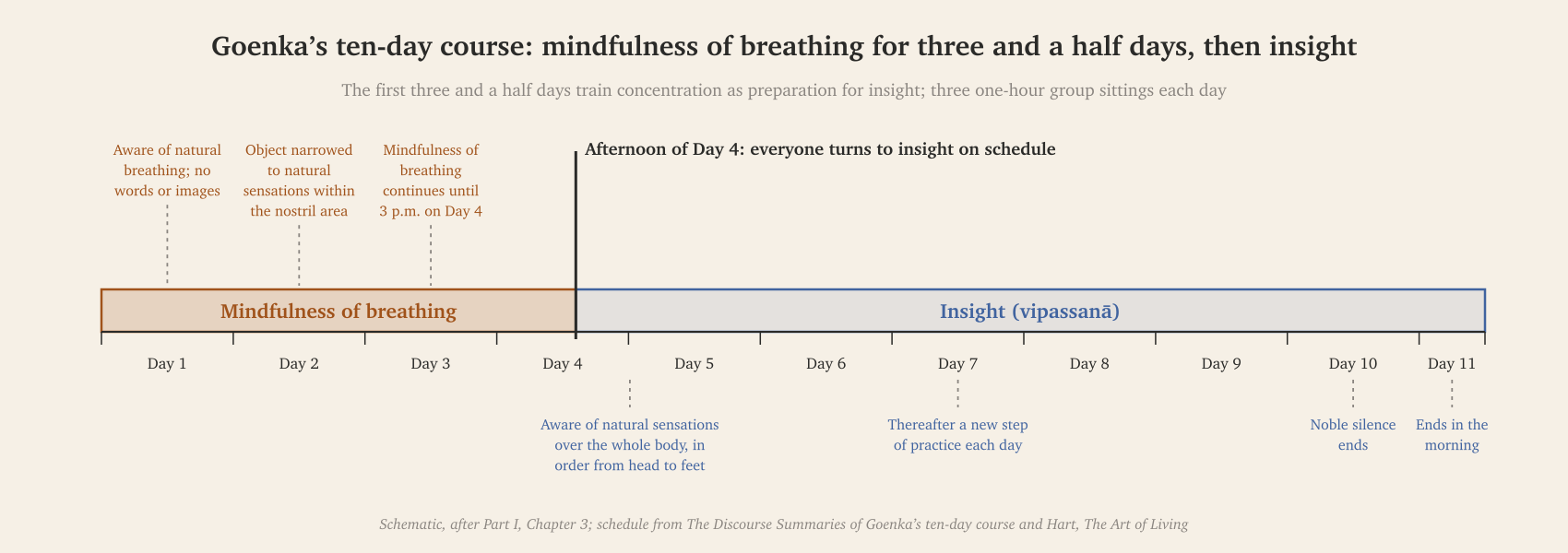
Calm in Goenka's ten-day course lasts only three and a half days and advances day by day according to the timetable. On the first day, students are aware only of the natural breath, adding no word and visualizing no form. Goenka says that adding a word, a mantra, or the image of a deity would make it quicker and easier to concentrate the mind, but this is not permitted, for the reason already given in Chapter 1, Section 1: the final aim of this meditation is not concentration of the mind. He gives two further reasons. An object one has made up or imagined leads only to more imagination; and a word or image belongs to a particular culture or religion and would give the technique a sectarian character, whereas the breath is common to everyone.18 In the first day's discourse he also explains in advance that at the moment of concentrating on the breath there is no craving, aversion, or delusion in the mind; the purity of this moment strikes against the old impurities stored in the unconscious, and some of them rise to the conscious level, appearing as various mental and physical discomforts. What looks like a problem is in fact a sign that the meditation is succeeding and that the technique has begun to work.19 The course discipline requires attendance in the hall for three one-hour sittings of group meditation each day.20 On the second day, the object shifts from the breath to the natural physical sensations within the limited area of the nostrils: the temperature of the air, slightly cool on the in-breath and slightly warm on the out-breath, and various sensations unrelated to breathing, such as heat, cold, itching, throbbing, vibration, pressure, tension, and pain. One need not attend to the name of the sensation; one is simply aware of it without reacting.21 Goenka defines right concentration as awareness of present reality, sustained continuously from moment to moment, free of craving and aversion, and says that mere concentration is not the aim of this technique; concentration must have a basis of purity.22 On the third day he says that concentration can suppress defilements that have arisen, but suppression does not eliminate them: they remain in the unconscious and go on multiplying, and so one must enter the stage of wisdom. The discourse ends by telling students to continue ānāpāna until three o'clock the next afternoon, continuing to observe reality within the area of the nostrils.23
The review on the tenth day sums up these three and a half days. When students could not feel the breath, they were permitted to breathe slightly harder, in order to fix their attention in the area of the nostrils, and then to return to natural, gentle breathing. No word is used, because each word has its own particular vibration: repeating a word creates an artificial vibration that lays a film of calm and harmony over the surface of the mind while the impurities in the depths remain, and it also hinders observation of the natural vibrations in the body that are connected with the impurities. Visualizing a form becomes an obstacle in the same way, and so "there should be neither visualization nor verbalization."24 The glossary defines the jhānas thus: "Cultivation of them brings tranquillity and bliss, but does not eradicate the deepest-rooted mental defilements."25
From the fourth day, students instead observe the natural sensations throughout the body in order from head to feet, moving from the surface into the depths.26 For the rest of the course, the course description gives only an outline: a further step of practice is introduced each day, silence ends on the tenth day, and the course concludes on the morning of the eleventh day.27 The place of the calm portion within the ten days is drawn as a timeline below.
Hart's book includes Goenka's answers to students' questions. Asked why ānāpāna is practiced at the nostrils rather than at the abdomen, Goenka answers that in this lineage ānāpāna is practiced as a preparation for Vipassana, and this kind of Vipassana requires especially strong concentration; the narrower the area of attention, the stronger the concentration, and since the abdomen is too large, the area of the nostrils is the most suitable. Asked why concentration is not enough for liberation, he answers that the purity of mind reached through concentration comes mainly from suppression, not from eliminating conditioning: it is like using alum to make the mud in muddy water sink to the bottom, so that the upper layer is clear while the sediment remains below.28 The book says that as concentration grows stronger, some people see lights or visions or hear unusual sounds; these only indicate that the mind has reached a heightened level of concentration, have no importance in themselves, and should be given no attention; they are "simply milestones that mark progress on the path." When the Buddha taught the jhānas, he stressed that they were only stepping-stones to the development of insight.29 Hart records an answer Goenka gave elsewhere: practice before the Buddha went only as far as the eighth jhāna, and the ninth jhāna that the Buddha discovered is Vipassana.30 This is the lineage's own statement of the relation between jhāna and insight; it differs from the commentarial classification and is simply recorded here.
U Ba Khin had originally set a criterion, based on the light sign, for the switch to insight. In his essay "The Real Values of True Buddhist Meditation" he says that the student concentrates on a point on the upper lip below the nose: by awareness of the breath, the range of thought is first narrowed to the area around the nose, and then, as the breath grows finer, to a point on the upper lip where only the warmth of the breath remains, and a good student can secure one-pointedness of mind within a few days. When meditation is going in the right direction, "pointers" appear: first white clouds, cotton wool, smoke, cobwebs, flowers, or discs, and, as attention becomes more concentrated, flashes, points of light, small stars, the moon, or the sun. If, after each short spell of relaxation, the student can return to concentration as quickly as possible by the pointer of light, he is already ready to switch to insight; if he can fix his attention on a point below the nose with a minute point of light remaining stationary for some time, so much the better, because he has then reached access concentration. He also says that when the student has reached a certain level of concentration, "preferably the upacāra samādhi," the course changes over to insight.31 Goenka's course does not use this criterion. The switch to insight is decided by the course timetable: all students switch together on the fourth day, regardless of whether each has seen the light sign, and lights and visions serve only as milestones that students are told to disregard.
The word ānāpāna refers to different things in the Goenka and Pa-Auk lineages, and this is clearest with respect to the sensations in the area of the nostrils. What Goenka asks students to be aware of on the second day is precisely the bodily sensations within the nostril area, such as cold, warmth, itching, throbbing, and pressure, and this is arranged as a step from the breath into subtler reality. Bhante Mahinda, by contrast, says (see Chapter 2, Section 1) that being aware of warmth, coolness, tingling, and softness at the philtrum is merely practice of skin sensation, not mindfulness of breathing. Each statement holds under its own definition: the former takes sensation as an object leading to insight, the latter takes the breath, as a concept, as the object of calm.
3. The jhāna debate
Whether jhāna must be attained before insight is developed is a long-standing debate within the Theravāda, and it became acute after the rise of modern Burmese insight meditation. The debate has two layers. One lies within the Theravāda tradition and asks how the commentarial teaching of the two vehicles should be read. The other lies in scholarship and asks what jhāna originally was in the early texts and how early the teaching of the two vehicles itself is.
Within the tradition, the debate was most public in Sri Lanka. The Mahāsi lineage reached Sri Lanka in the 1950s and established a meditation center at Kanduboda, where it at first met fierce opposition. Crosby records that the reasons given by the most vociferous opponent, Kheminda Thera, included the absence of calm; the lack of any requirement of Dhamma study as preparation; disagreement with the progression of practice set out in the Visuddhimagga; and the unorthodoxy of a breathing exercise that takes the rising and falling of the abdomen as its object. The other side pointed to the diversity of meditation teaching in the canon and commentaries and argued that there were textual authorities for insight practice other than the Visuddhimagga.32 Sharf's account is more detailed. A collection published in 1957 by Kassapa Thera attacked Mahāsi for taking the abdomen rather than the tip of the nose as the object of ānāpāna; Kheminda dismissed the method as an illegitimate "shortcut" that lacked canonical sanction and argued from scripture that jhāna and concentration must be acquired before the practice of insight; Mahāsi's defenders, arguing from their own reading of the scriptures, insisted that the canon recognizes a category of practitioner who proceeds directly to insight.33 Both sides appealed to the results of practice. The defenders cited as evidence the experience of meditators training under Mahāsi and urged the critics not to rest content with knowledge of the calm-vehicle method but to practice it until they attained jhāna together with the higher knowledges, and even the plane of the noble ones. The traditionalists flatly rejected the attainments their opponents claimed; Kassapa Thera said that practitioners of the Mahāsi method did not show the calm, concentrated, happy look described in the texts.34
The same passage of the Mahāṭīkā yields different conclusions in the two lineages. Mahāsi infers from it that momentary concentration is sufficient, as seen in Section 1 of this chapter. Pa-Auk responds to this kind of reading, without naming anyone, in his Burmese Nibbānagāmini-paṭipadā: "Some venerable teachers, who may be called excellent and good meditators, hold that the pure-insight practitioner need not establish concentration and can enter vipassanā on momentary concentration alone. They make this claim by citing the words of the author of the Visuddhimagga Mahāṭīkā." His answer is that "if one carefully examines and analyses the above instruction of the author of the Visuddhimagga Mahāṭīkā, one should understand that the momentary concentration of the pure-insight practitioner of which he speaks is directed toward the stage of calm."35 His argument has two steps. First, among the forty meditation subjects, the four-elements meditation belongs to the class that leads to access concentration. The sense-sphere concentration developed to its peak on the four elements as object is called access concentration by the commentary, as a figurative designation drawn from a similar kind, and momentary concentration by the subcommentary, in the literal sense: "The commentary's statement is figurative, the subcommentary's literal; the two differ only as literal and figurative usage and do not contradict each other." The four-elements meditation is therefore "a meditation subject belonging to both calm and insight," and the momentary concentration of the pure-insight practitioner is this concentration developed on the four elements.36 Second, the concentration that accompanies the insight knowledges in the stage of insight is also called momentary concentration, but only for meditators who already have access or absorption concentration as a basis and can discern materiality, mentality, causes, and effects, internal and external, in the three periods of time, does the concentration within their insight deserve this name. For those who cannot yet "practise insight by placing ultimate materiality, mentality, causes, and effects under the three characteristics," the concentration should not be called momentary concentration in the teaching of insight meditation.37 Both lineages accept the Mahāṭīkā, and both accept that the four elements yield only a semblance of access concentration. The disagreement is over whether the name "momentary concentration" refers to a concentration developed before insight or to a concentration that arises naturally within insight.
The Thai forest tradition does not speak with one voice. Ajahn Brahm holds that jhāna is indispensable. He says that calm and insight are two indivisible facets of the same process; that a jhāna lasts a long time, does not deserve the name if it lasts only a few minutes, and in its higher forms usually persists for many hours; and that once one has experienced the level of mindfulness of the fourth jhāna, one knows how absurd it is to think one can become enlightened without jhāna.38 His scriptural proof is the Naḷakapāna Sutta (MN 68): before one has attained the first jhāna or a higher one, the five hindrances, together with discontent and weariness, invade the mind and remain there, but not after one has attained it; deep insight requires the suppression of the five hindrances, and so jhāna too is necessary.39 At the opening of his chapter on jhāna he says that in the original scriptures the only word for "meditation" is jhāna, that the texts say the Buddha discovered jhāna, and that "Not once in the original texts does it say that the Buddha discovered vipassanā."40 His use of access concentration also differs from the commentaries. He regards the access concentration that precedes the first jhāna as extremely unstable: if one contemplates the Dhamma at that point, access is lost. Deep insight takes place in the state after emerging from jhāna, while the five hindrances remain suppressed for long periods.41 Buddhadāsa Bhikkhu, on the other hand, does not regard jhāna as indispensable. Discussing the fourth step of ānāpānasati, he says that it is not necessary to enter jhāna completely; these very refined levels of concentration are not needed in the practice of ānāpānasati, and one needs only a sufficient and appropriate level of concentration to continue, enough for joy and happiness to be clearly felt. Entering one of the four form-sphere jhānas is of course better still, but concentration sufficient to experience joy and happiness distinctly is enough for step four.42 He also gives ordinary people a shortcut that condenses the sixteen steps into two: first train the mind to an adequate and proper concentration, then use that concentration to contemplate impermanence, suffering, and nonself directly.43 Crosby records that Buddhadāsa advocated insight over calm because of the association of calm with jhāna and supernormal powers, and notes that this view is found in both Thailand and Burma.44
Gunaratana's study of the jhānas follows the commentarial position. He explains that momentary concentration denotes a concentration that flows with constantly changing objects, keeps a steady degree of intensity, and suffices to purify the mind of the hindrances; the name does not refer to a moment of concentration between scattered thoughts. In the pure-insight practitioner, it arises naturally in the course of developing insight.45 He grants that the possibility of arahantship without mundane jhāna has sometimes been questioned by Theravāda scholars, but holds that the weight of the Theravāda tradition leans toward recognizing such an attainment. His scriptural proof is the Susīma Sutta. A group of monks claim to have attained arahantship but deny having the supernormal powers or the peaceful immaterial liberations, and call themselves "liberated by wisdom." The commentary explains their answer as "we are contemplatives [nijjhānaka], dry insight workers, liberated by wisdom alone," and the subcommentary explains the commentary's phrase "even without concentration" as referring to the insight-vehicle practitioner who has not first developed concentration reaching the sign of calm.46 He also cites a sentence from the twenty-first chapter of the Visuddhimagga: the path arisen in a dry-insight worker, and the path arisen in one who has a jhāna but has not made it the basis for insight, are both paths of the first jhāna only. Since the two kinds of person are listed separately, the dry-insight worker evidently has no basic jhāna at all.47 In a note he also points out that the commentary's word nijjhānaka is ambiguous: it can be understood as "meditator" or as "lacking jhāna." U Paṇḍita of the Mahāsi lineage approaches the word jhāna from the other direction, extending it to vipassanā jhāna, as seen in Section 1 of this chapter.
Scholarly discussion moves the question to the texts themselves. Cousins examines the use of calm and insight in early Pāli literature. He finds that the two words occur in the Nikāyas mainly in stock formulas for the stages of the path, and that the four ways of attaining arahantship that Ānanda describes in the Aṅguttara Nikāya (calm followed by insight, insight followed by calm, calm and insight yoked together, and the mind seized by agitation about the Dhamma that then becomes settled) are the most significant for the later interpretation of the two vehicles. In explaining the fourth way, the Paṭisambhidāmagga lists the ten corruptions of insight for the first time, and the commentaries assign the fourth way to the dry-insight practitioner.48 He also points out that another sutta of the Aṅguttara Nikāya distinguishes the person who reaches the final goal with effort from the one who reaches it without effort, and that only the latter attains the four jhānas; Buddhaghosa's commentary explains the former as one who develops insight only and the latter as the calm-vehicle practitioner.49 His conclusion is that the ancient literature sees marked differences in how the path is entered, but "All are essential. Only the order of development is variable. There could be no question of a 'short cut', neglecting some aspects."50 He further notes that later tradition sometimes misunderstood sukkha as "dry," whereas the word's original sense is "pure."51 Cousins is skeptical that the early literature can be reliably stratified, and considers analyses built on chains of interdependent chronological judgments to be of very low reliability.52 Sujato, by contrast, takes the stratification of the texts as his method and traces how insight came to overpower calm, which is what the subtitle of his book means. He summarizes the "vipassanāvāda" in twentieth-century Theravāda meditation theory as follows: the Buddha taught two systems of meditation, calm and insight; calm existed before the Buddha and so is not really Buddhist; calm is dangerous, because one easily becomes attached to its bliss; and calm is unnecessary, because insight alone can develop the access concentration needed to suppress the hindrances. He says this view has become the de facto orthodoxy of the Theravāda, though not without controversy.53 He also says that interpreting concentration in the early texts through commentarial notions such as "access concentration" and "momentary concentration" will certainly misinterpret the texts.54 Sharf observes from another angle. He says that the description of the first jhāna differs among the Nikāyas, the Abhidhamma, and Buddhaghosa; contemporary insight teachers have no consensus at all on the identification of meditative states, their only point of agreement being that insight is superior to calm, so that competitors' techniques and experiences are often judged to be calm, while one's own practice is invariably said to be insight.55 The positions of the various parties are as follows:
| Person | Affiliation | Position | Source |
|---|---|---|---|
| Kheminda Thera | Sri Lankan traditionalists | Jhāna and concentration must be acquired before insight is practiced; Mahāsi's method lacks calm and is a "shortcut" without canonical sanction | Crosby, p. 164; Sharf, p. 263 |
| Mahāsi's defenders | Mahāsi lineage | The canon recognizes a category of practitioner who proceeds directly to insight | Sharf, pp. 263–264 |
| Mahāsi | Burma | Momentary concentration alone suffices to bring the purification of mind needed for attaining path and fruition | Manual of Insight, p. 49 |
| Pa-Auk | Burma | The momentary concentration of the pure-insight practitioner spoken of in the subcommentary is directed toward the stage of calm, that is, the concentration developed on the four elements | Nibbānagāmini-paṭipadā, vol. 1, pp. 192–202 of the original |
| Ajahn Brahm | Thai forest tradition | Jhāna is indispensable | Mindfulness, Bliss, and Beyond, chs. 2, 5, 9, 12 |
| Buddhadāsa Bhikkhu | Thailand | One need not enter jhāna completely; concentration sufficient to experience joy and happiness distinctly is enough | Mindfulness with Breathing, pp. 65–66 |
| Henepola Gunaratana | Study of the jhānas | Following the commentaries, accepts that dry-insight practitioners without mundane jhāna can attain arahantship | The Path of Serenity and Insight, pp. 199–200 |
| U Paṇḍita | Mahāsi lineage | Jhāna is the quality of mind that sticks to an object and observes it; divided into samatha jhāna and vipassanā jhāna | In This Very Life, pp. 179–180 |
| Cousins | Scholarship | Calm and insight are all essential; only the order of development varies | 1984, p. 65 |
| Sujato | Scholarship | Reading concentration in the early texts through access and momentary concentration necessarily misreads them | A History of Mindfulness, p. 82 |
| Sharf | Scholarship | The only consensus among insight teachers is that insight is superior to calm | 1995, p. 261 |
By comparison with the Geluk lineage: for Tsongkhapa, calm is a samādhi shared with non-Buddhists and serves only as the support of insight, and taking the Buddha's body or the mind itself as object is merely an expedient (see Part III of Essay 2, The Meditation of Tsongkhapa, Chapter 1, Sections 1 and 9). Calm in the three Burmese lineages likewise carries no doctrinal content: Pa-Auk takes the breath as a concept and the kasiṇa sign as objects, Goenka forbids adding words and images, and Mahāsi sets up no separate stage of calm. The disagreement among the three lineages lies in whether insight must be based on some degree of calm, and whether the commentarial name "momentary concentration" can bear the weight of that basis. On the content of calm itself, the three lineages have no dispute.
4. Summing up the side of calm
Taking the three chapters on calm together, each lineage's criteria fall in a different place (for the positions of the two vehicles and the three lineages, see the figure in Chapter 1, Section 1).
The Pa-Auk lineage's criteria fall on the side of calm and consist of explicit items. The counterpart sign is the precondition of access concentration; the counterpart sign remaining stable for two or three hours in three consecutive sittings is the threshold; the three checks of the bhavaṅga mind, the counterpart sign, and the five jhāna factors are the confirmation; and self-examination over many days and many months is the conclusion. The content of every item is the student's report of what he or she has seen in the sitting. Pa-Auk says that he gives guidance only on the basis of interview reports and never certifies anyone's attainment of jhāna or of path and fruition, and Chen Faling likewise says that the checks are standards for meditators to assess themselves.
The Mahāsi lineage sets no separate criterion for calm. For the pure-insight practitioner, purification of mind is carried by momentary concentration, which arises naturally in the course of insight; its strength is explained by the stage of insight knowledge, comparable to access at the knowledge of delimiting mentality-materiality and fully mature at the knowledge of dissolution. The criterion for calm therefore moves over to the side of insight and is merged into the progress of insight knowledge, which Chapter 4 takes up.
The Goenka lineage sets no individual criterion. Ānāpāna lasts three and a half days; on the second day the object shifts from the breath to the sensations in the area of the nostrils, and on the afternoon of the fourth day all students move into insight according to the timetable. U Ba Khin had made a stable light sign and the attainment of access concentration the occasion for switching to insight; Goenka's course does not use this criterion, and lights and visions serve only as milestones that students are told to disregard.
The distribution of the three lineages' criteria can be set side by side:
| Pa-Auk | Mahāsi | Goenka | |
|---|---|---|---|
| Side on which the criteria fall | Calm | Insight, merged into the progress of insight knowledge | No individual criterion |
| Content of the criteria | Counterpart sign; two or three hours in three consecutive sittings; three checks of the bhavaṅga mind, the counterpart sign, and the five jhāna factors; long-term self-examination | Strength of momentary concentration explained by the stage of insight knowledge: comparable to access at the knowledge of delimiting mentality-materiality, fully mature at the knowledge of dissolution | Switch to insight on the fourth day according to the timetable |
| Basis of the assessment | The student's self-report in interview; the teacher says he does not certify | See Chapter 4 | The course timetable |
What the three lineages share is that they all argue within the commentarial framework of the two vehicles. Pa-Auk and Mahāsi cite the same passage of the Mahāṭīkā, and their disagreement lies in what the name "momentary concentration" refers to; Goenka's glossary also treats momentary concentration as sufficient preparation for insight. Both sides of the jhāna debate, Kheminda and Mahāsi's defenders, Ajahn Brahm and Buddhadāsa, take the suttas and commentaries as their authority; Cousins and Sujato bring the question back to the date of the teaching of the two vehicles itself. Whether the three lineages' criteria are lax or strict, reasonable or not, the three chapters on calm do not judge; that is left to Chapter 10.
References
-
Mahāsi Sayādaw, Manual of Insight, trans. and ed. Vipassanā Mettā Foundation Translation Committee, Somerville: Wisdom Publications, 2016, pp. 45–46: "Contemplating the eight kinds of recollection (anussatī), the perception of impurity (pāṭikūlasaññā), or the analysis of the four elements (catudhātuvavatthāna) cannot arouse true access concentration. Concentration aroused using these three objects cannot be considered true access concentration because it does not have the potential to lead to absorption concentration. It is, nevertheless, typically referred to as access concentration because it produces similar results in terms of suppressing hindrances." ↩
-
Mahāsi, Manual of Insight, p. 46; p. 47: "However, momentary concentration develops naturally in the course of insight meditation practice." ↩
-
Mahāsi, Manual of Insight, pp. 47–49. The inference continues: "Likewise, we can also infer, based on the statement 'Insight knowledge can be aroused without depending on access or absorption concentration,' that insight knowledge must be aroused based on momentary concentration." ↩
-
Mahāsi, Manual of Insight, pp. 50–56; p. 55: "The important point here is that one who takes the vehicle of insight to enlightenment begins his or her insight practice without any access concentration or absorption concentration. However, they attain those concentrations by first developing insight knowledge." ↩
-
Mahāsi, Manual of Insight, pp. 52–54. On the knowledge of rise and fall, p. 53: "The Visuddhimagga considers this insight knowledge to be 'fledgling insight' (taruṇavipassanā) and calls one who reaches this stage an 'energetic meditator' (āraddhavipassaka)." p. 52: "This momentary concentration creates a unification of mind comparable to access concentration." p. 53: "When this happens, the strength of the momentary concentration is comparable to that of absorption in tranquility meditation." At p. 54 Mahāsi cites the Mahāṭīkā: "Momentary single-pointedness of mind (khaṇikacittekaggatā) is momentary concentration. When it continuously dwells on an object [of insight] over a long period, opposing hindrances cannot overwhelm it, and it is able to make the mind as strong and steadfast as jhāna or absorption concentration." ↩
-
Mahāsi, Manual of Insight, p. 62. ↩
-
Mahāsi, Manual of Insight, pp. 90–91: "This is why Pāḷi scriptures say that momentary concentration is fully mature at this stage of knowledge." ↩
-
Mahāsi, Manual of Insight, pp. 78–89; the verses quoted are referenced to Ñāṇamoli's translation of the Paṭisambhidāmagga (The Path of Discrimination), p. 169. The six remedies are summarized in note 167 to the book's second chapter: "The six remedies to the six obstacles to concentration are: countering distracting thoughts of the past by not thinking of the past, countering fantasies about the future by not thinking of the future, encouraging oneself when lazy, relaxing oneself when overzealous, recognizing lust when gratified, and recognizing aversion when frustrated." ↩
-
Mahāsi, Manual of Insight, pp. 80–88; the four lines are at p. 88. ↩
-
Mahāsi, Manual of Insight, p. 78: "It is called developing insight by continuously observing the usual meditation object without letting the mind incline elsewhere (appanidhāyabhāvanā). This method is most suitable for beginning practitioners and persons with little knowledge." "During intensive insight practice, however, one must give priority solely to insight meditation. Alternative methods of contemplation should only be used when one's mind wanders too much and one is not able to continue with insight." ↩
-
Mahāsi Sayādaw, Practical Insight Meditation: Basic and Progressive Stages, trans. U Pe Thin and Myanaung U Tin, Kandy: Buddhist Publication Society, n.d., pp. 3–4: "Try to keep your mind (but not your eyes) on the abdomen." "What you actually perceive is the bodily sensation of pressure caused by the heaving movement of the abdomen." ↩
-
Mahāsi, Practical Insight Meditation, pp. 2–3: "It is also important for you to begin your training with a brief contemplation on the 'Four Protections' which the Enlightened One, the Buddha, offers you for reflection. It is helpful for your psychological welfare at this stage to reflect on them." ↩
-
Mahāsi, Practical Insight Meditation, p. 15: "During a strict course of meditation, the time of practice is from the first moment you wake up until you fall asleep." ↩
-
Sayadaw U Pandita, In This Very Life: The Liberation Teachings of the Buddha, trans. U Aggacitta, ed. Kate Wheeler, 2nd ed., Boston: Wisdom Publications, 1993, p. 16: "During a retreat it is usual to alternate periods of sitting meditation with periods of formal walking meditation of about the same duration, one after another throughout the day. One hour is a standard period, but forty-five minutes can also be used." ↩
-
U Pandita, In This Very Life, p. 151: "Momentary concentration, the second type, is most important in vipassana practice." ↩
-
U Pandita, In This Very Life, pp. 179–180: "Jhana is usually translated as 'absorption.' Actually, it refers to the quality of mind that is able to stick to an object and observe it." "On the other hand, vipassana jhana allows the mind to move freely from object to object, staying focused on the characteristics of impermanence, suffering and absence of self that are common to all objects." ↩
-
Erik Braun, The Birth of Insight: Meditation, Modern Buddhism, and the Burmese Monk Ledi Sayadaw, Chicago: University of Chicago Press, 2013, p. 161. ↩
-
S. N. Goenka, The Discourse Summaries: Talks from a Ten-day Course in Vipassana Meditation, condensed by William Hart, Onalaska: Vipassana Research Publications, 2012 e-book (first published Vipassana Research Institute, 1987), Day One, pp. 11–13. ↩
-
Goenka, Discourse Summaries, Day One, pp. 15–16: "This moment of purity at the conscious level has a strong impact on the old impurities accumulated in the unconscious. The contact of these positive and negative forces produces an explosion. Some of the impurities hidden in the unconscious rise to the conscious level, and manifest as various mental or physical discomforts." "However, it would be wise to understand that what seems to be a problem is actually a sign of success in the meditation, an indication that in fact the technique has started to work." ↩
-
Goenka, Discourse Summaries, Day One, p. 16: "Also resolve to follow the timetable, and especially to be in the hall for the three one-hour sittings of group meditation each day." ↩
-
Goenka, Discourse Summaries, Day Two, pp. 21–22: "Now you will take a still subtler object of attention: the natural, physical sensations within this limited area." ↩
-
Goenka, Discourse Summaries, Day Two, p. 22: "Mere concentration is not the aim of this technique; the concentration you develop must have a base of purity. … Sustaining this awareness continuously from moment to moment—this is sammā-samādhi." ↩
-
Goenka, Discourse Summaries, Day Three, pp. 24, 29. p. 24: "However, suppressing defilements does not eliminate them. They remain in the unconscious and multiply there, continuing to cause harm to oneself." p. 29: "keep practicing Anapana until 3 p.m. tomorrow; keep observing reality within the area of the nostrils." ↩
-
Goenka, Discourse Summaries, Day Ten, pp. 77–79; the sentence quoted is at p. 79. p. 78: "When you could not feel the breath, you were permitted to breathe slightly hard, just to fix your attention in the area of the nostrils." ↩
-
Goenka, Discourse Summaries, glossary, p. 114, s.v. jhāna. ↩
-
Goenka, Discourse Summaries, Day Ten, p. 79: "From head to feet, you began observing natural sensations within the body, starting on the surface and then going deeper, learning to feel sensations outside, inside, in every part of the body." ↩
-
William Hart, The Art of Living: Vipassana Meditation as Taught by S. N. Goenka, Onalaska: Vipassana Research Publications, e-book (first published Harper & Row, 1987), p. 7: "Further steps within the practice are introduced each day, so that by the end of the course the entire technique has been presented in outline. On the tenth day silence ends, and meditators make the transition back to a more extroverted way of life. The course concludes on the morning of the eleventh day." ↩
-
Hart, The Art of Living, p. 75: "Because for us ānāpāna is practised as a preparation for the practice of Vipassana, and in this type of Vipassana a particularly strong concentration is necessary. The more limited the area of attention, the stronger the concentration will be." "Because the purity of mind developed through samādhi is achieved primarily by suppression, not elimination of conditioning." ↩
-
Hart, The Art of Living, pp. 73–74: "All these so-called extrasensory experiences are merely indications that the mind has attained a heightened level of concentration. In themselves these phenomena have no importance and should be given no attention." "When he taught the states of absorption, therefore, he emphasized their function only as stepping-stones to the development of insight." ↩
-
Hart, The Art of Living, p. 76: "The Buddha found the ninth jhāna, and that is Vipassana, the development of insight that will take the meditator to the ultimate goal beyond all sensory experience." ↩
-
U Ba Khin, "The Real Values of True Buddhist Meditation," in Sayagyi U Ba Khin Journal, Igatpuri: Vipassana Research Institute, 1991, pp. 62–63. p. 62: "With a determined effort to narrow down the range of thought waves firstly to the area around the nose with respiration mindfulness and gradually with the wavelength of respiration becoming shorter and shorter to a spot on the upper lip with just the warmth of the breath, there is no reason why a good student in meditation should not be able to secure the one-pointedness of mind in a few days of the training." On the same page: "What is essential, then, for the student is to try after each short spell of relaxation to get back to samādhi with the pointer of 'light' as quickly as possible. If he can do this, he is quite ready to be switched on to Vipassana meditation to gain insight into the ultimate truth and enjoy the great peace of nibbāna. If he is able to focus his attention to one point at the base of the nose with a minute point of light remaining stationary for some time, it is all the better, because at that time he reaches the upacāra samādhi or 'neighbourhood concentration.'" p. 63: "When the student has reached a certain level of samādhi, preferably the upacāra samādhi, the course of training is changed to Vipassana or insight." ↩
-
Kate Crosby, Theravada Buddhism: Continuity, Diversity, and Identity, Chichester: Wiley Blackwell, 2014, p. 164: "The most vociferous adversary was the monk Kheminda Thera, who criticized it for a number of reasons including the absence of samatha, that it does not require Dhamma study as a preparation, that it is not in accordance with the Visuddhimagga vision of progression or practice, and that the breathing exercises focusing on the rising and falling of the breath in the abdomen were unorthodox. Counter-arguments pointed to the diversity of meditation teaching to be found in the canon and commentaries, and thus to the possibility of textual authorities other than the Visuddhimagga for vipassanā practices." ↩
-
Robert H. Sharf, "Buddhist Modernism and the Rhetoric of Meditative Experience," Numen 42, no. 3 (1995): 228–283, quotation at pp. 263–264: "Kheminda Thera objected to the method as an illegitimate 'shortcut' that lacked canonical sanction. In particular, Kheminda argues from scripture that trance (jhāna) and concentration (samādhi) must be acquired prior to the practice of vipassana. The defenders of Mahasi's method argued from their own reading of the scriptures, which they insisted recognizes a category of practitioner who proceeds directly to vipassana." ↩
-
Sharf, "Buddhist Modernism and the Rhetoric of Meditative Experience," p. 264: "They also cited as evidence the experience of yogis training under Mahasi, and they suggested that their detractors 'not rest content with the mere knowledge of the samatha-yanika method but instead practise it diligently until they attain jhana together with abhinna, as well as ariyabhumi.' Not surprisingly, the response of the traditionalists was to categorically reject the claims of their opponents to have realized legitimate stages on the path. Kassapa could argue, for example, that practitioners of the Mahasi method 'do not exhibit the calm, concentrated, happy look mentioned in the texts.'" ↩
-
Pa-Auk, Nibbānagāmini-paṭipadā (Chinese translation titled Quxiang niepan zhi dao 趣向涅槃之道), vol. 1, "On Developing Concentration" (修定篇), section "Momentary Concentration" (刹那定), pp. 192 and 194 of the original (Burmese original edition, 1998). The English here is translated from the complete Chinese translation of the Nibbānagāmini-paṭipadā published on this book's website; likewise below. ↩
-
Pa-Auk, Nibbānagāmini-paṭipadā, vol. 1, "On Developing Concentration," sections "The Path of the Pure-Insight Practitioner" (纯观乘者之道) and "To Be Especially Noted and Remembered" (特别应注意并记住), pp. 196–200 of the original; the sentence on "belonging to both calm and insight" is on p. 197, the sentence on "literal and figurative" on p. 200. The same argument in English is in Pa-Auk, Mindfulness of Breathing and Four Elements Meditation (W.A.V.E. free-distribution reprint, revised, n.d.), pp. 83–86; the subcommentary passages cited are Vism-mhṭ 1.15 and 1.436. ↩
-
Pa-Auk, Nibbānagāmini-paṭipadā, vol. 1, "On Developing Concentration," section "To Be Especially Noted and Remembered," pp. 201–202 of the original. ↩
-
Ajahn Brahm, Mindfulness, Bliss, and Beyond: A Meditator's Handbook, Somerville: Wisdom Publications, 2006, ch. 2: "In fact the two are indivisible facets of the same process." "A jhāna will last a long time. It does not deserve to be called jhāna if it lasts only a few minutes. The higher jhānas usually persist for many hours." ch. 5: "Once you have experienced that level of mindfulness, then you will know for yourself how ridiculous it is to think you can become enlightened without jhāna." The e-book used has no print page numbers, so it is cited by chapter. ↩
-
Brahm, Mindfulness, Bliss, and Beyond, ch. 12: "Since the suppressing of the five hindrances is necessary for deep insight, so also is jhāna necessary." ↩
-
Brahm, Mindfulness, Bliss, and Beyond, ch. 9: "IN THE ORIGINAL Buddhist scriptures there is only one word for 'meditation' and that is jhāna." "The ancient Buddhist texts state that the Buddha discovered jhāna (SN 2,7; AN IX,42). Not once in the original texts does it say that the Buddha discovered vipassanā." ↩
-
Brahm, Mindfulness, Bliss, and Beyond, ch. 12: "The period just before entering the first jhāna is also upacāra samādhi. … However, the upacāra samādhi prior to jhāna is notoriously unstable when compared with that occurring post-jhāna. … Should one attempt to contemplate Dhamma at this time, the upacāra samādhi will be lost and the five hindrances will return." The same section also says: "the jhāna experience serves the purpose of firmly suppressing the five hindrances for long periods of time after emerging from a jhāna, and it is then that deep insight is possible." ↩
-
Buddhadāsa Bhikkhu, Mindfulness with Breathing: A Manual for Serious Beginners, trans. Santikaro Bhikkhu, rev. ed., Boston: Wisdom Publications, 1997, pp. 65–66: "In our practice of step four of ānāpānasati, it is not necessary to enter jhāna completely. In the practice of ānāpānasati these very refined levels of concentration are not necessary. We need only to have a sufficient and appropriate level of concentration to continue with our practice: that is, enough samādhi that feelings of pīti and sukha (contentment and happiness) are also present." "If you enter the first, second, third, or fourth rūpa-jhāna, it is better still. But sufficient samādhi to experience pīti and sukha distinctly is enough for step four." ↩
-
Buddhadāsa, Mindfulness with Breathing, pp. 123–124 (Buddhadāsa's words as quoted in the translator's afterword): "It is possible to condense the sixteen down to two steps. One—train the citta (mind) to be adequately and properly concentrated. Two—with that samādhi, skip over to contemplate aniccaṃ, dukkhaṃ, and anattā right away." ↩
-
Crosby, Theravada Buddhism, p. 165: "While he advocated vipassanā over samatha methods because of the association of the latter with jhāna and magical powers (a view found in both Thailand and Burma), he did not advocate intensive, formal meditation for laypeople." ↩
-
Henepola Gunaratana, The Path of Serenity and Insight: An Explanation of the Buddhist Jhānas, Delhi, 1985 (the copy used is the 2013 Malaysian free-distribution reprint, whose layout matches the printed edition), pp. 152–154; p. 152: "Rather, it denotes a dynamic concentration which flows from object to object in the ever-changing flux of phenomena, retaining a constant degree of intensity and collectedness sufficient to purify the mind of the hindrances." ↩
-
Gunaratana, The Path of Serenity and Insight, pp. 199–200. p. 199: "The possibility of arahatship without possession of a mundane jhāna has sometimes been questioned by Theravada Buddhist scholars, but the weight of the Theravada tradition leans towards the recognition of such an attainment." The quotation from the commentary on the Saṃyutta Nikāya is in Gunaratana's translation, p. 200. Note 1 on the same page says that the word nijjhānaka "is ambiguous" and may also mean "lacking jhāna." The Susīma Sutta is Saṃyutta Nikāya 12.70. ↩
-
Gunaratana, The Path of Serenity and Insight, p. 199; the passage cited is Visuddhimagga XXI.112, in Bhikkhu Ñāṇamoli (trans.), The Path of Purification, 4th ed., Kandy: Buddhist Publication Society, 2010: "According to governance by insight, the path arisen in a bare-insight (dry-insight) worker, and the path arisen in one who possesses a jhāna attainment but who has not made the jhāna the basis for insight, and the path made to arise by comprehending unrelated formations after using the first jhāna as the basis for insight, are paths of the first jhāna only." ↩
-
L. S. Cousins, "Samatha-yāna and Vipassanā-yāna," in Gatare Dhammapala, Richard Gombrich and K. R. Norman (eds.), Buddhist Studies in Honour of Hammalava Saddhātissa, Nugegoda: University of Sri Jayewardenepura, 1984, pp. 56–68. Ānanda's four ways (A II 157) are discussed at pp. 59–60; the Paṭisambhidāmagga's first listing of the ten corruptions of insight and the commentarial assignment at p. 61; the commentarial passage on calm before insight and insight before calm at p. 63. ↩
-
Cousins, "Samatha-yāna and Vipassanā-yāna," p. 63: "One sutta in the Anguttara-nikaya (II 155-6) distinguishes the person who reaches the final goal with effort (sa-saṅkhāraparinibbāyī) from one who does so with ease (asaṅkhāra). Only the latter attains to the four jhānas. Buddhaghosa's commentary explains that the first individual is one who develops just insight (sukkha-vipassaka). The person who reaches the goal with ease is explained as one whose vehicle is peace (samatha-yānika)." In note 34 Cousins adds that elsewhere in the Nikāyas these two persons are treated as two kinds of non-returner. ↩
-
Cousins, "Samatha-yāna and Vipassanā-yāna," p. 65: "The goal is seen as a dynamic balance of qualities—in this case peace and insight, but others are also important. The route to that goal may involve the development of some of those qualities before others, but in the longer term none can be neglected. All are essential. Only the order of development is variable. There could be no question of a 'short cut', neglecting some aspects." ↩
-
Cousins, "Samatha-yāna and Vipassanā-yāna," p. 68, note 33: "Later tradition sometimes erroneously interprets the word sukkha as meaning 'dry'." In the body of the article Cousins renders sukkha-vipassaka as "one who develops just insight" (p. 63). ↩
-
Cousins, "Samatha-yāna and Vipassanā-yāna," p. 56 and p. 67, note 2. ↩
-
Bhikkhu Sujato, A History of Mindfulness: How Insight Worsted Tranquillity in the Satipaṭṭhāna Sutta, e-book published by the author, no place or date of publication, p. 3: "This is a special interpretation of some central meditation concepts that has become the de facto orthodoxy in Theravāda Buddhism, although not without controversy." "The Buddha taught two systems of meditation, samatha and vipassana. Samatha was taught before the Buddha (so is not really Buddhist), it is dangerous (because one can easily get attached to the bliss), and it is unnecessary (because vipassana alone can develop the access samadhi necessary to suppress the hindrances)." ↩
-
Sujato, A History of Mindfulness, p. 82: "anyone who persists in the very common practice of interpreting early texts on samadhi in terms of the commentarial ideas of 'access samadhi' and 'momentary samadhi' will certainly misinterpret the present work, and, I believe, will also misinterpret the Suttas." ↩
-
Sharf, "Buddhist Modernism and the Rhetoric of Meditative Experience," p. 261: "the description of the first jhāna, for example, differs depending on whether one turns to the Nikāya accounts, the Abhidhamma, or Buddhaghosa." "The only area of agreement among vipassanā teachers is that vipassanā is superior to samatha, as the former alone leads to liberation. As a result, the techniques and experiences promoted by one's competitors are often deemed to be samatha, while one's own style of practice is invariably claimed to be vipassanā." ↩