续篇第三章 止禅(下):刹那定、安般预备与禅那之争
第二章复述了帕奥一系的止:先证禅那,再以定力之光修观,判准落在似相、有分心与五禅支上。本章转到另外两系与一场争论。马哈希一系不另设止的阶段,纯观乘者的心清净由刹那定承担;葛印卡的十日课程以三天半的安般作预备,第四天按日程转入内观。两系都以注释书的刹那定之说为依据,帕奥对同一说法另有读法,所以第三节整理上座部内外围绕"禅那是否必经"的争论。末节把止的三章合起来,归纳三系的判准各落在哪里。
马哈希一系所据是他的 Manual of Insight 第二章、入门手册 Practical Insight Meditation 与班迪达禅师的开示集;葛印卡一系所据是十日课程开示的摘要、Hart 的 The Art of Living 与乌巴庆的讲稿;禅那之争一节取斯里兰卡的论争、泰国森林传统的两家、德宝法师的禅那研究,以及 Cousins、Sujato、Sharf 的论文。
一、马哈希一系:刹那定
马哈希在 Manual of Insight 第二章把心清净分为三种定:近行定、安止定与刹那定。近行定以似相为所缘,可由遍处、不净、身至念、入出息、四梵住或无色的业处引生。他接着说,八种随念、食厌想与四界分别观不能引生真正的近行定,因为它们没有导向安止的可能;由这三类所缘所生的定"通常也称为近行定,因为它在镇伏诸盖上效果相似"。1 这一说法与帕奥对四界分别观的判定相同(见第二章第三节),两系对"四界只得相似的近行"一点并无分歧。刹那定则是内观修习者的信、精进、念、定、慧强盛平衡时,每一次标记都对所观的身心现象产生强而清晰的定,马哈希称之为"由刹那刹那的观察引生的刹那定",并说刹那定在观的修习过程中自然生起,不像近行与安止那样须预先修成。2
他为纯观乘者立论的依据,正是第一章第一节所引《大复注》的那段话。复注说纯观乘者是不依近行与安止而修纯观的人,马哈希以"提婆达多身体发胖而白天不吃,可知他夜里吃"为喻,推论说既然观智可以不依近行与安止生起,它就必定依刹那定生起,而复注接着明言纯观乘者离了刹那定不能证悟。3 他又引注释书与《无碍解道》,说纯观乘者先观色等为无常、苦、无我,观强盛时对所观对象的深入生起心一境性,即先观后止;纯观乘者开始修观时没有任何近行定或安止定,是先发展观智而后得到那些定。4
刹那定有强弱,马哈希把它与观智的阶次对应起来。基础一级始于名色分别智,此时妄念与诸盖不能干扰,所生的心一境性可比于止乘者的近行定;中级始于生灭智;高级始于坏灭智。刹那定可以强到如同专注于单一所缘,前后心刹那都同样专注于一个接一个的所缘,强度可比于止的安止;两者的差别只在止的所缘始终不变,不能帮助人看清名色及其无常,观的所缘不断变化。5 他用三个比喻描写刹那定强时的情形:标记之心与所标记的所缘像是绑在一起,如一袋重米放在哪里就立在哪里,如尖矛插在哪里就稳立在哪里,如黏物掷到墙上哪里就粘在哪里。6 到坏灭智至随顺智的阶段,每一次标记都只经验到现象的消失,他说巴利典籍讲刹那定在这一阶段完全成熟,正是指此。7 三级列如下:
| 级 | 起点 | 马哈希的说明 |
|---|---|---|
| 基础 | 名色分别智 | 妄念与诸盖不能干扰,所生的心一境性可比于止乘者的近行定 |
| 中级 | 生灭智 | 《清净道论》称此智为幼嫩之观 |
| 高级 | 坏灭智 | 至随顺智阶段每一次标记只经验到现象的消失,刹那定在此完全成熟 |
三级之外,马哈希又说刹那定强时,强度可比于止的安止,差别只在所缘变与不变。 由此可见,马哈希没有给止另设判准,止的程度由观智的阶次来说明,判准随之移到观的一侧,第四章再讨论。
马哈希也讲定的障碍与平衡,所用的框架是观的标记。他依《无碍解道》列出六种妨碍定的心态与六种对治:回想过去,以不想过去对治;幻想未来,以不想未来对治;懈怠时策励,过度用力时放松,因修行顺利而欢喜时认出其中的贪,因修行不顺而沮丧时认出其中的嗔;每一种都先标记,再把心放回当下的所缘。8 懈怠标记不去,可依《长部注》所列发起精进觉支的方法,思惟地狱之苦、修行的利益、修行的高贵等以策励自己;过度用力表现为决意不漏标任何细微的所缘、反复检查是否标到、咬紧牙关、握紧拳头,对治是放松。他用四句话收束:精进松弛时须策励,绷得过紧时须放松,不松不紧、标记平衡时,心即专注。9 对于妄念,他区分两种修法:始终守着通常的所缘、不让心倾向别处,最适合初学者与学识少的人;把心转向其他业处来对治,适合久修者与学识多的人;密集内观期间以观为先,只在妄念太多、无法继续修观时才用别的业处,妄念平息就立即回到观。10 帕奥的平衡(见第二章第二节)以似相为中心,马哈希的平衡以标记的连续为中心,两者调节的对象都是精进与定之间的松紧。
操作上,马哈希的入门指导是把心(而不是眼睛)放在腹部,觉知随呼吸而起的上升与下降,作"上""下"的标记;他说明所觉知的实际是腹部起伏所引起的压触,不是腹部的形状。11 妄念、意图、想象、身体的动作,一一随生随标记,标记完回到腹部的起伏。他也要求开始时简短地思惟四护卫,即佛陀、慈心、身体的不净与死,用意在于心理上的安顿。12 严格的禅修期间,修习时间从醒来的第一刻到入睡为止。13 班迪达禅师的开示说,禅修营中坐禅与经行交替,时长大致相同,一小时是标准的长度,也可以用四十五分钟。14 他说内观所缘时时生灭,刹那定随每一所缘在每一刹那生起,刹那刹那不间断时,与持续的定一样有使心寂静、使烦恼不起的力量。15 他又把"禅那"一词解为心能贴住所缘并观察它的品质,分为止的禅那与观的禅那:止的禅那是对单一所缘的固定觉知,观的禅那则让心在所缘之间自由移动,专注于一切所缘共有的无常、苦、无我。16 Braun 概括说,觉音的书以包括修习禅那在内的过程为首要,马哈希的方法则以"干"的修习为首要,只用较低层次的刹那定。17 至于马哈希一系实际一座的长短,导论第三章第二节已有作者见闻的注,本节不重复。
二、葛印卡的安般预备
葛印卡十日课程的止只有三天半,以日程为单位推进。第一天,学员只觉知自然的呼吸,不加任何词语,不观想任何形象。葛印卡说,加一个词、一句咒语或一位神的形象,可以更快更容易地集中心,但不允许这样做,理由已见第一章第一节:这一禅修的最终目的不是心的专注。他另给两条理由:用自造的、想象的所缘只会走向更多的想象;词语或形象属于某一文化、某一宗教,会使技术带上宗派色彩,呼吸则人人共有。18 他在第一天的开示里还预先说明,专注于呼吸的那一刻心中没有贪、嗔、痴,这一刻的清净会冲击积存在潜意识里的旧不净,一部分不净浮到意识层面,现为种种身心的不适;看似是问题,其实是禅修成功、技术已经开始起作用的标志。19 课程纪律要求每天在禅堂参加三次各一小时的集体共修。20 第二天,所缘从呼吸转向鼻孔这一有限区域内的自然的身体感受:入息时微凉、出息时微温的气温,以及与呼吸无关的种种感受,热、冷、痒、跳动、振动、压、紧、痛等,不必理会感受的名称,只觉知它而不起反应。21 葛印卡把正定界定为不带贪嗔、刹那刹那持续地觉知当下的实相,并说单纯的专注不是这一技术的目的,定须以清净为基础。22 第三天,他说定能压制已生起的烦恼,但压制并不能消除烦恼,烦恼留在潜意识里继续增长,所以必须进入慧的阶段;开示结尾要学员继续修安般到次日下午三点,继续观察鼻孔区域内的实相。23
第十天的回顾对这三天半作了总结。觉知不到呼吸时,允许学员稍微用力呼吸,以便把注意力固定在鼻孔区域,然后回到自然轻柔的呼吸。不用词语,因为每个词都有它特定的振动,重复一个词会造成一种人为的振动,在心的表层造成一层平静和谐,深处的不净却仍在,而且会妨碍观察身体中与不净相关的自然振动;观想形象同样会成为障碍,修习者因此"既不应观想,也不应默念"。24 词表对禅那的界定是:修习它们带来宁静与喜乐,但不能根除最深层的烦恼。25
第四天起,学员改为从头到脚依次觉知全身的自然感受,从表面入于深处。26 课程说明对此后的安排只交代大纲:每天引入一步新的练习,第十天止语结束,第十一天上午课程结束。27 止的部分在十日中的位置,画成时间线如下。
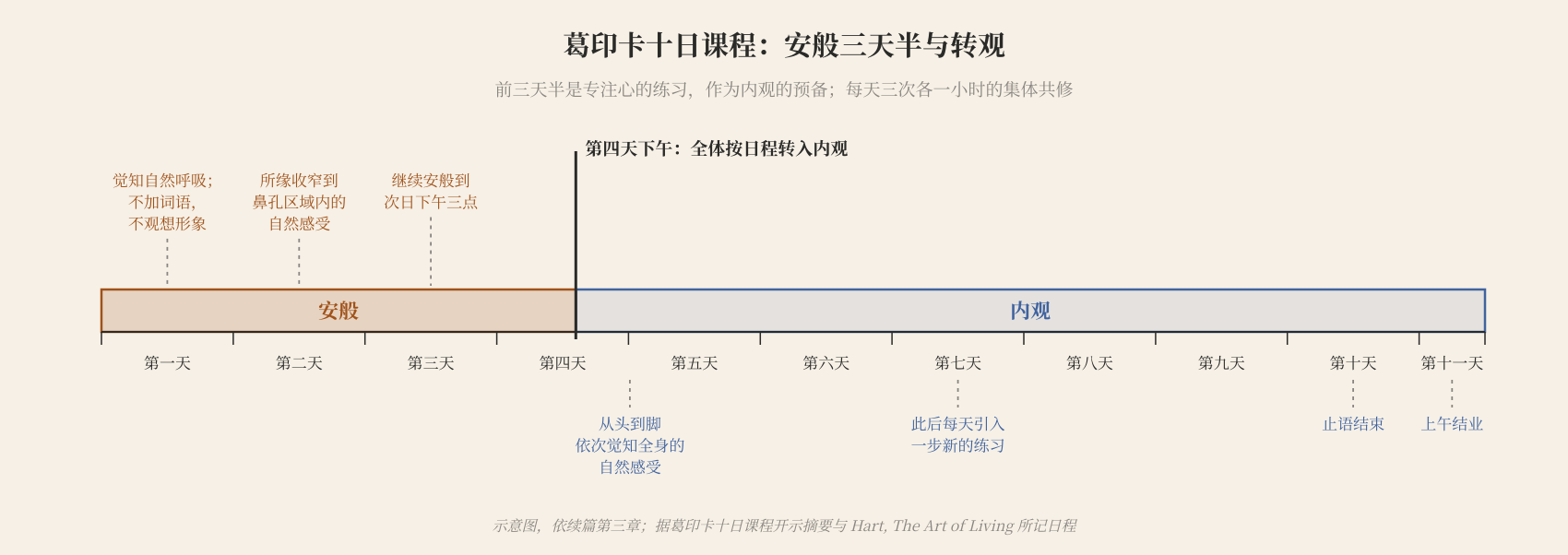
Hart 的书收有葛印卡对学员问题的回答。问为什么在鼻孔而不在腹部修安般,葛印卡答:在本系,安般是作为修内观的预备来修的,而这一种内观需要特别强的定,注意的范围越小,定就越强,腹部太大,鼻孔区域最合适。问为什么定不足以解脱,他答:定所达到的心的清净主要来自压制,而不是消除习性,如同用明矾使混水中的泥沉到底,上层清澈,底下的沉积仍在。28 书中说,定力增强时有人会见到光或景象,听到不寻常的声音,这些只表示心达到了较高的专注,本身没有重要性,不应理会,它们只是"标示道路进展的里程碑";佛陀讲禅那时,强调它们只是发展观的踏脚石。29 Hart 记葛印卡另一处的回答说,佛陀以前的修行只到第八禅,佛陀发现的第九禅就是内观。30 这是本系对禅那与内观关系的表述,与注释书的分类不同,此处只记录。
乌巴庆原本给转观设有一个以光相为准的判准。他在〈真正佛教禅修的真实价值〉一文中说,学员专注于鼻下上唇的一点,以呼吸的觉知把念头的范围先收窄到鼻子周围,再随呼吸变细收窄到上唇的一点,只剩气息的温暖,好学员在几天之内就能得到心一境性;禅修方向正确时会有"指标"出现,先是白色的云、棉絮、烟、蛛网、花或圆盘,注意力更集中时现为闪光、光点、小星、月或日。学员若每次短暂放松之后都能尽快以光的指标回到定,就已经可以转入内观;若能把注意力集中于鼻下一点,有微小的光点停留一段时间,那更好,因为那时他已达到近行定。他又说,学员达到一定程度的定,"最好是近行定",课程就转为内观。31 葛印卡的课程不用这一判准。转入内观由课程日程决定,所有学员在第四天同时转入,不按各人是否见到光相;光与景象只作为里程碑,并被要求不予理会。
安般一词在葛印卡与帕奥两系所指不同,这一点在鼻孔区域的感受上最清楚。葛印卡第二天要求学员觉知的,正是鼻孔区域内的冷、温、痒、跳动、压等身体感受,这被安排为从呼吸进入更微细实相的一步;玛欣德尊者则说(见第二章第一节),在人中觉知暖、冷、麻、轻柔,只是在练习皮肤的感觉,不是在修入出息念。两种说法各依自己的定义成立:前者以感受为通向内观的所缘,后者以作为概念的呼吸为止的所缘。
三、禅那之争
修观之前是否必须先得禅那,是上座部内部的一场长期争论,近代缅甸内观兴起以后变得尖锐。争论有两层:一层在上座部传统之内,问注释书的两乘之说应当怎样读;另一层在学界,问禅那在早期经典里本来是什么,两乘之说本身有多早。
传统之内的争论,在斯里兰卡表现得最公开。马哈希一系 1950 年代传入斯里兰卡,在康杜波达建立禅修中心,起初遭到激烈反对。Crosby 记,最激烈的反对者克明达长老(Kheminda Thera)的理由包括:缺少止;不要求以学法为预备;不合《清净道论》所示的修行次第;以腹部起伏为所缘的呼吸练习不合正统。反驳的一方则指出经与注释书中禅修教导的多样,主张《清净道论》以外另有内观修法的文本依据。32 Sharf 的记述更细:迦叶长老(Kassapa Thera)1957 年出版的文集攻击马哈希以腹部而不以鼻端作为安般的所缘;克明达把这一方法斥为缺少经典依据的不正当"捷径",并依经文主张禅那与定必须在修观之前获得;马哈希的辩护者则依自己对经文的读法,坚持经典承认有一类直接修观的修行者。33 双方都诉诸修行的结果:辩护者以马哈希门下禅修者的经验为证,并劝批评者不要满足于止乘者方法的知识,而要实际修习,直到证得禅那与神通乃至圣者之地;传统派则断然否认对方所称的证得,迦叶长老说马哈希法的修习者没有经中所说的那种寂静、专注、喜悦的样子。34
同一段《大复注》被两系读出不同的结论。马哈希由它推出刹那定已足,已见本章第一节。帕奥在缅文的《趣向涅槃之道》中回应了这一类读法,未点名:“有些堪称卓越、贤善禅修者的尊师认为,纯观乘者不必建立定,只凭刹那定也能进入毗钵舍那。他们是引用《清净道论大复注》作者的话来作此主张的。”他的回答是,“仔细审察、分析《清净道论大复注》作者上述指示,就应理解:他所说纯观乘者的刹那定,是以止的阶段为指向”。35 他的论证分两步。第一步,四界分别观在四十业处中属于导向近行定的一类,以四界为所缘修到顶点的欲界定,义注依"同类借称"称为近行定,复注依本义称为刹那定,“义注之说属于借称,复注之说属于本义;两者只是本义与借称的差别,并不相互矛盾”;所以四界分别观“是一种兼属止与观两方面的业处”,纯观乘者的刹那定就是在四界上修成的这一种定。36 第二步,观的阶段与观智相应的定也称刹那定,但只有已经以近行定或安止定为基础、能摄取三时内外的色名因果的修习者,其观中之定才配得上这一名称;尚不能“把究竟的色、名、因、果置于3相之下修观”的人,其定不应在观禅教法中称为刹那定。37 两系都接受《大复注》,都接受四界只能得到相似的近行;分歧在"刹那定"一名所指的是在观之前修成的那一种定,还是在观之中自然生起的那一种定。
泰国森林传统的说法并不一致。阿姜布拉姆主张禅那必经。他说止与观是同一过程不可分的两面;禅那会持续很长时间,若只持续几分钟就不配称为禅那,较高的禅那通常持续许多小时;体验过第四禅那种程度的念,就会知道认为不经禅那也能证悟是何等荒谬。38 他的经证是《那拉迦波那经》(MN 68):未证初禅或更高禅那时,五盖与不满、疲倦会侵入心中而停留,证得之后则否;深观须镇伏五盖,所以禅那也是必需的。39 他在论禅那的一章开头说,原始经典里表示"禅修"的只有 jhāna 一词,经中说佛陀发现了禅那,"原始经典一次也没有说佛陀发现了观"。40 他对近行定的用法也与注释书不同:入初禅之前的近行定他认为极不稳定,此时思惟法义会失去近行,深观发生在出禅之后五盖仍被长时镇伏的那一段状态中。41 佛使比丘则不以禅那为必经。他讲安般第四事时说,不必完全进入禅那,这些非常精细的定在安般修习中并不必要,只须有足以继续修习的适当的定,即足以清楚感到喜与乐的定;能进入色界四禅当然更好,但修第四事,有足以清楚经验喜乐的定就够了。42 他还给一般人一条捷径,把十六事压缩为两步:先训练心达到充分而适当的定,再以这份定直接观无常、苦、无我。43 Crosby 记,佛使比丘提倡观胜于止,理由是止与禅那、神通的联系,并说这种看法在泰国与缅甸都有。44
德宝法师的禅那研究依从注释书的立场。他说明,刹那定指随所缘不断变化而流动、保持一定强度、足以净除诸盖的定,这个名称并不指散乱念头中间的一刹那专注;在纯观乘者那里,它于修观过程中自然生起。45 他承认,无世间禅那而证阿罗汉的可能性曾受到一些上座部学者的质疑,但认为上座部传统的分量倾向于承认这种证得。经证是《须深经》:一群比丘自称已证阿罗汉,却否认有神通或无色寂静解脱,自称"慧解脱";注释书把他们的回答释为"我们是无禅那者、干观者,唯以慧解脱",复注又把注释书"即使无定"一语释为指未先修成达到止相之定的观乘者。46 他另举《清净道论》第二十一品的一句:干观者所生的道,与具有禅那而不以之为观之基础者所生的道,都只是初禅之道;两种人分开列出,可见干观者本来没有基础的禅那。47 他在注中也指出,注释书所用的 nijjhānaka 一词有歧义,可以理解为"静虑者",也可以理解为"无禅那者"。马哈希一系的班迪达禅师则从另一方向处理禅那一词,把它扩展为观的禅那,已见本章第一节。
学界的讨论把问题移到经文本身。Cousins 考察早期巴利文献中止与观的用法,认为两词在尼柯耶里主要出现在修道次第的套语中,《增支部》所记阿难陀所说证阿罗汉的四种方式,即先止后观、先观后止、止观双运,以及心为法掉举所执而后定住,对后来两乘之说的解释意义最大;《无碍解道》释第四种方式时首次列出十种观染,注释书把第四种方式归于干观者。48 他还指出,《增支部》另一经区分以努力证得究竟者与无须努力证得究竟者,只有后者得四禅,觉音的注释把前者解为只修观的人,后者解为止乘者。49 他的结论是,古代文献看到的修道在入手方式上有显著差异,但"一切都是必需的,只有发展的次序可以变化,不存在忽略某些方面的捷径"。50 他还在注中指出,后来的传统有时把 sukkha 误解为"干",此词本义是"纯"。51 Cousins 对早期文献能否可靠分层持怀疑,认为以层层相依的年代判断建立的分析可信度很低。52 Sujato 则以经文分层为方法,追溯观怎样压倒了止,书的副题即是此意。他把二十世纪上座部禅修理论中的"观之说"(vipassanāvāda)概括为:佛陀教了止与观两种禅修,止在佛陀以前已有,所以不真是佛教的,止有危险,因为容易执着喜乐,止也不必要,因为单凭观就能发展出镇伏五盖所需的近行定;他说这一说法已成为上座部事实上的正统,虽然不无争议。53 他又说,用"近行定""刹那定"这些注释书的观念去解读早期经文中的定,必然误读经文。54 Sharf 从另一角度观察:他说初禅的描述在尼柯耶、阿毗达磨与觉音那里各不相同;当代内观诸师之间对禅修状态的指认毫无共识,唯一的共识是观胜于止,所以竞争者的技术与经验常被判为止,自己的修法则总被说成观。55 各方的立场列如下:
| 人 | 所属 | 立场 | 出处 |
|---|---|---|---|
| 克明达长老 | 斯里兰卡传统派 | 禅那与定须在修观之前获得;马哈希法缺少止,是缺少经典依据的"捷径" | Crosby p. 164;Sharf p. 263 |
| 马哈希的辩护者 | 马哈希一系 | 经典承认有一类直接修观的修行者 | Sharf pp. 263–264 |
| 马哈希 | 缅甸 | 单凭刹那定就足以带来证道果所需的心清净 | Manual of Insight, p. 49 |
| 帕奥 | 缅甸 | 复注所说纯观乘者的刹那定以止的阶段为指向,即在四界上修成的定 | 《趣向涅槃之道》第一册,原书第 192–202 页 |
| 阿姜布拉姆 | 泰国森林传统 | 禅那必经 | Mindfulness, Bliss, and Beyond, 第 2、5、9、12 章 |
| 佛使比丘 | 泰国 | 不必完全进入禅那,足以清楚经验喜乐的定即可 | Mindfulness with Breathing, pp. 65–66 |
| 德宝法师 | 禅那研究 | 依注释书,承认无世间禅那的干观者可证阿罗汉 | The Path of Serenity and Insight, pp. 199–200 |
| 班迪达禅师 | 马哈希一系 | 禅那是心贴住所缘并观察它的品质,分止的禅那与观的禅那 | In This Very Life, pp. 179–180 |
| Cousins | 学界 | 止观一切都必需,只有发展的次序可以变化 | 1984, p. 65 |
| Sujato | 学界 | 用近行定、刹那定读早期经文中的定必然误读 | A History of Mindfulness, p. 82 |
| Sharf | 学界 | 内观诸师唯一的共识是观胜于止 | 1995, p. 261 |
与格鲁一系对照,止在宗喀巴那里是与外道共有的三摩地,只是观的所依,所缘取佛身或心本身只是方便(见第二篇续篇《宗喀巴禅法》第一章第一、九节)。缅甸三系的止同样不带教义内容:帕奥以作为概念的呼吸与遍相为所缘,葛印卡要求不加词语与形象,马哈希不另设止的阶段。三系的分歧落在观是否必须以某一程度的止为基础,以及注释书的"刹那定"一名能否承担这一基础;止本身的内容,三系之间并无争议。
四、这一边的归纳
把止的三章合起来看,三系的判准各落在不同的地方(两乘与三系的位置见第一章第一节的图)。
帕奥一系的判准落在止的一侧,有明确的条目:似相是近行定的前提,似相稳住两三小时、连续三座是门槛,有分心、似相、五禅支三项检查是确认,许多天、许多月的自检是收尾。所有条目的内容都是学员对自己座上所见的报告;帕奥说自己只据小参报告指导,从不印证任何人证得禅那与道果,陈法菱也说检查是给禅修者自行评估的标准。
马哈希一系不给止另设判准。纯观乘者的心清净由刹那定承担,刹那定在观的过程中自然生起,它的强弱由观智的阶次说明:名色分别智时可比于近行,坏灭智时完全成熟。止的判准因此移到观的一侧,并入观智的进度,第四章处理。
葛印卡一系不设个人判准。安般三天半,第二天由呼吸转向鼻孔区域的感受,第四天下午所有学员按日程转入内观;乌巴庆原以光相稳住、达到近行定为转观之机,葛印卡的课程不用这一判准,光与景象只作里程碑,要求不予理会。
三系判准的分布可以并列如下:
| 帕奥 | 马哈希 | 葛印卡 | |
|---|---|---|---|
| 判准落在哪一侧 | 止 | 观,并入观智的进度 | 不设个人判准 |
| 判准的内容 | 似相;两三小时、连续三座;有分心、似相、五禅支三项检查;长期自检 | 刹那定的强弱由观智阶次说明:名色分别智时可比于近行,坏灭智时完全成熟 | 第四天按日程转观 |
| 据什么判定 | 学员在小参中的自报,禅师自称不印证 | 见第四章 | 课程日程 |
三系的共同点在于都在注释书的两乘框架内立论:帕奥与马哈希引同一段《大复注》,分歧落在"刹那定"一名指什么;葛印卡的词表也以刹那定为修内观足够的预备。禅那之争的两方,克明达与马哈希的辩护者,阿姜布拉姆与佛使比丘,都以经与注释书为据;Cousins 与 Sujato 则把问题带回到两乘之说本身的年代。三系的判准孰宽孰严、合不合理,止的三章不作判断,留给第十章。
参考文献
-
Mahāsi Sayādaw, Manual of Insight, trans. and ed. Vipassanā Mettā Foundation Translation Committee, Somerville: Wisdom Publications, 2016, pp. 45–46:"Contemplating the eight kinds of recollection (anussatī), the perception of impurity (pāṭikūlasaññā), or the analysis of the four elements (catudhātuvavatthāna) cannot arouse true access concentration. Concentration aroused using these three objects cannot be considered true access concentration because it does not have the potential to lead to absorption concentration. It is, nevertheless, typically referred to as access concentration because it produces similar results in terms of suppressing hindrances." ↩
-
Mahāsi, Manual of Insight, p. 46:"This is momentary concentration aroused by moment-to-moment observation."p. 47:"However, momentary concentration develops naturally in the course of insight meditation practice." ↩
-
Mahāsi, Manual of Insight, pp. 47–49:"Based on the statement 'Devadatta, who is growing fat, does not eat during the day,' we can infer that Devadatta eats at night. Likewise, we can also infer, based on the statement 'Insight knowledge can be aroused without depending on access or absorption concentration,' that insight knowledge must be aroused based on momentary concentration." ↩
-
Mahāsi, Manual of Insight, pp. 50–56;p. 55:"The important point here is that one who takes the vehicle of insight to enlightenment begins his or her insight practice without any access concentration or absorption concentration. However, they attain those concentrations by first developing insight knowledge." ↩
-
Mahāsi, Manual of Insight, pp. 52–54。p. 53 说生灭智:"The Visuddhimagga considers this insight knowledge to be 'fledgling insight' (taruṇavipassanā) and calls one who reaches this stage an 'energetic meditator' (āraddhavipassaka)."p. 52:"This momentary concentration creates a unification of mind comparable to access concentration." p. 53:"When this happens, the strength of the momentary concentration is comparable to that of absorption in tranquility meditation." 马哈希在 p. 54 引《大复注》:"Momentary single-pointedness of mind (khaṇikacittekaggatā) is momentary concentration. When it continuously dwells on an object [of insight] over a long period, opposing hindrances cannot overwhelm it, and it is able to make the mind as strong and steadfast as jhāna or absorption concentration." ↩
-
Mahāsi, Manual of Insight, p. 62。 ↩
-
Mahāsi, Manual of Insight, pp. 90–91:"This is why Pāḷi scriptures say that momentary concentration is fully mature at this stage of knowledge." ↩
-
Mahāsi, Manual of Insight, pp. 78–89;所引偈颂注出 Ñāṇamoli 译《无碍解道》(The Path of Discrimination)p. 169。六种对治的归纳见该书第二章注 167:"The six remedies to the six obstacles to concentration are: countering distracting thoughts of the past by not thinking of the past, countering fantasies about the future by not thinking of the future, encouraging oneself when lazy, relaxing oneself when overzealous, recognizing lust when gratified, and recognizing aversion when frustrated." ↩
-
Mahāsi, Manual of Insight, pp. 80–88;p. 88:"When effort is slack, encouragement is needed; / When tension is excessive, relaxation is needed; / When neither slack nor tense, and when noting is balanced, / The mind becomes focused." ↩
-
Mahāsi, Manual of Insight, p. 78:"It is called developing insight by continuously observing the usual meditation object without letting the mind incline elsewhere (appanidhāyabhāvanā). This method is most suitable for beginning practitioners and persons with little knowledge." "During intensive insight practice, however, one must give priority solely to insight meditation. Alternative methods of contemplation should only be used when one's mind wanders too much and one is not able to continue with insight." ↩
-
Mahāsi Sayādaw, Practical Insight Meditation: Basic and Progressive Stages, trans. U Pe Thin and Myanaung U Tin, Kandy: Buddhist Publication Society, 未载年份, pp. 3–4:"Try to keep your mind (but not your eyes) on the abdomen." "What you actually perceive is the bodily sensation of pressure caused by the heaving movement of the abdomen." ↩
-
Mahāsi, Practical Insight Meditation, pp. 2–3:"It is also important for you to begin your training with a brief contemplation on the 'Four Protections' which the Enlightened One, the Buddha, offers you for reflection. It is helpful for your psychological welfare at this stage to reflect on them." ↩
-
Mahāsi, Practical Insight Meditation, p. 15:"During a strict course of meditation, the time of practice is from the first moment you wake up until you fall asleep." ↩
-
Sayadaw U Pandita, In This Very Life: The Liberation Teachings of the Buddha, trans. U Aggacitta, ed. Kate Wheeler, 2nd ed., Boston: Wisdom Publications, 1993, p. 16:"During a retreat it is usual to alternate periods of sitting meditation with periods of formal walking meditation of about the same duration, one after another throughout the day. One hour is a standard period, but forty-five minutes can also be used." ↩
-
U Pandita, In This Very Life, p. 151:"Momentary concentration, the second type, is most important in vipassana practice." ↩
-
U Pandita, In This Very Life, pp. 179–180:"Jhana is usually translated as 'absorption.' Actually, it refers to the quality of mind that is able to stick to an object and observe it." "On the other hand, vipassana jhana allows the mind to move freely from object to object, staying focused on the characteristics of impermanence, suffering and absence of self that are common to all objects." ↩
-
Erik Braun, The Birth of Insight: Meditation, Modern Buddhism, and the Burmese Monk Ledi Sayadaw, Chicago: University of Chicago Press, 2013, p. 161:"As mentioned in the last chapter, Buddhaghosa gives pride of place to a process that includes cultivation of the jhānas. In contrast, the Mahasi method privileges a 'dry' (sukkha) practice that uses only the lower level of momentary concentration (khaṇikasamādhi)." ↩
-
S. N. Goenka, The Discourse Summaries: Talks from a Ten-day Course in Vipassana Meditation, condensed by William Hart, Onalaska: Vipassana Research Publications, 2012 电子书(初版 Vipassana Research Institute, 1987),Day One, pp. 11–13。 ↩
-
Goenka, Discourse Summaries, Day One, pp. 15–16:"This moment of purity at the conscious level has a strong impact on the old impurities accumulated in the unconscious. The contact of these positive and negative forces produces an explosion. Some of the impurities hidden in the unconscious rise to the conscious level, and manifest as various mental or physical discomforts." "However, it would be wise to understand that what seems to be a problem is actually a sign of success in the meditation, an indication that in fact the technique has started to work." ↩
-
Goenka, Discourse Summaries, Day One, p. 16:"Also resolve to follow the timetable, and especially to be in the hall for the three one-hour sittings of group meditation each day." ↩
-
Goenka, Discourse Summaries, Day Two, pp. 21–22:"Now you will take a still subtler object of attention: the natural, physical sensations within this limited area." ↩
-
Goenka, Discourse Summaries, Day Two, p. 22:"Mere concentration is not the aim of this technique; the concentration you develop must have a base of purity. … Sustaining this awareness continuously from moment to moment—this is sammā-samādhi." ↩
-
Goenka, Discourse Summaries, Day Three, pp. 24, 29。p. 24:"However, suppressing defilements does not eliminate them. They remain in the unconscious and multiply there, continuing to cause harm to oneself." p. 29:"keep practicing Anapana until 3 p.m. tomorrow; keep observing reality within the area of the nostrils." ↩
-
Goenka, Discourse Summaries, Day Ten, pp. 77–79。p. 78:"When you could not feel the breath, you were permitted to breathe slightly hard, just to fix your attention in the area of the nostrils." p. 79:"For this reason, there should be neither visualization nor verbalization." ↩
-
Goenka, Discourse Summaries, 词表 p. 114,jhāna 条:"Cultivation of them brings tranquillity and bliss, but does not eradicate the deepest-rooted mental defilements." ↩
-
Goenka, Discourse Summaries, Day Ten, p. 79:"From head to feet, you began observing natural sensations within the body, starting on the surface and then going deeper, learning to feel sensations outside, inside, in every part of the body." ↩
-
William Hart, The Art of Living: Vipassana Meditation as Taught by S. N. Goenka, Onalaska: Vipassana Research Publications 电子书(初版 Harper & Row, 1987),p. 7:"Further steps within the practice are introduced each day, so that by the end of the course the entire technique has been presented in outline. On the tenth day silence ends, and meditators make the transition back to a more extroverted way of life. The course concludes on the morning of the eleventh day." ↩
-
Hart, The Art of Living, p. 75:"Because for us ānāpāna is practised as a preparation for the practice of Vipassana, and in this type of Vipassana a particularly strong concentration is necessary. The more limited the area of attention, the stronger the concentration will be." "Because the purity of mind developed through samādhi is achieved primarily by suppression, not elimination of conditioning." ↩
-
Hart, The Art of Living, pp. 73–74:"All these so-called extrasensory experiences are merely indications that the mind has attained a heightened level of concentration. In themselves these phenomena have no importance and should be given no attention. … All these extraordinary experiences are simply milestones that mark progress on the path." "When he taught the states of absorption, therefore, he emphasized their function only as stepping-stones to the development of insight." ↩
-
Hart, The Art of Living, p. 76:"The Buddha found the ninth jhāna, and that is Vipassana, the development of insight that will take the meditator to the ultimate goal beyond all sensory experience." ↩
-
U Ba Khin, "The Real Values of True Buddhist Meditation," in Sayagyi U Ba Khin Journal, Igatpuri: Vipassana Research Institute, 1991, pp. 62–63。p. 62:"With a determined effort to narrow down the range of thought waves firstly to the area around the nose with respiration mindfulness and gradually with the wavelength of respiration becoming shorter and shorter to a spot on the upper lip with just the warmth of the breath, there is no reason why a good student in meditation should not be able to secure the one-pointedness of mind in a few days of the training." 同页:"What is essential, then, for the student is to try after each short spell of relaxation to get back to samādhi with the pointer of 'light' as quickly as possible. If he can do this, he is quite ready to be switched on to Vipassana meditation to gain insight into the ultimate truth and enjoy the great peace of nibbāna. If he is able to focus his attention to one point at the base of the nose with a minute point of light remaining stationary for some time, it is all the better, because at that time he reaches the upacāra samādhi or 'neighbourhood concentration.'" p. 63:"When the student has reached a certain level of samādhi, preferably the upacāra samādhi, the course of training is changed to Vipassana or insight." ↩
-
Kate Crosby, Theravada Buddhism: Continuity, Diversity, and Identity, Chichester: Wiley Blackwell, 2014, p. 164:"The most vociferous adversary was the monk Kheminda Thera, who criticized it for a number of reasons including the absence of samatha, that it does not require Dhamma study as a preparation, that it is not in accordance with the Visuddhimagga vision of progression or practice, and that the breathing exercises focusing on the rising and falling of the breath in the abdomen were unorthodox. Counter-arguments pointed to the diversity of meditation teaching to be found in the canon and commentaries, and thus to the possibility of textual authorities other than the Visuddhimagga for vipassanā practices." ↩
-
Robert H. Sharf, "Buddhist Modernism and the Rhetoric of Meditative Experience," Numen 42, no. 3 (1995): 228–283, 引文在 pp. 263–264:"Kheminda Thera objected to the method as an illegitimate 'shortcut' that lacked canonical sanction. In particular, Kheminda argues from scripture that trance (jhāna) and concentration (samādhi) must be acquired prior to the practice of vipassana. The defenders of Mahasi's method argued from their own reading of the scriptures, which they insisted recognizes a category of practitioner who proceeds directly to vipassana." ↩
-
Sharf, "Buddhist Modernism and the Rhetoric of Meditative Experience," p. 264:"They also cited as evidence the experience of yogis training under Mahasi, and they suggested that their detractors 'not rest content with the mere knowledge of the samatha-yanika method but instead practise it diligently until they attain jhana together with abhinna, as well as ariyabhumi.' Not surprisingly, the response of the traditionalists was to categorically reject the claims of their opponents to have realized legitimate stages on the path. Kassapa could argue, for example, that practitioners of the Mahasi method 'do not exhibit the calm, concentrated, happy look mentioned in the texts.'" ↩
-
帕奥《趣向涅槃之道》(Nibbānagāminipaṭipadā)第一册〈修定篇〉"刹那定"一节,原书第 192、194 页(缅文原版,1998 年)。中译据本书网站所载《趣向涅槃之道》中文全译本,下同。 ↩
-
帕奥《趣向涅槃之道》第一册〈修定篇〉"纯观乘者之道""特别应注意并记住"两节,原书第 196–200 页;"兼属止与观"一句在第 197 页,"本义与借称"一句在第 200 页。同一论证的英文本见帕奥 Mindfulness of Breathing and Four Elements Meditation(W.A.V.E. 免费流通重印修订版,未载年份),pp. 83–86,所引复注为 Vism-mhṭ 1.15 与 1.436。 ↩
-
帕奥《趣向涅槃之道》第一册〈修定篇〉"特别应注意并记住"一节,原书第 201–202 页。 ↩
-
Ajahn Brahm, Mindfulness, Bliss, and Beyond: A Meditator's Handbook, Somerville: Wisdom Publications, 2006, ch. 2:"In fact the two are indivisible facets of the same process." "A jhāna will last a long time. It does not deserve to be called jhāna if it lasts only a few minutes. The higher jhānas usually persist for many hours." ch. 5:"Once you have experienced that level of mindfulness, then you will know for yourself how ridiculous it is to think you can become enlightened without jhāna." 所据电子书无印本页码,按章引。 ↩
-
Brahm, Mindfulness, Bliss, and Beyond, ch. 12:"Since the suppressing of the five hindrances is necessary for deep insight, so also is jhāna necessary." ↩
-
Brahm, Mindfulness, Bliss, and Beyond, ch. 9:"IN THE ORIGINAL Buddhist scriptures there is only one word for 'meditation' and that is jhāna." "The ancient Buddhist texts state that the Buddha discovered jhāna (SN 2,7; AN IX,42). Not once in the original texts does it say that the Buddha discovered vipassanā." ↩
-
Brahm, Mindfulness, Bliss, and Beyond, ch. 12:"The period just before entering the first jhāna is also upacāra samādhi. … However, the upacāra samādhi prior to jhāna is notoriously unstable when compared with that occurring post-jhāna. … Should one attempt to contemplate Dhamma at this time, the upacāra samādhi will be lost and the five hindrances will return." 同节又说:"the jhāna experience serves the purpose of firmly suppressing the five hindrances for long periods of time after emerging from a jhāna, and it is then that deep insight is possible." ↩
-
Buddhadāsa Bhikkhu, Mindfulness with Breathing: A Manual for Serious Beginners, trans. Santikaro Bhikkhu, rev. ed., Boston: Wisdom Publications, 1997, pp. 65–66:"In our practice of step four of ānāpānasati, it is not necessary to enter jhāna completely. In the practice of ānāpānasati these very refined levels of concentration are not necessary. We need only to have a sufficient and appropriate level of concentration to continue with our practice: that is, enough samādhi that feelings of pīti and sukha (contentment and happiness) are also present." "If you enter the first, second, third, or fourth rūpa-jhāna, it is better still. But sufficient samādhi to experience pīti and sukha distinctly is enough for step four." ↩
-
Buddhadāsa, Mindfulness with Breathing, pp. 123–124(译者结语所引佛使比丘语):"It is possible to condense the sixteen down to two steps. One—train the citta (mind) to be adequately and properly concentrated. Two—with that samādhi, skip over to contemplate aniccaṃ, dukkhaṃ, and anattā right away." ↩
-
Crosby, Theravada Buddhism, p. 165:"While he advocated vipassanā over samatha methods because of the association of the latter with jhāna and magical powers (a view found in both Thailand and Burma), he did not advocate intensive, formal meditation for laypeople." ↩
-
Henepola Gunaratana, The Path of Serenity and Insight: An Explanation of the Buddhist Jhānas, Delhi, 1985(所用为 2013 年马来西亚免费流通重印本,版面与印本同), pp. 152–154;p. 152:"Rather, it denotes a dynamic concentration which flows from object to object in the ever-changing flux of phenomena, retaining a constant degree of intensity and collectedness sufficient to purify the mind of the hindrances." ↩
-
Gunaratana, The Path of Serenity and Insight, pp. 199–200。p. 199:"The possibility of arahatship without possession of a mundane jhāna has sometimes been questioned by Theravada Buddhist scholars, but the weight of the Theravada tradition leans towards the recognition of such an attainment." p. 200 所译《相应部注》:"we are contemplatives, dry insight workers, liberated by wisdom alone."同页注 1 说 nijjhānaka 一词"is ambiguous",也可能意为"lacking jhāna"。《须深经》见《相应部》12.70。 ↩
-
Gunaratana, The Path of Serenity and Insight, p. 199;所引为《清净道论》第二十一品第 112 节,Bhikkhu Ñāṇamoli (trans.), The Path of Purification, 4th ed., Kandy: Buddhist Publication Society, 2010:"According to governance by insight, the path arisen in a bare-insight (dry-insight) worker, and the path arisen in one who possesses a jhāna attainment but who has not made the jhāna the basis for insight, and the path made to arise by comprehending unrelated formations after using the first jhāna as the basis for insight, are paths of the first jhāna only." ↩
-
L. S. Cousins, "Samatha-yāna and Vipassanā-yāna," in Gatare Dhammapala, Richard Gombrich and K. R. Norman (eds.), Buddhist Studies in Honour of Hammalava Saddhātissa, Nugegoda: University of Sri Jayewardenepura, 1984, pp. 56–68;阿难陀四种方式(A II 157)见 pp. 59–60,《无碍解道》首列十种观染与注释书的归属见 p. 61,注释书论先止后观、先观后止的一段见 p. 63。 ↩
-
Cousins, "Samatha-yāna and Vipassanā-yāna," p. 63:"One sutta in the Anguttara-nikaya (II 155-6) distinguishes the person who reaches the final goal with effort (sa-saṅkhāraparinibbāyī) from one who does so with ease (asaṅkhāra). Only the latter attains to the four jhānas. Buddhaghosa's commentary explains that the first individual is one who develops just insight (sukkha-vipassaka). The person who reaches the goal with ease is explained as one whose vehicle is peace (samatha-yānika)." Cousins 在注 34 补充,尼柯耶别处把这两种人当作两类不还者。 ↩
-
Cousins, "Samatha-yāna and Vipassanā-yāna," p. 65:"The goal is seen as a dynamic balance of qualities—in this case peace and insight, but others are also important. The route to that goal may involve the development of some of those qualities before others, but in the longer term none can be neglected. All are essential. Only the order of development is variable. There could be no question of a 'short cut', neglecting some aspects." ↩
-
Cousins, "Samatha-yāna and Vipassanā-yāna," p. 68 注 33:"Later tradition sometimes erroneously interprets the word sukkha as meaning 'dry'." Cousins 在正文中把 sukkha-vipassaka 译作"one who develops just insight"(p. 63)。 ↩
-
Cousins, "Samatha-yāna and Vipassanā-yāna," p. 56 及 p. 67 注 2。 ↩
-
Bhikkhu Sujato, A History of Mindfulness: How Insight Worsted Tranquillity in the Satipaṭṭhāna Sutta, 作者发布的电子书,未载出版地与年份,p. 3:"This is a special interpretation of some central meditation concepts that has become the de facto orthodoxy in Theravāda Buddhism, although not without controversy." "The Buddha taught two systems of meditation, samatha and vipassana. Samatha was taught before the Buddha (so is not really Buddhist), it is dangerous (because one can easily get attached to the bliss), and it is unnecessary (because vipassana alone can develop the access samadhi necessary to suppress the hindrances)." ↩
-
Sujato, A History of Mindfulness, p. 82:"anyone who persists in the very common practice of interpreting early texts on samadhi in terms of the commentarial ideas of 'access samadhi' and 'momentary samadhi' will certainly misinterpret the present work, and, I believe, will also misinterpret the Suttas." ↩
-
Sharf, "Buddhist Modernism and the Rhetoric of Meditative Experience," p. 261:"the description of the first jhāna, for example, differs depending on whether one turns to the Nikāya accounts, the Abhidhamma, or Buddhaghosa." "The only area of agreement among vipassanā teachers is that vipassanā is superior to samatha, as the former alone leads to liberation. As a result, the techniques and experiences promoted by one's competitors are often deemed to be samatha, while one's own style of practice is invariably claimed to be vipassanā." ↩