Part I, Chapter 1: Calm I: The Two Vehicles and the Origins of Ānāpāna¶
When Section II of Chapter 3 of the Introduction discussed the cost of southern Abhidhamma soteriology, it touched on two Burmese meditation traditions without developing the point. The ten chapters of this Part take up three concrete cases: the lineage of Mahāsi Sayadaw (1904–1982), the lineage of Pa-Auk Sayadaw (born 1934), and the lineage that descends from U Ba Khin (1899–1971) and was spread around the world by S. N. Goenka. All three come from Burma, all three argue within the Theravāda tradition of the suttas and the commentaries, and all three make "insight" (vipassanā) the core of practice. Chapters 1 to 3 restate the practice of calm according to each lineage's own literature, Chapters 4 to 6 restate the practice of insight, Chapter 7 reads what the founders said about their own practice and attainment, Chapter 8 reads the accounts left by practitioners, Chapter 9 gathers external criticism, and Chapter 10 gives this volume's judgment. The first nine chapters only restate and summarize.
The three chapters on calm deal with one question: must calm be attained before insight is developed, and to what degree must it be developed to count as attained? The answers of the three lineages range from a required stage to a preparation. Pa-Auk's main approach is first to attain jhāna on mindfulness of breathing or on a kasiṇa and then to develop insight with the light of concentration; even the pure-insight practitioner must develop the light of access concentration on the four elements. The Mahāsi lineage develops insight directly with momentary concentration and sets up no separate stage of calm. Goenka's ten-day course uses three and a half days of mindfulness of breathing as preparation and moves to vipassanā on the fourth day according to the course schedule. All three answers are argued within the framework of the Theravāda commentaries; the disagreement concerns what several of the commentaries' terms refer to and how much they demand. This chapter sets out the doctrine of the two vehicles and the textual origins of mindfulness of breathing (ānāpānasati); Chapter 2 restates the Pa-Auk lineage's mindfulness of breathing, jhāna, and criteria; Chapter 3 restates Mahāsi's momentary concentration and Goenka's preparatory mindfulness of breathing, and sorts out the debate over jhāna.
The literature on which the three chapters rely falls into three layers. The first layer is the suttas and the treatises: the passage on mindfulness of breathing in the Ānāpānasati Sutta (Majjhima Nikāya 118) and the Mahāsatipaṭṭhāna Sutta (Dīgha Nikāya 22), with the Chinese parallel taken from the "Discourse on the Establishments of Mindfulness" in fascicle 24 of the Madhyama Āgama; the treatment of mindfulness of breathing and the earth kasiṇa in fascicle 7 of Upatissa's Vimuttimagga and in Chapters IV and VIII of Buddhaghosa's Visuddhimagga; and the passage of the great subcommentary on the Visuddhimagga that discusses the two kinds of "vehicle." The second layer is the teaching texts of the three lineages: Mahāsi's Manual of Insight and Practical Insight Meditation, and the collected talks of his disciple Sayadaw U Paṇḍita; Pa-Auk's Knowing and Seeing, Mindfulness of Breathing and Four Elements Meditation, and the Burmese Nibbānagāmini-paṭipadā, two Chinese-language lecture records by his disciple Bhante Mahinda, the Collected Questions and Answers of Pa-Auk Sayadaw, and Chen Faling's analysis based on recordings of Pa-Auk's meditation instruction in Burmese; the summaries of the talks given in Goenka's ten-day course, The Art of Living, which Hart wrote on their basis, and U Ba Khin's lectures. The third layer is the discussion of whether jhāna is required: Ajahn Brahm of the Thai forest tradition and Buddhadāsa Bhikkhu, Bhante Henepola Gunaratana's study of the jhānas, and the studies of Cousins, Sujato, Sharf, Crosby, Braun, and Bhikkhu Anālayo.
The dating of several terms must be made clear first. "Access concentration" (upacāra-samādhi), "absorption concentration" (appanā-samādhi), "momentary concentration" (khaṇika-samādhi), "one whose vehicle is calm" (samatha-yānika), "one whose vehicle is pure insight" (suddha-vipassanā-yānika), and "dry-insight practitioner" (sukkha-vipassaka) are all categories of the commentaries and subcommentaries; the four Nikāyas do not use them. The grading into "preliminary sign," "learning sign," and "counterpart sign" (parikamma-, uggaha-, paṭibhāga-nimitta) comes from the Visuddhimagga tradition, and taking the nimitta as the object on which to concentrate is likewise a later practice. Before looking for canonical support for the doctrine of the two vehicles, Gunaratana first concedes that all three names appear first in the commentaries.1 The suttas have calm (samatha) and insight (vipassanā), the four jhānas, and also the luminosity of the mind, but not this system of grades. Ñāṇamoli also points out, in a note to his English translation of the Visuddhimagga, that the three signs, preliminary, learning, and counterpart, do not appear in the Tipiṭaka.2 Wherever these terms are used below, they restate the commentarial system on which the three lineages rely and are not treated as the language of the early scriptures. The sources of the terms are listed as follows:
| Term | Pāli | Earliest source used in this chapter | Four Nikāyas |
|---|---|---|---|
| Access concentration, absorption concentration | upacāra-samādhi, appanā-samādhi | Visuddhimagga IV.32–33 | Not used as names of kinds of concentration |
| Momentary concentration | khaṇika-samādhi | Great subcommentary on the Visuddhimagga (Vism-mhṭ 9–10, 13) | Not used as the name of a kind of concentration |
| One whose vehicle is calm, one whose vehicle is pure insight | samatha-yānika, suddha-vipassanā-yānika | Visuddhimagga XVIII.3–5; the great subcommentary | No such terms; a precursor in the four kinds of person of the Aṅguttara Nikāya (AN 4.92–94) |
| Dry-insight practitioner | sukkha-vipassaka | Buddhaghosa's commentaries (e.g. the commentary on the Aṅguttara Nikāya) | No such term |
| Preliminary sign, learning sign, counterpart sign | parikamma-, uggaha-, paṭibhāga-nimitta | Visuddhimagga (IV.30–31 on the learning sign and the counterpart sign) | The three signs do not appear in the Tipiṭaka |
1. The place of calm in the three lineages
The textual premise from which the three lineages diverge is the commentarial doctrine of the "two vehicles." Chapter XVIII of the Visuddhimagga says that when one whose vehicle is calm develops insight, he emerges from any jhāna, such as the first, and discerns the jhāna factors and the states associated with them; one whose vehicle is pure insight does not pass through jhāna but begins by discerning the four elements, and one whose vehicle is calm may also take this route if he wishes.3 In its comment on Chapter I, the great subcommentary on the Visuddhimagga has a passage that was later quoted again and again: without access and absorption concentration for one whose vehicle is calm, without momentary concentration for one whose vehicle is insight, and, for both kinds of person, without the three gateways to liberation (impermanence, suffering, and nonself), the supramundane can never be reached.4 This passage acknowledges two approaches, and it assigns to the pure-insight practitioner a kind of concentration that only the subcommentaries mention. The doctrine of the two vehicles has a precursor in the suttas. The Aṅguttara Nikāya says that one person gains internal calm of mind but not the higher wisdom of insight into phenomena, another gains insight but not calm, another gains neither, and another gains both, and the Buddha urges the first two each to make up the side they lack. Gunaratana holds that the fact that a person can gain one without the other provides a starting point for dividing the vehicles by capacity, but he also says that in the end all practitioners must develop insight to reach the path of liberation.5 The two approaches do not carry equal weight in the commentaries. Braun points out that the Visuddhimagga places purification of mind before purification of view, and that Buddhaghosa also says the two purifications of virtue and of mind are roots that must first be perfected; the structure favours calm first, and the book seldom mentions those who work without the jhānas.6
Modern Burma raised the approach that held second place in the commentaries to first place. Ledi Sayadaw held that the development of insight by itself was sufficient and needed no support from practices labeled as calm.7 His 1904 manual on mindfulness of breathing (which Braun calls Breath Meditation) says that the suttas and the commentaries teach moving to insight only after attaining the four jhānas through mindfulness of breathing, and that doing so is best; if one cannot, one may also move to it from the third, the second, or the first jhāna; one who has not reached jhāna may move to it from access concentration or from the stage of knowing the long and short breaths, and even from the stage of counting the breaths, once the wandering thoughts of the mind have been calmed. On this basis Braun judges that Ledi's approach gave first place to "dry" insight, which in the Visuddhimagga appears to be a secondary option.8
In Chapter 2 of the Manual of Insight, Mahāsi states plainly that the main purpose of the book is to explain how those whose vehicle is pure insight practice, that is, how to develop pure insight without a foundation of calm concentration; of these practitioners he writes: "Momentary concentration alone is enough for them to bring about the mental purification required for path knowledge and fruition knowledge."9 For the English collection of Pa-Auk's talks, the editor states the aim: Pa-Auk's main approach to insight is to practice calm first and then to use it as a necessary vehicle for insight; he also teaches pure insight, which is why the orthodox instructions for both methods are set out.10 The pure-insight practitioner as Pa-Auk describes him begins with four-elements meditation and must see a transparent form in the body emitting light; only when he can concentrate on this light continuously for at least half an hour has he reached access concentration, after which he analyses the kalāpas.11 Asked by a disciple whether pure vipassanā can lead to arahantship, he answered: "Yes. If one practises correctly according to the method taught by the Buddha, the method of pure vipassanā can also lead to arahantship. Such an arahant is called an arahant of pure insight, and usually they must begin their practice with four-elements meditation."12 The course description of the Goenka lineage states that during the first three and a half days of the ten-day course participants practice an exercise of mental concentration, which is preparation for vipassanā proper, and that vipassanā is taught on the fourth day.13 Summarizing the Burmese vipassanā traditions, Crosby says that all of them incorporate Abhidhamma analyses into the four establishments of mindfulness, and that they differ in how mindfulness and any preparatory calm are developed.14 In his talk on the first day, Goenka says that the final aim of this meditation is not concentration of mind; concentration is only a help, a step toward purification of mind. The glossary appended to the discourse summaries says that, of the three kinds of concentration, momentary concentration is sufficient preparation for beginning the practice of vipassanā.15
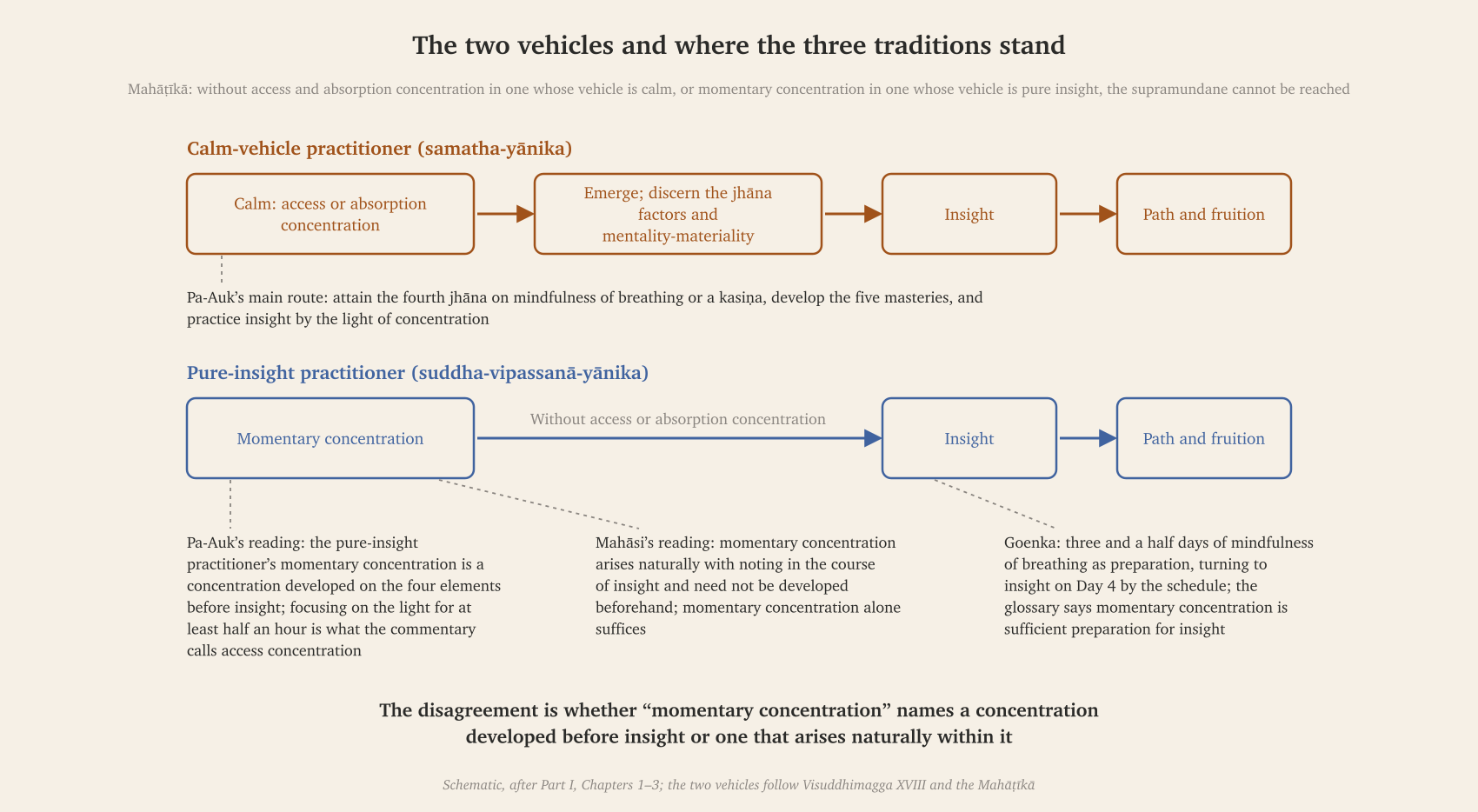
All three lineages acknowledge the two vehicles; they disagree at two points. The first is which vehicle the ordinary practitioner should take. Pa-Auk gives priority to calm followed by insight, with the vehicle of pure insight in second place; Mahāsi gives priority to the vehicle of pure insight; Goenka treats mindfulness of breathing as a preparation with a fixed schedule and does not divide students into two vehicles. The second is how much concentration the vehicle of pure insight requires. Pa-Auk's pure-insight practitioner must still develop, on the four elements, the light that the commentaries call access concentration; Mahāsi's pure-insight practitioner does no separate calm practice, and momentary concentration arises naturally in the course of insight. The second disagreement is discussed in Chapter 3, Section 3.
The two vehicles and the positions of the three lineages can be drawn as in the figure below. The upper path is that of one whose vehicle is calm: he first attains access or absorption concentration, emerges and discerns the jhāna factors and mentality-materiality, and then develops insight. The lower path is that of one whose vehicle is pure insight, who does no separate calm practice.
The answers of the three lineages to whether calm must be attained before insight can be set side by side as follows (for the criteria of each lineage, see Chapter 2, Section 4, and Chapter 3, Sections 1 and 2):
| Pa-Auk | Mahāsi | Goenka | |
|---|---|---|---|
| Status of calm | The main approach is first to attain jhāna and then to develop insight with the light of concentration; the pure-insight practitioner too must develop the light of access on the four elements | No separate stage of calm; momentary concentration arises naturally in the course of insight | Three and a half days of mindfulness of breathing as preparation for vipassanā |
| Main vehicle | Mainly the vehicle of calm; the vehicle of pure insight is also taught | The vehicle of pure insight | Students are not divided into two vehicles |
| Object of calm | The breath as a concept, kasiṇa signs, and so on; for the pure-insight practitioner, the four elements | None set up separately; the beginning object is the rising and falling of the abdomen, and what is known is pressure and touch | The natural breath in the area of the nostrils; from the second day, bodily sensations within the same area |
| When insight begins | Usually after the fourth jhāna and its five masteries; the light of access concentration also suffices | Insight from the very start | The fourth day, according to the course schedule |
2. Mindfulness of breathing in the suttas and the commentaries
The practice of mindfulness of breathing takes the Ānāpānasati Sutta and the Mahāsatipaṭṭhāna Sutta as its basis in the suttas, but the sutta text itself is very brief. The first tetrad of the Ānāpānasati Sutta is: knowing a long in-breath and a long out-breath, knowing a short in-breath and a short out-breath, training to breathe in and out experiencing the whole body, and training to breathe in and out calming the bodily formation. The sutta says that when he practices in this way, a bhikkhu abides contemplating the body in the body, because in-breathing and out-breathing are a certain body among the bodies.16 The parallel passage in the "Discourse on the Establishments of Mindfulness" in fascicle 24 of the Madhyama Āgama reads: "Mindful of the in-breath, he knows he is mindful of the in-breath; mindful of the out-breath, he knows he is mindful of the out-breath. When the in-breath is long, he knows the in-breath is long; when the out-breath is long, he knows the out-breath is long. When the in-breath is short, he knows the in-breath is short; when the out-breath is short, he knows the out-breath is short. He is aware of the breath of the whole body going in, aware of the breath of the whole body going out; aware of calming the bodily formation as the breath goes in, aware of calming the verbal formation as the breath goes out."17 The sutta has no counting of breaths, no nimitta, and nothing about entering concentration on some sign. Discourse 807 in fascicle 29 of the Saṃyukta Āgama records the Buddha sitting alone for two months and describing what he practiced as mindfulness of breathing: "When breathing in, mindful of the in-breath, I know it as it really is; when breathing out, mindful of the out-breath, I know it as it really is. Whether long or short, aware of the whole body, mindful of the in-breath, I know it as it really is; aware of the whole body, mindful of the out-breath, I know it as it really is. With the bodily formation at rest, mindful of the in-breath, I know it as it really is." After he had practiced until coarse thinking had ceased, he "further entered subtle thinking, and abided much in that abiding"; at its end the discourse calls mindfulness of breathing "the noble abiding, the divine abiding, the Brahmā abiding, the abiding of the trainee, the abiding of the one beyond training, the abiding of the Tathāgata."18 This discourse presents mindfulness of breathing as the Buddha's own abiding, and its sequence too goes no further than breathing in and out, long and short, the whole body, and the stilling of the bodily formation; it too has no nimitta. What "the whole body" refers to is not settled by the text itself. The Chinese translation has "the breath of the whole body" (一切身息); Bhikkhu Bodhi's English translation adds "of breath" in square brackets after "whole body"; and Chen Faling, following the Pa-Auk understanding, also says that "whole body" and "bodily formation" here "do not refer to the physiological body, but to the 'body of in-and-out breathing'."19 This is one reading, and the Chinese translation supports it, but the reading itself belongs to the commentarial tradition.
The Vimuttimagga, in the chapter on the gateways of practice in fascicle 7, discusses mindfulness of breathing, and the "sign" it speaks of is tactile: "That meditator, his mind purified of the nine minor defilements, with mindfulness established attends to the in-breath, and the sign arises. As for the sign: it is like the pleasant touch produced when drawn-out cotton or drawn-out kapok touches the body, like the pleasant touch produced when a cool breeze touches the body. In the same way the wind of the in-breath and out-breath touches the nose and lips; one is mindful of it as the perception of wind, not by way of visible form (不由形色). This is called the sign." Once the sign is mastered, joy arises, then equanimity; the mind is undistracted, the hindrances cease, and the jhāna factors arise. The same fascicle also says that some practitioners see "different signs" (異相) at the outset, like smoke, like mist, like dust, like gold dust, seeing various colors; if the meditator's mind is not clear and he forms a different perception about the different signs, he falls into error and does not achieve the perception of in- and out-breathing; the clear-minded meditator forms no different perception, and the different signs then disappear.20 The same fascicle also records four methods of practice taught by earlier teachers, counting, following, placing, and contemplating, with the breaths counted from one to ten, or from one to five.
Chapter VIII of the Visuddhimagga divides attention to this meditation subject into eight stages: counting, connection, touching, fixing, observing, turning away, purification, and looking back on these, and assigns each a place: counting is just counting, connection is carrying on, touching is the place touched by the breaths, fixing is absorption, observing is insight, turning away is the path, purification is fruition, and looking back is reviewing. When counting, one should not stop short of five or go beyond ten. Short of five, the mind becomes agitated in the cramped space, like a herd of cattle shut in a narrow pen; beyond ten, the mind takes the numbers rather than the breath as its object.21 This assignment places the whole course, from counting the breaths to the realization of fruition, within the single meditation subject of mindfulness of breathing, and Pa-Auk's rules for counting come from it.
Chapter VIII of the Visuddhimagga records two views. Some say that the nimitta appears to certain people as a light touch, like cotton, silk-cotton, or a draught; the commentaries, however, say that it appears to some like a star, a cluster of gems, or a cluster of pearls, and to others like a long string, a wreath of flowers, or smoke, or like a cobweb, a film of cloud, a lotus flower, a chariot wheel, the disk of the moon, or the disk of the sun. Buddhaghosa explains that this single meditation subject appears in different ways because perception differs; the nimitta "is born of perception, its source is perception, it is produced by perception."22 Chapter VIII also records a disagreement. When the nimitta appears and the student tells the teacher, the Dīgha reciters say that the teacher should say neither "This is the sign" nor "This is not the sign," lest the student become complacent and stop, or become discouraged and give up; the Majjhima reciters, however, say that he should be told, "This is the sign, friend. Well done."23 Buddhaghosa goes on to say that as soon as the nimitta appears, the hindrances are suppressed, mindfulness is established, and the mind is concentrated in access concentration. Chapter IV describes the difference between access and absorption as a difference in the strength of the jhāna factors: in access, the mind now takes the sign as its object and now falls into the life-continuum (bhavaṅga), like a young child who is lifted up and stood on its feet and repeatedly falls down.24
From this the layers of the literature can be distinguished. The suttas speak of the breath, the stilling of the bodily formation, and the four establishments of mindfulness. In the Vimuttimagga the sign is a pleasant touch at the tip of the nose and on the lips, and visual images are classed as different signs. The Visuddhimagga takes a luminous image as the sign and acknowledges that it differs from person to person and is produced by perception. Bhikkhu Anālayo points out that cultivating a nimitta as an object is characteristic of later tradition; its precursor in the suttas is the light and forms that the Buddha and his disciples met in the course of developing concentration, as recorded in the Upakkilesa Sutta (MN 128), but that discourse does not make the light itself the object. He also notes that Pa-Auk, influenced by the commentaries, reads the fourth step of the first tetrad as an implicit reference to the fourth jhāna, and therefore requires students first to complete the first tetrad, attain the four jhānas, and contemplate materiality and mentality before taking up the second tetrad.25 The differences among the three kinds of text are listed as follows:
| Suttas (MN 118, the Madhyama Āgama "Discourse on the Establishments of Mindfulness," Saṃyukta Āgama 807) | Vimuttimagga, fascicle 7 | Visuddhimagga, Chapter VIII | |
|---|---|---|---|
| Sequence of practice | The first tetrad: knowing long and short breaths, experiencing the whole body, calming the bodily formation | Counting, following, placing, contemplating | Counting, connection, touching, fixing, observing, turning away, purification, looking back |
| Counting the breaths | None | From one to ten, or from one to five | Not short of five, not beyond ten |
| Sign | None | A pleasant touch between the nose and lips, "not by way of visible form"; visual images are "different signs" | Some say a light touch; the commentaries say luminous images like a star or a cluster of pearls, "produced by perception" |
| Sign and concentration | None | Once the sign is mastered, joy and equanimity arise, the hindrances cease, and the jhāna factors arise | As soon as the nimitta appears, one enters access concentration |
3. Summary
This chapter has set out two things. First, the divergence of the three lineages on whether calm must be attained before insight has a common textual premise, the commentarial doctrine of the two vehicles: one whose vehicle is calm develops insight on the basis of access or absorption concentration, and one whose vehicle is pure insight on the basis of the momentary concentration described by the subcommentaries. The two vehicles carry unequal weight in the commentaries, and the structure of the Visuddhimagga favours calm first. In modern Burma, from Ledi onward, the vehicle of pure insight was raised to first place: Mahāsi gives priority to the vehicle of pure insight, Pa-Auk gives priority to the vehicle of calm while also teaching the vehicle of pure insight, and Goenka set mindfulness of breathing as a preparation of three and a half days. Second, for the mindfulness of breathing practiced by Pa-Auk and Goenka, the suttas give only the first tetrad, with no counting of breaths and no nimitta; the Vimuttimagga takes a pleasant touch between the nose and lips as the sign and classes visual images as different signs; the Visuddhimagga takes a luminous image as the sign, acknowledges that it is produced by perception, and places the whole course from counting the breaths to the realization of fruition within the single meditation subject of mindfulness of breathing. The Pa-Auk mindfulness of breathing restated in Chapter 2 rests on this Visuddhimagga layer.
References
-
Henepola Gunaratana, The Path of Serenity and Insight: An Explanation of the Buddhist Jhānas, Delhi, 1985, p. 146: "Though all three terms appear initially in the commentaries rather than in the suttas, the recognition of the two vehicles seems implicit in a number of canonical passages." The three terms are samathayānika, vipassanāyānika (also called suddhavipassanāyānika), and sukkhavipassaka. The canonical support the book cites is the four kinds of person in the Aṅguttara Nikāya (AN 4.92–94), at p. 148. The copy used for this chapter is the 2013 Malaysian free-distribution reprint, whose layout is the same as that of the printed edition. ↩
-
Bhikkhu Ñāṇamoli (trans.), The Path of Purification, 4th ed., Kandy: Buddhist Publication Society, 2010, Chapter III, note 33: "The three kinds, that is, the preliminary-work sign, learning sign and counterpart sign, do not appear in the Piṭakas. There the use rather suggests association of ideas as, for example, at M I 180, M I 119, A I 4, etc., than the more definitely visualized 'image' in some instances of the 'counterpart sign' described in the following chapters." ↩
-
Visuddhimagga XVIII.3–5. Bhikkhu Ñāṇamoli (trans.), The Path of Purification, 4th ed., Kandy: Buddhist Publication Society, 2010, XVIII.5: "But one whose vehicle is pure insight, or that same aforesaid one whose vehicle is serenity, discerns the four elements in brief or in detail in one of the various ways given in the chapter on the definition of the four elements." ↩
-
Great subcommentary on the Visuddhimagga (Vism-mhṭ 13), cited in a note to Chapter I of Ñāṇamoli's English translation: "for without the access and absorption concentration in one whose vehicle is serenity, or without the momentary concentration in one whose vehicle is insight, and without the gateways to liberation (see XXI.66f.), the supramundane can never in either case be reached." The same note also cites Vism-mhṭ 9–10: "for no insight comes about without momentary concentration." ↩
-
Gunaratana, The Path of Serenity and Insight, p. 148. The suttas cited are AN 4.92–94 (Gunaratana gives them by the volume and page of the PTS edition as AN 2:92–93; for an English translation, see Bhikkhu Bodhi, The Numerical Discourses of the Buddha, Boston: Wisdom Publications, 2012, pp. 473–474): "The fact that individuals are capable of one attainment in the absence of the other provides a starting point for a differentiation of vehicles adapted to their differing capacities. In the end, however, all meditators have to enter upon the development of insight in order to reach the liberating path." The same page says that the commentary explains "internal calm of mind" as concentration of mind in absorption, and "the higher wisdom of insight into phenomena" as the insight knowledge that comprehends formations. ↩
-
Erik Braun, The Birth of Insight: Meditation, Modern Buddhism, and the Burmese Monk Ledi Sayadaw, Chicago: University of Chicago Press, 2013, p. 139: "While the Visuddhimagga acknowledges this possibility of choosing between first cultivating calm or first pursuing insight, its structure suggests it prefers the former. … Mention of those who work without the jhānas are few." ↩
-
Kate Crosby, Theravada Buddhism: Continuity, Diversity, and Identity, Chichester: Wiley Blackwell, 2014, p. 146: "A key advocate was Ledi Sayadaw (see Chapter 7), who taught that the development of insight was sufficient and did not need to be supported by the practices labeled as samatha (Braun 2008: 5–6)." ↩
-
Braun, The Birth of Insight, pp. 138–139. Ledi's text in Braun's translation: "The suttas and the commentaries say that one can move to the fourth stage [of practice, which is vipassanā] only after attaining the four jhānas through mindfulness of breathing. If one can proceed in this way, it is best. But if one cannot, one can also move to vipassanā from the third jhāna, from the second, or from the first. If one has not reached the jhānas, one can move to insight practice from access concentration or from the stage of noting the long and short breaths. One can also move to vipassanā from the stage of counting the breaths, when you have pacified the thoughts of the mind that run hither and thither." Braun's judgment: "What makes Ledi's approach distinctive, then, is that it gives preeminence to the 'dry' technique that was seemingly a secondary option in Buddhaghosa's view." ↩
-
Mahāsi Sayādaw, Manual of Insight, trans. and ed. Vipassanā Mettā Foundation Translation Committee, Somerville: Wisdom Publications, 2016, p. 57: "The principal emphasis of this book is to explain precisely this point: how those who take the vehicle of insight to enlightenment practice—that is, how to develop pure insight without a foundation of tranquility concentration." The sentence on momentary concentration quoted in the text is at p. 49. ↩
-
Pa-Auk Sayadaw, Knowing and Seeing: Talks and Questions-and-Answers at a Meditation Retreat in Taiwan, 2nd ed., © W. K. Ng, 2000, Editorial Note, pp. 11–12: "The talks are concerned mainly with the Sayadaw's principal approach to insight meditation: to practise tranquillity meditation first, after which to use it as a necessary vehicle for insight meditation. The Sayadaw teaches also pure-insight meditation, which is why he provides an exposition of the orthodox instructions for both methods." The book contains the talks and the questions and answers of Pa-Auk's two-month retreat at Yitong Temple in Hsinchu, Taiwan, in 1998; the editor states that both the talks and the questions and answers were prepared in advance at Pa-Auk Forest Monastery (p. 11). ↩
-
Pa-Auk, Knowing and Seeing, p. 124: "When you can concentrate on this light continuously for at least half an hour, you have reached access concentration. With that light, discern the space-element in that transparent form, by looking for small spaces in it. You will find that the transparent form breaks down into small particles, which are called rūpa kalāpas." The same page and p. 125 say that the pure-insight practitioner can use this access concentration as a stronghold in which to rest while developing insight. ↩
-
Collected Questions and Answers of Pa-Auk Sayadaw (Pa'ao chanshi foxue wenda zhengli 帕奧禪師佛學問答整理; compiler and year not stated; unpaginated), first part, "Resolving Doubts about Wisdom" (慧學釋疑), Q&A 41. ↩
-
William Hart, The Art of Living: Vipassana Meditation as Taught by S. N. Goenka, Onalaska: Vipassana Research Publications, e-book (first ed. Harper & Row, 1987), p. 7: "During the first three and a half days the participants practice an exercise of mental concentration. This is preparatory to the technique of Vipassana proper, which is introduced on the fourth day of the course." ↩
-
Crosby, Theravada Buddhism, p. 163: "While closely based on the Mahasatipaṭṭhāna Sutta, the vipassanā methods all incorporate Abhidhamma analyses into the four satipaṭṭhāna, as also found in the third division Visuddhimagga even though not all traditions accept the Visuddhimaga as a correct authority. There are variations in the way mindfulness, and any preparatory samatha, are to be developed." ↩
-
S. N. Goenka, The Discourse Summaries: Talks from a Ten-day Course in Vipassana Meditation, condensed by William Hart, Onalaska: Vipassana Research Publications, 2012, e-book (first ed. Vipassana Research Institute, 1987), Day One, p. 11: "They are not permitted because the final aim of this meditation is not concentration of mind. Concentration is only a help, a step leading to a higher goal: purification of mind, eradicating all the mental defilements, the negativities within, and thus attaining liberation from all misery, attaining full enlightenment." Glossary, p. 117, entry samādhi: "Of these, khaṇika samādhi is sufficient preparation in order to be able to begin the practice of vipassanā." ↩
-
Majjhima Nikāya 118, Ānāpānasati Sutta, §§18, 24. Zhuang Chunjiang's Chinese translation (Zhuang Chunjiang Workstation, agama.buddhason.org) reads, in English rendering: "When breathing in long, he knows: 'I breathe in long.' Or when breathing out long, he knows: 'I breathe out long.' Or when breathing in short, he knows: 'I breathe in short.' Or when breathing out short, he knows: 'I breathe out short.' He trains: 'Experiencing the whole body, I shall breathe in.' He trains: 'Experiencing the whole body, I shall breathe out.' He trains: 'Calming the bodily formation, I shall breathe in.' He trains: 'Calming the bodily formation, I shall breathe out.'" And: "Bhikkhus, I say that this is a certain body among the bodies, namely, breathing in and breathing out." For the English translation, see Bhikkhu Ñāṇamoli and Bhikkhu Bodhi (trans.), The Middle Length Discourses of the Buddha, Boston: Wisdom Publications, 1995, pp. 943–945: "I say that this is a certain body among the bodies, namely, in-breathing and out-breathing." (§24) ↩
-
Madhyama Āgama 98, "Discourse on the Establishments of Mindfulness," fascicle 24. The same passage also appears in fascicle 20, in the "Discourse on Mindfulness of the Body" (no. 81), where "aware" (jue 覺) reads "train" (xue 學). ↩
-
Saṃyukta Āgama 807, fascicle 29. The full closing sentence: "If one were to speak rightly of the noble abiding, the divine abiding, the Brahmā abiding, the abiding of the trainee, the abiding of the one beyond training, the abiding of the Tathāgata, by which the trainee gains what he has not yet gained, reaches what he has not yet reached, and realizes what he has not yet realized, and which is the pleasant abiding here and now of the one beyond training, that is mindfulness of breathing; this is speaking rightly." The Pāli parallel is SN 54.11. ↩
-
Ñāṇamoli and Bodhi, Middle Length Discourses, p. 944: "He trains thus: 'I shall breathe in experiencing the whole body [of breath]'." For the Pa-Auk reading, see Chen Faling 陳法菱, "Dazhi 'xin qingjing': Pa'ao chanshi de 'ruchuxi nian' jiaochan wenben zhi yindao jiexi" 達至「心清淨」:帕奧禪師的「入出息念」教禪文本之引導解析 (Attaining "purification of mind": a guided analysis of Pa-Auk Sayadaw's meditation-teaching text on mindfulness of breathing), Zhengguan 正觀 107 (December 2023): 67–126; the passage quoted is at p. 79. Chen Faling's source is a recording of Pa-Auk explaining the Ānāpānasati Sutta in Burmese, which she calls ASR and on which she based her Chinese translation (pp. 79–80). ↩
-
Upatissa, Vimuttimagga (Jietuo dao lun 解脫道論), fascicle 7, chapter on the gateways of practice (行門品), part 4, translated by Saṅghapāla (Sengqiepoluo) of the Liang. The passage on "different signs" reads: "Again, some meditators see different signs from the very start, like smoke, like mist, like dust, like gold dust, like the prick of a needle, like the bite of an ant, seeing various colours. If the meditator's mind is not clear and he forms a different perception about these different signs, he falls into error and does not achieve the perception of in- and out-breathing. The clear-minded meditator does not form a different perception; with mindfulness established he attends to the in-breath, with mindfulness established he attends to the out-breath, and he refrains from forming other perceptions. If he attends in this way, the different signs then cease." The passage that begins with mastery of the sign reads: "When he has mastered the sign, having mastered the sign he wishes to develop the practice; through mastery of the wish, with mindfulness established he attends to the in-breath and to the out-breath, and joy arises. Having mastered joy and mastered the wish, with mindfulness established he attends to the in-breath and to the out-breath, and equanimity arises. Having mastered equanimity, mastered the wish, and mastered joy, with mindfulness established he attends to the in-breath and to the out-breath, and his mind is not distracted. If the mind is not distracted, the hindrances cease and the jhāna factors arise." The four methods are in the same fascicle: "Again, the former teachers spoke of four ways of developing mindfulness of breathing, namely counting, following, placing, and contemplating." ↩
-
Visuddhimagga VIII.189–190. Ñāṇamoli's translation, VIII.189: "Here are the stages in giving attention to it: (1) counting, (2) connection, (3) touching, (4) fixing, (5) observing, (6) turning away, (7) purification, and (8) looking back on these. Herein, counting is just counting, connection is carrying on, touching is the place touched [by the breaths], fixing is absorption, observing is insight, turning away is the path, purification is fruition, looking back on these is reviewing." VIII.190: "And when counting, he should not stop short of five or go beyond ten or make any break in the series." ↩
-
Visuddhimagga VIII.214–216. Ñāṇamoli, The Path of Purification, VIII.214: "some say that when it appears it does so to certain people producing a light touch like cotton or silk-cotton or a draught." VIII.215: "But this is the exposition given in the commentaries: It appears to some like a star or a cluster of gems or a cluster of pearls …" The sentence quoted in the text is VIII.216. ↩
-
Visuddhimagga VIII.218. Ñāṇamoli's translation: "But [say the Dīgha reciters] the teacher should say neither 'This is the sign' nor 'This is not the sign'; after saying 'It happens like this, friend,' he should tell him, 'Go on giving it attention again and again;' … But the Majjhima reciters say that he should be told, 'This is the sign, friend. Well done. Keep giving attention to it again and again.'" ↩
-
Visuddhimagga VIII.220: "So as soon as the sign appears, his hindrances are suppressed, his defilements subside, his mindfulness is established, and his consciousness is concentrated in access concentration." IV.33: "It is because they are not strong that when access has arisen, the mind now makes the sign its object and now re-enters the life-continuum, just as when a young child is lifted up and stood on its feet, it repeatedly falls down on the ground." (Both from Ñāṇamoli's translation.) ↩
-
Bhikkhu Anālayo, Mindfulness of Breathing: A Practice Guide and Translations, Cambridge: Windhorse Publications, 2019, chapter 4, "Contemplation of the Mind": "Although concern with the cultivation of such a nimitta is characteristic of later tradition, a precedent can be found in the Upakkilesa-sutta … The discourse does not give the impression that the light itself should become the object of meditation, in fact no object of meditation is described at all." Chapter 8, note 19: "Influenced by the commentarial understanding that the fourth step is an implicit reference to the fourth absorption, Pa-Auk (no date) instructs the meditator to proceed from the first tetrad of mindfulness of breathing to mastery of the four absorptions and the cultivation of insight into materiality (by way of the kalāpas) and mentality (by way of the cognitive process) … Only after covering all this does he take up the second tetrad of mindfulness of breathing." Cited from the electronic edition of the book, which has no print pagination; references are by chapter and note. ↩