Part III, Chapter 11: This Book's Critique
The ten preceding chapters set out, from the sources, this tradition's view, its boundaries, its origins, the preliminaries, pointing-out and Trekchö, Tögal, the systematizers' own accounts, the records of practitioners, and the criticisms made from outside, and confined themselves to restating and summarizing. This chapter gives the judgment of this volume. It differs in one respect from the closing chapters of the other two supplementary Parts of this volume, and this must be stated first. What the Geluk tradition negates in the meditation session is an object of negation defined in advance by doctrine, and The Meditation of Tsongkhapa (Essay 2, Part III), Chapter 6, judged it to have no point of contact with the baseline. What the three Burmese lineages observe is mentality-materiality, and their object falls on the baseline; the criticism in Burmese Insight Meditation (Part I of the Introduction), Chapter 10, falls on verification: how far one has seen is decided by a later map. Dzogchen (the Great Perfection) differs from both. Its main practice negates nothing, and it does not take formations as its object either; it requires the practitioner to recognize one thing, namely rigpa (awareness), and rigpa by definition is not an object of consciousness. The question therefore becomes: what is it that is recognized, and on what basis is it known that it has been recognized? Below, the points that can be acknowledged are acknowledged first; then pointing-out, what is seen in Tögal, dark retreat, the simultaneous and the gradual, the ground, and the rainbow body are discussed in turn; then the place of this tradition within this volume's framework is fixed; and finally the boundaries of the critique are drawn.
1. Four points acknowledged first
First, the end point of practice can be compared with the baseline. Chapter 1 said that "perfection" is a statement about the ground and speaks of its being complete; where practice has to arrive in order to count as having arrived is stated separately. On the side of Trekchö, the measure given by the third statement of the Three Statements That Strike the Vital Point is that a thought, once recognized, leaves no trace, and that the remedy still works in adversity; on the side of Tögal, the last of the "unchanging secret signs" is that afflictions no longer arise in the mindstream.1 All of these speak of whether afflictions still arise. The criterion of verification set out in Chapter 2 of the Introduction is greater steadiness of mind, fewer defilements, and looser grasping, and the two are of the same kind. The critique of this chapter does not fall at this level.
Second, this tradition's reservations about states of concentration and about what is seen are written very clearly. Merely relaxing in the stillness of the mind strays into the samādhi of the gods and does not subdue greed and hatred; the vacuity at the extreme of calm abiding is judged to be the ālaya-consciousness; bliss, clarity, and nonthought and the ten signs are not liberation; what is seen is unpredictable, may not be taken as a sign that this path has been perfected, and must in the end be exhausted; exceptional insight and knowledge of others' minds can be demonic obstacles.2 The Meditation of Tsongkhapa, Chapter 6, acknowledged the same point: the cessation of attention is not the same as cutting off the afflictions, and this agrees with the baseline. What is acknowledged is only this one discrimination. Whether what this tradition calls calm abiding meets the standard of calm abiding, this book doubts: the manuals give the three steps of calm abiding with signs seven days each, and the resting at the end of the preliminaries three to twenty-one days; Düdjom Lingpa himself says that in his time few people could gain more than a moment's stability; and all that is required before pointing-out is that coarse deluded thoughts have subsided.3
Third, that what is seen is based on the ordinary body is the tradition's own statement. Hatchell points out that this tradition does not treat the initial visions as mystical or otherworldly experiences, and that anyone who has a body can see them; modern research explains the initial visions by entoptic phenomena and by the hallucinations that occur under visual deprivation, and this does not conflict with the tradition's statement; the disagreement lies only in the source and the meaning of what is seen.4
Fourth, the question of credentials has been raised by the great masters of this tradition themselves. Jigme Lingpa says that in the degenerate age too many people claim pure visions, and also says that pure visions are erratic like lightning and that nothing firm can be told to others; Düdjom Lingpa says that the experiences of calm abiding are extremely misleading, and that those without a spiritual friend to guide them will go astray at this point; Shabkar and Togden Ugyen Tendzin each report what they saw in a single sentence.5 The critique below is directed at the structure of the system, and these statements must be recorded here first.
2. Pointing-out: an experience, and a statement
Chapter 5, Section 3, set the three instances of pointing-out side by side, and their structure is the same: a state is first produced or designated, and then the teacher or the instruction tells the disciple what this state is. What the disciple recognizes therefore consists of two things: an experience, and a statement about that experience. The critique has to fall on these two separately.
First, the experience. The manuals' ways of producing this experience are consistent throughout. In the preliminaries, the practitioner drives body, speech, and mind into violent activity until they are exhausted, and then observes the state that follows the exhaustion; in the key point of speech for Tögal, a person who is fond of talking shouts words until there is no longer any wish to speak; in searching for the mind, the practitioner asks where the mind comes from, where it stays, and where it goes, until the search finds nothing; in the empowerment of the dynamic energy of awareness, the teacher gives a forceful shout and at once asks three times what the mind is, and the disciple cannot answer.6 These methods come from the same line of thought: to be without the strength to fabricate is to be not fabricating. The text's description of the moment after the shout is that the disciple is speechless, has no object of attention, and is in a startled state; the awareness of this moment is called uncontrived.
This volume's judgment is that this line of thought does not reach the seat of the illness. What this series of operations stops is the part of fabrication that it holds the mind ought to be doing: asked what the mind is, the mind would ordinarily fabricate an answer; when words have been shouted to exhaustion, the mind no longer fabricates words to say. That this part has stopped does not mean that the mind's fabrication has ceased. After the shout, the mind is fabricating startlement; under the three questions, the mind is guessing how it ought to answer; and afterward it fabricates the determination that "at this moment there is no fabrication." The statement that there is "no object of attention" is not correct either. At this moment the disciple has very obvious objects: the shout, the teacher's questions, and the recollection of them that follows immediately.
Patrul says that the forceful shout is meant to break open attachment to bliss, clarity, and nonthought. This volume holds that "breaking open" is one more kind of direct confrontation, of the same type as the blows and shouts of Chan. What the shout draws out is startlement and resistance, which belong on the side of hatred; greed is indeed set aside at this moment, but what takes its place is another kind of formation. Chapter 2 of the Introduction said that the baseline's path does not attack symptoms head-on; what it dissolves is the conditions on which the symptoms depend. Pressing down one formation with another is not on this road. In this tradition this shout is in any case classed as wrathful: it is among the mantra sounds uttered when the wrathful aspect is taken in the outer distinguishing of saṃsāra and nirvāṇa (rushen); and when Patrul's book on the preliminaries teaches Chö, the practitioner, while shouting this sound, visualizes consciousness turning into the Wrathful Mother and shooting out through the crown of the head.7
That a blank in itself does not count as realization is something the tradition itself agrees with: Düdjom Lingpa judges the vacuity at the extreme of calm abiding to be the ālaya-consciousness; Jigme Lingpa, commenting on the meditation of Heshang Moheyan, says that to stop all thoughts without distinguishing ordinary mind from rigpa is to fall into an ignorance like deep sleep.8 So to say only that the disciple is for a moment stopped short by the shout is not yet to reach the essential point. The essential point is the three things above: fabrication has not stopped, the object is not absent, and breaking greed by startlement is exchanging one formation for another. This tradition calls the awareness of this moment uncontrived, and the experience itself does not support that name.
Next, the statement. The whole weight of pointing-out rests on it. The content of the statement is the view of Chapter 1: this present uncontrived awareness is the rigpa of the dharmakāya, pure from the beginning and never bound. Every item in this sentence goes beyond what that experience is able to show. The experience is of this moment, and the statement speaks of beginningless time; the experience is produced by ritual, a shout, or questioning, and the statement speaks of something unconditioned that does not depend on conditions; the experience belongs to one disciple at one time, and the statement says that it is the common ground of saṃsāra and nirvāṇa. An experience cannot bear such a statement. When the disciple makes the determination, what is determined is what the teacher has told him. Dowman records an objection: this is indoctrination, and what is instilled is no truer than the preconceptions it replaces. The reply he relays is that pointing-out does not add attributes to an object; it only attaches verbal symbols to the actual experience.9 This volume's judgment is that this reply does not meet the question: the question is precisely that the symbols attached say more than the experience does.
Whether recognition has occurred is decided by the teacher. What the teacher relies on is the lineage's account of rigpa; the disciple has no means of checking independently, because the thing recognized is by definition not an object and cannot be taken out and compared with anything else. Conversely, the disciple's determination that what the teacher says is true has no independent basis either. Namkhai Norbu's own account is a rare specimen. He determined that what Changchub Dorje said was true, and the text gives only one basis for this: the teacher's way of speaking was like a tantra being spoken spontaneously, such as even the most learned scholar could not have spoken. This is an impression formed on the spot; and what he obtained that day was still a view.10 The one who receives pointing-out judges the teacher to be genuine on the strength of an impression; the teacher judges whether the disciple has recognized on the strength of the received teaching. At neither end is there a third thing. On the side of the systematizers the chain is shorter still: those who confirmed Longchenpa, Jigme Lingpa, and Düdjom Lingpa were figures in pure visions, and Düdjom Lingpa says of himself that no human teacher gave him pointing-out.11
Part II, Chapter 3, said that verification in esoteric Buddhism undergoes two alterations: the reading belongs to the teacher, and verification authority is placed in advance of testing. Pointing-out pushes this structure to its end. There, what the teacher reads is a public list of meditative experiences; here, what the thing being read is, is also supplied by the teacher. The concluding words of the empowerment of the dynamic energy of awareness are proclaimed by the teacher: today the greatest discovery has been made, the wheel of rebirth has been cut, and the path to liberation is held in the hand.12 The proclamation comes before any testing.
Re-recognition after recognition is another matter. It is a skill that can be practiced: when a thought arises, one recognizes the state recognized earlier and does not follow the thought. Its criterion has been acknowledged above and can be compared with the baseline. But even if this criterion is met, what it proves is only that this skill is effective; it cannot prove the statement. That thoughts are liberated as they arise and leave no trace, and whether what was recognized is the unconditioned dharmakāya, are two questions; the former can be checked in adversity, and the latter cannot. This tradition writes the two as one thing, and the checkable part thereby stands surety for the uncheckable part.
This tradition says that the main practice does not use analysis and that there is nothing to meditate on. This is its own account, and it does not agree with what the manuals record. Searching for the mind is analysis: van Schaik points out that the training of mind in the Yeshe Lama is a Madhyamaka-style analysis and is in effect an establishment of emptiness through the intellect.13 Calm abiding and practice in sessions are meditation. These contents are either assigned to the preliminaries or said to be intended only for those who have not yet gained stability.
There are many places where this tradition's statements collide with one another: nonmeditation and five hundred thousand repetitions of the preliminaries, primordial purity and delusion, the nonduality of saṃsāra and nirvāṇa and the distinguishing of saṃsāra and nirvāṇa, not using analysis and searching for the mind, what is seen not being a sign and liberation claims being attached to what is seen, recognition being buddhahood and recognition still having to be maintained afterward. Each place is joined up by the same three things: capacity, recognition or nonrecognition, and the teacher. Once joined up, each place makes sense within its own premises, so to judge the tradition self-contradictory is not accurate. The cost is that it cannot fail: when there is no effect, this can always be put down to not having recognized, to insufficient capacity, or to not having received the transmission. The more accurate verdict is self-sealing.
As to where the collisions come from, this volume's judgment is that this tradition was never unified internally and yet never split apart. Chapter 3 has already set out its chronological strata: the Mind Series type of the ninth century has only the view of being complete from the beginning; the embodied ground and Tögal appear in the texts only from the eleventh century on; the pair of names Trekchö and Tögal became the standard framework only with Longchenpa. The statements of the several strata were gathered under one name and were never corrected against one another. The Mind Series literature holds that saṃsāra and nirvāṇa are nondual, while the Heart Essence requires the practitioner to separate the two strictly; the treasure texts speak of simultaneous entry, while Jigme Lingpa's manual teaches gradual practice; the same set of ten signs is cited by Dudjom Rinpoche as similar supporting evidence and is ranked by Jigme Lingpa below his own tradition's visions; of the two kinds of pointing-out, Jigme Lingpa does not take the common kind to be the intent of the Heart Essence, yet says that in his time many people relied on it alone.14 The result is a disorderly state of affairs. The use of the three things above is to join together strata that do not agree with one another.
This verdict must be applied symmetrically. Chan confirmation and the tathāgatagarbha claim that "all possess Buddha-nature" are structures of the same kind, already discussed in Part II, Chapter 3, and in Essay 4, Part II; Burmese Insight Meditation, Chapter 10, also admits that this book has no better way of judging whether practice has succeeded than report and reading. Where Dzogchen differs is in the number of layers: the thing recognized is defined as not being an object, the method is defined as not being a method, and the criterion is handed to the teacher. With the three layers stacked together, very little room is left for practitioners to check for themselves.
3. What is seen in Tögal: two registers
Part II, Chapter 3, entered the indicators of esoteric Buddhism in two separate registers: one records technical mastery, and one records the exhaustion of afflictions; the equals sign between the two is written by the system, not measured by the indicators. That chapter relied only on outlines. The four visions of Tögal give the most concrete form in which this equals sign is written. In explaining the second vision, the Yeshe Lama says: when the expanse and rigpa separate from the point between the eyebrows, saṃsāra is thereafter not reentered; one for whom they have separated four finger-widths from the point between the eyebrows cannot possibly reenter saṃsāra; one who sees angular forms obtains the qualities of the nirmāṇakāya; one whose visions are grouped and round is liberated at death with no intermediate state.15 The liberation claims are attached to describable features of what is seen: distance, shape, grouped or not grouped. That these features of what is seen can be produced by training, this volume does not doubt; from spots of light being so many finger-widths from the eyebrows to no longer entering saṃsāra, there is no step of reasoning in between, only the proclamation of a tantra.
The text at the same time has its own reservations, and Chapter 7, Section 6, has already set the two side by side: the reservations are directed at what is seen itself, which is unpredictable, can be a demonic obstacle, and is not the true nature; the liberation claims, however, are attached to features of what is seen; and how the two sides connect, the text does not explain. This volume's judgment is that the two sides cannot both be taken seriously at once. If the reservations are taken seriously, no feature of what is seen can guarantee liberation; if the liberation claims are taken seriously, what is seen is a sign. The text keeps both ends, and the decision is handed to the instructions on the ultimate result, that is, to the teacher. Shabkar's case is exactly this: he himself wrote only one sentence; which vision he had reached was decided by his teacher by comparison with a song of Longchenpa; and the conclusion that he had already finished with the intermediate state in this life was given by the teacher by citing a tantra.16
Here three cases under the word "seeing" must first be distinguished. The first is visualization. The inner rushen has the practitioner imagine the seed syllables of the six realms at six places in the body and three syllables at the crown, throat, and heart, and purify the former with the latter. As to what it is that is visualized, this book has reservations: that the seed syllables of the six realms reside in the body is what the tantra says; what the practitioner imagines are the syllables that the tantra has told him of, and what is purified is something he has himself just imagined. The second is the seeing spoken of in Tögal, which the text stresses arises of itself and not through fabrication, and which it distinguishes in this way from the visualization of the generation stage. The third is found in Burmese Insight Meditation: the Pa-Auk lineage requires the practitioner to see kalāpas and ultimate materiality, and says that this is seeing things as they are.17 Of the three, the first is said outright to be imagined, and the latter two are both said not to be. But as to what counts as having seen, neither of the latter two gives a method that can separate what is seen by insight from what is fabricated. Chapter 10, Section 2, of that Part has already pointed out with regard to the Pa-Auk lineage that "seeing" of this kind is in every case mediated by images, and that clarity and directness alone cannot tell whether something is seen by insight or fabricated; the case of Tögal is the same.
There is a further problem with the content of what is seen. The names and body colors of the buddhas of the five families who appear in the third vision have already been announced by the teacher at the empowerment; Shabkar says that what he saw in dark retreat were the visions that the texts describe; and what he saw in the dark as a child were forms of deities like those in temple murals.18 Hatchell has asked how, in a doctrine that speaks of spontaneous presence and of the uncontrived, what is seen can be expected to agree with what the literature describes. His own answer is that the literature is itself part of the visionary process: it guides what is seen and serves for interpreting it; and visions of this kind are also easily reinterpreted at the prompting of others.19 Burmese Insight Meditation, Chapter 10, Section 2, argued with regard to the Pa-Auk lineage that images in the meditation session can be produced by expectation; the same argument applies to the four visions. In present-day first-person accounts of dark retreat, what is seen is spheres of rainbow light containing buddhas, ḍākinīs, lineage teachers, and the deities of the intermediate state. This belongs to the class that that section calls "seeing the Buddha in samādhi." The author's own account is recorded there: images of this kind can be induced, may be controlled or uncontrolled, and seeing them does not count as entering concentration.20
The critique here must be bounded. It does not fall on whether anything is seen: gazing for a long time at a clear sky or staying long in a dark room will bring spots of light, patches of light, and even formed images into view, and there are experiments to support this; see the next section. It falls on two things: the sequence of stages attached to what is seen, and the liberation claims attached to the stages.
4. Dark retreat and the experiments
Chapter 10, Section 8, has already cited the blindfolding experiment of Merabet and colleagues: thirteen healthy subjects were blindfolded for ninety-six hours, and ten reported visual hallucinations, ranging from spots of light to faces and landscapes, generally beginning after one day, and the subjects knew that what they saw was not real. Another study can be added on the side of the daylight practice: the paper by Wackermann and colleagues says that a uniform, unstructured visual field causes most observers to have hallucination-like percepts.21 Dark retreat corresponds to the former and gazing at a clear sky to the latter, and to these must be added the entoptic phenomena of which Hatchell speaks. Neither study is a study of meditation; the subjects did no practice and had no expectations about what they would see. All that these studies can show is that, without any practice at all, the reduction of visual input by itself makes people see these things.
On this basis the effect of dark retreat can be broken down into three layers. The first layer is darkness itself, discussed above. The second layer is the situation: one goes in oneself, the duration is known beforehand, one can come out at any time, and someone looks after one. There is experimental evidence for how much the situation weighs. Orne and Scheibe had two groups of male college students each spend four hours alone in an ordinary, well-lit small room; one group was asked beforehand about their medical history, signed a release form, and had an emergency button in the room, while the other group was told that they were a control group. The first group reported markedly more "sensory deprivation symptoms" than the second. The two authors state that these data do not bear on the effects of actually restricting sensory input.22 At a rehabilitation center in the Czech Republic, thirty-seven people each completed a seven-day therapeutic stay in a dark room, and they had almost no meditation experience; the same article relays Suedfeld's figure that fewer than one in ten of those who enter a dark room voluntarily break off because of discomfort.23 Only the third layer is the practice: the postures, the gazes, and the interpretation of what is seen.
The tradition credits the efficacy of dark retreat entirely to the third layer. Ray's statement is representative: people without technique who are shut up alone go mad, whereas trained meditators who spend weeks alone grow instead.24 He gives no evidence, and the dark-room stays described above do not fit this. A comparison with solitary confinement also needs to be qualified first. The review by Kapoor and Trestman says that most studies have not found that short-term confinement increases psychological symptoms, and that on the long-term side the studies are few and their conclusions conflict; they also point out that the literature on sensory deprivation shows that a person's expectations about what is going to be experienced can markedly change the symptoms reported.25 The differences between confinement and dark retreat lie in whether going in and coming out is up to oneself, whether what is seen is interpreted as progress or as a sign of going mad, whether the people have been selected, and whether what is taken away is light or human contact; none of these lies in darkness itself, and none lies in the practice.
The conclusion of this section must be qualified. The sample of the dark-room stays includes only those who completed them and has no control group; Orne's experiment lasted only four hours, and the room was not dark; the first-person accounts of dark retreat all come from people who finished, and there is no denominator.26 So what can be said here is this: the arising of what is seen in dark retreat, and the fact that most people can complete their stay without harm, can already be explained in considerable part by the first two layers; how much the practice contributes, the available material cannot determine. The tradition's crediting of everything to the practice is likewise without evidence. Chatral Kunga Palden says that he had expected the visions of Tögal to increase after he entered dark retreat, and that in the event they did not increase; this is a record from within the tradition that agrees with this.27
5. Simultaneous and gradual: the circumference of the circle
Part II, Chapter 2, said that nonmeditation at the summit makes the truth of the path a circle: the starting point and the end point are the same sentence, and between them are daily exercises counted in hundreds of thousands. If recognition really is the result made present, the sequence should not be so long; if the sequence is indispensable, "already arrived" is only a claim. That chapter too relied only on outlines. The material of the preceding chapters measures the circumference of this circle: the contemplations of the outer preliminaries, the five inner preliminaries at one hundred thousand repetitions each, the outer rushen for seven days to half a month, the inner rushen at seven hundred thousand repetitions, the training of body, speech, and mind, calm abiding, empowerment and samaya, and then pointing-out; after pointing-out, until stability is gained one must still practice in sessions, and Shabkar, after all the various stages, practiced Trekchö and Tögal exclusively for about three years.28
The conclusion of van Schaik's study of the Longchen Nyingthig is that this cycle of teachings is both a gradual method and a gradual realization; the simultaneous statements are assigned the role of the view and stand above the various methods, while the methods take up most of the pages of the texts and most of the practitioner's time. What reconciles the two is the doctrine of capacity: people suited to simultaneous entry are extremely rare, and Jigme Lingpa restricts this type to semi-legendary figures of the past such as Padmasambhava.29 This volume's judgment is that the doctrine of capacity plays the same role here as Part II described: it explains why almost everyone has to go the whole way, but it does not make the type that need not go the whole way checkable. A shortcut that works only for figures of the past who cannot be verified performs no function in the truth of the path; what performs the function is the curriculum.
There is an example of the two statements standing side by side within one and the same passage. The concluding words of the empowerment of the dynamic energy of awareness say that even one who passes gradually through all ten bodhisattva grounds may not directly see all the qualities of the tathāgatagarbha; the very next sentence is that from today on one must diligently practice the four visions until the exhaustion of dharmatā.30
Compared with The Meditation of Tsongkhapa, the two traditions run in opposite directions. That tradition's curriculum turns insight into first positing an object of negation and then negating it; this tradition's curriculum wraps a single pointing-out between the preliminaries and the four visions. On both sides the curriculum tells more about what actually happens than the tradition's own claims do: there it is a redoing of doctrine, and here it is long gradual practice, in the course of which there is one experience named by the teacher.
6. "From the beginning": the ground as bearer
This volume's judgment is this: once "from the beginning" is posited, whether under the name of tathāgatagarbha or under the name of the ground, it stands in tension with three things, impermanence, saṃsāra, and ignorance, and it does so at all three levels, philosophy, worldview, and soteriology. Dzogchen has not solved the old problem of systems of the tathāgatagarbha type: why would a ground that is perfect from the beginning fall into saṃsāra?
This volume has already written about this problem in connection with tathāgatagarbha. Essay 4, Part II, Chapter 1, Section 3, read the Śrīmālā Sūtra's "hard to understand," the Awakening of Faith's "a thought suddenly arises," and Pūrṇa's question in the Śūraṅgama Sūtra, and its verdict was: once purity is posited as the prior nature, there is necessarily nowhere to place the origin of the obscuration; placed within this volume's framework, this is the empty place in the truth of origin. Dzogchen is one more instance of the same type of structure, and only its own material is added here.
Chapter 1, Section 4, has already pointed out that this tradition's standard account describes only the structure of delusion: the three kinds of ignorance arise from the ground, being the ground's manifestation that is not known as such; sentient beings have never for an instant been apart from primordial wisdom, and only because of nonrecognition are they like water turned to ice; one ground, two paths, and two results are the magical display of awareness and unawareness. Why the primordially pure ground should have any nonrecognition, these passages do not explain. There are two further accounts. One gives a very small quantity. A verse cited by Karmay says that there is no movement in the ground, that movement comes from the dynamic energy of rigpa, and that this movement is called mind and also coemergent ignorance; its measure is like the breath of a small bird, or like one part of a single hair of a horse's tail split into a hundred.31 This is of the same type as "a thought suddenly arises": a quantity is given, and no cause. The other abolishes before and after. The primordial ālaya of which Longchenpa speaks is an unawareness that from the very first is attached to rigpa and coemergent with it, like gold and tarnish; Sokdokpa, replying to Mikyö Dorje, says that primordial purity and the ālaya are coemergent with no before or after, like a bird and its egg, and that the two are neither identical nor different; Longchenpa, replying to an earlier objection of the same kind, says that saṃsāra is like a dream that suddenly appears in dreamless sleep, manifesting through the dynamic energy of spontaneous presence.32
At the level of philosophy, the difficulty lies in the meaning of the expression "from the beginning." If it means prior in time, one must answer when, and from what cause, delusion came about. If, as Longchenpa and Sokdokpa answer, it means coemergent without beginning, then "perfect from the beginning" and "having unawareness from the beginning" hold equally, and "from the beginning" is left with only a logical or evaluative priority and is no longer a statement about fact. Mikyö Dorje's question of identity or difference is put at exactly this point. Karmay judges Sokdokpa's reply to be close to a riddle and holds that the problem was never settled between the Nyingma and their opponents.33
At the level of worldview, the baseline describes all conditioned dharmas in terms of impermanence and dependent origination, says that saṃsāra is without beginning, and does not posit a pure starting point. To posit an unchanging, unconditioned ground that is complete from the beginning is to posit one more thing outside this. Karmay has explained why the New Translation schools cannot accept it: the matter is directly connected with the doctrine that saṃsāra has no starting point, and so they cannot admit a pure and unmixed state at the origin.
At the level of soteriology there are two places. The first is the truth of origin. The baseline's truth of origin is a causal chain that can be traced, contact, feeling, craving, grasping, each link the condition for the next. Here the truth of origin is replaced by "nonrecognition," an event prior to all experience for which no cause can be pointed to; all that can be remedied on the path is its consequences.
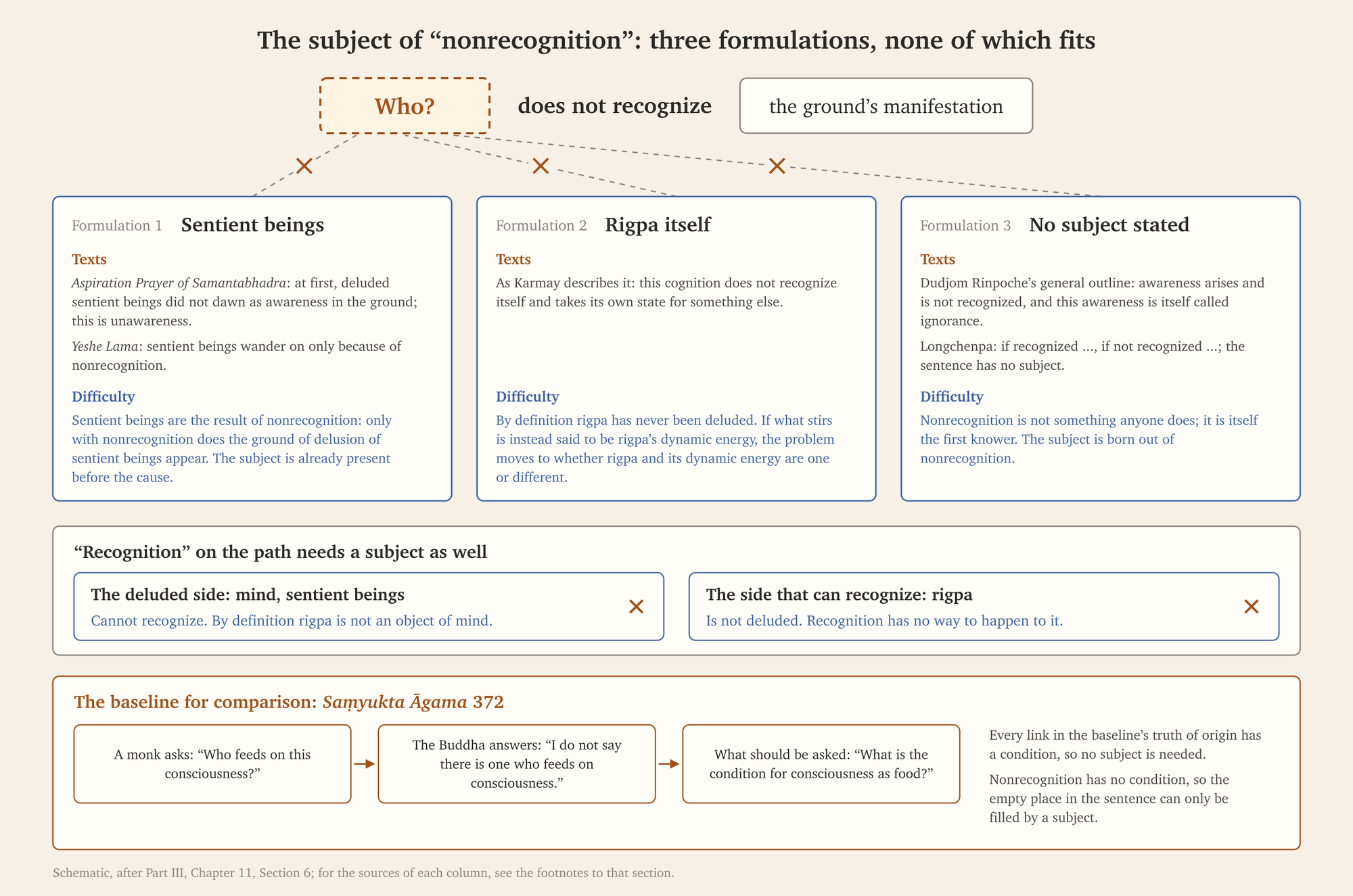
Nonrecognition, "not recognizing," is a verb, and one can ask what its subject is. The texts write it in three ways, and in none of them can a subject be placed. The first takes sentient beings as the subject. The Aspiration Prayer of Samantabhadra says that at first, deluded sentient beings did not dawn as awareness in the ground and were dull and without thought, and that this is unawareness, the cause of delusion; the Yeshe Lama says that all sentient beings wander in saṃsāra only because of nonrecognition.34 But sentient beings are the result of nonrecognition. In the Zab don rgya mtsho'i sprin, Longchenpa says that the ground's manifestation, when recognized, is Samantabhadra's ground of freedom and, when not recognized, is sentient beings' ground of delusion.35 By this sentence, there is first nonrecognition and only then sentient beings; yet in the prayer the "deluded sentient beings" are already on the scene before the cause of delusion has appeared. The second takes rigpa itself as the subject. Karmay, in summarizing this account, uses a reflexive construction: this cognition does not recognize itself and takes its own state for something else.36 But rigpa by definition has never been deluded: in the prayer Samantabhadra says in the first person that the awareness of the ground has never been deluded; Longchenpa says that one must wake from sleep and dream but need not return from rigpa. The verse cited above deals with this by attributing the movement to the dynamic energy of rigpa and saying that there is no movement in the ground; the question is thereby shifted to whether rigpa and its dynamic energy are identical or different. The third gives no subject. Dudjom Rinpoche's general exposition uses a passive construction: awareness arises and is not recognized, this unrecognized awareness is itself what is called the ignorance of single identity, and the three kinds of ignorance are the knowing side that discerns objects.37 On this way of writing it, nonrecognition is not something done by some prior subject; it is itself that very first knower; the subject is born out of nonrecognition.
The difficulty is not confined to that first occasion; recognition on the path equally needs a subject. The words of aspiration in the prayer are: may the awareness of all sentient beings recognize its own face. The translator Brunnhölzl, explaining the "I, Samantabhadra" of the text, says that this "I" refers literally to the primordial buddha and ultimately to each sentient being's own awareness, which has never been obscured; the prayer is awareness aspiring to recognize itself.38 The one that goes from deluded to not deluded is the sentient being, the one that can recognize is rigpa, and rigpa has never been deluded. The deluded side cannot recognize, because rigpa by definition is not an object of ordinary mind; the side that can recognize is not deluded, and so there is no event of recognizing that could happen to it.
The baseline does not have the same difficulty here, and the reason deserves to be stated. A bhikkhu asks, "Who consumes this consciousness?" (誰食此識); the Buddha answers, "I do not say that there is one who consumes consciousness" (我不言有食識者), and says that what should be asked is "Through what conditions is there consciousness as nutriment?" (何因緣故有識食); for contact, feeling, craving, and grasping the answer is the same, link by link.39 Every link in the baseline's truth of origin has a condition, and so it can do without a subject. Dzogchen's nonrecognition has no condition; the place left empty in the sentence can only be filled by a subject, and yet its view does not allow any candidate to stand there. Essay 4, Part II, Chapter 1, Section 3, mentioned that Vedānta has debated "what supports ignorance" for centuries; this is the same question.
The second place is relapse into delusion: since what is already perfect can become deluded, why would there be no further delusion after recognition? The tradition saw this problem. In the Treasury of the Supreme Vehicle (Theg mchog mdzod), Longchenpa uses it as a reductio: if the ālaya is said to be the dharmakāya, there follows the fault that after buddhahood one would again err as a sentient being; he cites Self-Arisen Awareness (Rig pa rang shar) as saying that in that case buddhas and sentient beings would alternate with each other. His own solution is to separate the two: what is deluded is the ālaya and ordinary mind, and the dharmakāya has never been deluded; one must wake from sleep and dream but need not return from rigpa.40 The Third Dodrupchen, Jigme Tenpe Nyima (1865–1926), separates the ground and the result as well: not recognizing that single luminous fundamental mind is the ground of delusion; realizing it and making it stable is liberation. At every death the complete clear light arises, and if it is not realized one returns to the deluded movement of apprehended and apprehender; when the result is reached and its own state is attained, there is no more returning. He says that Longchenpa rejects the account on which the ground and the result are the same.41
This volume's judgment is that this answer pays two costs. First, since the result is distinct from the ground, the one item by which the result exceeds the ground, namely stability with no more returning, is not complete from the beginning but is obtained on the path. When Chapter 1 summarized this tradition's view, it said that on this view nothing can be added to or taken from the ground, and that the only thing to be done on the path is to recognize it. At this point a qualification must be added: the ground to which nothing can be added and from which nothing can be taken does not guarantee against delusion; what guarantees against delusion is the stability that follows recognition, and stability has to be cultivated. Second, as to why there is no more returning once stability is gained, what is given is a definition, not a reason. Since the original nonrecognition had no cause, there is no basis for saying that it will not come again. The baseline's answer here is that when the cause is exhausted the effect does not arise, and this answer presupposes that the truth of origin has a cause that can be pointed to; Dzogchen's truth of origin is precisely an empty place.
The ground therefore has two levels in this tradition. At the level of claim, it is without intrinsic nature, serves as a support in the manner of a non-support, and neither supported nor support is established. At the functional level, it is unchanging, unconditioned, and complete from the beginning, is a knower in an affirmative sense, and is the source of all the appearances of saṃsāra and nirvāṇa; Karmay points out that the central doctrine of nonself is seldom mentioned in Dzogchen texts; Mikyö Dorje says that the light at the heart differs hardly at all from the self that the eternalist non-Buddhists say dwells at the heart.42 Chapter 1 of the Introduction gave a way of reading cases of this kind: a concept plays the role of A within a system while the system verbally insists that it is not A, and in reading one must separate the level of claim from the functional level. Essay 4, Part II, Chapter 5, separated these two levels for tathāgatagarbha question by question, and the assessment of the ground agrees with it: the de-substantializing clauses are real clauses; they qualify the wording but do not change the work that the ground performs in the system. The end of Chapter 2 said that the position the ground occupies in the system is close to what Volume 1 described as establishing a separate bearer for some function. What it bears is the one sentence "already liberated from the beginning."
The same tension has a counterpart in the practice, which can be seen by way of a question: the rushen described in Chapter 4 is meant to put saṃsāra and nirvāṇa, ordinary mind and rigpa, on two sides; what is it that it separates? It must first be made clear for whom this question holds. The chapter on the examination of nirvāṇa in the Mūlamadhyamakakārikā (Zhonglun) says: "Between nirvāṇa and the world, there is not the slightest difference; between the world and nirvāṇa, likewise there is not the slightest difference" (涅槃與世間,無有少分別;世間與涅槃,亦無少分別). It also says: "The limit of nirvāṇa and the limit of the world: between these two limits there is not a hair's breadth of difference" (涅槃之實際,及與世間際,如是二際者,無毫釐差別).43 This book does not accept the absence of difference that is read out of these verses. The fourth essay of the topical series Nāgārjuna and the Middle Way and Volume 1, Part II, Essay 18, Chapter 6, have already argued that what can be inferred from both being empty is only that sameness and difference are rejected together at the level of intrinsic nature; it cannot be inferred that the two are without difference at the conventional level. On this reading, Madhyamaka does not forbid separating saṃsāra and nirvāṇa at the conventional level, and the question above is not a difficulty for this book.44 For this tradition, however, it is one that must be answered. The Mind Series literature holds that saṃsāra and nirvāṇa are nondual and that to separate the two is mere conceptual discrimination; Nyingma scholars count themselves as belonging to the Prāsaṅgika line, and Candrakīrti, commenting on this chapter, says precisely that the two have no distinction whatever from each other and are of one taste; and the Heart Essence in turn requires the practitioner to separate the two sides strictly.45 What this book examines by way of this question is Dzogchen's actual attitude toward Madhyamaka.
This tradition's own answers are of three kinds, and taken one by one none of them completes the answer.46
The first says that on the primordially pure ground buddhas and sentient beings are not two, and that at the time of the path they appear separately. As to what has changed at the time of the path, the tantra goes on to give only two similes and one sentence: camphor is good medicine for one who knows how to use it and fatal for one who does not; a conch has no yellow color of its own, yet appears yellow to someone with an eye disease; and delusion arises from the coming together of four conditions. The reason for the separate appearing is in the end still recognition and nonrecognition. The tantra does not list the four conditions; on the account in Dudjom Rinpoche's general exposition, the first, the causal condition, is the three kinds of ignorance. The explanation stops here, and nonrecognition is precisely the thing whose cause and subject were asked after above.
The second is Sokdokpa's "neither identical nor different." It collides with what this tradition says elsewhere. In the Treasury of the Supreme Vehicle, Longchenpa says that it is vital to distinguish clearly between the ālaya and the dharmakāya, cites a tantra as saying that to take the ālaya for the dharmakāya is a deviation, and compares the two to the ocean and a ship upon it; Higgins, summarizing the classical Nyingma approach, uses the words "radically differentiate." Sokdokpa himself, in the same reply, also says that the two are coemergent, like a bird and its egg.47 More important is the practice. If the two are not different, rushen has nothing to separate; if they are not identical, it must be explained on what basis they are separated. What the manual actually uses to separate them is the state that follows the exhaustion of the three doors, and the visualization in which the three syllables purify the seed syllables of the six realms; neither of these is a criterion for distinguishing ordinary mind from rigpa. The criterion in the end is still pointing-out, that is, the teacher's identification.
The third borrows the tathāgatagarbha model: on one side is what obscures, which is adventitious dust and unreal, and on the other is what is obscured. As van Schaik points out, it is this model that actually does the reconciling, and neither the treasure texts nor Jigme Lingpa's own writings deal with this tension directly. Tathāgatagarbha itself did not solve this problem. Essay 4, Part II, Chapter 1, Section 3, has already written of this: to the question of how adventitious dust can obscure original purity, the Śrīmālā Sūtra answers that it is hard to understand; and the Sarvāstivāda asked still earlier why, since defilement and purity are associated, adventitious dust alone is allowed to stain the pure mind, and the pure mind is not allowed to purify adventitious dust. What has been borrowed is an old case still pending.
The three answers have one thing in common: none of them is given within the domain of Madhyamaka discourse. The closest is the rereading of the two truths described in Chapter 2: the ultimate truth is the domain of primordial wisdom, and the conventional truth is the scope of the mind of dualistic grasping. On this reading, what rushen separates is two kinds of knowing, not two classes of dharmas. But this has already replaced the two truths as two levels of judgment with two kinds of cognizer, and one can go on to ask how real the distinction between these two kinds of knowing is. If the distinction is real, rigpa is unconditioned and does not depend on conditions, ordinary mind is conditioned and rides the winds, and each has its own seat in the body, one at the heart and one in the lungs; when the Geluk scholar Palmang says that the doctrine of a sentient being in the lungs and a buddha in the heart is worse than other-emptiness, this is exactly what he is referring to. If the distinction is only an expedient, the definition "rigpa is not consciousness" loses its referent, and what is recognized in pointing-out cannot be said to be distinct from ordinary mind either.48
Dzogchen's actual attitude toward Madhyamaka can be settled from this. Nominally, the Nyingma count themselves as Prāsaṅgika, and Mipam's line places Madhyamaka at the summit of the four tenet systems of the causal vehicle. In practice, the doxography lists Madhyamaka among the tenets reached by the intellect; the manual says that the understanding gained by way of the four extremes and the eight extremes has no inner experience and is not stable; and the outer rushen lists analyzing the tenets of Prāsaṅgika Madhyamaka among "the conduct of the Three Jewels" that has to be acted out. Madhyamaka's determinations belong to the side that is separated off.49 That a system which counts itself as Prāsaṅgika posits a ground complete from the beginning, and then speaks of a separation and a joining between ground and result, is in itself already unexpected. This tradition uses the vocabulary of Madhyamaka, freedom from elaboration, absence of intrinsic nature, neither identical nor different, yet is not bound by Madhyamaka arguments; where an answer by argument is required, it falls back on recognition and nonrecognition, or borrows from tathāgatagarbha. This point and the question of why the ground is deluded are two faces of the same structure: there the question is how the primordially pure ground can have nonrecognition, and here it is on what basis nonrecognition and primordial purity can be separated. Mikyö Dorje's question of identity or difference asks about both faces at once.
7. The rainbow body
Part II, Chapter 3, did not judge the truth or falsity of individual cases of the rainbow body, for the reason that the truth of an individual case does not change the structural argument. Now that Chapters 9 and 10 have read the cases, this boundary stands as before, and the reason can be stated more concretely, under three points.
First, the state of the evidence. The only investigation from outside the tradition is Tiso's, and the first item he writes at the end of his book is that there is so far no scientific evidence for the attainment of the rainbow body. Different tellings of the same event diverge from one another: the 1952 case at Manigango has three retellings, two of which cannot both stand; for the death of Togden Ugyen Tendzin, the place and the discoverer recorded by the same author on two occasions differ; in the case of Khenpo A-chö, the newspaper report does not agree with what the interviews yielded. It is not that there is nothing that could be examined: some shrunken bodies survive to this day, none has undergone forensic examination, and the bodies of high lamas are customarily treated with salt and camphor, which itself promotes the dehydration of the tissues. Nor has this book found any case that was examined and shown to be false.50 So all that can be said here is that there is no evidence that can be examined; it cannot be said that the claim has been shown to be false.
Second, the breadth of the criterion. No remains at all, only hair and nails left, relics left behind: all of these outcomes count as attainment; the shrinking of the body is regarded as a lesser kind of rainbow body; and where it ought to have appeared and did not, there are further explanations such as disciples breaking samaya or activity being too extensive.51 The body of great transference, moreover, appears only to those whose eyes are pure. Any manner of death is compatible with the system, and this is the same arrangement as the fallback gates described in Part II, Chapter 3.
Third, even if the cases are true, Part II has already said that from a physical anomaly to the cessation of suffering there is no public chain of inference. Chapter 7, Section 9, pointed out that the result promised by this path is stated in every text in terms of what becomes of the body. The baseline's truth of cessation speaks of the cessation of suffering, and what is registered here is the corpse; at this point the two registers are furthest apart.
It is not that no one within the tradition has doubted. The doubters recorded by Mipam frame their question from the signs listed in the texts: the speech of one who has perfected the four visions should be only like an echo, yet Pema Düdül was still talking volubly on the day before he died.52 What this test checks against is still the texts, but it shows that there is precedent within this tradition for treating what is seen and what becomes of the body as facts that can be checked.
8. The place of this tradition within this volume's framework
To gather things up under this volume's five questions. Diagnosis: the root of suffering is set as nonrecognition, that is, not recognizing one's own appearances; why nonrecognition occurs is an empty place. Goal: recognition and the gaining of stability; the result is stated separately in terms of what becomes of the body. Mechanism: the claim is nonmeditation, with recognition itself being the whole of it; functionally it is a gradual curriculum, in the middle of which there is one experience named by the teacher, followed by practice of the skill of re-recognition and a progress chart of what is seen. Verification: whether recognition has occurred is identified by the teacher, progress is decided by the teacher by comparison with the texts, and the systematizers are confirmed by figures in pure visions. The deadline has fallback gates: at its very beginning the Yeshe Lama divides its teaching into three parts, with those of highest capacity arriving in this life, those of middling capacity attaining buddhahood in the intermediate state, and those of lower capacity being born in the natural nirmāṇakāya pure realms; the passage on entering the nirmāṇakāya maṇḍala says further that a person who has pure faith and has formed a connection with a realized teacher can be born there even without having practiced in this life.53 This matches item by item the fallback gates listed in Part II, Chapter 3.
Part II, Chapter 4, judged the attachment of esoteric Buddhism to be attachment to the result, with enactment as its mechanism: the practitioner acts the part of an accomplished buddha. Looking back over the preceding chapters, there is no lack of enactment in this tradition's curriculum. The outer rushen has the practitioner first act the six realms and then act the peaceful and wrathful aspects of a buddha; guru yoga and the generation stage in Jigme Lingpa's stages of the path follow the general pattern of esoteric Buddhism; on entering the maṇḍala, the disciple, as the teacher directs, looks toward the pure realms of the four directions, goes to them like a lion leaping or a tigress springing, and is told that by this alone one can be born there; the empowerment of the dynamic energy of awareness matches the lights that are seen, item by item, with the five buddhas and the five wisdoms.54 The statement at the summit, by contrast, is that the result need not be enacted: it has been there from the beginning, and what practitioners are told is that they have never not been it. So this tradition has not left enactment behind; it has added a layer of proclamation on top of enactment: enactment acknowledges that there is a distance to be crossed by acting a part, and pointing-out proclaims that this distance never existed. The distance between claim and function is here stretched to its widest: the claim is that there is nothing whatever to do, the function is a lifetime's curriculum, and not one of the various enactments of esoteric Buddhism is missing from the curriculum.
The three supplementary Parts can be set side by side.
| The Meditation of Tsongkhapa | Burmese Insight Meditation | The Dzogchen Approach | |
|---|---|---|---|
| What is faced in the session | An object of negation defined by doctrine | Mentality-materiality, that is, formations | The present awareness identified as rigpa; afterward, the arising and ceasing of thoughts, and what is seen |
| What verification rests on | Ascertainment of the result of reasoning | A later map | The teacher's identification; the progress chart of the four visions |
| Who holds the authority to determine | The treatises and the teacher; the practitioner's self-report | The teacher's reading of reports | The teacher; the systematizers are confirmed by figures in pure visions |
| Relation to the baseline | The two lines do not meet | They meet at the object and part at verification | Neither end is on formations; they meet only at the criterion of re-recognition |
The relation between the two lines is therefore of a third kind. The upper line is the baseline: formations, arising and ceasing and impermanent, the suffering of formations, contemplating formations as they are, the cessation of suffering in the cessation of formations. The lower line is this tradition: the ground complete from the beginning, nonrecognition, the curriculum, pointing-out, re-recognition, the four visions, the result. The starting point is not on the baseline: the ground is unconditioned and does not belong to formations. The end point is not on the baseline either: the result is stated in terms of what becomes of the corpse. The two lines meet at only one place in the middle, the criterion of re-recognition: thoughts liberated as they arise and leaving no trace, and afflictions no longer arising, speak of exactly the changes observable in this life of which the baseline speaks. What meets is the kind of criterion, not the degree reached.
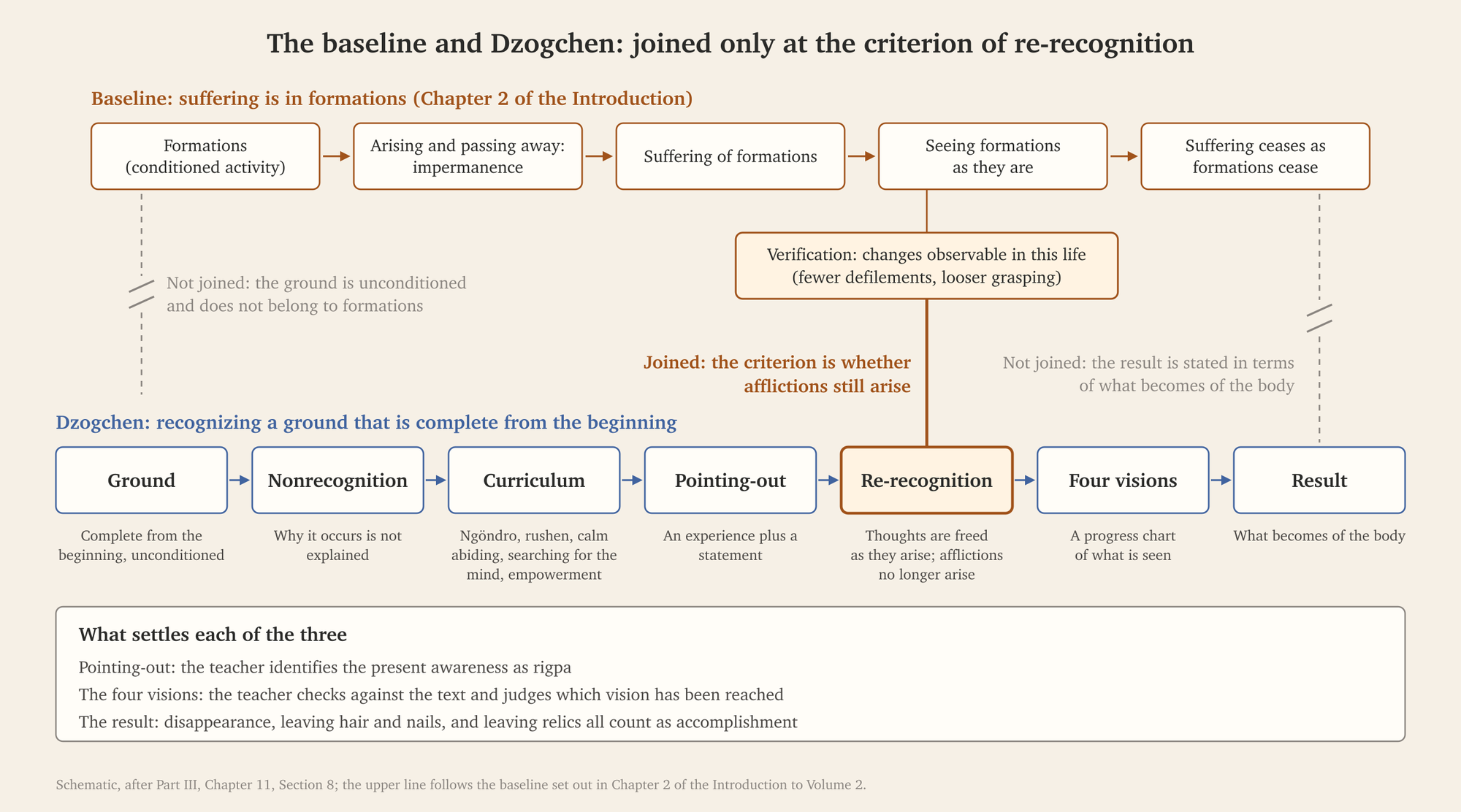
The segment of re-recognition can also be described in another way. What it actually faces is the arising and ceasing of thoughts and afflictions: a thought arises, it is recognized, and one does not follow it. This tradition's own description is resting in unconditioned rigpa; in the baseline's terms, it is close to observing mental formations and not grasping at them. This volume adopts the latter description, for the reason that it does not need the ground: whether this practice works can be seen simply from whether the afflictions decrease, and whether what is recognized is the dharmakāya makes no difference to this test. The author acknowledges that this practice may be partly effective. As to how far it is from liberation, this book takes a conservative estimate: what meets the baseline is only the kind of criterion; Section 1 has already said that it is still doubtful whether this tradition's calm abiding meets the standard of calm abiding, and Section 2 pointed out that its way of producing the "uncontrived" does not reach the seat of the illness. If this tradition has a part that can stand up to testing, that part does not depend on its view either.
Taking the preceding sections together, the author is disappointed in both the philosophy and the stages of practice of this tradition. In philosophy, why the ground is deluded, who it is that does not recognize, and on what basis the distinguishing is done are three questions that must be answered; this tradition's answers are either similes, or formulas of the "neither identical nor different" kind, or borrowings from tathāgatagarbha. In the stages of practice, the claim is nonmeditation and the reality is a lifetime of gradual practice; the only checkable item in it is the criterion of re-recognition, and this item does not depend on its view; the determination of pointing-out, of the four visions, and of the result falls respectively on the teacher's word, the texts' progress chart, and what becomes of the corpse.
9. Boundaries
Four boundaries must be stated.
First, this chapter does not deal with the Dzogchen of Bön or the Mahāmudrā of the Kagyu; Chapter 3 only explained their relation to this tradition. Nor does this chapter's critique depend on origins: even if the texts of the Instruction Series come from the eighth century as tradition says, the arguments of the sections above are unchanged.
Second, this chapter does not judge individual cases. The section on the rainbow body speaks of the state of the evidence and the breadth of the criterion; it does not say that any case is false.
Third, training in calm abiding and in re-recognition may have real effects. The study by MacLean and colleagues shows that three months of training in calm abiding improves visual discrimination and sustained attention.55 Studies of this kind do not touch on what is recognized in pointing-out, nor on what is seen in Tögal; what they support is the part of the curriculum that is shared with other schools.
Fourth, this chapter's critique is directed at structure and does not doubt anyone's sincerity. Shabkar writes only one sentence about what he saw; Chatral Kunga Palden says plainly that what he saw in dark retreat did not increase; Jigme Lingpa says that his own pure visions are erratic like lightning; Mipam says that he has not attained the qualities of a noble one. These statements are a side of this tradition that deserves to be recorded.
Finally, this book's own position must be stated. The last paragraph of Burmese Insight Meditation, Chapter 10, has already said that this book, too, has no better way of judging whether practice has succeeded than report and reading, and that this is a barrier between third-person observation and first-person experience that cannot as yet be crossed. That paragraph applies here equally, and one more sentence must be added. Pointing-out is an event, not a text. All that this book can read is the texts written around this event: manuals, first-person accounts, and biographies. What happened in the disciple's mind at that moment, this book has no means of reading. What this chapter says is that, by these texts' own record, this tradition too gives no way of reading it other than the teacher's word.
References
-
See Chapter 5, Section 4, and the source cited there: the third statement in Patrul's own commentary on the Three Statements That Strike the Vital Point; and Chapter 7, Section 6, and the source cited there: Jigme Lingpa, Yeshe Lama, trans. Lama Chönam and Sangye Khandro, Ithaca: Snow Lion, 2008, pp. 137–139. Hereafter cited as Yeshe Lama. ↩
-
See Chapter 5, Sections 4 and 5, and the sources cited there: the third statement in Patrul's own commentary on the Three Statements That Strike the Vital Point, and Düdjom Lingpa, The Vajra Essence, trans. B. Alan Wallace, Somerville: Wisdom Publications, 2015, pp. 20–21, 26–28 (hereafter cited as Vajra Essence); and Chapter 7, Section 6, and the source cited there: Yeshe Lama, pp. 91, 113, 115, 125, 135–137. ↩
-
See Chapter 5, Sections 3 and 5, and Chapter 4, Section 6, and the source cited there: Vajra Essence, pp. 20–21. For this volume's discussion of the standard of calm, see The Meditation of Tsongkhapa, Chapter 1, and Burmese Insight Meditation, Chapter 10, Section 3. ↩
-
See Chapter 10, Section 8, and the source cited there: Christopher Hatchell, Naked Seeing: The Great Perfection, the Wheel of Time, and Visionary Buddhism in Renaissance Tibet, New York: Oxford University Press, 2014, pp. 112–113, 121, 123. Hereafter cited as Hatchell. ↩
-
See Chapter 8, Sections 3 and 7; Chapter 5, Section 5; Chapter 9, Sections 1 and 4; and the sources cited in each place. ↩
-
For the preliminaries, see Chapter 4, Section 4, and the source cited there: Yeshe Lama, pp. 23–41; for the key point of speech, see Chapter 6, Section 3; for searching for the mind, see Chapter 5, Section 6; for the empowerment of the dynamic energy of awareness, see Chapter 5, Section 3, and the source cited there: Yeshe Lama, p. 91. ↩
-
For Patrul's statement, see Chapter 5, Section 3, and the source cited there: the first statement in Patrul's own commentary on the Three Statements That Strike the Vital Point. For the sentence on the baseline, see the second point of "A structural summary of the early Buddhist baseline" in Chapter 2 of the Introduction. For the mantra sounds of the wrathful aspect, see Chapter 4, Section 4, and the source cited there: Yeshe Lama, p. 27; for Chö, see Patrul Rinpoche, The Words of My Perfect Teacher, trans. Padmakara Translation Group, rev. ed., Boston: Shambhala, 1998, p. 298; in teaching transference the same book also has this sound shouted several times in succession at the close of the session, see p. 364. ↩
-
See Chapter 5, Section 5, and the source cited there: Vajra Essence, pp. 26–28; and Chapter 10, Section 6, and the source cited there: Sam van Schaik, Approaching the Great Perfection: Simultaneous and Gradual Methods of Dzogchen Practice in the Longchen Nyingtig, Boston: Wisdom Publications, 2004, p. 62. Hereafter cited as van Schaik. ↩
-
See Chapter 5, Section 6, and the source cited there: Keith Dowman, The Flight of the Garuda: Teachings of the Dzokchen Tradition of Tibetan Buddhism, Boston: Wisdom Publications, 1994, p. 71. ↩
-
See Chapter 9, Section 4, and the source cited there: Namkhai Norbu, The Crystal and the Way of Light: Sutra, Tantra and Dzogchen, comp. and ed. John Shane, London: Routledge and Kegan Paul, 1986, pp. 17–19. ↩
-
See Chapter 8, Sections 2 to 4 and Section 7, and the sources cited in each place. ↩
-
See Chapter 6, Section 7, and the source cited there: Yeshe Lama, p. 103. ↩
-
van Schaik, pp. 98–99. The original reads "the instructions are in effect an establishment of emptiness through the intellect". For the training of mind, see Chapter 4, Section 4, and the source cited there: Yeshe Lama, pp. 37–41. ↩
-
For the chronological strata, see Chapter 3, Section 8, and Chapter 10, Section 8; for the difference between the Mind Series and the Heart Essence and between the treasure texts and the manual, see Chapter 4, Sections 4 and 6; for the ten signs, see Chapter 6, Section 9; for the two kinds of pointing-out, see Chapter 5, Section 2. ↩
-
See Chapter 7, Sections 3 and 6, and the source cited there: Yeshe Lama, pp. 115–117. ↩
-
See Chapter 9, Section 1, and the source cited there: Shabkar Tsogdruk Rangdrol, The Life of Shabkar: The Autobiography of a Tibetan Yogin, trans. Matthieu Ricard, Ithaca: Snow Lion, 2001, pp. 50–52. Hereafter cited as Life of Shabkar. ↩
-
For the inner rushen, see Chapter 4, Section 4, and the source cited there: Yeshe Lama, pp. 27–29; for what is said of Tögal, see Chapter 6, Section 9; for the Pa-Auk lineage, see Burmese Insight Meditation, Chapter 5, Section 1. ↩
-
For the announcement of the five buddhas at the empowerment, see Chapter 6, Section 7, and the source cited there: Yeshe Lama, pp. 93–103; for the two passages in Shabkar, see Chapter 9, Section 1, and the source cited there: Life of Shabkar, pp. 17, 81. ↩
-
See Chapter 10, Section 8, and the source cited there: Hatchell, pp. 69, 112–113. ↩
-
For the first-person accounts of dark retreat, see Chapter 7, Section 7, and the sources cited there; for the author's own account, see Burmese Insight Meditation, Chapter 10, Section 2. ↩
-
For the study by Merabet and colleagues, see Chapter 10, Section 8, and the source cited there. Jiří Wackermann, Peter Pütz, and Carsten Allefeld, "Ganzfeld-induced Hallucinatory Experience, Its Phenomenology and Cerebral Electrophysiology," Cortex 44 (2008): 1364–1378, at p. 1364. The copy used is the authors' self-archived version, which carries the journal pagination. The first sentence of the abstract has "elicits in most observers pseudo-hallucinatory percepts". ↩
-
Martin T. Orne and Karl E. Scheibe, "The Contribution of Nondeprivation Factors in the Production of Sensory Deprivation Effects: The Psychology of the 'Panic Button'," Journal of Abnormal and Social Psychology 68, no. 1 (1964): 3–12. The copy used is the web version in the Orne archive at the University of Pennsylvania, which does not mark the original journal pagination. There were ten subjects in each group; the between-group difference in the number of symptoms was p = .01 (one-tailed). ↩
-
Marek Malůš, Martin Kupka, and Daniel Dostál, "Prožívaná životní smysluplnost, všímavost a sebehodnocení v kontextu omezené zevní stimulace," Psychologie a její kontexty 7, no. 2 (2016): 59–72, at pp. 60, 62–63. In Czech, with an English abstract. What the article relays is Peter Suedfeld, Restricted Environmental Stimulation: Research and Clinical Applications, New York: Wiley, 1980; the original book has not been seen. ↩
-
Reginald A. Ray, "Reggie Ray on Dark Retreat," interview by Tami Simon, transcript of the Sounds True podcast Insights at the Edge, December 6, 2010, third page of the transcript. The transcript has no page numbers. ↩
-
Reena Kapoor and Robert Trestman, "Mental Health Effects of Restrictive Housing," in Restrictive Housing in the U.S.: Issues, Challenges, and Future Directions, Washington, D.C.: U.S. Department of Justice, National Institute of Justice, 2016, chap. 6, pp. 206–208. Among the short-term studies cited, the four-day and seven-day studies used prisoners who volunteered. ↩
-
On the nature of the first-person accounts of dark retreat, see Chapter 7, Section 7. ↩
-
See Chapter 7, Section 7, and the source cited there: Dilgo Khyentse, The Wondrous Light of Lunar Nectar: The Biography of Chatral Kunga Palden, trans. Ryan Jacobson, Lotsawa House online edition, 2020, unpaginated. ↩
-
See Chapter 4, Section 6; Chapter 5, Section 4; Chapter 9, Section 1; and the sources cited in each place. ↩
-
See Chapter 4, Section 6, and the source cited there: van Schaik, pp. 129–131. ↩
-
See Chapter 6, Section 7, and the source cited there: Yeshe Lama, p. 103. ↩
-
Samten Gyaltsen Karmay, The Great Perfection (rDzogs chen): A Philosophical and Meditative Teaching of Tibetan Buddhism, 2nd ed., Leiden: Brill, 2007, pp. 189–190. Hereafter cited as Karmay. The verse is from the lTa ba klong yangs, Karmay's note 74; one line of it he says he was unable to make out and does not translate. The Tibetan for "mind" here is yid, and for "coemergent ignorance" lhan cig skyes pa'i ma rig pa. ↩
-
For gold and tarnish, see Chapter 2, Section 1, and the source cited there: David F. Germano and William S. Waldron, "A Comparison of Ālaya-vijñāna in Yogācāra and Dzogchen," in Buddhist Thought and Applied Psychological Research: Transcending the Boundaries, ed. D. K. Nauriyal, Michael S. Drummond, and Y. B. Lal, London: Routledge, 2006, pp. 53–54; for the bird and its egg, see Karmay, p. 182, where the Tibetan reads bya dang sgong nga lta bu; for "neither identical nor different" and the dream simile, see Chapter 10, Section 5, and the source cited there: David Higgins, The Philosophical Foundations of Classical rDzogs chen in Tibet, Vienna: Arbeitskreis für Tibetische und Buddhistische Studien, 2013, pp. 208–213. The edition used is the Lausanne doctoral dissertation (2012); page numbers follow the dissertation. Hereafter cited as Higgins. ↩
-
See Chapter 10, Section 5, and the source cited there: Karmay, pp. 181–183. ↩
-
Karl Brunnhölzl, A Lullaby to Awaken the Heart: The Aspiration Prayer of Samantabhadra and Its Tibetan Commentaries, Somerville: Wisdom Publications, 2018, chap. 13, translation of the common version. The e-book used has no print pagination and is cited by chapter. The opening line is translated as "At first, since deluded sentient beings do not dawn as awareness in the ground". For the sentence from the Yeshe Lama, see Chapter 1, Section 4, and the source cited there: Yeshe Lama, p. 53. ↩
-
The Zab don rgya mtsho'i sprin as translated in Higgins, p. 215. The Tibetan reads rig na kun tu bzang po'i grol gzhir 'ong la / ma rig na sems can gyi 'khrul gzhir byung ba, and the sentence has no subject; Longchenpa calls this "indeterminate spontaneous presence" (ma nges pa'i lhun grub). The Chinese title used in the Chinese edition of this book is the book's own rendering; the English gives only the Tibetan title. ↩
-
Karmay, p. 189. The Tibetan reads rang gis rang ma rig pa. For Samantabhadra's words, see Brunnhölzl, cited above, chap. 13, translated as "ground awareness was never deluded"; for Longchenpa's statement, see Higgins, p. 303. ↩
-
See Chapter 1, Section 4, and the source cited there: Dudjom Rinpoche, The Nyingma School of Tibetan Buddhism: Its Fundamentals and History, trans. and ed. Gyurme Dorje and Matthew Kapstein, Boston: Wisdom Publications, 1991, vol. 1, p. 54. The translation reads "arises as consciousness, but it is not recognised as such", and also "the threefold ignorance which subjectively discerns objects". ↩
-
Brunnhölzl, cited above, chap. 7; for the words of aspiration, see chap. 13, translated as "their awareness recognize its own face". ↩
-
Saṃyukta Āgama, discourse 372, the Poqiuna jing (Discourse to Phagguna), T2, no. 99, p. 102a. The Pāli parallel is Saṃyutta Nikāya 12.12. Already cited in Volume 1, Part II, Essay 13, Chapter 3. ↩
-
Higgins, pp. 300–303, a translation of the passage on the difference between the ālaya and the dharmakāya in chapter 14 of Longchenpa's Treasury of the Supreme Vehicle. The sentence of the reductio is translated as "after buddhahood one would once again err as a sentient being". ↩
-
Longchen Rabjam, The Practice of Dzogchen, introduced, translated and annotated by Tulku Thondup, ed. Harold Talbott, 2nd ed., Ithaca: Snow Lion, 1996, p. 82, as quoted in Tulku Thondup's introduction. For the dates of birth and death, see the same book. The Tibetan original has not been checked. ↩
-
See Chapter 2, Sections 2 and 3, and the sources cited there: Karmay, p. 177, and Longchenpa's statement; and Chapter 10, Section 5, and the source cited there: Karmay, pp. 187–188. ↩
-
Nāgārjuna, Zhonglun (Mūlamadhyamakakārikā), with the commentary of Qingmu, translated by Kumārajīva, fascicle 4, chapter 25, "Examination of Nirvāṇa," verses 19 and 20, T30, no. 1564, p. 36a. Already cited in Essay 2, Part II, Chapter 3, of this volume. ↩
-
Topical series Nāgārjuna and the Middle Way (Chinese only), fourth essay, "Does It Follow from All Being Empty That There Is No Difference?", Sections 2, 3, and 5; Volume 1, Part II, Essay 18, Chapter 6. Siderits and Katsura, in their note on this verse, say that the Mādhyamika can still maintain that the two are sharply distinct conventionally; see the source cited in Section 5 of the fourth essay of the topical series. ↩
-
For the position of the Mind Series, see Chapter 4, Section 4, and the source cited there: van Schaik, pp. 51, 57; for the Nyingma counting themselves as Prāsaṅgika, see Chapter 2, Section 2, and the source cited there: Higgins, pp. 107–108; for Candrakīrti's commentary on 25.19 and 25.21, see Section 5 of the fourth essay of the topical series and the source cited there: the Prasannapadā, Poussin's edition, pp. 535, 536. ↩
-
For the first, see a tantra that records Śrī Siṃha's answers to questions (Rin po che 'phags lam bkod pa'i rgyud) as translated in Higgins, p. 181; the two similes of camphor and the conch and the sentence on the four conditions are all in the same passage; Higgins, n. 473, conjectures that the four conditions are the four that Dzogchen uses in explaining delusion, the causal, object, dominant, and immediately preceding conditions; for Dudjom Rinpoche's account, see Chapter 1, Section 4, and the source cited there: Dudjom, p. 54. For the second, see Chapter 10, Section 5, and the source cited there: Higgins, p. 211, n. 537. For the third and for van Schaik's statement, see Chapter 4, Section 4, and the source cited there: van Schaik, pp. 51, 57, 62, 69–70. ↩
-
Higgins, pp. 300–302, chapter 14 of the Treasury of the Supreme Vehicle; the tantra cited is the Mirror of the Heart of Samantabhadra, translated as "The claim that the all-ground is the dharmakāya is a deviation from me". For "radically differentiate," see Higgins, p. 213, where these are the words of the original. For the bird and its egg, see Karmay, p. 182. For what the manual does, see Chapter 4, Section 4, and the source cited there: Yeshe Lama, pp. 23–29. ↩
-
For the rereading of the two truths, see Chapter 2, Section 2, and the source cited there: Higgins, pp. 107–108; for the seats of ordinary mind and primordial wisdom, see Chapter 1, Section 5; for Palmang's statement, see Chapter 10, Section 4, and the source cited there: Karmay, p. 186. ↩
-
For the self-identification as Prāsaṅgika and Bötrül's arrangement, see Chapter 2, Section 2, and the sources cited there: Higgins, pp. 107–108, and Douglas S. Duckworth, Mipam on Buddha-Nature: The Ground of the Nyingma Tradition, Albany: State University of New York Press, 2008, p. 134; for the statements of the doxography and of the manual, see the same section and the sources cited there: Dudjom, pp. 294–295, and Yeshe Lama, p. 47; for the conduct of the Three Jewels, see Chapter 4, Section 4, and the source cited there: Yeshe Lama, pp. 25–27. ↩
-
See Chapter 10, Section 7, and the sources cited there: Francis V. Tiso, Rainbow Body and Resurrection: Spiritual Attainment, the Dissolution of the Material Body, and the Case of Khenpo A Chö, Berkeley: North Atlantic Books, 2016, concluding chapter; Matthew T. Kapstein, "The Strange Death of Pema the Demon Tamer," in The Presence of Light: Divine Radiance and Religious Experience, ed. Matthew T. Kapstein, Chicago: University of Chicago Press, 2004, pp. 119–121, 149–151; Namkhai Norbu, The Crystal and the Way of Light, pp. 125–128. ↩
-
See Chapter 7, Section 9, and the source cited there: Yeshe Lama, pp. 129–131, 143; and Chapter 9, Section 3, and the source cited there: Tulku Urgyen Rinpoche, Blazing Splendor, pp. 65–66, 111, 174–175. ↩
-
See Chapter 10, Section 7, and the source cited there: Kapstein, "The Strange Death of Pema the Demon Tamer," p. 121. ↩
-
See Chapter 4, Section 6, and the source cited there: Yeshe Lama, p. 21; and Chapter 6, Section 7, and the source cited there: Yeshe Lama, pp. 93–97. ↩
-
For the outer rushen, see Chapter 4, Section 4; for guru yoga and the stages of the path, see Chapter 4, Sections 2 and 3; for entering the maṇḍala and the item-by-item matching, see Chapter 6, Section 7, and the source cited there: Yeshe Lama, pp. 93–103. ↩
-
See Chapter 9, Section 7, and the source cited there: Katherine A. MacLean et al., "Intensive Meditation Training Improves Perceptual Discrimination and Sustained Attention," Psychological Science, first published online in 2010. ↩