Part III, Chapter 6: Tögal I: The Key Points and the Four Lamps
Chapter 5 restated pointing-out and Trekchö (breakthrough). This chapter and the next restate Tögal (thod rgal, direct crossing). This chapter restates the theory of Tögal, its key points, the first visions, the empowerment, and the arrangement of sessions; the four visions, dark retreat, and the result are left to Chapter 7. The sources are the first half of the Tögal section of the Yeshe Lama; Dudjom Rinpoche's overview of Tögal; the Blazing Lamp, one of the Seventeen Tantras, together with Hatchell's annotated translation and study; Karmay's account of this theory of the body; and the Great Commentary attributed to Vimalamitra.
This chapter makes three points. Tögal is a regimen of posture, gaze, lighting, and breathing, and each of its rules comes with a bodily reason. Behind the regimen stands a theory of the body: primordial wisdom dwells at the heart and is connected to the two eyes by a light channel, and the light the practitioner sees is explained as primordial wisdom's own light. Only one instruction is addressed to the mind, namely not to analyze what is seen and not to grasp at it.
1. Where Tögal stands in the manual
After finishing with Trekchö, the Yeshe Lama goes on to "the path of clear-light Tögal," in two parts: the ways in which Tögal is superior to Trekchö, and the practice proper.1 On the first, Jigme Lingpa cites Longchenpa to the effect that there are seven such points; those the text spells out are as follows. Trekchö cannot purify deluded perceptions such as mountains, rocks, and earth; Tögal makes appearances manifest as five-colored light. Trekchö settles the rigpa (awareness) of primordial clear light as nothing more than a clear, nonconceptual emptiness; Tögal stresses the key points, opens the gates of primordial wisdom, and sees dharmatā in clear light. Trekchö relies on the coarse channels and winds, from which deviations and obstacles grow, and the practitioner is subject to the power of the four elements and declines with age; Tögal treats what is coarse as something to be given up, travels the path of the winds and channels of primordial wisdom by means of the key points of the three kinds of motionlessness, and uses no effort of holding, and the body, its coarse aspects exhausted, is freed into clear light. With Trekchö, even if the physical body disperses into minute particles, it cannot dissolve into clear light; the vajra body of great transference is therefore not obtained, and one cannot act widely for the benefit of others.2
Jigme Lingpa carries this comparison into Dzogchen itself. He says that among the three series of Atiyoga, neither the Mind Series nor the Space Series directly realizes awareness; that of the four cycles of the Instruction Series, the first three still place their hope of liberation in the intermediate state (bardo); and that here there is the key point of liberation in a body of light, so that the undeluded result is obtained by the path of deluded appearances.3
Dudjom Rinpoche says the same. Trekchö frees deluded apprehended appearances, which have neither ground nor root, right where they are, in dharmatā; Tögal surpasses this "lower path" because here all the appearances of the three realms are freed in the clear light of the great bindu of five-colored light, and this clear light is the natural radiance of awareness.4 The division of labor described in Chapter 1, Section 6, with primordial purity assigned to Trekchö and spontaneous presence to Tögal, here acquires a ranking of higher and lower.
Two points about the names are worth recording. Karmay points out that thod rgal, unlike khregs chod, is the Tibetan translation of the Sanskrit vyutkrāntaka, and he himself glosses the word as "passing over the crest."5 Hatchell points out that neither of the words Trekchö and Tögal appears in the Blazing Lamp or in its commentary, Stringing a Garland of Pearls; that in the Seventeen Tantras as a whole the two have no great standing and have not yet become a pair of rubrics governing the whole; and that only in the works of Longchenpa, in the mid-fourteenth century, does the pair become the dominant framework. What the four lamps of the Blazing Lamp teach is largely the same thing as what was later called Tögal.6
2. The light at the heart, the light channels, and the four lamps
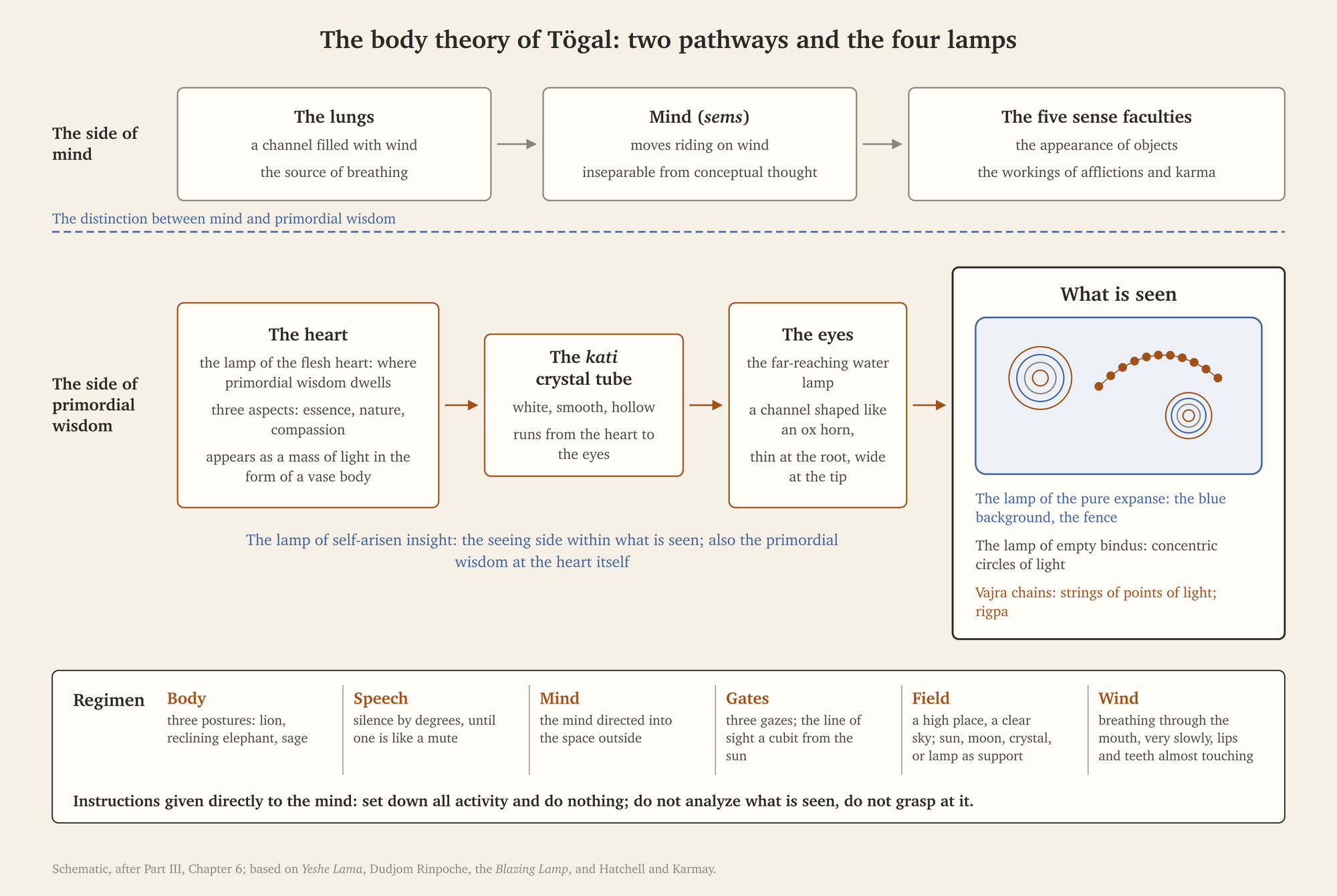
The practice proper opens with a passage of bodily theory. Chapter 1, Section 5, has already restated its first half: the key point of this vehicle is to distinguish ordinary mind from primordial wisdom; ordinary mind rides on the winds, whose source is a wind-filled channel in the lungs, and from this arise the appearances of the objects of the five senses and the working of afflictions and karma. The second half concerns where primordial wisdom is located. The Yeshe Lama says that primordial wisdom dwells within "the lamp of the flesh heart" (tsitta sha'i sgron ma), has the three aspects of essence, nature, and compassion, and is called "the lamp of the abiding ground" (gnas lugs gzhi'i sgron ma). Jigme Lingpa cites the Reverberation of Sound: in the palace of the precious heart there is an aspect of the primordially pure essence; it is the radiance of the body of emptiness and clarity, appears in the form of a vase body with face and hands, and abides as a spontaneously present mass of light. He goes on to say that it has no existence by nature and abides only as the ground from which clear light arises.7 Chapter 3, Section 5, cited Karmay's account of this theory: the youthful vase body dwells at the heart, as small as a mustard seed, and its light shines out through the two eyes; the two practices of dark retreat and gazing at sunlight are built directly on this theory, and both aim at seeing the light of one's own primordial wisdom.8
Since primordial wisdom and ordinary mind each have their own location, the direction of the practice is thereby fixed. Jigme Lingpa says that the other vehicles, up to and including the secret cycle of the Instruction Series, rely on the effortful generation and completion stages and only make conceptual thoughts and their workings temporarily dormant; here one is required to abandon all activity of body, speech, and mind, whether virtuous or nonvirtuous, and to remain as motionless as a corpse in a charnel ground, and in this way to recognize the path by which primordial wisdom arises.9
The heart and the eyes are joined by a channel of primordial wisdom called "the kati crystal tube" (ka ti shel gyi sbu gu can). Jigme Lingpa cites the Golden Rosary: this channel is white and smooth, hollow, and the great primordial wisdom of the bindus moves within it, untouched by blood. When the body first forms, two kinds of eye arise at a knot of channels: the eye of the elements produces the body, and the eye of the lamps emits the light of primordial wisdom. At the center of the pupil there is a channel shaped like an ox horn, narrow at the root and wide at the tip; together with it there is another channel, clear as water, called "the far-reaching water lamp" (rgyang zhags chu'i sgron ma).10 The Great Commentary attributed to Vimalamitra gives the same account: two channels shaped like the horns of a wild ox enter the eyeballs, wide at the mouth and narrow at the root; this gate has the nature of water, and so it is called the far-reaching water lamp.11 Hatchell points out that the Dzogchen body has, besides the channels, winds, and bindus it shares with the other tantras, a further set of light channels branching from the heart, among which the several that run from the heart over the crown of the head to the two eyes are specifically responsible for what is seen; Bön Dzogchen has the same channels under different names, and Kālacakra has no such set.12
What appears by way of this passage is collectively called the four lamps. The Yeshe Lama cites the Self-Arisen Awareness for the list: the lamp of empty bindus, the lamp of the expanse of awareness, the lamp of self-arisen insight, and the far-reaching water lamp, all of them present in the body of every sentient being.13 The tantra devoted to the four lamps is the Blazing Lamp. Hatchell introduces it as follows: the tantra is in verse throughout and presents itself as an Indian composition translated by Vimalamitra and Kawa Paltsek; the whole tantra is a dialogue between two Vajradharas, in effect one buddha questioning and answering himself; it first treats the four lamps in brief and then gives one chapter to each lamp, setting out each lamp under headings such as essence, etymology, divisions, and nature, in a thoroughly scholastic manner. On dating, he says that the Seventeen Tantras cannot be dated precisely; the Tibetan tantras themselves may have begun to circulate in manuscript in the mid-eleventh century, the commentaries may date from the early twelfth century, and the whole is no later than 1127.14
What each of the four lamps refers to is set out in a table.
| Lamp | What the Blazing Lamp teaches (following Hatchell's explanation) | Dudjom Rinpoche's definition |
|---|---|---|
| The far-reaching water lamp (rgyang zhags chu'i sgron ma) | The eyes, together with the light channels that run from the heart to the eyes, through which primordial wisdom appears outwardly; also the ordinary functioning of the eyes. "Far-reaching" means that it can draw nirvāṇa near and cast saṃsāra far away, or the reverse | It perceives outwardly the appearances that manifest through the radiance of awareness |
| The lamp of self-arisen insight (shes rab rang byung gi sgron ma) | The side of what is seen that does the seeing; also the primordial wisdom at the heart itself, which is the source of the four lamps | The unerring reality of higher insight, that is, the very face of awareness, appearing as pure essence and not as coarse objects |
| The lamp of empty bindus (thig le stong pa'i sgron ma) | The content of what is seen: concentric circles of light, like the spots on a peacock's feathers, like the eyes of a hawk, a fish, or a cat | The support that sets the arising of appearances in motion |
| The lamp of the pure expanse (dbyings rnam par dag pa'i sgron ma) | The background of what is seen: a deep blue that first appears at the corners of the eyes and later becomes multicolored; it is the "fence" that encloses the points of light | The ground on which the inner expanse appears as outer radiance |
In the Self-Arisen Awareness the fourth lamp is called "the lamp of the expanse of awareness" (rig pa dbyings kyi sgron ma), and this is the name Dudjom Rinpoche uses.15 Besides the four lamps, there is one more thing among what is seen, called the vajra chains (rdo rje lu gu rgyud): points of light linked in strings. Dudjom Rinpoche says that they are awareness itself; Hatchell translates the term literally as "little linked lambs," and what the practitioner has to do is to drive these "lambs" into the "fence" of the lamp of the expanse, so that they no longer move about.16
The chapter of the Blazing Lamp on the lamp of empty bindus also contains two ways of bringing out light with the hands: pressing the eyeballs and the corners of the eyes with the thumb and forefinger, or repeatedly pressing with the fingers on the pulsing vessels at the sides of the neck. Hatchell says that visions brought out by deliberate actions of this kind are called effortful and in this tradition do not count as accomplishments of practice; they are only an introductory device for letting a person see for the first time that there is light in the body.17 The Tögal section of the Yeshe Lama does not adopt these two methods.
Hatchell summarizes the whole theory as follows: pure awareness is sealed in the center of the body, at the heart; a set of light channels runs from the heart to the eyes, and awareness can pass outward along them; through particular yogic techniques awareness comes out of the eyes and appears as visions; this gives the practitioner an opportunity for recognition, the recognition that the visions "outside" are in fact the manifestation of inner awareness, and so an opportunity to undo the fundamental error of ignorance. He adds that this practice reenacts the liberation of Samantabhadra: the heart corresponds to the vase in which the light is sealed, the visions correspond to the ground's manifestation, and the recognition corresponds to Samantabhadra's self-recognition. The distinction between recognition and nonrecognition described in Chapter 1, Section 4, here becomes the model for the practice.18
3. The key points of body, speech, and mind
The first group of rules in the practice consists of the key points of the three doors of body, speech, and mind. Jigme Lingpa first gives the general reason: if the key points of the body are not mastered, the key points of the channels cannot be mastered; if the channels are not under control, neither are the winds and awareness; and in that case clear light will not fully appear.19
The key points of the body are three postures, taken from the Garland of Pearls. For each posture, every part of the body is assigned a function.
| Posture | How it is done | Functions stated in the text |
|---|---|---|
| The dharmakāya posture of the lion | Squat, with the soles of the two feet joined in front of the body; hold the body straight; let the weight of the head rest on the neck; make fists with both hands and place them where the soles meet | Suppresses the moving winds; lets the winds flow freely; stops conceptual thought; balances the elements. Reverberation of Sound: free from the fear of delusion, one sees with the vajra eye |
| The saṃbhogakāya posture of the reclining elephant | Knees against the chest; elbows on the ground; palms supporting the chin; feet stretched straight back, soles facing up | Increases bliss, warmth, and the elements; balances the three kinds of wind, male, female, and neuter; stops the coarse winds; balances laxity and excitement. Reverberation of Sound: one sees with the lotus eye |
| The nirmāṇakāya posture of the sage (ṛṣi) | Squat, with the soles of both feet on the ground; back straight; knees against the chest; lower abdomen drawn slightly toward the spine; arms crossed over the knees, or hands touching the armpits, or elbows on the knees with the fists supporting the throat | Balances the channels and winds; suppresses the water element; makes wind-mind flow into dharmatā; makes warmth and wind blaze as primordial wisdom; cuts the continuity of conceptual thought; the last three hand positions respectively remove imbalances of heat, remove cold disorders, and balance heat and cold. Reverberation of Sound: one sees with the Dharma eye |
Jigme Lingpa adds two remarks. First, all three postures are to be relaxed, neither too tight nor forced; this is a key point for avoiding obstacles. Second, there are in fact more postures than these three, but for those who favor the approach without elaboration these three are enough. He also relays Longchenpa's criticism of a variant: some hold that the lion posture is a squat with the soles on the ground and the palms pressed on the ground to the left and right of the feet, and Longchenpa regards this as a failure to grasp the original meaning.20
The key point of speech is to stop speaking. Jigme Lingpa cites the root tantra, which says that speech must rely on training, forbearance, and resolve. If silence is not kept, conceptual thought, disturbance, dispute, and idle talk increase, so speech is to be reduced step by step. For those who are extremely fond of talking he gives the method already mentioned in Chapter 4: go to an uninhabited place and shout whatever one most loves to say hundreds, thousands, millions of times; once exhausted, one no longer wants to speak, and in the end one is willing to set aside even the recitation of liturgies. In those who are content to be like a mute, the movement of the winds slows and then stops.21
The key point of mind consists of a single line of scriptural proof, from the Clear Expanse: when the mind is directed toward outer space, the inner lamp directly appears. Jigme Lingpa explains that once the mind, which has awareness as its essence and is driven by the winds, is cast toward outer space, the moving winds become extremely calm, and the unconditioned, clear and empty radiance of the inner lamp appears as the union of the expanse and awareness.22
4. The key points of the gates, the field, and the wind
The second group of rules is called "viewing clear light by means of the three key points" and comes from the Reverberation of Sound: rely on the key points of the gates, the field, and wind and awareness. Jigme Lingpa says that counting wind and awareness as one item gives three key points and counting them separately gives four, and that the two ways of counting do not conflict.23
The gates are the eyes. The root tantra says that the key point of the gates is to gaze upward, downward, and to the side. Jigme Lingpa matches these to the three kāyas: the dharmakāya gaze is upward, toward the crown of the head; the saṃbhogakāya gaze looks straight outward; the nirmāṇakāya gaze is downward. He adds that in the inner sense the gates are not limited to the two eyes: the light of emptiness arises from the light channel of the central channel, and the light of the awareness of compassion arises from the channel in the lungs, and another tantra accordingly says that to accept only the two channels of the eyes as the path is a limitation; but for the present practice two gates are enough. Concretely, one keeps the eyes half open and places the gaze one cubit away from the sun. The sign that the key point of the gates has been accomplished is the ability to gaze at the object for a long time.24
The field is the outer field that is gazed at and the place of practice. The place should be high, clear, and open, with nothing unfavorable about it. The seasons are autumn, from late summer until before the onset of winter, and spring. A beginner gazes in a clear sky free of conditions such as cloud and wind, relying on the light of the sun and the moon. Once the expanse and awareness have separated from the point between the eyebrows, the face is extremely relaxed, and one gazes toward the west in the early morning and toward the east in the evening; the translators note that at this stage the practitioner no longer needs the supporting light source and therefore faces away from it.25 The supporting light sources are specified separately in the Yeshe Lama, at the start of its account of the first vision: by day the sun and a fire crystal are the supports of the dharmakāya; by night the moon and a water crystal are the supports of the saṃbhogakāya, and practice at night can remove the heat that builds up in the eyes during the day; in the morning and evening a butter lamp is the support of the nirmāṇakāya. When first becoming familiar with the thing gazed at, one must not stare too close to it, and one should gradually lead the light to a point below it or beside it. When what is seen leans toward one color, one turns in the corresponding direction: if white predominates, look to the right; if yellow, look up; if green, look to the left; if red, look down; if blue, look to the center; if the five colors are equal, let things be. When no bindus are seen, the key point is to gaze evenly with both eyes.26
The key point of wind is the manner of breathing. Jigme Lingpa says that the winds are in motion and conceptual thought rides on them, so their cause must be remedied; the tradition of the Heart Essence is to breathe through the mouth and not the nose, with both exhalation and inhalation extremely slow and quiet and the lips and teeth almost touching. He contrasts this with other instructions: all instructions that prescribe inhaling through the nose treat the winds as what is to be purified within the four cakras, and through the force of the winds obstacles and faults easily arise; here the wind enters through the mouth, the wind moving in the lungs relaxes where it is and purifies itself, its radiance dissolves into the heart, and the qualities of the cakras are accomplished of themselves without being sought. He cites the Clear Expanse: once the breathing is evened out it becomes subtle, and at last the going out and coming in stop; this is the key point for making the expanse and awareness motionless.27
Hatchell makes a general observation about rules of this kind. He says that this tradition's most basic account of the visions is that one places body, speech, and mind as prescribed and then waits for the visions to arise; the postures and gazes are all fairly simple and do not use practices such as the blazing and dripping of inner heat, but only put the body into particular shapes and let it take effect by itself. He illustrates this with a remark by a Bön commentator: a snake has limbs, but they cannot be seen unless it is squeezed. The snake stands for the practitioner's body, and the squeezing for the postures.28
5. The key point of awareness and the first visions
After the three key points comes the key point of awareness. It contains no new rules; its content is the state, and the visions, that follow once the preceding items are all in place. Jigme Lingpa says that, relying on the gazes and postures described above and practicing according to the three key points of the gates, the field, and the wind, the practitioner sets aside all affairs and remains entirely without action. When attention is then placed on the clear, open stretch of outer space, it will feel as though awareness were dissolving.29
The visions come in the following order. First there appears a patch of extremely pure, bright blue light. From it appear five lights in five colors, like brocade unrolled; this is called the inner expanse appearing outwardly. Next, within the lamp of the pure expanse, the karmic winds are purified and the lamp of empty bindus appears: like the round ripples that spread when a stone is dropped into well water, circles of five-colored light become distinct. When one concentrates on this with the far-reaching water lamp, extremely bright inner awareness is experienced without becoming a substantial entity, and this is the essence of the lamp of self-arisen insight; from it arises a sharp, quick insight that can discern objects and naturally understands the meanings of words. After that, the awareness of higher insight appears as the vajra chains of awareness, like fine beads on a string, or like floating gold threads. The vajra chains are to be placed inside the fence of the expanse and the bindus; the Clear Expanse says that the key point of awareness is precisely to hold the vajra chains.30
On inner and outer, Jigme Lingpa makes a point of citing a master whom he calls "the primordial buddha." Some people identify "the expanse" only with the cloudless sky outside, and this is unacceptable, because the sky has nothing to do with the practitioner, whereas whether there is clear light depends on the practitioner. The inner expanse is the blue radiance that arises outwardly, and it is called the outer expanse; the sky is only the passage through which the ground's manifestation passes, and is not the true expanse. The true expanse is blue, and that is the inner expanse. The two are not a matter of drawing the inner back in or projecting the outer out; the one arises from the other.31
At first the visions are not stable. Jigme Lingpa says that before one is practiced the appearances waver and flicker like a mirage; as one gradually guides them by means of the gazes and becomes practiced, then to the degree that the inner nature of the channels dissolves into clear light, the expanse and awareness separate from the point between the eyebrows, dependence on the outer field decreases accordingly, and the meditative experiences of the four visions gradually increase accordingly. He adds a qualification: the way these visions arise differs from person to person and cannot be predicted, so they must not be taken as signs that this path has been perfected; a seed can ripen early through warmth and moisture alone and yet be without strength, and where one has reached is to be judged by the instructions on the final result.32
6. The instruction addressed to the mind
Among the items above, very few instructions are addressed directly to the mind. The key point of mind is to cast the mind toward space; the key point of awareness is to set aside all affairs and not act. Beyond these there is only one, placed after the first visions. Jigme Lingpa says that at this time, if one falls into even a hair's breadth of analysis of the appearances of light, the awareness of the vajra chains will become a substantial entity and bind the practitioner to obstacles and wrong paths; the lamps that are seen are one's own dharmatā made manifest, and one is to practice with fearless conduct that is free of clinging.33
In his account of the four lamps he cites a passage from Longchenpa's Treasury of Word and Meaning that places the same instruction within the order of the whole course: at the beginning, the visions of Tögal must be made to arise; during practice, there must be no clinging; at the end, everything must be brought to exhaustion. Longchenpa explains that awareness is joined with the winds, so the wind aspect must be purified; and that after the radiance aspect of awareness has increased, it must still come to exhaustion within the inner expanse. At the end of the passage Longchenpa says that this intent is very hard to grasp, and that he realized it only after a long time, through the kindness of his teacher.34
Hatchell offers an explanation of how this instruction relates to Trekchö. He says that Trekchö and Tögal are two successive steps, with Trekchö preparing for Tögal by producing a kind of stability; without this stability the practitioner would chase or grasp at the visions and could not let them take their own course. As for the points of light moving about in the sky, the practitioner's task is not to force oneself not to look at them, but to keep them from becoming a focus that narrows the mind.35
7. Entering the maṇḍala and the empowerment of the dynamic energy of awareness
After the first visions, the Yeshe Lama schedules a ritual, titled the pointing-out of awareness, in two steps: entering the self-appearing maṇḍala of great primordial wisdom, and conferring the empowerment of the dynamic energy of awareness so as to point out the nature.36 Chapter 5, Section 3, restated the opening of this ritual: offerings are made on a mountaintop or in a very secluded place, the empowerment of the dynamic energy of awareness is requested three times, teacher and disciples remove their upper garments, the disciples gaze at the syllable A at the teacher's heart, and the teacher gives a forceful shout and asks three times, "What is mind?"
Then comes the formal entry into the maṇḍala, done three times according to the three kāyas, each time with its own posture and gaze. In entering the nirmāṇakāya maṇḍala, the disciples take the posture of the sage, gaze into space without a reference point, and bring to mind the natural nirmāṇakāya pure realms. The teacher proclaims the pure realms of the four directions, east, south, west, and north, and the body colors of the four buddhas, and has the disciples look toward the four directions in turn with the elephant gaze, the lion gaze, the gaze of a wrathful deity, and the gaze of Vajradhara, and go there like a lion leaping, a tigress springing, a garuḍa soaring, and a flash of lightning. Jigme Lingpa says that disciples who are led in this way into the four gates of the maṇḍala of awareness, provided they have pure faith and a connection with a realized vajra master, can be born in the natural nirmāṇakāya pure realms even if they do not practice in this life. In entering the saṃbhogakāya maṇḍala, the disciples take the vajra posture, gaze straight into space, and bring to mind the Ghanavyūha pure realm, while the teacher proclaims the Buddha Amitābha and his retinue. In entering the dharmakāya maṇḍala, the disciples take the lion posture and, in order to establish the auspicious connection for attaining the five eyes of the buddha stage, gaze in five directions, up, down, right, left, and straight ahead; the teacher points out naked, empty awareness and has the disciples look, within this nature in which there is nowhere to go, for who the traveler is, and then rest. Jigme Lingpa says that of those who receive empowerment in this maṇḍala, even those whose familiarity is weak will be liberated in the intermediate state, and the best will be liberated in this very life.37
In the second step, the disciples adopt the postures and gazes of the three doors in full, and the teacher proclaims the essential meaning of Tögal: within the innate secret of the precious heart dwells the seed of the bindu of primordial wisdom; its essence is empty and without self, its nature is clear and unceasing, and the kāyas and wisdoms manifested by its compassion shine everywhere like a lamp inside a vase; the four lamps appear clearly of themselves from within the precious crystal tube channel; the disciples thereby meet dharmatā directly, and this is to have received the great empowerment of the dynamic energy of awareness. The text then correlates the light that is seen, item by item, with the five buddhas, the five wisdoms, the five families, the five colors, the five winds, the five kinds of insight, and the five ḍākinīs: seven sets of five.38
Two passages in this section bear on later chapters. First, Jigme Lingpa says that this innate dharmatā is different from meditative experiences of the mind such as the "empty form" that is posited through analysis, and that it does not come from dependent conditions brought about by effortful striving and holding in the practice of channels and winds.39 Second, the empowerment closes with a proclamation by the teacher: today the greatest discovery has been made; receiving the empowerment of the dynamic energy of awareness is like seeing the faces of three thousand buddhas; the wheel of rebirth has been cut, and the path to liberation is in hand; even one who passed through the ten bodhisattva grounds in succession might not directly see all the qualities of the tathāgatagarbha; from today on, one must practice the four visions diligently until the exhaustion of dharmatā.40
8. Sessions, night practices, and conduct
After the empowerment, the Yeshe Lama explains how to get the practice on track, distinguishing two kinds of people: those with elaboration and those without elaboration.41
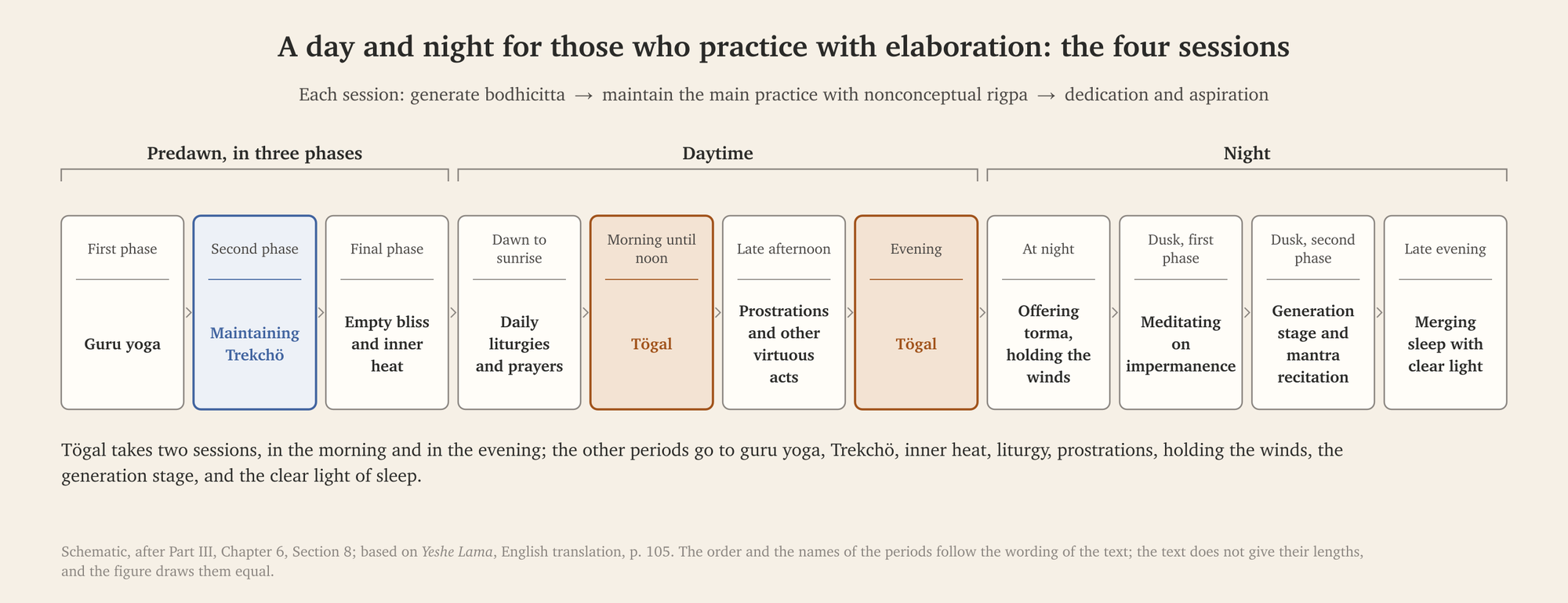
Those with elaboration practice in four sessions, and the schedule for a day and night is as follows. The time before dawn is divided into three phases: first guru yoga, then maintaining Trekchö, then bliss-emptiness and inner heat. From daybreak to sunrise, one recites the daily liturgies and prayers. From morning to noon one practices Tögal; in the afternoon one does prostrations and other virtuous acts; in the evening one practices Tögal again; after nightfall one offers torma and holds the winds. In the first phase of dusk one contemplates impermanence, and in the second one practices the generation stage and mantra recitation. The late-night session blends sleep with the innate clear light. Each session begins with arousing bodhicitta, maintains the main practice with nonconceptual awareness, and ends with dedication and aspiration.
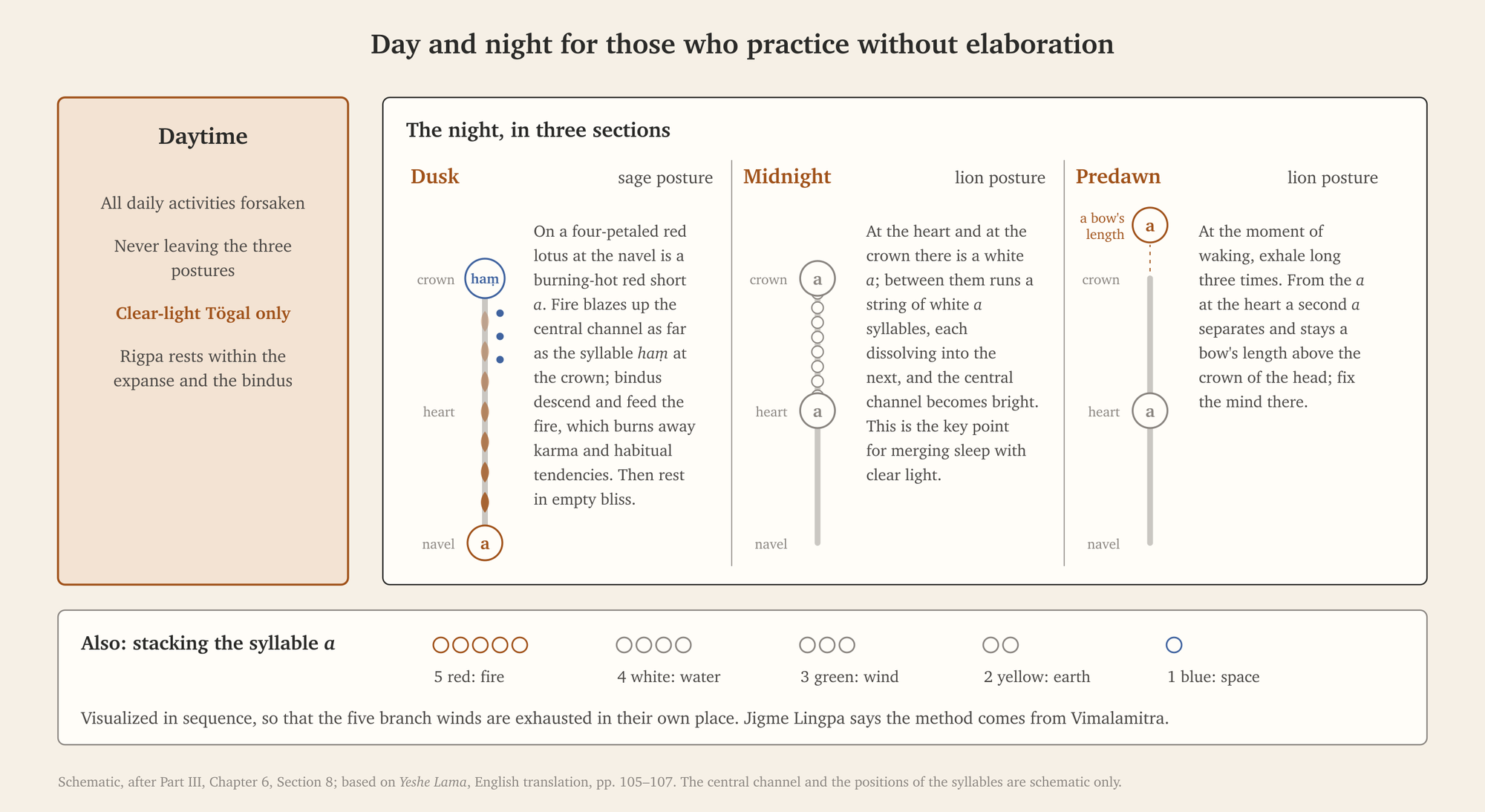
Those without elaboration practice only Tögal, give up all everyday affairs, and never leave the postures. The night is divided into three phases, each with its own visualization. At dusk one takes the posture of the sage and visualizes, on a four-petaled red lotus at the navel, a blazing-hot red short A; from it fire burns up the central channel to the syllable haṃ at the crown of the head, bindus descend and feed the fire, karma and habitual tendencies are burned away, and one then rests in bliss-emptiness. At midnight one takes the lion posture and visualizes a white syllable A at the heart and another at the crown of the head, with a string of white A syllables inside the central channel dissolving one into the next, so that the central channel becomes bright; this is the key point for blending sleep with clear light. At the moment of waking before dawn, one exhales three long breaths, takes the lion posture, visualizes a second A, emerging from the A at the heart, poised one bow-length above the crown of the head, and focuses the mind there. There is also a practice of visualizing stacked A syllables, used to exhaust the five branch winds where they are; Jigme Lingpa says that it comes from Vimalamitra.
This passage can be read alongside van Schaik's summary cited in Chapter 5, Section 1: Jigme Lingpa's texts leave no room for practicing Dzogchen alone, apart from other practices. In the four-session schedule, Tögal takes up two sessions, the morning and the evening; the other sessions are guru yoga, Trekchö, inner heat, liturgy, prostrations, holding the winds, the generation stage, and the clear light of sleep. Even in the schedule of those without elaboration, the three phases of the night use visualizations of syllables, the central channel, and fire.
The section ends with conduct. Jigme Lingpa cites the Union of Sun and Moon for seven kinds of conduct, likened in turn to a bee, a deer, a mute, a finch, a madman, a lion, and a dog and a pig: tasting the flavor of all phenomena, leaving behind objects that cause delusion, giving up deluded speech, cutting through doubt by secret means, giving up a fixed dwelling, giving up fear and roaming the charnel grounds, and removing the distinction between clean and unclean. He says that there are seven stages, from the conduct of the beginner who has just begun to study and reflect and is like a bee, to the conduct of the great practitioner for whom pleasure and pain, good and bad, have become one taste; one measures one's conduct against one's own mind, and view and meditation are enhanced accordingly.42
9. Comparison with the six-limbed yoga of Kālacakra
Tögal is not the only system that writes the visions out as a sequence that can be expected. In his passage on the four visions, Dudjom Rinpoche cites a verse from the Kālacakra: with the mind fixed on space in all directions and the eyes unclosed, one enters the vajra path, and then out of emptiness one sees smoke, a mirage, clear light, a stainless sky, a lamp, a blazing fire, the moon, the sun, a vajra, the supreme aspect, and a bindu, within which is the form of a buddha. He says that this is almost like the way the bindus ripen in the body.43
Hatchell's monograph takes this resemblance as its subject. In his overview, the first limb of the six-limbed yoga of the Kālacakra completion stage, withdrawal (pratyāhāra), has two forms of practice, by night and by day: the night practice is done in a dark room with no gap that lets in light, and the day practice in an unsheltered place where only the sky is seen; the practitioner keeps the prescribed posture and gaze, and lights appear of themselves, ten kinds in all, called the ten signs, the last of which is a bindu in which the form of a buddha appears. The Kālacakra literature stresses that these signs are not fabricated by conceptual thought, compares them to the images that a maiden sees in a mirror during divination, and calls them empty form. The second limb, meditative concentration, takes these signs as its object and unites the mind with the object. From the third limb on, the practice turns to the winds: the winds of the left and right channels are made to enter the central channel and join at the navel, inner heat is ignited, and the bindus melt and descend, producing bliss.44
As Hatchell describes them, what the two systems of practice have in common comes down to four things: both use the two settings of dark room and sky; both use posture and gaze as their means, and in both the methods are simple; both stress that the visions arise of themselves, unlike the deities visualized according to a liturgy in the generation stage; and in both the visions follow an order, from unformed light to bindus and then to buddha bodies within the bindus. Hatchell says that the Dzogchen that reemerged in the eleventh century is in this respect very like Kālacakra, as if the first two of the six limbs had been taken over wholesale; and that, as far as written systems of Buddhist practice are concerned, Kālacakra appears to be the earliest major tradition to incorporate yogas of light and dark of this kind. At the same time he does not favor identifying Kālacakra as the source of Tögal: almost nothing can be known of the practice traditions of Indian Kālacakra in the eleventh century, and the Nyingma and Bön each have their own histories; the more fitting account, in his view, is that a set of visionary experiences and themes circulated among several traditions, and each reorganized them in its own way.45
Where the two differ, the literature on both sides says so quite plainly. Dudjom Rinpoche draws the distinction immediately after his citation from the Kālacakra. He says that the lower tantras make the winds enter the central channel from the left and right channels and thereby produce the wisdom of bliss, clarity, and nonthought, and that this cannot reverse the eight consciousnesses: the feeling of bliss is fabricated by the mental consciousness and the afflicted mind, and the nonconceptual mind has not gone beyond the ālaya (all-ground); the claim that the winds and bindus enter the central channel and untie the channel knots at each point, and that the qualities of the ten grounds arise from this, is a key point of deviation, because at that time the winds and the mind still remain in the channel petals that correspond to the six realms and produce impure, deluded appearances. Tögal, by contrast, lets the winds subside naturally and does not make them enter the central channel; once the winds in each place have purified themselves, the wind of primordial wisdom shines where it is within the light channels, and the channel knots dissolve by stages into clear light.46 This is the same point as the key point of wind described in Section 4: one does not inhale through the nose, and one does not treat the winds as what is to be purified within the four cakras.
The Yeshe Lama is cooler toward the ten signs than the passage Dudjom Rinpoche cites. In his account of the second vision, Jigme Lingpa says that the meditative experience of the bliss, clarity, and nonthought produced by the gathering of wind-mind is precisely the ten signs, smoke, mirage, and the rest; there is mental holding in this, and so it is not liberation.47 The remark about "empty form" cited in Section 7 points to the same place. The two masters do not handle the same set of signs in the same way: Dudjom Rinpoche cites them as corroboration by resemblance, while Jigme Lingpa ranks them below his own tradition's visions.
The theoretical differences Hatchell reduces to two. The light channels running from the heart to the eyes are unique to Dzogchen; Kālacakra explains the visions by another means, namely the five eyes that are obtained by stages once the practice is accomplished. And in Kālacakra the first two limbs are followed by the entry of the winds into the central channel and the practice of bliss; Dzogchen drops this part and turns to primordial purity and clear light, and the bindus that are seen therefore also carry a point directed against practices of the union type.48
10. Summary of this chapter
The rules restated in this chapter are tabulated below according to the text's own classification.
| Key point | Rule | Reason or sign given by the text |
|---|---|---|
| Body | The three postures of the lion, the reclining elephant, and the sage, all of them relaxed | If the key points of the body are not secure, the channels, the winds, and awareness are all uncontrolled, and clear light does not appear |
| Speech | Reduce speech step by step, until one is like a mute | With silence, the movement of the winds slows and stops |
| Mind | Cast the mind toward outer space | The moving winds grow calm, and the inner lamp appears |
| Gates | Three gazes, upward, outward, and downward; eyes half open, with the gaze one cubit to the side of the sun | The sign is the ability to gaze for a long time |
| Field | A high place and a clear sky; late summer through autumn, and spring; the sun and a fire crystal, the moon and a water crystal, and a butter lamp as supports; turn according to the predominant color | It is clear when free of conditions such as cloud and mist |
| Wind | Breathe slowly through the mouth, lips and teeth almost touching | The wind in the lungs purifies itself where it is, without passing through the four cakras |
| Awareness | Set aside all affairs and do not act; hold the vajra chains within the fence of the expanse and the bindus; do not analyze or grasp at what is seen | A hair's breadth of analysis turns the vajra chains into a substantial entity |
The summary comes to five points. First, Tögal is placed above Trekchö: what Trekchö realizes is only a clear emptiness, whereas Tögal makes dharmatā manifest in clear light, and it alone leads to the body of light. The names themselves have a date: the Blazing Lamp has only the four lamps, and the pair of Trekchö and Tögal becomes the dominant framework only with Longchenpa. Second, the regimen rests on a theory of the body: primordial wisdom dwells at the heart, and ordinary mind rides the wind in the lungs; a hollow light channel runs from the heart to the eyes; the blue background, the circles of light, and the strings of points of light that are seen are called, respectively, the lamp of the expanse, the lamp of bindus, and the vajra chains, and are explained as primordial wisdom's own light. Third, the content of the regimen is almost entirely an arrangement of the body: posture, silence, the direction of the gaze, place and season, light source, and breathing, together with the directions and steps of the ritual. The instructions addressed directly to the mind are not to act, not to analyze, and not to grasp. Fourth, this practice does not stand alone in the manual. It is embedded in the rituals of pointing-out, entry into the maṇḍala, and empowerment, and the four-session schedule sets it alongside guru yoga, Trekchö, inner heat, and the generation stage. Fifth, practices of the same kind are found in the first two limbs of the six-limbed yoga of Kālacakra. Both sides use the dark room and the sky, and both say that the visions arise of themselves and in order; the Dzogchen side posits the light channels in addition, drops the entry of the winds into the central channel and the practice of bliss, and judges the ten signs of Kālacakra to be products of wind-mind.
Already at this stage the text has attached several claims to the visions. Those who enter the nirmāṇakāya maṇḍala can be reborn in the natural nirmāṇakāya pure realms even if they do not practice in this life; of those who receive empowerment in the maṇḍala, even those whose familiarity is weak will be liberated in the intermediate state; and the closing words of the empowerment of the dynamic energy of awareness say that the wheel of rebirth has been cut. The same stretch of text also contains a reservation: the arising of the visions differs from person to person and must not be taken as a sign that this path has been perfected. The four visions develop both of these sides and are the subject of Chapter 7.
As to what the light that is seen is, this chapter has restated only the tradition's own explanation. In the same book Hatchell sets beside it another explanation, namely physiological phenomena within the eye and the response of vision to monotonous stimulation; this is left to Chapter 10. How the visions are related to the claims attached to them is left to Chapter 11.
References
-
Jigme Lingpa, Yeshe Lama, trans. Lama Chönam and Sangye Khandro, Ithaca: Snow Lion, 2008, p. 65. Hereafter cited as Yeshe Lama. The Tögal section is at pp. 65–141; the account in this chapter stops at p. 111. ↩
-
Yeshe Lama, pp. 65–67. The translation reads "the three states of motionlessness" for the three kinds of motionlessness and "the vajra body of the great transference" for the vajra body of great transference. ↩
-
Yeshe Lama, p. 67. ↩
-
Dudjom Rinpoche, The Nyingma School of Tibetan Buddhism: Its Fundamentals and History, trans. and ed. Gyurme Dorje and Matthew Kapstein, Boston: Wisdom Publications, 1991, vol. 1, p. 337. Hereafter cited as Dudjom. The translation reads "that lower path" for the lower path. ↩
-
Samten Gyaltsen Karmay, The Great Perfection (rDzogs chen): A Philosophical and Meditative Teaching of Tibetan Buddhism, 2nd ed., Leiden: Brill, 2007, p. 214 and n. 35. Karmay's rendering is "passing over the crest"; he also gives the Sanskrit viṣkandaka and points out that Jacques May has a dedicated study of this word in the Hōbōgirin. ↩
-
Christopher Hatchell, Naked Seeing: The Great Perfection, the Wheel of Time, and Visionary Buddhism in Renaissance Tibet, New York: Oxford University Press, 2014, p. 60. Hereafter cited as Hatchell. The Tibetan title of the commentary is Mu tig phreng ba brgyus pa, which Hatchell translates as Stringing a Garland of Pearls. ↩
-
Yeshe Lama, pp. 67–69. The translation uses "luminosity" throughout for sgron ma (lamp). ↩
-
Karmay, The Great Perfection, p. 187. ↩
-
Yeshe Lama, p. 69. ↩
-
Yeshe Lama, p. 71. The translation gives the title of the Golden Rosary as [Precious] Golden Rosary. ↩
-
Vimalamitra, Buddhahood in This Life: The Great Commentary by Vimalamitra, trans. Malcolm Smith, Somerville: Wisdom Publications, 2016, pp. 111–112. This treatise comes from the treasure dGongs pa zang thal revealed by Rigdzin Gödem (1337–1408) and is attributed to Vimalamitra; see the prefatory matter of that book. ↩
-
Hatchell, pp. 104–105. ↩
-
Yeshe Lama, p. 73. ↩
-
Hatchell, pp. 53–55 (the transmission and dating of the Seventeen Tantras and the format of the Blazing Lamp), 63–64 (the two introductory scenes and the brief presentation). The Tibetan title of the Blazing Lamp is sGron ma 'bar ba; the full translation is at pp. 201–228 of that book. ↩
-
The Blazing Lamp column of the table follows Hatchell, pp. 64–68; for Dudjom Rinpoche's definitions see Dudjom, p. 338; the order of the four lamps follows the Blazing Lamp. For the names in the Self-Arisen Awareness see the citations in Yeshe Lama, p. 73, and Dudjom, p. 338. ↩
-
Dudjom, p. 337; Hatchell, pp. 61–62. Hatchell's rendering is "little linked lambs." ↩
-
Blazing Lamp, chap. 3, sec. 11, in Hatchell's translation, p. 222; for the explanation see pp. 67, 123. ↩
-
Hatchell, pp. 57, 59–60. ↩
-
Yeshe Lama, p. 75. ↩
-
Yeshe Lama, pp. 75–79. The functions in the table are matched one by one to the steps of each posture, in the order of the original. ↩
-
Yeshe Lama, p. 79. ↩
-
Yeshe Lama, pp. 79–81. Clear Expanse is the title as the translation gives it. ↩
-
Yeshe Lama, p. 81. ↩
-
Yeshe Lama, pp. 81–83. ↩
-
Yeshe Lama, pp. 83–85, and translators' notes 49 and 50 (p. 247). ↩
-
Yeshe Lama, pp. 109–111. ↩
-
Yeshe Lama, p. 85. ↩
-
Hatchell, pp. 61, 124–125. The remark cited is by Drugyalwa, the commentator on the Bön Advice on the Six Lamps. ↩
-
Yeshe Lama, p. 85. ↩
-
Yeshe Lama, pp. 85–89. For the awareness of higher insight the translation reads "the awareness of true seeing"; the Tibetan is lhag mthong. ↩
-
Yeshe Lama, p. 87. ↩
-
Yeshe Lama, pp. 89–91. ↩
-
Yeshe Lama, p. 89: "if one falls prey to even a hair's worth of analysis." ↩
-
Cited in Yeshe Lama, p. 73. The Tibetan title of the Treasury of Word and Meaning is Tshig don rin po che'i mdzod. ↩
-
Hatchell, pp. 60, 123. ↩
-
Yeshe Lama, p. 91. The Tibetan name of the empowerment is rig pa'i rtsal dbang. ↩
-
Yeshe Lama, pp. 93–97. ↩
-
Yeshe Lama, pp. 97–99. ↩
-
Yeshe Lama, p. 101. The translation's term is "empty form." ↩
-
Yeshe Lama, p. 103. ↩
-
Yeshe Lama, pp. 103–107. The Tibetan for the short A is a thung; a translators' note says that it is the source of inner heat (p. 247, n. 62). ↩
-
Yeshe Lama, pp. 107–109. The translation gives the title of the Union of Sun and Moon as Conjunction of the Sun and Moon. ↩
-
Dudjom, pp. 339–340. ↩
-
Hatchell, pp. 31–37. The names of the ten signs vary slightly from book to book; Hatchell's overview is followed here. ↩
-
Hatchell, pp. 69, 148. ↩
-
Dudjom, pp. 340–341. ↩
-
Yeshe Lama, p. 113. ↩
-
Hatchell, pp. 66, 69, 105. ↩