Part III, Chapter 2: Boundaries: Yogācāra, Madhyamaka, and Tathāgatagarbha
The previous chapter stated the Dzogchen view in Dzogchen's own terms. A good part of the vocabulary this view uses is shared with other systems: the ālaya (kun gzhi, all-ground) and self-cognition (rang rig) are Yogācāra terms, emptiness free from extremes and from elaboration is a Madhyamaka term, and original purity covered by adventitious stains is the language of tathāgatagarbha. Essays 2, 3, and 4 of this volume have already discussed the soteriologies of Madhyamaka, Yogācāra, and tathāgatagarbha in turn, and how Dzogchen draws its boundaries with these three systems is the second thing that must be set out before its methods of practice are read. This chapter restates, in four sections, the tradition's own boundary drawing and the way researchers have organized it; the last section summarizes.
1. Yogācāra
Dudjom Rinpoche's verdict was cited in the previous chapter: Yogācāra takes self-aware, self-illuminating consciousness as the ultimate and does not go beyond mundane mind and mental factors.1 Yet both of Dzogchen's core terms are taken from the Yogācāra side, and the researchers' first task is to give a clear account of this borrowing.
Karmay's account has three steps. The first is the early usage. The term kun gzhi appears on its own in early Dzogchen texts, where it refers to the primordial ground itself: the introduction to the Dunhuang manuscript Small Hidden Grain uses it as a name for bodhicitta and says that it is the pure expanse of space; Nupchen's Lamp for the Eye of Meditation uses it only once, in the form "ālaya bodhicitta." Karmay concludes from this that in the early period the term did not carry the full sense of the theory of ālaya-consciousness and took only the literal sense, "the ground of all." That it was borrowed from Yogācāra is nonetheless beyond doubt, and the source was probably the Laṅkāvatāra Sūtra and the Ghanavyūha Sūtra, which identify ālaya-consciousness with tathāgatagarbha, although neither of these two sūtras counts as a principal authority in Dzogchen.2 The term self-cognition is likewise borrowed from Yogācāra, and in Dzogchen it refers to primordial wisdom.3
The second step is the distinction made in the eleventh century by Rongzom Chökyi Zangpo (Rong zom Chos kyi bzang po). He divides the definition of the ālaya into two. According to the lower vehicle, the ālaya is the essence of the causes and effects of all contaminated dharmas. According to the higher vehicle, the ālaya has from the very beginning been the pure nature of the essence of awakening, and is therefore called "ālaya bodhicitta"; the afflictions and the habitual tendencies of the lower realms are only adventitious stains, like gold covered by tarnish or a jewel sunk in mud, so that the qualities are temporarily not manifest while the nature is undamaged. Karmay says that this explanation shows that the problem existed very early, and also that Dzogchen does not regard the ālaya-consciousness posited by Yogācāra as the same as the primordial ground.4
The third step is Longchenpa's separation. He says that some sūtras and tantras, speaking from the standpoint of the "ground," call the ground the ālaya, and that many people have therefore mistakenly supposed the ālaya and the dharmakāya to be one and the same. If the two were the same, then, since the ālaya is the root of saṃsāra and carries habitual tendencies, the dharmakāya too would become something that carries habitual tendencies. At the level of the result, he likewise denies that self-arisen primordial wisdom has any relation to the Yogācāra wisdom free of dualistic grasping. Karmay's comment is that this denies any doctrinal kinship between Dzogchen and Yogācāra at both ends, the ground and the result. Yet the doctrine of the ālaya was established in Dzogchen very early and may even be the actual source of the concept of the primordial ground; the dependence on Yogācāra is still more evident in the later literature, and Jigme Lingpa's Tantra of the Wisdom Expanse of Samantabhadra is the example in which the two doctrines are most fully fused.5
The study by Germano and Waldron shows the configuration that followed Longchenpa's separation. Dzogchen texts have a fixed set of paired contrasts: the ālaya against the dharmakāya, ordinary mind against primordial wisdom, ordinary mind against rigpa (awareness), and, less often, mentation against insight. The ālaya and the dharmakāya are the substrata on which ordinary mind and primordial wisdom respectively operate; ordinary mind and the ālaya belong to the impure side, the side of dualistic grasping, and primordial wisdom and the dharmakāya belong to the pure, nondual side.6 Longchenpa further divides the ālaya into four kinds.7
| Name | Tibetan | Content |
|---|---|---|
| The primordial ālaya | ye don gyi kun gzhi | The unawareness that from the very first is coemergent with rigpa and dependent on it, like gold and its tarnish; it is the first support of all the dharmas of saṃsāra |
| The linking ālaya | sbyor ba don gyi kun gzhi | The support of karma; neutral; it leads beings toward saṃsāra or nirvāṇa according to their respective karma |
| The ālaya of various habitual tendencies | bag chags sna tshogs pa'i kun gzhi | The various latent karmas; neutral; it sustains the cycle of ordinary mind and its particular activities |
| The ālaya of the body of habitual tendencies | bag chags lus kyi kun gzhi | The ground of unawareness, from which the three bodies appear: the gross body, the body of light, and the body that appears in dependence on concentration |
All four describe a support on the side of saṃsāra. In Instruction Series treatises of the kind represented by the Treasury of Word and Meaning, kun gzhi is assigned to the side of ordinary mind and saṃsāra, and the primordial ground, which the early texts referred to with this same word, is now called dharmakāya, rigpa, and primordial purity instead. Elsewhere Longchenpa sets up a separate name, "the ultimate ālaya," to refer to the ground (see Section 3), so the usage is not uniform. Germano and Waldron's comment is that Dzogchen authors handle this concept more innovatively than other Tibetan authors, while at the same time they often continue to use, and to depend on, standard Yogācāra categories and motifs.8
The transformation of the basis is also redefined. Longchenpa says that Yogācāra holds that the eight collections of consciousness are transformed into wisdom; what is spoken of here, by contrast, is that the consciousnesses are removed and self-arisen primordial wisdom simply becomes manifest, so that to call it a "transformation" is only a designation, and the difference between the two is very great.9
The practice manuals contain a provision that corresponds to this. Yeshe Lama, in teaching the pointing-out for Trekchö, distinguishes a common kind and an uncommon kind. The common kind cites the Tantra of the Adornment of Pointing-Out and has three steps: pointing out that appearances are mind, pointing out that the nature of mind is empty, and pointing out that emptiness is rigpa. Jigme Lingpa says that although this way of teaching emphasizes these points, it does not come near the intent of the Heart Essence at all. He cites Longchenpa to the effect that the approach of pointing out appearances as mind and the nature of mind as empty is not the intent of the Heart Essence of the Instruction Series, and that when statements of this kind appear in some instructions, they are there in order to lead those of lower capacity upward and are not of definitive meaning. The reason he gives is this: in the five states without mind, such as dreamless sleep, fainting, and the two absorptions, appearances have not gone anywhere else, from which it can be seen that appearances are not mind. The passage closes with another statement of Longchenpa's: to hold that appearances are mind is the great darkness of mistaken understanding.10
This boundary was not uncontested in Tibet. Mikyö Dorje, the Eighth Karmapa (1507–1554), put a dilemma to the Nyingma. If primordial purity and the ālaya are one, then, since coemergent ignorance is present in the ālaya, there can be no talk of primordial purity and primordial liberation. If they are two, one must ask which comes first, and whichever comes first, there is a fault. The reply of Sokdokpa Lodrö Gyaltsen (1552–1624) is as follows. To say that the ground is primordially pure and primordially liberated means that Samantabhadra is self-liberated on this ground; it is not a claim that the ālaya is primordially pure. Primordial purity and primordial liberation are said of the ground of freedom (grol gzhi), not of the ālaya. Here the ālaya is ordinary mind, and the ground of freedom is rigpa. The ālaya and primordial purity are neither identical nor different; the two are coemergent, with no before or after, like a bird and its egg. Karmay holds that this reply comes close to a riddle and does not resolve the Karmapa's problem, and that the problem was never settled between the Nyingma and their opponents.11 The course of this dispute is left for Chapter 10.
2. Madhyamaka
Dudjom Rinpoche's verdict on Madhyamaka also appears in the previous chapter: Madhyamaka holds to a truth of cessation that is examined by the four great reasonings and the like and measured by the two truths, and to an emptiness that, like space, is free from extremes and from elaboration; together with all the other vehicles, these are tenets reached by the intellect.12 The verdict is aimed at the way emptiness is arrived at. On this tradition's account, the emptiness free from elaboration that is arrived at by analysis is still an object of the intellect.
Yeshe Lama writes the same verdict into a practice manual. It says that even if one has gained some intellectual understanding by way of the four extremes and the eight extremes of freedom from elaboration, this understanding is not stable, because there is no inner experience; and that if "all dharmas lack intrinsic nature" is treated as a path of mere conjecture, one cannot directly encounter that nature which is without intrinsic nature. The passage does not name Madhyamaka, but the terms it uses, the four extremes, freedom from elaboration, and the lack of intrinsic nature, all belong to the Madhyamaka vocabulary.13
Karmay sums up the boundary in a contrast. The emptiness of Madhyamaka is conceived first of all as the domain (spyod yul) of the intellect, and the various schools take, in differing degrees, a position of negation. The primordial ground of Dzogchen is fundamentally affirmative and is conceived as the knower (yul can). Karmay also points out that nonself, the central doctrine of Buddhism, is seldom mentioned in Dzogchen texts.14
Nyingma scholars at the same time maintain that they are in agreement with Madhyamaka, and they do so by reinterpreting the two truths. Higgins points out that classical Nyingma scholars read the two truths as the respective objects of two modes of cognition: the ultimate truth is the domain of primordial wisdom, and the conventional truth is the scope of the mind of dualistic grasping. On this basis they count themselves as belonging to the Prāsaṅgika line and say that this is the original intent of Śāntideva and Candrakīrti. Longchenpa, summarizing the Prāsaṅgika view in the Wish-Fulfilling Treasury (Yid bzhin mdzod), says that the essence of both truths is the lack of intrinsic nature, that the conventional is the object of the conceptual mind and the sense faculties, and that the ultimate is the object of individually self-cognizing primordial wisdom. Some suppose that individual self-cognition and the conceptual mind are one and the same, but that is only a confusion at the level of terms: the conceptual mind is imputation, and individual self-cognition is undeluded primordial wisdom beyond words and thought.15
For the relative positions of Madhyamaka and Dzogchen, Mipam's line has a simple arrangement. Duckworth summarizes it from the verses of Bötrül, who belongs to Mipam's line: the four tenet systems of the causal vehicle have Madhyamaka at their summit, and their emphasis is on the consummation of nonself; the four classes of tantra of the mantra vehicle have Dzogchen at their summit, and their emphasis is on the view of spontaneous presence.16 On this arrangement, the two summits belong to two different series.
3. Tathāgatagarbha
On the relation between Dzogchen and tathāgatagarbha, three kinds of material point to different chronological strata.
First, tathāgatagarbha has no place in the early texts. Karmay says that the doctrine of tathāgatagarbha gained a certain degree of acceptance in Dzogchen, but that this was a later addition.17
Second, the vocabulary of tathāgatagarbha was used very early to explain the ground. Rongzom's higher-vehicle definition, cited in the preceding section, uses precisely the similes of adventitious stains and of gold and the jewel. With Longchenpa the ground is directly called tathāgatagarbha. In his autocommentary to the Wish-Fulfilling Treasury he sets up "the ultimate ālaya" (don gyi kun gzhi) and says that it is neither conjoined with nor separable from the kāyas and wisdoms and is therefore tathāgatagarbha; that because it is the support of all the dharmas of saṃsāra and nirvāṇa it is called the ultimate ālaya; and that it is unconditioned and abides as great primordial purity.18
Third, Longchenpa adds a qualification in the same place. As the support of the dharmas of saṃsāra, the ground is a support "in the manner of a non-support," as the sun and space are for clouds; in fact it has no intrinsic nature, neither supported nor support is established, and it is posited as a support only in accordance with how things appear.19 This qualification is aimed precisely at the reading that takes the ground to be a substance.
Mipam, following Longchenpa's direction, teaches tathāgatagarbha and the Dzogchen ground together. He says that tathāgatagarbha is not a mere void but is emptiness and clear light, the abiding reality of the primordial ground of all dharmas; and he says that the unmistaken principle of Buddha-nature lies in the fact that the primordial purity of the causes and effects of saṃsāra and the uncontaminated appearances of the spontaneously present nature are neither conjoined nor separable.20 The three qualities of Mipam's listed in the previous chapter come from the same discussion.
To call the ground tathāgatagarbha is to speak of the referent. As to the manner of teaching, this tradition ranks the teaching of tathāgatagarbha in the sūtras below its own. In his autocommentary to the Wish-Fulfilling Treasury, Longchenpa uses tathāgatagarbha to divide the causal vehicle from the mantra vehicle. The causal vehicle holds that tathāgatagarbha exists only as a seed, that it is made to grow with the two accumulations of merit and wisdom as conditions, and that Buddhahood is then attained; it accepts that cause and result come one before the other, and is therefore called the causal vehicle. The mantra vehicle holds that this garbha is primordially and spontaneously complete in all sentient beings, with its vast qualities lacking nothing. It is the ground of purification, comparable to the sun. What is to be purified is the eight consciousnesses that belong to saṃsāra, together with the ālaya, comparable to clouds. What purifies is empowerment and the two stages of generation and completion. Once the purification is complete, the ultimate ālaya appears like the sun, with no difference between before and after.21 Mipam, in summarizing this passage, says that the causal vehicle accepts that tathāgatagarbha is a seed, which grows through the two accumulations and after a long time accomplishes the result of Buddhahood, and that it therefore posits cause and result as earlier and later; what the Vajrayāna teaches is the tenet that cause and result are inseparable.22 This classification divides sūtra from mantra and is not specific to Dzogchen; in this tradition Dzogchen is placed at the summit of the mantra vehicle, and the verdict applies to it as well.
Mipam also explains where this difference of rank lies. Sūtra and mantra do not differ in the object to be ascertained, which in both is the dharmadhātu free from elaboration. The difference lies on the side of the subject, that is, in the way the dharmadhātu is seen, and since the view is posited from the side of the subject, the difference is very great. If the dharmadhātu to be ascertained were not one and the same, the suchness of dharmas would be of different kinds, the path of seeing of the sūtra vehicle would not see suchness, and beyond the elaborations of the four extremes there would be yet another elaboration to refute.23 Bötrül adds that the causal vehicle teaches clear light in only three ways: it indicates it by simile, or states briefly that sentient beings possess tathāgatagarbha, or says only that it is the clear light that is the dharmatā of mind; the mantra vehicle teaches clear light clearly, extensively, and completely.24 Duckworth's summary is that the Nyingma tradition uses its interpretation of tathāgatagarbha as one of the main ways of distinguishing the resultant vehicle from the causal vehicle; what sūtra and mantra express is the same, and the terminology shifts from the emptiness of the second turning of the wheel of Dharma, to the tathāgatagarbha of the third turning, and then to the clear light of the tantras.25
Germano and Waldron sum up this relation as follows: the Dzogchen traditions have a particular interest in the models of purity and of consciousness found in the tathāgatagarbha literature and in Yogācāra treatises, and models and terms plainly taken from these two bodies of Mahāyāna literature can be seen in the texts, though often in altered form and joined with other doctrines and practices in unprecedented combinations.26 When Volume 1, Part I, Essay 7, Chapter 4, says that Dzogchen carries the logic of tathāgatagarbha to the point of "the ground is the result," it rests on this same relation.
Longchenpa's qualification and Mipam's statements both concern how this tradition describes the ground: it has no intrinsic nature, and neither supported nor support is established. What role the ground plays in the system as a whole is a question at another level. Chapter 1 of the Introduction to this volume distinguishes these two levels as claim and function, and Chapter 11 discusses the matter according to that distinction.
4. Mipam's argument
Volume 1, Part I, Essay 7, Chapter 4, said that Dzogchen bypasses argument for the positive claims of tathāgatagarbha and appeals directly to experience in practice. This judgment holds on the whole for the scriptures of the Mind Series and the Instruction Series; Mipam is the exception. The material is supplied here.
Pettit's study of Mipam's Beacon of Certainty reaches three conclusions. First, Nyingma scholars treat the subjective side of experience as a constituent of the view of definitive meaning, and their final ultimate is primordial wisdom inseparable from the dharmadhātu. Mipam therefore often uses the distinction between the categorized ultimate (rnam grangs pa'i don dam) and the uncategorized ultimate (rnam grangs ma yin pa'i don dam): the former is an object of mundane cognition and is determined by reasoning, and the latter belongs to supramundane nonconceptual wisdom. Second, this distinction looks as though it would leave reasoning of little account in Nyingma philosophy, yet the Beacon of Certainty is a work that defends the Nyingma and Dzogchen by reasoning, and it affirms the usefulness of reasoning in Nyingma philosophy and practice. Third, one of the most important themes of the whole work is that Prāsaṅgika Madhyamaka and Dzogchen are complementary, the former being the theoretical approach to awakening and the latter the practical approach. The introduction to one commentary states the relation in this way: outwardly this treatise accords with Prāsaṅgika, inwardly with the Sūtra That Gathers the Intentions and the Tantra of the Net of Illusion, and secretly with Dzogchen.27 The treatise's first topic criticizes both the Geluk interpretation of Prāsaṅgika and other-emptiness, calling the former "verbal other-emptiness" and the latter "other-emptiness in meaning," on the ground that neither establishes the union of the two truths.28
Mipam's short text The Vajra Mirror is devoted to self-cognition as Dzogchen speaks of it. The opponent's position is that the self-cognition of Dzogchen is inferior to the Madhyamaka wisdom of meditative equipoise. Mipam first replies with a dilemma put as questions: when one rests in the dharmadhātu, is cognizance interrupted; if it is not interrupted, is it mind that experiences dharmatā; and if it is mind, do dharmas appear without obstruction before this mind as subject. From this he arrives at a wisdom that knows itself individually without any division into subject and object, and says that this is self-cognition. He then draws the line with Yogācāra: Yogācāra takes consciousness to be truly existent, whereas the self-cognition spoken of here is great emptiness; to understand it as the clear knowing of Yogācāra is a statement that has nothing to do with the experience of the abiding reality. The text concludes that the result sought through many eons of philosophical speculation can be realized by the experiential approach of resting in equipoise in the expanse of union.29
Mipam's line therefore draws the boundary by argument, and the end point of the argument is still experience.
5. Summary of this chapter
Taking the four sections above together, the boundary between Dzogchen and the three systems comes down to two definitions. First, the ground is the knower, not the known: the emptiness of Madhyamaka is an object arrived at by analysis, and the ground is a knower in an affirmative sense. Second, rigpa is not consciousness: the ālaya, the eight consciousnesses, and the conceptual mind belong to the side of ordinary mind, while primordial wisdom, rigpa, and the dharmakāya belong to the other side, and the self-cognition and the wisdom free of dualistic grasping of Yogācāra are both said to be something other than rigpa and primordial wisdom. With tathāgatagarbha no such line is drawn as to the referent: the later scholars directly call the ground tathāgatagarbha and then add the qualifications that it has no intrinsic nature and that neither supported nor support is established. The line is drawn at the manner of teaching: the sūtras' teaching, which takes tathāgatagarbha as a seed and posits cause and result as earlier and later, is classed as the causal vehicle, and what the mantra vehicle teaches is primordial completeness and the inseparability of cause and result.
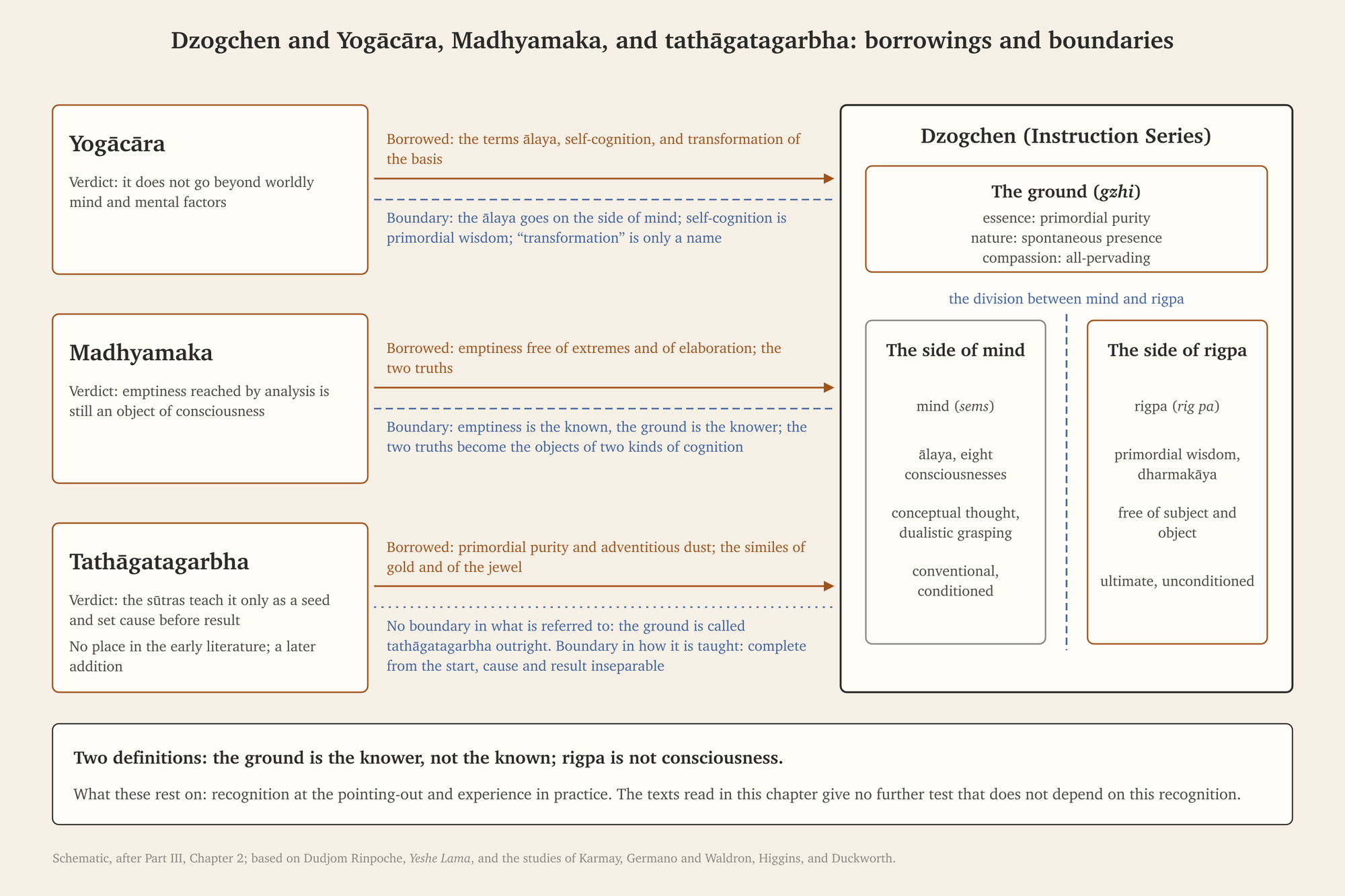
The borrowed terms have all been redefined, and they can be listed in one place.
| Term | Meaning on the source side | Definition on the Dzogchen side |
|---|---|---|
| The ālaya (kun gzhi) | The essence of the causes and effects of all contaminated dharmas; the support of habitual tendencies | In the early period, the primordial ground and bodhicitta; from Longchenpa on, assigned to the side of ordinary mind and unawareness, in contrast to the dharmakāya |
| Self-cognition (rang rig) | The self-cognition of consciousness | Refers to primordial wisdom; Mipam calls it great emptiness, different from the clear knowing of Yogācāra |
| Transformation of the basis | The eight collections of consciousness are transformed into wisdom | The consciousnesses are removed and self-arisen primordial wisdom becomes manifest; "transformation" is only a designation |
| The two truths | The conventional and the ultimate | The object of the mind of dualistic grasping and the object of primordial wisdom |
| Adventitious stains and primordial purity | Tathāgatagarbha is covered by afflictions | The ground is primordially pure, and afflictions and habitual tendencies do not damage its nature; the ground is a support in the manner of a non-support |
As the basis for these two definitions, the texts read in this chapter offer the same kind of thing. Yeshe Lama says that understanding without inner experience is not stable. Sokdokpa answers the Karmapa's dilemma with the difference between rigpa and ordinary mind, and this difference is itself exactly what is in dispute. Mipam's argument ends with the experiential approach. As far as these texts go, how rigpa is to be told apart from consciousness, and the ground that knows from the emptiness that is known, is in the end handed over to recognition in practice; the texts do not give any separate test that does not depend on this recognition.
When Volume 1, Part II, Essay 20, Chapter 3, discussed the way ālaya-consciousness is established, it read it side by side with the dharmas that the Sarvāstivādins established for "continuation," and described this kind of move as establishing a separate bearer for some function. The Dzogchen ground occupies a similar position in its system, while carrying several qualifications: primordial purity, freedom from elaboration, and the nonestablishment of supported and support. This comparison, together with the question of a test raised above, is left for Chapter 11.
References
-
Dudjom Rinpoche, The Nyingma School of Tibetan Buddhism: Its Fundamentals and History, trans. and ed. Gyurme Dorje and Matthew Kapstein, Boston: Wisdom Publications, 1991, vol. 1, p. 294. Hereafter cited as Dudjom. ↩
-
Samten Gyaltsen Karmay, The Great Perfection (rDzogs chen): A Philosophical and Meditative Teaching of Tibetan Buddhism, 2nd ed., Leiden: Brill, 2007, pp. 178–179 and p. 179, n. 33. The Small Hidden Grain is sBas pa'i rgum chung. Karmay's words for the term are "is borrowed from it"; "it" refers to Yogācāra. Hereafter cited as Karmay. ↩
-
Karmay, p. 189. ↩
-
Karmay, p. 179, citing Rongzom's Entering the Way of the Mahāyāna (Theg pa chen po'i tshul la 'jug pa). ↩
-
Karmay, pp. 180–181. Longchenpa's statements come from three works, among them the Treasury of Word and Meaning; for the difference between self-arisen primordial wisdom and the wisdom free of dualistic grasping, see the Treasury of the Dharmadhātu and the Treasury of Philosophical Systems. ↩
-
David F. Germano and William S. Waldron, "A Comparison of Ālaya-vijñāna in Yogācāra and Dzogchen," in Buddhist Thought and Applied Psychological Research: Transcending the Boundaries, ed. D. K. Nauriyal, Michael S. Drummond, and Y. B. Lal, London: Routledge, 2006, pp. 36–68, at p. 53. The electronic edition of the book was used; whether its page numbers agree with the print edition has yet to be checked. ↩
-
Germano and Waldron, "A Comparison of Ālaya-vijñāna," pp. 53–54, following Longchenpa's Treasury of Word and Meaning. The names of the four kinds are this book's own renderings, based on the Tibetan and the English translation. ↩
-
Germano and Waldron, "A Comparison of Ālaya-vijñāna," p. 52. ↩
-
Longchenpa as quoted in Douglas S. Duckworth, Mipam on Buddha-Nature: The Ground of the Nyingma Tradition, Albany: State University of New York Press, 2008, pp. 104–105; the last sentence reads "the difference between the two is vast". ↩
-
Jigme Lingpa, Yeshe Lama, trans. Lama Chönam and Sangye Khandro, Ithaca: Snow Lion, 2008, pp. 47–51. The book gives the Tibetan and the English on facing pages, with the English on the odd-numbered pages. The Tantra of the Adornment of Pointing-Out is Ngo sprod spras pa; for the five states without mind, Jigme Lingpa cites the Madhyāntavibhāga. Hereafter cited as Yeshe Lama. ↩
-
Karmay, pp. 181–183. Karmay says that Sokdokpa's reply "amounts to a riddle" and that the problem "remains unresolved". ↩
-
Dudjom, pp. 294–295. ↩
-
Yeshe Lama, p. 47. ↩
-
Karmay, p. 177. ↩
-
David Higgins, The Philosophical Foundations of Classical rDzogs chen in Tibet, Vienna: Arbeitskreis für Tibetische und Buddhistische Studien, 2013, pp. 107–108. The edition used is the Lausanne doctoral dissertation (2012); page numbers follow the dissertation. Longchenpa's statement is from the autocommentary to chapter 12 of the Wish-Fulfilling Treasury. ↩
-
Duckworth, Mipam on Buddha-Nature, p. 134. ↩
-
Karmay, p. 179, n. 33: "it is only a later innovation". ↩
-
Longchenpa's autocommentary to the Wish-Fulfilling Treasury, as quoted in Duckworth, Mipam on Buddha-Nature, p. 104. ↩
-
Ibid. The translation reads "in the manner of a non-support". ↩
-
Duckworth, Mipam on Buddha-Nature, pp. 105–106. The first statement is from Mipam's Trilogy of Innate Mind, and the second from his Lion's Roar: Exposition of Buddha-Nature; both titles are those of Duckworth's English translation, from which the Chinese titles used in the Chinese edition of this book were rendered. ↩
-
Higgins, The Philosophical Foundations of Classical rDzogs chen in Tibet, p. 248, translates the whole passage and gives the Tibetan; Duckworth, Mipam on Buddha-Nature, p. 131, translates the first half. Both rely on Longchenpa's autocommentary to the Wish-Fulfilling Treasury. For the sentence on the seed, the Tibetan reads "sa bon du yod pa tsam". ↩
-
Duckworth, Mipam on Buddha-Nature, p. 131, quoting Mipam's digest of the section on tenets in the Wish-Fulfilling Treasury, whose title is translated as Concise Summary of the Philosophies from the Wish-Fulfilling Treasury. ↩
-
Duckworth, Mipam on Buddha-Nature, p. 132, quoting Mipam's overview of the Guhyagarbha Tantra, whose title is translated as Overview: Essential Nature of Luminous Clarity. "Subject" here is yul can in Tibetan, translated as "subjectivity". ↩
-
Duckworth, Mipam on Buddha-Nature, pp. 133–134, quoting Bötrül. ↩
-
Duckworth, Mipam on Buddha-Nature, pp. 131, 134. ↩
-
Germano and Waldron, "A Comparison of Ālaya-vijñāna," p. 52. ↩
-
John W. Pettit, Mipham's Beacon of Certainty: Illuminating the View of Dzogchen, the Great Perfection, Boston: Wisdom Publications, 1999, pp. 126–128. On p. 127 the complementarity is called "one of the most important themes" of the treatise; the commentary's introduction cited here is at p. 128. ↩
-
Pettit, Mipham's Beacon of Certainty, p. 115. ↩
-
Mipham Rinpoche, "The Vajra Mirror: Eliminating Doubts Concerning Self-Awareness," trans. Adam Pearcey, Lotsawa House, 2016. A short verse text, without pagination. ↩