Part III, Chapter 7: Tögal II: The Four Visions, Dark Retreat, and the Result
Chapter 6 restated the theory of Tögal, the key points, and the first visions. This chapter restates what comes after: how what is seen is arranged into the four visions, what liberation claims are attached to the four visions, how the same practice is moved into a dark room, how the same visions are written into the intermediate state (bardo) after death, and the result that this path promises. The sources are the three parts of Yeshe Lama on the four visions, the supplementary instructions, and the intermediate state; Dudjom Rinpoche's overview; Hatchell's synthesis based on Stringing a Garland of Pearls; three studies by Germano; Longchenpa's Finding Rest in Meditation; and several accounts of dark retreat.
This chapter makes three points. The four visions write the changes in what is seen as a progress chart that can be anticipated, and attach liberation claims to the individual visions; the weightiest of these is at the second vision: the expanse and awareness separate from the point between the eyebrows, and thereafter saṃsāra is not reentered. Dark retreat and the doctrine of the intermediate state connect the same theory of light to death: the dark room is called a bardo retreat, and what is seen after death is the same set of visions as what was practiced in life. The result is classified by what becomes of the body: it disperses into particles, or it becomes a body of light.
1. The names of the four visions
After the empowerment and the schedule of sessions, Yeshe Lama treats the four visions (snang ba bzhi) under a heading on distinguishing the signs of the stages of the four lamps. Jigme Lingpa first cites a verse from Reverberation of Sound (sGra thal 'gyur) as the general outline: through the vision of the direct perception of dharmatā, one passes beyond the words of the mind that grasps and analyzes; through the vision of increasing experience, deluded appearances vanish and the primordial wisdom of the intermediate state becomes manifest; through the vision of awareness reaching full measure, one passes beyond appearances in which the three kāyas are conceived as belonging to the path; through the vision of the exhaustion of dharmatā, the continuity of saṃsāra in the three realms is cut. He says that the four visions are distinguished according to what is to be purified and the result of purification; they resemble the five paths of the Pāramitā Vehicle, and the difference in speed is like that between a chariot and the sun and moon.1
Dudjom Rinpoche assigns the four visions to the three kāyas: the vision of the direct perception of dharmatā opens the door to the buddha fields; in the vision of increasing experience the bindus in the body approach maturity, and through this the nirmāṇakāya is seen; in the vision of awareness reaching full measure the bindus in the body mature, and through this the saṃbhogakāya is seen; finally all appearances are purified in the maṇḍala of the sole great bindu, everything posited by the mind ceases, and the dharmakāya is seen through the vision in which even the grasping at dharmatā is itself exhausted.2
The Tibetan for the four names and what they refer to are listed below; the details are in the four sections that follow.
| Vision | Tibetan | One-sentence definition |
|---|---|---|
| Direct perception of dharmatā | chos nyid mngon sum | Light and bindus first appear directly before the eyes |
| Increasing experience | nyams gong 'phel | What is seen multiplies, enlarges, and takes shape, and appears constantly without depending on a light source |
| Awareness reaching full measure | rig pa tshad phebs | Buddha bodies appear within the bindus, up to the maṇḍala of the peaceful and wrathful deities |
| Exhaustion of dharmatā | chos nyid zad pa | Everything seen dissolves back into the inner expanse, leaving nothing behind |
The "direct perception" in the first name, Germano points out, is the very term used for "direct perception" in the theory of valid cognition, and it means that at this step the light of dharmatā is seen directly, without inference. He adds that the four visions are generally experienced gradually over a long period, and that the literature also acknowledges the possibility of their appearing all at once.3 The simile that Yeshe Lama uses is the moon: the visions on the path increase gradually, as the moon gradually becomes full; the exhaustion of dharmatā is like the moon of the thirtieth day disappearing into the sky, while the moon itself neither increases nor decreases.4
2. The direct perception of dharmatā
The practice of the first vision has already been described in Chapter 6, Sections 4 and 5: with the sun, the moon, a crystal, or a lamp as the supporting light source, one gazes in accordance with the three key points of gates, field, and wind. Here Jigme Lingpa adds the sequence of what is seen and the signs. The radiance of the tathāgatagarbha in the heart is first seen as the manifestation of the expanse, like the pattern of a rainbow; after that, the circles of light of the lamp of empty bindus and three small linked bindus appear and disappear. Among these appearances, as with the sun and its rays, there is the empty clarity of primordially pure awareness, that is, the awareness of higher insight, which appears as vajra chains. He says that, as with a face and its reflection in a mirror, the appearance and the essence are one and the same, so the vajra chains are called both cause and result; those who do not understand this key point will grasp dharmatā as something really existent and fall into obscuration.5
The signs of liberation at this vision fall under three heads, channels, bindus, and wind: the channels, though fine, are narrow and winding; at the bends two small bindus are linked; the appearances move about. After familiarization, without letting awareness be distracted, one leads it into the fence of the expanse and the bindus; the radiance of the lamps becomes clear and stable without effort, and a samādhi of bliss, clarity, and nonthought arises accordingly. Following Longchenpa's account, Germano says that this vision lasts until three linked bindus appear.6
The text attaches its first liberation claim here. Jigme Lingpa says that at this point, even if one dies prematurely along the way, one will be liberated in the natural nirmāṇakāya pure realms; this is not merely because one has seen outer appearances, and the key point is that one has seen the truth with the eye of insight free from obscuration. He cites Clear Expanse (Klong gsal) in support: awareness is seen directly, and because the truth has been seen, there is no return to the three realms.7
Hatchell's description comes from Stringing a Garland of Pearls and from Bön commentaries, and its angle is slightly different. He says that the most basic form of the teaching is simply to place body, speech, and mind as prescribed and then wait; after some time, visions begin to appear as chaotic lights: in the foreground are frantically moving lights, among them circular forms called bindus and strings of vajra chains, and in the background is a glowing field of blue, the expanse, which is at the same time the fence that encloses the vajra chains.8
3. Increasing experience
Before treating the second vision, Jigme Lingpa first separates it from another kind of meditative experience. The bliss, clarity, and nonthought that arise from the gathering of wind and mind have as their meditative experiences the ten signs, such as smoke and mirage; in these there is a holding by the mind, so they are not liberation. The increase that Dzogchen speaks of is a different matter: the inner, empty dharmatā becomes directly manifest, its radiance increases outward, the channels within become as clear as light, and the afflictions are liberated in the secret place; the three happen at once and do not depend on analysis by the mind.9
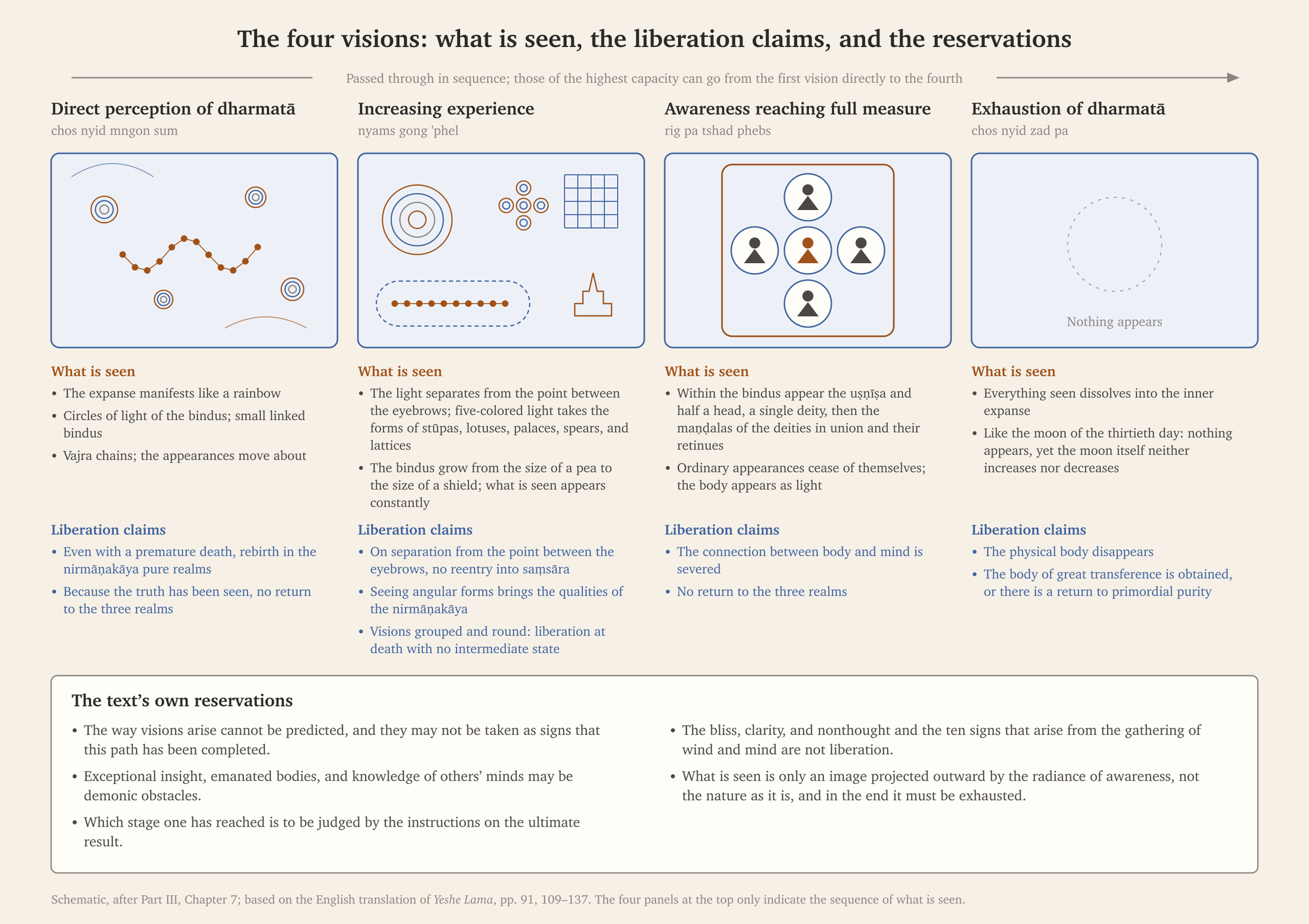
The increase in what is seen is as follows. As the appearances of light increase, the expanse and awareness separate from the point between the eyebrows. Five-colored light appears horizontally, vertically, and in circles; it appears like stūpas, like thousand-petaled lotuses, like palaces, like spears and arrowheads, like lattices, and like the dots on dice. Jigme Lingpa says that none of these appearances can be predicted. The light of the bindus is at first the size of a pea and gradually becomes the size of a shield. The movement of awareness is compared to four things: a bird taking flight, a deer running in the mountains, the slow walk of a certain animal, and a bee settling slowly on a flower. The highest sign of familiarization, he says, citing a tantra, is that all appearances appear as bindus and abide like the Ghanavyūha pure realm; at that time, wherever one looks, the sky is filled with visions of clear light that neither move nor waver. The gaze is adjusted according to the shape of what is seen: for horizontal appearances one looks to the front, for squares to the right, for half-moons upward, for triangles downward, for circles to the left, and for stūpa-like forms straight ahead.10
On the basis of Stringing a Garland of Pearls, Hatchell sorts what is seen in this vision into three groups: shapes, such as stacked flowers, spear points, rows of stūpas, lattices, and tents; bindus, which become finer and finer and gather in groups of five, within which incomplete bodily forms begin to appear; and light, such as rays, bands of color, and rings of light. He points out that the mark of this vision is that what is seen becomes continuous and no longer needs to be induced by gazing at a light source or by other means; the commentary uses the comparison of a jackal's eyes, which shine by day and by night alike; the vajra chains, which had been moving about chaotically, are in this vision drawn into the fence of the expanse and become still.11
The liberation claim attached to the second vision is the weightiest. Its gist is as follows.
If the signs of liberation are distinguished by the degree of familiarization: when the expanse and awareness separate from the point between the eyebrows, the vision of the union of the four aspects of wisdom brings liberation, and thereafter saṃsāra is not reentered. Those for whom appearances arise in angular forms, and who are liberated within the appearances of group formations, are liberated in the natural nirmāṇakāya pure realms. All appearances ripen into the five lights, the appearance of the expanse becomes perfectly round, and the visions appear in group formations, each adorned with a four-petaled lotus; such a person is liberated in the first instant in which the clear light dawns, with no intermediate state. Sole Heir of the Buddha says: how could a fortunate one for whom the expanse and awareness have separated four finger-widths from the point between the eyebrows reenter saṃsāra? One who sees angular forms will accomplish the qualities of the nirmāṇakāya; for one who sees the visions in group formations, it is as stated above.
This passage connects three conditions that can be described visually, namely the distance of the light from the point between the eyebrows, whether the shapes seen are angular or perfectly round, and whether the bindus form groups, to three outcomes respectively: no reentry into saṃsāra, rebirth in the nirmāṇakāya pure realms, and liberation at death without passing through the intermediate state.12
On the boundary between the second and third visions, Jigme Lingpa records two positions. Vimalamitra holds that the appearances of group formations are the result of the vision of increase, and that as soon as a bodily form appears it is awareness reaching full measure; Padmasambhava holds that it is called full measure only from the arising of deities in union until the appearances of increase are complete, and that a single deity may still belong to the vision of increase. Jigme Lingpa considers the two positions to have the same intent: the appearance of a single deity's body both shows that the vision of increase has reached its end and hints at the beginning of the vision of full measure, just as a mountain can be seen from the valleys on both sides of it.13
4. Awareness reaching full measure
Jigme Lingpa explains the name of the third vision as meaning that the qualities of the three kāyas, primordially complete in awareness, are completed as appearances on the path. He uses this to criticize other tenet systems: they hold that the qualities of the kāyas and wisdom of the tathāgatagarbha are something that exists and can be obtained, and so they have something to hope for and pursue separate accomplishments such as the major and minor marks.14
The sequence of what is seen is described very concretely. As the qualities of increase gain strength, all appearances become clear light. In the center of the five grouped bindus there first appear the uṣṇīṣa and half the head of a deity, and then the complete body of a single deity. When the primordial wisdom of the saṃbhogakāya reaches full measure, the buddhas of the five families, Akṣobhya and the others, first appear as single deities, then with their full ornaments, then in union with their consorts, complete in every respect; the principal deities and their retinues each appear in group formations, surrounded on the outside by the vajra wall of the maṇḍala and the like. What is seen is extremely clear, and ordinary appearances cease of themselves. Wherever the mind is directed, it can penetrate: inanimate things are shaken by it, one's own body can be seen as partless particles, and solid things such as mountains and rocks can be passed through without obstruction. The dualistic mind collapses completely, the sources of hope and fear are abandoned, and the person becomes like a babbling fool.15
The text also treats full measure under two aspects, body and mind. On the side of the body, Jigme Lingpa cites the root tantra: windows of light appear between the particles of the body, and fine rays shine out through them; the solid body ceases of itself, and an unobstructed, stainless body of light appears, marked at its center with the syllable A; the ūrṇā between the eyebrows radiates light to the length of one fathom; the uṣṇīṣa is as if lifted by the wind; the clusters of light between the fingers of the peaceful deities are like strung rosary beads; all the wrathful deities actually emerge from the palace in the skull. He explains that at this time all appearances are the fields of the five buddhas, and the light from the hearts of the buddhas shines into the syllable A at one's own heart, whereby one receives the empowerment of great light; the bindus of the wind of primordial wisdom stack up on the uṣṇīṣa in nine or five tiers; every pore and every particle is complete as a buddha field. On the side of the mind, conceptual mind, mentation, and consciousness disappear together, and only the stainless dharmadhātu remains; the practitioner obtains the six superknowledges, can know the minds of others, and can see countless buddha fields and distant things that are blocked from view by solid matter.16
Two passages at the end of this vision need to be noted. First, the coarse connection between body and mind is reversed at this point, and only a subtle portion remains, like the flash of a shooting star; Jigme Lingpa cites Reverberation of Sound as saying that once the connection between body and mind is severed, there is no return to the three realms. Second, he records and rebuts a criticism, and then explains how his own tradition regards what is seen.17
The criticism comes from those in Tibet whom he calls scholars of other schools: they say that the appearances of empty form are merely deluded perception, and that the four visions of Dzogchen belong to a non-Buddhist tradition called "viewers of the sun." Jigme Lingpa says that such people commit the root downfall of hostility toward the Dharma, and that without realizing it they disparage the teachings on the appearances of empty form in the Kālacakra and the other texts that they themselves follow. Others maintain that it is a wrong view to say that there are no kāyas and wisdom at the level of buddhahood, and that the level of buddhahood is both an illusory body and true reality. Jigme Lingpa answers with the position of his own tradition: the qualities of the tathāgatagarbha are the form body, and his tradition does not regard this form body as a deluded appearance; like the moon, whose nature is full from the beginning, it is gradually completed in the vision of increase as an appearance on the path. But such an appearance is only an image projected outward by the radiance of awareness, not the nature as it is, so his tradition does not grasp it as true reality; as the moon disappears on the thirtieth day, the radiance that manifests outwardly must come to exhaustion. He goes on to say that when phenomena reach the stage of exhaustion, one's own tenet system also falls apart, the guru's instructions also disappear, the boundaries of view, meditation, and conduct are all empty, and there is likewise no view of the dharmakāya; since the continuity of kāyas and wisdom has ceased, there are no buddhas and no sentient beings.18
5. The exhaustion of dharmatā
For the fourth vision, Jigme Lingpa cites the root tantra for the definition: the vision of the exhaustion of dharmatā empties out the remaining visions, exhausts the body and the objects of the senses, is freed from the delusion of conceptual thought, and departs from the basis of verbal expression. He draws a comparison with the teaching of the lower levels: from Mahāyoga downward, the side of method has countless generation stages, all of which must be gathered into the empty insight of the completion stage; likewise here, the wind is made to increase as primordial wisdom by relying on the three key points, and through the power of purification in dharmatā, the deluded appearances of outer objects and the delusion of the inner mind, together with the habitual tendencies of mentation, cease of themselves, and even the secret appearances of clear light dissolve into dharmatā. This is called "exhaustion." In the final analysis it is like the moon of the thirtieth day, when nothing at all appears and yet the nature of the moon neither increases nor decreases; the radiance of awareness dissolves into the inner expanse, as the light of a crystal is drawn back inside it.19
Exhaustion comes about in two ways. Gradual exhaustion is the four visions reaching their full extent one after another. Sudden exhaustion is extremely rare: a person of the very highest capacity, at the very moment of seeing the vision of the direct perception of dharmatā, by force of familiarization passes over the visions of increase and full measure and arrives directly at exhaustion.20
On what follows exhaustion, Jigme Lingpa speaks under three heads: the solid body disappears, and the enemy that is the four elements can do no harm; the afflictions disappear, and recollection and its support leave no trace; appearances disappear, the appearances of going, of staying, and of the sun and moon leave no impression, and there is not even the thought that this has happened. This is called all forms entering nirvāṇa.21 The result obtained at this point is described in Section 9, together with the accounts of Dudjom Rinpoche and others.
Hatchell makes one observation on the fourth vision: this tradition gives such weight to what is seen, and yet in the end it depicts transcendence as the dissolution of what is seen; it is still called a "vision," as if the absence of what is seen opened a space in which one sees how things really are.22
6. Signs, liberation claims, and reservations
When the statements attached to the four visions at various places are brought together, they fall into three classes.
The first class is the liberation claims, which have already been listed in the sections above. First vision: even if one dies prematurely along the way, one is reborn in the nirmāṇakāya pure realms; because the truth has been seen, there is no return to the three realms. Second vision: the expanse and awareness separate from the point between the eyebrows, and thereafter saṃsāra is not reentered; one for whom they have separated four finger-widths from the point between the eyebrows cannot possibly reenter saṃsāra; one who sees angular forms obtains the qualities of the nirmāṇakāya; one whose visions are grouped and round is liberated at death with no intermediate state. Third vision: the connection between body and mind is severed, and there is no return to the three realms.
The second class is signs other than what is seen, and it comes from the supplementary instructions at the end of the Tögal section.23 Among these, the item on the "three abidings" assigns to each of the four visions signs of the three doors of body, speech, and mind, all written as similes. At the direct perception of dharmatā, the body is like a tortoise placed in a copper basin, speech is like a mute, and the mind is like a bird caught in a net: wherever it is put, there it stays. At increasing experience, the body is like a person with a terminal illness, with no sense of shame or reserve; speech is like a madman's, heedless of consequences; the mind is like a person intoxicated after being poisoned seven times, and no longer engages in the activities of saṃsāra. At awareness reaching full measure, the body is unobstructed by the five elements, like an elephant stuck in mud that pulls itself out by its own strength; speech is like the song of a young kumbhāṇḍa, and whatever is said is accepted by others; the mind is certain not to reenter saṃsāra, like a person who has had smallpox and will not catch it again. At the exhaustion of dharmatā, the body is like a corpse in a charnel ground, without the least fear even when surrounded by a hundred messengers of Yama; speech is like an echo, only repeating the words of others; the mind is like a person shot through the heart by an arrow: awareness is discerned on the spot, and like mist dispersing it departs for the ground of primordial purity.24
The same place also has a set of "unchanging secret signs": the body is as light as cotton, the complexion is fair and clear, white hair and wrinkles disappear, white hair turns black, new teeth grow, the hair and nails stop growing, and the hand emblems and seed syllables of the five families appear on the body; whatever one says benefits others, and one naturally understands many points of Dharma and the languages of the six realms; food, drink, and clothing are no longer needed, and one can remain in samādhi for months or years; afflictions no longer arise in the mindstream. There is also an item that takes dreams as the measure: for the best, dreams cease and sleep appears as clear light, which is a sign of attaining buddhahood in this life; for the middling, one knows in the dream that one is dreaming, and by familiarity with the transformation of dreams attains buddhahood in the intermediate state; for the lesser, the continuity of bad dreams is cut and there are only good dreams, and one will be reborn in the natural nirmāṇakāya pure realms.25 Germano, summarizing the chapter on signs and measures in Longchenpa's Treasury of Word and Meaning (Tshig don mdzod), says that analysis of this kind allows practitioners to observe empirically the success or failure of their own practice and to guard against stagnation and deviation, and also helps teachers assess their disciples; the number and strangeness of the kinds of signs is also a check on those who take understanding for realization.26
The third class is the text's own reservations, of which there are five. First, the way in which visions arise differs from person to person and cannot be predicted, and they may not be taken as signs that this path has been completed; see Chapter 6, Section 5. Of the variously shaped appearances in the second vision, too, Jigme Lingpa says that none can be predicted. Second, the bliss, clarity, and nonthought and the ten signs that arise from the gathering of wind and mind are not liberation. Third, the supplementary instructions cite Self-Arisen Awareness (Rig pa rang shar) as saying that when exceptional insight arises in the mind, one must recognize it as the deception of a demon. Jigme Lingpa gives the case of those of dull faculties: they grasp at what is seen and take it to be real, and they are verbally fluent without any deep understanding; such people can emanate bodies of various colors, a second image appears in their reflection in a mirror, and they can know the minds of others; these are listed as signs of demonic obstacles, and the remedy is such measures as anointing the body with frankincense and nectar. Ḍākinīs appearing in the sky and prophesying that one will obtain the common accomplishments are likewise a test of meditative experience; the sign of deviation is that the person's mind becomes like that of a different person, attachment, aversion, and refuting and affirming arise, and the person goes more and more against the Dharma. Fourth, from the way wind and mind combine, an unreliable samādhi may arise suddenly, with indeterminate deity forms and masses of light appearing in the sky; this is listed as a sign of the waxing and waning of meditative experience, and the remedy is at times to immerse the body in water, at times to place two pieces of wood sixteen finger-widths long under the jaw, to massage the body with sandalwood oil, to eat cooling food, and to recite the syllable A. Fifth, what is seen is only an image projected outward by the radiance of awareness, not the nature as it is, and in the end it must be exhausted; see Section 4.27
With the three classes set side by side, an arrangement can be seen. The reservations are directed at what is seen as such: it cannot be predicted, it may be a demonic obstacle, and it is not the nature. The liberation claims, however, are tied to particular features of what is seen: how many finger-widths from the point between the eyebrows, angular or perfectly round, grouped or not. The text does not explain how these two sides fit together; it gives only one general rule, in a sentence cited in Chapter 6: what stage one has reached is to be judged by the instructions on the ultimate result.
The content of the four visions is set out in a table.
| Vision | What is seen | Liberation claims attached by the text | Signs of the three doors |
|---|---|---|---|
| Direct perception of dharmatā | The manifestation of the expanse, like a rainbow; the circles of light of the lamp of empty bindus and small linked bindus; vajra chains; the appearances move about | Even with a premature death, rebirth in the nirmāṇakāya pure realms; because the truth has been seen, no return to the three realms | Body like a tortoise in a basin, speech like a mute, mind like a bird in a net |
| Increasing experience | The light separates from the point between the eyebrows; five-colored light takes horizontal, vertical, and circular forms and the forms of stūpas, lotuses, palaces, spears, and lattices; the bindus grow from the size of a pea to the size of a shield; what is seen appears constantly, and the vajra chains enter the fence and become still | On separation from the point between the eyebrows, no reentry into saṃsāra; seeing angular forms brings the qualities of the nirmāṇakāya; those whose visions are grouped and round are liberated at death with no intermediate state | Body like a terminally ill person, speech like a madman's, mind like a person intoxicated by poison |
| Awareness reaching full measure | Within the bindus the uṣṇīṣa and half a head appear first, then a single deity, the deity with ornaments, the deity in union, and the maṇḍala with its retinue; ordinary appearances cease of themselves; the body appears as light, and the wrathful deities appear in the skull | The connection between body and mind is severed, with no return to the three realms; the six superknowledges are obtained | Body like an elephant pulling itself out of mud, speech like a pleasing song, mind like a person who has had smallpox and will not catch it again |
| Exhaustion of dharmatā | Everything seen dissolves into the inner expanse, like the moon of the thirtieth day | The physical body disappears; the body of great transference is obtained, or there is a return to primordial purity | Body like a corpse in a charnel ground, speech like an echo, mind like a person shot through the heart by an arrow |
7. Dark retreat
Everything described above takes practice in daylight as the standard. Yeshe Lama does not treat dark retreat. This tradition has a separate practice of cultivating the same visions in total darkness, called mun mtshams in Tibetan; Karmay sets it alongside gazing at sunlight as the two practices that are built directly on the theory of the light in the heart.28
Two places in Longchenpa's works deal with it. The seventh vajra topic of the Treasury of Word and Meaning explains how to induce the appearances of the lamps, and this includes what is called dark retreat. In Germano's summary, it is practiced alone in a specially prepared hut that no outside light at all can enter; because there is no light source to gaze at, certain special means are used instead to induce the appearances of light; it is carried out in combination with the practice done outside in reliance on sunlight, and the sequence of what is seen is broadly the same, with slight differences in the early phase; the final aim is for these self-manifesting visions of light to appear naturally by day and by night alike. Germano stresses that there is none of the contrived visualization common in tantric practice here; a series of very simple postures and key points is used to let the visions of light unfold of themselves.29 The first vajra topic of Finding Rest in Meditation prescribes the form of the dark house used for the yoga of the night: the house has a double wall, one practices in a raised chamber within the inner wall, and the head is pillowed toward the north, as at the time the Buddha entered nirvāṇa. In his autocommentary Longchenpa says that the doors in the two walls face different directions, and that a window is opened in each of the four walls to give light and allow walking around when one is not in session; the windows are blocked up when a session begins. The yoga of the day is done under a south-facing half shelter on the roof, from which one must be able to see the open sky and distant snow mountains, flowing water, and wooded valleys.30
Hatchell records present-day practice: all the windows and cracks of a room are sealed, and the entrance is built as a winding passage so that air and food can come in and light cannot; a typical period is seven weeks.31 Germano points out that this forty-nine-day dark retreat is called a "bardo retreat," and that the number forty-nine evidently corresponds to the duration of the intermediate state after death; in both situations, death and the dark house, what is seen arises out of darkness, natural in the one case and artificial in the other.32
First-person accounts of dark retreat are rare in the traditional biographies; this book has found two. Shabkar writes in his autobiography that he sealed himself in a mountain cave with mud and practiced in total darkness according to the instructions of Yangti Nagpo, and that he was amazed to see the visions the texts describe and other signs. The English translator's note says that this cycle of teachings belongs to the most profound and secret class of Atiyoga, takes the hundred peaceful and wrathful deities and the stages of Dzogchen as its content, and comes with instructions for practice in total darkness.33 The other is the oral account of Patrul's disciple Chatral Kunga Palden, which Dilgo Khyentse recorded in the biography he wrote of him. Kunga Palden says that the fortress of a Derge official stood empty and had in it a room that let in no light at all, and that he did a hundred-day dark retreat there. He describes what he saw at first: a deep ravine whose end could not be seen, with thick darkness gathering above and below, and himself crouching in the ravine on a stone the size of two feet, with the wind howling; on another occasion a hail cloud rolled in and swept him up into space, he recalled the merging of his own mind with the guru's mind and felt joy, and then he became uneasy again. Later many pure and impure visions appeared; inside a bindu the size of a fingernail, the beings of the six realms were arranged according to their suffering and happiness, distinct and unmixed, and from this he gained confidence. He says at the end that after entering dark retreat he had expected the visions of Tögal to increase, and that in the event they did not increase.34 There is one further record in the third person: Dudjom Rinpoche's history records that Longchenpa in his early years practiced yoga in darkness for five months in a mountain cave and afterward saw extraordinary visions; see Chapter 8, Section 2.35
Present-day accounts come mostly from Western practitioners. Von Bujdoss reports having done a forty-nine-day dark retreat; on coming out, he first took down the blackout panels at night, and as the faint light of early morning came in, the visions that remained from the retreat began to fade; the visions he lists are spheres of rainbow light containing buddhas, ḍākinīs, lineage masters, and the deities of the bardo.36 These accounts all speak of conditions and risks. Von Bujdoss says that a period is usually seven to forty-nine days, and that it is safer for beginners to start with a few hours; the practitioner must first have learned the instructions from an experienced teacher, have had sufficient training, and be in good health; this practice can destabilize the mind of a person who is not prepared, and the instructions contain many warnings of this kind; when it becomes too difficult one should know to stop, and there is no shame in stopping. He also says that Chögyam Trungpa equated dark retreat with going through the bardo.37 Palmer records that her two teachers repeatedly stressed the risks in interviews, especially the possibility of triggering psychosis. Lowenthal says at the end of his book that one should not enter dark retreat without proper preparation, and that the guidance of a teacher is needed; he himself did eleven dark retreats over nine years and guided eighteen students into retreat.38
The nature of this material needs to be stated. All of what exists is self-report and secondhand report by people who completed the retreat; it contains no records of people who withdrew partway or became disturbed, and no statistics on numbers; for dark retreat in the practice communities of Tibet, this book has found no field studies. So on what dark retreat usually results in, and on what proportion of people are able to complete it, the existing material is not sufficient for a judgment.
8. The intermediate state
The instructions that Yeshe Lama sets out for those of middling capacity treat four intermediate states: the natural intermediate state, the intermediate state of dying, the intermediate state of dharmatā, and the intermediate state of becoming.39 The one directly related to Tögal is the third.
Jigme Lingpa uses the simile of mother and child to explain the relation between what is practiced in life and what is seen after death. The practice of Trekchö brings realization of the ground of awareness, the great nature of primordial purity, which abides like a mother; the phenomena that arise from the ground's manifestation are like a child, and in life one becomes familiar with them through Tögal; in the intermediate state, like a child recognizing its mother, one recognizes that the essence and its own dynamic energy are like the sun and its rays, knows for certain that this is nothing other than one's own appearance, and attains buddhahood at the moment of recognition, with no intermediate state.40
The sequence of the intermediate state of dharmatā is divided into several steps of dissolution, and each step is an opportunity for liberation.41
In the first step, after the connection between body and mind is severed, the ālaya-consciousness dissolves into the dharmadhātu, and the natural clear light dawns like a cloudless autumn sky, without limit, empty and clear, and unobscured. If one recognizes it and rests without contrivance, one is liberated on the spot in the inner expanse of primordial purity.
The second step is called space dissolving into clear light. Solid appearances cease and the body of light becomes manifest, and the entire field of experience appears as a maṇḍala of five-colored rays of light; mountains, rocks, forests, the sun and moon, and the whole supporting world disappear, and wherever one looks it is like unfurled brocade, or like looking at sunlight through thin gauze, with everything shimmering and flickering and the radiance dazzling. Here Jigme Lingpa makes the statement that links life and death: at this time, these appearances last as companions of awareness for as long as corresponds to one's degree of familiarity with Tögal; for those without familiarity, they vanish as quickly as a shooting star. One who can recognize what is seen as one's own appearance is, in the first instant, convinced that appearances are unreal; in the second instant, the appearances are liberated where they are; in the third instant, unchanging liberation is attained.
The third step is called clear light dissolving into union, and all appearances appear only as bodily forms. The wrathful deities emerge from the palace in the skull; their bodies are as small as mustard seeds, but in the intermediate state they are so large that they seem to fill the world; their heads, faces, and postures cannot be predicted, they brandish all kinds of weapons, and their roar is like a thousand dragons roaring together. The peaceful deities appear in group formations of the five families, each in union with a consort and each surrounded by a ring of light, and they arise in the order of the "meditation days": on the first day Vairocana, on the second Akṣobhya, on the third Ratnasambhava, on the fourth Amitābha, and on the fifth the principal deity of the karma family (Amoghasiddhi). One so-called meditation day is as long as the time the deceased was able to remain in samādhi while alive. Jigme Lingpa cites an instruction text as saying that those who have not received the key instructions cannot recognize the three, sounds, lights, and rays; the lights give rise to fright, the sounds to alarm, and the rays to dread, and so they wander on once again.
The fourth step is called union dissolving into wisdom, and "the union of the four aspects of wisdom" arises: four carpets of light, blue, white, yellow, and red, are stacked from the bottom upward, each adorned with bindus, and at the very top is a mass of light like a peacock feather. At this point one must be like a physician draining the fluid around the heart with a golden needle, where the needle may not waver in the slightest: before each appearance one rests in present awareness without wavering.
The fifth step is called wisdom dissolving into spontaneous presence. Above, primordial purity arises like a clear sky; below it, in order, are the maṇḍala of the wrathful deities, the maṇḍala of the peaceful deities, and the natural nirmāṇakāya pure realms, and at the very bottom are the deluded appearances of the six realms. This is called the ground's manifestation that does not depart from the ground. After this the visions of spontaneous presence dissolve inward in eight ways, and the practitioner rests in the empty awareness of primordial purity and secures the ground of freedom.
On the time needed for liberation, the tantras do not agree, and give such figures as three instants, five days, twenty-one instants, and twenty-one days; Jigme Lingpa says that this depends on capacity, and cautions that "instants" and "meditation days" must not be confused. He also makes a comparison: the tantras of Mahāyoga also teach, to some extent, that the illusory body of the intermediate state appears as the saṃbhogakāya, but they are not tantras of the instructions, and the spontaneously self-manifesting appearances are left hidden and unstated there; Six Expanses (Klong drug pa) says that the pure intermediate state of dharmatā and the illusory body of deity meditation are extremely similar and easily confused.
The "union of the four aspects of wisdom" and the appearances in "group formations," which occurred in the liberation claim of the second vision, are here two steps in what is seen after death; the peaceful and wrathful deities of the third vision here arise day by day. The four visions in life and the intermediate state after death use the same set of visions, and the order is broadly the same as well.
Germano explains this relation from the side of textual history. He says that the set of the hundred peaceful and wrathful deities derives from the Mahāyoga tantras, especially the system of the Guhyagarbha Tantra; Liberation Through Hearing in the Intermediate State (Bar do thos grol), revealed by Karma Lingpa in the fourteenth century, is to a large extent a systematization of the Heart Essence teachings. The Heart Essence practice lets specific, sequenced images arise of themselves, and the arising of the peaceful and wrathful deities after death described in Liberation Through Hearing in the Intermediate State corresponds to this exactly, the same set of deities appearing in both; these deities are said to flow out from the heart, and to appear in these specific forms whether or not one was familiar with them in life. He therefore says that Tögal can be seen as bringing the experience after death into life, as the practice in this life of Liberation Through Hearing in the Intermediate State.42 In another article he groups content of this kind under the heading of "funerary" Buddhism and divides it into five items: charnel grounds; funerary rituals; the signs of dying and death, especially relics; the doctrine of the intermediate state; and yogas based on death. He holds that the early Dzogchen literature has none of these elements, and that they were incorporated step by step, reaching a peak with the rise of the Heart Essence in the eleventh century.43
Part II, Chapter 3, listed several fallback gates of esoteric Buddhism, and the row "intermediate state of dharmatā" there refers to this system. By the threefold division of Yeshe Lama, those of highest capacity reach the primordial ground in this life, those of middling capacity attain buddhahood in the intermediate state, and those of lower capacity are reborn in the natural nirmāṇakāya pure realms; the intermediate state is provided for those who have not succeeded in this life.
9. The result
The result that this path promises is stated in every source in terms of what becomes of the body.
Jigme Lingpa first distinguishes two kinds of buddhahood. One is called complete and perfect buddhahood, in which the body leaves no remainder of any kind; the other is called manifest buddhahood, and it is accompanied by signs such as lights, sounds, bodily forms, relics, and earthquakes. He says that the former includes Jetsün Sengé Wangchuk and the masters before him who were renowned for accomplishment; the example of the latter is Longchenpa, who displayed the signs at the charnel ground of Chimpu and left bones and relics that the four elements cannot destroy, while the earth shook and the six kinds of signs were repeated seven times.44
The difference between the results of Trekchö and Tögal was given in Jigme Lingpa's words in Chapter 6, Section 1: by Trekchö the body disperses into particles and the mind dissolves into dharmatā, and one is liberated only in the state of primordial purity; with Tögal the body turns to particles and becomes clear light, and one gains mastery over birth and entering, which is unique to Tögal. Dudjom Rinpoche says that once the realization of Trekchö is stable, the practitioner finally dissolves into the great place of liberation that is primordial purity, and the coarse particles of the four elements are transformed into the power of the fire of primordial wisdom and vanish, accompanied by great miraculous displays; if there is work to be done for the benefit of others, the dispersed particles emanate and leave behind four kinds of relics. When the four visions of Tögal are complete, the form body continues to appear like the reflection of the moon in water while awareness abides in the signless, and from this limitless activity for the benefit of others is carried out; this is called the body of great transference, and it is the body that Padmasambhava and Vimalamitra attained. When for the time being there are none to be trained, the form body is gathered into the inner expanse, and primordial wisdom abides within the inwardly luminous youthful vase body.45 Karmay cites Longchenpa's own words, which are to the same effect: the two practices are alike in purifying away the coarse matter, outer and inner; in Trekchö one is liberated into primordial purity at the instant in which the particles each disperse and vanish, and there is no appearance of a body of light; Tögal has the body of light, and by it the great transference is accomplished; the difference lies only in whether or not there is a body of light, and the manner of liberation into primordial purity does not differ. Karmay also points out that the term "without remainder," common to Buddhism in general, takes on a new meaning in the literature of the Instruction Series, where it refers to the gradual dissolution of the body and its continued existence in the form of a body of light; the name rainbow body probably derives from the body turning into lights of various colors, and the idea itself is not unique to Dzogchen.46
On what follows the attainment of the body of great transference, Jigme Lingpa writes: the supporting world and the sentient beings supported in it all appear like the moon in water, like a dream; his own body too is like a reflection in a mirror, unobstructed and insubstantial; what he sees cannot be seen by those whose eyes are impure, as when the king prostrated to the body of Padmasambhava and his head touched only the cushion. Thereafter the miraculous displays are inconceivable; he benefits beings directly or indirectly everywhere in the six realms, and accomplishes one special activity, namely causing three thousand fortunate people to be liberated "without remainder"; finally he attains buddhahood in the youthful vase body of dharmatā, and Padmasambhava and Vimalamitra are the ready examples.47
Thondup's introduction sorts the distinctions above under the two names that are current today. He says that the most distinctive sign at the death of a Dzogchen practitioner is the dissolution or transformation of the body, of which there are two main kinds: dissolving the particles of the body through Trekchö, commonly called the rainbow body; and attaining the body of light through Tögal, that is, the great transference. Elsewhere he says that there are two classes of accomplished masters: one class, such as Vimalamitra, Padmasambhava, and Jetsün Sengé Wangchuk, transform the physical body into a subtle body of light and do not die, and appear as circumstances require; the other is the rainbow body attained by many practitioners over the generations, in which at death the body dissolves amid displays of light and leaves behind only the nails and hair. He further cites the four modes of dissolution from Union of Sun and Moon (Nyi zla kha sbyor): dying like a ḍākinī, dying like a vidyādhara, burning out like a fire, and becoming invisible like space.48
Two points in these accounts bear on what follows. The statement that those whose eyes are impure do not see makes the body of great transference something that appears only to some people. Leaving behind hair and nails, leaving behind relics, and leaving no remainder at all: all three outcomes are counted as accomplishment. Individual cases and the investigation of cases are left to Chapters 9 and 10.
10. Summary of this chapter
The summary comes to six points.
First, the four visions are a progress chart. What is seen goes from moving points of light and circles of light, to taking shape, enlarging, and appearing constantly, to buddha bodies and the maṇḍala of the peaceful and wrathful deities appearing within the bindus, and in the end it dissolves entirely. What is seen in each vision is described concretely; the buddhas of the five families that appear in the third vision have already had their names and body colors announced by the guru at the empowerment, as noted in Chapter 6, Section 7.
Second, liberation claims are attached to the progress chart, and they are tied to describable features of what is seen. The weightiest is at the second vision: the expanse and awareness separate from the point between the eyebrows, and thereafter saṃsāra is not reentered; one for whom they have separated four finger-widths from the point between the eyebrows cannot possibly reenter saṃsāra.
Third, the text at the same time has its own reservations: what is seen cannot be predicted and is not a sign of completion; the ten signs that arise from wind and mind are not liberation; exceptional insight, emanated bodies, and knowledge of others' minds may be demonic obstacles; what is seen is only an image of the radiance of awareness, not the nature, and in the end it must be exhausted. Jigme Lingpa also records the criticism from other schools that judges the four visions to be the non-Buddhist practice of gazing at the sun. The text does not explain how the reservations and the liberation claims fit together.
Fourth, apart from what is seen there is another set of signs: the similes for the three doors, the rejuvenation of the body, and the cessation of dreams. They stand alongside what is seen as the basis on which practitioner and teacher judge progress.
Fifth, dark retreat and the intermediate state connect this practice to death. Dark retreat cultivates the same visions in a dark room, takes forty-nine days as its period, and is called a bardo retreat; the sequence of the intermediate state of dharmatā uses the same set of visions as the four visions, and what is seen after death lasts as long as corresponds to one's familiarity with Tögal in life. According to Germano, Liberation Through Hearing in the Intermediate State is to a large extent a systematization of the Heart Essence teachings.
Sixth, the result is classified by what becomes of the body: with Trekchö the body disperses into particles, with Tögal it becomes a body of light, and the body of great transference can be seen only by pure eyes.
In the two other supplementary Parts of this volume, what is verified differs in each. The Meditation of Tsongkhapa takes pliancy and certainty about the object of negation as the measure, and Burmese Insight Meditation takes the sequence of insight knowledges as the measure. The Tögal of Dzogchen takes the visions of light that are seen as the measure, and connects them to no longer reentering saṃsāra and to what becomes of the body. Whether these liberation claims hold, what causes the visions, and whether the outcome of the body has been checked are left to Chapter 11, Chapter 10, and Chapter 9 respectively.
References
-
Jigme Lingpa, Yeshe Lama, trans. Lama Chönam and Sangye Khandro, Ithaca: Snow Lion, 2008, p. 109. Hereafter cited as Yeshe Lama. The four visions are at pp. 109–131, the supplementary instructions at pp. 131–141, and the intermediate state at pp. 143–187. The translation renders snang ba as "vision" and sgron ma as "luminosity." ↩
-
Dudjom Rinpoche, The Nyingma School of Tibetan Buddhism: Its Fundamentals and History, trans. and ed. Gyurme Dorje and Matthew Kapstein, Boston: Wisdom Publications, 1991, vol. 1, p. 339. Hereafter cited as Dudjom. The Tibetan for the four visions follows this page. ↩
-
David Germano, "Poetic Thought, the Intelligent Universe, and the Mystery of Self: The Tantric Synthesis of rDzogs Chen in Fourteenth Century Tibet," PhD diss., University of Wisconsin–Madison, 1992, p. 126. Hereafter cited as Germano 1992. ↩
-
Yeshe Lama, pp. 75, 127–129. ↩
-
Yeshe Lama, p. 111. ↩
-
Yeshe Lama, p. 111; Germano 1992, p. 126. ↩
-
Yeshe Lama, pp. 111–113. Where the text above says "dies prematurely along the way," the translation reads "an interruption," which the translators' note 63 explains as "untimely death." ↩
-
Christopher Hatchell, Naked Seeing: The Great Perfection, the Wheel of Time, and Visionary Buddhism in Renaissance Tibet, New York: Oxford University Press, 2014, p. 61. Hereafter cited as Hatchell. ↩
-
Yeshe Lama, pp. 113–115. ↩
-
Yeshe Lama, p. 115. The tantra cited is given in the translation as Lamp That Illuminates Appearances. The slow-walking animal is sharana in the original; the translators' note 66 says that it is a herbivore that moves extremely slowly. ↩
-
Hatchell, p. 62. ↩
-
Yeshe Lama, pp. 115–117. The translation reads "the union of the four aspects of wisdom" and "group formations," and gives the title of the tantra as Sole Heir of the Buddha. The first sentence reads in the translation "thereafter samsara is not reentered." ↩
-
Yeshe Lama, pp. 117–119. ↩
-
Yeshe Lama, p. 119. ↩
-
Yeshe Lama, pp. 119–121. ↩
-
Yeshe Lama, pp. 121–123. ↩
-
Yeshe Lama, pp. 123–125. ↩
-
Yeshe Lama, pp. 125–127. The translation reads "viewers of the sun" and "empty form." ↩
-
Yeshe Lama, pp. 127–129. ↩
-
Yeshe Lama, p. 129. ↩
-
Yeshe Lama, p. 129. ↩
-
Hatchell, p. 63. ↩
-
Yeshe Lama, pp. 131–141. The four supplementary instructions are: holding the ground by the three states of motionlessness, showing the measure by the three abidings, driving in the stake by the three attainments, and showing the signs of liberation by the four confidences. ↩
-
Yeshe Lama, pp. 133–135. ↩
-
Yeshe Lama, pp. 137–139. ↩
-
Germano 1992, p. 128. ↩
-
Yeshe Lama, pp. 91, 113, 115, 125, 135–137. ↩
-
Samten Gyaltsen Karmay, The Great Perfection (rDzogs chen): A Philosophical and Meditative Teaching of Tibetan Buddhism, 2nd ed., Leiden: Brill, 2007, p. 187. ↩
-
Germano 1992, pp. 112–113. ↩
-
Longchenpa, Finding Rest in Meditation, The Trilogy of Rest, vol. 2, trans. Padmakara Translation Group, Boulder: Shambhala, 2018, first vajra topic, stanza 8 and autocommentary. The e-book used has no print pagination. ↩
-
Hatchell, p. 61. ↩
-
David Germano, "Architecture and Absence in the Secret Tantric History of the Great Perfection (rdzogs chen)," Journal of the International Association of Buddhist Studies 17, no. 2 (1994): 203–335, at p. 290. Germano's English is "bardo retreat," and he notes that it follows Fremantle 1987. ↩
-
Shabkar Tsogdruk Rangdrol, The Life of Shabkar: The Autobiography of a Tibetan Yogin, trans. Matthieu Ricard, Ithaca: Snow Lion, 2001, p. 81; for the description of this cycle of teachings see chap. 4, note 17, of the same book. The full Tibetan name of the teaching is yang ti nag po gser gyi 'bru gcig. ↩
-
Dilgo Khyentse, The Wondrous Light of Lunar Nectar: The Biography of Chatral Kunga Palden, trans. Ryan Jacobson, Lotsawa House online edition, 2020, unpaginated. The practice he did is given in the translation as The Guru's Inner Essence. The last sentence reads in the translation "I did not experience any increase." ↩
-
Dudjom, p. 579. ↩
-
Justin von Bujdoss, "Embracing the Darkness," Tricycle, Fall 2023. The text used is the full text as reposted online, which lacks the pagination of the original issue. ↩
-
von Bujdoss, "Embracing the Darkness." ↩
-
Tracie L. Palmer, "Darkness, My Teacher: A Journey into Yangti Yoga," MDiv thesis, Harvard Divinity School, 2024, p. 42; Martin Lowenthal, Dawning of Clear Light: A Western Approach to Tibetan Dark Retreat Meditation, Charlottesville: Hampton Roads, 2003, pp. xxii, 165. Lowenthal relies on instructions of the Bön tradition, and he states that his own way of practicing differs in many respects from traditional dark retreat. ↩
-
Yeshe Lama, p. 143. ↩
-
Yeshe Lama, p. 161. ↩
-
Yeshe Lama, pp. 163–185. The translation names the steps, in order, "space dissolving into clear light," "clear light dissolving into nonduality," "nonduality dissolving into wisdom," and "wisdom dissolving into spontaneous presence"; what is called union above is rendered there as "nonduality." The sentence that links life and death is at p. 165. ↩
-
Germano, "Architecture and Absence," pp. 289–291. The Tibetan title of Liberation Through Hearing in the Intermediate State is Bar do thos grol; Germano gives Karma Lingpa's dates as 1327–1387. ↩
-
David Germano, "The Funerary Transformation of the Great Perfection (Rdzogs chen)," Journal of the International Association of Tibetan Studies 1 (October 2005): 1–54, at pp. 3–4. ↩
-
Yeshe Lama, p. 143. The Tibetan for the two kinds of buddhahood reads yang dag par rdzogs par sangs rgyas pa and mngon par rdzogs par sangs rgyas pa. ↩
-
Dudjom, pp. 336–337, 341–342; the summary in the translators' introduction, p. 38, is the same. The Tibetan for the body of great transference is 'pho ba chen po'i sku. ↩
-
Karmay, The Great Perfection, pp. 193–194. ↩
-
Yeshe Lama, pp. 129–131. ↩
-
Longchen Rabjam, The Practice of Dzogchen, introduced, translated and annotated by Tulku Thondup, ed. Harold Talbott, 2nd ed., Ithaca: Snow Lion, 1996, pp. 82–83, 137–138. The Tibetan for rainbow body is 'ja' lus, and for body of light 'od lus. ↩