Part III, Chapter 3: Origins: Dunhuang, the Lamp for the Eye of Meditation, the Heart Essence, and the Treasures
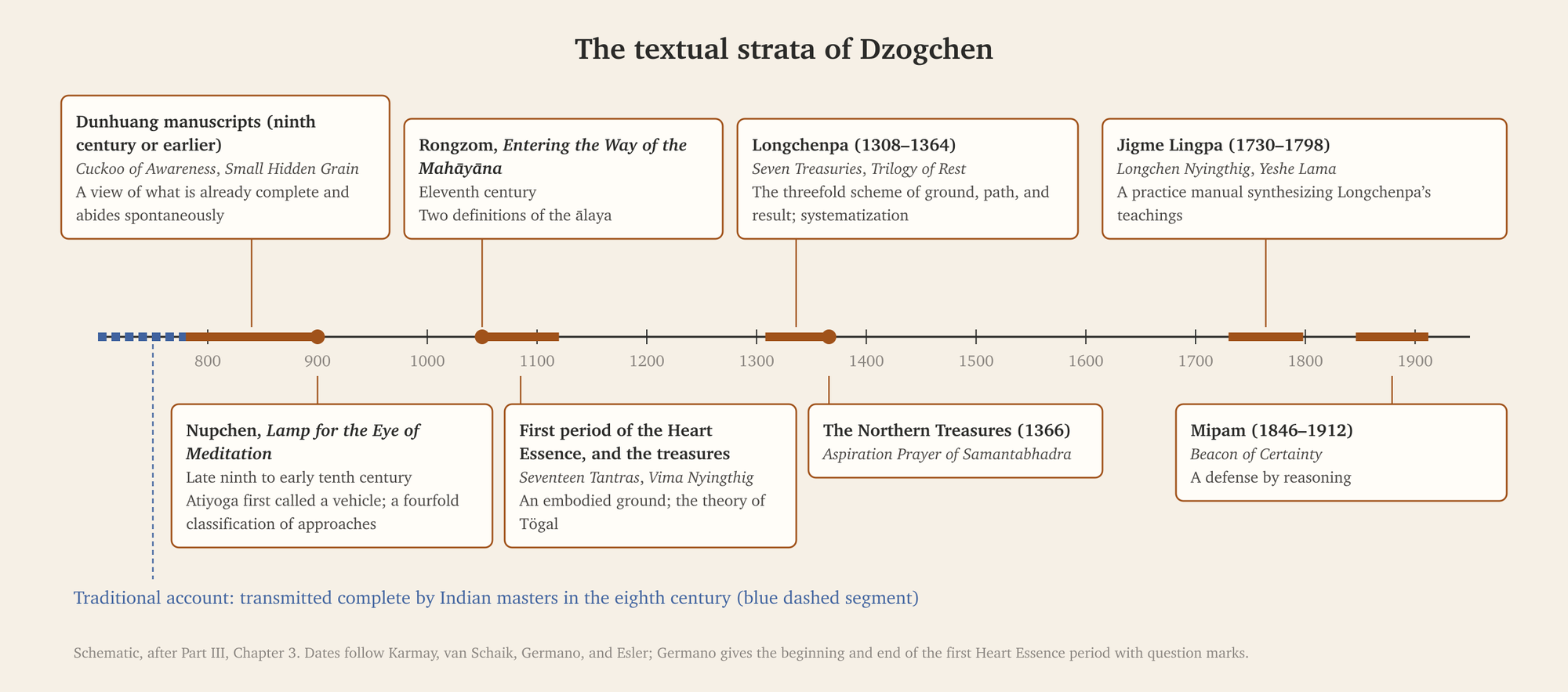
The traditional Nyingma account says that the branches of Dzogchen, the Great Perfection, had all been transmitted to Tibet in complete form by Indian masters in the eighth century. Volume 1, Essay 11, Chapter 3, discussed this historical self-identification and pointed out that the name "Nyingma school" took shape only in the Later Diffusion. The surviving texts give a different picture: a discernible sequence of chronological strata, running from the short texts of Dunhuang in the eighth and ninth centuries, through Nupchen's doctrinal classification in the tenth century, the Heart Essence and the treasures from the eleventh century onward, and Longchenpa's systematization in the fourteenth century, to Jigme Lingpa's Longchen Nyingthig in the eighteenth century. The view described in the two preceding chapters is a product of the later strata of this sequence. This chapter restates the strata in chronological order, and the relation between Dzogchen and Chan is also dealt with in the course of it.
Germano sums up the disagreement between traditional historiography and modern research in three points. Traditional historiography takes the revelation and excavation of treasures as its narrative, presents every branch of Dzogchen as something completed in the eighth century by non-Tibetan authors, stresses that the branches agree with one another, and gives no separate account of how each branch relates to the tantras. His own research argues that most of the relevant literature was written after the eighth century by Tibetans, that the branches were movements that competed with and criticized one another, and that their relation to the tantras changed over time.1
1. Dunhuang
The earliest material evidence is the Tibetan manuscripts from Dunhuang. Among the manuscripts acquired by Stein, Karmay found three documents connected with Dzogchen: IOL 647, IOL 594, and IOL 689/2. He calls the first two prototypes of the later Dzogchen literature; the third is a list of three lines of teachers in Tibet in the eighth and ninth centuries, which includes the names of people in a Dzogchen line.2
IOL 647 consists of five folios and contains a basic text of only six lines together with a commentary on it, neither of which names its author. The commentary gives the six lines three titles: Cuckoo of Awareness is the title by simile, Ornament of the Appearance That Brings Awareness is the title by meaning, and Six Vajra Lines is the title by number. The six lines are also found as Chapter 31 of the All-Creating King, and they are listed first among the eighteen texts of the Mind Series; the Lamp for the Eye of Meditation quotes the text twice, which shows that it was already circulating under this title before the eleventh century. Karmay dates this manuscript to the ninth century, and possibly even the eighth.3 IOL 594 is titled Small Hidden Grain; its preface names Buddhagupta as the author and assigns the text to the category of Atiyoga.4
Karmay points out, line by line, where the content of the six lines agrees with the later view: the first two lines speak of "nonduality"; the middle two speak of going beyond the two extremes of conceptuality and nonconceptuality; the fifth speaks of being "already complete"; and the last speaks of abiding in spontaneous presence. He notes in particular that the line saying that it is not conceptualized as being thus is easily read as the nonconceptuality prized by Chan, whereas what it actually refers to is the original aspect of the mind; according to the Dzogchen tradition, the term "nonconceptuality" itself presupposes "conceptuality" as its opposite and so still falls within the two extremes.5
On the basis of these manuscripts van Schaik makes two points. First, in the ninth century there was already a recognizable Dzogchen, close to what was later called the Mind Series; the Mind Series literature has only one central theme, namely that the awakened mind is immediately present, and that all practices aimed at creating, cultivating, or uncovering the awakened state are therefore useless. Second, the authors of these early texts were the same people who wrote the commentaries on the Mahāyoga tantras; there were already two different kinds of text at the time, but the practice of assigning them to the two categories of Mahāyoga and Atiyoga had not yet taken shape.6
Karmay's estimate of the starting point agrees with this: Dzogchen took shape as a distinct religious movement in the ninth century and existed at least in embryonic form in the eighth; after Langdarma's persecution of Buddhism, it continued and developed along the line of Mahāyoga until the monastic system was reestablished in the eleventh century.7
2. The Lamp for the Eye of Meditation of Nupchen
The second stratum is the Lamp for the Eye of Meditation by Nupchen Sangye Yeshe (gNubs chen Sangs rgyas ye shes), composed around the end of the ninth century or the beginning of the tenth. Chapter 1 has already cited van Schaik's judgment that the earliest datable instance in which Atiyoga is explicitly treated as a vehicle is found in this book. It is at the same time Nyingma's own earliest doctrinal classification, and Esler considers that it may be the first doxography written by a Tibetan.8
The book divides the approaches to awakening into four, which from lowest to highest are: the gradual approach, that is, the sūtra teaching of gradual entry; the simultaneous approach, that is, the sūtra teaching of simultaneous entry, meaning the Chan of Moheyan's line; Mahāyoga; and Atiyoga, that is, Dzogchen.9 As Karmay summarizes it, Nupchen holds that the simultaneous approach derives from scriptures that state the real meaning fully and explicitly, and the gradual approach from scriptures that do not, so that the teaching of the simultaneous approach is closer to the truth and its method is superior to that of the gradual approach; seen from Dzogchen, however, both are deviations. The four approaches each understand "nonconceptuality" differently, and each stands higher than the one before, like the rungs of a ladder.10
Nupchen himself explains why he describes the simultaneous approach in detail: it resembles Dzogchen, and he fears that some may go astray on that account, so he records it at length. He also says that the simultaneous approach uses the same terms as Dzogchen and likewise speaks of nonaction and nonmeditation, yet it still takes the "unborn ground" as the consummate nature and the ultimate as unborn emptiness; on close examination, it still longs for "truth," still strives to become familiar with the state of emptiness, and proceeds in the nonduality of the two truths without ever having experienced it. Karmay's comment is that the author's feeling the need to clarify the difference between the two shows that in his time presenting Dzogchen as doctrinally distinct from the simultaneous approach was already a problem.11 Ruegg's observation is the same: the Lamp for the Eye of Meditation proves that there was indeed a connection between the Chan tradition of Moheyan's line and Dzogchen and the Nyingma, while it also explicitly places the simultaneous approach above the gradual approach and below Mahāyoga and Dzogchen.12
3. The relation to Chan
Whether Dzogchen is a remnant of Chan in Tibet is the longest-disputed question about the origins of this tradition. Volume 1, Essay 11, Chapter 1, and Volume 3, Essay 12, Chapter 1, discussed the Samye debate and its consequences; here only the part that bears on Dzogchen is set out.
The claim that Dzogchen is the same as Chan originated inside Tibet. Karmay says that after the persecution Dzogchen was still in its early stage and the simultaneous approach had disappeared as a living tradition, and that this led part of the orthodox camp, from Lha Lama Yeshe Ö, the king of Ngari, down to the Sakya and the Geluk, to conclude that Dzogchen was the simultaneous approach in disguise; the Western scholarly view of Dzogchen as a remnant of the simultaneous approach is for the most part inherited from this attitude, and the attitude has no basis. He acknowledges at the same time that the two traditions do share certain attitudes and features, and that most of the later criticism arose from these.13 Van Schaik adds that the most explicit identification of Dzogchen with Chan came from the Geluk school, beginning with Khedrup Jé (1385–1438); in the twentieth century Tucci revived the claim, his main evidence being passages favorable to Chan in the fourteenth-century treasure text Minister's Edict; it was later established that these passages were copied from the Lamp for the Eye of Meditation, whose purpose was precisely to show how Dzogchen differs from Chan.14
Van Schaik holds that "whether Dzogchen was influenced by Chan" is a badly posed question. He gives two reasons. First, "Dzogchen" and "Chan" each refer to a vast and varied body of texts spanning several centuries; the question presupposes that each has an essence that can be compared, and the result of the comparison depends on which materials are chosen. Second, in the eighth and ninth centuries neither had yet formed an identity that could be considered on its own, apart from the setting of practice in which it was found: the practice instructions of Chan were closely connected with what later became the Tiantai line and with the Yogācāra lineages of China, and they absorbed esoteric practices; Dzogchen, for its part, cannot be viewed apart from its relation to the sādhanas of Mahāyoga. His positive account is that by the tenth century the Chan lineages and the Dzogchen lineages occupied the same position in Tibetan Buddhism, that the advocates of Dzogchen saw this as a threat, and that Nupchen's fourfold classification of approaches was a response to it.15
The Dunhuang manuscripts provide actual instances of the two coexisting and merging during the period of fragmentation. IOL Tib J 689-1, which Meinert studies, is a Chan instruction on "looking at the mind" belonging to Moheyan's line, and PT 699 is a Tibetan commentary on it. She considers that this commentary shows how Chan concepts were interwoven with elements of other traditions such as Dzogchen, and that it is apparently views of just this kind that Nupchen's criticism of the simultaneous approach was aimed at. Van Schaik and Dalton read the same commentary as a Mahāyoga commentary on a Chan text; Meinert says that the difference between the two readings shows first of all that, before they were codified as distinct paths, the two categories of Mahāyoga and Dzogchen were fluid.16
Dzogchen was also not the only tradition to absorb Chan material. Kapstein points out that it was once thought that the continuation of Chan in Tibet was to be found mainly in the Dzogchen of the Nyingma and of Bön, and that this view is too simple: on the one hand, Dzogchen is a family of systems that is complex both doctrinally and historically and cannot be reduced to a single source; on the other, the Mahāmudrā line of the Kagyu adopted material drawn from Chan sources at a very early date.17
4. The three series and the Heart Essence
Nyingma divides Atiyoga into the Mind Series, the Space Series, and the Instruction Series. Dudjom Rinpoche's definitions are as follows: the Mind Series holds that all phenomena are inseparable from the nature of mind, and so it is free from the extreme of abandoning; the Space Series holds that all appearances of dharmatā are perfectly gathered in the dharmadhātu of Samantabhadrī and are free from activity, and so it is free from the extreme of antidotes; the Instruction Series, in keeping with the way the true nature itself is established, is free from both extremes. The introduction by the English translators summarizes the ranking of the three accordingly: the Mind Series attains depth more than clarity and comes close to a mental scrutiny that clings to mind; the Space Series attains both depth and clarity but comes close to straying into emptiness; the Instruction Series gathers all appearances of dharmatā into dharmatā itself and is therefore superior to the other two.18
Germano points out that this ranked threefold division is a later systematization. The Heart Essence (snying thig) appears from the middle of the eleventh century and differs greatly from the picture presented by the early Mind Series literature; it was only as new movements of this kind appeared that the various classifications gradually took shape, and the group that had absorbed the most completion-stage techniques was classed as the Instruction Series. Within the scheme of the three series, the function of the Mind Series is to systematize the earlier traditions, while the Instruction Series and its internal classifications authorize and give a place to the radical developments led by the Heart Essence.19
Before the twelfth century the transmission history of the Heart Essence has only legendary links: the texts were passed by Vimalamitra to Tibetans, hidden in a temple, and later repeatedly taken out, hidden again, and taken out again. Datable figures begin with Zhangtön Tashi Dorje (1097–1167), and the transmission then passes through several generations to Longchenpa's root teacher Kumārādza (1266–1343). Germano divides the history of the Heart Essence into three phases. The first runs from about the beginning of the eleventh century to the beginning of the twelfth; the longer tantras such as Reverberation of Sound and Self-Arisen Awareness, and the two great collections, the Seventeen Tantras and the Vima Nyingthig, gradually took shape during these decades through many hands.20 The Instruction Series view cited in the two preceding chapters, that is, the threefold division into essence, nature, and compassion and the distinction between mind and primordial wisdom, belongs textually to this stratum.
5. The treasures and the embodied ground
The tantras of the Instruction Series have an account of the ground in bodily terms that is not found in the early literature. Karmay sets it out as follows: the ground is divided into three components, body, wisdom, and light, each with its own location; the youthful vase body dwells in the heart, its wisdom is in the "conch house" in the brain, and its light shines out through the two eyes; the youthful vase body is as small as a mustard seed and sits at the center of five-colored light in the heart. The two practices of dark retreat and gazing at sunlight are built directly on this theory, and the aim of both is to see the light of one's own primordial wisdom; the doctrine of the rainbow body is also closely connected with the light of the youthful vase body.21
Karmay goes on to point out a fact of chronology: in early literature such as the Dunhuang manuscripts and the Lamp for the Eye of Meditation, there is no detailed discussion that describes the ground in bodily terms; the tantras that contain this material are mostly treasures, deriving from the discoveries of Jetsün Sengé Wangchuk (lCe btsun Seng ge dbang phyug) in the second half of the eleventh century, and others are later still, as late as the fourteenth century. Critics therefore suspected that practices of this kind, and the claim that there is a subtle body of light within the bodies of sentient beings, came from non-Buddhist sources. Mikyö Dorje said that the Nyingma claim that the nature of mind dwells in the heart as light possessing color is almost no different from the non-Buddhist claim that the self is in the heart, as large as an egg or as small as a mustard seed.22 The theoretical basis of Tögal belongs to this stratum; Chapters 6 and 7 restate its procedures, and Mikyö Dorje's criticism is left to Chapter 10.
The treasures as a textual mechanism have already been dealt with in Volume 1, Essay 11, Chapter 3, Section 3. Germano offers a further line of interpretation: he reconstructs the differentiation of the branches of Dzogchen from the eighth to the fourteenth century in terms of two trajectories, the "pristine" and the "funerary," and holds that the funerary orientation of late Indian tantric Buddhism is one of the main lines dividing the branches, and that their differing treatment of death-related themes is the key to understanding how the branches relate to one another.23 The entry of the teachings on the intermediate state (bardo) into the Dzogchen curriculum belongs to this line of interpretation.
6. Systematization
In the fourteenth century Longchenpa organized the strata described above into a single system. Chapter 1 has already cited Karmay's observation that the threefold framework of ground, path, and result does not yet appear in the works of Nupchen and Rongzom and came to be used in writings on Dzogchen only with Longchenpa. The separation of the ālaya from the dharmakāya and the classification of four kinds of ālaya, described in the previous chapter, also come from his works. The Aspiration Prayer of Samantabhadra of the Northern Treasures was revealed not long after his death.
Jigme Lingpa in the eighteenth century is a further stratum. At the opening of his Yeshe Lama he states that Drimé Özer (that is, Longchenpa) has already unveiled the meaning of the true nature, and that he himself here clearly synthesizes what Longchenpa revealed, in response to the request of fortunate disciples.24 The procedures restated from Chapter 4 of this Part onward belong textually to this last stratum, while their content brings together the earlier strata: the view of the Mind Series, the bodily theory of the Heart Essence, the intermediate-state teachings that came from the treasures, and Longchenpa's system.
7. The Dzogchen of Bön
Bön has its own Dzogchen, which is treated here only for comparison. Karmay says that the surviving Bön Dzogchen literature is relatively late and appears in every case to be no earlier than the eleventh century; within it, the treasure texts such as the Nine Hidden Cycles hold a view that is largely the same as that of the Nyingma Mind Series. One of the nine Bön Mind Series texts is also titled Cuckoo of Awareness, and Karmay infers that it was borrowed around the eleventh century from the text of that name found at Dunhuang. Borrowing between the two schools was frequent, though neither was necessarily willing to admit it.25
The eighteenth-century Geluk scholar Thuken Losang Chökyi Nyima, after quoting passages from Bön scriptures on the mass of light in the heart and on three kinds of practice, says: "On examination, what is said above is extremely similar in outward form to what the Dzogchen school of recent times says; it may be that the two traditions, Bön and the Dzogchen school, are quite in accord at heart."26 In modern research, Hatchell's monograph on Tögal and dark retreat reads three texts side by side, one of which is the Bön Advice on the Six Lamps with its commentary; he holds that reading the three texts together shows how their respective traditions competed with, borrowed from, and influenced one another.27
8. Summary of this chapter
The strata can be set out in a table.
| Date | Texts and figures | What first appears in this stratum |
|---|---|---|
| Eighth and ninth centuries | The Dunhuang manuscripts Cuckoo of Awareness and Small Hidden Grain | The view of being complete from the beginning and abiding in spontaneous presence; the authors also write Mahāyoga commentaries |
| End of the ninth century to the beginning of the tenth | Nupchen, Lamp for the Eye of Meditation | Atiyoga first called a vehicle; the fourfold classification of approaches, with the simultaneous approach ranked below it |
| Eleventh century | Rongzom, Entering the Way of the Mahāyāna | Two definitions of the ālaya, for the lower and the higher vehicles; the theory of the ground takes shape |
| Middle of the eleventh century to the beginning of the twelfth | First phase of the Heart Essence: the Seventeen Tantras and the Vima Nyingthig; the treasures of Jetsün Sengé Wangchuk | The Instruction Series and the classification into three series gradually take shape; the embodied ground, the youthful vase body, light shining out through the eyes; the theory of dark retreat and gazing at sunlight |
| Fourteenth century | Longchenpa, the Seven Treasuries and other works; the Northern Treasures (1366) | The threefold division into ground, path, and result; the separation of the ālaya from the dharmakāya; the Aspiration Prayer of Samantabhadra |
| Eighteenth century | Jigme Lingpa, Longchen Nyingthig and Yeshe Lama | A practice manual that synthesizes Longchenpa's teaching |
| Nineteenth century | Mipam, Beacon of Certainty and other works | A defense of Dzogchen by reasoning |
Three points can be summarized from this. First, the "most ancient" of which the tradition speaks applies, as far as the texts go, only to the first stratum: a view of the Mind Series kind already existed in the ninth century, whereas the embodied ground and the theory of Tögal appear in the literature only from the eleventh century onward, with about two centuries in between. Second, Tögal, which this tradition ranks highest, has its theoretical basis in tantras that date from the eleventh century onward, and most of these tantras are treasures. Third, the resemblance between Dzogchen and Chan was a problem that the Nyingma scholars of the tenth century raised themselves and tried to deal with; the later charge that Dzogchen is the same as Chan rests on the same resemblance but does not adopt the distinction that Nupchen drew.
The chronological strata do not in themselves decide whether the practices are effective. This volume's criterion is whether a teaching helps bring about the cessation of suffering, and origins are a separate question. The origins are set out here because this tradition makes being "the most ancient" part of its authority, and its own accounts and the external criticism, when they are read later, must be read against this sequence of strata.
References
-
David Germano, "The Funerary Transformation of the Great Perfection (Rdzogs chen)," Journal of the International Association of Tibetan Studies 1 (October 2005): 1–54, at pp. 1–2. ↩
-
Samten Gyaltsen Karmay, The Great Perfection (rDzogs chen): A Philosophical and Meditative Teaching of Tibetan Buddhism, 2nd ed., Leiden: Brill, 2007, p. 41. Hereafter cited as Karmay. ↩
-
Karmay, pp. 41–44. For the sentence on the date, see p. 44: "undoubtedly dates back to the ninth century A.D. if not eighth century". The Tibetan of the three titles is, in order, Rig pa'i khu byug, Rig byed snang ba'i rgyan, and rDo rje tshig drug. ↩
-
Sam van Schaik, "The Early Days of the Great Perfection," Journal of the International Association of Buddhist Studies 27, no. 1 (2004): 165–206, at p. 166. ↩
-
Karmay, p. 49. ↩
-
van Schaik, "The Early Days of the Great Perfection," pp. 165–166, 195. ↩
-
Karmay, pp. ix, 89. ↩
-
Dylan Esler, "The Exposition of Atiyoga in gNubs-chen Sangs-rgyas ye-shes' bSam-gtan mig-sgron," Revue d'Etudes Tibétaines 24 (2012): 81–136, at p. 81. ↩
-
Ibid., p. 81. Esler explains that the Mahāyoga approach also includes Anuyoga. ↩
-
Karmay, pp. 103–104. ↩
-
Karmay, p. 105, quoting two passages from the Lamp for the Eye of Meditation. ↩
-
David Seyfort Ruegg, Buddha-Nature, Mind and the Problem of Gradualism in a Comparative Perspective: On the Transmission and Reception of Buddhism in India and Tibet, London: School of Oriental and African Studies, 1989, pp. 66–67. In note 129 on p. 66 Ruegg says that the date of the extant text is not entirely beyond doubt. ↩
-
Karmay, pp. ix, 89. ↩
-
Sam van Schaik, "Dzogchen, Chan and the Question of Influence," Revue d'Etudes Tibétaines 24 (2012): 5–19, at p. 5 and notes 2 and 3. ↩
-
van Schaik, "Dzogchen, Chan and the Question of Influence," pp. 6, 16. On p. 6 he calls the question "a bad one" because it presupposes that each of the two is an ahistorical entity. ↩
-
Carmen Meinert, "The Conjunction of Chinese Chan and Tibetan Rdzogs chen Thought: Reflections on the Tibetan Dunhuang Manuscripts IOL Tib J 689-1 and PT 699," in Contributions to the Cultural History of Early Tibet, ed. Matthew T. Kapstein and Brandon Dotson, Leiden: Brill, 2007, pp. 239–241 and note 4 on p. 240. ↩
-
Matthew T. Kapstein, The Tibetan Assimilation of Buddhism: Conversion, Contestation, and Memory, New York: Oxford University Press, 2000, p. 75. ↩
-
Dudjom Rinpoche, The Nyingma School of Tibetan Buddhism: Its Fundamentals and History, trans. and ed. Gyurme Dorje and Matthew Kapstein, Boston: Wisdom Publications, 1991, vol. 1, p. 319; for the translators' introduction, see p. 37. ↩
-
David Germano, "Architecture and Absence in the Secret Tantric History of the Great Perfection (rdzogs chen)," Journal of the International Association of Buddhist Studies 17, no. 2 (1994): 203–335, at p. 267. ↩
-
Germano, "Architecture and Absence," p. 272. Germano puts question marks after the dates of the phases. ↩
-
Karmay, p. 187. ↩
-
Karmay, pp. 187–188. ↩
-
Germano, "The Funerary Transformation of the Great Perfection," pp. 1–2. ↩
-
Jigme Lingpa, Yeshe Lama, trans. Lama Chönam and Sangye Khandro, Ithaca: Snow Lion, 2008, p. 19. ↩
-
Karmay, pp. 201–202; for the borrowing of the Cuckoo of Awareness, see p. 44, and for the mutual borrowing, p. 188. The Nine Hidden Cycles is the Gab pa dgu bskor. ↩
-
Thuken Losang Chökyi Nyima 土观·罗桑却季尼玛, Tuguan zongpai yuanliu 土观宗派源流 (Thuken's Crystal Mirror of Philosophical Systems), translated and annotated by Liu Liqian 刘立千, Lhasa: Xizang renmin chubanshe 西藏人民出版社, 1985, p. 190. The English here is translated from Liu's Chinese translation, which writes Bön as 笨教; the quotation follows it. ↩
-
Christopher Hatchell, Naked Seeing: The Great Perfection, the Wheel of Time, and Visionary Buddhism in Renaissance Tibet, New York: Oxford University Press, 2014, preface, p. x. ↩