Part III, Chapter 4: The Preliminaries: Ngöndro, Rushen, and Empowerment
The first three chapters set out this tradition's view, its boundaries, and its origins. From this chapter on, the practices are restated. According to the view described in Chapter 1, there is only one thing to do on the path, namely recognition; the curriculum this tradition actually teaches places two sets of preliminaries and one empowerment before recognition. The first set is the ngöndro of the Longchen Nyingthig, divided into outer and inner preliminaries. It is common to everyone who practices this cycle of teachings, and the standard exposition is Patrul Rinpoche's The Words of My Perfect Teacher. The second set is the preliminaries that belong to Dzogchen, the Great Perfection, itself. They are taught only in the practice manuals of the Instruction Series, and this chapter follows the Yeshe Lama. The relation between the two sets of preliminaries, the place of empowerment, and the length of the whole curriculum are the subject of the last three sections of this chapter.
1. Outer and inner preliminaries
The Words of My Perfect Teacher is an explanation of the preliminary liturgy of the Longchen Nyingthig. The translators' introduction to the English version explains where these preliminaries stand in the cycle as a whole: the Longchen Nyingthig contains a complete Vajrayāna path, beginning with the preliminaries (sngon 'gro) for beginners and continuing with the main practice (dngos gzhi), which has three main parts, namely the generation stage, the completion stage, and Dzogchen.1 Dzogchen comes last on this path.
The preliminaries have an outer and an inner part. The outer preliminaries are the common part, which the book sets out in six chapters: the difficulty of finding the freedoms and advantages, the impermanence of life, the defects of saṃsāra, actions and their results, the benefits of liberation, and following a spiritual friend. The first four are what are usually called the four contemplations that turn the mind toward the Dharma. The translators say that this part is the general foundation of Buddhism and can be practiced by anyone, Buddhist or not.2
The inner preliminaries are the uncommon part. The five usual items are taking refuge, arousing bodhicitta, meditating on Vajrasattva to purify obscurations, offering the maṇḍala to accumulate merit, and guru yoga. The Longchen Nyingthig adds two more, the kusāli's accumulation and transference (phowa). The translators say that this part must be practiced under the guidance of a qualified teacher, and that those who have decided to follow this path seriously usually practice each item one hundred thousand times.3
The figure of one hundred thousand is stated item by item in the main text. The chapter on refuge says: "In each session recite the refuge verse with all your effort; the total must come to at least a full one hundred thousand recitations. Until that number is reached you must practice in the form of a retreat, and in ordinary daily life too you should recite and practice refuge." The chapter on Vajrasattva says: "If one recites the hundred-syllable mantra one hundred thousand times, all downfalls can be purified completely." The chapter on the maṇḍala says: "The maṇḍala offered in this way must be offered a full one hundred thousand times."4 The chapter on guru yoga, where it discusses prostrations, mentions the combined figure: "Generally speaking, those who have not completed the five hundred thousand of the guided practice may also practice prostrations together with the refuge verse and the like."5 This is what is commonly called in Chinese the "five hundred thousand ngöndro" (五十万加行).
Patrul lays down a clear rule on the relation between the preliminaries and the main practice. He criticizes two ways of proceeding: doing the preliminaries perfunctorily, and, after entering the main practice, giving up the preliminaries on the assumption that they have already been done and are no longer needed. He says: "To abandon the preliminaries, which are the foundation of the noble path, is like wanting a mural where there is no wall; it will surely cut off the root of the true Dharma."6 By this rule the preliminaries must still be practiced after one has entered the main practice. They stand to the main practice as a foundation to what rests on it, and they do not come to an end as the stages advance.
2. Guru yoga
Of the five inner preliminaries, guru yoga is placed last and is also said to be the most important. At the end of the chapter on guru yoga, Patrul says that one should above all concentrate on guru yoga, the gateway of blessings, and make it the root of one's practice. The translators' introduction says that guru yoga is the uniting of one's own mind with the teacher's mind, that it is the root of the Vajrayāna, and that the purity of the relationship between teacher and disciple is of the utmost importance in the Vajrayāna.7
Part II, Chapter 3 of this Essay discussed teacherly authority in Esoteric Buddhism: empowerment places the acceptance of the teacher before the disciple is able to test any claim, and guru yoga further makes the teacher the support of the practice. The ngöndro of the Longchen Nyingthig agrees with this description. One point should be added. The last chapter of the outer preliminaries, "following a spiritual friend," is divided into two sections, examining the teacher and following the teacher, and the examining comes first.8 In its texts this tradition requires the disciple to examine first and follow afterward, and the criteria for the examination are given by the same book.
3. The stages of the path in the Treasury of Precious Qualities
Jigme Lingpa also wrote the Treasury of Precious Qualities, which arranges everything from turning the mind toward the Dharma to Dzogchen into a single sequence of stages of the path. The Dalai Lama's foreword to the English translation says that the book belongs to the genre of the stages of the path (lam rim) and, following the Nyingma tradition, covers all the stages leading to awakening, up to Dzogchen; the exoteric portion is presented according to the stages of the three kinds of person.9
The work has thirteen chapters. The English translation, together with Kangyur Rinpoche's commentary, is divided into two books.10
| Book | Chapters | Content |
|---|---|---|
| Book One (exoteric teachings) | 1, 2 | Turning the mind toward the Dharma: the difficulty of finding the freedoms and advantages; impermanence |
| 3 | Path of the person of lesser scope: actions and their results | |
| 4 | Path of the person of middle scope: the sufferings of saṃsāra | |
| 5 to 9 | Path of the person of great scope: the four wheels, refuge, the four immeasurables, the vow of bodhicitta, the precepts of bodhicitta in aspiration and in action | |
| Book Two (esoteric teachings and Dzogchen) | 10 | The teachings of the vidyādharas: classification of the tantras, empowerment, generation stage, completion stage |
| 11 | The ground of Dzogchen | |
| 12 | The extraordinary path of Dzogchen | |
| 13 | The ultimate result: the kāyas and wisdoms |
Two things may be noted in this table of contents. First, the framework of the paths for three kinds of person is the same as the one used in Tsongkhapa's Great Treatise (Lamrim Chenmo); arranging all the teachings into one sequence that runs from the shallow to the deep is an equally common practice on the Nyingma side. Second, the three chapters on Dzogchen come after empowerment and the generation and completion stages, a position that agrees with what the translators' introduction to The Words of My Perfect Teacher says. This tradition, which holds that the ground is complete from the beginning, places the chapter that teaches this view at Chapter 11 of its own stages of the path.
4. Dzogchen's own preliminaries
The instructions that the Yeshe Lama provides for those of highest capacity have three preliminaries before the main practice: training in the four elements in order to attain the three kāyas; distinguishing saṃsāra and nirvāṇa (rushen) by means of the three doors of body, speech, and mind in order to recognize rigpa (awareness); and training body, speech, and mind in order to recognize the mind.11 The training in the four elements follows the Reverberation of Sound (sGra thal 'gyur) and works with the four sounds of earth, water, fire, and wind. Jigme Lingpa says that few people practice it nowadays and that it may be omitted. The other two, and the resting that follows them, are described in the book in concrete detail.
| Stage | Method | Prescribed amount |
|---|---|---|
| Outer rushen | In a deserted place, acting out with body, speech, and mind the conduct of the beings of the six realms and of the Three Jewels | Half a month, or eleven days, or seven days |
| Inner rushen | Purifying the seed syllables of the six realms at six places in the body with the three syllables oṃ, āḥ, and hūṃ | One hundred thousand recitations for each of the six places; seven hundred thousand in all with the recitations that make up for omissions |
| Training of body | The vajra posture, visualizing the body as a blazing three-pronged vajra, until exhausted | Not specified |
| Training of speech | Reciting the syllable hūṃ in four steps: sealing, training, seeking pliancy, and entering the path | Not specified |
| Training of mind | Examining where the mind comes from, where it stays, and where it goes | Not specified |
| Resting and recovery | The body like a corpse in a charnel ground, no speech, the mind without thought; then recovery by means of three gazes | Resting for twenty-one days, or seven days, or three days |
The outer rushen ('khor 'das ru shan) is a practice found only in this tradition. As the Yeshe Lama describes it, the practitioner must first go to a secluded place where it is certain that no one will pass, offer a torma to the local guardian deities, and form the aspiration to distinguish saṃsāra and nirvāṇa by means of the three doors for the benefit of all sentient beings. Then, naked, the practitioner personally undergoes the heat and cold of the hells, the hunger and thirst of the hungry ghosts, the servitude of the animals, the birth, aging, sickness, and death of humans, the warfare of the asuras, and the fall of the gods when their merit is exhausted, running, jumping, twisting, and flinging the limbs about, acting out whatever comes to mind without restraint. On the side of speech, the practitioner utters the various sounds of every kind of being, talks nonsense, and imitates various languages. On the side of mind, the practitioner gives rise in turn to every sort of thought: liking and disliking, pleasure and pain, permanence and impermanence, view, meditation, and conduct, greed, hatred, and delusion, virtue and nonvirtue, and so on. When the three doors have become thoroughly exhausted in this way, the practitioner stops to rest and observes the nature of the state that follows.12 What has been acted out so far is the side of saṃsāra. Next the side of nirvāṇa is acted out. Jigme Lingpa, citing the Last Testament, calls this "the conduct of the Three Jewels," and it too is divided into body, speech, and mind. In the peaceful aspect, the body takes the cross-legged vajra posture with the hands in the earth-touching mudrā, and one imagines oneself wearing the Dharma robes, with light radiating from the tuft of white hair between the eyebrows and the gaze reaching no farther than the length of a yoke; the mouth recites scriptures such as the Heart Sūtra; the mind analyzes words and phrases and the tenets of Prāsaṅgika Madhyamaka. In the wrathful aspect, the body stands in the nine postures of dance and the mouth shouts wrathful mantric sounds such as "hūṃ" and "phaṭ."13
Jigme Lingpa explains the purpose of this practice: by it the activity of the three doors that arises from karmic habitual tendencies can be blocked and finally brought to a stop, and clinging to the three doors falls away of itself. He cites a tantra to the effect that whoever practices this distinguishing does not return to the three realms.14
The inner rushen moves the same procedure inside the body. At six places in the body there are the seed syllables of the six realms: at the crown the syllable ah of the gods, at the throat the syllable su of the asuras, at the heart the syllable nri of humans, at the navel the syllable tri of the animals, at the secret place the syllable pre of the hungry ghosts, and at the soles of the feet the syllable du of the hells. The practitioner visualizes the three syllables oṃ, āḥ, and hūṃ at the crown, throat, and heart radiating light and purifying these six seed syllables together with all habitual tendencies, reciting one hundred thousand times for each place; with the number that makes up for omissions the total is seven hundred thousand.15
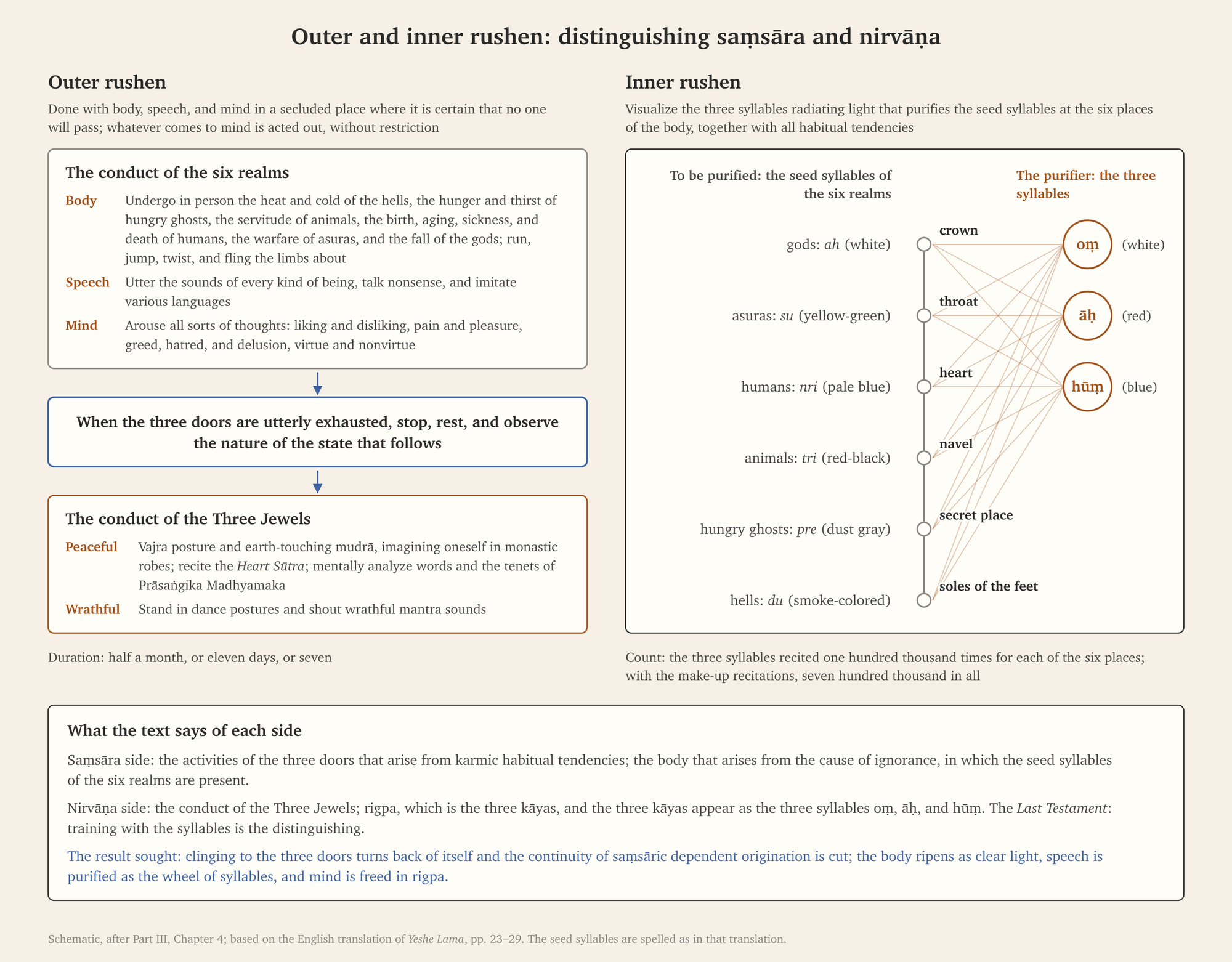
What it is that the "distinguishing" (ru shan) in the name distinguishes is explained both by the text and by scholars. The Yeshe Lama states the purpose of this preliminary as the recognition of rigpa. In the outer kind, the conduct of the six realms and the conduct of the Three Jewels are alike performed as activities of body, speech, and mind. Jigme Lingpa says that every characteristic of saṃsāra and nirvāṇa appears as the manifestation of the three doors and the three kāyas; when the practice has reached the point where clinging to the three doors falls away of itself, the continuity of saṃsāra's dependent origination is interrupted, and in the end the body ripens into clear light, speech is purified into the wheel of syllables, and mind is liberated into rigpa. For the inner kind he cites the Last Testament: this body arises from ignorance as its cause, and so the seed syllables of the six realms exist; rigpa is in fact the three kāyas, and so the three kāyas appear as the three syllables; training with the syllables is itself the distinguishing.16 On these statements, what is set on the two sides is the activity of body and mind that arises from ignorance and karmic habitual tendencies, on the one side, and rigpa, on the other. Germano, summarizing the same set of preliminaries as taught by Longchenpa, says that in the final analysis they enable the practitioner to separate the ordinary, conditioned mind from primordial wisdom; to distinguish saṃsāra and nirvāṇa is to distinguish the ordinary mind from the nature of mind that is its ultimate source.17 Van Schaik points out that the name of this preliminary reflects the dualistic cast of two pairs of distinctions in the Heart Essence literature, between mind and rigpa and between the ālaya and the dharmakāya.18
Van Schaik also points out that these two pairs of distinctions do not agree with another kind of statement in the same body of literature. The literature of the Mind Series for the most part holds that saṃsāra and nirvāṇa are nondual and that separating the two is mere conceptual discrimination. The Heart Essence tradition likewise teaches that rigpa is immanent in all sentient beings, yet it also introduces a strongly dualistic teaching that sets up the two pairs of concepts as opposed poles, so that the side of nirvāṇa wholly transcends the side of saṃsāra. He calls this a tension between immanence and distinction, and says that neither the treasure texts nor Jigme Lingpa's own writings deal directly with the philosophical problem of how to reconcile the two. What actually does the work of reconciliation is the tathāgatagarbha model: the side of saṃsāra is what obscures, adventitious dust without reality; the side of nirvāṇa is what is obscured.19 Arguillère describes the practice of the Dzogchen practitioner as two successive steps. First consciousness and primordial wisdom, mind and rigpa, are strictly separated, and the example he gives in a parenthesis is precisely the distinguishing of saṃsāra and nirvāṇa; then the one is reabsorbed into the other, until the very notion of "other" disappears.20 These distinctions were challenged in Tibet. One example is the question that the Karmapa Mikyö Dorje put to the Nyingma as to whether primordial purity and the ālaya are the same or different; see Chapter 10. How the distinctions coexist with the statement that saṃsāra and nirvāṇa are nondual is left to Chapter 11.
Each of the trainings of body, speech, and mind comes with a passage explaining its purpose. In the training of body, the heels are placed together, the knees are spread outward, the back is held straight, and the palms are joined above the crown of the head without touching it; one visualizes the body as a blazing blue three-pronged vajra, and when exhausted one changes to another vajra sitting posture. Jigme Lingpa says that the exhaustion of the body can purify the obscurations of the body; exhausting activity of this kind interrupts the unbroken stream of conceptual thought and leaves naked rigpa without any support, and this makes the subsequent encounter with the nature of mind easier.21 The training of speech uses the single syllable hūṃ throughout: one seals outer objects and one's own body with hūṃ, pierces mountains, houses, and one's own body with hūṃ, makes hūṃ syllables coil upward around a wooden staff, and finally visualizes oneself as a hūṃ syllable one cubit high that travels everywhere.22 The training of mind examines the mind in three steps: where it comes from, where it stays, and where it goes. At each step several answers are considered and ruled out one by one. For example, to hold that the mind arises from the side of "existence" is to fall into the tenets of those the book calls "śrāvakas"; to know that the mind is without inherent nature, like a dream, while not having cut off the apprehending mind resembles the view of the school the book calls "Madhyamaka-Yogācāra." Each of the three steps ends in not finding a place of origin, a place of abiding, or a place of going, and the book says that through these one understands the meaning of the dharmakāya, the saṃbhogakāya, and the nirmāṇakāya respectively. Jigme Lingpa makes a point of saying that arriving in this way differs from the procedure of the scholars of his time who claimed to hold this view: it does not rely on intellectual exercise and analysis; it relies on seeing dharmatā.23
After these have been completed, one must rest and recover. The violent activity of the preliminaries disturbs the elements of the body, and so the body is to be laid down like a corpse in a charnel ground, without speaking, the breath slow and even, the mind like a clear and cloudless sky. One rests in this way for twenty-one days, or seven days, or three days. Recovery then proceeds by three gazes. What the book calls the "gaze of the śrāvakas" is to take the seven-point posture of Vairocana without blocking the arising of thoughts; the "gaze of the bodhisattvas" is to look straight ahead at the ground a yoke's length away without fixing on one spot; the "gaze of the wrathful deities" is to stand with the legs apart, glare into space, and laugh loudly.24
This set of preliminaries shares one technique: body, speech, and mind are first driven into violent activity until they are exhausted, and then the state that follows the exhaustion is observed. The same technique appears once more in the key point of speech for Tögal (direct crossing): a person who is fond of talking goes to a deserted place and shouts whatever they most like to say hundreds, thousands, and millions of times, until exhausted and no longer wanting to speak.25 The pointing-out described in Chapter 5 is carried out on a body and mind prepared in this way.
5. Empowerment comes first
Between the preliminaries and the main practice, the Yeshe Lama deals with empowerment in a single paragraph. In order to plant the seeds of the four kāyas and to make the practitioner fit to practice this swift path, the practitioner must first enter the great maṇḍala of empowerment. Jigme Lingpa says that to finish giving the instructions first and confer the empowerment afterward is unreasonable, and that in the eyes of those who understand the meaning of the tantras it is also improper.26 Chapter 10 of the Treasury of Precious Qualities, before it treats the generation and completion stages, likewise first treats the necessity of empowerment, the qualifications of teacher and disciple, and the four empowerments.
This rule continues in publications today. The copyright page of the English translation of the Yeshe Lama carries a restriction stating that the book is to be read only by those who have received the empowerment and the reading transmission from a qualified lineage holder.27 Part I, Chapter 2 of this Essay said that the path of Esoteric Buddhism begins with authorization, and that when one practices without empowerment the method does not take effect. In its view Dzogchen judges the eight lower vehicles to be contrived, but on this point it is no different from the rest of Esoteric Buddhism.
Van Schaik, on the basis of another guidance text by Jigme Lingpa, explains the order of the several steps: first one finds a qualified teacher and receives empowerment, then one practices the various sets of Vajrayāna preliminaries, and after that comes the main practice, which appears to include both the yogas of the generation and completion stages and the Dzogchen practices taught in the Yeshe Lama. Jigme Lingpa's writings make no provision for practicing Dzogchen alone, apart from the other practices.28
6. The length of the curriculum
Putting the five preceding sections together, the curriculum before recognition can be outlined roughly. The six contemplations of the outer preliminaries have no fixed amount. The five inner preliminaries are done one hundred thousand times each, five hundred thousand in all. Among Dzogchen's own preliminaries, the outer rushen takes from seven days to half a month, the inner rushen takes seven hundred thousand recitations, the trainings of body, speech, and mind have no specified duration, and the resting takes from three to twenty-one days. In the course of this there is also one empowerment, together with the samaya that the empowerment brings. All of this comes before the Trekchö (breakthrough) instructions described in Chapter 5.
The conclusion of van Schaik's study of the Longchen Nyingthig is that this cycle is both a gradual method and a gradual realization: the practitioner passes through the various methods level by level, and realization too advances by levels. This stands in sharp contrast to the simultaneous approach stated in the Dzogchen treasure texts themselves. Jigme Lingpa's way of reconciling the two is to distinguish capacities. People suited to simultaneous entry are extremely rare, and he restricts this type to semi-legendary figures of the past such as Padmasambhava; the simultaneous statements of the treasure texts and the gradual instructions that he wrote himself are thereby placed on different levels. Van Schaik points out that this solution did not originate with him and that predecessors such as Longchenpa had already used it.29
The opening of the Yeshe Lama gives the same kind of stratification. The instructions of the whole book are divided into three parts: those of highest capacity reach the expanse of the primordial ground in this life; those of middling capacity attain buddhahood in the intermediate state (bardo); those of lower capacity find relief in the natural nirmāṇakāya pure realms.30 The preliminaries described in this chapter are provided for those of highest capacity among them.
Van Schaik also explains the place of the simultaneous statements within this curriculum. Trekchö has no specific meditation instructions in the Yeshe Lama; it is presented as the view. This simultaneous statement stands above the various methods, while the various methods occupy most of the pages of the Longchen Nyingthig texts and also take up most of the practitioner's meditation time. Jigme Lingpa arranges the two by means of a threefold division into understanding, experience, and realization: the view stated in the simultaneous texts is present from the beginning of the path in the mode of understanding; the levels of gradual realization are experiences of that state; and buddhahood is the constant and complete realization of it.31
7. Summary of this chapter
The curriculum that this tradition arranges before recognition can be summarized in four points. First, the preliminaries come in two sets, common and uncommon. The common set is broadly the same as the ngöndro of the other Tibetan schools, with five times one hundred thousand as the usual amount; the uncommon set takes as its technique exhausting the three doors and observing the state that follows, and is peculiar to the Instruction Series. Second, empowerment precedes the main practice, and the text sets a restriction on those who have not received empowerment. Third, Jigme Lingpa's own stages of the path place Dzogchen after the paths for three kinds of person, empowerment, and the generation and completion stages. Fourth, the simultaneous statements are assigned the role of the view, the curriculum itself is gradual, and the two are joined by the doctrine of capacities.
The question raised at the end of Chapter 1 was how the view's "nothing to be done" coexists with the graded sequence of the curriculum. This tradition's own answer has now been laid out: "nothing to be done" is a statement about the ground; the curriculum is provided for those who cannot recognize the ground; and according to Jigme Lingpa there is almost no one who does not need the curriculum. Whether this answer holds is left to Chapter 11.
References
-
Patrul Rinpoche, The Words of My Perfect Teacher, trans. Padmakara Translation Group, rev. ed., Boston: Shambhala, 1998, p. xxxv. Hereafter cited as WMPT. ↩
-
WMPT, p. xxxv; for the six chapters see the table of contents of Part One of that book. At p. xxxvi the translators call the outer preliminaries "the four contemplations which turn away from saṃsāra." ↩
-
WMPT, pp. xxxv–xxxvi: "usually repeating each element one hundred thousand times." ↩
-
Patrul Rinpoche (Huazhi Renboqie 华智仁波切), Da yuanman qianxing yindaowen 大圆满前行引导文 (Guide to the Preliminaries of the Great Perfection), trans. Khenpo Sodargye 索达吉堪布, Collected Works of Khenpo Sodargye (索达吉堪布全集), December 2023 edition, pp. 392, 571, 597. The quotations in the text are translated from this Chinese translation. The corresponding passages in the English translation are at WMPT, pp. 180, 276, 290. Where the Chinese translation has "practice in the form of a retreat" (以闭关的形式来观修), the English translation reads "practise it in distinct sessions." Huazhi Renboqie is the Chinese name of Patrul Rinpoche. ↩
-
Da yuanman qianxing yindaowen, p. 648. ↩
-
Da yuanman qianxing yindaowen, p. 706; for the English translation see WMPT, p. 347, where the simile is of painting a mural where there is no wall. ↩
-
WMPT, pp. 347, xxxvi. ↩
-
WMPT, Part One, Chapter 6. The two sections are titled "Examining the teacher" and "Following the teacher" and begin at p. 137 and p. 143 respectively. ↩
-
Jigme Lingpa and Longchen Yeshe Dorje, Kangyur Rinpoche, Treasury of Precious Qualities, Book One, trans. Padmakara Translation Group, rev. ed., Boston: Shambhala, 2010, foreword by the Dalai Lama. The e-book used has no print pagination. ↩
-
Tables of contents of Treasury of Precious Qualities, Book One (2010) and Book Two (Boston: Shambhala, 2013). The general title of Part Three of Book One is "The Gradual Path of the Three Kinds of Beings." ↩
-
Jigme Lingpa, Yeshe Lama, trans. Lama Chönam and Sangye Khandro, Ithaca: Snow Lion, 2008, p. 21. The book is a Tibetan-English parallel edition, with the English on the odd-numbered pages. Hereafter cited as Yeshe Lama. ↩
-
Yeshe Lama, pp. 23–25. ↩
-
Yeshe Lama, pp. 25–27. ↩
-
Yeshe Lama, pp. 23, 27. For the duration of the practice see p. 27. ↩
-
Yeshe Lama, pp. 27–29. The six seed syllables are given here as in the English translation: ah, su, nri, tri, pre, du. The Chinese version of this chapter transliterates them in Chinese characters. ↩
-
Yeshe Lama, pp. 21, 27, 29. Last Testament is the title as given in the English translation; the last sentence is translated as "Training with the syllables is the discernment." ↩
-
David Germano, "Poetic Thought, the Intelligent Universe, and the Mystery of Self: The Tantric Synthesis of rDzogs Chen in Fourteenth Century Tibet," PhD diss., University of Wisconsin–Madison, 1992, p. 124. What is summarized there is the preliminaries to Tögal listed in Longchenpa's Treasury of Word and Meaning (Tshig don mdzod); Germano gives the Tibetan name of this preliminary as 'khor 'das ru shan 'byed pa'i spyod pa. ↩
-
van Schaik, Approaching the Great Perfection, p. 98. He translates the name as "making a gap between samsara and nirvana." ↩
-
van Schaik, Approaching the Great Perfection, pp. 51, 57, 62, 69–70. The wording at p. 51 is "a notable tension between the belief in the immanence of the samsaric in the nirvanic, and the belief that the two need to be strongly distinguished." ↩
-
Stéphane Arguillère, Profusion de la vaste sphère: Klong-chen rab-'byams (Tibet, 1308–1364). Sa vie, son œuvre, sa doctrine, Orientalia Lovaniensia Analecta 167, Leuven: Peeters, 2007, p. 207. He goes on to say that the direction taken by Longchenpa's writings over his lifetime is similar. ↩
-
Yeshe Lama, pp. 31–33. ↩
-
Yeshe Lama, pp. 33–37. ↩
-
Yeshe Lama, pp. 37–41. ↩
-
Yeshe Lama, pp. 43–45. The English translation renders the three gazes as "the gaze of the shravakas," "of the bodhisattvas," and "of the herukas." ↩
-
Yeshe Lama, p. 79. ↩
-
Yeshe Lama, p. 45. ↩
-
Copyright page of Yeshe Lama: "to be read only by those who have received empowerment and the reading transmission." ↩
-
Sam van Schaik, Approaching the Great Perfection: Simultaneous and Gradual Methods of Dzogchen Practice in the Longchen Nyingtig, Boston: Wisdom Publications, 2004, p. 130. The guidance text referred to is the White Lotus (rGyab brten padma dkar po). ↩
-
van Schaik, Approaching the Great Perfection, p. 129. ↩
-
Yeshe Lama, p. 21. ↩
-
van Schaik, Approaching the Great Perfection, pp. 130–131. The Tibetan for the three terms is go ba, myong ba, and rtogs pa. ↩