Chapter Four: The Later Influence of Tathāgatagarbha in China and Tibet
The first three chapters discussed tathāgatagarbha within its Indian texts and philosophical frameworks. This chapter turns to China and Tibet and follows its fate after leaving India. In both places tathāgatagarbha achieved an influence far exceeding its scale in India, but in completely different ways. China absorbed it into sectarian doctrine and made it a shared background across schools. Tibet made it a central subject of philosophical controversy and used precise debates over doctrinal classification to determine its status.
I. Two Routes of Transmission
Tathāgatagarbha thought entered China early and spread widely. The Nirvāṇa Sūtra, translated by Dharmakṣema around 412–421; the Śrīmālādevī Sūtra, translated by Guṇabhadra in 435; and the Laṅkāvatāra Sūtra, translated in 443, appeared in close succession. The Awakening of Faith, composed around the sixth century as discussed in 7.3, soon followed. Before the Tang dynasty, these works had already entered deeply into the intellectual bloodstream of Chinese Buddhism. The direct conflict between the Faxiang school (consciousness-only) and tathāgatagarbha briefly intensified in the early Tang. After Faxiang declined, the tathāgatagarbha framework became the common background of Chinese Buddhism almost without competition.
Tathāgatagarbha reached Tibet somewhat later, chiefly through the arrival of Śāntarakṣita and Kamalaśīla in the eighth century. The Ratnagotravibhāga was transmitted as a central curricular text. How it should be interpreted—especially whether it was “definitive” (nītārtha, expressing final truth) or “provisional” (neyārtha, an expedient requiring further interpretation)—became a focal point of philosophical dispute among Tibetan schools for centuries.
II. China: The Development of Buddha-Nature Theory
Daosheng and the Nirvāṇa Sūtra
Daosheng, or Zhu Daosheng (360–434), was the earliest Chinese thinker to engage directly with the problem of buddha-nature. Before the complete Nirvāṇa Sūtra reached China, Daosheng inferred from the partial translation available to him that “icchantikas too can become buddhas”: even beings entirely without faith in the Buddhist teaching possess buddha-nature and can eventually attain buddhahood. The claim was highly controversial, and Daosheng was reportedly ostracized for it. When the complete Nirvāṇa Sūtra later arrived, it confirmed his position and greatly enhanced his reputation.1
The episode has an important historical implication. Daosheng’s judgment resulted primarily from extending the internal logic of tathāgatagarbha thought, not from a ready-made textual authority. Once the universal claim that “all living beings possess buddha-nature” entered China, it was rapidly carried to its furthest conclusion. Even if the original text had reservations concerning icchantikas, it could scarcely prevent that inference.
The Sanlun School and Jizang
Jizang (549–623), the great synthesizer of the Sanlun school, used the three Madhyamaka treatises (the Mūlamadhyamakakārikā, Śataka, and Dvādaśanikāya) to organize and criticize the popular theories of buddha-nature in his day. He explicitly rejected treating buddha-nature as a real thing. Buddha-nature was not some identifiable existent; it described the capacity for buddhahood originally possessed by living beings, and its true meaning was the “middle way,” not an entity.2
This was the Chinese treatment of tathāgatagarbha closest to a Madhyamaka critique. Jizang did not deny that “living beings have buddha-nature,” but refused to reify it. His approach moved in the same direction as the Prāsaṅgika strategy of incorporating tathāgatagarbha into emptiness, though he lacked Candrakīrti’s rigorous reductio techniques.
The Sanlun school declined after the Tang, and Jizang’s critical position that “buddha-nature is not a real existent” did not form a continuous lineage in later Chinese Buddhism. More affirmative tathāgatagarbha narratives instead became dominant.
Tiantai: The Theory of Inherent Inclusion
The Tiantai school, represented by Zhiyi (538–597), developed the most original Chinese philosophical form of tathāgatagarbha thought: the theory that nature inherently includes all phenomena.3
Its basic claim is that the nature of living beings, tathāgatagarbha or buddha-nature, is not merely “pure.” It originally contains every possibility of good and evil. A buddha’s tathāgatagarbha contains not only good but evil; the buddha-nature of living beings contains not only purity but affliction. This philosophically revises the mainstream tathāgatagarbha position that the mind is “originally pure and adventitiously defiled.” Inherent-inclusion theory says that defilement is not “adventitious dust” but one of the aspects originally included in nature.
The revision aims to avoid the dualistic tension between “original purity” and “actual defilement.” If nature is pure, the relation between real defilement and pure nature always requires explanation—the old problem from 7.2. The theory of inherent inclusion directly says that nature originally possesses both good and evil. Since defilement is not external, its origin no longer needs a separate explanation.
Zhiyi’s teaching of “three thousand worlds in one thought” philosophically develops this theory. The reckoning given in the fifth fascicle of the Mohe zhiguan runs in four steps: “One mind possesses the ten dharma-realms, and each dharma-realm possesses in turn the ten dharma-realms, making a hundred dharma-realms; one realm possesses thirty kinds of world, and the hundred dharma-realms accordingly possess three thousand kinds of world.”4 One mind possessing the ten dharma-realms is the first step. Each dharma-realm possessing in turn the ten dharma-realms, so that the ten realms mutually include one another and make a hundred realms, is the second. One realm possessing thirty kinds of world, the ten suchnesses distributed across the three kinds of world, is the third. Each of the hundred realms possessing those thirty kinds of world, which yields three thousand, is the fourth.
The step of mutual inclusion among the ten realms decides whether the theory of inherent inclusion can stand at all. Within the single realm of hell the remaining nine realms are equally present, and the same holds within the realm of buddhas; the realm of living beings and the realm of buddhas include one another, so that good and evil are both present within one mind, and it is upon this that the next move of inherent-inclusion theory rests, namely that a buddha inherently possesses evil. Omit the mutual inclusion, and multiplying the three factors of ten dharma-realms, ten suchnesses, and three kinds of world yields only three hundred; the figure of three thousand cannot be reached at all.
“Three thousand in one thought” does not mean that one thought can think of three thousand things. It means that the existence of this thought is intrinsically interwoven with those three thousand modes of existence. Every possibility in the cosmos is inherently included in each present moment of thought.3
The theory produced a famous controversy within Tiantai: does a buddha possess “inherent evil”? Zhiyi answered yes. Buddha-nature includes both good and evil, but a buddha does not “cultivate evil”—does not actualize its possibility. The Shanjia lineage of later Tiantai, including Zhili, developed this claim of “buddhas inherently possessing evil,” while the Shanwai lineage challenged it. The issue became the sharpest internal debate over inherent inclusion in Tiantai.
Tiantai’s positive answer to the question “if one is already a buddha, why must one still practice?” falls on the side of the ranking of stages and is called the six identities. Zhiyi states his reason for setting them up in the first fascicle of the Mohe zhiguan, which is to block misreadings in two directions at once: “If wisdom and faith are both complete, one hears that a single thought is it. Because of faith one does not slander; because of wisdom one is not afraid; and beginning and end are alike it. Without faith, one pushes the realm of the sages up on high as no portion of one’s own wisdom; without wisdom, one gives rise to overweening pride and says that one is equal to the Buddha; and beginning and end are alike not it. For this reason one must know the six identities.”5 The six stages in order are identity in principle, identity in name, identity in the practice of contemplation, identity in resemblance, identity in partial realization, and identity in ultimacy. The first stands before any hearing of the teaching, its text reading “identity in principle means that a single thought of mind is the principle of the tathāgatagarbha”; the second begins with hearing, “though in principle it is it, one does not know it in daily use.”5
The construction deserves to be recorded plainly. The word “identity” secures sameness along the horizontal: living beings and the Buddha are not two at the level of principle, and inherent possession is thereby confirmed. The six stages secure sequence along the vertical: from not yet having heard the teaching up to ultimacy, six grades are marked out, and the necessity of practice is thereby given a place. A teaching of one step furnishes itself with six grades of stage, so that inherent possession and cultivated realization can stand together on the same page without either being cancelled to preserve the other. The two lines of defense the text states for itself are likewise a matched pair. Without faith, one pushes the realm of the sages so high that it becomes no portion of one’s own capacity, which is self-abandonment; without wisdom, one says that one is equal to the Buddha, which is usurpation of the sequence. Zhiyi’s closing simile is the poor man and the treasure store: the treasure lies in his own house (identity in principle), a friend points it out (identity in name), the weeds are cleared and the digging begins (the practice of contemplation and resemblance), he gradually draws near (partial realization), and the store is opened and used to the full (ultimacy).5 Inherent possession and the digging out are the two ends of one and the same thing in that simile.
This frame belongs to the perfect teaching alone. It is a device for ranking stages internal to Tiantai’s own system of doctrinal classification and should not be carried over directly into the vocabulary of Chan or Huayan, and the treatment of Chan below gives its own account of the matter. Its construction is nevertheless worth the notice of the tathāgatagarbha tradition as a whole. The problem of reconciling inherent possession with cultivated realization did receive one fully constituted positive answer in China, and the method was to separate sameness and sequence into two notations, each stated independently, neither obstructing the other.
Huayan: Dependent Arising in the Dharma-Realm
The Huayan school, represented by Fazang (643–712), developed from tathāgatagarbha thought a cosmological framework of “dependent arising in the dharma-realm.”6
The core of Huayan’s dependent arising from tathāgatagarbha is that the existence of all dharmas rests upon a common basis—tathāgatagarbha, dharma-nature, or suchness. The appearance of each dharma is the manifestation of the dharma-realm—tathāgatagarbha—in response to conditions, while each exists in mutual dependence and mutual inclusion with every other dharma. This is Huayan’s famous image of “Indra’s Net”: every jewel or dharma reflects all the others, while all the others each reflect every jewel in turn. The reflections are infinite and overlap without limit; no dharma exists independently or in isolation.
Fazang analyzes this relation through the “perfect interpenetration of the six characteristics.” The fourth fascicle of the Huayan wujiao zhang (Treatise on the Five Teachings of Huayan) supplies a definition for each characteristic in turn, taking for its example a house together with the rafters, tiles, and other conditions that compose it. The whole-characteristic is “because one house has many qualities,” and the part-characteristic “because the many qualities are not one”: these state the relation of whole and member between the house and its rafters, doors, and windows. The sameness-characteristic is “because the many meanings do not conflict with one another and together make up one whole”: the several conditions act in concert to make a house and complete one house together without contradicting one another. What the term registers is co-operation, not resemblance among the members. The difference-characteristic is “because the many meanings, set over against one another, are each of them different”: rafters and tiles each follow their own shape and kind and differ when set against one another. Fazang also answers in so many words how difference is to be told from part. Part is the distinctness of each condition over against the whole, a rafter as distinct from the house; difference is the distinctness of the conditions among themselves, a rafter as distinct from a tile. The two look in different directions.
The formation-characteristic is “because it is by these various conditions that the whole arises and is brought to completion,” and the disintegration-characteristic “because the various meanings each abide in their own dharma and do not shift.” This pair does not mean establishment and dissolution. Fazang’s own answer runs: “If the rafter were to go and become the house, it would lose its own dharma of being a rafter, and the meaning of house could not be brought about.” Were a rafter to turn into the house, the rafter’s own dharma would be lost, no rafter would be available for use, and the house could not be completed after all. The very condition of composition is that each member keeps its own form and abides in its own dharma. Formation and disintegration therefore hold at one and the same time and are the condition of each other.7
The perfect interpenetration of the six characteristics is a typical path by which tathāgatagarbha thought moves from a “theory of practice” into a “cosmology.” Tathāgatagarbha is no longer only the basis of practice but the fundamental principle explaining the mutual inclusion of all phenomena in the cosmos.
Section 7.1 identified one source for Huayan dependent arising from tathāgatagarbha: the Śrīmālādevī Sūtra’s identification of tathāgatagarbha with the unconditioned dharma-realm. One further point should be added. Once tathāgatagarbha is identified with the dharma-realm, it expands from a seed of buddha-nature within living beings into the ontological ground of all phenomena in the cosmos. This is a major philosophical expansion far beyond the original intention of Indian tathāgatagarbha texts.
The controversy over whether insentient things possess buddha-nature was legislated in the eighth century, and the two parties to it were Tiantai and Huayan. Zhanran of Tiantai (711–782) argued in the Jin’gang bei that insentient things too possess buddha-nature, and the ground he took was the Huayan doctrine of following conditions while remaining unchanged. He marked the source himself: “The doctrine of following conditions while remaining unchanged comes from the great teaching.” The myriad phenomena are suchness, because it is unchanging; suchness is the myriad phenomena, because it follows conditions. To grant following conditions while remaining unchanged and yet confine buddha-nature to the sentient is, on Zhanran’s ruling, self-contradiction.8
Fazang’s Huayan jing tanxuan ji had long since written, in its gate on the general and the particular, that nature-origination “pervades the insentient as well,” drawing the range out as far as insentient things.9 The one who narrowed that range was Chengguan (738–839). His Suishu yanyi chao devotes a passage to blocking the doctrine that insentient things possess buddha-nature, and the correct sense it establishes reads: “Nature and characteristic are neither identical nor different, and the sentient and the insentient are likewise neither identical nor different.” Huayan does have a doctrine of the insentient attaining buddhahood, but “this does not mean that insentient things too possess an awakened nature and attain buddhahood as the sentient do.”10 What Zhanran refuted was Chengguan’s narrowing; the range Fazang had drawn agrees with Zhanran’s own claim.
Chan: Seeing One’s Nature and Becoming a Buddha
Chan (especially the Southern school after the Sixth Patriarch Huineng) is the most influential Chinese destination of tathāgatagarbha thought, although Chan itself rarely invokes the term. It instead uses more ordinary expressions such as “original face,” “one’s own mind,” and “buddha-nature.”
“Seeing one’s nature and becoming a buddha” is a central expression of Southern Chan. “Nature” means buddha-nature or tathāgatagarbha. It is already present and already buddha, but obscured; “seeing” is a sudden intuition, not gradual analysis. Practice does not accumulate merit or cultivate a lineage. What matters is direct recognition: recognizing that one has always been a buddha. This takes the Awakening of Faith’s “original awakening” to its limit. Original awakening is not only the basis of practice but occupies the position of its goal: original awakening is itself buddhahood, and recognizing it (seeing one’s nature) is becoming a buddha.11
An internal tension deserves emphasis. If one has always been a buddha, why is practice necessary? Chan replies that practice merely “removes delusion,” rather than “obtaining awakening.” That reply places the issue in the background of practice and keeps it away from the metaphysical foreground; the question of how a being who already is buddha can remain in saṃsāra receives no positive answer in Chan’s own vocabulary. The same question did receive a positive answer in Tiantai, in the six identities discussed above: the word “identity” acknowledges inherent possession, the six stages array the sequence, and inherent possession and cultivated realization are separated by level within the ranking of stages, each occupying its own place. The comparison marks out what Chan chose. What it gave up is the layering on the side of the ranking of stages; what it gained is directness in the theory of practice. Chan’s strength lies in practical efficacy, not metaphysical consistency.
III. The Overall Picture in China
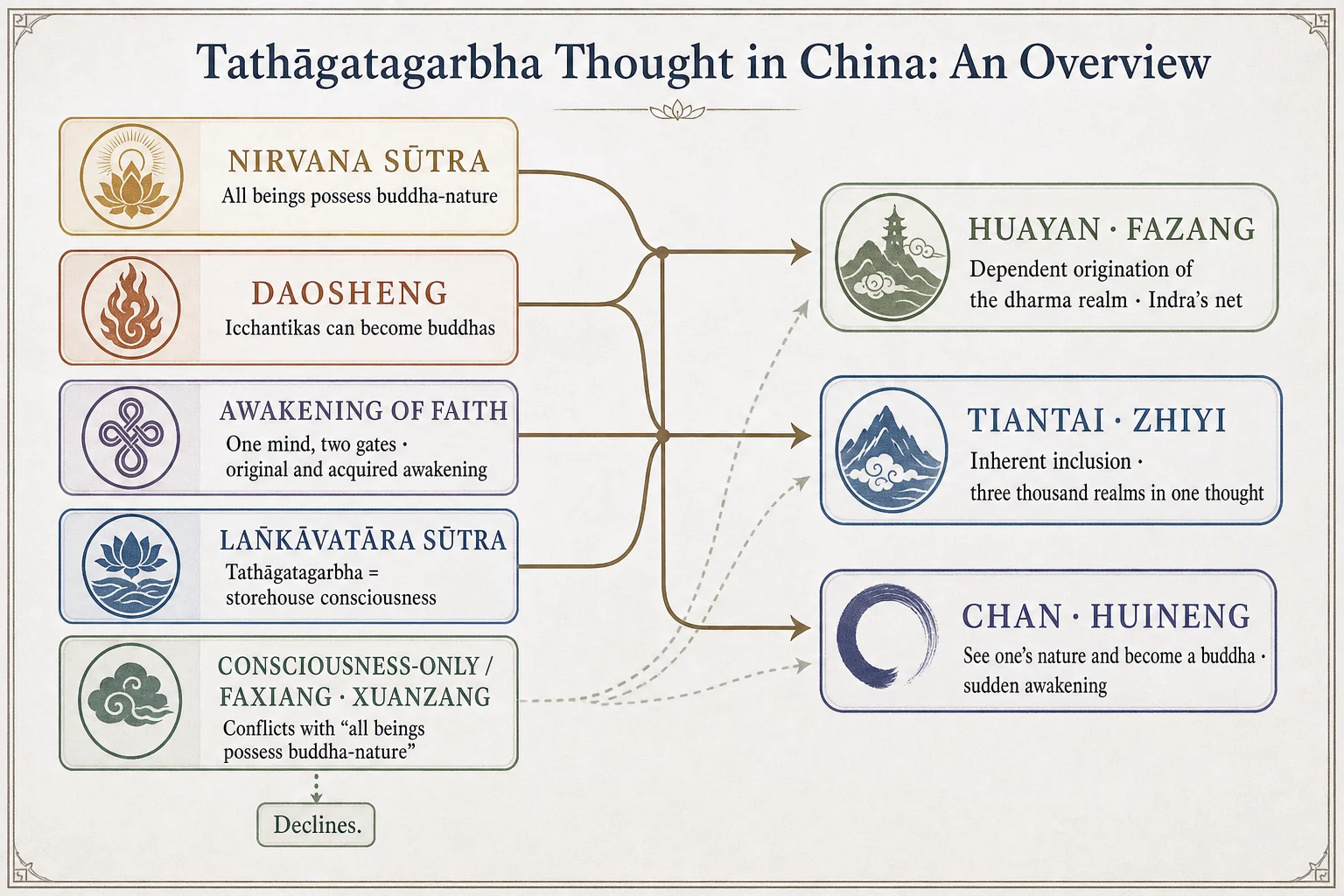
The overall Chinese trajectory was the infiltration of tathāgatagarbha as a shared presupposition across schools, without a Candrakīrti-style philosophical criticism to define its boundaries. Its central claims (original purity, the omnipresence of buddha-nature, and practice as the manifestation of what is already present) became the default background of Chinese Buddhism. Yet the schools treated them philosophically in very different ways. Tiantai emphasized inherent inclusion—good and evil are both included. Huayan emphasized perfect interpenetration—all dharmas mutually contain one another. Chan emphasized sudden awakening—the present is already it. These three directions reflect different understandings of “how tathāgatagarbha functions in the present.”
IV. Tibet: The Refinement of Debate through Doctrinal Classification
The Three Turnings of the Dharma Wheel and Definitive Teachings
Tibetan Buddhism inherited the Indian framework of the “three turnings of the Dharma wheel” (trīṇi dharmacakrāṇi):
| Turning | Content | Principal texts |
|---|---|---|
| First turning | The four truths and dependent arising: foundational teachings of liberation | Āgama and Nikāya literature |
| Second turning | Prajñāpāramitā emptiness: all dharmas lack intrinsic nature | Prajñāpāramitā scriptures |
| Third turning | Consciousness-only and tathāgatagarbha: detailed analysis of consciousness and buddha-nature | Consciousness-only texts and the tathāgatagarbha scriptures |
The crucial question was which turning was “definitive” (nītārtha)—the final truth requiring no further interpretation—and which was “provisional” (neyārtha)—an expedient teaching requiring further interpretation.
The Geluk classification, represented by Tsongkhapa, treats the second turning (Prajñāpāramitā emptiness) as definitive. The third turning, consciousness-only and tathāgatagarbha, offers expedient teachings for beings of particular capacities. Positive tathāgatagarbha language about inherently possessed buddha qualities reveals its true meaning only when reduced to “tathāgatagarbha is emptiness.” The affirmations of the third turning are skillful means for those unable to accept emptiness directly.12
The Jonang classification, represented by Dolpopa, treats the third turning as definitive. The second is a teaching that dismantles attachment, given to remove realist grasping, but not the final position. The affirmative content of tathāgatagarbha (the real and permanent existence of the qualities of buddha-nature) is the ultimate truth. The emptiness taught in the second turning is “self-emptiness” (rang stong), the emptiness of phenomena in their own nature, and serves to dismantle grasping. Ultimate tathāgatagarbha, by contrast, is “other-emptiness” (gzhan stong): empty of adventitious defilements, not empty of tathāgatagarbha itself.13
This dispute in doctrinal classification goes beyond textual interpretation and concerns the ultimate direction of Buddhist thought. Does practice move toward a thoroughgoing emptiness in which “nothing is there,” or toward the manifestation of a “pure essence already present”?
The Geluk Interpretation through Prāsaṅgika Madhyamaka
In works including the Great Treatise on the Stages of the Path to Enlightenment and the Essence of Eloquence Distinguishing the Definitive and Interpretive, Tsongkhapa (1357–1419) gave the Geluk school a systematic position on tathāgatagarbha.
His central judgment is that any tathāgatagarbha language of “inherent possession,” “truly existent purity,” or “permanence,” if understood as a positive reality beyond conventional designation, falls into eternalism. Correct interpretation reduces tathāgatagarbha to the proposition that “the nature of mind is emptiness.” To say that living beings “inherently possess” tathāgatagarbha means that their minds have always been empty. Practice consists in seeing that emptiness thoroughly. The language of tathāgatagarbha is a poetic expression of emptiness, not an independent ontological claim.12
This parallels the Prāsaṅgika treatment of consciousness-only. Just as Candrakīrti criticizes the “other-dependent consciousness” of consciousness-only as residual realism, Tsongkhapa criticizes the Jonang other-emptiness position as a form of true permanence. In Geluk classification, Prāsaṅgika Madhyamaka is the highest view; tathāgatagarbha discourse becomes definitive only after reduction to Prāsaṅgika emptiness.
The Jonang School and Other-Emptiness Madhyamaka
Dolpopa Sherab Gyaltsen (1292–1361) was the most systematic exponent of Tibetan “other-emptiness.” Section 7.2 introduced his philosophy; here we add its historical and social setting.
The Jonangpa position was influential in Tibetan Buddhism during the fourteenth and fifteenth centuries, with the Ratnagotravibhāga as one of its principal authorities. Dolpopa insisted that the qualities of tathāgatagarbha or buddha-nature ultimately and truly exist. This is “other-emptiness” (empty of other things, namely afflictions and conditioned dharmas), not self-emptiness, in which a thing is empty of itself.
In the seventeenth century, the Fifth Dalai Lama supported Geluk political ascendancy. The Jonang school was suppressed to varying degrees in central Tibet, its monasteries were converted, and its main transmission moved to what is now the Ngawa region of Sichuan. Jonang lineages received renewed scholarly attention in the twentieth century, and Dolpopa’s works have increasingly been translated and studied.14
Philosophically, other-emptiness remains closest to the literal wording of tathāgatagarbha, and for that reason faces the sharpest criticism. How does a “truly existent and permanent quality of buddha-nature” differ from the non-Buddhist ātman? Jonang replies (different causal relations, not the self of saṃsāra, and so on) resemble those of the Ratnagotravibhāga discussed in 7.2. Critics maintain that they do not resolve the problem fundamentally.
The Nyingma School: Dzogchen and Tathāgatagarbha
The Dzogchen or Great Perfection tradition (Tibetan rdzogs pa chen po) of the Nyingma school is deeply connected internally with tathāgatagarbha thought, but expresses it more radically.
Dzogchen’s basic position is that the minds of living beings—or the “ground” (gzhi)—are originally in a state of completely perfected awareness. Practice does not obtain awareness from nothing; it recognizes this already perfected awareness. The Tibetan term rigpa, knowledge or awareness, is central. This carries the logic of “original awakening” to its extreme. It not only says that “living beings inherently possess buddha-nature,” but that “the essential condition of their minds is originally buddha”—the ground is already the fruition.15
The principal difference between Dzogchen and tathāgatagarbha is that Dzogchen bypasses argument for the latter’s positive claims and appeals directly to the experience of practice. “Recognizing rigpa” is a direct event within practice, not first of all a philosophical position. This lets Dzogchen sidestep direct confrontation with philosophical criticism when it accepts the affirmative claims of tathāgatagarbha. If one criticizes it for holding that “the qualities of buddha-nature truly exist,” it replies that this is not a metaphysical proposition but a description of meditative experience.
Nyingma theorists discuss the relationship between Dzogchen and Prāsaṅgika Madhyamaka in detail. Some, such as Longchenpa (1308–1364), seek to show that Dzogchen does not conflict with Prāsaṅgika. Others hold that Dzogchen transcends the level of Prāsaṅgika Madhyamaka. The debate continues today.
The Kagyü School: Mahāmudrā
The Mahāmudrā tradition of the Kagyü school likewise centers on the natural luminosity and purity of mind (the luminous mind), and structurally overlaps the “original purity” of tathāgatagarbha. The point of Mahāmudrā practice is to recognize the nature of mind directly in meditation. That nature is described as “empty and luminous”: empty as emptiness, yet luminous as cognitive clarity.
Kagyü thinkers treat the relationship between Mahāmudrā and philosophical traditions, especially Madhyamaka and consciousness-only, in different ways. Some traditions, such as that transmitted by Gampopa, tend toward recognizing the nature of mind through progressive meditation. Others, such as the Marpa–Milarepa lineages, place greater emphasis upon direct pointing-out instruction.16
V. The Overall Tibetan Map of Doctrinal Classification
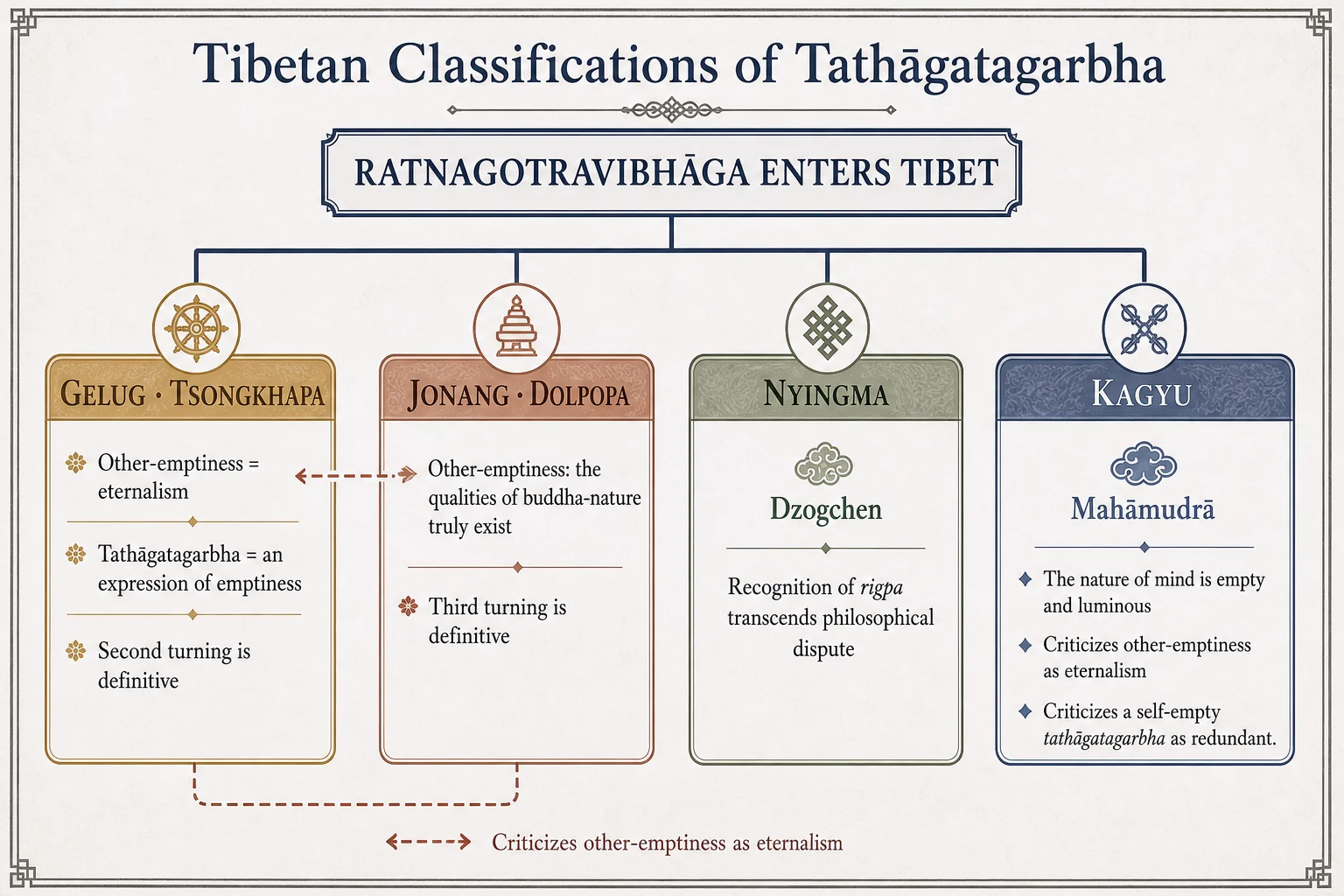
Tibetan disputes over tathāgatagarbha became more precise than their Chinese counterparts and placed it explicitly within frameworks of doctrinal classification. Which statement is definitive and which provisional directly determines the ultimate goal of practice. This precision is both a strength of Tibetan scholastic tradition (it inherited Indian philosophy systematically) and a cause of deeper philosophical division. Distinct schools formed clear boundaries in the debate, and no consensus has emerged.
VI. A Comparison between China and Tibet
The fate of tathāgatagarbha in China and Tibet presents an instructive contrast.
China: tathāgatagarbha became a “shared background.” Each school accepted it in its own language, but it seldom produced direct philosophical controversy. Consensus exceeded dispute, at the cost of indistinct philosophical boundaries. “All living beings possess buddha-nature” became an unquestioned premise. Differences among schools concerned primarily how buddha-nature is actualized (inherent inclusion, dependent arising in the dharma-realm, or sudden awakening through seeing one’s nature) rather than what it is.
Tibet: tathāgatagarbha became a central question of doctrinal classification. Each school’s interpretation directly determined its philosophical position. Debate became precise, at the cost of clear sectarian boundaries and difficulty in synthesis.
The contrast is partly the product of historical circumstances. China lacked a Candrakīrti-style Prāsaṅgika tradition capable of placing pressure upon tathāgatagarbha. Tibet imported tathāgatagarbha together with Candrakīrti’s lineage (especially through Tsongkhapa’s systematization), and therefore had to confront the tension between them directly.
VII. The Historical Influence and Philosophical Legacy of Tathāgatagarbha
Return to the starting point of this part. Tathāgatagarbha thought was a genuine response to a genuine philosophical question: what kind of existential guarantee is required for liberation to be possible? Madhyamaka “emptiness” is negative, while consciousness-only “transformation of the basis” is transformational. Their answers to “why can one become a buddha?” remain indirect. Tathāgatagarbha answers: because the buddha is already there; practice reveals rather than creates. The answer has powerful intuitive force and is also philosophically full of tension.
Sections 7.1–7.3 explained the unresolved difficulties it introduces: how purity and defilement can coexist, and how tathāgatagarbha differs from ātman. This chapter adds the history of its reception. In China the answer became an axiom; in Tibet it became a subject of debate. In Chan it grounded sudden awakening, in Huayan it became a cosmological principle, in Dzogchen it became an object of recognition in practice, and in Geluk it became a provisional teaching that was definitive only when reduced to emptiness. Each mode of reception embodies a different answer to the question “toward what does practice ultimately move?”
A longer retrospective is possible here.
When Part I discussed early Buddhism, the core of liberation was the three characteristics: impermanence (anicca), suffering (dukkha), and not-self (anattā). Practice proceeds by seeing these characteristics lucidly, thereby ceasing to appropriate psychophysical processes; craving ends, suffering ceases, and nirvāṇa is realized. Nirvāṇa itself is described primarily in negative terms: unconditioned, unborn and unceasing, no further birth. It uses the language of “what is absent,” not the language of “some beautiful thing present over there.” Nothing is presupposed as already existing. The practitioner’s direction is “to see the state of things as it is” and let go, not “to recognize one’s original state.”
With tathāgatagarbha, the language of liberation changes. It becomes permanence (nitya), bliss (sukha), self (ātman), and purity (śuddha), established by the Ratnagotravibhāga and Nirvāṇa Sūtra as the four virtues of nirvāṇa. Each term reverses one of the early Buddhist characteristics or their associated contemplations: impermanence becomes permanence, suffering becomes bliss, not-self becomes self, and impurity (or neutrality) becomes purity. Practice is no longer directed toward seeing clearly and letting go, but toward removing obscurations so that what has always existed may appear. “Original awakening,” “seeing one’s nature and becoming a buddha,” and “recognizing rigpa” share a presupposition: at the deepest level there is something pure, complete, and originally so, and one need only recognize it.
This is no small step. From “nothing is originally present; there are only processes gathering and dispersing according to conditions—observe them as they are and let go” to “there is an essence originally buddha, and practice recognizes it,” lies the entire course of Mahāyāna’s development: Prajñāpāramitā emptiness, Madhyamaka’s dismantling of grasping, consciousness-only’s transformation of the basis, and finally this point. The core of early Buddhist liberation (not-self, impermanence, cessation, and letting go) remains only a shadow in tathāgatagarbha language. It is still called “liberation,” still called “practice,” and still points toward some cessation of suffering; but the metaphysics supporting it has become a completely different structure.
This statement is not intended to judge the tathāgatagarbha tradition as good or bad. It simply identifies a historical movement that genuinely occurred. Each stage of the movement had its reasons: the needs of a theory of liberation invited metaphysical support, and the practical demands of the language of cultivation invited a positive description of “what the endpoint is.” But seeing the distance clearly is a requirement of honest historical reading.
Tathāgatagarbha thought continues to evolve. Tibetan and Western scholars still debate other-emptiness and self-emptiness, the difference between tathāgatagarbha and ātman, and the philosophical status of Dzogchen. Chinese Chan and Tiantai thought are being reconsidered in new ways within scholarship. All this is not merely an organization of history but an unfinished philosophical inquiry.
References
References
-
Kenneth K. S. Ch'en. Buddhism in China: A Historical Survey. Princeton: Princeton University Press, 1964 (a historical account of Daosheng and the transmission of the Nirvāṇa Sūtra). ↩
-
Aaron K. Koseki. “Prajñāpāramitā and the Buddhahood of the Non-Sentient World: The San-Lun Assimilation of Buddha-Nature and Middle Path Doctrine.” Journal of the International Association of Buddhist Studies 3, no. 1 (1980): 16–33 (the Sanlun assimilation of buddha-nature to the middle way). ↩
-
Paul Swanson. Foundations of T'ien-T'ai Philosophy: The Flowering of the Two Truths Theory in Chinese Buddhism. Berkeley: Asian Humanities Press, 1989 (a philosophical analysis of inherent inclusion and three thousand worlds in one thought). ↩↩
-
Mohe zhiguan, fascicle five (T1911, expounded by Zhiyi, recorded by Guanding): “One mind possesses the ten dharma-realms, and each dharma-realm possesses in turn the ten dharma-realms, making a hundred dharma-realms; one realm possesses thirty kinds of world, and the hundred dharma-realms accordingly possess three thousand kinds of world. These three thousand are in a single thought of mind. If there is no mind, there is an end of it; but let there be the least stirring of mind, and it possesses the three thousand.” For a sentence-by-sentence analysis see the second division, Part 21, Chapter 3. ↩
-
Mohe zhiguan, fascicle one (T1911, expounded by Zhiyi, recorded by Guanding), on the reason for establishing the six identities: “If wisdom and faith are both complete, one hears that a single thought is it. Because of faith one does not slander; because of wisdom one is not afraid; and beginning and end are alike it. Without faith, one pushes the realm of the sages up on high as no portion of one’s own wisdom; without wisdom, one gives rise to overweening pride and says that one is equal to the Buddha; and beginning and end are alike not it. For this reason one must know the six identities: identity in principle, identity in name, identity in the practice of contemplation, identity in resemblance, identity in partial realization, and identity in ultimacy. These six identities begin in the ordinary and end in sagehood. Because they begin in the ordinary, doubt and timidity are removed; because they end in sagehood, arrogance and grandiosity are removed.” Identity in principle: “Identity in principle means that a single thought of mind is the principle of the tathāgatagarbha.” Identity in name: “Though in principle it is it, one does not know it in daily use; not having yet heard the three truths, one does not recognize the Buddha’s teaching at all, like the eyes of oxen and sheep, which cannot make out the quarters.” The simile of the poor man and the treasure store: “It is as when a poor man has a treasure store in his house and does not know of it; a friend points it out to him, and he comes to know it; he clears away the weeds and digs it out, and gradually draws near; and the store once opened, he takes and uses it to the full.” The text notes of itself that this frame belongs to the perfect teaching alone. For a sentence-by-sentence analysis see the second division, Part 21, Chapter 5. ↩↩↩
-
Kiyotaka Kimura, Chūgoku Kegon shisōshi [A History of Chinese Huayan Thought]. Kyoto: Heirakuji Shoten, 1992, on the formation of Chinese Huayan thought and dependent arising in the dharma-realm; for an English-language introduction, see Francis H. Cook, Hua-yen Buddhism: The Jewel Net of Indra. University Park: Pennsylvania State University Press, 1977. ↩
-
Huayan wujiao zhang (Treatise on the Five Teachings of Huayan), fascicle four (T1866, set forth by Fazang), where the six characteristics are established by name: “As for the whole-characteristic: because one house has many qualities. As for the part-characteristic: because the many qualities are not one.” “As for the sameness-characteristic: because the many meanings do not conflict with one another and together make up one whole.” “As for the difference-characteristic: because the many meanings, set over against one another, are each of them different.” “As for the formation-characteristic: because it is by these various conditions that the whole arises and is brought to completion.” “As for the disintegration-characteristic: because the various meanings each abide in their own dharma and do not shift.” On difference as distinguished from part: “The earlier part-characteristic was only that rafters and the other conditions are distinct from the one house, and it is therefore called the part-characteristic; the present difference-characteristic is that rafters and the other conditions, set over against one another, are each of them of a different characteristic.” On formation: “If the rafter were to go and become the house, it would lose its own dharma of being a rafter, and the meaning of house could not be brought about.” For a sentence-by-sentence analysis see the second division, Part 22, Chapter 4. ↩
-
Jin’gang bei (T1932, set forth by Zhanran): “The doctrine of following conditions while remaining unchanged comes from the great teaching; the saying that wood and stone have no mind arises from the lesser tenets.” “Therefore you should know: the myriad phenomena are suchness, because it is unchanging; suchness is the myriad phenomena, because it follows conditions.” See also the second division, Part 21, Chapter 3, and Part 22, Chapter 5. ↩
-
Fazang, Huayan jing tanxuan ji, fascicle sixteen (T1733), the gate on the general and the particular: “In the perfect teaching, buddha-nature and nature-origination both pervade the direct and the dependent recompense, as the text below explains. Hence the attainment of buddhahood comprises the three kinds of world, and lands, bodies, and the rest are all the buddha’s body; hence, particularly, it is the buddha-fruit alone, and generally it pervades the insentient as well.” ↩
-
Chengguan, Da fangguang fo huayan jing suishu yanyi chao (T1736), fascicle fifty-one: “This passage of the commentary is to block the deluded grasping at the doctrine that all insentient things possess buddha-nature … now, stating the correct sense directly: nature and characteristic are neither identical nor different, and the sentient and the insentient are likewise neither identical nor different.” Fascicle eighty: “Hence it is said that when one attains buddhahood all attain it; this does not mean that insentient things too possess an awakened nature and attain buddhahood as the sentient do.” ↩
-
Heinrich Dumoulin. Zen Buddhism: A History. Vol. 1: India and China. New York: Macmillan, 1988 (the relation between Chan’s “seeing one’s nature and becoming a buddha” and the tathāgatagarbha tradition). ↩
-
Jeffrey Hopkins (trans.). Tsong-kha-pa's Final Exposition of Wisdom. Ithaca: Snow Lion, 2008 (Tsongkhapa’s criticism of other-emptiness and Prāsaṅgika classification of the definitive teaching). ↩↩
-
Dolpopa Sherab Gyaltsen. Mountain Doctrine: Tibet's Fundamental Treatise on Other-Emptiness and the Buddha Matrix. Trans. Jeffrey Hopkins. Ithaca: Snow Lion, 2006. ↩
-
Cyrus Stearns. The Buddha from Dölpo: A Study of the Life and Thought of the Tibetan Master Dolpopa Sherab Gyaltsen. Albany: SUNY Press, 1999 (the history of the Jonang school and Dolpopa’s philosophy). ↩
-
David Germano. “Architecture and Absence in the Secret Tantric History of the Great Perfection (rdzogs chen).” Journal of the International Association of Buddhist Studies 17, no. 2 (1994): 203–335 (the relationship between Dzogchen and the tathāgatagarbha tradition). ↩
-
Klaus-Dieter Mathes. A Direct Path to the Buddha Within: Gö Lotsāwa's Mahāmudrā Interpretation of the Ratnagotravibhāga. Boston: Wisdom, 2008 (the Kagyü Mahāmudrā interpretation of the Ratnagotravibhāga). ↩