Chapter Three: Tathāgatagarbha, Consciousness-Only, and Madhyamaka
The preceding two chapters laid out the scriptural basis of tathāgatagarbha (7.1) and its most systematic treatise (7.2). This chapter addresses a more complex question: what exactly is the relationship between tathāgatagarbha thought and the contemporaneous traditions of Madhyamaka and consciousness-only? Do they genuinely disagree philosophically, or merely express the same thing in different terms? How did their theoreticians treat the relationship—through rejection, absorption, or attempted synthesis?
The question already produced an evident tension within Indian Buddhism. After reaching China, it was reworked in a distinctive fashion through translation and interpretation, ultimately producing forms of synthesis absent from Indian texts.
I. The Origins of the Problem: Three Discourses in Tense Coexistence
Placing their central claims side by side makes the tension clear:
| School | Central claim | Account of liberation |
|---|---|---|
| Madhyamaka, especially Prāsaṅgika | All dharmas are empty and lack intrinsic nature; even “consciousness” is established through linguistic convention | Emptiness is seen completely, conceptual proliferation ceases, and the negation is non-affirming |
| Consciousness-only | Everything is manifested by consciousness alone; other-dependent consciousness exists, while the imagined is empty | Transformation of the basis: consciousness changes from contaminated to uncontaminated—consciousness is transformed into knowledge |
| Tathāgatagarbha | Every living being inherently possesses tathāgatagarbha; it is pure in essence and only adventitiously obscured by afflictions | Adventitious dust is removed, allowing the originally pure essence, the dharma-body, to appear |
All three discourses operate under the banner of Mahāyāna and claim compatibility with emptiness, yet they give structurally different accounts of what liberation is. Madhyamaka liberation is cognitive—seeing the truth thoroughly and ending conceptual proliferation. Consciousness-only liberation is transformational—the character of consciousness is overturned. Tathāgatagarbha liberation is revelatory—removing obscuration so that what was already present can appear. These are not merely rhetorical differences. They presuppose different metaphysical pictures of “what a living being in saṃsāra actually is.”
II. Tathāgatagarbha and Madhyamaka: Two Modes of Dialogue
Madhyamaka Doubts about Tathāgatagarbha
Madhyamaka, particularly Candrakīrti’s Prāsaṅgika, presents the sharpest philosophical challenge to tathāgatagarbha. Prāsaṅgika requires that no dharma (including consciousness and even an “other-dependent existent”) serve as the real foundation of anything (Section 6.5). Tathāgatagarbha claims that “tathāgatagarbha is originally pure and is the source of a buddha’s qualities.” Within the Prāsaṅgika framework, this already supplies something with a positive foundation in reality, even if one then calls it empty.
The Prāsaṅgika treatment wholly incorporates tathāgatagarbha discourse into emptiness. Tathāgatagarbha is merely a positive way of speaking about emptiness and has no independent content beyond it. To say “living beings inherently possess tathāgatagarbha” is equivalent to saying “the minds of living beings have always lacked intrinsic nature—that is, they are empty,” while practice consists in seeing that emptiness thoroughly. On this reading, tathāgatagarbha is a poetic expression of emptiness rather than an independent metaphysical claim.1
Does This Treatment Succeed?
If tathāgatagarbha is only another expression for emptiness, how should one explain the “nonempty tathāgatagarbha”—the qualities of buddha-nature? Emptiness is negative; “nonempty tathāgatagarbha” is affirmative and claims that tathāgatagarbha “naturally possesses” a buddha’s qualities. Such a claim has no foothold in a purely Prāsaṅgika position. Incorporating nonempty tathāgatagarbha into emptiness as well means that “a buddha’s qualities” are equally established by linguistic convention and lack intrinsic nature. This makes the assertion “tathāgatagarbha inherently possesses a buddha’s qualities” difficult to understand: can something established by convention “inherently possess” another conventionally established thing?
Nāgārjuna and Tathāgatagarbha: A Contested Group of Texts
Tradition attributes to Nāgārjuna several works with evident tathāgatagarbha coloring, including the Dharmadhātustava. These texts praise the all-pervading purity of the dharma-realm, suchness, and tathāgatagarbha in a style quite different from the reductive dismantling of grasping in the Mūlamadhyamakakārikā.
Modern scholarship disputes these attributions. Some researchers regard the texts as pseudepigrapha or as evidence for another aspect of Nāgārjuna’s thought. Others hold that outside the Mūlamadhyamakakārikā, Nāgārjuna did make positive statements about tathāgatagarbha under the names of dharma-realm and suchness.2 Whatever their authorship, the existence of these works shows that Madhyamaka and tathāgatagarbha discourses in India did not simply exclude one another. They also interpenetrated and coexisted to a significant degree.
The Treatment in Candrakīrti’s Lineage
In his commentaries, Candrakīrti explicitly rejects the consciousness-only claim that “consciousness possesses some level of positive reality.” For the same reason, he remains distant from the tathāgatagarbha claim of “nonemptiness.” In his framework, any positive assertion of reality, even “original purity,” becomes another attachment to intrinsic nature. Candrakīrti did not discuss tathāgatagarbha separately, but the logic of his position excludes every positive tathāgatagarbha claim extending beyond emptiness.
III. Tathāgatagarbha and Consciousness-Only: The Identification in the Laṅkāvatāra Sūtra
The Strategy of the Laṅkāvatāra Sūtra
As 7.1 noted, the Laṅkāvatāra Sūtra explicitly identifies tathāgatagarbha with storehouse consciousness. The identification follows an ingenious strategy. By incorporating tathāgatagarbha into the consciousness-only system, it gives tathāgatagarbha a comparatively mature philosophical language with which to describe how it operates.
Storehouse consciousness was already a finely theorized concept: the repository of seeds, the bearer of ripened karmic results, and the basis of the stream of consciousness. To identify it with tathāgatagarbha is to say that the foundational consciousness originally pure and bearing the qualities of buddha-nature is storehouse consciousness itself. Viewed from its contaminated side, storehouse consciousness is the repository of afflicted seeds; viewed from its uncontaminated side, it is tathāgatagarbha, the basis upon which pure nature appears.
The Internal Difficulty of the Identification
The identification creates a serious philosophical problem. Within consciousness-only, storehouse consciousness is neutral with a negative inclination. It is the basis of saṃsāra, carries contaminated seeds, is appropriated as “I” by manas, and forms the deepest level of the mechanism of affliction. Tathāgatagarbha is positive: originally pure, the locus of buddha-nature, and the support of liberation. The functional orientations of the two are almost opposed.
The Laṅkāvatāra Sūtra handles this by acknowledging the tension. Storehouse consciousness, or tathāgatagarbha, has two aspects: a contaminated aspect as the basis of saṃsāra and a pure aspect as tathāgatagarbha and the basis of buddha-nature. The real difficulty is how these two aspects can coexist within one consciousness. The coexistence of contamination and purity is simply the old tathāgatagarbha problem (“if it is originally pure, how is defilement possible?”) appearing again in consciousness-only terminology.3
Immaculate Consciousness (Amala-vijñāna): Paramārtha’s Ninth Consciousness
As 6.1 noted, in translating consciousness-only texts Paramārtha (499–569) separated the pure aspect of storehouse consciousness into “immaculate consciousness” (amala-vijñāna), the ninth consciousness, and correlated it with tathāgatagarbha. This move has no direct source in Indian consciousness-only texts. It was Paramārtha’s creative interpretation of the synthesis between tathāgatagarbha and consciousness-only.4
Paramārtha’s structure:
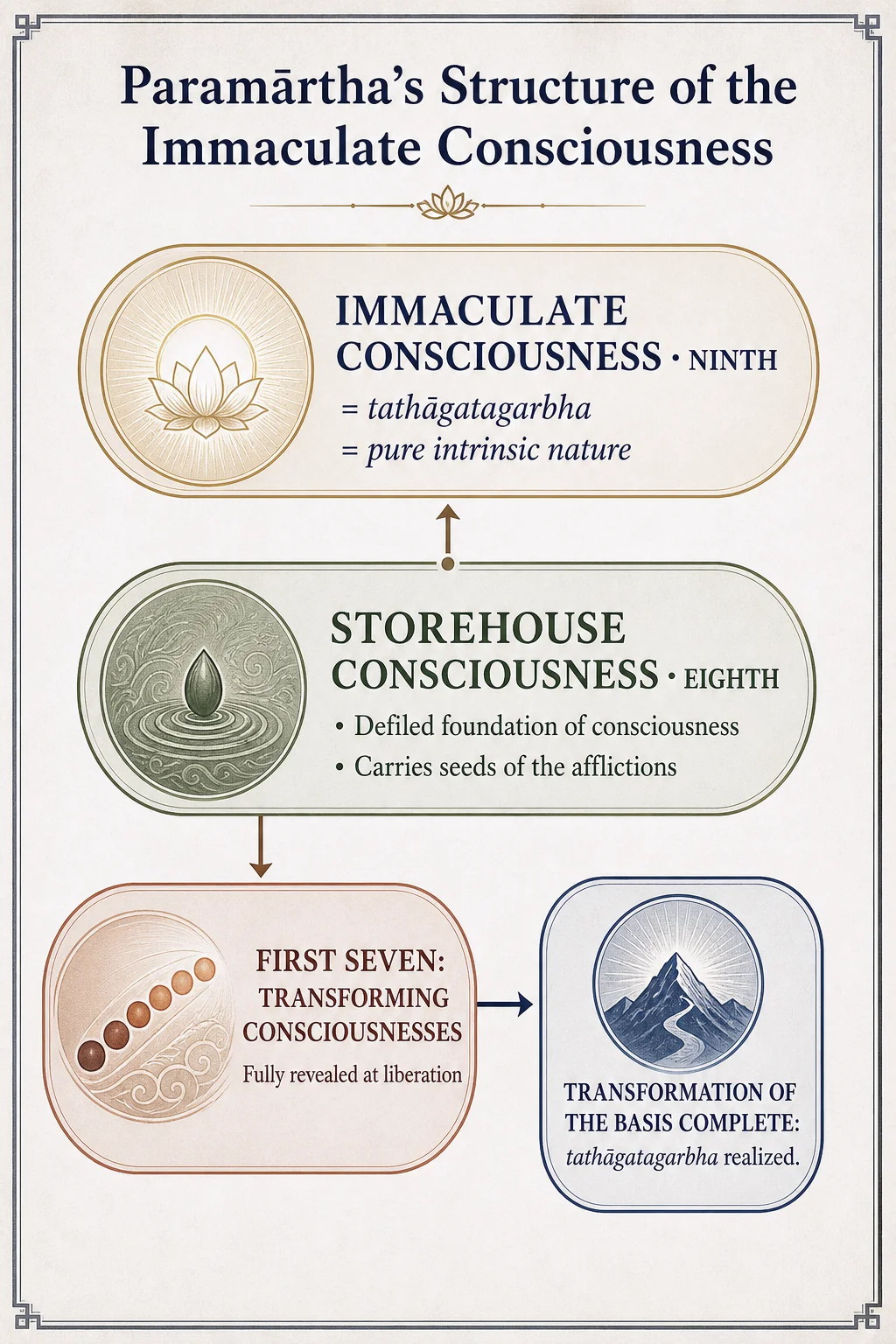
The structure attempts to resolve the tension between the contaminated character of storehouse consciousness and the purity of tathāgatagarbha. It separates out the pure aspect as a ninth consciousness, leaving storehouse consciousness to carry only contaminated functions; tathāgatagarbha, immaculate consciousness, becomes fully manifest only in liberation.
The problem is that establishing another “pure consciousness” as an underlying foundation still gives something a positive ground of reality. The Madhyamaka critique of consciousness-only, especially Candrakīrti’s, can equally be applied to this ninth consciousness. Paramārtha’s creative interpretation did not produce a continuous lineage in India, but it had far-reaching influence in China and became an important precursor of the framework in the Awakening of Faith in the Mahāyāna.
IV. The Awakening of Faith in the Mahāyāna: A Chinese Synthesis
The Awakening of Faith in the Mahāyāna (Mahāyāna-śraddhotpāda-śāstra) is one of the most influential “treatises” in East Asian Buddhism and a key text for understanding how the synthesis of tathāgatagarbha and consciousness-only evolved in China.
The Question of Authorship
East Asian tradition attributes it to Aśvaghoṣa, around the first or second century. Modern scholarship holds almost unanimously that it was composed in China around the sixth century, perhaps within Paramārtha’s circle or under his direct influence. The reasons include the absence of any credible Sanskrit original (the only purported one is a highly dubious nineteenth-century back-translation), the mismatch between its conceptual structure and terminology and those of Indian texts, and its precise correspondence to Chinese debates over synthesizing tathāgatagarbha and consciousness-only after Paramārtha’s translations.5
This book’s position is that the Awakening of Faith is a Chinese composition, not a translation of an Indian original. Its philosophical value should be understood in that setting. It does not belong to an internal development of Indian Buddhism; it is a philosophical synthesis independently developed by Chinese thinkers after they absorbed imported tathāgatagarbha and consciousness-only materials. This does not diminish its value, but it prevents us from citing it as a representative of the Indian tradition.
One Mind and Two Gates: The Structure
The central framework of the Awakening of Faith is “one mind opening into two gates”:
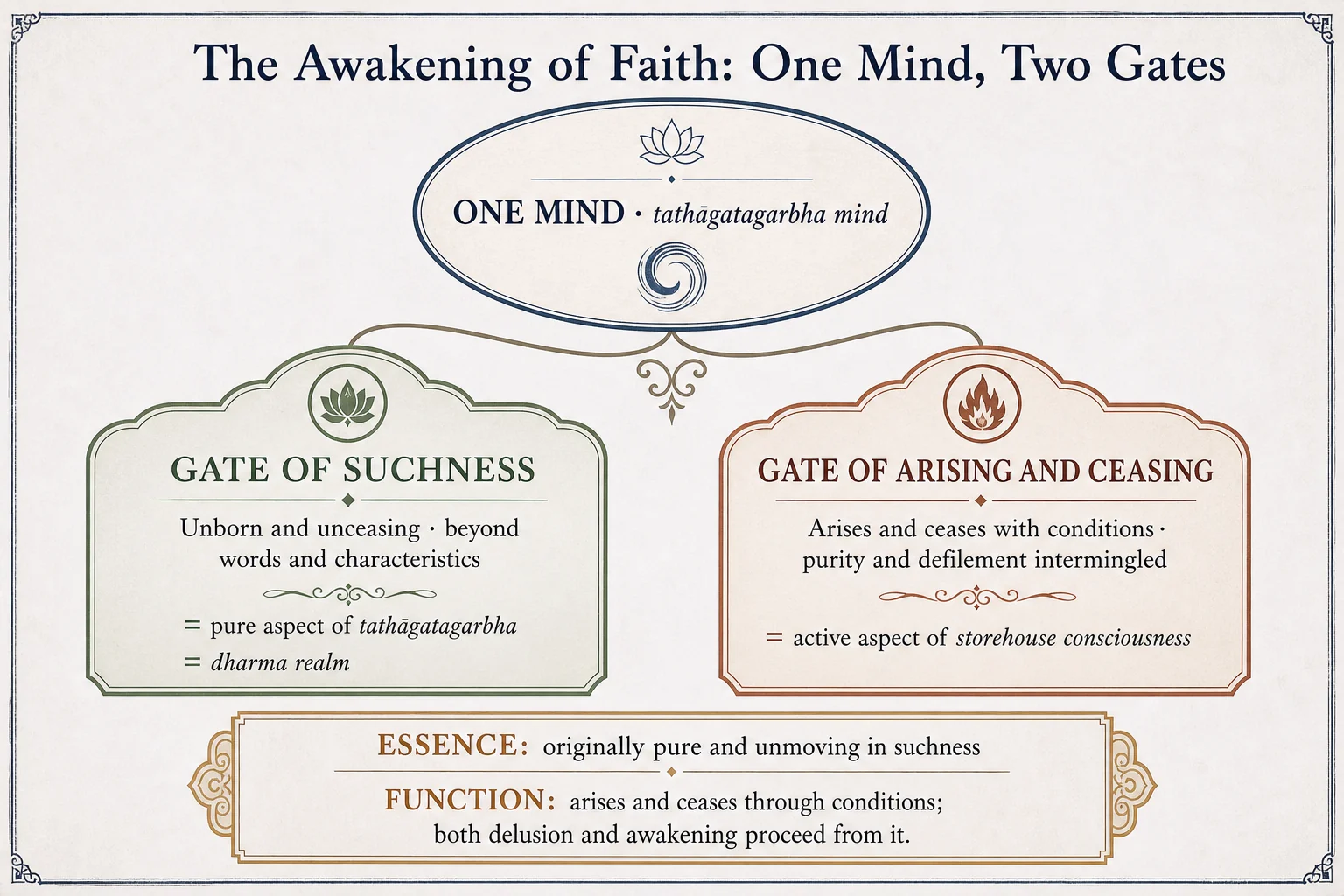
The “one mind” is the tathāgatagarbha mind. It is the source of all dharmas and has two aspects: the gate of suchness (the static, absolute, and pure aspect), and the gate of arising and ceasing—the dynamic and conditioned aspect within which defilement and purity coexist.5
The philosophical intention is to integrate the pure nature of tathāgatagarbha, the gate of suchness, with the dynamism of storehouse consciousness, the gate of arising and ceasing, into a single system. It explains how delusion or saṃsāra and awakening or liberation originate together in the “one mind,” and how one moves from the obscuration of “ignorance” (avidyā) toward “initiated awakening.”
Original Awakening and Initiated Awakening
The Awakening of Faith introduces another central pair of concepts: original awakening and initiated awakening.
Original awakening: the minds of living beings are, in their nature, originally awakened. The pure aspect of tathāgatagarbha is original awakening. This is not a potential but an originally present awakened character.
Initiated awakening: practice is the process by which “initiated awakening” (awakening that gradually develops in cultivation) continuously conforms to “original awakening,” the awakened character already present. When initiated awakening fully coincides with original awakening, ultimate awakening is attained and the two become one.
This framework defines the meaning of practice as follows: practice does not create awakening, because original awakening is already present. Instead, the awareness unfolding through practice, initiated awakening, gradually recognizes and conforms to the awakened character that already exists—original awakening.
Philosophical Problems in the Awakening of Faith
The synthesis of the Awakening of Faith has been criticized from both sides.
From Madhyamaka: the “tathāgatagarbha mind” in the gate of suchness is described as an originally pure, permanent, and unchanging “essence.” This approaches ātman. However one explains it, a “permanent and unchanging essence” must be negated under Madhyamaka’s thoroughgoing analysis of emptiness.
From consciousness-only: Xuanzang’s Faxiang school strictly rejected this framework, considering it a confusion of different levels in the operation of mind and consciousness. Its claim that “all living beings inherently possess awakened nature” also directly conflicts with consciousness-only’s theory of “five lineages,” which gives different beings different possibilities of buddhahood.
From early Buddhism: “original awakening” (the idea that living beings are already awakened) differs fundamentally from the early Buddhist position that awakening results from the effort of practice. Why does a being already awakened remain in saṃsāra? The Awakening of Faith replies that it is “obscured by ignorance,” but this simply reproduces the question concerning the origin of ignorance: how can a mind originally awakened be covered by ignorance? This is exactly the traditional tathāgatagarbha problem, “if it is originally pure, how is defilement possible?”6 Two strands can be separated within that question, and they must be recorded separately. One is how original awakening and practice can be compatible; the other is the origin of ignorance. The first strand received a positive answer in Tiantai, where the six identities acknowledge what is inherently possessed by the word “identity” and array the sequence by the word “six,” the two sides standing together on separate levels (7.4). The second strand lies outside what the six identities handle, and it remains within the framework of the Awakening of Faith.
V. The Overall Relation among the Three Discourses
The relationship of tathāgatagarbha to Madhyamaka and consciousness-only can be summarized in one diagram:
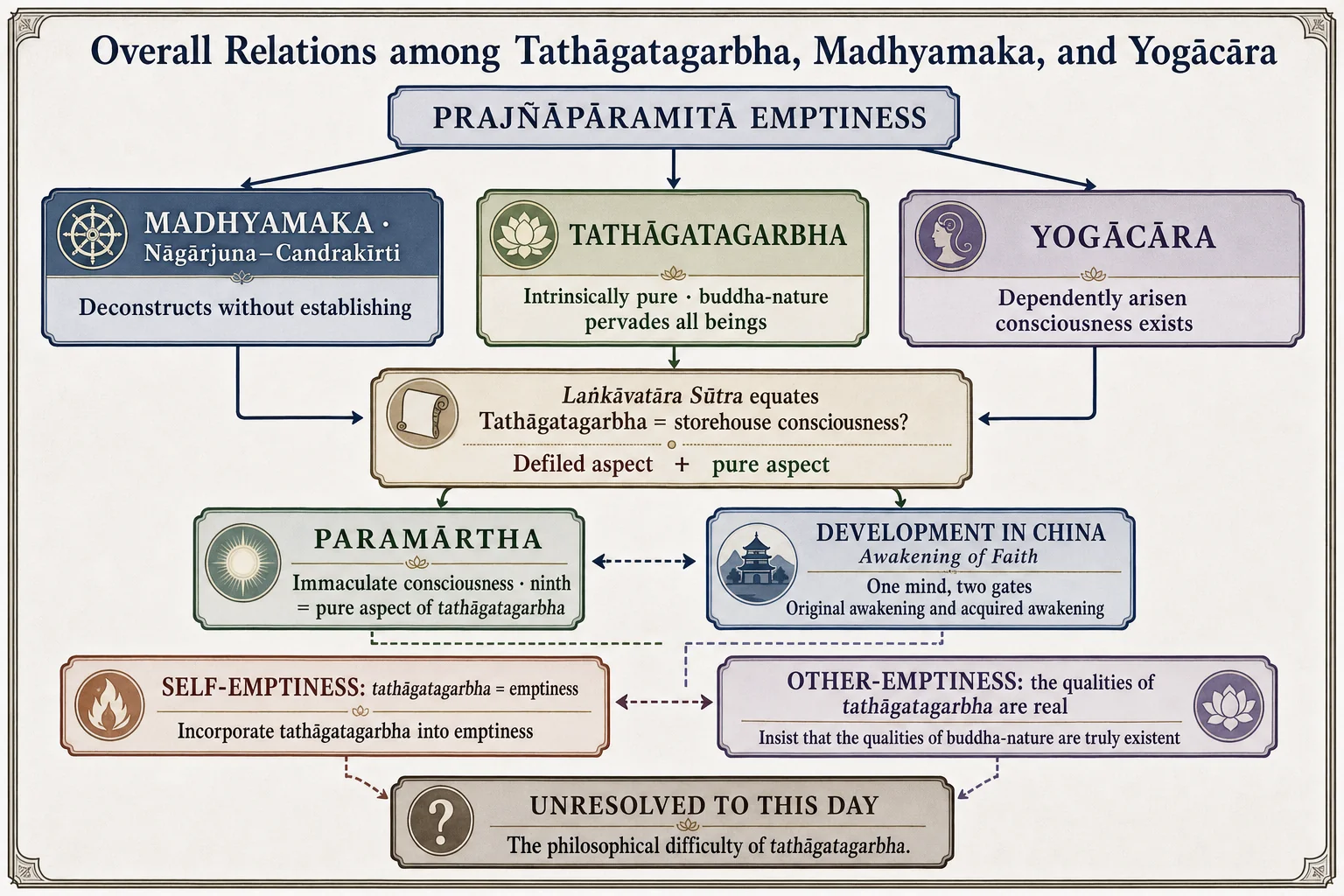
The diagram does not depict a process moving from problem to solution. It shows an open process that begins from a shared point, Prajñāpāramitā emptiness, then repeatedly branches, produces mutual criticism, attempts synthesis, and generates new tensions within each synthesis.
VI. In India and in China
In India
Indian philosophical discussion of tathāgatagarbha occurred primarily within a consciousness-only framework, through the identification made by the Laṅkāvatāra Sūtra. Prāsaṅgika Madhyamaka largely bypassed its positive claims or incorporated them into emptiness. India produced no major thinker who systematically integrated all three discourses. Śāntarakṣita came closest, but his synthesis concerned primarily Madhyamaka and consciousness-only; tathāgatagarbha remained in the background rather than the foreground.
In India, tathāgatagarbha remained one voice within a large scriptural literature and never formed an independent philosophical school. It lacked its own commentarial tradition and institutional curriculum and did not develop the fine-grained internal debates of Abhidharma or consciousness-only.2
In China
After tathāgatagarbha entered China, the situation was almost exactly reversed. It became central to East Asian Buddhism—not only through the Awakening of Faith, but also through the Nirvāṇa Sūtra’s universal declaration that “all living beings possess buddha-nature” and through the tathāgatagarbha-centered doctrinal systems independently built by Tiantai and Huayan.
China had no tradition of Candrakīrti-style Prāsaṅgika Madhyamaka capable of subjecting tathāgatagarbha to rigorous philosophical criticism; the influence of the Madhyamaka-based Sanlun school remained limited. Consciousness-only, the Faxiang school, did directly conflict with tathāgatagarbha over the “five lineages,” but its transmission in China soon declined.
Consequently, in the absence of strong internal criticism, Chinese tathāgatagarbha thought developed a relatively coherent framework whose philosophical boundaries remained quite indistinct. Concepts such as “the mind is naturally pure,” “buddha-nature is all-pervading,” and “original awakening” achieved an influence in China far beyond anything they had enjoyed in India. They deeply shaped core Chan language about “seeing one’s nature and becoming a buddha,” Tiantai’s teaching of inherent inclusion, and Huayan’s dependent arising from tathāgatagarbha. Part X will develop these traditions.
VII. This Book’s Assessment
Tathāgatagarbha is an independent philosophical impulse that cannot be wholly absorbed into Madhyamaka or consciousness-only.
Incorporating tathāgatagarbha into Madhyamaka (“tathāgatagarbha is a positive expression of emptiness”) is the most philosophically rigorous treatment, but effectively eliminates its independent content. “Nonempty tathāgatagarbha” can no longer be taken seriously, and every positive claim about inherently possessed buddha qualities is cut away. This is too distant from the original intentions and traditional use of tathāgatagarbha texts.
Incorporating tathāgatagarbha into consciousness-only (“tathāgatagarbha is the pure aspect of storehouse consciousness”) proved more fruitful historically and supplied tathāgatagarbha with an operative philosophical language. Yet it did not resolve the basic tension; it merely repackaged it. The coexistence of contaminated and pure aspects within the same consciousness remains unexplained.
The philosophical problem of tathāgatagarbha still has no entirely satisfactory answer.
The coexistence of purity and defilement, of original awakening and saṃsāra, and of inherently possessed buddha qualities with the necessity of practice: none of these three pairs of contradictions is genuinely dissolved by the syntheses discussed here. They are accommodated and reformulated to varying degrees. The third of the three pairs did receive a fully constituted answer in China, in Tiantai’s classification of stages as the six identities: the word “identity” acknowledges what is inherently possessed, the word “six” arrays the sequence, and inherent possession and cultivated realization belong to two separate notations that stand together on the same page (7.4). What that answer treats is only the compatibility of inherent possession with cultivated realization; the first two pairs of contradictions fall outside its jurisdiction, and this section’s judgment upon those two still stands.
But the problem raised by tathāgatagarbha is real.
Its question is: what existential guarantee does the possibility of liberation require? If everything is empty and everything is established through linguistic convention, toward what does practice move? The respective answers of Madhyamaka and consciousness-only each leave gaps in their theories of liberation. Tathāgatagarbha fills that gap with “the pure buddha-nature already present.” It is a philosophically motivated attempt, even though it introduces new difficulties.
References
References
-
Paul Williams. Mahāyāna Buddhism: The Doctrinal Foundations. 2nd ed. London: Routledge, 2009 (an overview of the relationship between tathāgatagarbha, Madhyamaka, and consciousness-only). ↩
-
David Seyfort Ruegg. Buddha-Nature, Mind and the Problem of Gradualism in a Comparative Perspective. London: SOAS, 1989 (Nāgārjuna and tathāgatagarbha; the place of Indian tathāgatagarbha within philosophical traditions). ↩↩
-
D. T. Suzuki (trans.). The Lankavatara Sutra. London: Routledge, 1932 (the passages identifying tathāgatagarbha with storehouse consciousness). ↩
-
Diana Paul. Philosophy of Mind in Sixth-Century China: Paramārtha's “Evolution of Consciousness”. Stanford: Stanford University Press, 1984 (Paramārtha’s ninth or immaculate consciousness and the synthesis of tathāgatagarbha with consciousness-only). ↩
-
Yoshito S. Hakeda (trans.). The Awakening of Faith. New York: Columbia University Press, 1967 (an English translation and introduction discussing the authorship controversy). ↩↩
-
Peter N. Gregory. Sudden and Gradual: Approaches to Enlightenment in Chinese Thought. Honolulu: University of Hawaii Press, 1987 (original and initiated awakening and the sudden–gradual debate in Chinese Buddhism). ↩