Chapter 2: The Transmission of Buddhism to the West
The preceding chapter considered Buddhist modernism from the perspective of intellectual history. This chapter turns to geography: how Buddhism traveled from Asia to Europe, North America, and Oceania over the past century and a half; how it took root there; and what forms it developed.
The transmission consisted of several routes and waves, with traditions arriving from different parts of Asia, growing in Western cultural soil, influencing one another, and also competing.
I. Several Waves of Transmission
First wave, nineteenth to early twentieth century: scholarly discovery and symbolic encounter.
The earliest Buddhism to enter Western public consciousness was a product of scholarship. German and British Orientalists translated a large body of Buddhist literature in Pali and Sanskrit. The preceding chapter analyzed the construction and its problems. The most influential early medium for Western general audiences was Edwin Arnold's long poem The Light of Asia (1879), which narrated the Buddha's life in Victorian poetic language. It sold hundreds of thousands of copies in both Britain and the United States and introduced a highly idealized, deritualized image of the Buddha to a large Western readership.
The 1893 World's Parliament of Religions in Chicago was the first wave's high point. Several Asian Buddhist representatives addressed Western audiences in person, including Anagarika Dharmapala of Sri Lanka and Shaku Sōen (1860–1919), the Japanese teacher of D. T. Suzuki. Symbolically, this was the first time Asian Buddhist traditions participated as equals in public interreligious dialogue in the West. Very few Westerners actually converted to Buddhism in this period; the encounter consisted more in intellectual contact and Romantic longing.
Second wave, 1950s–1970s: the encounter between Zen and the counterculture.
Zen was primarily responsible for introducing the Western public to Buddhist practice, especially through the English writings of D. T. Suzuki, discussed in the preceding chapter, and America's "Zen boom."
The Beat Generation, including Jack Kerouac, Allen Ginsberg, and Gary Snyder, used Zen as a spiritual resource in their opposition to mainstream American culture—consumerism, political conformity, and Christian conservatism. Their Zen was mostly romanticized and deinstitutionalized, but it made the word "Zen" genuinely popular in Western mass culture for the first time.
Alan Watts (1915–1973) was the period's most influential popular Buddhist writer. He explained Zen and Daoism to Western readers in vivid language, emphasized the importance of direct experience, and sold in enormous numbers. He had no teacher or authorization and called himself an "interpreter" rather than a teacher. This was itself a typically Western modernist Buddhist posture.1
Third wave, 1970s to the present: institutionalization and diversification.
Beginning in the 1970s, large numbers of authentic Asian lineage holders entered the West and established organized practice centers and lineage institutions. Three principal currents developed simultaneously:
- Southern Buddhist insight meditation, represented by the Insight Meditation Society, founded in 1975;
- Tibetan Buddhism, represented by Chögyam Trungpa's Shambhala system beginning in the 1970s and by numerous Nyingma, Gelug, and Kagyu lineages;
- Japanese Zen, represented by the San Francisco Zen Center, founded in 1962.
II. Zen Takes Root in the West
Shunryu Suzuki (1904–1971)—not to be confused with D. T. Suzuki, whose influence operated principally through writing—came to San Francisco in 1958 and established the San Francisco Zen Center. In 1967 he founded Tassajara Zen Mountain Center in Big Sur, California, the first specialized Zen training monastery in the United States. The record of his talks, Zen Mind, Beginner's Mind (1970), remains one of the best-known English-language works of Zen.
Philip Kapleau (1912–2004) practiced for many years in Japan and established the Rochester Zen Center after returning to the United States. He wrote The Three Pillars of Zen (1965), the first English-language Zen book to describe the practice of meditation systematically and in detail, including kōan study and concrete records of practical instruction. It exerted a major influence on Western Zen practitioners.
Zen's institutionalization in the West differed systematically from its original Asian form. Asian monastic Zen involved a complete way of monastic life—food, clothing, shelter, travel, collective daily liturgy, and ordination. Most practitioners at Western Zen centers, by contrast, were laypeople who participated periodically in intensive retreats, or sesshin, and otherwise lived secular lives. This predominantly lay structure created considerable institutional distance between Western Zen and its Asian traditions.2
Zen's cultural influence in the West also extended far beyond communities of practice. As a cultural signifier in psychotherapy, contemporary art, architecture, and design, "Zen" influenced far more people than professed belief in it. It was extracted as an aesthetic and philosophy of life and detached from religious practice—a quintessential operation of Buddhist modernism.
III. Western Forms of Southern Buddhist Insight Meditation
The Insight Meditation Society, or IMS, was founded in Barre, Massachusetts, in 1975 by Joseph Goldstein, Sharon Salzberg, and Jack Kornfield. It became the institutional center of the Western insight movement, as Chapter 9.5 explained. In 1981 Kornfield founded Spirit Rock Meditation Center in California, creating two core institutions on the East and West Coasts.
Spiritually, the tradition descends from Ajahn Chah in Thailand and Mahāsi Sayadaw in Myanmar, but its Western form differs considerably from its Asian sources. Most students are unordained laypeople. Intensive retreats, normally lasting from one to ten days, are the main form of practice, while commuting, work, and family life remain part of ordinary existence.
Ajahn Sumedho (born 1934) represents another current. An American disciple of Ajahn Chah, he founded Amaravati Buddhist Monastery in Britain in 1984, which became the most important center of Southern Buddhist transmission in the country. His student Ajahn Brahm established Bodhinyana Monastery in Australia, extending the lineage into Oceania. This current maintains a full system of ordination and remains closer to the traditional Southern Buddhist monastery.
IV. Tibetan Buddhism in the West
The transmission of Tibetan Buddhism to the West occurred chiefly after the 1960s, alongside the formation of the Tibetan exile community.
Chögyam Trungpa Rinpoche (1939–1987), discussed in Chapter 11.8, gave up monastic robes and taught in the West as a layman. He established the Shambhala system and Naropa University in 1974. Naropa was the first Buddhist-inspired university in the West, combining Buddhist studies, poetry, dance, psychology, and other disciplines. It became an important center of American alternative spiritual culture in the 1970s and 1980s. In his later years, Trungpa provoked extensive controversy through drinking and sexual conduct, becoming an early case in the problem of abuses of power by Western Buddhist teachers.
Lama Thubten Yeshe (1935–1984) and Lama Zopa Rinpoche (born 1945) founded the Foundation for the Preservation of the Mahayana Tradition, or FPMT, one of the largest international networks transmitting Gelug teachings in the West, with practice centers in more than thirty countries.
Tibetan Buddhism's distinctive appeal in the West derives partly from its preservation of a complete system of practice, from the four preliminary practices through Highest Yoga Tantra; its extraordinary visual richness in thangkas, ritual implements, and rites; and its explicit system of lineage authorization through empowerments and oral transmissions. This is especially attractive to Western practitioners seeking a tradition with roots and depth.
V. Immigrant-Community Buddhism: The Overlooked Other Half
Academic discussion and public attention concerning Western Buddhism often concentrate on "Western converts to Buddhism," people who actively choose Buddhism. But they constitute only half of Western Buddhism.
The other half is immigrant-community Buddhism. Immigrants from China, Japan, Korea, Vietnam, Thailand, Sri Lanka, Myanmar, Tibet, and elsewhere brought their Buddhist traditions to the West. Temples in these communities ordinarily place greater emphasis on maintaining forms from their Asian countries of origin (language, ritual, calendar, and festivals), and serve particular ethnic communities. They are almost invisible in Western media, but may outnumber Western converts among Buddhist adherents as a whole.
In an important 1998 article, Jan Nattier proposed three types of Buddhism in the West:
| Type | Mode of Transmission | Principal Recipients | Typical Examples |
|---|---|---|---|
| Export, or Elite | Masters or teachers actively promote the tradition abroad | Highly educated local residents | IMS and Zen centers |
| Import, or Evangelical | Recipients actively seek it and invite teachers | People actively seeking alternative traditions | Some Tibetan centers |
| Baggage | Arrives with immigrants rather than through active transmission | Asian immigrant communities | Chinatown temples and Vietnamese immigrant communities |
Nattier points out that "baggage" Buddhism, the Buddhism of immigrants, is almost invisible in media and scholarship. Yet in both the number of adherents and the depth of Buddhist practice, it may be closer to the original forms of Asian traditions. Western understandings of Buddhism have been distorted by their excessive focus on the "export" type.3
VI. Several Common Characteristics of Western Buddhism
Despite the enormous internal diversity of Western Buddhism, several characteristics recur across traditions.
Psychologization. Western Buddhism commonly translates the language of practice into psychological terms. Dukkha is rendered "existential anxiety," practice becomes "cultivating psychological health," and nirvāṇa becomes "full psychological functioning." This has made dialogue between Buddhism and psychotherapy one of its most active interdisciplinary conversations.
Horizontal authority structures. Western society possesses a deep suspicion of hierarchy, which affects master–disciple relationships. Western students expect to be able to question teachers and expect some mechanism of accountability within lineage communities. This produces profound tension with Tibetan Buddhism's strong emphasis on the authority of the guru. The tension has erupted most violently in numerous scandals involving teachers' sexual conduct, discussed in the next section.
The status of women. Western Buddhism has moved more rapidly than most Asian traditions in women's participation and leadership. Many leading teachers in Western Buddhist communities are women, including Sharon Salzberg, Pema Chödrön, and Ajahn Brahm. The movement in the West concerning women's ordination, discussed in Section IV of Part IX, has been driven in part by women practitioners and supporters in Western communities.
The separation of mindfulness. Western Buddhism's most extensive influence may be the penetration of mindfulness into the broadest range of nonreligious domains—medicine, psychotherapy, education, and corporate training. In this context, "mindfulness" has become substantially detached from Buddhism and turned into an intervention extracted from Buddhist techniques in the service of secular goals, as Chapter 9.5 explained.
Race and class. Since the 2010s, the heavily white and middle-class character of Western convert communities has been discussed more openly. Who can afford a ten-day retreat? Whose Buddhist experience is treated as "typical"? How can the experiences of Asian American Buddhists (often defined as the other within discussions of "American Buddhism") be included? The conversation continues, and it has already encouraged the formation of several racially diverse practice communities and related academic research.
VII. Abuse of Power, Accountability, and a Crisis of Trust
One of the most serious internal problems confronting Western Buddhism in the twenty-first century has been the exposure of a series of cases involving Buddhist teachers' sexual abuse of power. These incidents were moral failures by individuals, but they also revealed systematic institutional weaknesses in Western Buddhism:
- Trust in an "awakened master" was sometimes almost unconditional, with no mechanism of accountability;
- Certain tantric interpretations claiming that the "master–disciple relationship transcends conventional morality" were abused to justify misconduct;
- A culture of silence, in which the master could not be criticized, made it difficult for victims to speak;
- Independent investigative and disciplinary bodies did not exist.
Representative cases include allegations by multiple former students that Sogyal Rinpoche engaged in decades of sexual misconduct and psychological manipulation: a detailed letter of accusation became public in July 2017, he resigned as Rigpa's spiritual director that August, and he died in 2019; accusations by multiple female students over several decades that the Zen teacher Eido Shimano engaged in sexual misconduct, with internal documents from the Zen Studies Society in New York showing long-term organizational concealment when the case became public around 2010; and the revelation in late 1988 that Chögyam Trungpa's successor Ösel Tendzin had continued sexual relations with disciples without informing them that he carried HIV.4
These incidents generated broad debate within Western Buddhist communities over how to establish effective mechanisms of accountability. No institutional solution has yet won universal acceptance. Yet the controversy has also produced some positive institutional changes. Several organizations created codes of conduct and complaint procedures, and some lineages began requiring teachers to receive more systematic ethical training.
VIII. The Overall Configuration of Contemporary Western Buddhism
After a century and a half of transmission, Western Buddhism today presents a highly diverse and tension-filled picture:
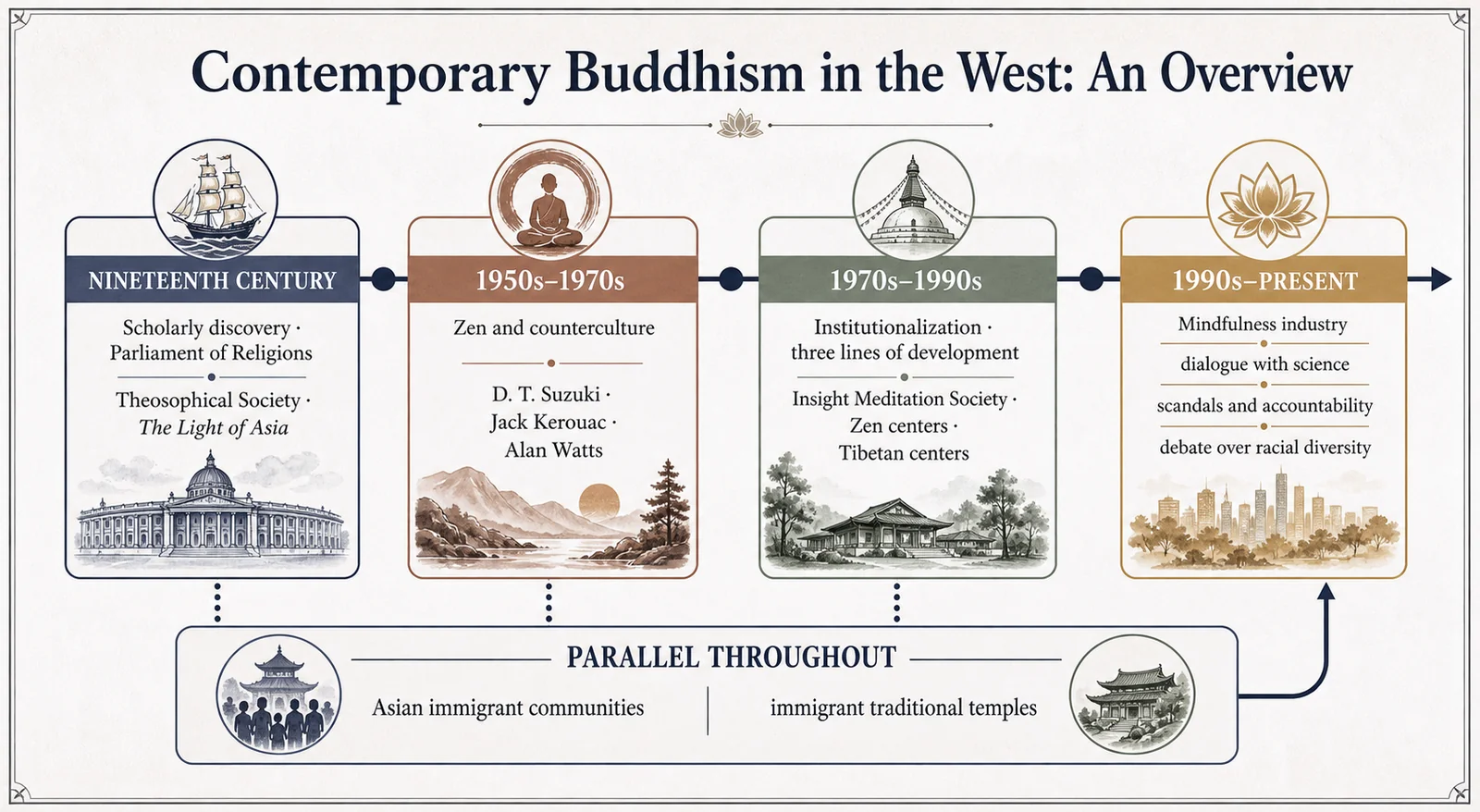
Western Buddhism's most basic tension lies between depth of transmission and breadth of access. The more fully a tradition preserves its traditional forms, the fewer people it reaches. The more it adapts to Western culture through deinstitutionalization, individualization, and secularization, the more people it reaches—but the greater its distance from the original transmission. The tension admits no simple resolution. Every tradition entering a new cultural environment must confront it, but the history of Buddhism's entry into the West makes it exceptionally visible.
The next chapter turns to scholarship: how modern academic Buddhist studies changed our understanding of Buddhist history and philosophy, and how those changes in turn influenced Buddhism's own self-understanding.
Further Reading
- Shunryu Suzuki. Zen Mind, Beginner's Mind. New York: Weatherhill, 1970. (One of the most important English-language works of Zen)
- Ann Gleig. American Dharma: Buddhism Beyond Modernity. New Haven: Yale University Press, 2019. (Comprehensive contemporary study of twenty-first-century American Buddhism, including scandals, women, race, and related issues)
- Martin Baumann. "Global Buddhism: Developmental Periods, Regional Histories, and a New Analytical Perspective." Journal of Global Buddhism 2 (2001): 1–43. (Analytical framework for a global history of Buddhism in the West)
References
References
-
Rick Fields. How the Swans Came to the Lake: A Narrative History of Buddhism in America. 3rd ed. Boston: Shambhala, 1992. (The most comprehensive narrative history of the transmission of Buddhism to the United States) ↩
-
Charles S. Prebish and Martin Baumann (eds.). Westward Dharma: Buddhism beyond Asia. Berkeley: University of California Press, 2002. (Regional comparative study of Western Buddhism) ↩
-
Jan Nattier. "Who Is a Buddhist? Charting the Landscape of Buddhist America." In The Faces of Buddhism in America, ed. Charles Prebish and Kenneth Tanaka. Berkeley: University of California Press, 1998. (Analysis of the three types of Western Buddhism and the neglect of immigrant Buddhism) ↩
-
Jack Kornfield. After the Ecstasy, the Laundry: How the Heart Grows Wise on the Spiritual Path. New York: Bantam, 2000. (Practical challenges faced by Western Buddhist practitioners); on abuses of power by teachers, see also Ann Gleig, American Dharma: Buddhism Beyond Modernity. New Haven: Yale University Press, 2019, chapter 6. ↩