书 474「The same is true of tadutpatti and tadātmya, Dharmakīrti's two fundamental analyses of the universe of discourse and the foundation of svabhāvapratibandha」,注「论法称以因果性(tadutpatti)与同一性(tadātmya)二者为自性关联之基础」合,正文书 51 行「这种必然关联只有两种来源」由此担。②Dunne《Foundations of Dharmakīrti's Philosophy》(书目 0217)第三章题「Svabhāvapratibandha: The Basis of Inference」,书内 145 页起,Boston: Wisdom, 2004,合。
所据 Dunne《Foundations of Dharmakīrti's Philosophy》(书目 0217,):书内 392 页「In this context, that which is capable of telic function is said to be ultimately real. The other one is said to be conventionally real. They are, respectively, the particular and the universal.' [PV3.3]」,注录英译逐字合,且 Dunne 即以此颂为 PV3.3,合注「第三品第 3 颂」;
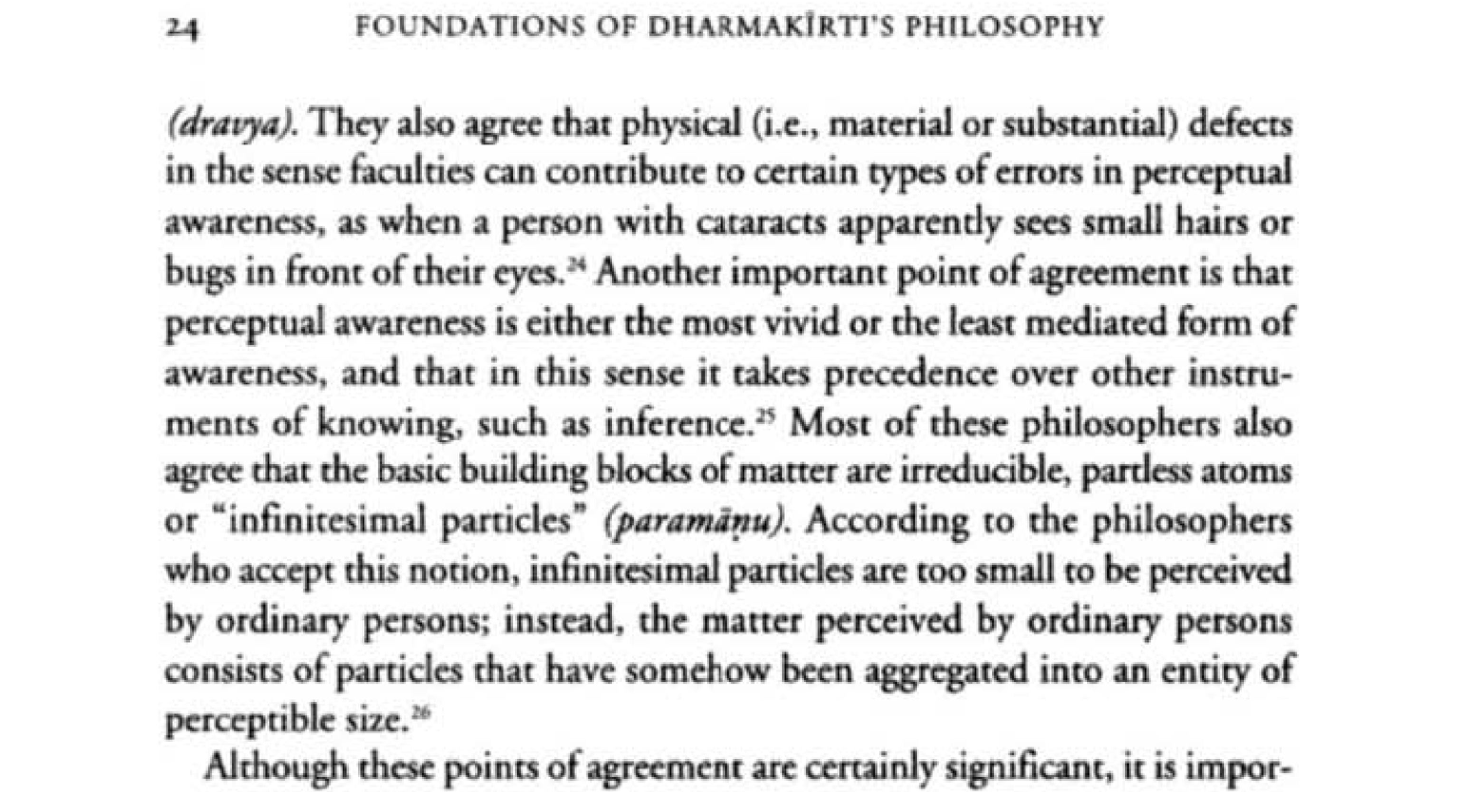
51 行所述由概念转为直接经验一段,书内第 306 页有直接对应:“The way a yogin attains that exalted state, however, is precisely that, as an ordinary person, she focused in meditation upon a concept—i.e., one of the sixteen aspects—until she attained a direct, nonconceptual experience of that content.”邓恩紧接指出此说要害在可信性:所转出的禅定经验若欲成量,其所自出之概念认识本身须无可疑。又书内第 24 页注二五:“For Dharmakīrti, only perceptual awareness is ‘vivid’ (spaṣṭa)”,与比量对举,并指其瑜伽现量之论在《量评释》三之二八一至二八七,正文第 151 行「生动当下经验(vivid direct experience)」一语所本即此。已改:脚注原为白文书目条,今补書頁换算、第 306 页原文、及第 24 页注二五之 spaṣṭa 与《量评释》出处。
Apoha Buddhist Nominalism and Human Cognition - Mark Siderits 与 Tom Tillemans 与 Arindam Chakrabarti (eds.) - 2011
书页
书内第 91 页(Dunne 篇)
核查结论
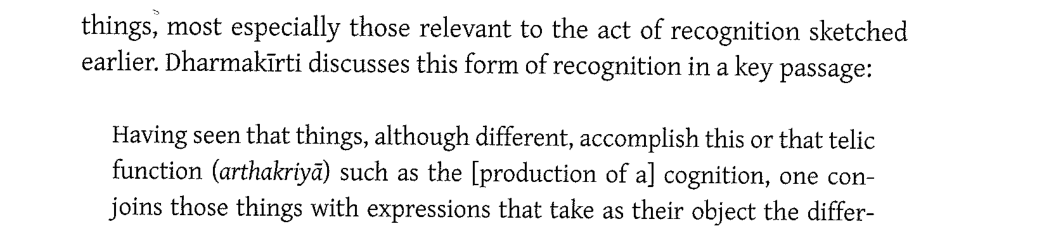
同一文集(见前章第 192 行)。脚注「含法称对遮诠论的修正」确:目次列有三篇专治法称一侧——Tillemans〈How to Talk About Ineffable Things: Dignāga and Dharmakīrti on Apoha〉、Dunne〈Key Features of Dharmakīrti’s Apoha Theory〉、Hugon〈Dharmakīrti’s Discussion of Circularity〉。正文第 114 行「引入因果功效(arthakriyā)来为遮诠论提供更坚实的基础」,Dunne 篇书内第 91 页引法称原文可核:「Havin
核查全文
g seen that things, although different, accomplish this or that telic function (arthakriyā) such as the [production of a] cognition, one conjoins those things with expressions that take as their object the difference from things that are other than those [that accomplish the aforementioned telos]」(书影 `apoha-091`)。全书 arthakriyā 三十二见、causal efficacy 二十五见,非偶及。
按
法称以因果功效改造遮诠,见 John D. Dunne〈Key Features of Dharmakīrti’s Apoha Theory〉所引法称原文:「Having seen that things, although different, accomplish this or that telic function (arthakriyā) such as the [production of a] cognition, one conjoins those things with expressions that take as their object the difference from things that are other than those [that accomplish the aforementioned telos]」,与正文第 114 行「引入因果功效(arthakriyā)」相合。全书另有 Tillemans〈Dignāga and Dharmakīrti on Apoha〉与 Hugon〈Dharmakīrti’s Discussion of Circularity〉两篇专治法称一侧,脚注「含法称对遮诠论的修正」不虚。