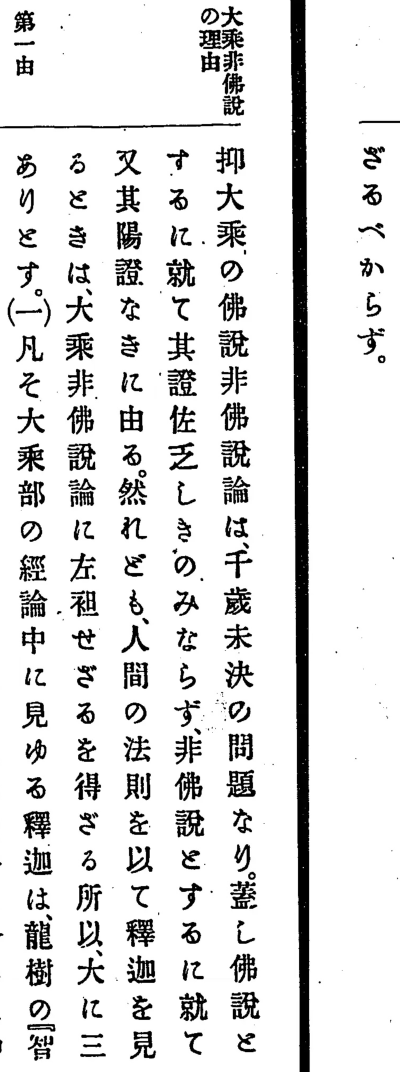
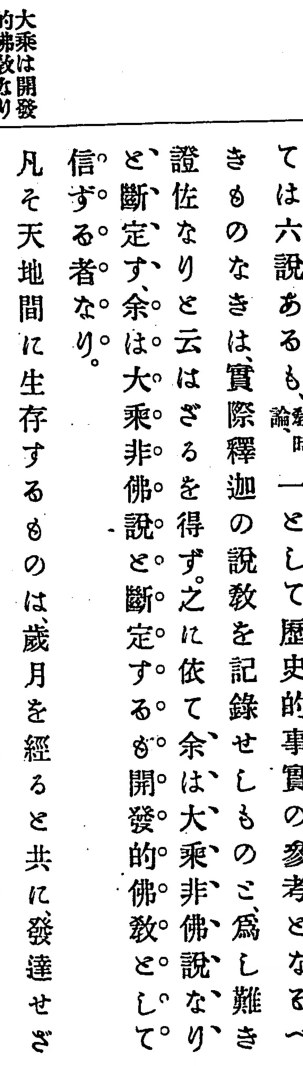
十九世纪欧洲佛教文献学的兴起,见 Donald S. Lopez Jr. (ed.). Curators of the Buddha: The Study of Buddhism under Colonialism. Chicago: University of Chicago Press, 1995,洛佩兹导言(书内第 2 页):"The sustained study of Buddhist texts did not really begin in Europe until the delivery of Brian Hodgson's package of Sanskrit manuscripts into the hands of Eugène Burnouf in 1837";布尔努夫《印度佛教史导论》一八四四年出,其《法华经》法译一八五二年出,即其卒年。本节所说的传入日本一层,同书导言注三十六所引里斯·戴维斯一八九五年语可为实据(书内第 27 页):"When Japanese students, for instance, come to our Western colleges and learn there to read their Pali and Sanskrit books under the guidance of professors trained in historical criticism, it is almost impossible that they can return to their country without the accuracy of their knowledge being greatly improved, and their ideas of Buddhism, to some extent at least, corrected and modified.",此语出于村上专精《佛教统一论》之前六年。惟本节的因果次第须记一层保留:大乘非佛说的论证骨架,日本本土早已具备。见 James Edward Ketelaar. Of Heretics and Martyrs in Meiji Japan: Buddhism and Its Persecution. Princeton: Princeton University Press, 1990 第一章(书内第 20 页起)论富永仲基(一七一五—一七四六)《出定后语》:该书"is generally recognized as the work that taught Buddhists to fear their own history",其直接对象正是当时日本所传的大乘,所立"加上"之说谓教理如漆之层层叠加,后出者不得冒充原初;同书注五十(书内第 236 页)明言,富永关于诸经晚出("delayed construction … in a later age")的断定"contributed the basic outline to the argument against the possibility of the historical Buddha being able to have preached the Mahayana sutras: the so-called Daijō hibussetsu"。凯特拉又谓《出定后语》"formed … the basis of what would be called in the nineteenth century, 'modern Buddhism' (kindaiteki bukkyō), that is, 'historical Buddhism' (rekishiteki bukkyō)"。结论本身在德川时代已由本土学者提出,与明治相隔约一百五十年;明治所引进的是支持它的方法、语料与学术权威。西方学界以此为断而成一时之规,今有直书之据:Judith Snodgrass. Presenting Japanese Buddhism to the West: Orientalism, Occidentalism, and the Columbian Exposition. Chapel Hill: University of North Carolina Press, 2003,书内第 7 页谓当时学术之规"shaped Western academic Buddhism by directing the selection of the Pali texts as the source of Buddhist knowledge",又谓"Rules of scholarship then determined which parts of the texts were to be taken as the Buddha's actual speech and, conversely, which parts were to be excluded as later interpolations and denied recognition as part of Buddhist belief";同页并记其时西方视日本佛教"was regarded as nothing more than a local expression of the universal essence captured by Western scholarship and its scientific study of the Pali texts. As a form of Mahayana Buddhism, it was necessarily a later and therefore aberrant form of the teachings of the historical Buddha",而"Challenging this assumption was one of the specific aims of the Japanese Buddhist delegation"(一八九三年芝加哥万国宗教大会)。日本一侧的接受史见 Orion Klautau, "Against the Ghosts of Recent Past: Meiji Scholarship and the Discourse on Edo-Period Buddhist Decadence," Japanese Journal of Religious Studies 35, no. 2 (2008): 263–303:其列明治排佛诸论,明标一类为"criticisms based on a historical analysis of the Buddhist scriptures, which questioned whether or not the Mahayana teachings had been spoken by Shakyamuni himself (the so-called daijō-hibussetsuron 大乗非仏説論)";又记"In 1894, the study of Japanese Buddhist history was established in the Meiji academic world",村上专精时为东京帝国大学印度哲学讲师,与门人鹫尾顺敬、境野黄洋共创《佛教史林》,为日本首份专治佛教史的刊物。