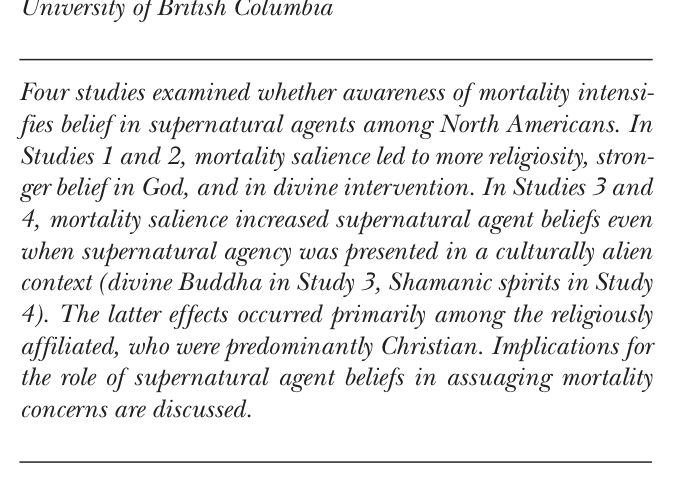
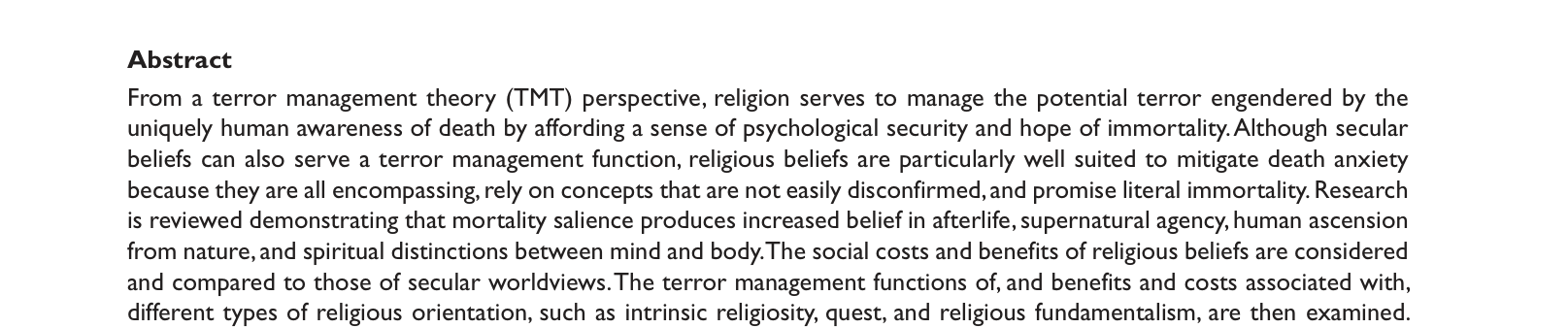
死亡与无常凸显(mortality salience)增强超越性信念的实验证据,见 Ara Norenzayan and Ian G. Hansen. "Belief in Supernatural Agents in the Face of Death." Personality and Social Psychology Bulletin 32, no. 2 (2006): 174–187(死亡提示提高对神明与超自然者的信念,跨传统效应主要见于已有宗教归属者);综述见 Kenneth E. Vail III, Zachary K. Rothschild, Dave R. Weise, Sheldon Solomon, Tom Pyszczynski, and Jeff Greenberg. "A Terror Management Analysis of the Psychological Functions of Religion." Personality and Social Psychology Review 14, no. 1 (2010): 84–94(宗教信念以"字面不朽"缓冲死亡焦虑)。两文所据的实测與限度,须照原文记明。诺伦扎扬與韩森一文摘要作:"Four studies examined whether awareness of mortality intensifies belief in supernatural agents among North Americans. In Studies 1 and 2, mortality salience led to more religiosity, stronger belief in God, and in divine intervention. In Studies 3 and 4, mortality salience increased supernatural agent beliefs even when supernatural agency was presented in a culturally alien context (divine Buddha in Study 3, Shamanic spirits in Study 4). The latter effects occurred primarily among the religiously affiliated, who were predominantly Christian."(书内第 174 页)。故两点须限:受试为北美人,跨传统一效应又主要见于本已有宗教归属者,而该群体以基督徒为主;本节引此,只取其所示的方向,不推及无宗教归属者,亦不推及以佛教为母语传统的人群。韦尔等一文摘要作:"religious beliefs are particularly well suited to mitigate death anxiety because they are all encompassing, rely on concepts that are not easily disconfirmed, and promise literal immortality",所综述者为"mortality salience produces increased belief in afterlife, supernatural agency, human ascension from nature, and spiritual distinctions between mind and body"(书内第 84 页)。该文同时自设一层保留:"Although secular beliefs can also serve a terror management function",并分别字面不朽(literal immortality)與象征不朽(symbolic immortality)两路;是则此机制不为宗教所专有,本节据以说明的只是凸显无常未必松动对恒常的投入这一点。此处为概念参照,非历史影响关系。