← 引用核查

03-如来藏与唯识中观

6 条 · 5 行 · 到书里读本章 →

第 149 行脚注 williams

书目著录1.7.3-1条0169
所据
Early Indian Mahayana Buddhism I Recent Scholarship - David Drewes - 2010
书页
版权页
版权页

此页所载版权声明禁止以任何方式复制或传播本书的任何部分。本页书影只为核对该条著录而摆在此处,请勿转载、转贴、下载或另行传播——禁令未开「少量节取」之例,剪一小段同样不在许可之内。

核查结论

Williams《Mahāyāna Buddhism》第二版 pp. 112–114 将这一空性解释限定于格鲁传统;正文已改为“格鲁派应成中观”并补具体页码。

第 150 行脚注 ruegg2 条佐证

纸本1.7.3-6条1761
所据
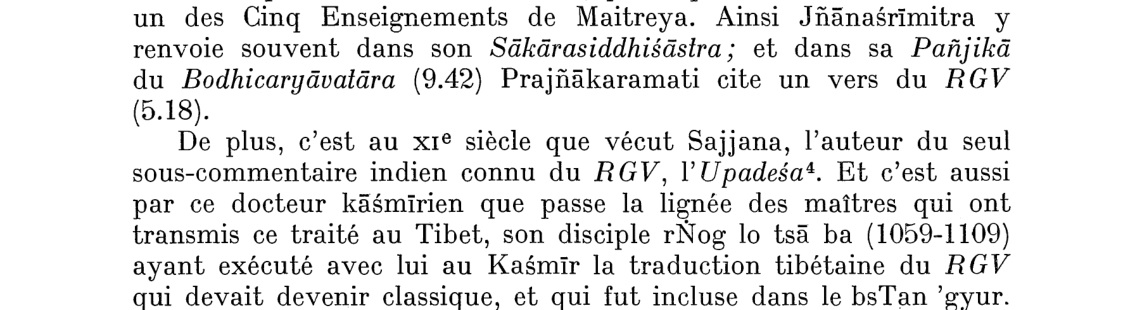
[0287] La théorie du Tathâgatagarbha et du Gotra - David Seyfort Ruegg - EFEO 1969
书页
书内第 35 页 书影
书内第 35 页
书内第 35 页 书影
书内第 35 页
核查结论

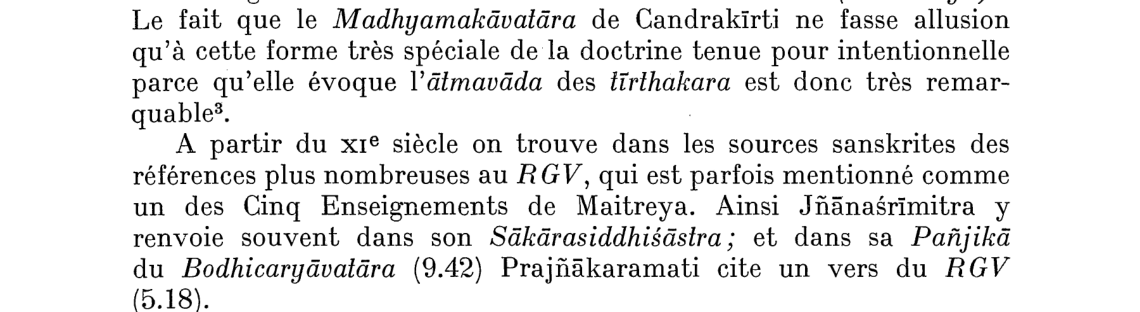
前据所悬「未形成独立学派、论疏与寺院体系」一层,另有两书可担:Ruegg《La théorie du Tathāgatagarbha et du Gotra》([0287],EFEO 1969,书内第 35 页)记十一世纪以前梵文文献征引《宝性论》者寥寥(安慧一偈不能断其取自此论,月称只及《楞伽》式之说而于此论所立者「passe sous silence」),「A partir du XIe siècle」方多见,唯一存世的印度复注为十一世纪迦湿弥罗萨阇那所作;Mathes《A Direct Path to the Buddha Within》([0014],Wisdom 2008,书内第 2 页)更径言「the Indian reaction on the whole was simply to ignore the Ratnagotravibhāga and its teaching of buddha nature for six centuries」。正文书 121 行「并未形成独立的哲学学派……缺少自己的注疏传统与学院教学」由此坐实。已更新: 注补二书书页与原句。

十一世纪起梵文来源对《宝性论》的征引才转多;同页称萨阇那《教授》为唯一已知的印度复注。

纸本1.7.3-7条1762
所据
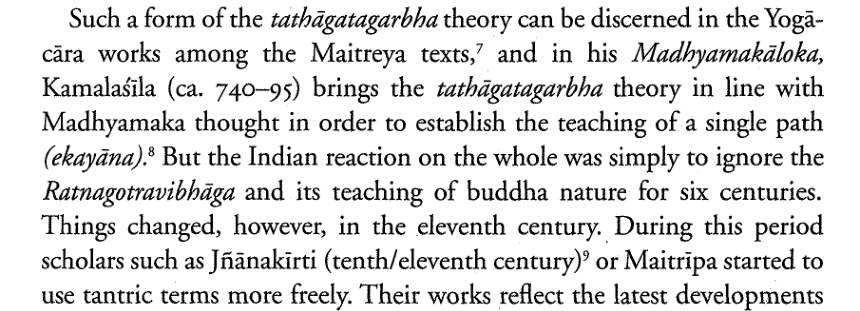
[0014] A Direct Path to the Buddha Within - Klaus-Dieter Mathes - 2008
书页
书内第 2 页 书影
书内第 2 页
核查结论

前据所悬「未形成独立学派、论疏与寺院体系」一层,另有两书可担:Ruegg《La théorie du Tathāgatagarbha et du Gotra》([0287],EFEO 1969,书内第 35 页)记十一世纪以前梵文文献征引《宝性论》者寥寥(安慧一偈不能断其取自此论,月称只及《楞伽》式之说而于此论所立者「passe sous silence」),「A partir du XIe siècle」方多见,唯一存世的印度复注为十一世纪迦湿弥罗萨阇那所作;Mathes《A Direct Path to the Buddha Within》([0014],Wisdom 2008,书内第 2 页)更径言「the Indian reaction on the whole was simply to ignore the Ratnagotravibhāga and its teaching of buddha nature for six centuries」。正文书 121 行「并未形成独立的哲学学派……缺少自己的注疏传统与学院教学」由此坐实。已更新: 注补二书书页与原句。

Mathes 明言印度方面总体上忽略《宝性论》及佛性说达六百年,至十一世纪情形始变。

第 151 行脚注 suzuki

书目著录1.7.3-3条0401
所据
The Lankavatara Sutra A Mahayana Text - Daisetz Teitaro Suzuki 英譯 - 1932
书页
版权页
版权页

此页所载版权声明禁止以任何方式复制或传播本书的任何部分。本页书影只为核对该条著录而摆在此处,请勿转载、转贴、下载或另行传播——禁令未开「少量节取」之例,剪一小段同样不在许可之内。

核查结论

書 53 行末补两句:「而经文自己已经说出了这个张力的代价:染污之时无从现证,凡愚与外道于是把如来藏当成造物主,或者当成一个我。后世『批判佛教』抓住不放的那一点,经文在此先自道了。」所据即本行已核之铃木本导论:染则「an intuitive penetration (pratyakṣa) is impossible」,而不可现证者「the Garbha is believed sometimes to be a creator (kāraṇa) and sometimes to be an ego-substance (ātman)」。此补于本书论旨有用:第七篇他处与第二卷论如来藏之贪著、及日本批判佛教一系的争论,皆可回指此处——该说的风险不是后人加的,是经文自陈的

第 152 行脚注 paul

书目著录1.7.3-4条0402
所据
Philosophy of Mind in Sixth-Century China - Diana Y. Paul - 1984
书页
版权页
版权页

此页所载版权声明禁止以任何方式复制或传播本书的任何部分。本页书影只为核对该条著录而摆在此处,请勿转载、转贴、下载或另行传播——禁令未开「少量节取」之例,剪一小段同样不在许可之内。

核查结论

两项俱坐实。全书 Paramārtha 七百五十三见、amala 一百四十六见、ninth consciousness 二十二见、tathāgatagarbha 一百三十八见。(一)第九识无垢识:「Paramārtha's famous innovation of a ninth consciousness called the amala-vijñāna」;其性质作「The amala, the ninth consciousness, is Pure Consciousness, the perfect cause」,与正文「阿赖耶识的清净面单独立为无垢识」相合。

核查全文

(二)「印度唯识文献里找不到直接来源」亦有据,且原书的说法更精确:该概念之解说独见于《转识论》(Chuan shih lun)——「this short text also includes an explanation of Paramārtha's important innovation, the concept of the amala-vijñāna, which is not found in his much longer works」;作者并明言该文本之要,正在「demonstrating essential differences between Indian and Chinese Yogācāra」。旁证亦足:唐人不许此说,「The Tang scholars do not permit this interpretation, asserting that the ninth consciousness is another name for the eighth. Consequently, the new translation of the Mahāyāna-saṃgraha does not preserve the ninth」;地论诸本亦无第九之说。正文「创造性诠释」四字与原书 innovation 一语相当,未夸大。

第 154 行脚注 gregory

书目著录1.7.3-5条0403
所据
Sudden and Gradual Approaches to Enlightenment in Chinese Thought - Peter N. Gregory 編 - 1987
书页
版权页
版权页

此页所载版权声明禁止以任何方式复制或传播本书的任何部分。本页书影只为核对该条著录而摆在此处,请勿转载、转贴、下载或另行传播——禁令未开「少量节取」之例,剪一小段同样不在许可之内。

核查结论

Gregory《Sudden and Gradual》通检坐实:pen-chueh(本觉,「a priori enlightenment」)与 shih-chüeh(始觉,「incipient enlightenment」)对举明文可查,直系于宗密一段:「Tsung-mi (780-841)... would take enlightenment to be a priori (pen-chueh) and accordingly deem practice to be its derived function—a gradual cultivation based on sudden enlightenment」;

核查全文

「veils which obscure the mind」一句亦及无明覆蔽。与正文「本觉与轮回如何相容」「无明的起源」两支对应。判确,脚注不必改。