← 引用核查

04-金刚乘的兴起

4 条 · 4 行 · 到书里读本章 →

第 143 行脚注 sanderson

纸本1.8.4-1条0305
所据
Śaivism and the Tantric Traditions - Alexis Sanderson - 1988
书页
书内第 679 页(右栏) 书影
书内第 679 页(右栏)
核查结论

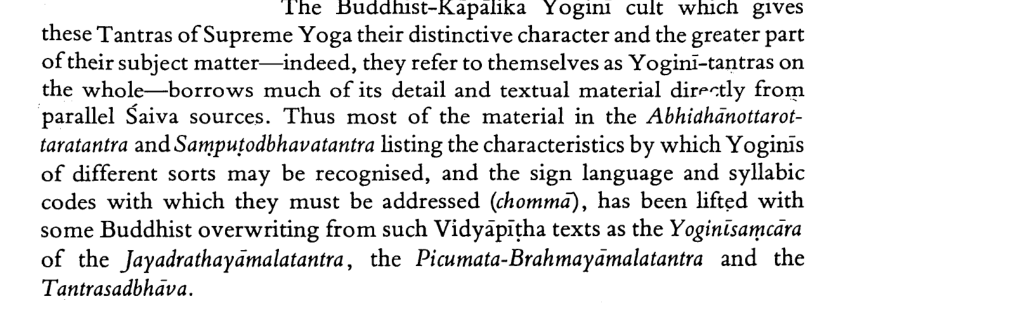
Sanderson〈Śaivism and the Tantric Traditions〉抽印本(书内第 660—704 页)。脚注的两项断言逐一坐实:①「权威研究」——此文第 678—679 页专设〈The Vidyāpīṭha and Esoteric Buddhism〉一节,以毗底亚皮塔文献与佛教无上瑜伽续对勘,正是这一议题的经典出处;②「主张佛教密教大量借用了湿婆教传统」——原文作:「The Buddhist-Kāpālika Yoginī cult which gives these Tantras of Supreme Yoga their distinctive characte

核查全文

r and the greater part of their subject matter—indeed, they refer to themselves as Yoginī-tantras on the whole—borrows much of its detail and textual material directly from parallel Śaiva sources. Thus most of the material in the Abhidhānottarottaratantra and Saṃpuṭodbhavatantra listing the characteristics by which Yoginīs of different sorts may be recognised, and the sign language and syllabic codes with which they must be addressed (chommā), has been lifted with some Buddhist overwriting from such Vidyāpīṭha texts as the Yoginīsaṃcāra of the Jayadrathayāmalatantra, the Picumata-Brahmayāmalatantra and the Tantrasadbhāva.」第 681 页并径称佛教一方为「their Buddhist imitators」。书影已剪 `sanderson-679`。 旁得两条:①同页给出八世纪佛教密续的五重判摄——kriyā、caryā、yoga、yogottara、yoganuttara,并说这套阶序「roughly parallel in its organisation and character to that of the Mantramārga」;第一卷同章第 144 行的「四部怛特罗分类」现托于 Snellgrove《Indo-Tibetan Buddhism》,此处可作补证或改注之资。②Sanderson 记无上瑜伽续行者可长期修「金刚髑髅外道行」(Vajra-Kāpālika-vrata):住尸林、食肉饮酒、行欲供,与第三卷第七篇〈借来的技术〉所述的承袭清单直接相接。

脚注称此文为「湿婆教怛特罗与佛教密教关系的权威研究」并谓「Sanderson 主张佛教密教大量借用了湿婆教传统」,书内第 678—679 页〈The Vidyāpīṭha and Esoteric Buddhism〉一节即其立论所在:无上瑜伽续的瑜伽女崇拜「borrows much of its detail and textual material directly from parallel Śaiva sources」,《呬呼呼野续》与《三补吒续》辨识瑜伽女的记号与暗语(chommā)「has been lifted with some Buddhist overwriting」自《夜叉王本续》的〈瑜伽女行品〉、《梵天本续》与《本续精髓》诸毗底亚皮塔文献。

第 144 行脚注 snellgrove

纸本1.8.4-2条0316
所据
Indo-Tibetan Buddhism - Indian Buddhists and Their Tibetan Successors - David Snellgrove - 1987
书页
书内第 118 页 书影
书内第 118 页
核查结论

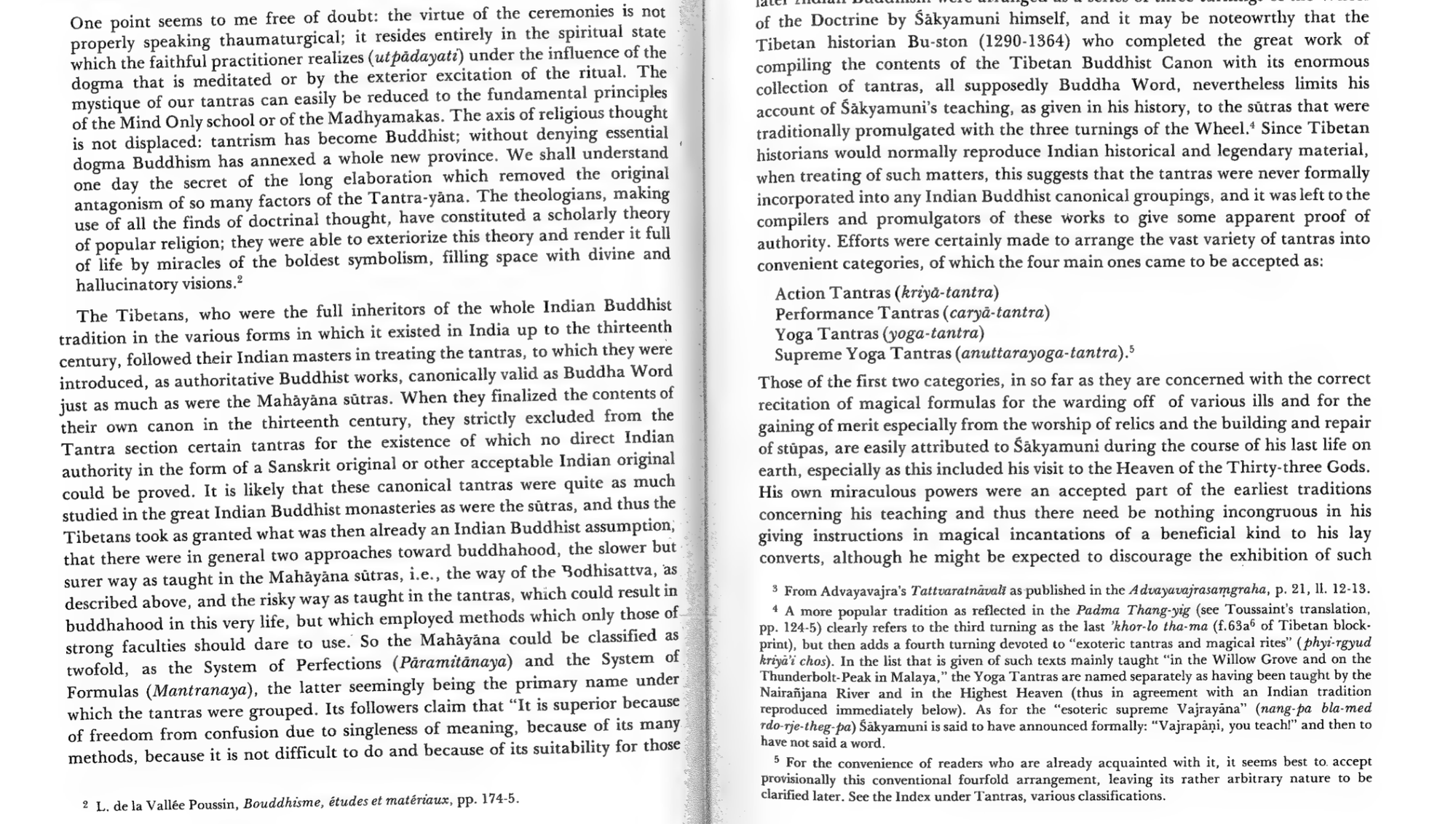
Snellgrove《Indo-Tibetan Buddhism》并强制重跑 (重跑后全 298 页中 294 页可检索)。脚注两项俱确:①四部怛特罗分类——书内第 118 页:「Efforts were certainly made to arrange the vast variety of tantras into convenient categories, of which the four main ones came to be accepted as: Action Tantras (kriyā-tantra) / Performance Tantras (caryā-tantra) / Yoga Tantras (yoga-tantra) / Supreme Yoga Tantras (anuttarayoga-tantra).」与正文第 44 行的四部一一相符。

核查全文

速道与佛性逻辑——同页左栏:藏人所承的印度旧说是成佛有两途,「the slower but surer way as taught in the Mahāyāna sūtras……and the risky way as taught in the tantras, which could result in buddhahood in this very life, but which employed methods which only those of strong faculties should dare to use」,正文第 79 行「密教声称速道的逻辑根据」得其解。书影 `snellgrove-itb-118`。 两处分寸可加:(a)正文说四部分类是「藏传佛教(主要是格鲁派)」所作,而此书说的是这套分类在印藏两地共同「came to be accepted」,非格鲁一家所立;(b)Snellgrove 于同页注 5 自下折扣:「it seems best to accept provisionally this conventional fourfold arrangement, leaving its rather arbitrary nature to be clarified later」——他认为这套四分法带有相当的人为성分。正文把它称作「经典的四部分类」不误,但若加一句「此分类系后起的整理,本身不无人为」,与所引之书更合。 旁得(与第二卷密法篇直接相干):同页左栏引密咒乘自许之四殊胜的英文:「It is superior because of freedom from confusion due to singleness of meaning, because of its many methods, because it is not difficult to do and because of its suitability for those [of sharp faculties]」——这正是《三理趣炬》那一颂(不愚于义、方便众多、无有难行、为利根者)的英译。第二卷第五篇下篇第 47 行正为此颂立论,此处可作西文旁证,与《密宗道次第广论》B0068 卷二互参。

四部分类原文:「Efforts were certainly made to arrange the vast variety of tantras into convenient categories, of which the four main ones came to be accepted as: Action Tantras (kriyā-tantra) / Performance Tantras (caryā-tantra) / Yoga Tantras (yoga-tantra) / Supreme Yoga Tantras (anuttarayoga-tantra).」同页左栏并给出速道之说:「the slower but surer way as taught in the Mahāyāna sūtras……and the risky way as taught in the tantras, which could result in buddhahood in this very life, but which employed methods which only those of strong faculties should dare to use」。

第 145 行脚注 wedemeyer

书目著录1.8.4-3条0342
所据
Making Sense of Tantric Buddhism History Semiology and Transgression in the Indian Traditions - Christian K. Wedemeyer - 年份不详
书页
版权页
版权页

此页所载版权声明禁止以任何方式复制或传播本书的任何部分。本页书影只为核对该条著录而摆在此处,请勿转载、转贴、下载或另行传播——禁令未开「少量节取」之例,剪一小段同样不在许可之内。

核查结论

Wedemeyer《Making Sense of Tantric Buddhism》(2013) 并核查。核心论旨直引:「I argue that the transgressions of Tantric ritual and scripture constitute a form of connotative semiotics…demonstrating that these are neither fully literal nor truly figurative, as has previously been claimed」——正面反驳"字面实践"的误解,与脚注"反驳字面实践的误解"相合。

核查全文

第五章「结构性分析显示 caryā(观行)并非广义的密教修行,而是"a very specific and highly managed and contextualized ritual observance (vrata), a rarified discipline reserved for a sacerdotal elite"」,即限制在祭司精英的高度规约化仪轨范围内,与"限制范围与观想解释"相合。判语改「确」。

第 146 行脚注 dowman

书目著录1.8.4-4条0407
所据
Masters of Mahāmudrā - Keith Dowman - 1985
书页
版权页
版权页

此页所载版权声明禁止以任何方式复制或传播本书的任何部分。本页书影只为核对该条著录而摆在此处,请勿转载、转贴、下载或另行传播——禁令未开「少量节取」之例,剪一小段同样不在许可之内。

核查结论

書 113 行所述与原书相合,措辞亦有分寸。所举五色人等皆见于书中:铁匠、猎人(hunter 二十见,如 Śavaripa, The Hunter)、妓女(prostitute 六见/courtesan 二十三见)、国王(如 Lilapa, The Royal Hedonist;Indrabhūti, The Enlightened Siddha-King)、乞丐(如 Catrapa, The Lucky Beggar);另有织工(weaver 二十四见,Tantipa, The Senile Weaver)、渔夫(fisherman 九见)、鞋匠(cobbler 十七见)。正文「包括各种背景的人物」一语,正与原书自述相当

核查全文

:「They were found in every reach of the social structure: kings and ministers, priests and yogins, poets and musicians, craftsmen and farmers, housewives and whores」。著录亦对:SUNY Series in Buddhist Studies,副题 Songs and Histories of the Eighty-Four Buddhist Siddhas 无误。