← 引用核查

01-瑜伽行派的形成

6 条 · 6 行 · 到书里读本章 →

第 116 行脚注 frauwallner

书目著录1.6.1-1条0396
所据
The Philosophy of Buddhism (Die Philosophie des Buddhismus) - Erich Frauwallner - 2010
书页
版权页
版权页

此页所载版权声明禁止以任何方式复制或传播本书的任何部分。本页书影只为核对该条著录而摆在此处,请勿转载、转贴、下载或另行传播——禁令未开「少量节取」之例,剪一小段同样不在许可之内。

核查结论

本注不列页码,两本于所核各项无别,可不改著录,惟日后补页码须注明所据版本。该书有专节论此题:CFC.〈Maitreyanātha (ca. 300 c.e.)〉,书内 313 页起,下分 CFC.1〈The works of Maitreyanātha〉(314 页)与 CFC.2〈The first philosophical system of the Yogācāra: the doctrine of Maitreyanātha〉(315 页)。(一)历史人物说,逐字坐实(书内 313 页):「Asaṅga cannot, however, be the author of th

核查全文

ese works since the doctrines expounded in them show a clearly pronounced originality and distinguish themselves noticeably from Asaṅga's own works. We are therefore justified in seeing in their author a historical personage other than Asaṅga, who was probably known by the oft handed down name of Maitreyanātha, and who was only later seen as the well-known Bodhisattva.」(二)「部分五论」之「部分」亦准:CFC.1 所列弥勒奴「most frequently mentioned works」仅三种——Abhisamayālaṃkāra、Mahāyānasūtrālaṃkāra、Madhyāntavibhāga,非五种。脚注作「部分『弥勒五论』作者」,措辞恰当,不可改作「五论作者」。(三)文体证据在,惟非藏译:其立论所据为文体与义理两端——「it is striking that the works attributed to Maitreya are not sutras, as one would expect, but philosophical works like any others」(不是经而是论,此为文体一层),及上引与无著自作诸论「clearly pronounced originality」之别(义理一层)。通检该节,Tibetan 与 Tibet 皆零命中,其论不倚藏译。故本行前判所云「所据文体藏译证据」当收窄为「所据文体与义理证据」,藏译一项系此前判语的想当然,非该书所有。
第 117 行脚注 frauwallner_vb

纸本1.6.1-2条0551
所据
[0367] On the Date of the Buddhist Master of the Law Vasubandhu - Erich Frauwallner - 1951
书页
书内第 32 页 书影
书内第 32 页
书内第 46 页 书影
书内第 46 页
书内第 54 页 书影
书内第 54 页
核查结论

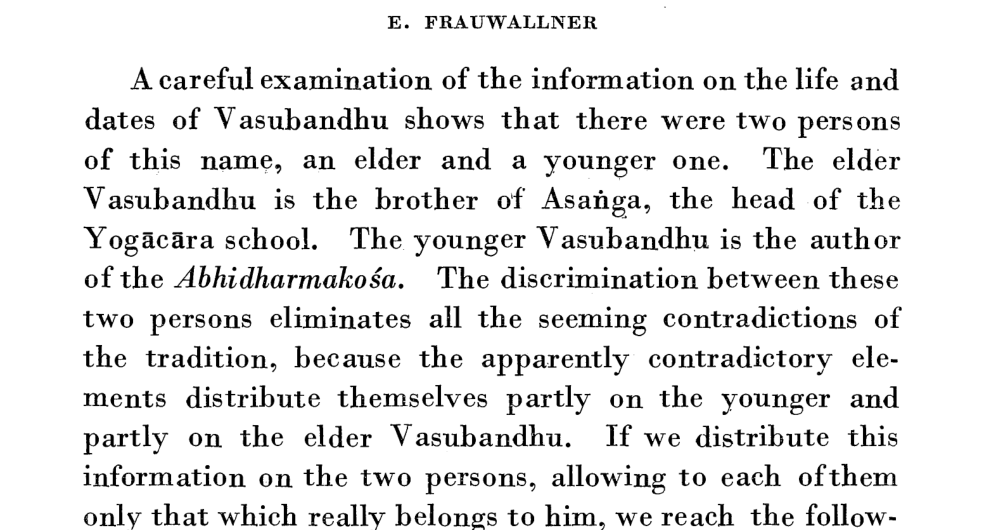
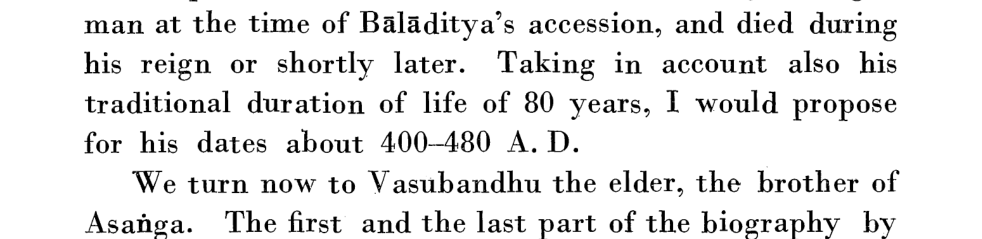
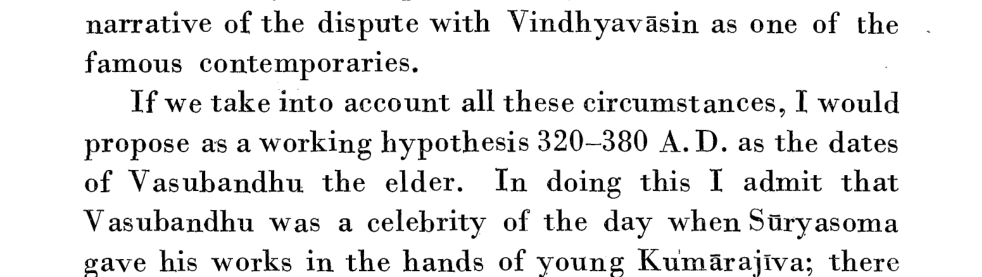
著录:Is.M.E.O. Serie Orientale Roma III;页码在方括号里;脚注版本项四事逐一相符:Serie Orientale Roma 3、Rome、IsMEO、1951。正文第 62 行两组年代亦皆核到原文:少者书内第 32 页作 “I would propose for his dates about 400-480 A. D.”;长者书内第 46 页作 “I would propose as a working hypothesis 320-380 A. D. as the dates of Vasubandhu the elder”。第 54 至 56 页复述全案:长者约生 320 年,父 Kauśika 为国师,“He had two brothers, an elder one, Asanga, and a younger one, Virin-civatsa”,是正文「无著的弟弟」不误(无著为兄);

核查全文

长者所著列《中边分别论》及《十地经论》《法华经论》《金刚般若论》《发菩提心论》,“He died before his brother Asanga, possibly about 380 A. D.”;少者 “was born about 400 A. D.”,师佛陀蜜多罗,属说一切有部,“He died around the year 480 A. D. in Ayodhya, at the age of 80 years”。又第 54 页明言旧传所载相牴牾之诸事「distribute themselves partly on the younger and partly on the elder Vasubandhu」,即两世亲说之枢纽,脚注括注「两世亲说的系统提出」不虚。已改:脚注原为白文书目条,今补書頁换算与上述三处页码,使正文年代可径复核。

第 32 页提出少世亲约四〇〇至四八〇年,第 46 页以 working hypothesis 提出长世亲约三二〇至三八〇年;第 54 页明确分作两人,并把传记中貌似相反的材料分别归给长、少世亲。三图承担脚注的两组年代与两世亲说;其余生平细目仍以脚注所列第 54—56 页为定位。

第 118 行脚注 gold

书目著录1.6.1-3条0397
所据
Paving the Great Way - Jonathan C. Gold - 2015
书页
版权页
版权页

此页所载版权声明禁止以任何方式复制或传播本书的任何部分。本页书影只为核对该条著录而摆在此处,请勿转载、转贴、下载或另行传播——禁令未开「少量节取」之例,剪一小段同样不在许可之内。

核查结论

書 64 行两项俱坐实。(一)一世亲论:作者正面立说——「Once there is acknowledged to be one Vasubandhu who was a brother of Asaṅga, composed the AKBh, converted to Mahāyāna, and composed Yogācāra treatises that prominently advocate the Three Natures—as Jaini showed in 1958—there is very little explanatory pow

核查全文

er left for the 'two Vasubandhus' thesis.」并驳二世亲说之根基「rested from the start on a biased, shaky historical foundation」,谓所谓第二世亲「is just a catchall, a basket toward which we can throw dubiously attributed texts」。另有一处论证亦可取:若真有一位早于《俱舍》的「长老世亲」,则佛教史上千百年间对其「complete and utter lack of awareness」无从解释。(二)《俱舍》与唯识论著的思想连续:作者以「Buddhist Causal Framing」一名统摄世亲全部著作,谓此一贯之见「is implicit in the doctrines of the Three Natures and the storehouse consciousness (ālayavijñāna), and which I have shown Vasubandhu drawing from the central goals of Abhidharma and the Buddha's core doctrines of impermanence, dependent origination, and no-self」。正文「完全可以是同一个人在不同阶段的著作」措辞有分寸,与原书相合。(三)一处宜留意(不改判):作者虽主一人一贯,却明拒目的论式的读法——「I believe it is a mistake to set up a teleological directionality for Vasubandhu's works, with the Yogācāra system as its ultimate end」,又谓其思想「cut across, and against, doctrinal identities」,连《俱舍》虽可标为经量部,亦「collects within it countless alternative viewpoints」。正文書 64 行作「思想发展脉络」,尚不违此戒;若他处有把世亲写成「必然走向唯识」者,须按此收紧。

第 119 行脚注 chen

书目著录1.6.1-4条0143
所据
Buddhism in China - Kenneth K. S. Ch'en - 1964
书页
版权页
版权页

此页所载版权声明禁止以任何方式复制或传播本书的任何部分。本页书影只为核对该条著录而摆在此处,请勿转载、转贴、下载或另行传播——禁令未开「少量节取」之例,剪一小段同样不在许可之内。

核查结论

Ch'en《Buddhism in China》pp. 320–325 叙述摄论宗以真谛学说为基础、玄奘窥基法相宗兴起并取代之、种姓/成佛资格与普遍佛性说的冲突,以及其后衰落与会昌打击;脚注概括有据。

第 120 行脚注 schmithausen

书目著录1.6.1-5条0594
所据
[0815] Ālayavijñāna - Lambert Schmithausen - 1987
书页
版权页
版权页

此页所载版权声明禁止以任何方式复制或传播本书的任何部分。本页书影只为核对该条著录而摆在此处,请勿转载、转贴、下载或另行传播——禁令未开「少量节取」之例,剪一小段同样不在许可之内。

核查结论

现文不再以该书担本书之裁断。

第 121 行脚注 lamotte

纸本1.6.1-6条0222
所据
Mahāyānasaṃgraha Volume II - Étienne Lamotte (Gelongma Karma Migme Chodron trans.) - undated [法译英;译文与注释卷;文中以 [138a15] 式夹注玄奘译本 T31n1594 的栏行]
书页
书内第 25 页 书影
书内第 25 页
核查结论

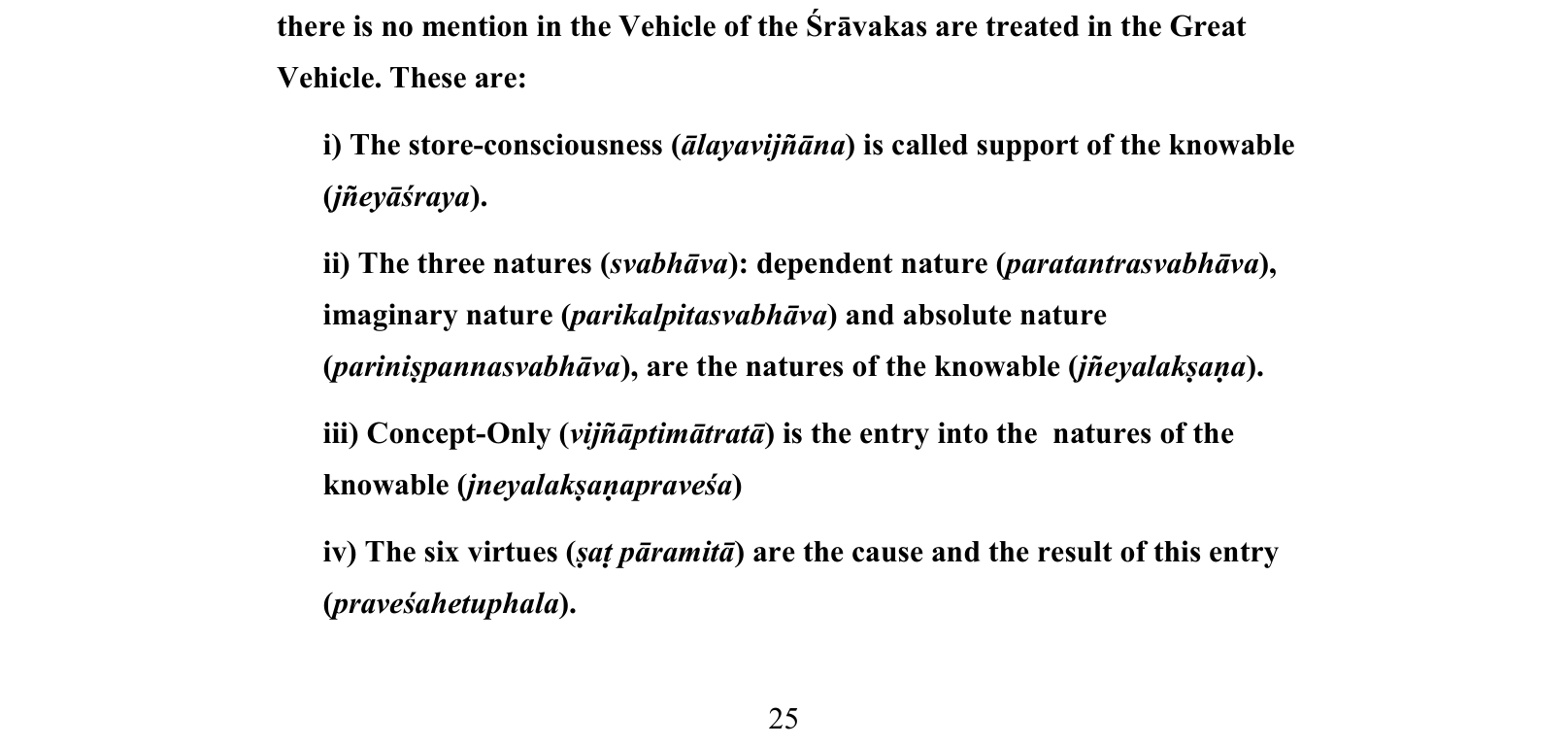
正文说《摄大乘论》「分章讲阿赖耶识、三性、六度菩萨行与转依」,四项皆有据:总标十事(书内第 25 页)作 ①阿赖耶识为所知依 ②三自性为所知相 ③唯识为入所知相 ④六波罗蜜为入之因果 ⑤十地为因果修差别 ⑥⑦⑧增上戒、心、慧 ⑨无住涅槃为彼果断 ⑩佛三身为彼果智。一处分寸:「转依」不是章名,是第九分(彼果断·无住涅槃)的实质,另见第一分 §48、§57;正文说「分章讲……转依」,宜解作「以转依为一分之所治」,不宜解作有一章题作转依。

论首总标全论十事,正文所举四项(阿赖耶识、三性、六度菩萨行、转依)皆在其中。「转依」不作章名而是第九分「无住涅槃·彼果断」的实质,另见第一分 §48、§57。