Patrick Olivelle 译《The Early Upaniṣads: Annotated Text and Translation》(Oxford University Press, 1998)
书页
书内第 12 页
核查结论
(一)断代(书内第 12 页):「The scholarly consensus, well founded I think, is that the Brhadaranyaka and the Chandogya are the two earliest Upanisads……The two texts as we have them are, in all likelihood, pre-Buddhist; placing them in the seventh to sixth centuries BCE may be reasonable, give or take a century or so」;
核查全文
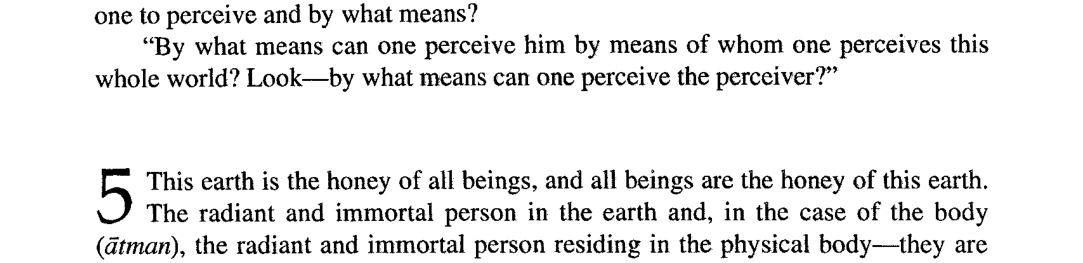
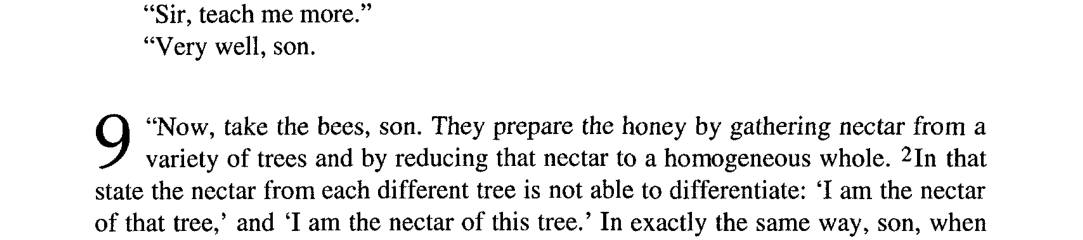
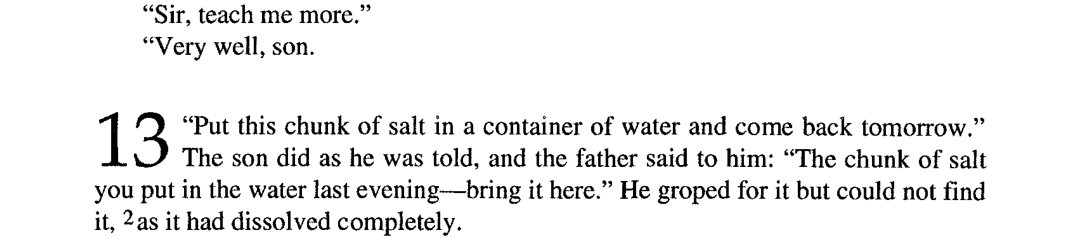
次页续云另三部散文奥义书(Taittiriya、Aitareya、Kausitaki)「all are probably pre-Buddhist」,而偈颂诸奥义书(Kena、Katha、Isa、Svetasvatara、Mundaka)后出。与正文「只有最早的几部散文奥义书可以确定在佛陀之前」全合。同页 Olivelle 另有一警语可为本书所用:「any dating of these documents that attempts a precision closer than a few centuries is as stable as a house of cards」。(二)neti neti(书内第 44 页,BU 2.3.6):Olivelle 译作「Here, then, is the rule of substitution: “not—, not—,” for there is nothing beyond this “not.”」;BU 3.9.28(书内第 101 页)又作「About this self (atman), one can only say ‘not—, not—.’ He is ungraspable, for he cannot be grasped」。(三)「知者」不可对象化(书内第 71 页,BU 2.4.14):「By what means can one perceive him by means of whom one perceives this whole world? Look—by what means can one perceive the perceiver?」正是正文第 63 行所引「认识者无法被认识」一语之所本。(四)邬达罗迦两喻俱在《歌者》第六章,且确为其教子白净之语:树汁归一见 ChU 6.9(书内第 253 页)「Now, take the bees, son. They prepare the honey by gathering nectar from a variety of trees and by reducing that nectar to a homogeneous whole」;盐溶于水见 ChU 6.13(书内第 255 页)「Put this chunk of salt in a container of water and come back tomorrow」,次日取而不得,四处啜之皆咸。(附)正文第 73 行「私下传授业报」一节亦得实:BU 3.2.13(书内第 81 页)「My friend, we cannot talk about this in public. Take my hand, Artabhaga; let’s go and discuss this in private」,二人退而所论「nothing but action」,结语作「A man turns into something good by good action and into something bad by bad action」,与正文所述秘传与善恶业报两点分毫不差。
按
断代一项。同页并有「any dating… closer than a few centuries is as stable as a house of cards」一语,可为本书论奥义书年代时的分寸。
Patrick Olivelle 译《The Early Upaniṣads: Annotated Text and Translation》(Oxford University Press, 1998)
书页
书内第 71 页
核查结论
(一)断代(书内第 12 页):「The scholarly consensus, well founded I think, is that the Brhadaranyaka and the Chandogya are the two earliest Upanisads……The two texts as we have them are, in all likelihood, pre-Buddhist; placing them in the seventh to sixth centuries BCE may be reasonable, give or take a century or so」;
核查全文
次页续云另三部散文奥义书(Taittiriya、Aitareya、Kausitaki)「all are probably pre-Buddhist」,而偈颂诸奥义书(Kena、Katha、Isa、Svetasvatara、Mundaka)后出。与正文「只有最早的几部散文奥义书可以确定在佛陀之前」全合。同页 Olivelle 另有一警语可为本书所用:「any dating of these documents that attempts a precision closer than a few centuries is as stable as a house of cards」。(二)neti neti(书内第 44 页,BU 2.3.6):Olivelle 译作「Here, then, is the rule of substitution: “not—, not—,” for there is nothing beyond this “not.”」;BU 3.9.28(书内第 101 页)又作「About this self (atman), one can only say ‘not—, not—.’ He is ungraspable, for he cannot be grasped」。(三)「知者」不可对象化(书内第 71 页,BU 2.4.14):「By what means can one perceive him by means of whom one perceives this whole world? Look—by what means can one perceive the perceiver?」正是正文第 63 行所引「认识者无法被认识」一语之所本。(四)邬达罗迦两喻俱在《歌者》第六章,且确为其教子白净之语:树汁归一见 ChU 6.9(书内第 253 页)「Now, take the bees, son. They prepare the honey by gathering nectar from a variety of trees and by reducing that nectar to a homogeneous whole」;盐溶于水见 ChU 6.13(书内第 255 页)「Put this chunk of salt in a container of water and come back tomorrow」,次日取而不得,四处啜之皆咸。(附)正文第 73 行「私下传授业报」一节亦得实:BU 3.2.13(书内第 81 页)「My friend, we cannot talk about this in public. Take my hand, Artabhaga; let’s go and discuss this in private」,二人退而所论「nothing but action」,结语作「A man turns into something good by good action and into something bad by bad action」,与正文所述秘传与善恶业报两点分毫不差。
Patrick Olivelle 译《The Early Upaniṣads: Annotated Text and Translation》(Oxford University Press, 1998)
书页
书内第 253 与 255 页(278 页)
核查结论
(一)断代(书内第 12 页):「The scholarly consensus, well founded I think, is that the Brhadaranyaka and the Chandogya are the two earliest Upanisads……The two texts as we have them are, in all likelihood, pre-Buddhist; placing them in the seventh to sixth centuries BCE may be reasonable, give or take a century or so」;
核查全文
次页续云另三部散文奥义书(Taittiriya、Aitareya、Kausitaki)「all are probably pre-Buddhist」,而偈颂诸奥义书(Kena、Katha、Isa、Svetasvatara、Mundaka)后出。与正文「只有最早的几部散文奥义书可以确定在佛陀之前」全合。同页 Olivelle 另有一警语可为本书所用:「any dating of these documents that attempts a precision closer than a few centuries is as stable as a house of cards」。(二)neti neti(书内第 44 页,BU 2.3.6):Olivelle 译作「Here, then, is the rule of substitution: “not—, not—,” for there is nothing beyond this “not.”」;BU 3.9.28(书内第 101 页)又作「About this self (atman), one can only say ‘not—, not—.’ He is ungraspable, for he cannot be grasped」。(三)「知者」不可对象化(书内第 71 页,BU 2.4.14):「By what means can one perceive him by means of whom one perceives this whole world? Look—by what means can one perceive the perceiver?」正是正文第 63 行所引「认识者无法被认识」一语之所本。(四)邬达罗迦两喻俱在《歌者》第六章,且确为其教子白净之语:树汁归一见 ChU 6.9(书内第 253 页)「Now, take the bees, son. They prepare the honey by gathering nectar from a variety of trees and by reducing that nectar to a homogeneous whole」;盐溶于水见 ChU 6.13(书内第 255 页)「Put this chunk of salt in a container of water and come back tomorrow」,次日取而不得,四处啜之皆咸。(附)正文第 73 行「私下传授业报」一节亦得实:BU 3.2.13(书内第 81 页)「My friend, we cannot talk about this in public. Take my hand, Artabhaga; let’s go and discuss this in private」,二人退而所论「nothing but action」,结语作「A man turns into something good by good action and into something bad by bad action」,与正文所述秘传与善恶业报两点分毫不差。
Patrick Olivelle 译《The Early Upaniṣads: Annotated Text and Translation》(Oxford University Press, 1998)
书页
书内第 81 页
核查结论
(一)断代(书内第 12 页):「The scholarly consensus, well founded I think, is that the Brhadaranyaka and the Chandogya are the two earliest Upanisads……The two texts as we have them are, in all likelihood, pre-Buddhist; placing them in the seventh to sixth centuries BCE may be reasonable, give or take a century or so」;
核查全文
次页续云另三部散文奥义书(Taittiriya、Aitareya、Kausitaki)「all are probably pre-Buddhist」,而偈颂诸奥义书(Kena、Katha、Isa、Svetasvatara、Mundaka)后出。与正文「只有最早的几部散文奥义书可以确定在佛陀之前」全合。同页 Olivelle 另有一警语可为本书所用:「any dating of these documents that attempts a precision closer than a few centuries is as stable as a house of cards」。(二)neti neti(书内第 44 页,BU 2.3.6):Olivelle 译作「Here, then, is the rule of substitution: “not—, not—,” for there is nothing beyond this “not.”」;BU 3.9.28(书内第 101 页)又作「About this self (atman), one can only say ‘not—, not—.’ He is ungraspable, for he cannot be grasped」。(三)「知者」不可对象化(书内第 71 页,BU 2.4.14):「By what means can one perceive him by means of whom one perceives this whole world? Look—by what means can one perceive the perceiver?」正是正文第 63 行所引「认识者无法被认识」一语之所本。(四)邬达罗迦两喻俱在《歌者》第六章,且确为其教子白净之语:树汁归一见 ChU 6.9(书内第 253 页)「Now, take the bees, son. They prepare the honey by gathering nectar from a variety of trees and by reducing that nectar to a homogeneous whole」;盐溶于水见 ChU 6.13(书内第 255 页)「Put this chunk of salt in a container of water and come back tomorrow」,次日取而不得,四处啜之皆咸。(附)正文第 73 行「私下传授业报」一节亦得实:BU 3.2.13(书内第 81 页)「My friend, we cannot talk about this in public. Take my hand, Artabhaga; let’s go and discuss this in private」,二人退而所论「nothing but action」,结语作「A man turns into something good by good action and into something bad by bad action」,与正文所述秘传与善恶业报两点分毫不差。
按
BU 3.2.13。正文第 73 行「他把提问者拉到一边,私下传授」与「善业得善趣,恶业得恶趣」两点,此页兼具:「Take my hand, Artabhaga; let’s go and discuss this in private」,及「A man turns into something good by good action and into something bad by bad action」。
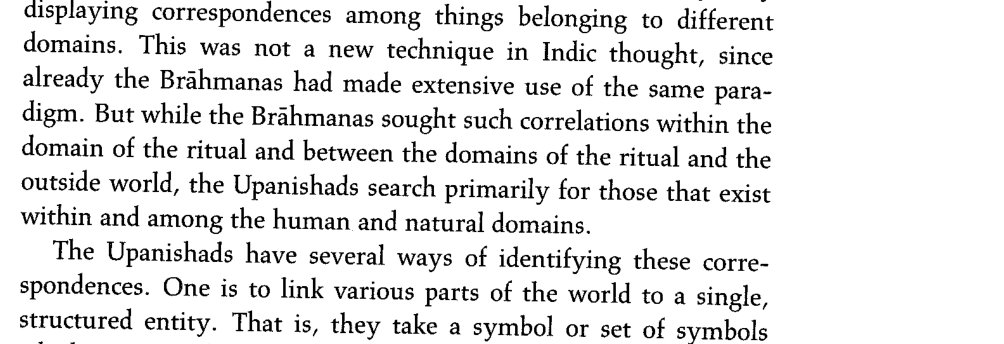
「祭祀内化」一层的直接书证,也是本注承担的第一事。全句:「But while the Brahmanas sought such correlations within the domain of the ritual and between the domains of the ritual and the outside world, the Upanishads search primarily for those that exist within and among the human and natural domains.」须辨:布雷雷顿说的是相配之域的转移,「把祭祀之火搬进身体」是本书的概括而非其原语;他并谓梵书本已 anticipate the Upanishadic aspiration to see the world as a totality(书 134),故此转折不宜看得太陡。,见开双页,两点验过。**
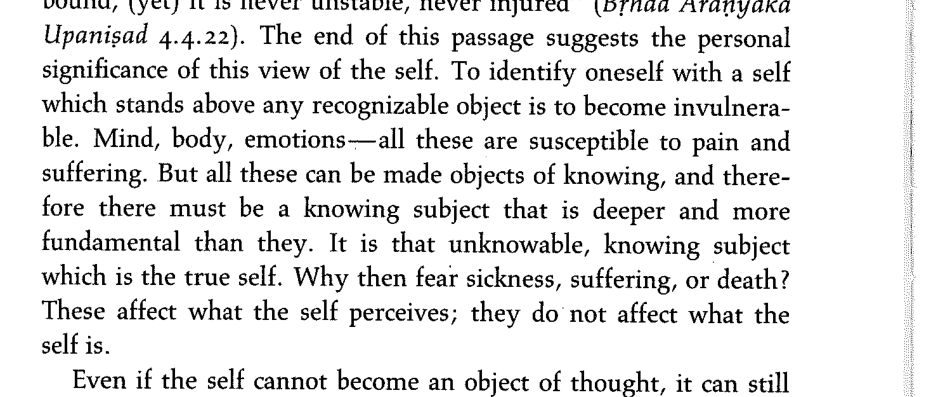
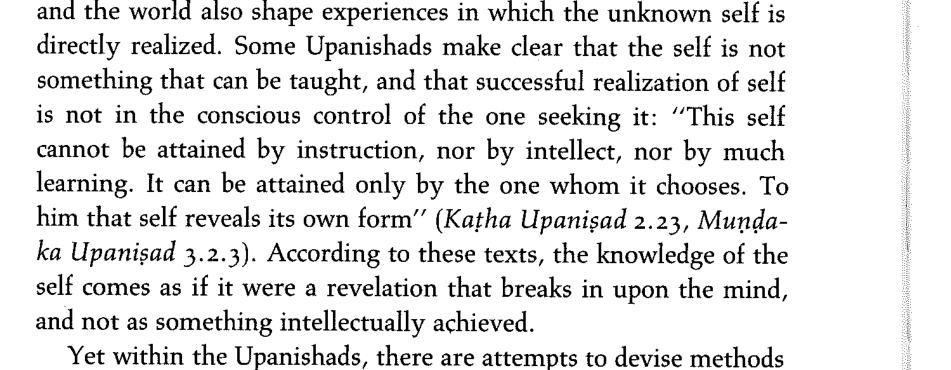
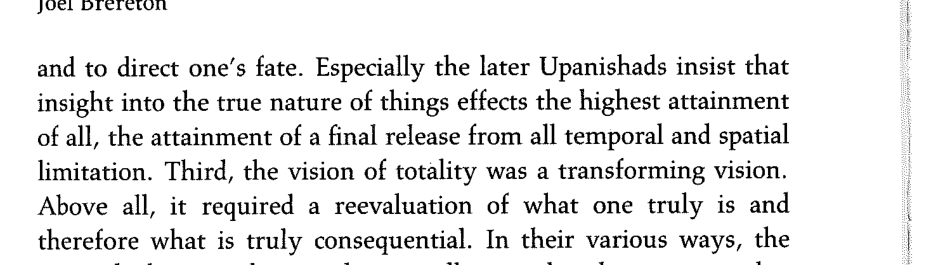
第二、三事之据。书 126–127:「all these can be made objects of knowing, and therefore there must be a knowing subject that is deeper and more fundamental than they. It is that unknowable, knowing subject which is the true self」,当正文「认知主体内部是什么」一语。书 134:「Especially the later Upanishads insist that insight into the true nature of things effects the highest attainment of all, the attainment of a final release」,当「由行转知」。惟书 128–129 另有一层限制:引 Kaṭha 2.23 与 Muṇḍaka 3.2.3「This self cannot be attained by instruction, nor by intellect, nor by much learning」,并释为 a revelation that breaks in upon the mind, and not as something intellectually achieved;即此「知」不作理智所得解,已写入脚注。
前记谓「Cohen 未获原文复核」,今已过时:书目 0671(The Upanisads A Complete Guide, Signe Cohen 編, Routledge 2018;(一)Cohen 本身即作此说:论《爱陀雷耶奥义书》一章谓 prajñānam brahma 一句 became known as one of the Mahāvākyas, or Great Sayings of the Upaniṣads in the later Vedānta school of philosophy,即「大语」之名出于后世吠檀多,与正文書 45 行「这种整理是晚出的」正合。
核查全文
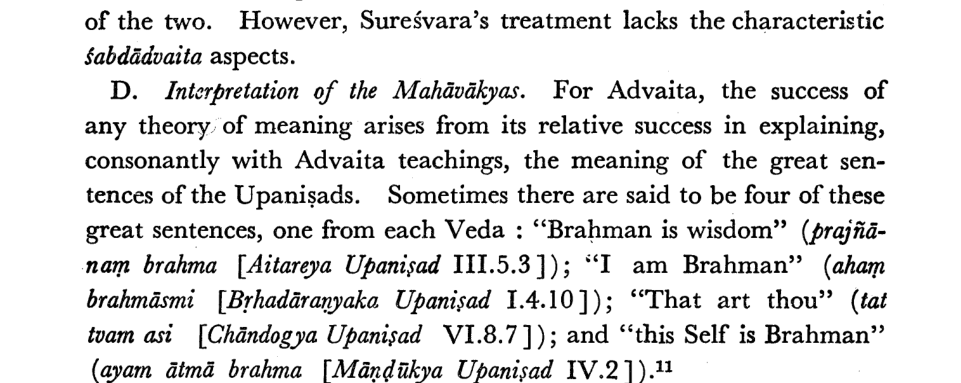
(二)「每部吠陀配一句」此前无出处,今得两条:Potter 编《Encyclopedia of Indian Philosophies III》(书目 0209,書 59,版心作 PHILOSOPHY OF LANGUAGE 59,)作 Sometimes there are said to be four of these great sentences, one from each Veda,并列四句與出处(prajñānam brahma/aham brahmāsmi/tat tvam asi/ayam ātmā brahma);Nicholson《Unifying Hinduism》(书目 1070,書 41,)作 the eighth-century Advaita Vedāntin Śaṅkara dubbed four Upaniṣadic sentences as great statements (mahāvākyas),把这套整理系于商羯罗其人,且明标八世纪。(三)反面亦须记:这套名单并不固定。Flood《An Introduction to Hinduism》(书目 0051,書 242,版心自作 242,)所列第四句作 sarvam khalu idam brahma,不作 prajñānam brahma。此不损正文论旨,反是「晚出整理」的旁证,但引用时不可当作定本。另记一层可留意者:Potter 所列 ayam ātmā brahma 系于《蛙氏奥义书》,而本注其三所举是《广林》2.5.19 與 4.4.5,合之正见同一语在三处语境,「语境不一」益明。(四)Cohen 有一处不与本注同调,据实记下:该书正文引《歌者》6.8.7 仍作 You are that(Roebuck 译),未从 Brereton 之新读,只在注中列 Brereton 1986 一篇;本注其二所据是 Olivelle,不是 Cohen,两者不可相冒。判仍确。
按
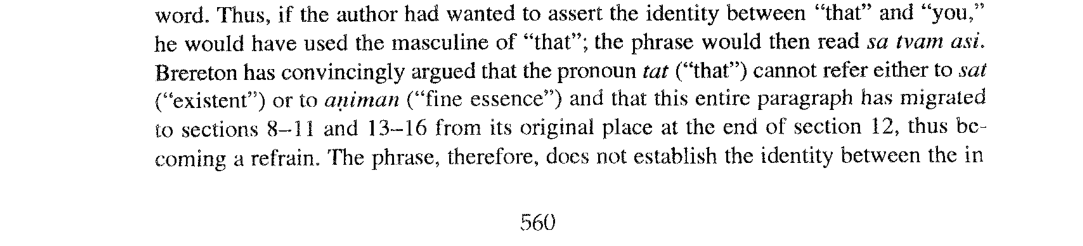
本行两项判断之据。書 560 注(《歌者奥义书》6.8.7–16.3)从 Brereton (1986) 之说,把 tat tvam asi 译作 that's how you are,理由是 the neuter pronoun tat cannot stand in apposition to a masculine noun or pronoun;并谓该句 has migrated to sections 8-11 and 13-16 from its original place at the end of section 12, thus becoming a refrain。書 xvii 以引号称之为 great saying(后世指称);書 72–73 为 ayam ātmā brahma 所在的《广林》2.5.19 蜜喻一章。该书通检 mahāvākya 零命中。(三点验:→書 560、→書 73、→書 xvii)。
[0209] Encyclopedia of Indian Philosophies III Advaita Vedanta up to Samkara and His Pupils - Karl H. Potter (ed.) - 1981
书页
書 59(版心作 PHILOSOPHY OF LANGUAGE 59)
核查结论
前记谓「Cohen 未获原文复核」,今已过时:书目 0671(The Upanisads A Complete Guide, Signe Cohen 編, Routledge 2018;(一)Cohen 本身即作此说:论《爱陀雷耶奥义书》一章谓 prajñānam brahma 一句 became known as one of the Mahāvākyas, or Great Sayings of the Upaniṣads in the later Vedānta school of philosophy,即「大语」之名出于后世吠檀多,与正文書 45 行「这种整理是晚出的」正合。
核查全文
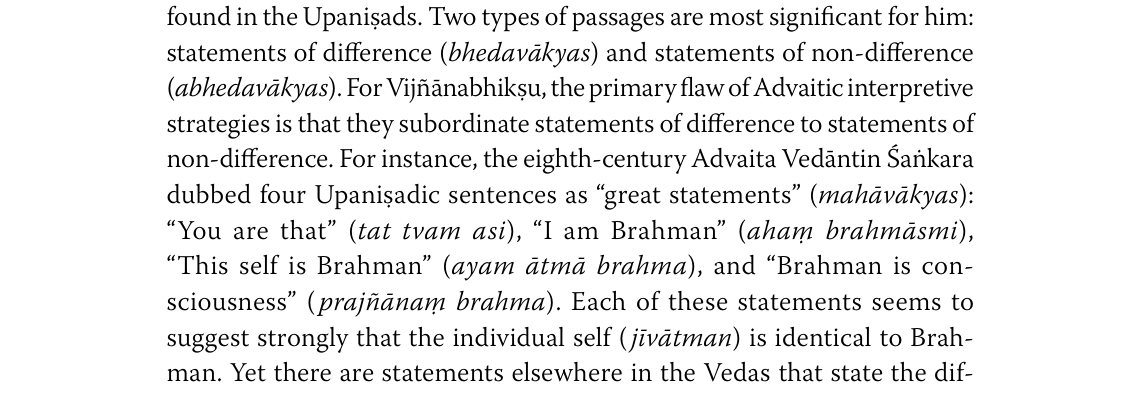
(二)「每部吠陀配一句」此前无出处,今得两条:Potter 编《Encyclopedia of Indian Philosophies III》(书目 0209,書 59,版心作 PHILOSOPHY OF LANGUAGE 59,)作 Sometimes there are said to be four of these great sentences, one from each Veda,并列四句與出处(prajñānam brahma/aham brahmāsmi/tat tvam asi/ayam ātmā brahma);Nicholson《Unifying Hinduism》(书目 1070,書 41,)作 the eighth-century Advaita Vedāntin Śaṅkara dubbed four Upaniṣadic sentences as great statements (mahāvākyas),把这套整理系于商羯罗其人,且明标八世纪。(三)反面亦须记:这套名单并不固定。Flood《An Introduction to Hinduism》(书目 0051,書 242,版心自作 242,)所列第四句作 sarvam khalu idam brahma,不作 prajñānam brahma。此不损正文论旨,反是「晚出整理」的旁证,但引用时不可当作定本。另记一层可留意者:Potter 所列 ayam ātmā brahma 系于《蛙氏奥义书》,而本注其三所举是《广林》2.5.19 與 4.4.5,合之正见同一语在三处语境,「语境不一」益明。(四)Cohen 有一处不与本注同调,据实记下:该书正文引《歌者》6.8.7 仍作 You are that(Roebuck 译),未从 Brereton 之新读,只在注中列 Brereton 1986 一篇;本注其二所据是 Olivelle,不是 Cohen,两者不可相冒。判仍确。
[1070] Unifying Hinduism Philosophy and Identity in Indian Intellectual History - Andrew J. Nicholson - 2010
书页
書 41
核查结论
前记谓「Cohen 未获原文复核」,今已过时:书目 0671(The Upanisads A Complete Guide, Signe Cohen 編, Routledge 2018;(一)Cohen 本身即作此说:论《爱陀雷耶奥义书》一章谓 prajñānam brahma 一句 became known as one of the Mahāvākyas, or Great Sayings of the Upaniṣads in the later Vedānta school of philosophy,即「大语」之名出于后世吠檀多,与正文書 45 行「这种整理是晚出的」正合。
核查全文
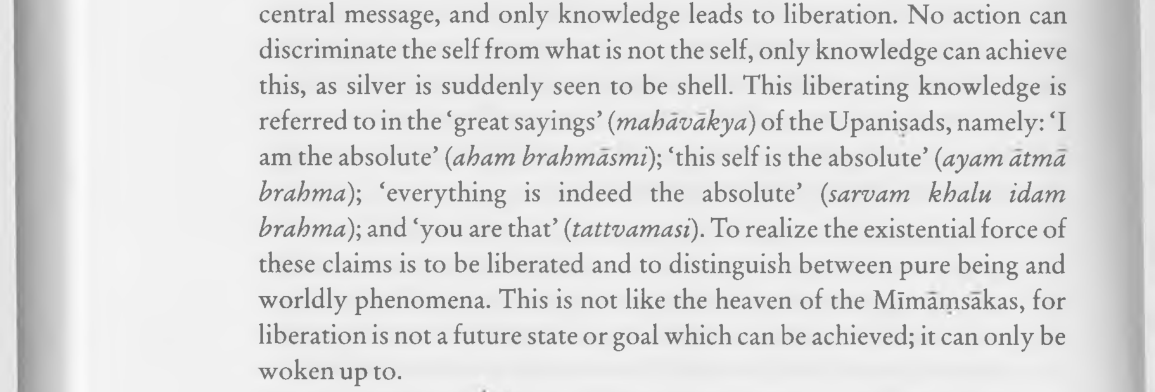
(二)「每部吠陀配一句」此前无出处,今得两条:Potter 编《Encyclopedia of Indian Philosophies III》(书目 0209,書 59,版心作 PHILOSOPHY OF LANGUAGE 59,)作 Sometimes there are said to be four of these great sentences, one from each Veda,并列四句與出处(prajñānam brahma/aham brahmāsmi/tat tvam asi/ayam ātmā brahma);Nicholson《Unifying Hinduism》(书目 1070,書 41,)作 the eighth-century Advaita Vedāntin Śaṅkara dubbed four Upaniṣadic sentences as great statements (mahāvākyas),把这套整理系于商羯罗其人,且明标八世纪。(三)反面亦须记:这套名单并不固定。Flood《An Introduction to Hinduism》(书目 0051,書 242,版心自作 242,)所列第四句作 sarvam khalu idam brahma,不作 prajñānam brahma。此不损正文论旨,反是「晚出整理」的旁证,但引用时不可当作定本。另记一层可留意者:Potter 所列 ayam ātmā brahma 系于《蛙氏奥义书》,而本注其三所举是《广林》2.5.19 與 4.4.5,合之正见同一语在三处语境,「语境不一」益明。(四)Cohen 有一处不与本注同调,据实记下:该书正文引《歌者》6.8.7 仍作 You are that(Roebuck 译),未从 Brereton 之新读,只在注中列 Brereton 1986 一篇;本注其二所据是 Olivelle,不是 Cohen,两者不可相冒。判仍确。
[0671] The Upanisads A Complete Guide - Signe Cohen 編 - 2018
书页
〈The Aitareya Upaniṣad〉章(电子书无原书页码)
核查结论
前记谓「Cohen 未获原文复核」,今已过时:书目 0671(The Upanisads A Complete Guide, Signe Cohen 編, Routledge 2018;(一)Cohen 本身即作此说:论《爱陀雷耶奥义书》一章谓 prajñānam brahma 一句 became known as one of the Mahāvākyas, or Great Sayings of the Upaniṣads in the later Vedānta school of philosophy,即「大语」之名出于后世吠檀多,与正文書 45 行「这种整理是晚出的」正合。
核查全文
(二)「每部吠陀配一句」此前无出处,今得两条:Potter 编《Encyclopedia of Indian Philosophies III》(书目 0209,書 59,版心作 PHILOSOPHY OF LANGUAGE 59,)作 Sometimes there are said to be four of these great sentences, one from each Veda,并列四句與出处(prajñānam brahma/aham brahmāsmi/tat tvam asi/ayam ātmā brahma);Nicholson《Unifying Hinduism》(书目 1070,書 41,)作 the eighth-century Advaita Vedāntin Śaṅkara dubbed four Upaniṣadic sentences as great statements (mahāvākyas),把这套整理系于商羯罗其人,且明标八世纪。(三)反面亦须记:这套名单并不固定。Flood《An Introduction to Hinduism》(书目 0051,書 242,版心自作 242,)所列第四句作 sarvam khalu idam brahma,不作 prajñānam brahma。此不损正文论旨,反是「晚出整理」的旁证,但引用时不可当作定本。另记一层可留意者:Potter 所列 ayam ātmā brahma 系于《蛙氏奥义书》,而本注其三所举是《广林》2.5.19 與 4.4.5,合之正见同一语在三处语境,「语境不一」益明。(四)Cohen 有一处不与本注同调,据实记下:该书正文引《歌者》6.8.7 仍作 You are that(Roebuck 译),未从 Brereton 之新读,只在注中列 Brereton 1986 一篇;本注其二所据是 Olivelle,不是 Cohen,两者不可相冒。判仍确。
按
本段说 prajñānam brahma 后来在吠檀多学派中才以奥义书 Mahāvākya 或“Great Saying”之一而知名,正面支持“大语”为后世归类。该书仍把《歌者》6.8.7 译作 You are that,未采用 Brereton 的新读;脚注后一层判断据 Olivelle,非据 Cohen。
[0051] An Introduction to Hinduism - Gavin Flood - 1996
书页
書 242(版心自作 242)
核查结论
前记谓「Cohen 未获原文复核」,今已过时:书目 0671(The Upanisads A Complete Guide, Signe Cohen 編, Routledge 2018;(一)Cohen 本身即作此说:论《爱陀雷耶奥义书》一章谓 prajñānam brahma 一句 became known as one of the Mahāvākyas, or Great Sayings of the Upaniṣads in the later Vedānta school of philosophy,即「大语」之名出于后世吠檀多,与正文書 45 行「这种整理是晚出的」正合。
核查全文
(二)「每部吠陀配一句」此前无出处,今得两条:Potter 编《Encyclopedia of Indian Philosophies III》(书目 0209,書 59,版心作 PHILOSOPHY OF LANGUAGE 59,)作 Sometimes there are said to be four of these great sentences, one from each Veda,并列四句與出处(prajñānam brahma/aham brahmāsmi/tat tvam asi/ayam ātmā brahma);Nicholson《Unifying Hinduism》(书目 1070,書 41,)作 the eighth-century Advaita Vedāntin Śaṅkara dubbed four Upaniṣadic sentences as great statements (mahāvākyas),把这套整理系于商羯罗其人,且明标八世纪。(三)反面亦须记:这套名单并不固定。Flood《An Introduction to Hinduism》(书目 0051,書 242,版心自作 242,)所列第四句作 sarvam khalu idam brahma,不作 prajñānam brahma。此不损正文论旨,反是「晚出整理」的旁证,但引用时不可当作定本。另记一层可留意者:Potter 所列 ayam ātmā brahma 系于《蛙氏奥义书》,而本注其三所举是《广林》2.5.19 與 4.4.5,合之正见同一语在三处语境,「语境不一」益明。(四)Cohen 有一处不与本注同调,据实记下:该书正文引《歌者》6.8.7 仍作 You are that(Roebuck 译),未从 Brereton 之新读,只在注中列 Brereton 1986 一篇;本注其二所据是 Olivelle,不是 Cohen,两者不可相冒。判仍确。
按
反面一条:大语名单并不固定。Flood 所列四句之第四作 sarvam khalu idam brahma,不作 prajñānam brahma。此不损正文论旨,引用时不可当作定本。