← 引用核查

03-反建制的收编

7 条 · 7 行 · 到书里读本章 →

第 29 行脚注 siddha

站内互引3.7.3-8条1812
所指
该章可证成就者道歌对班智达论书文化的抗议,并以萨拉哈颂及 Roger Jackson 道歌研究定位;八十四大成就者名录与传记由 Dowman/Guenther 等外部书证另核。
链接
05-论辩场 › 03-论辩的代价 章级 · 点开即所指之章
核查结论

David Jackson 1994《Enlightenment by a Single Means》(书目 0212)另是一书,专论 dkar po chig thub,與道歌无涉。须记一层分寸:0479 主体是印度三家道歌(萨拉哈、康哈、帝洛巴),藏传 nyams mgur 只带过一句(「In Tibet, the dohās inspired the development of … the 'song of experience' (nyams mgur), which reached an early apogee in the works attributed to Milarepa」,索引另见 songs of experience 42);本注所需只是道歌文献之交叉引用,此书足担,若日后要专论藏传道歌之作则另属一件。
第 31 行脚注 naropa

纸本3.7.3-2条1656
所据
[0594] The Life and Teaching of Nāropa - Herbert V. Guenther - 1963
书页
导言第 xii 页 书影
导言第 xii 页
书内第 24、42 页(55 页) 书影
书内第 24、42 页(55 页)
[0594] The Life and Teaching of Nāropa - Herbert V. Guenther - 1963 书影
核查结论

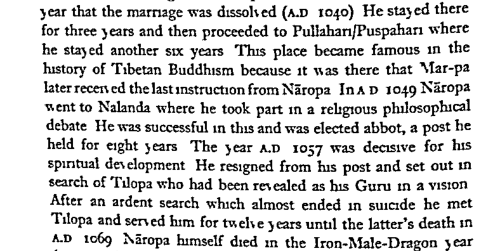
三项俱坐实。(一)弃职:「In A.D. 1049 Nāropa went to Nālandā where he took part in a religious philosophical debate. He was successful in this and was elected abbot, a post he held for eight years. The year A.D. 1057 was decisive for his spiritual development. He resigned from his post and set out in search of Tilopa」。

核查全文

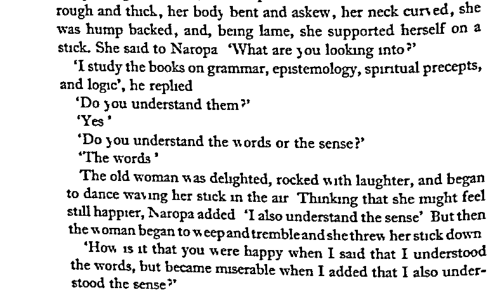
(二)老妇问难:老妇现三十七丑相,诘曰「Do you understand the words or the sense?」那洛巴答「The words」,老妇大喜起舞;那洛巴复添一句「I also understand the sense」,老妇乃恸哭掷杖,曰:「I felt happy because you, a great scholar, did not lie and frankly admitted that you only understood the words. But I felt sad when you told a lie by stating that you understood the sense, which you do not」,并指其兄(帝洛巴)解义,命其往求。(三)十二苦行:书中有专章标目「THE TWELVE ACTS OF SELF-DENIAL」,目次作「His twelve great acts of self-denial in order to obtain the [teaching]」,另有「twelve minor visionary experiences whilst seeking [Tilopa]」一目,并记其从帝洛巴十二年(「served him for twelve years until the latter's death in A.D. 1069」)。脚注「本卷按圣传折半读,只取其在传统内部被传颂这一事实为档案」一语,方法上稳妥,与本判无碍。

三处坐实圣传所述三项:导言记那洛巴在那烂陀胜辩后被选为住持,八年后辞职寻帝洛巴;书内第 24 页写三十七丑相老妇以「懂词还是懂义」相诘;第 42 页立专节「The Twelve Acts of Self-Denial」并明言十二大苦行。本卷只把这些当作传统内部传颂的圣传档案,不据以还原可独立证实的传记史实。

第 33 行脚注 bianmu

汉文原典3.7.3-3条1675
所据
T2125《南海寄歸內法傳》 唐 義淨撰
原典


二十六客舊相遇
二十七先體病源
二十八進藥方法
二十九除其弊藥
三十旋右觀時
三十一灌沐尊儀
三十二讚詠之禮
三十三尊敬乖式
三十四西方學儀
三十五長髮有無
三十六亡財僧現
三十七受用僧衣
三十八燒身不合
三十九傍人獲罪
四十古德不為
凡此所論,皆依根本說一切有部,不…

坐标
T54n2125_p0206a08 段起行 · 卷 1 · 该段甚长,引文在段内第 678 字,宜按上面标黄的字用浏览器查找
核查结论

两半各有本可依,两半都坐实。(一)「义净所记那烂陀学程以论为单位」· 确。T2125《南海寄歸內法傳》卷四西方學法〉(卷四目次列作「三十四西方學儀」,正文标题作「西方學法」,两名并存,检索须两写并试)。该章把学程逐部胪列,每部系以颂数与年限,正是「以论为单位」的实证:悉談章(十八章、一萬餘字、三百餘頌,「六歲童子學之,六月方了」)→ 蘇呾囉(一千頌,波尼儞〔Pāṇini〕所造,「八歲童子八月誦了」)→ 馱覩章(一千頌)→ 三棄攞章(三部各一千頌,「十歲童子三年勤學方解其義」)→ 苾栗底蘇呾羅(十八千頌,「十五童子,五歲方解」)→ 朱儞(二十四千頌,鉢顛社攞〔Patañjali〕所造,「明經學此三歲方了」,义净并比之曰「功與《春秋》《周易》相似」)。

核查全文

其上更进一层则径以论名为学程之目:「閑斯釋已…致想《因明》、虔誠《俱舍》,尋《理門論》比量善成,習本生貫清才秀發」;那烂陀之名亦在同段:「然後函丈傳授經三二年,多在那爛陀寺(中天也)或居跋臘毘國(西天也)」。(二)「《现观庄严论》以八事七十义为般若语料立目」· 确,且「立目」二字于原书有一个现成的比喻译者导论(在书内编码页之前,故只标至导论,不给页码)引藏地達瑪仁欽(Darma Rinchen, 1364–1432)之说:「The systematization of the contents of the Sutras into eight subjects and seventy topics are the golden ornaments, and the Ornament the mirror through which they view her. When readers study the Ornament and understand its meaning they glimpse Her Ladyship, the beautiful Prajñā-pāramitā, her beauty highlighted by the eight subjects and seventy topics.」同导论又云菩提心之發起是「the first of the seventy topics under which the Ornament explains the Sūtra」。「八事七十义」之数逐字对上;而「镜」这个比喻正说的就是脚注所谓「编目功能」——论不是另立一说,是给般若那一大片语料做的一面索引之镜。落实时若要给这一句添一个坐标,此喻现成。该书该书通检:seventy topics 五见、eight subjects 十二见、eight topics 二见、padartha 十二见。另: Sparham 该译本共四卷(Vol. I 第一现观、Vol. II、Vol. III 第四现观、Vol. IV 第五至第八现观),分卷之名本身即八现观(八事)之目,可作旁证;惟各卷页码换算不一,引页码前须自对页眉。(三)「见第五篇第二章已引」与「见第一卷第六篇」两处交叉引用,属站内互引,本行不另核。

第 35 行脚注 taidu

汉文原典3.7.3-4条1481
所据
T2066《大唐西域求法高僧傳》 唐 義淨撰
原典

…顏之有乎。是知智士識己之度量。愚者闇他之淺深矣斯之呪藏東夏未流。所以道琳意存斯妙。故呪藏云。升天乘龍役使百神。利生之道唯呪是親。淨於那爛陀。亦屢入壇場希心此要。而為功不並就。遂泯斯懷為廣異聽。粗題綱目云爾。道琳遂從西境轉向北天。觀化羯濕彌羅。便入烏長那國。詢訪定門搜求般若。次往迦畢試國禮烏率膩沙(佛頂骨也)自…

坐标
T51n2066_p0006c06 段起行 · 卷 2 · 该段甚长,引文在段内第 581 字,宜按上面标黄的字用浏览器查找
核查结论

脚注补引《菩提道灯论》后果与例外两节(照 G2518 录文,改简体),并注明法尊译。

第 37 行脚注 wedemeyer

书目著录3.7.3-5条1644
所据
Making Sense of Tantric Buddhism History Semiology and Transgression in the Indian Traditions - Christian K. Wedemeyer - 年份不详
书页
版权页
版权页

此页所载版权声明禁止以任何方式复制或传播本书的任何部分。本页书影只为核对该条著录而摆在此处,请勿转载、转贴、下载或另行传播——禁令未开「少量节取」之例,剪一小段同样不在许可之内。

核查结论

Wedemeyer《Making Sense of Tantric Buddhism》(2013) 并核查(详见 08-印度佛教晚期/04-金刚乘的兴起.md:145 一行复核记录)。核心论证以巴特(Roland Barthes)的内涵符号学(connotative semiotics)分析反律法话语:"a complete sign in natural language…functions as a signifier in a higher order cultural discourse. At this higher, performative level, the signified is the attainment of the goal of advanced Tantric practice"——即反律法语言在字面之上另有一层文化符号功能,指向证悟目标,与"反律法语言的符号学功能"逐字相合;全书以此为方法论反驳字面主义解读,注释传统对其的规训化处理亦是全书第二部分主线。判语改「确」。

第 39 行脚注 v2_shiquan

站内互引3.7.3-6条1509
所指
第二卷第五篇下篇第三章确专论证相判读权与师权前置;
链接
上篇-解脱论综述 › 01-即身成佛:核心主张 篇级 · 所指为整篇,链接落在该篇首章
核查结论

第二卷第五篇下篇第三章确专论证相判读权与师权前置;上篇第一章亦明确把「竹筒中蛇」析为效力广告、失败吸收器与控权特许状三重功能,交叉引用准确。

第 43 行脚注 kalacakra

纸本3.7.3-7条1615
所据
John Newman〈Islam in the Kālacakra Tantra〉(*Journal of the International Association of Buddhist Studies* 21.2, 1998)
书页
书内第 317 页 书影
书内第 317 页
书内第 330 页 书影
书内第 330 页
核查结论

2026-09-05 Newman 该文(JIABS 21.2, 1998, pp. 311–371 全帙,另附该期目次一面;书内 面加 309)。①「蔑戾车」所指:书内第 317 页,mleccha 本「denotes any foreigner who does not follow Indian customs, but the Kālacakra texts seem to apply it only to Muslims」,同页注 11 更直白:「With a few exceptions, one could accurately gloss mleccha as ‘Muslim’ throughout the Kālacakra literature」;

核查全文

时轮诸本并指其族属为 Tāyin(藏译 stag gzig),即大食。②末法战争叙事:书内第 330 页,迦尔吉王之战「will dismay the barbarians, thus establishing them in his own Dharma. He will eradicate their dharma, not kill them (1.15)」。③语境:书内第 314 页指 Yaśas 与 Puṇḍarīka 皆是托名,「an elaborate mythology devised to provide the newly created Kālacakra tantra with a suitable Buddhist pedigree」,时在十一世纪初;文末系于伽色尼的马茂德侵印,正与正文所置的年代相合。旁得:Newman 强调此战是两读的——外则为世界末劫的预言,内则为修道的譬喻,「the war on the mlecchas serves as an allegory for the personal transformation that is the main subject of the tantra」,蔑戾车之军喻嗔恚嫉贪,迦尔吉喻乐空之智,故称「internal Buddhist jihad」。这一层于第八篇第二章「应对是叙事化的,不是组织化的」一判尤其有用:连那场战争本身,在教内的正解里也是内向的。

①「蔑戾车」之所指:「denotes any foreigner who does not follow Indian customs, but the Kālacakra texts seem to apply it only to Muslims」,同页注 11 径以 Muslim 释之;②末法之战的剧本:「the war on the mlecchas serves as an allegory for the personal transformation that is the main subject of the tantra」,迦尔吉「will eradicate their dharma, not kill them」。