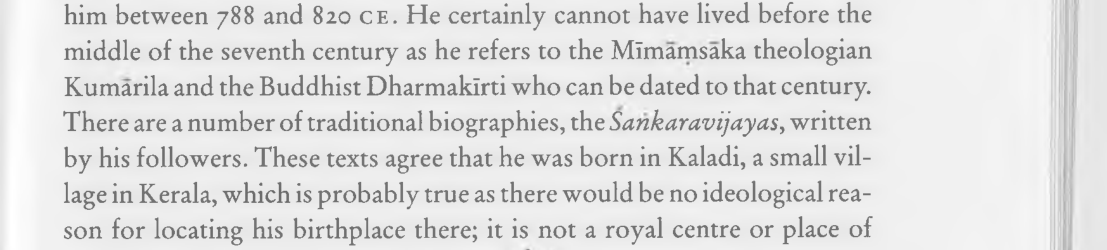
[0051] An Introduction to Hinduism - Gavin Flood - 1996
书页
書 239(版心页 239,标题行 SANKARA)
核查结论
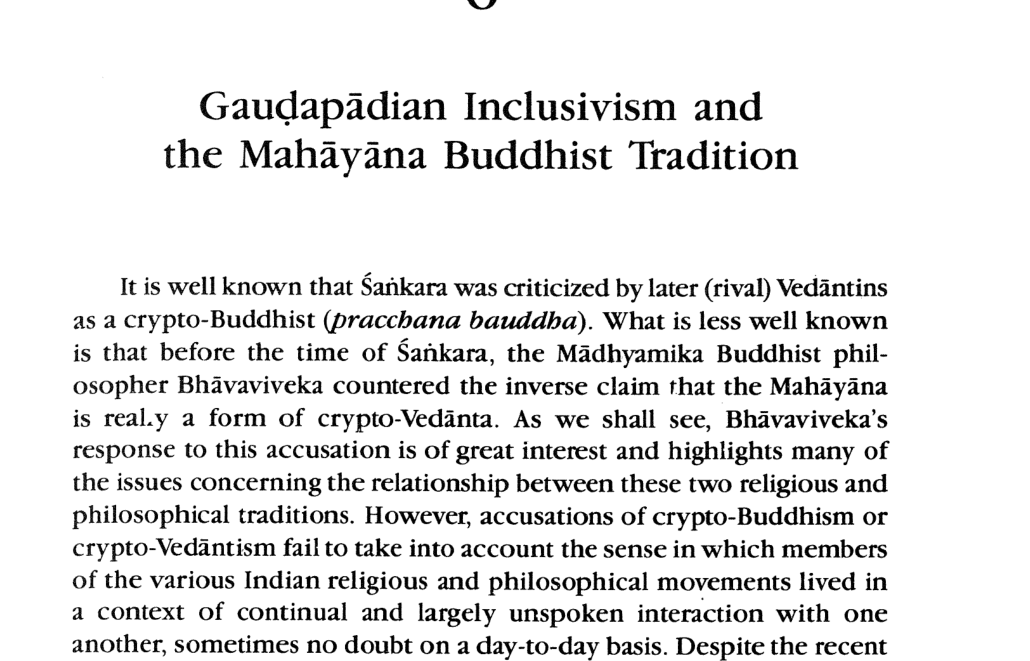
本面覆看两处:①正文書 11 行「同时代佛教文献无一记录」與「主导地位到十一二世纪才稳固」二语已删,改依可证之形(年代之定全靠他提到鸠摩利罗与法称而未见佛家引他;教团扩张系于四方寺院与十名教团),與甲案合;②注 :29 的 Flood 页次已由 書 237 改作 書 239(照本面ⓑ King《Early Advaita Vedanta and Buddhism》(书目 0192)書 183(版心 183,第六章首页)作 It is well known that Śaṅkara was criticized by later (rival) Vedāntins as a crypto-Buddhist (pracchanna bauddha),同页并作 before the time of Śaṅkara, the Mādhyamika Buddhist philosopher Bhāvaviveka countered the inverse claim that the Mahāyāna is really a form of crypto-Vedānta;ⓒ King《Indian Philosophy》(书目 0248)
核查全文
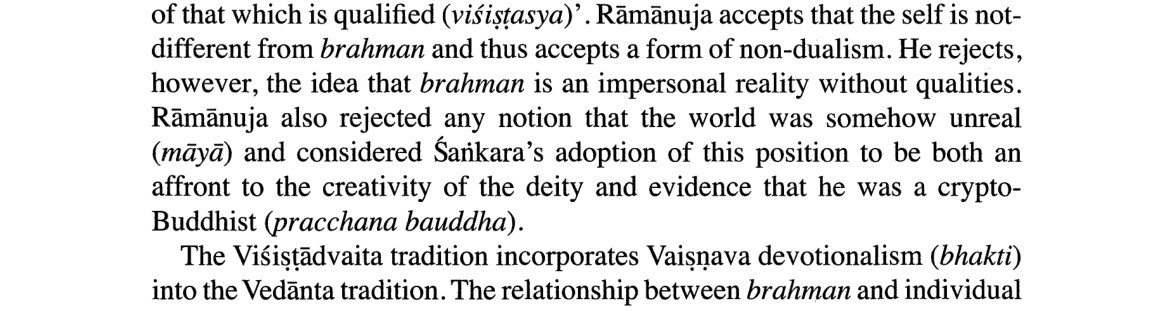
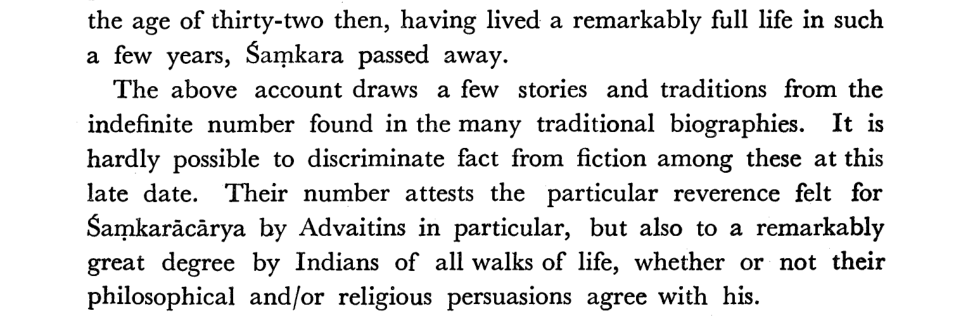
書 56(版心 -56-)作 Ramanuja also rejected any notion that the world was somehow unreal (māyā) and considered Śaṅkara’s adoption of this position to be both an affront to the creativity of the deity and evidence that he was a crypto-Buddhist (pracchana bauddha);書 227(版心 -227-)作 the Advaitin is a crypto-Buddhist (pracchana bauddha),泛指不二论者而非其人,注中所分之「两处所指微异」不误;ⓓ Potter(书目 0209)書 16(版心 16)作 It is hardly possible to discriminate fact from fiction among these at this late date。无一处不合,不必回报。**判疑→确,处置待裁→已改。
按
同页并作 He certainly cannot have lived before the middle of the seventh century as he refers to the Mimamsaka theologian Kumarila and the Buddhist Dharmakirti who can be dated to that century——即正文改後所依「年代之定全靠他提到鸠摩利罗与法称」。前此误作 書 237,已由
[0192] Early Advaita Vedanta and Buddhism 全本 - Richard King - 1995
书页
書 183(版心页 183,第六章首页)
核查结论
本面覆看两处:①正文書 11 行「同时代佛教文献无一记录」與「主导地位到十一二世纪才稳固」二语已删,改依可证之形(年代之定全靠他提到鸠摩利罗与法称而未见佛家引他;教团扩张系于四方寺院与十名教团),與甲案合;②注 :29 的 Flood 页次已由 書 237 改作 書 239(照本面ⓑ King《Early Advaita Vedanta and Buddhism》(书目 0192)書 183(版心 183,第六章首页)作 It is well known that Śaṅkara was criticized by later (rival) Vedāntins as a crypto-Buddhist (pracchanna bauddha),同页并作 before the time of Śaṅkara, the Mādhyamika Buddhist philosopher Bhāvaviveka countered the inverse claim that the Mahāyāna is really a form of crypto-Vedānta;ⓒ King《Indian Philosophy》(书目 0248)
核查全文
書 56(版心 -56-)作 Ramanuja also rejected any notion that the world was somehow unreal (māyā) and considered Śaṅkara’s adoption of this position to be both an affront to the creativity of the deity and evidence that he was a crypto-Buddhist (pracchana bauddha);書 227(版心 -227-)作 the Advaitin is a crypto-Buddhist (pracchana bauddha),泛指不二论者而非其人,注中所分之「两处所指微异」不误;ⓓ Potter(书目 0209)書 16(版心 16)作 It is hardly possible to discriminate fact from fiction among these at this late date。无一处不合,不必回报。**判疑→确,处置待裁→已改。
按
同页并作 before the time of Śaṅkara, the Mādhyamika Buddhist philosopher Bhāvaviveka countered the inverse claim that the Mahāyāna is really a form of crypto-Vedānta——假面之讥两家互施,且佛教一方在先。该本系见开双页扫描,本条页次照版心所定(脚作 183)。旧 变音符坏码(Śaṅkara 作 Sailkara、pracchanna 作 praccbana),检索须照坏码形。
[0248] Indian Philosophy An Introduction to Hindu and Buddhist Thought - Richard King - 1999
书页
書 56(版心作 -56-)
核查结论
本面覆看两处:①正文書 11 行「同时代佛教文献无一记录」與「主导地位到十一二世纪才稳固」二语已删,改依可证之形(年代之定全靠他提到鸠摩利罗与法称而未见佛家引他;教团扩张系于四方寺院与十名教团),與甲案合;②注 :29 的 Flood 页次已由 書 237 改作 書 239(照本面ⓑ King《Early Advaita Vedanta and Buddhism》(书目 0192)書 183(版心 183,第六章首页)作 It is well known that Śaṅkara was criticized by later (rival) Vedāntins as a crypto-Buddhist (pracchanna bauddha),同页并作 before the time of Śaṅkara, the Mādhyamika Buddhist philosopher Bhāvaviveka countered the inverse claim that the Mahāyāna is really a form of crypto-Vedānta;ⓒ King《Indian Philosophy》(书目 0248)
核查全文
書 56(版心 -56-)作 Ramanuja also rejected any notion that the world was somehow unreal (māyā) and considered Śaṅkara’s adoption of this position to be both an affront to the creativity of the deity and evidence that he was a crypto-Buddhist (pracchana bauddha);書 227(版心 -227-)作 the Advaitin is a crypto-Buddhist (pracchana bauddha),泛指不二论者而非其人,注中所分之「两处所指微异」不误;ⓓ Potter(书目 0209)書 16(版心 16)作 It is hardly possible to discriminate fact from fiction among these at this late date。无一处不合,不必回报。**判疑→确,处置待裁→已改。
按
注中所分「两处所指微异」之前一处:此处直指商羯罗其人(罗摩奴阇之讥)。另一处在同书 書 227(版心作 -227-),作 the Advaitin is a crypto-Buddhist (pracchana bauddha),泛指不二论者。两处本面皆开卷看过版心。
[0209] Encyclopedia of Indian Philosophies III Advaita Vedanta up to Samkara and His Pupils - Karl H. Potter (ed.) - 1981
书页
書 16(版心页 16)
核查结论
本面覆看两处:①正文書 11 行「同时代佛教文献无一记录」與「主导地位到十一二世纪才稳固」二语已删,改依可证之形(年代之定全靠他提到鸠摩利罗与法称而未见佛家引他;教团扩张系于四方寺院与十名教团),與甲案合;②注 :29 的 Flood 页次已由 書 237 改作 書 239(照本面ⓑ King《Early Advaita Vedanta and Buddhism》(书目 0192)書 183(版心 183,第六章首页)作 It is well known that Śaṅkara was criticized by later (rival) Vedāntins as a crypto-Buddhist (pracchanna bauddha),同页并作 before the time of Śaṅkara, the Mādhyamika Buddhist philosopher Bhāvaviveka countered the inverse claim that the Mahāyāna is really a form of crypto-Vedānta;ⓒ King《Indian Philosophy》(书目 0248)
核查全文
書 56(版心 -56-)作 Ramanuja also rejected any notion that the world was somehow unreal (māyā) and considered Śaṅkara’s adoption of this position to be both an affront to the creativity of the deity and evidence that he was a crypto-Buddhist (pracchana bauddha);書 227(版心 -227-)作 the Advaitin is a crypto-Buddhist (pracchana bauddha),泛指不二论者而非其人,注中所分之「两处所指微异」不误;ⓓ Potter(书目 0209)書 16(版心 16)作 It is hardly possible to discriminate fact from fiction among these at this late date。无一处不合,不必回报。**判疑→确,处置待裁→已改。
[0260] Is Enlightenment Possible Dharmakirti and rGyal tshab rje on Knowledge Rebirth No-Self and Liberation - Roger R. Jackson - Snow Lion 1993
书页
书内第 441 页
核查结论
判疑转确。本行所悬诸项今皆了结。(一)"量士夫"(pramāṇabhūta)· 确:Dunne《Foundations of Dharmakīrti's Philosophy》引 PV2.282-283c 并总结"the Buddha is therefore one who has become an instrument of knowledge (pramāṇabhūta)"。(二)"多生串习的大悲"· 确:Franco《Dharmakīrti on Compassion and Rebirth》(WSTB 38, 1997)書 95 作"the existenc
核查全文
e of an infinite number of previous lives, for an infinite compassion like the Buddha's could not be practised and accumulated during a single lifetime";是则前记"留待日后"之项今已补上,本行无未核之据。正文、注皆不须再动。
Buddhist Texts Through the Ages - Edward Conze (ed.) with I. B. Horner; D. Snellgrove 与 A. Waley - Bruno Cassirer 1954
书页
书内第 233 页
核查结论
Conze 编《Buddhist Texts Through the Ages》,上条所悬的版次与页码全部核到:版权页作「Edited by EDWARD CONZE in collaboration with THE ROYAL INDIA, PAKISTAN AND CEYLON SOCIETY;BRUNO CASSIRER · OXFORD;Published 1954」;书前目次作「Third Part: THE TANTRAS By David Snellgrove……Saraha’s Treasury of Songs 224……Anangavajra, The Attainment of the Realization of Wisdom and Means 240」,故该篇为书内 224—239 页;
核查全文
书前小序并记「Saraha’s Treasury of Songs (no. 188) was written, probably in the 9th century」。第 68 颂在书内第 233 页(书影 `conze-233`),逐字与前引相同。 脚注已改:坐实译者、篇题、所收之书与版次、篇幅起讫、全篇 112 颂、所引颂次与页码,并照录英文原句;Jackson 一项改注明其「三集」为萨拉哈、康哈、帝洛巴三家,与本篇不相冒。**
按
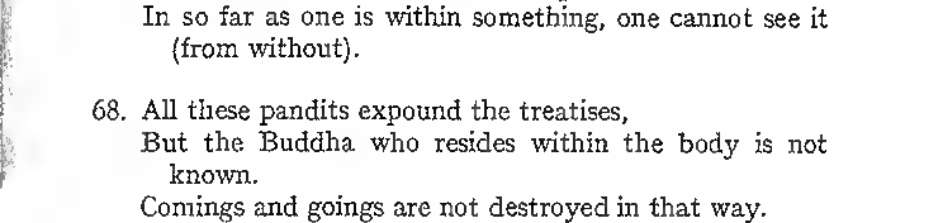
Snellgrove 译〈Saraha’s Treasury of Songs〉第 68 颂:「All these pandits expound the treatises, / But the Buddha who resides within the body is not known. / Comings and goings are not destroyed in that way. / But they shamelessly say: “We are pandits.”」正文第 17 行「班智达们讲遍一切论书,却不知佛就住在身内」即前两句的取意。该篇起讫据书前目次:第三部分〈The Tantras〉由 Snellgrove 译撰,Saraha 一篇 224 页起,次篇 Anaṅgavajra 240 页起,故为 224—239 页;版权页作 Bruno Cassirer, Oxford,Published 1954。
注末「新正理自甘吉沙(约十四世纪)起」一句前无出处,今有据:导论〈Historical Résumé〉書 3「This, the second volume on the Nyāya-Vaiśeṣika system, takes up where Volume II of the Encyclopedia of Indian Philosophies left off, in the early fourteenth century with the pivotal figure of Gaṅgeśa, author of Tattvacintāmaṇi」;書 4 并言新正理「was largely a Maithila monopoly until the time of Raghunātha」。
核查全文
已更新:该句后补「见 Karl H. Potter & Sibajiban Bhattacharyya (eds.), Encyclopedia of Indian Philosophies, vol. 6(Princeton: Princeton University Press, 1993),书内第 3 页」,与同注所引 EIP 第四卷同式。本行诸项至此俱有出处。判确,处置待件→已更新。
按
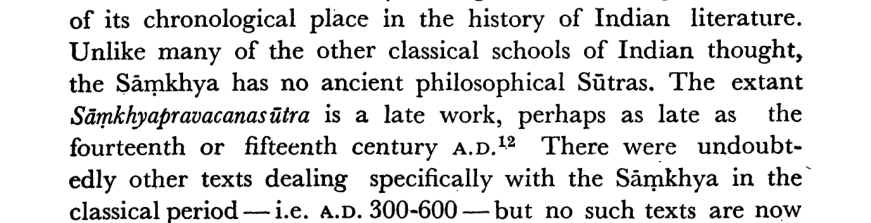
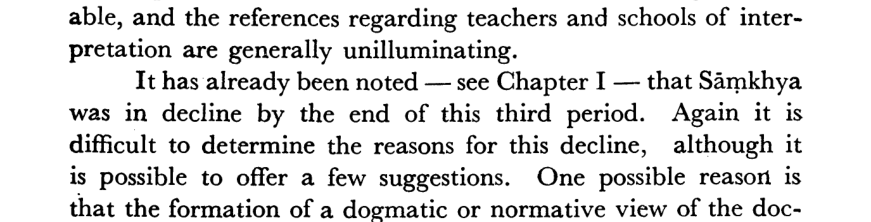
①《数论经》托古晚出:「the Sāṃkhya has no ancient philosophical Sūtras. The extant Sāṃkhyapravacanasūtra is a late work, perhaps as late as the fourteenth or fifteenth century A.D.」;②十世纪后中断:古典期「extends from the first century A.D. through about the tenth century」,且「Sāṃkhya was in decline by the end of this third period」。


![[0051] An Introduction to Hinduism - Gavin Flood - 1996 书影](../../书影/flood-sankara-dating-dharmakirti-p239.92d70fb2.webp)